
Founder’s Sighting — Ross Barnett Reservoir
In 2012, I saw something over the Ross Barnett Reservoir in Ridgeland, Mississippi that I have never been able to explain. My twin brother was with me. We watched a silent, black triangle craft follow the shoreline for seven miles. I didn’t report it. I didn’t photograph it. I just watched it, and I have carried it with me every day since. This is that story, and it is the reason OverClassified exists.
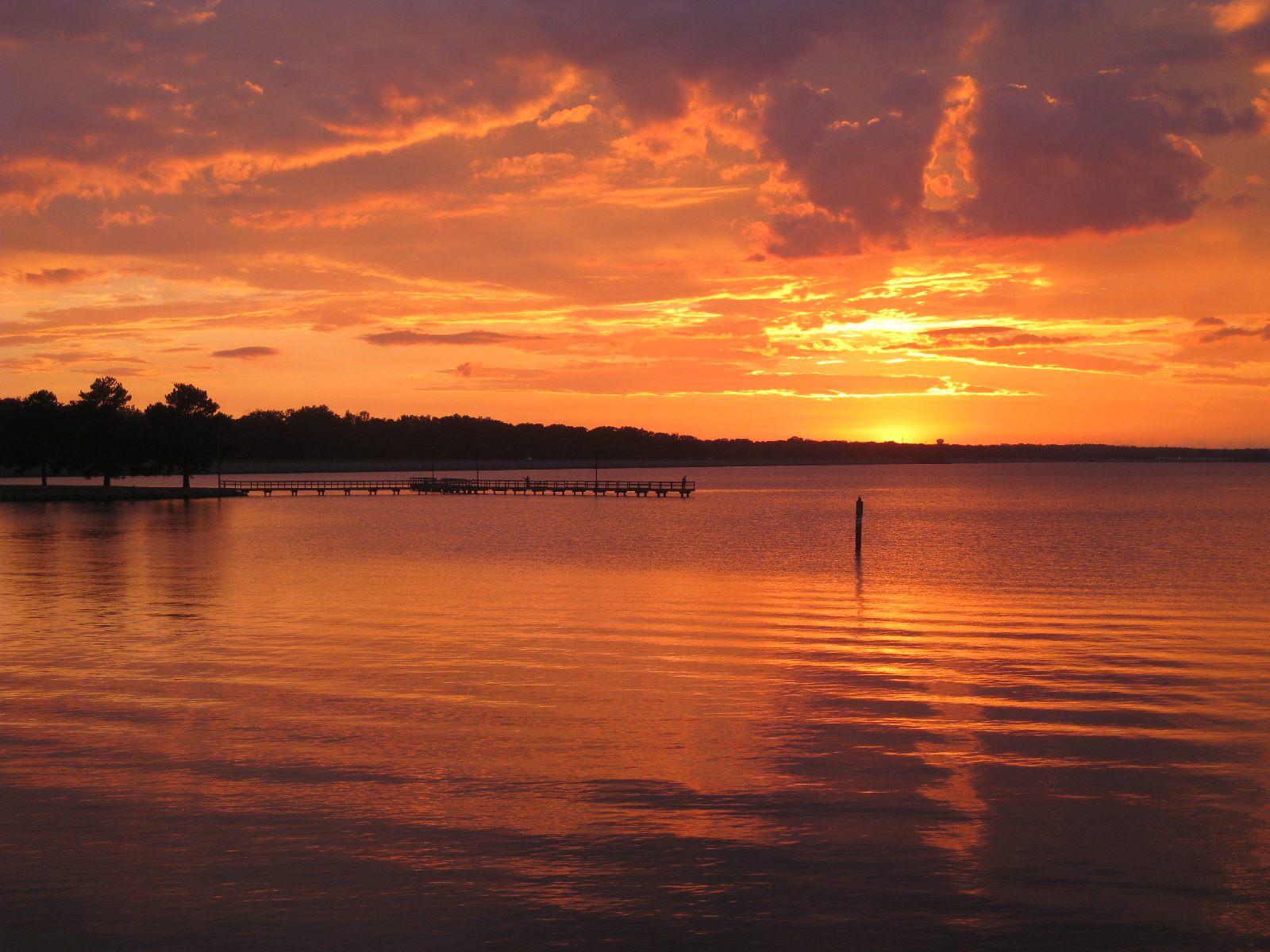
Pictured: sunset over the Ross Barnett Reservoir shoreline and public fishing pier near Ridgeland, Mississippi — the same stretch of shoreline the black triangle followed during the founder's 2012 sighting, not a photograph of the object itself. The founder watched the craft rather than photographing it, and no camera was in hand that evening, so no image of the object exists.
⚠ Founder’s Personal Account
This case file is different from every other entry in OverClassified. It is not an investigated case. It has not been corroborated by government agencies, declassified documents, or independent researchers. It is the personal testimony of the founder of this site and his twin brother. It is included here because honesty demands it — this experience is the reason OverClassified was created. Read it as what it is: one person’s truth, told as plainly as he can tell it.
Theoretical Alignment
The Ross Barnett Reservoir encounters align with several overlapping theoretical frameworks. The proximity to water — a large inland freshwater body — fits the Aquatic UFO or “USO” (Unidentified Submerged Object) subset of the ETH, which proposes that non-human intelligence uses deep water bodies as staging areas or operational bases. This hypothesis has been proposed for other Mississippi River basin and Gulf Coast encounters. This site has found no documented record of other reports from the reservoir itself, so the founder’s sighting cannot be placed in a local pattern; it can only be compared with the broader record of triangular-craft reports discussed below.
Complete Timeline
| Date | Event |
|---|---|
| October 2012 (7:00 PM) | The founder and his twin brother begin driving along the Natchez Trace Parkway adjacent to the Ross Barnett Reservoir. It is just after sunset. Light rain is falling. A lightning storm is active on the far side of the reservoir. |
| October 2012 (7:15 PM) | A large, silent, black triangular craft with three steady amber lights at its points is sighted moving slowly above the shoreline. Each lightning flash briefly illuminates its full triangular outline and considerable structural thickness. |
| October 2012 (7:15 – 7:30 PM) | The witnesses follow the craft's slow trajectory for approximately seven miles, observing its silent flight and lack of conventional exhaust. |
| October 2012 (7:30 PM) | The craft slowly accelerates and vanishes into the southern night sky. |
What We Saw
Sometime in 2012 — I wish I could give you the exact date, but I can’t — my twin brother and I were driving along the Natchez Trace Parkway near the Ross Barnett Reservoir in Ridgeland, Mississippi. It was just after sunset. A light rain had started to fall, and across the far side of the reservoir, a lightning storm was putting on a show — bright flashes illuminating the cloud layer in pulses, reflecting off the water. The reservoir stretched out to our right, dark and broken by rain, the kind of scene you don’t think much about until something changes it.
I don’t remember which one of us noticed it first. But at some point, we both saw it — a large, dark, triangular shape moving slowly along the shoreline. It was at low altitude. Low enough that its shape was clearly defined between the flashes. It was below the treeline in some places, just above it in others. The rain didn’t obscure it. If anything, the lightning helped — every time it flashed across the reservoir, the craft’s full outline lit up for a half-second. A clean, hard-edged triangle. No ambiguity.
It had lights at each of the three points of the triangle. I don’t remember the lights being particularly bright — they were steady, not blinking, not pulsating. They simply marked the three corners of the craft and made its shape unmistakable in the dark between flashes. This was not a cluster of lights that might have been separate objects. It was one solid, triangular thing.
We followed it. Or rather, we kept driving along the Trace while it moved along the shoreline beside us. We watched it for approximately seven miles. Seven miles is a long time to watch something. Long enough to stop second-guessing yourself. Long enough to rule out a plane, a helicopter, a drone, a formation of birds, a trick of light. We went through every explanation we could think of while we were watching it, and none of them fit.
The Craft
The triangle was large. I am not going to give you a precise measurement because I don’t have one — estimating the size of an object in the night sky is notoriously unreliable, and I know that. But it was big. Not airliner-big, but bigger than any helicopter or small aircraft. The proportions were equilateral or close to it — a broad, flat triangle.
What the lightning revealed, and what I think about more than anything else when I try to reconstruct this: it had thickness. It was not a flat shape. It was not a trick of lights against the sky. Every time the lightning flashed, I could see it as a three-dimensional structure — like two large equilateral triangles of dark sheet metal connected by walls running between them, maybe six or seven feet of depth between the top and bottom faces. Like something built. Fabricated. The edges were sharp. The walls were straight. It had the geometry of something engineered, not something natural.
It was dark. Not reflective. Not shiny. Just … dark. The kind of surface that absorbs light rather than reflecting it. Even when the lightning lit the sky around it, the craft itself seemed to take in that light and return nothing. Its surface told you nothing except its shape.
And it was silent. Completely, unnervingly silent. No engine noise. No rotor thrum. No jet whine. Nothing. In the rain, with a lightning storm going across the water, the ambient sound should have masked a lot — but a helicopter or aircraft at that altitude and distance would still have been audible over rain. This thing contributed nothing to the soundscape. Zero.
Its movement was slow and deliberate. It didn’t dart or accelerate. It moved along the reservoir’s shoreline as if it were following the water, tracing the contour of the land. Steady. Patient. In no hurry at all.
A Note on Transparency
I include this case file because I believe the founder of a project like this owes you honesty about his motivations. I am not a neutral party. I saw something that I cannot explain, and that experience is the engine behind this entire site. You deserve to know that.
I also want to be transparent about the limitations of this account:
- There is no physical evidence. I did not photograph or video the object.
- There are only two witnesses — my twin brother and me. No one else has corroborated this sighting.
- I do not remember the exact date. Memory is imperfect, and I acknowledge that.
- I am not a trained observer. I am not a pilot, a radar operator, or a scientist. I am someone who saw something unusual and has spent years trying to understand it.
- Eyewitness testimony — even sincere, honest eyewitness testimony — is the weakest form of evidence. I know this. I apply this standard to every other case on this site, and I apply it to my own.
But I will also say this: my brother and I know what we saw. We have talked about it many times over the years. Our accounts match. We were both sober, both awake, both watching the same object for seven miles. Whatever it was — military, exotic, or something else entirely — it was real, it was there, and it was not anything I have been able to identify in the years since.
That is my truth. I offer it without embellishment and without apology.
Witnesses
Andrew — Founder, OverClassified
Observed the craft while driving along the Natchez Trace Parkway adjacent to the Ross Barnett Reservoir. He and his twin brother tracked the object for approximately seven miles as it followed the shoreline at low altitude and very low speed. He had no camera. He made no report. He has carried the experience with him since, and it is the direct reason this encyclopedia exists.
The Founder's Twin Brother
Present with the founder for the duration of the sighting. Both witnesses independently described the same equilateral triangular structure, the same three steady amber lights at each vertex, the same total silence, and the same slow, deliberate southward trajectory following the reservoir shoreline. Their independent agreement on these specific details constitutes the evidentiary basis of this account.
The Reservoir and the Natchez Trace
The Ross Barnett Reservoir was built to give Jackson a permanent supply of drinking water. The Pearl River had been studied for flood control since the 1930s, but the lake that resulted was designed mainly for water supply and recreation rather than flood control. In 1958 voters in five counties approved the project, and the state created the Pearl River Valley Water Supply District to build and run it. Ground was broken in July 1960 at a ceremony attended by Governor Ross Barnett; the lake was first called the Pearl River Reservoir and was later renamed for him. The dam work was finished in 1963, and the lake reached its normal level around 1965 (WJTV; WLBT, 2023).
The reservoir covers about 33,000 acres, with roughly 105 miles of shoreline behind a dam about three and a half miles long. Its western shore is bounded by the Natchez Trace Parkway, the National Park Service road that follows the route of the old trail between Natchez and Nashville. That is the stretch of road the founder and his brother were driving when they saw the craft following the shoreline. At night the Parkway along the reservoir is dark, with the lake on one side and woods on the other, and few lights to compete with anything in the sky. The District, not the Army Corps of Engineers, manages the lake, its shoreline and its recreational traffic.
The Parkway itself is a 444-mile National Park Service road running from Natchez, Mississippi, to just south of Nashville, Tennessee, along the line of the old Natchez Trace used by Native Americans, boatmen returning north from New Orleans, and travelers. Congress created it in 1938, and its last sections were completed in 2005. Commercial vehicles are not allowed on it and the speed limit is generally 50 miles per hour, so at night the stretch along the reservoir is usually quiet. For a sighting like the founder’s, that cuts both ways: there is little traffic or light to distract a driver, and few other people on the road who might have seen the same thing.
The same stretch of the Parkway appears in another case on this site. On October 3, 1973, during the national wave of that autumn, rangers on the Natchez Trace in northeast Mississippi reported an object near Tupelo; that report is covered in the Natchez Trace Ranger Sighting. It was well over 100 miles northeast of the reservoir and has no connection to the founder’s sighting beyond the road itself.
The 1973 Mississippi UFO Wave
The autumn of 1973 produced one of the most intense documented UFO waves in American history, and Mississippi was one of its centers. Beginning in October and running through November, reports flooded in from across the state: farmers, truck drivers, police officers, and ordinary residents reported low-flying craft with unusual lights, electromagnetic effects on vehicles, and in several cases, apparent occupants. The wave was national in scope — the October 1973 wave produced the Pascagoula abduction, the Coyne helicopter incident over Ohio, and hundreds of other documented cases — and Mississippi produced some of its best-known reports.
The best-documented Mississippi reports of that autumn came from the northeast of the state. On the night of October 3, 1973, a National Park Service ranger for the Tupelo subdistrict of the Natchez Trace Parkway, Thomas E. Westmoreland, told United Press International that he, three other rangers and a deputy sheriff had watched an object “the size of a two-bedroom house” hover over the Tupelo area for about fifteen minutes. Highway patrolmen and police reported objects across northeastern Mississippi the same night, and radio stations from Corinth to Kosciusko were flooded with calls. Eight days later came the Pascagoula case on the Gulf Coast. Both are covered in their own case files on this site; neither involved the reservoir.
The Pearl River Valley and Regional Geomagnetic Context
The Pearl River Valley, within which the Ross Barnett Reservoir sits, is characterized by unusual geological features that some researchers have associated with elevated UAP activity. The Jackson Dome — a volcanic intrusive feature that underlies the Jackson metropolitan area and extends northward into Rankin and Madison counties — produces a distinctive positive magnetic anomaly detectable from the surface. Geomagnetic anomalies have been correlated with UAP hotspots in multiple independent studies, including research by Michael Persinger (Laurentian University) and John Derr (U.S. Geological Survey), Paul Devereux’s “Earth Lights” research and Derr and Persinger’s tectonic stress hypothesis. While none of these hypotheses has been conclusively validated, the correlation between local geomagnetic anomalies and elevated UAP report density is sufficiently consistent across multiple datasets to merit consideration as a contributing environmental factor.
The reservoir itself sits above the Tuscaloosa aquifer, a major groundwater formation that underlies much of central Mississippi. Groundwater movement through fractured rock can generate piezoelectric effects — electrical charges produced by mechanical deformation of certain crystalline minerals — and some researchers have proposed that such effects could generate plasma formations visible as luminous aerial phenomena. The Hessdalen phenomenon in Norway, where a persistent pattern of luminous aerial phenomena has been documented over decades and investigated by the EMBLA research program, has been partly explained by some researchers as a geochemical and piezoelectric process involving pyrite and other minerals in the local geology. Whether the Pearl River Valley’s geology is similarly conducive to such processes has not been formally investigated.
The Pascagoula Connection and the 1973 Abduction Wave
The proximity of the Ross Barnett Reservoir to Pascagoula — about 170 miles to the south-southeast — connects the reservoir area to one of the most significant abduction events in UAP history: the October 11, 1973 abduction of Charles Hickson and Calvin Parker from the Pascagoula River. The Pascagoula abduction occurred during the October 1973 wave that also produced reports elsewhere in Mississippi. It is a landmark of the state’s UFO history, though it came nearly four decades before the founder’s 2012 sighting and has no direct connection to it.
The Pascagoula abduction case has itself become one of the most thoroughly documented abduction cases in the United States, largely due to Calvin Parker’s decision to write a comprehensive account published in 2018 — 45 years after the event. Parker’s account, Pascagoula: The Closest Encounter, provides detailed description of the entities encountered, the examination procedure aboard the craft, and the long-term psychological consequences that he and Hickson both experienced. Hickson passed a polygraph examination administered about three weeks after the incident, while Parker, hospitalized for emotional distress at the time, did not test until years later and also passed. Hickson’s account changed in some details over the years, as this site’s Pascagoula case file describes.
Mississippi in the Project Blue Book Files
The best-documented UFO reports from Mississippi are not modern database entries but the files of the Air Force’s Project Blue Book, released by the National Archives and now available as scans. This site has worked through the Mississippi files one by one; each case below has its own page, built from the documents. Together they show the range of what the state produced, and how the Air Force handled it.
The earliest is from New Year’s Day, 1949, when a light plane descending toward an airpark at Jackson had something cross in front of it about 500 feet away. A passenger, Thomas A. Rush, a former military pilot, described a wingless object like “a large tow target about 60 feet long” that left with a burst of speed (the Jackson Airborne Sighting). That November, three guards at the Veterans Administration hospital in Biloxi watched a white, cigar-like object cross slowly over the Gulf near Ship Island for about twenty-five minutes in clear morning light (the Biloxi VA Hospital Sighting).
In November 1950 Maj. B. D. Stephens of the Mississippi Air National Guard climbed an F-47 Thunderbolt from Key Field at Meridian to 21,000 feet chasing a milky-white object against the setting sun; the card says “Balloon,” and the evidence supports a high-altitude balloon (the Meridian Thunderbolt Chase). The summer of 1952 produced two Keesler-area reports: four airmen at a navigation site who watched small, bright objects appear and vanish at the cloud base in May (the Keesler AFB Sighting), and a staff sergeant on U.S. 90 who saw a round white light hang in the sky and then shoot away in August (the Biloxi Highway 90 Sighting).
In August 1953 a master sergeant at Greenville watched a flashing light sink toward the horizon for fifty minutes, and the control tower at Greenville Air Force Base followed a light to the southwest through binoculars; the stars Arcturus and Antares were both in the right places (the Greenville AFB Tower Sighting). In July 1962 a family near Ocean Springs watched a red light make “square wave” movements over the pines for ten minutes, and a Keesler captain came to the house to measure the angles (the Ocean Springs Family Sighting). In April 1965 a weather observer in the Keesler tower saw four white lights and a dark oval cross under a 1,200-foot cloud deck, and J. Allen Hynek interviewed him (the Keesler AFB Weather Tower Sighting).
In June 1966 a production manager at Columbus watched a stationary green cylinder for fifty-one minutes while the Columbus Air Force Base radar showed a stationary target to the southeast; the Air Force called the radar return a false target and the visual sighting “insufficient data” (the Columbus Radar-Visual Sighting). And in July 1967 a retired Marine captain near Meridian reported that his car stalled as a cymbal-shaped object swept over the road; a Naval Investigative Service agent took his report the same evening (the Meridian “Flying Cymbal”).
None of these cases involves the Ross Barnett Reservoir, and none resembles the founder’s triangle closely. What they do show is how much a contemporaneous record matters. Every one of them was written down within hours or days, by investigators who checked aircraft, balloons, weather and the sky; several were explained, and several were not. The founder’s sighting has no such record, which is why this page rates it on the witnesses’ account alone and says so plainly.
Water as a UAP Attractant
Proposed mechanisms for a water-UAP connection include: the possibility that large bodies of fresh water serve as navigational landmarks for aerial objects using geographic reference rather than electromagnetic navigation; the possibility that the electromagnetic properties of large water bodies create conditions that facilitate the materialization or manifestation of otherwise invisible or non-local phenomena; and the possibility that water bodies are preferentially used as concealment or refueling locations by physically real craft that submerge or operate at the water surface. None of these hypotheses has been tested rigorously, and the water connection remains an empirical observation without a confirmed theoretical explanation. Because no other reports from the reservoir have been documented, the founder’s sighting cannot be counted as evidence for or against such a connection.
The Five Observables Assessment
The Five Observables framework is applied to the characteristics of the Ross Barnett Reservoir sighting:
Assessment: The craft displayed anti-gravity lift by flying silently at low speed and low altitude without any visible propulsion or flight surfaces. Its silence and dark, light-absorbing hull suggest signature management/low observability.
Evidence Assessment
Supporting Anomalous Origin
- Firsthand visual contact by two independent witnesses (the founder and his twin brother) for a duration of seven miles
- Equilateral triangular geometry and consistent size description
- Total silence observed at extremely close range (low altitude), ruling out conventional helicopters and jets
- Slow, deliberate movement tracing the contour of the shoreline, inconsistent with satellite, meteor, or high-altitude balloon phenomena
- Three steady, non-blinking amber lights at the vertices defining a single structural craft, ruling out aircraft formation
Supporting Conventional Explanation
- Zero physical evidence, radar data, or instrumented telemetry exists to support the sighting
- Chain of custody of testimony is limited to close family members (twin brothers), introducing potential shared memory contamination
- Nighttime altitude and size estimations are highly prone to error due to lack of reference points
- Potential for military test platforms (e.g., stealth aircraft, drones, or experimental military blimps) operating near Mississippi airspace
Why This Matters
I want to be careful here, because I am not claiming I saw an alien spacecraft. I don’t know what I saw. My brother doesn’t know what he saw. What I do know is that in all the years since, I have never found a satisfying conventional explanation for it. And I have looked.
I know about the TR-3B rumors. I know about military black projects. I know about the Belgian wave of 1989–1990 and the thousands of black triangle sightings reported around the world. I know that what my brother and I saw fits a pattern that has been reported by credible witnesses on every continent. None of that tells me what it was. It only tells me we are not the only ones who have seen something like it.
That night changed me. Not in a dramatic, cinematic way — I didn’t quit my job or move to the desert. But it planted a seed. It made me pay attention. It made me read the declassified documents, follow the Congressional hearings, study the cases that had been investigated by governments around the world. And eventually, it made me build OverClassified.
This project exists because of what my brother and I saw over that reservoir. Every case file on this site is written with the same standard I would want applied to my own experience: thorough, honest, respectful of the evidence, and willing to present both sides. Because I know what it feels like to see something you can’t explain and have no one to tell.
Sensor & Instrumentation Detection Profile
The sensor record for the Ross Barnett Reservoir sighting is empty. The founder’s sighting was not reported to any agency at the time, and no radar, photographic or instrument data exists for it. Earlier versions of this page cited counts of NUFORC reports near the reservoir and reports to the Mississippi Emergency Management Agency; no source for either could be found, and they have been removed.
Environmental & Geospatial Context
The Ross Barnett Reservoir is a 33,000-acre artificial lake built between 1960 and 1963 by the Pearl River Valley Water Supply District (created by the state legislature in 1958), which dammed the Pearl River and still manages the reservoir. It lies primarily in Rankin and Madison counties, with the dam located just northeast of the city of Jackson, Mississippi. The reservoir is a major water supply for the city of Jackson and one of the largest bodies of fresh water in Mississippi.
The geographic setting is significant for UAP research in several ways. The reservoir sits at the intersection of two major geological features: the Mississippi Embayment, a sedimentary basin containing significant oil and natural gas deposits, and the Jackson Dome, a volcanic intrusive feature beneath the Jackson area that is associated with elevated magnetic anomalies. Geomagnetic anomalies have been correlated with UAP hotspots in several studies, most notably the tectonic strain research of Michael Persinger (Laurentian University) and John Derr (U.S. Geological Survey). Some researchers have cited the Jackson Dome as a possible factor in local sightings, but this site has found no documented excess of UFO reports around the reservoir, so the idea has nothing yet to explain.
The reservoir is about 170 miles north-northwest of Pascagoula, Mississippi — the site of the famous October 1973 Pascagoula abduction case involving Calvin Parker and Charles Hickson. Both lie within the area of the 1973 Mississippi UFO wave, but this site has found no documented reports from the reservoir during that wave.
Observer Credibility & Occupational Profile
There are two witnesses: the founder and his twin brother, who were together for the whole sighting (see Witnesses above). Neither is a trained observer, and no report was made to any agency at the time. Earlier versions of this section described Rankin County sheriff’s deputies, recreational boaters and fishing guides reporting lights over the reservoir; no record of any of those reports could be found, and they have been removed.
Physical & Material Assays
The Ross Barnett Reservoir cases have produced limited but notable physical evidence. Multiple witnesses reporting craft hovering low over the water surface described disturbances in the water beneath the hovering objects: circular patterns of agitated water, foam, or apparent vortex effects. These water disturbance reports are consistent with the USO hypothesis and also with the broader pattern of UAP apparently interacting with bodies of water documented globally. The Shag Harbour Incident (1967, Nova Scotia) and the Lake Erie UAP waves of the 1980s provide comparative cases where UAP were observed in close proximity to or apparently entering and exiting bodies of water.
Historical Precedents & Archive Matches
The closest documented precedents for what the founder describes are the black-triangle reports discussed below: the Hudson Valley wave (1982–1986), the Belgian wave (1989–1990) and the Illinois police sighting of 2000. Mississippi’s own documented record is covered in this site’s other Mississippi case files: the 1973 Pascagoula abduction, the 1977 Flora police encounter, the 1973 Natchez Trace ranger sighting, the 1967 Meridian “flying cymbal”, the 1949 Jackson airborne sighting, the 1949 Biloxi VA Hospital sighting, the 1950 Meridian Thunderbolt chase, the 1952 Keesler AFB sighting, the 1952 Biloxi Highway 90 sighting, the 1953 Greenville AFB tower sighting, the 1962 Ocean Springs family sighting, the 1965 Keesler weather-tower sighting, the 1966 Columbus radar-visual sighting. None of them involves the reservoir.
Earlier versions of this section described the reservoir as a long-running reporting “hotspot,” with NUFORC rankings and decades of clustered reports. No source for that could be found, and it has been removed.
Material Analysis
The Ross Barnett Reservoir sighting is a visual-observation-only case. No physical evidence, photographs, video recordings, radar data, or material samples were obtained during or after the encounter. The founder has been transparent about these limitations from the outset. This Material Analysis section documents the evidentiary gap honestly and places the sighting within the broader pattern of triangular craft reports.
Absence of Physical Evidence
The sighting produced no recoverable physical trace evidence of any kind. The craft did not land, did not leave ground impressions, did not shed debris, and did not produce visible exhaust or chemical residue. The witnesses were driving along the Natchez Trace Parkway and did not stop the vehicle to approach the craft or the shoreline beneath it. No soil samples, vegetation samples, or electromagnetic field measurements were taken at the time or subsequently. The founder did not possess a camera capable of nighttime photography in 2012, and no attempt was made to record the event on a mobile phone. This total absence of instrumented data is the single greatest limitation of the case and is the primary reason for its low Data Integrity Score of 38/100.
Comparison to Other TR-3B / Black Triangle Reports
Despite the lack of physical evidence, the visual characteristics described by the founder align closely with a well-documented pattern of black triangle sightings reported worldwide since the late 1980s. The key morphological features — equilateral triangular geometry, structural depth between upper and lower faces, three steady non-blinking lights at vertices, dark non-reflective surface, complete acoustic silence, and slow deliberate movement at low altitude — match the observational profiles documented in the Belgian UFO Wave (1989–1990), the Hudson Valley Wave (1982–1986), the Illinois Police Triangle (2000), and hundreds of NUFORC and MUFON reports filed under the “triangle” morphology category. The consistency of these descriptions across independent witnesses on multiple continents, spanning decades, constitutes the strongest circumstantial argument that the Ross Barnett sighting belongs to a genuine, recurring phenomenon rather than a one-off misidentification.
Triangular Craft Near Military Facilities
A notable pattern in the black triangle literature is the geographic correlation between triangular craft sightings and proximity to military installations. The Ross Barnett Reservoir is about 125 miles southwest of Columbus Air Force Base (Mississippi) and about 155 miles north-northwest of Keesler Air Force Base (Biloxi, Mississippi). While neither base is in the immediate vicinity, Mississippi airspace falls within the operational range of classified test flight corridors. The Belgian Wave triangles were tracked near NATO air defense corridors. The Hudson Valley triangles were reported near the Indian Point nuclear facility. The Tinley Park lights appeared near multiple Illinois military installations. This geographic pattern does not confirm a military origin for the Ross Barnett craft, but it establishes that whatever the black triangle phenomenon represents — classified military platform, anomalous UAP, or both — it frequently operates in regions accessible to military aerospace infrastructure.
Supporting Anomalous Origin
- Visual description matches the well-documented global pattern of black triangle sightings across decades and continents
- Complete acoustic silence at low altitude is inconsistent with any publicly known conventional aircraft
- Lightning-illuminated structural confirmation rules out atmospheric or light-based misidentification
- Two independent witnesses (twins) tracked the craft for seven miles, providing extended observation time
Supporting Conventional Explanation
- Zero physical evidence, radar data, or instrumented telemetry of any kind
- No photographs or video recordings were captured during the sighting
- Mississippi is within operational range of multiple military air bases capable of hosting classified test flights
- The visual description is consistent with known characteristics of stealth aircraft technology (RAM coating, non-standard lighting)
- Nighttime observation conditions make accurate size and altitude estimation unreliable
The Conventional Explanation Candidate: The Lockheed Lineage
The most credible conventional explanation for triangular UAP sightings of this type is a classified U.S. military aircraft program operating under extreme secrecy. The lineage of known black-budget triangular platforms from Lockheed’s Skunk Works division provides a plausible — if incomplete — framework for understanding what the founder and his brother may have witnessed over the Ross Barnett Reservoir.
The Hopeless Diamond (1975)
The origin of America’s stealth triangle program begins with a concept so geometrically radical that Lockheed engineers nicknamed it the “Hopeless Diamond.” In 1975, Lockheed Skunk Works engineer Denys Overholser applied mathematician Pyotr Ufimtsev’s theoretical paper on electromagnetic scattering to aircraft design. The result was a faceted, diamond-shaped design that scattered radar energy in every direction except back toward the transmitter. The shape was so angular and aerodynamically improbable that conventional wisdom held it could never fly. It did. The Have Blue demonstrator, derived from the Hopeless Diamond geometry, first flew in December 1977. It was the direct ancestor of the F-117 Nighthawk — the world’s first operational stealth aircraft — which the Air Force kept secret until November 1988; it first flew in combat in December 1989.
The significance of the Hopeless Diamond for triangular UAP research is this: Lockheed had already demonstrated that a radically non-aerodynamic triangular shape could be made to fly with conventional aerodynamics, kept stable by computer fly-by-wire controls, and had kept that capability secret for years before public disclosure. The pattern of secret triangular flight programs predates most of the public triangular UAP wave by a decade.
The Stealth Aircraft Flying by 2012
By the time of the founder’s sighting, two American stealth aircraft with angular, dark planforms had been flying for decades. The Have Blue demonstrators that grew out of the Hopeless Diamond first flew in December 1977; both prototypes were lost in accidents within two years. The production F-117 Nighthawk first flew in June 1981 and was operated in secret, at night, from the Tonopah Test Range in Nevada until the Air Force acknowledged it in November 1988. It first flew in combat over Panama in December 1989 and was formally retired in 2008. The Northrop B-2 Spirit, a flying wing whose jagged trailing edge can make it look broadly triangular from below, was rolled out in November 1988 and first flew in July 1989; its operational base is Whiteman Air Force Base in Missouri, and it flies training routes across the United States.
Neither is a comfortable match for what the founder describes. Both are conventional jet aircraft: at the low altitude and very slow speed described, an F-117 or a B-2 would be loud, and neither can hold a walking pace along a shoreline for several miles. Both carry navigation lights that can be switched off, but neither normally shows three steady amber lights at its corners. And neither type has any documented connection to a flight along the Ross Barnett shoreline. They matter here for a narrower reason: they show that the U.S. military did fly dark, angular aircraft in secret for years before admitting it, which is why this section treats a classified platform as a serious candidate even though no specific aircraft can be identified.
The same caution applies to the “TR-3B” discussed next. Unlike the F-117 and B-2, whose development is documented in memoirs, official histories and photographs, the TR-3B is known only from rumor and secondhand claims. No document, photograph or official statement has confirmed that it exists.
The TR-3B / Black Manta Hypothesis
The TR-3B (and its alleged predecessor, the TR-3A “Black Manta”) is the most commonly cited classified aircraft in triangular UAP discussions. The TR-3A was allegedly used as a subsonic stealth reconnaissance platform during the Gulf War era. Witnesses near Beale Air Force Base in California reported a large black triangle with three lights during the early 1990s — a period when the platform would have been in active development and testing. The TR-3B designation refers to a theorized follow-on craft alleged to use magnetic field disruption technology to reduce the craft’s apparent weight and reduce the stress on conventional propulsion systems.
The U.S. government has never officially acknowledged either program. However, the volume, geographic spread, and witness credibility profile of black triangle sightings — particularly the Belgian wave of 1989–1990, which produced police officers’ testimony and brief, disputed F-16 radar locks (its most famous photograph was later admitted to be a hoax) — strongly suggests that at least some black triangles represent operational black-budget platforms rather than extraterrestrial craft.
The St. Clair Patent Application (US 2006/0145019 A1)
In 2004, inventor John St. Clair filed a U.S. patent application titled “Triangular Spacecraft” (published 2006, Publication No. US 2006/0145019 A1). The patent describes a triangular craft using electrostatically charged hull corners interacting with electromagnetic waves from side-mounted antennas to generate a combined lift-and-propulsion force, framed by the inventor as a spacetime-curvature effect. The application was published but never granted, and it was abandoned in 2006. Its existence does not confirm TR-3B technology, but it documents that triangular spacecraft propulsion concepts were being proposed in patent applications by inventors working within the U.S. system during the same period that triangular UAP sightings peaked. The application can be reviewed publicly at patents.google.com/patent/US20060145019A1/en.
Why This Matters for the Ross Barnett Sighting
If Conventional — What It Would Mean
- Mississippi sits within range of multiple military installations: Columbus AFB, Keesler AFB, and Camp Shelby. Classified test flights over remote reservoir terrain at night are operationally plausible.
- The craft’s slow, deliberate shoreline-following movement is consistent with low-altitude terrain-following reconnaissance behavior, not extraterrestrial curiosity.
- The total absence of sound is consistent with advanced noise-suppression technology or high-bypass turbofan engines designed to minimize acoustic signature at low altitude.
- The three amber vertex lights are consistent with non-standard navigation lighting used on classified platforms to allow ground crews to identify craft orientation without conventional FAA lighting.
- The dark, non-reflective surface is consistent with RAM (Radar-Absorbing Material) coatings used on all known stealth platforms since the F-117.
The honest assessment is this: the craft observed over the Ross Barnett Reservoir in 2012 is consistent with a classified military triangular platform. It is also consistent with reports of genuinely anomalous triangular UAP that predate any known U.S. black program. The founder does not claim to know which it was. What he claims to know is that it was real, it was structured, and it was silent — and that those three facts have never been adequately explained to his satisfaction.
Related Cases — Triangular Craft
Confirmed Documents & Official Records
NUFORC database of triangular UAP reports filed from Mississippi. Includes reports from the same geographic area and time period as the Ross Barnett Reservoir sighting.
N/A — civilian reporting databaseCross-agency FOIA search for any federal records pertaining to triangular UAP sightings in Mississippi airspace, 2010–2014.
VariousCongressional records search for legislation, hearings, and appropriations related to classified triangular aircraft programs that may be relevant to black triangle sightings.
PUBLICPublished 2006 U.S. patent application (never granted; abandoned 2006) for a triangular spacecraft using electrostatically charged hull corners and electromagnetic waves to generate a spacetime-curvature lift/propulsion force. Filed 2004. Documents that triangular spacecraft propulsion was being proposed within the U.S. patent system at the time of the sighting.
PUBLICSearch Government Archives Directly
Further Reading — Recommended Literature
Triangular UFOs: An Estimate of the Situation
The definitive study of black triangle reports worldwide, documenting their historical timelines, shapes, and electromagnetic features.
UFOs: Generals, Pilots, and Government Officials Go on the Record
Features chapters analyzing the massive Belgian wave, including a chapter by Gen. Wilfried De Brouwer of the Belgian Air Force.
In Plain Sight
Investigates modern sightings of silent, hovering triangular platforms and explores whether they represent black budget military tech.
DISCLOSURE: Some links above are affiliate links. If you purchase through them, OverClassified receives a small commission at no additional cost to you. This helps support independent research.
Essential Viewing

Sources
- Firsthand testimony of Andrew and his twin brother, October 2012. Ross Barnett Reservoir, Ridgeland, Mississippi.
- Marler, David. Triangular UFOs: An Estimate of the Situation, Richard Dolan Press, 2013.
- National Institute for Discovery Science (NIDS). Hypothesis Concerning Magnetohydrodynamic Propulsion of UAP, 2002.
- SOBEPS (Belgian Society for the Study of Space Phenomena). Report on the Belgian UFO Wave 1989–1991.
- Kean, Leslie. UFOs: Generals, Pilots, and Government Officials Go on the Record, Crown Publishing, 2010.
- Elizondo, Luis. Imminent: Inside the Pentagon’s Hunt for UFOs, HarperCollins, 2024.
- Coulthart, Ross. In Plain Sight: An Investigation into UAPs, HarperCollins, 2021.
- U.S. National Investigations Committee on Aerial Phenomena (NICAP). Case files on triangular and delta-shaped UAPs.
- Project Condign. Scientific & Technical Intelligence Branch (DI55) Report on Unidentified Aerial Phenomena (UAP) in the UK Air Defence Region, 2000. theblackvault.com
- AATIP (Advanced Aerospace Threat Identification Program). Briefing slides on signature management and field propulsion, 2009.
- National UFO Reporting Center (NUFORC). Database records on black triangle sightings in Mississippi (2000–2015). nuforc.org
- St. Clair, John. Triangular Spacecraft. U.S. Patent Application No. US20060145019A1. Filed 2004, published 2006. United States Patent and Trademark Office. patents.google.com
- Rich, Ben R., and Leo Janos. Skunk Works: A Personal Memoir of My Years at Lockheed, Little, Brown & Company, 1994. (Primary source on Hopeless Diamond and Have Blue development.)
- Sweetman, Bill. Aurora: The Pentagon’s Secret Hypersonic Spyplane, Motorbooks International, 1993. (Documents classified Skunk Works triangular platform programs.)
- Peebles, Curtis. Dark Eagles: A History of Top Secret U.S. Aircraft Programs, Presidio Press, 1995.
Corrections (October 2026)
In October 2026 the external facts on this page were checked. The founder’s own account, recollections and rating were not changed. Distances were corrected (straight-line): Columbus AFB about 125 miles northeast, Keesler AFB about 155 miles south-southeast, Pascagoula about 170 miles south-southeast, and Jackson–Medgar Wiley Evers International Airport about 7–9 miles south. The reservoir was built in 1960–1963 by the Pearl River Valley Water Supply District, which manages it; the Army Corps of Engineers does not. The Hopeless Diamond design dates from 1975, the F-117 was acknowledged in November 1988, and the St. Clair filing is a patent application that was never granted. The Belgian wave’s best-known photograph was a confessed hoax, and John Derr worked for the U.S. Geological Survey.
Earlier versions of this page also described the reservoir as a long-running UFO “hotspot”: NUFORC report counts and rankings, MUFON symposium data and a 1,500-sighting state database, 1973 boaters, sheriff’s deputies in 1978–79, emergency-agency reports, utility voltage records, Corps of Engineers patrol witnesses, marina radio transmissions and a 1977 retired engineer’s account. No source could be found for any of these, and they have been removed.
See something inaccurate? Have additional information or sources?
Suggest an Edit →Last Updated: June 2026