
The Belgian UFO Wave
Beginning on November 29, 1989, around Eupen in eastern Belgium, and peaking through April 1990, Belgian gendarmes and members of the public reported large, slow-moving lights, often described as a dark triangle with bright lights at the corners and a red light in the middle. On the night of March 30–31, 1990, after ground observers and two military radar stations reported targets, the Belgian Air Force scrambled two F-16s. Its report records nine interception attempts and brief radar lock-ons on targets whose speed and altitude changed abruptly. The pilots never saw anything. The Air Force publicly said it could not identify the phenomena. The wave remains one of the best-known UFO events in Europe and one of the most argued over. Its most famous photograph was a hoax. Skeptics attribute much of the wave to helicopters, aircraft, stars and media contagion, and the F-16 radar data to atmospheric and instrumental effects.
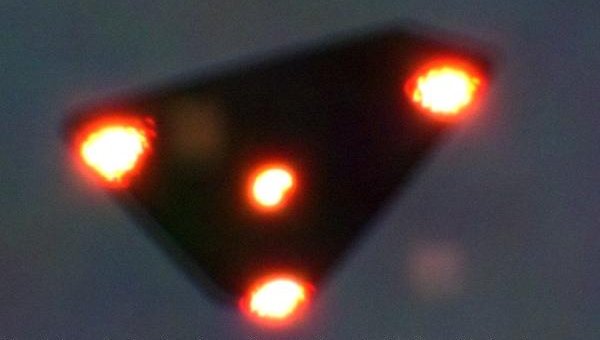
Pictured: the April 1990 Petit-Rechain photograph long reproduced as the emblematic image of the Belgian UFO wave — not a genuine photograph of an unidentified craft. Photographer Patrick Maréchal confessed in 2011 that the object is a painted Styrofoam model he built, suspended, and photographed himself; the image is included here, honestly captioned as a hoax, because of its historical role in the case rather than as evidence of anything real.
Theoretical Alignment
The Belgian UFO Wave of 1989–1990 is often presented as Europe's strongest case for the Extraterrestrial Hypothesis because part of its evidence is institutional rather than anecdotal. The Belgian Air Force cooperated openly with civilian investigators. It published a report on the night of March 30–31, 1990, describing radar contacts it could not explain, and it said publicly that it could not identify the phenomena. Colonel Wilfried De Brouwer, who presented the Air Force's findings in July 1990, later argued that the objects were not aircraft. The Air Force, however, never claimed that a craft had been confirmed. By De Brouwer's own later account, the evidence was judged insufficient to prove real craft were in the air that night. The radar data have also been analyzed as atmospheric and instrumental effects, including by the SOBEPS physicist Auguste Meessen. The psycho-social hypothesis, that a media-driven wave turned ordinary lights into “triangles,” has serious advocates among Belgian researchers.
Background
The Belgian UFO Wave is unusual mainly because of who took part in the investigation. The Ministry of National Defence, under Minister Guy Coëme, agreed to back the civilian group SOBEPS (Société belge d'étude des phénomènes spatiaux). The Air Force “has regularly cooperated with this society” (Lambrechts report, 1990), and its operations section, headed by Colonel Wilfried De Brouwer, briefed the press. The Air Staff ruled out the presence or testing of B-2 or F-117A stealth aircraft, remotely piloted vehicles, ultralights and AWACS in Belgian airspace on the dates in question. The U.S. Embassy reportedly confirmed that no USAF stealth aircraft were operating in the area.
The wave began on November 29, 1989, in the Eupen and Verviers area near the German border. Researcher Patrick Gross lists close to 150 reports in that area for the day, from morning to night. Brian Dunning notes that most of the 143 reports usually cited for that day were collected over the following week, after appeals in the press. The best-known accounts describe a large, dark triangle with three bright downward-pointing lights and a red or orange light in the center, hovering or moving slowly and almost silently. Others describe only lights. In the Air Force's own summary, witnesses “on some occasions” described “a triangle-shaped platform up to 200 feet wide with 3 downward beaming projectors, hovering at ± 100 m above the ground and making only a very light humming noise.” Before March 30, 1990, Air Force radars could not confirm any of the sightings, and fighters scrambled twice in the evening found nothing. On one of those occasions the pilots identified a laser projector on the ground (BAF summary, July 1990). F-16s were based at Beauvechain Air Base, and air defense radar was run from Glons, with a second radar at Semmerzake.
Complete Timeline
| Date | Event |
|---|---|
| November 29, 1989 | The Wave Begins. Around Eupen, gendarmes Heinrich Nicoll and Hubert von Montigny report a large triangular platform with powerful lights underneath and a flashing orange light in the middle, first over a field beside the Eupen–Kettenis road. They follow it toward Eupen and later watch a bright light near the Gileppe dam, which skeptics identify as Venus. Their dispatcher at Eupen, gendarme Creutz, later said he saw a light from the station. Other patrols, including gendarme Plumanns, and dozens of residents report lights that evening. |
| December 11, 1989 | Ernage Sighting. Belgian Army Lt. Col. André Amond and his wife, driving from Ernage to Gembloux, see a row of four white-yellow trapezoidal lights above a pulsating red light. Amond reports it to the Defence Minister's office on December 19. Skeptics propose a helicopter; Amond rejects that. |
| March 30–31, 1990 | The F-16 Night. At 23:00 gendarme A. Renkin reports three bright, color-changing lights in a triangle near Ramillies, and gendarmes led by Capt. Pinson confirm them. The Glons CRC and Semmerzake radars report a contact, and two F-16s (AL 17 and AL 23) are scrambled from Beauvechain at 00:05. Over nine interception attempts, the Lambrechts report records three brief lock-ons, with speed and altitude changing abruptly (for example, 150 to 970 knots). The pilots never see anything. The F-16s land at 01:10 and 01:16. |
| April 1990 | The Petit-Rechain Photograph. An anonymous photographer, later identified as Patrick Maréchal, releases a slide of a dark triangle with lights at its corners. Analyses, including one at Belgium's Royal Military Academy, find no obvious sign of fakery, and the image becomes the wave's icon. |
| May 31, 1990 | Lambrechts Report. Major P. Lambrechts of the Air Staff completes the report on the night of March 30–31. |
| June 22, 1990 | Paris Match Interview. De Brouwer shows extracts of the F-16 radar recordings to a Paris Match team, SOBEPS's Lucien Clerebaut and French scientist Jean-Pierre Petit. |
| July 11, 1990 | Air Force Press Briefing. Colonel De Brouwer briefs the press. The Air Force “was unable to identify neither the nature nor the origin of the phenomena” but rules out balloons, ultralights, remotely piloted vehicles, aircraft and laser projections. |
| 1991 and 1994 | SOBEPS Volumes. SOBEPS publishes Vague d'OVNI sur la Belgique – Un dossier exceptionnel (1991) and Vague d'OVNI sur la Belgique 2 – Une énigme non résolue (1994). Reports continue sporadically into 1991–92. |
| 1992–1993 | Skeptical Critiques. Marc Hallet publishes La Vague OVNI belge ou le triomphe de la désinformation (1992); astrophysicists Pierre Magain and Marc Remy publish a critique in Physicalia Magazine (1993). |
| July 26, 2011 | Photo Hoax Confessed. On RTL-TVI, Patrick Maréchal says the Petit-Rechain photograph was a hoax, made to fool his workmates from a polystyrene triangle painted black with a light in each corner, hung on a thread, and demonstrates how he made it. |
The F-16 Radar Telemetry
The climax of the Belgian UFO Wave was the night of March 30–31, 1990. The Air Force's report, compiled by Major P. Lambrechts, gives the sequence. At 23:00 the master controller at the Glons Control and Reporting Center (CRC) took a call from a gendarme, A. Renkin, who could see from his home at Ramillies three unusual lights in a triangle toward Thorembais-Gembloux, “distinctly more intense than stars and planets.” A Wavre gendarmerie patrol, including Captain Pinson, confirmed the lights at 23:28. Glons reported an unidentified radar contact, and from 23:49 the Semmerzake radar reported a contact in the same position. At 23:56 Glons ordered the quick-reaction alert scrambled. Two F-16s of the 1st Fighter Wing, call signs AL 17 and AL 23, took off from Beauvechain Air Base at 00:05. One pilot, Capt. Yves Meelbergs, spoke publicly about the mission in 2026.
The Lambrechts report records nine interception attempts between 00:07 and 00:54. The pilots had brief radar contacts on several occasions and three lock-ons lasting a few seconds each:
- 00:13: Lock-on “on the nose,” 6 NM, 9,000 ft. “The target speed changes within minimum time from 150 to 970 knots, altitude coming down from 9000 to 5000 feet, then up to 11000 feet, and, shortly after, down to ground level,” followed by a break-lock after some seconds.
- 00:30: AL 17 has a contact at 5,000 ft, 20 NM from Beauvechain, moving at 740 knots; the lock lasts 6 seconds, and at the break-lock “the signal of a jamming appears on the scope.”
- 00:39–00:41: A contact at 7 NM accelerates from 100 to 600 knots; the lock lasts only a few seconds.
The pilots “never have had visual contact with the UFOs.” The Air Force's July 1990 press summary gives somewhat different figures: six lock-ons at 5 to 8 NM, break-locks after 10 to 60 seconds, speeds between 150 and 1,010 knots, and three occasions on which both F-16s, flying about 2 NM apart, registered simultaneous lock-ons with the same parameters. The two official documents do not agree on the number or duration of the locks. Neither describes the cockpit video as showing a lock square “jumping wildly,” nor states any G-force.
Calculated G-Forces
The figure of about 40 g, widely quoted for the targets' maneuvers, does not appear in either Air Force document. It comes from later statements attributed to De Brouwer and from proponents' calculations based on the recorded changes in speed and altitude, which the Lambrechts report gives only as occurring “within minimum time.” Jean-Pierre Petit, who saw extracts of the recordings in June 1990, described a lock at 7,000 ft and 150 knots in which, two seconds later, the target's computed speed was 990 knots and its altitude below the radar's 200-meter cutoff. If those numbers describe a real object, the accelerations are far beyond any aircraft. If they describe radar artifacts, they describe nothing physical. That is the central question about the F-16 data.
Evidence & Debate
Supporting Points & Corroboration
- Ground Radar Correlation: On March 30–31, Glons and Semmerzake (about 100 NM apart) reported a contact in the same place, and the Beauvechain approach radar reported one later. The Lambrechts report calls this the first time a radar contact was observed in correlation with several Air Force sensors in the same area as visual reports.
- F-16 Radar Recordings: The fighters' radars recorded lock-ons on targets whose computed speed and altitude changed abruptly. The Air Force said the speeds and altitude shifts excluded the hypothesis that aircraft could be mistaken for the UFOs.
- Gendarme Witnesses: Gendarmes reported the lights at Eupen on November 29, 1989 and around Wavre, Ramillies and Jodoigne on March 30–31, 1990; four police stations about 10 NM apart reportedly confirmed visual observations that night.
Contradicting Points & Skeptics
- Radar Artifacts: Physicist Auguste Meessen, a SOBEPS scientist, concluded from a detailed study of the F-16 recordings (Inforespace, 1998) that the contacts were false echoes from cells of warm, humid air, with phantom speeds produced by the Doppler processing. Brian Dunning adds that the three locks were the two F-16s locking onto each other, and the Air Force summary itself records simultaneous identical locks by both aircraft flying 2 NM apart.
- The Helicopter Hypothesis: Renaud Leclet and colleagues (The Belgian UFO Wave of 1989–1992 – A Neglected Hypothesis, 2008) argued that many sightings were helicopters, with the noise masked by car engines or wind. Dunning notes that the first Eupen report mentioned a turbine-like component and an engine noise.
- Petit-Rechain Hoax and Media Contagion: The wave's most famous photograph was a polystyrene model (Maréchal, 2011). Marc Hallet and Jean-Michel Abrassart argue that the wave was largely a media-driven psycho-social phenomenon, and the March 30 ground observers' “triangles” of lights that changed color and kept their positions relative to one another have been interpreted as stars.
The F-16 Intercept: A Technical Analysis
The F-16s carried the AN/APG-66 pulse-Doppler fire-control radar. In a lock-on, the pilot designates a return and the radar's computer then tracks it, reporting its range, altitude, heading and computed speed. A lock breaks when the radar loses the return. In the air-to-air mode used that night, the radar filters out returns below about 200 meters above the ground to suppress ground clutter, so a target that “dives to ground level” simply disappears from the display (Petit, as summarized by Gross).
The Air Force's report drew strong conclusions from the recordings. Once the targets were seen by the F-16 radar in track mode, they “have drastically changed their parameters. The speeds measured at that time and the altitude shifts exclude the hypothesis according to which planes could be mistaken for the observed UFOs.” It also recorded oddities it could not explain. Speeds greater than sound were measured several times, yet “not any bang has been noticed.” And although ground witnesses pointed out eight points of light, “the radars have registered only one contact at the same time.” The Maastricht control center, which covered part of the same airspace, “had no contact with this UFO” at 00:32.
Those oddities are the basis of the skeptical reading. Auguste Meessen, a physicist at the Catholic University of Louvain who worked with SOBEPS and never accepted a conventional explanation for the wave as a whole, studied the F-16 recordings in detail. He concluded that the contacts were false echoes produced by cells of warm, humid air. The extreme speeds, he argued, were artifacts of the radar's Doppler processing, which partly reflected the fighters' own motion. He also suggested that the ground could act as a mirror, producing returns at impossible altitudes (Meessen, “Analyse approfondie des mystérieux enregistrements radar des F-16,” Inforespace, 1998, as summarized by Printy). Brian Dunning goes further and argues that the three locks were the two fighters locking onto each other. That reading draws support from the Air Force's own note that both aircraft, flying about 2 NM apart, registered simultaneous locks with identical parameters. According to De Brouwer's later account in Leslie Kean's 2010 book, as reported in 2020, the Air Force ultimately judged the evidence insufficient to prove that real craft had been in the air that night. Proponents reply that the ground radars at Glons and Semmerzake reported a contact in the same area as the ground observers before the fighters took off, and that the F-16 recordings are not the only radar evidence.
How the Reports Were Gathered
The size of the wave depends on how reports are counted. SOBEPS is usually credited with some 2,000 reports, and Dunning cites a figure of up to 2,600 over the whole period. A total of 13,500 witnesses is often quoted, but no breakdown has been found. Patrick Gross, a researcher sympathetic to the case, counts “about a thousand sightings” from 1989 to 1993, of which at least 500 produced an investigation report. Much of the material came in response to appeals for witnesses in the press, and the gendarmerie forwarded reports to SOBEPS.
That process is central to the skeptical case. Dunning notes that the 143 reports usually cited for November 29, 1989 “were indeed received, but only after more than a week of aggressive and repeated solicitation in the mass media,” and that “all the reports were after the fact.” Jean-Michel Abrassart argued in 2010 that the beginning of the wave is consistent with the psycho-social hypothesis. Marc Hallet argued in 1992 that SOBEPS had amplified a mass delusion. Astrophysicists Pierre Magain and Marc Remy of the University of Liège wrote in 1993 that the wave would have been better studied by specialists in the human sciences than by physicists. SOBEPS and Meessen replied that the early reports were detailed and mutually consistent before the media coverage spread. Meessen defended the wave as “completely unexplained” as late as 2011, and the exchange continued in print with Roger Paquay and Abrassart. No published psychological testing of the witnesses has been found.
The Aftermath and Ongoing Mystery
The intense phase of the wave ended in April 1990, although reports continued sporadically into 1991 and 1992. Defence Minister Guy Coëme wrote that no explanation had been found. In its July 1990 statement, the Air Force said it had excluded balloons, ultralights, remotely piloted vehicles, aircraft (including stealth types) and laser projections or mirages, while being “unable to identify neither the nature nor the origin of the phenomena.” A frequently quoted line attributed to the Air Force's conclusion reads: “a certain number of anomalous phenomena [have] been produced within Belgian airspace” (as quoted by Gross). Wilfried De Brouwer later retired as a major general. He wrote a postface to the SOBEPS report and a chapter in Leslie Kean's UFOs: Generals, Pilots, and Government Officials Go on the Record (2010), and he has continued to describe the wave as unexplained.
No source has been found for claims that the wave led the Belgian Ministry of Defence to adopt standing UAP protocols, that Belgian officials were later consulted by the U.S. UAP Task Force or AARO, or that the U.S. pressured Belgium to be less open. They are not repeated here.
The Triangle Phenomenon and Its Global Parallels
Large triangles or chevrons of lights are among the most commonly reported UFO shapes since the 1980s. The Hudson Valley wave of 1982–1986 in New York produced many reports of a large boomerang or V of lights. J. Allen Hynek, who died in 1986, co-wrote Night Siege (1987) about it with Philip Imbrogno and Bob Pratt. Skeptics attributed many of the Hudson Valley reports to light aircraft flying in formation.
The Phoenix Lights of March 13, 1997 are sometimes cited as a parallel, but the comparison is weak. The 10 PM lights over Phoenix were flares dropped by the Air National Guard. Accounts of the earlier “V” conflicted, and an amateur astronomer saw it through a telescope as a formation of planes (see this site's Phoenix Lights case file). Similar descriptions in different countries may point to a common phenomenon. They may equally reflect how people interpret groups of lights at night after seeing pictures of triangles in the media.
The idea that the Belgian triangles were a secret American aircraft, such as the F-117A or the mythical “TR-3B,” was promoted at the time by the French magazine Science et Vie. The F-117 was publicly acknowledged in 1988, but the Belgian Air Staff excluded stealth aircraft over Belgium on the dates in question, and the U.S. Embassy reportedly confirmed that none had flown there. The “TR-3B” has no verifiable basis.
The Declassified Files and Academic Analysis
The core official documents are public. They are Major Lambrechts's report on the night of March 30–31, the summary prepared for De Brouwer's press briefing of July 11, 1990, and extracts of the F-16 radar recordings shown to Paris Match and SOBEPS. All are available in transcription or reproduction through SOBEPS's books and researcher archives. SOBEPS's two volumes, of 1991 and 1994, are the main civilian investigation. They include Meessen's analyses and a postface by De Brouwer. They are in French and have not been fully translated.
The academic literature is small and divided. On the anomalous side are SOBEPS and Meessen, who studied the F-16 data and other cases over many years. On the skeptical side are Magain and Remy's 1993 article, Hallet's 1992 critique, the 2008 helicopter paper by Leclet and colleagues, and articles by Abrassart and Paquay in Tim Printy's SUNlite. The French COMETA report of 1999 is sometimes said to have relied on the Belgian wave, but its published list of case studies (Lakenheath, the RB-47, Tehran, Russia, Bariloche and French cases) does not include it.
The Night of March 30-31 in Detail
The visual part of that night is less dramatic than the radar part. What the gendarmes saw from the ground, starting at Ramillies at 23:00, were points of light: “the bright points have the dimension of a big star,” Captain Pinson reported, with colors changing continually through red, blue, green, yellow and white. A second group of lights joined the first and formed another triangle. Between 23:45 and 00:15, “their respective position does not change. The whole formation seems to move slowly in comparison with the stars.” As the F-16s passed overhead, the ground observers saw the brightest point move away and the others fade. After the fighters left, Pinson saw “four luminous white points at the apexes of a square” from Jodoigne, which lost their luminosity and “seem[ed] to disappear in four distinct directions” around 01:30 (Lambrechts report).
The weather was clear, with 8 to 15 km visibility, a 50–60 knot wind at 10,000 feet and slight temperature inversions at ground level and at 3,000 feet. Captain Pinson reported that the stars were clearly visible. The report rejected the hypothesis of planets or other optical illusions because of the radar observations. Skeptics note that a group of twinkling, color-changing points that keep their relative positions and drift slowly against the sky is also how bright stars look near the horizon on a clear, windy night. On that reading, the ground observations and the radar contacts were linked only by being reported at the same time.
Colonel De Brouwer’s Public Statements
Colonel Wilfried De Brouwer was head of the operations section of the Air Staff during the wave. He presented the Air Force's findings to the press on July 11, 1990, and is the senior officer most associated with the case. His first thought, he later wrote, was that the objects might be American experimental aircraft, until the U.S. Embassy said no USAF stealth aircraft were operating in the area. He has since said that the observations were real and unexplained, and that the descriptions did not match any known aircraft. Later writers attribute the “40 g” figure to his accounts. He has also acknowledged that the radar data on their own did not prove that a craft was present. He retired as a major general and has presented the case at international conferences and in Kean's 2010 book.
SOBEPS: The Civilian Investigation
The Société belge d'étude des phénomènes spatiaux was founded in 1971 and led during the wave by Michel Bougard (president) and Lucien Clerebaut (secretary general). When the wave began it asked the Ministry of Defence for support, and the request was granted. From then on the Air Force cooperated with SOBEPS, and the gendarmerie passed it reports. SOBEPS's investigators interviewed witnesses, mapped sightings and collected the Air Force material. The resulting books, Vague d'OVNI sur la Belgique – Un dossier exceptionnel (1991, about 500 pages) and Vague d'OVNI sur la Belgique 2 – Une énigme non résolue (1994), are the main documentary record of the wave.
SOBEPS's critics include several of the Belgian scientists who examined the wave. Their charge is that SOBEPS treated the wave as anomalous from the start, publicized the Petit-Rechain photograph as genuine for two decades, and gathered reports in a way that encouraged contagion. SOBEPS considered and rejected explanations such as aircraft formations, ground lights reflected on clouds, the F-117 and radar malfunction, but its conclusions are those of an advocacy-minded research group, not of an independent scientific review. SOBEPS later ceased operating; COBEPS presents itself as its successor.
The Enduring Mystery
More than thirty-five years later, the Belgian wave has no agreed explanation. Proponents point to the gendarme witnesses, the Air Force's statement that it could not identify the phenomena and the F-16 radar recordings. Skeptics point to the timing and collection of the reports, the helicopter and star explanations for individual sightings, the radar-artifact analyses of the F-16 data, and the photograph that turned out to be a hoax. The fair summary is that many people in Belgium reported lights they could not identify, during a period of intense media attention. The Air Force could not identify what its radars and pilots recorded on one night. And none of this has been shown to be a structured craft.
Official Acknowledgment and Transparency
The Belgian Air Force's handling of the wave remains a rare example of a military working openly with civilian investigators. It cooperated with SOBEPS, briefed the press and released its findings, including its inability to explain them. That openness is well documented. But “we could not identify it” is not the same as “we confirmed an anomalous craft,” and the Air Force did not claim the second. The same Air Force conclusion, as quoted by Gross, noted that “not a single trace of aggressiveness has been signaled.”
Scientific Context: Why UAP Evidence Standards Are High
The Belgian wave shows why evidence standards for UAP claims need to be high. The most extraordinary data, accelerations of tens of g and supersonic speeds with no sonic boom, come from a fire-control radar's computed values during lock-ons lasting seconds. The two official documents disagree on the details of those values, and a physicist sympathetic to the wave attributed them to atmospheric echoes. The visual data that night were points of light at a distance. And the one photograph of a “triangle” was faked. Taken together, the record shows that something prompted many reports and a military scramble. It is not strong enough to establish physics beyond known technology.
Summary Assessment
The Belgian UFO wave of 1989–1990 produced an unusually well-documented official record: gendarme reports, an Air Force report and press briefing, F-16 radar recordings and a large civilian investigation. That record shows real, sustained public reports and one night on which the Air Force recorded contacts it could not explain. It does not show agreement among investigators about what any of it was, and the radar contacts have credible artifact explanations.
SOBEPS Investigation and Scientific Analysis
SOBEPS's investigators reported that descriptions of the triangle were broadly consistent: three bright white lights at the corners, often a central red light, slow movement and little or no sound. Sizes varied widely. The Air Force summary mentions witnesses describing a platform “up to 200 feet wide.” Some accounts, like Lt. Col. Amond's at Ernage, described quite different light patterns. The often-repeated figure of an average 120-meter triangle, and claims that SOBEPS ran statistical or psychological tests proving the witnesses independent, could not be traced to the SOBEPS volumes and are not repeated here.
Key Witnesses
Primary Military & Law Enforcement Witnesses
Colonel Wilfried De Brouwer
De Brouwer headed the operations section of the Air Staff during the wave, and the July 11, 1990 press briefing was given in his name. He first suspected American experimental aircraft; the Air Staff excluded B-2 and F-117A flights, and the U.S. Embassy reportedly said no USAF stealth aircraft were operating in the area. He has consistently rejected mass hysteria as an explanation for the gendarmes' reports, while accepting that the radar data alone did not prove a craft was present. He retired as a major general and set out his view of the case in Leslie Kean's 2010 book.
Heinrich Nicoll & Hubert von Montigny
The two gendarmes whose sighting on the evening of November 29, 1989 opened the wave. Near the Eupen–Kettenis road they saw a field lit up “like the lights on a huge football field” and, in Nicoll's words, “a huge triangular platform, with powerful headlights on its underside. And in the middle, there was this orange flashing light.” They followed it toward Eupen, and later watched a bright light near the Gileppe dam that skeptics identify as Venus. One of them recalled a faint humming sound, and some descriptions mention a turbine-like component, details that skeptics read as pointing to a helicopter. Their account was recorded by several investigators from December 1989 onward and repeated for NBC's Unsolved Mysteries in 1991.
Albert Creutz
The gendarmerie dispatcher at Eupen who took Nicoll and von Montigny's call. “They reported to me an odd, silent object. We joked around, saying that it must be Santa,” he later said. He logged the call, and later said he saw a bright light from the station and “something like a laser beam” shoot out of it and go back (Unsolved Mysteries, 1991, as transcribed by Gross). No record has been found of him verifying the sighting with the Glons radar.
Dieter Plumanns
Another Eupen gendarme who reported observations on November 29, 1989 and was interviewed for the 1991 Unsolved Mysteries segment. Accounts of that evening describe several patrols reporting lights in the Eupen area; the claim that he and a partner tracked a solid object for over an hour is not supported by the sources found.
Primary Research & Civilian Witnesses
Michel Bougard
President of SOBEPS during the wave. The Ministry of Defence agreed to back SOBEPS's inquiry, and the Air Force cooperated with it. Bougard's group collected witness reports and the Air Force material and published the two volumes Vague d'OVNI sur la Belgique (1991) and Vague d'OVNI sur la Belgique 2 (1994). The group also promoted the Petit-Rechain photograph as genuine for some twenty years.
Professor Auguste Meessen
A physicist at the Catholic University of Louvain who worked with SOBEPS and wrote extensively on the wave. He studied the F-16 radar recordings in detail and concluded that the contacts were false echoes from cells of warm, humid air, with the extreme speeds produced by the radar's Doppler processing (Inforespace, 1998; earlier work in SOBEPS's second volume). He nonetheless maintained that the wave as a whole was “completely unexplained” (2011), and he debated skeptics Roger Paquay and Jean-Michel Abrassart in print.
Patrick Maréchal [DISCREDITED]
Released anonymously in April 1990, his slide of a dark triangle with lights at the corners became the wave's icon. On July 26, 2011, on RTL-TVI, he said it was a hoax made to fool his workmates: a polystyrene triangle painted black, with a light in each corner, hung from a thread. He demonstrated how he had made it. The photograph had been examined by several experts, including at the Royal Military Academy, without obvious signs of fakery being found. It shows how little a lack of evidence of fakery proves.
The Five Observables Assessment
Why "Credible"
The Belgian UFO Wave is classified as CREDIBLE: the core events are documented by official sources. The Belgian Air Force investigated and reported on the night of March 30–31, 1990 (the Lambrechts report and the July 1990 press summary). Its ground radars at Glons and Semmerzake reported a contact in the same area as gendarme observers. It scrambled F-16s whose radars recorded brief lock-ons. And it stated publicly that it could not identify the phenomena. Gendarmes reported the lights at Eupen and on March 30–31, and the Ministry of Defence cooperated openly with civilian researchers.
It is rated Credible rather than Verified because the documentation establishes the reports, not the phenomena. The Air Force did not claim to have confirmed a craft, and by De Brouwer's later account it judged the evidence insufficient to prove that real craft were in the air that night. The F-16 data have serious artifact explanations, and the wave's famous photograph was a hoax. Skeptics attribute much of the rest to helicopters, stars and media-driven reporting.
Sensor & Instrumentation Detection Profile
The instrumental record of the Belgian wave comes almost entirely from one night, March 30–31, 1990. Before then, by the Air Force's own account, its radars “could not confirm, in any case” the visual sightings. That night, the Control and Reporting Center at Glons reported an unidentified contact about 5 km north of Beauvechain, moving west at about 25 knots, and from 23:49 the radar post at Semmerzake, about 100 NM away, reported a contact at the same position. Later the Beauvechain approach radar (RAPCON) also reported a contact. The Maastricht control center saw nothing at 00:32. No third radar “at Tiege” is mentioned in the official reports.
The F-16s' AN/APG-66 radars recorded the interception attempts. The Lambrechts report lists nine attempts and three lock-ons lasting a few seconds; the July press summary lists six lock-ons lasting 10 to 60 seconds, with speeds between 150 and 1,010 knots. At one break-lock the scope showed a jamming signal. The figures most often quoted, a drop from 3,000 to 150 meters in about a second and 40 g, are not in either document, and the Air Force did not release “printouts” of nine evasive maneuvers. Extracts of the recordings were shown to Paris Match and SOBEPS in June 1990, and Jean-Pierre Petit published sketches of one lock sequence.
Speeds recorded by the ground radars that night ranged from about 25 knots for the first slow contact to 478–690 knots for a contact at 00:32 that headed toward Bierset and was lost there. No source has been found for a “Belgian Space Science Institute” analysis concluding that the target exceeded every aircraft in existence; the claim has been removed. The main published technical analysis of the F-16 recordings, Meessen's, concluded that they recorded atmospheric false echoes, not an object.
Environmental & Geospatial Context
The Belgian wave was concentrated in eastern and central Belgium: the Eupen–Verviers–Liège area in late 1989 and the area south and east of Brussels, around Wavre, Gembloux, Ramillies and Jodoigne, by March 1990. This is a densely populated region, crossed by busy airways, with civil and military radar coverage and a free press that covered the reports intensively. Proponents see that as making misidentification less likely. Skeptics see it as making both misidentifications and media-driven reporting more likely.
Descriptions were broadly similar, with a triangle of bright lights and often a central red light, but by no means identical. Lt. Col. Amond's Ernage sighting described four trapezoidal lights above a red one. The March 30 ground observers saw only points of light. Other reports described rectangles or rhombuses. Most reports came from French-speaking Wallonia, the region where SOBEPS was most active and the press coverage most intense.
Belgium hosted NATO headquarters in Brussels and SHAPE near Mons, and its air defense radar at Glons was part of NATO's network. That is one reason the Air Force set conditions for scrambling fighters: from early 1990, it authorized F-16 scrambles only when ground sightings were confirmed by police and a contact appeared on radar (BAF summary, July 1990). Those conditions were first met on March 30.
Observer Credibility & Occupational Profile
The Belgian wave produced a large witness pool. SOBEPS is usually credited with some 2,000 reports, and Dunning cites up to 2,600, though many were gathered after the fact in response to appeals. The witnesses included members of the gendarmerie, the national police force of the time. On March 30–31 the head of the Wavre police alerted four other stations about 10 NM apart, which reportedly all confirmed the lights. The Air Force report said the gendarmes' objectivity “cannot be questioned.” No count of military pilots, air traffic controllers or astronomers among the witnesses has been found.
The two gendarmes whose November 29, 1989 sighting began the wave, Heinrich Nicoll and Hubert von Montigny, were on patrol near Eupen. They described a large dark triangle with three powerful lights pointing down and a flashing orange-red light in the center, hovering and then moving slowly, almost silently. They gave their account to several investigators, including a SOBEPS interview on December 9, 1989, and later on television. Critics point to differences between the early and later versions, for example on whether light beams went “in all directions” or only sideways from the object near the Gileppe dam. They note the faint hum one of them recalled, and argue that the later part of the sighting was Venus.
Colonel Wilfried De Brouwer, head of the operations section of the Air Staff during the wave, is the case's most important official voice. He gave the July 11, 1990 press briefing, which concluded that the Air Force could not identify “neither the nature nor the origin of the phenomena.” A widely quoted line from the Air Force's conclusion reads: “the Belgian air force has arrived at the conclusion that a certain number of anomalous phenomena [have] been produced within Belgian airspace” (as quoted by Gross). He was not a direct witness of the lights, and his later statements, though consistent in calling the case unexplained, also acknowledge that the radar evidence did not prove a craft.
Physical & Material Assays
The Belgian wave produced no physical material evidence: no landing traces, debris or samples. The Petit-Rechain photograph, released anonymously in April 1990 and showing a dark triangle with lights at its corners, was for years treated as the main image of the craft. Experts, including at Belgium's Royal Military Academy, examined it without finding obvious signs of fakery. In July 2011 its author, Patrick Maréchal, admitted it was a polystyrene model with lights in the corners, and showed how he had made it. No “Royal Belgian Aerospace Institute” analysis declaring it authentic has been found.
The F-16 radar recordings are the closest thing to instrumental evidence in the case. They are machine records, but what they recorded is disputed. The Air Force read the computed speeds and altitude changes as excluding aircraft. Meessen, working from the same recordings, concluded that they showed atmospheric false echoes and Doppler artifacts. The two official documents give different counts and durations for the lock-ons. The recordings have not been released in full for independent analysis.
Historical Precedents & Archive Matches
The Belgian wave is often grouped with the Hudson Valley wave (1982–1986) and the Phoenix Lights (1997) as a “triangle” event. The parallels are looser than they look. In the Hudson Valley, skeptics identified pilots flying in formation. In Phoenix, the 10 PM lights were military flares and the earlier “V” was seen through a telescope as aircraft. In Belgium, the best-known photograph was a hoax and the radar contacts have artifact explanations. The common thread is groups of lights at night interpreted as a single large object.
The Belgian government's handling of the wave is a genuine example of institutional openness. The Air Force cooperated with SOBEPS, briefed the press, published its findings and said plainly that it could not identify what it had recorded. Belgium never claimed to have identified the objects, and never claimed to have confirmed them as anomalous craft either.
SOBEPS's investigation produced the two-volume Vague d'OVNI sur la Belgique (1991 and 1994), the most extensive civilian study of the wave. It concluded that the phenomena were unexplained. Belgian scientists including Magain and Remy disputed its methods, and the group's long defense of the Petit-Rechain photograph has damaged its standing. Claims that the books drew on “over 650 trained observers” and are “cited in virtually every major academic paper” on UAP could not be verified and have been removed.
Material Analysis
The Belgian UFO Wave left no physical debris. Its evidence is documentary and instrumental: the Air Force's reports, recordings from the F-16 radars and from the ground radars at Glons, Semmerzake and Beauvechain, and witness reports. Its one widely published photograph was a hoax.
F-16 Radar Recordings
On the night of March 30–31, 1990, two Belgian Air Force F-16s scrambled from Beauvechain Air Base made nine interception attempts. The Lambrechts report records three lock-ons of a few seconds each. In one, the target's computed speed went from 150 to 970 knots while its altitude went from 9,000 ft to 5,000 ft, then up to 11,000 ft, then down to ground level, all “within minimum time.” In another the contact moved at 740 knots and a jamming signal appeared at the break-lock. In a third it accelerated from 100 to 600 knots. The press summary gives six lock-ons, speeds of 150 to 1,010 knots, and three simultaneous identical locks by both aircraft flying 2 NM apart. There is no “gun camera footage” of an object, and the pilots never saw one.
Ground-Based Radar Confirmation
The Glons and Semmerzake radars reported a contact in the same position before the scramble, and Beauvechain's approach radar later reported one too. This is the strongest instrumental point in the case. It does not by itself rule out artifacts. The ground radars generally lost the contact during the interceptions, the Air Force noted that only one radar contact was registered while ground witnesses saw eight lights, and the nearby Maastricht center saw nothing. Claims that the multi-radar picture “eliminates” atmospheric effects go beyond the official reports.
Photographic Evidence & The Petit-Rechain Controversy
The most famous photograph from the Belgian Wave, the Petit-Rechain slide of a dark triangle with three bright lights, appeared in April 1990 and became the wave's icon. In July 2011 its author, Patrick Maréchal, confessed it was a polystyrene model. Other photographs and videos from the wave exist, notably the Ramillies photographs discussed by Meessen, but none is widely accepted as showing a structured craft. The claim of “hundreds of photographs and video recordings” of the triangle is not supported.
Supporting Anomalous Origin of Evidence
- F-16 radar lock-ons recorded abrupt changes in computed speed and altitude that the Air Force said excluded aircraft
- Two ground radars (Glons and Semmerzake) reported a contact in the same position as gendarme observers before the scramble
- The Belgian Air Force stated publicly that it could not identify the nature or origin of the phenomena
- Gendarmes on duty reported the lights at Eupen (Nov 29, 1989) and around Wavre and Jodoigne (Mar 30–31, 1990)
Supporting Conventional Explanation of Evidence
- The iconic Petit-Rechain photograph was proven to be a hoax in 2011
- No physical debris, landing traces, or material samples were ever recovered
- Meessen's analysis attributes the F-16 contacts to atmospheric false echoes and Doppler artifacts; the press summary records simultaneous identical locks by the two F-16s
- Most reports were gathered after the fact following media appeals; helicopters, aircraft and stars explain many individual sightings (Leclet, Dunning, Hallet)
Conventional Explanation Candidates: Stealth Aircraft, Helicopters and Stars, Radar Artifacts
Three families of conventional explanation have been proposed for the Belgian wave. The first is secret aircraft, especially the F-117A, promoted in 1990 by Science et Vie. The second is ordinary aircraft, helicopters and celestial objects, combined with media-driven reporting (Hallet, Leclet and colleagues, Abrassart, Dunning). The third is atmospheric and instrumental artifacts in the March 30–31 radar data (Meessen, Dunning).
F-117 Nighthawk Classified Overflight
ImplausibleThe F-117A was publicly acknowledged in November 1988 and first used in combat over Panama in December 1989. Its faceted, roughly triangular planform made it an obvious suspect. But the Belgian Air Staff excluded the presence or testing of B-2 or F-117A aircraft over Belgium on the dates in question, and the U.S. Embassy reportedly confirmed that no USAF stealth aircraft were operating there. The F-117 is not a slow, quiet hoverer. Nothing links it to the reports beyond its shape.
Aircraft, Helicopters, Stars and Media Contagion
InconclusiveMarc Hallet (1992) argued that the wave was largely a mass delusion amplified by SOBEPS and the press. Leclet and colleagues (2008) argued that many “silent triangles” were helicopters. The first Eupen account mentioned a faint hum and a turbine-like component, and the Gileppe light has been identified as Venus. The March 30 ground observers' color-changing points that held their relative positions match bright stars near the horizon. Dunning stresses that most reports were collected after the fact, following media appeals. This explains many individual reports. Whether it explains all of them, including the closest gendarme sightings at Eupen, is disputed.
Radar Artifacts (March 30–31)
PlausibleMeessen, a SOBEPS scientist who regarded the wave as unexplained, concluded that the F-16 contacts were false echoes from warm, humid air cells, with impossible speeds produced by Doppler processing. The Air Force's own documents are consistent with artifacts in several ways. The two F-16s registered simultaneous identical locks while flying 2 NM apart, and Dunning argues they locked onto each other. Only one radar contact appeared while eight lights were seen. Maastricht saw nothing, and the pilots saw nothing. The ground-radar contacts before the scramble are harder to dismiss, but they too were weak and intermittent.
The Assessment
The Belgian Air Force acknowledged that it recorded radar contacts it could not identify and that its pilots saw nothing. It did not acknowledge that a real object had defeated its fighters, and, by De Brouwer's later account, it judged the evidence insufficient to prove a craft. On the record available, the radar-artifact explanation for the F-16 data is plausible, and the misidentification-plus-contagion explanation accounts for much of the wider wave. What remains unexplained is a smaller set of close, early sightings by gendarmes and others, for which no specific conventional cause has been established.
A caveat on crediting the Belgian Air Force's statement: an air force saying it cannot identify something is strong evidence that it could not identify it. It is not evidence that the thing was anomalous. This file treats the Belgian Air Force's candor as establishing that the reports and radar contacts were real and unexplained at the time, not that a non-human or unknown craft was confirmed.
Related Cases
Confirmed Documents & Official Records
General search of the CIA's FOIA reading room. No CIA intelligence report or assessment specific to the Belgian wave has been identified; the link is provided for searching only. The primary official records are Belgian (see the Lambrechts report and the July 1990 Air Force summary in Sources).
UNCLASSIFIED (partially declassified)General U.S. National Archives catalog search. No U.S. or NATO record specific to the Belgian wave has been identified; the link is provided for searching only.
VariousSearch Government Archives Directly
Further Reading — Recommended Literature
Open Skies, Closed Minds: For the First Time a Government UFO Investigator Speaks Out
Written by the former UK Ministry of Defence UFO investigator, discussing official European military and defense responses to close encounters.
Vague d'OVNI sur la Belgique: Un dossier exceptionnel
SOBEPS's roughly 500-page first volume (1991), compiling gendarme and civilian reports from the wave's first phase and the Air Force material on March 30–31.
Vague d'OVNI sur la Belgique 2: Une énigme non résolue
SOBEPS's second volume (1994), with further cases and analyses, including work by Prof. Auguste Meessen on the observations and radar data, and a postface by De Brouwer.
DISCLOSURE: Some links above are affiliate links. If you purchase through them, OverClassified receives a small commission at no additional cost to you. This helps support independent research.
Essential Viewing
Primary Case Video
Unsolved Mysteries classic segment documenting the massive wave of triangular sightings in Belgium.

Belgium General Says Incredible UFO Case Is a Mystery
Open Minds Productions exclusive interview with a senior retired Belgian Air Force officer involved in the 1989–1990 investigation, on why the wave has never been officially explained.
This European UFO Was Spotted by Thousands of People
Red Web's investigative episode on the Belgian wave, examining why thousands of independent witnesses — including police officers and military personnel — reported the same triangular craft.
13 O'Clock Podcast: The Belgian UFO Wave
Long-form analysis episode covering the full timeline of the 1989–1990 wave, the March 30 F-16 intercept, and the ongoing debate over the case's evidence.
Sources
- Belgian Air Force (Maj. P. Lambrechts, VS3/Ctl-Met). Report concerning the observation of UFOs during the night of March 30 to 31, 1990, preliminary report dated May 31, 1990 (English translation). ufoevidence.org (archived)
- Belgian Air Force (Col. W. De Brouwer). Summary Report on Observations 30–31 March 1990, basis of the press briefing of July 11, 1990. patrickgross.org
- SOBEPS (Société belge d'étude des phénomènes spatiaux). Vague d'OVNI sur la Belgique – Un dossier exceptionnel, Brussels, 1991.
- SOBEPS. Vague d'OVNI sur la Belgique 2: Une énigme non résolue, Volume 2, Brussels, 1994.
- Meessen, Auguste. “Analyse approfondie des mystérieux enregistrements radar des F-16,” Inforespace, December 1998; and “The Belgian Wave and the photos of Ramillies” (2011), meessen.net (as summarized by Printy and Wikipedia).
- Petit, Jean-Pierre. Enquête sur les OVNIS, Albin Michel, 1990 (account of the June 22, 1990 viewing of F-16 radar extracts). Summarized at patrickgross.org
- Gross, Patrick. “The Belgium UFO wave 1989–1993” case files: the Eupen sightings of November 29, 1989 (including the December 9, 1989 interview of Nicoll and von Montigny and the 1991 Unsolved Mysteries testimony). patrickgross.org
- Dunning, Brian. “The Belgian UFO Wave,” Skeptoid #538, September 27, 2016.
- COBEPS (Comité belge d'étude des phénomènes spatiaux). Successor archive to SOBEPS. cobeps.org
- Leclet, Renaud, et al. The Belgian UFO Wave of 1989–1992 – A Neglected Hypothesis, October 2008 (helicopters).
- Kean, Leslie. UFOs: Generals, Pilots, and Government Officials Go on the Record, Harmony Books (Crown), 2010. Includes a chapter by Maj. Gen. Wilfried De Brouwer (as reported in “30 years later, we still don't know what really happened during the Belgian UFO wave,” The Week, March 30, 2020).
- Magain, Pierre, and Remy, Marc. “Les OVNI : un sujet de recherche ?” Physicalia Magazine 15(4), 1993, pp. 311–318.
- Abrassart, Jean-Michel. “The Beginning of the Belgian UFO wave,” SUNlite 2(6), 2010; Paquay, Roger, answer to Meessen, SUNlite 3(3), 2011.
- Vey, Tristan. “La photo d'un ovni belge célèbre était un trucage,” Le Figaro, July 28, 2011; and RTL-TVI interview with Patrick Maréchal, July 26, 2011.
- Van Utrecht, Wim. “Triangles over Belgium” and the Ernage case file (Lt. Col. André Amond, December 11, 1989), Caelestia. caelestia.be
- Wikipedia, “Belgian UFO wave” (used as a pointer to the above; consulted October 2026).
- Hallet, Marc. La Vague OVNI Belge ou le triomphe de la désinformation, self-published, Liège, 1992. Contemporary skeptical critique arguing the wave was amplified by media-driven mass delusion.
Corrections (October 2026)
A fact-check of this page found extensive invented detail, now removed or corrected against the Belgian Air Force's own documents (the Lambrechts report and the July 1990 press summary). Removed or corrected:
- Invented lock-on figures: "Lock 2: 160 to 1,120 knots," "150 to 970 knots in less than 2 seconds," a "0000" altitude readout, "nine radar locks," each broken by "a descent from 3,000 to 150 meters in one second," and "printouts" of nine evasive maneuvers. The report records three short locks; the press summary records six.
- "30–40 g" presented as recorded data. It is a later estimate and appears in neither official document.
- The pilots' "visual contact." The report says they never had any.
- A press conference dated June 22, 1990. That was a Paris Match interview; the Air Force briefing was on July 11, 1990.
- A "military radar at Tiege."
- A "Belgian Space Science Institute" analysis and a "Royal Belgian Aerospace Institute" authentication of the Petit-Rechain photo.
- COMETA's supposed reliance on the wave. The Belgian wave is not among the case studies listed in the 1999 report.
- Consultation of Belgian officials by the UAP Task Force and AARO, U.S. pressure on Belgium, and standing Belgian UAP protocols.
- SOBEPS psychological testing of witnesses, an average 120 m triangle and "650 trained observers."
- "Hundreds of photographs and video recordings."
- Car engines stalling, landing traces, scorched vegetation and witness illnesses.
- An "overcast" sky on March 30 (it was clear).
- The Ernage sighting described as a three-light triangle (Lt. Col. Amond described four trapezoidal lights above a red light).
- The gendarme Plumanns "tracking a solid object for over an hour."
- The Petit-Rechain photographer called a "welder" who made a public claim in 1990. The photograph was released anonymously.
- Meessen's 1994 work described as "software artifacts from thermal stratification." His published conclusion, in Inforespace in 1998, was false echoes from warm, humid air cells.
- Invented sources: a Glons "radar tracking records released 1991" and "Nov 29, 1989 tracking logs," a De Brouwer "statement to Parliament," a 1994 Maccabee JUFOS photo analysis and a "Meessen academic study" that was actually Patrick Gross's website. Sturrock's book is not a study of the Belgian wave.
Following this review, the rating was changed from Verified 91 to Credible 62 (October 26, 2026): the higher rating had rested partly on the radar figures removed above.
See something inaccurate? Have additional information or sources?
Suggest an Edit →Last Updated: October 2026