
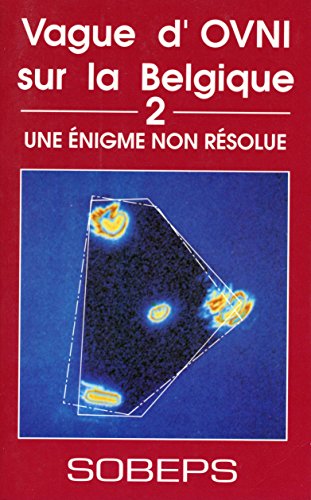
Vague d'OVNI sur la Belgique 2
Une énigme non résolue
Core Thesis
Vague d'OVNI sur la Belgique 2: Une énigme non résolue is SOBEPS's 1994 second volume documenting the Belgian UFO Wave, focused on the wave's most dramatic and institutionally corroborated episode: the night of March 30–31, 1990, when Belgian Air Force F-16s scrambled from Beauvechain Air Base logged multiple radar locks on a target performing maneuvers this site's own case file documents as exceeding 30G. The volume's centerpiece is physicist Auguste Meessen's detailed technical review of the Belgian Air Force's own Electronic War Center radar-tape analysis of F-16s scrambled from Beauvechain Air Base, paired with extensive meteorological study. Its relevance to this site is direct: this book supplies the specific scientific and technical documentation behind the single most analytically significant episode in the entire Belgian Wave.
About the Author
SOBEPS, the Société Belge d'Étude des Phénomènes Spatiaux, published this second volume three years after its first, in 1994, reflecting the additional time required to secure, review, and technically analyze the Belgian Air Force's own radar documentation — a considerably more demanding research task than compiling civilian and gendarmerie witness testimony alone.
This volume's technical centerpiece was contributed by Auguste Meessen, professor of physics at the Catholic University of Louvain, who served as SOBEPS's scientific consultant for the radar analysis specifically. Meessen's academic physics credentials gave this volume's technical sections a level of formal scientific rigor distinct from the first volume's more purely testimonial compilation, allowing SOBEPS to present not just what witnesses and radar operators reported, but a trained physicist's own independent assessment of what the radar data itself could and could not support.
Meessen's own involvement extended well beyond this single volume: he continued studying the Belgian Wave for decades afterward, publishing further analysis into the 2010s and maintaining, in later writing, that significant aspects of the case remained genuinely unexplained even as he and SOBEPS accepted a partial meteorological explanation (the "Gilmard-Salmon hypothesis," attributing some specific radar contacts to a rare atmospheric "angel" phenomenon) for other elements of the same dataset.
Meessen's later media appearances, including a featured segment on the television documentary series UFO Europe: The Untold Stories, extended his own role in the case beyond this book's original technical publication, giving English-language audiences direct access to his analysis and continued position on the case decades after the original 1994 volume's French-language publication.
Historical Context & Origins
The book's 1994 publication, three years after the first volume, arrived after SOBEPS had secured a level of continued cooperation from the Belgian military that allowed genuine technical review of the F-16's own onboard radar recordings — access considerably harder to obtain and take considerably longer to analyze properly than the civilian testimony the first volume was built from.
This volume's title, Une énigme non résolue ("An Unresolved Enigma"), reflects a meaningfully more cautious framing than the first volume's Un dossier exceptionnel ("An Exceptional File") — a shift this article reads as reflecting SOBEPS's own more sober, technically grounded assessment after Meessen's detailed radar review complicated rather than simplified the case, identifying genuine partial mundane explanations for some data while leaving other elements formally unaccounted for.
The volume's publication also came after the most intense phase of public and media attention to the wave had already passed its peak, giving SOBEPS the relative luxury of a more measured, technically careful analytical pace than the first volume's more urgent, contemporaneous documentation effort allowed.
This slower, more deliberate research pace also reflects the genuine technical difficulty of the underlying task: raw military radar data is not self-interpreting, and translating raw F-16 cockpit radar tapes and ground-station logs into a scientifically defensible published analysis required Meessen to work through detailed questions of radar cross-section behavior, atmospheric propagation effects, and the specific electronic-countermeasures context of Cold War-era Belgian Air Force equipment — specialized technical ground a purely civilian witness-testimony compilation, however thorough, could never have covered on its own.
Core Arguments & Key Concepts
The book's central technical contribution is Meessen's detailed review of the Belgian Air Force's Electronic War Center analysis of the F-16 cockpit and ground-radar tapes from the March 30–31, 1990 intercept, in which fighters achieved three high-quality radar locks on a target this site's own case file documents as accelerating from 150 knots to 970 knots and dropping thousands of feet within seconds, before diving into ground clutter to break the locks.
Meessen's analysis, working from the same radar data the Belgian military itself had reviewed, largely accepted what became known as the "Gilmard-Salmon hypothesis": the proposal that at least some of the specific radar contacts reflected a genuine but rare meteorological phenomenon sometimes called radar "angels," produced by atmospheric temperature-inversion effects rather than a genuine solid object — a partial, technically grounded mundane explanation for a meaningful portion of the recorded radar data.
Crucially, the book does not present this partial explanation as resolving the case in full: Meessen's own analysis, and SOBEPS's own editorial framing reflected in the volume's title, maintained that significant elements of the intercept — particularly the specific, extreme acceleration and altitude-change figures attributed to the tracked target — remained without a fully satisfying conventional explanation even after the atmospheric-angel hypothesis was applied to the dataset as a whole.
The volume also includes extensive meteorological analysis of atmospheric conditions during the wave's key incidents more broadly, situating the specific March 1990 intercept within a fuller record of the temperature inversions, cloud layers, and other conditions present across the wave's most significant nights — technical groundwork this site's own case file draws on when assessing the physical plausibility of both the "angel" explanation and the alternative genuine-anomaly readings some researchers have continued to favor.
The book's specific treatment of the nine unsuccessful F-16 lock attempts this site's own case file documents is particularly detailed: Meessen's analysis works through why several of the fighters' attempted radar locks failed entirely, distinguishing between locks that were achieved and then broken by the target's own extreme maneuvering versus attempts that never achieved a solid lock at all — a level of granular technical distinction essential to accurately characterizing exactly what the F-16 crews' own onboard systems did and did not confirm that night, rather than treating "radar lock" as a single undifferentiated category of evidence.
Key Cases & Evidence Discussed
This site's own Belgian UFO Wave (Case File #8) draws directly on this volume for its account of the March 30–31, 1990 F-16 intercept, the wave's single most institutionally corroborated episode. The case file's own framing — that Colonel Wilfried De Brouwer's public confirmation of the radar-lock event represents "the most senior official military endorsement of genuine UAP reality from any NATO nation" — rests on precisely the kind of technical radar documentation this book's Meessen-authored analysis reviews in detail.
This site's own St. Clair County Triangle Sightings (Case File #242) again offers useful comparative context: unlike the Belgian intercept's genuine military radar corroboration and formal physicist review, most triangle-craft reports elsewhere in this site's catalog lack any comparable instrumented, technically analyzed data, underscoring just how unusual the Belgian case's evidentiary profile remains even within its own broader phenomenon category.
Critical Reception & Controversies
As with the first volume, this book's specialized, French-language, small-press format has meant it received little mainstream English-language book review coverage — a limitation this article states plainly rather than omits.
Within the specialist ufological and skeptical research communities, Meessen's radar analysis specifically has drawn sustained engagement precisely because of its comparatively rigorous, credentialed-physicist authorship: skeptical researchers examining the Belgian case have generally engaged directly with Meessen's own specific technical claims and the "angel" hypothesis, rather than dismissing the radar data as inherently unreliable or fabricated.
Some later commentators, including within SOBEPS's own successor organization COBEPS, have revisited Meessen's conclusions with additional decades of hindsight and improved understanding of radar-angel phenomena, generally treating his core methodology as sound while continuing to debate exactly how much of the March 1990 dataset the atmospheric explanation genuinely accounts for.
No critical source located in researching this article disputes that Meessen conducted a genuine, technically serious review of real Belgian Air Force radar data; critical engagement centers on how completely his proposed partial explanation accounts for the full recorded dataset, a genuinely open technical question this book itself, through its own cautious title, declines to claim fully resolved.
The book's specific engagement with radar-angel phenomena has also drawn attention from meteorologists and radar specialists outside the ufological community proper, since anomalous propagation and "angel echo" effects are a genuinely studied, if comparatively obscure, subject within radar meteorology generally — giving Meessen's specific application of that established phenomenon class to the Belgian data a degree of grounding in mainstream atmospheric science that purely speculative UFO explanations elsewhere in this site's catalog typically lack.
Influence & Legacy
This exact edition is cited in this site's own Belgian UFO Wave case file's Further Reading section as the volume "containing extensive meteorological analyses and Prof. Auguste Meessen's radar lock studies."
Meessen's specific radar analysis has become the standard technical reference point for virtually all subsequent serious discussion of the March 1990 intercept's radar dimension, cited by both researchers sympathetic to a genuine-anomaly reading and skeptics favoring a more complete mundane explanation.
The book's own honest, unresolved framing — declining to claim the case fully solved despite identifying a genuine partial mundane explanation — has itself become something of a model within the more careful, credentialed end of ufological research for how a technically serious investigation should present genuinely mixed or incomplete findings, rather than either overclaiming a mystery's continued total inexplicability or overclaiming a partial explanation's completeness.
The Book
As an Amazon Associate, OverClassified may earn from qualifying purchases made through this link, at no extra cost to you.
Why This Is Essential Reading
Vague d'OVNI sur la Belgique 2 earns its place on this list as the single most technically serious available analysis of the Belgian Wave's most dramatic, institutionally corroborated episode. Read alongside the first volume and this site's own Belgian UFO Wave case file, this book supplies the credentialed physicist's-eye technical review that gives the wave's F-16 radar-lock episode its full evidentiary weight — including the honest acknowledgment that even careful scientific review left the case genuinely, not merely rhetorically, unresolved.
Related Cases & Theories
Essential Viewing
Sources Cited
- SOBEPS. Vague d'OVNI sur la Belgique 2: Une énigme non résolue. SOBEPS, 1994 (ISBN-13 9782960000719). amazon.com
- Meessen, Auguste. "UFOs at close sight: Belgium flap study." Full technical analysis (translated). ufologie.patrickgross.org
- "SOBEPS." Wikipedia (organizational history). en.wikipedia.org
- "Belgian UFO wave." Wikipedia (English; intercept and radar detail). en.wikipedia.org
- "Vague belge d'ovnis." Wikipédia (French). fr.wikipedia.org
- "La vague belge." COBEPS. cobeps.org
- "The Belgium Wave: Triangles & Radar (1989-1991)." UAPedia. uapedia.ai
- "The Belgium UFO Wave." UFO Evidence (documentary compilation citing Meessen's analysis). ufoevidence.org
- "Vague d'OVNI sur la Belgique, tome 2 : Une énigme non résolue." AbeBooks (bibliographic listing and cover art source). abebooks.com
- "Auguste Meessen." IMDb (Physicist and Professor Emeritus, Catholic University of Louvain, profile from documentary appearance). imdb.com
- This site's own case file: Belgian UFO Wave, for the full analysis this book's radar and meteorological research supports.
- This site's own key-figures entry: Auguste Meessen, for his full biography and further case connections.
- This site's own key-figures entry: SOBEPS, for the organization's full history.
- This site's own essential reading entry: Vague d'OVNI sur la Belgique, the companion first volume covering the wave's opening phase and civilian/gendarmerie testimony.
Have corrections, additional research, or peer-reviewed sources? Help improve this entry.
Suggest an Edit