
The St. Clair County Triangle Sightings
At about 4:00 a.m. on January 5, 2000, Melvern Noll, a 66-year-old miniature-golf-course owner in Highland, Illinois, saw a large, brightly lit object he likened to a floating two- or three-story house and drove to the Highland police station to report it. Over the next hour, on-duty police officers in Lebanon, Shiloh, Millstadt and Dupo, all within a few miles of Scott Air Force Base, looked for it after hearing the call on the shared St. Clair County dispatch channel, and three of them described a huge, low, slow, silent triangular or arrowhead-shaped object with brilliant white lights. An O'Fallon detective also later said he saw it. One officer took a Polaroid that shows only a few blurred lights, and the Dupo officer's lights were at airliner altitude. Robert Bigelow's National Institute for Discovery Science (NIDS) interviewed the witnesses within days and never reached a conclusion. Scott AFB said it had nothing in the air, and Lambert airport's radar showed nothing. An advertising-blimp explanation, first attributed to the FAA in April 2000, fits much of the description but has never been confirmed by a flight record and does not fit two officers' accounts of sudden fast movement.

Pictured: the former main gate at Scott Air Force Base, Illinois — the installation whose airspace and radar coverage sit at the center of this case's central factual dispute, not a photograph of the object or any specific sighting location. The single Polaroid photograph taken during the event itself shows only ambiguous, unresolved points of light and has never been published in a form clear enough to reproduce meaningfully; no photograph of Officer Craig Stevens's actual Polaroid, or of the golf course, roads, or fields where the officers were positioned that night, is known to be rights-clear and publicly available. U.S. Air Force photo, public domain, via Wikimedia Commons.
Theoretical Alignment
This case does not sort neatly into any one framework. Real-time radio traffic from several on-duty officers in different towns argues against a purely psycho-social reading, but the officers were also listening to each other on a shared channel, which is exactly the setting in which expectation can shape what people report, and the Psycho-Social weight reflects that. The absence of any radar, photographic or physical confirmation, combined with a specific advertising-blimp candidate that fits much of the lighting and motion, keeps the Extraterrestrial allocation from going higher. NIDS, which investigated, never endorsed an extraterrestrial reading; the 2002 paper it published presented an aircraft designer's hypothesis of a secret military airship. Nothing in any account involves missing time or other effects usually invoked for the Interdimensional Hypothesis.
Background
Understanding why five separate police departments' radio traffic about one object became one of the more closely studied multi-witness police sightings in American UFO history requires understanding the specific corridor of southwestern Illinois where it happened, the nearby military installation whose radar became central to the case, and the private research organization that investigated it.
St. Clair County and the Metro-East Corridor
St. Clair County and neighboring Madison County sit directly across the Mississippi River from St. Louis, Missouri, forming what the region calls the "Metro-East" — a corridor of small and mid-sized towns (Belleville, O'Fallon, Shiloh, Lebanon, Millstadt, Dupo, Summerfield, and Highland among them) strung along Interstate 64, U.S. Route 50, and Illinois Route 4 through flat farmland and the Mississippi River's American Bottom floodplain. In January 2000 these were quiet, low-density municipalities with their own small police departments, each typically staffing only one or two patrol officers on an overnight shift — a detail directly relevant to how the case unfolded, since it meant the officers who responded were often the only law-enforcement presence in their entire town that night, radioing directly to a shared St. Clair County dispatch center (CENCOM) rather than up any large departmental chain of command.
Scott Air Force Base
Scott Air Force Base, next to Belleville, O'Fallon, Mascoutah and Shiloh, has been a military installation since 1917. By 2000 it was headquarters of Air Mobility Command (formed 1992) and U.S. Transportation Command (formed 1987), with airlift, aeromedical and tanker aircraft. Every town involved lies within a few miles of the base or its approaches, and NIDS noted that the reported flight path would have taken the object almost directly over it. That made the base's answers about what was in the air, and what its radar saw, an important part of the record.
NIDS and the Broader "Black Triangle" Wave
The National Institute for Discovery Science was a private research organization founded in 1995 by the businessman Robert Bigelow and based in Las Vegas, with Colm Kelleher as deputy administrator. It ran a 24-hour hotline and collected reports of large, silent, triangular or deltoid craft, the "black triangle" category of sightings. In the two years after the Illinois case NIDS accumulated more than 150 such reports, mainly from the United States, and published an apparent correlation between their locations and Air Mobility Command and Air Force Materiel Command bases. NIDS closed in 2004.
Complete Timeline
| Time (Jan. 5, 2000) | Event |
|---|---|
| ~4:00 a.m. | Melvern Noll, 66, arriving at his miniature golf course in Highland, Illinois, sees what he takes at first for a low star, then an object "like a floating house" with very bright lights moving from the northeast toward the southwest. He drives to the Highland police station, whose dispatcher passes the report to the county's central dispatch (CENCOM), which asks Lebanon to look for it. The dispatch call to Lebanon refers to "a truck driver who just stopped in." |
| ~4:10 a.m. | Lebanon Officer Ed Barton reports a very bright white light east of Summerfield that "keeps changing colors" and asks dispatch to contact Scott AFB. He later told NIDS he watched a massive elongated triangle, perhaps 65–75 ft long at about 1,000 ft, make "a flat turn" and pass slowly over him; while he reached into his car for the radio, it was gone toward Shiloh within "2 or 3 seconds." |
| 4:23 a.m. | Shiloh Officer David Martin reports the object; the Shiloh marker records his report at 4:23. He later described a dark, arrowhead-shaped craft with three big bright lights, moving at first at "maybe 15 miles an hour," then speeding off at "at least 80 to a hundred" toward Belleville or Swansea, with no sound although his window was down. |
| ~4:28–4:39 a.m. | Millstadt Officer Craig Stevens, who heard the radio traffic, sees a huge, fat-arrowhead-shaped object with a concave rear, moving very slowly at 500–1,000 ft with a very low buzzing sound. He takes a Polaroid (Skeptoid gives 4:28) and later makes a sketch and an unofficial report. |
| ~5:03 a.m. | Dupo Officer Matt Jany, looking with binoculars, sees lights that are "pretty far off" and judges them at "20 or 30,000. It's about where planes usually are. It's not low at all." He is told that Lambert airport has nothing on its radar. |
| Same morning | According to a 2007 UPI report, O'Fallon Detective Mark Lopinot also saw a large object floating over O'Fallon, which he called "shocking." |
| 5:46 a.m. CST | A Millstadt officer calls the NIDS 24-hour hotline (3:46 a.m. Pacific). NIDS makes telephone inquiries and then sends two investigators to interview witnesses. |
| 6:50 a.m. | A schoolteacher driving west on Lake Drive in Centreville, near Dupo, sees a motionless arrowhead-shaped object with bright lights (NIDS witness 7, named in later accounts as Steven Wonnacott). |
| Jan. 9, 2000 | The St. Louis Post-Dispatch reports Stevens's account; a Scott AFB spokeswoman says the only calls the base received were from the media and that the control tower was closed at that hour. |
| Feb. 2000 | NIDS publishes its report with the abstract, eight witness transcripts, officers' sketches, and analyses ruling out a B-2 (none was flying) and, per astrophysicist Eric Davis, Venus, which rose only at 4:25 a.m. |
| April 5, 2000 | The Riverfront Times (William Stage, "Space Case") reports that the FAA attributed the object to an advertising blimp. |
| July 2002 | NIDS publishes "Hypothesis: The Illinois Flying Triangle is A Department of Defense, Not An ET Craft," an aircraft designer's essay proposing a large lighter-than-air "Big Black Delta" with electrokinetic drive; NIDS says it "did not come to a definite conclusion regarding the origin of the object." |
| 2004–2005 | NIDS closes (2004). The case features on Sci-Fi Channel's Proof Positive (2004) and ABC's Peter Jennings Reporting: UFOs — Seeing Is Believing (2005); Sufjan Stevens releases "Concerning the UFO Sighting Near Highland, Illinois" on Illinois (2005). |
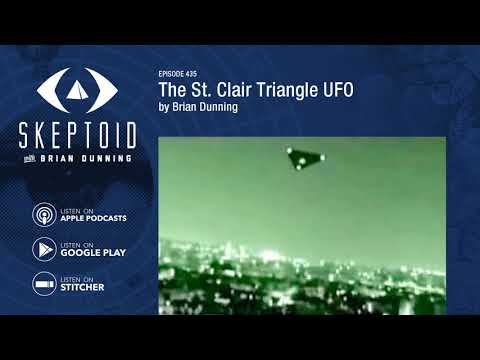
| 2014 | Brian Dunning's Skeptoid episode 435 argues for an advertising blimp in transit, citing Van Wagner Airship Group veterans. |
Detailed Narrative
Melvern Noll and the First Report
At about 4:00 a.m., Melvern Noll, the 66-year-old owner of a miniature golf course in Highland, Illinois, drove in to check that the pipes had not frozen. He told NIDS that he first took the light in the northeastern sky for a star, then saw that it was low and moving, and as it came closer it looked like a house with very bright internal lights, "two to three stories high" and about the length of a football field, moving slowly toward the southwest. He drove straight to the Highland police station. The Highland dispatcher contacted the St. Clair County central dispatch (CENCOM), which asked the Lebanon police to look out for the object; the transcript of that call describes "a truck driver who just stopped in" reporting "a flying object... It looks like a two-story house."
Officer Ed Barton's Pursuit Near Summerfield
Lebanon Officer Ed Barton answered at about 4:10 a.m. with some scepticism ("Did they say the truck driver was DUI or anything?"), noted that a military cargo plane, probably a C-5, had passed over Lebanon about five minutes earlier, and then reported "a very bright white light east of town... just east of Summerfield, and it keeps changing colors... It's not the moon, and it's not a star." In his NIDS interview he described two very bright lights that merged into one, then a massive elongated triangle at roughly 1,000 feet, "somewhere between 65 and 75 feet long, probably longer than that," with lights pointing straight down. It came toward him, made "a flat turn," and passed slowly over him; as he reached into his car to call CENCOM, it was gone toward Shiloh, in "2 or 3 seconds." As The Debrief pointed out in 2022, the radio recording shows that he did not watch the departure itself; he looked away to use the radio and found the object far off when he looked back. Later retellings that have it covering "eight miles in three seconds" go beyond what he saw.
Barton's interview also shows how hard the object was to measure. He described the two lights before they merged as "this tremendously bright, white light... also emitting almost like rays, like a Japanese rising sun battle flag," with the light "just pointing straight down," so bright that it was like looking into a squad-car spotlight. His size estimate depended on an altitude he could not know: asked to compare the object with the C-5 that had crossed Lebanon a few minutes earlier, he said "about probably the same size, maybe a little bigger," adding, "if I knew exactly how high it was, I could tell you without a doubt," and later that "it could very easily have been as big as or bigger than a C-5." He put the altitude at "anywhere between 1,000 to 2,000 ft." below a scattered cloud layer, and the speed of the departure at something that "just seemed to be here and it was gone," without hearing any sound or seeing any contrail. His candour about these limits is one reason his account is useful, and one reason its numbers should not be pressed too hard. Three officers estimated sizes from 65 feet to 100 yards for what they took to be the same object, and Noll thought it was as long as a football field.
Barton also explained why he went through dispatch rather than describing everything openly at first. Between the two bright rear lights, he told NIDS, he saw "a red, like a blinking light. That's why first I thought again, maybe it is an aircraft," so he asked CENCOM to call Scott and find out whether the base had anything in the air or on radar. "They advised negative." What changed his mind, he said, was the silence: "This probably isn't a plane and what really got me was when there was no noise." A blinking red light between two very bright white ones is also, as Dunning pointed out, close to what an airship of the period displayed, with a red light on its underside and bright landing lights that could be switched on and off. The same detail can therefore be read as evidence for an aircraft, as Barton first did, or against it, as he concluded once he heard nothing.
Officer David Martin's Independent Sighting in Shiloh
At 4:23 a.m. Shiloh Officer David Martin reported the object. His radio traffic was brief ("I see something, but I don't know what the heck it is.... It's probably heading to Lambert"). He told NIDS he saw a dark, triangular, arrowhead-shaped craft, "like a heavy steel," with three big white lights underneath and small coloured flashing lights at the rear, perhaps 75 to 100 yards wide. It moved at first like a vehicle "maybe 15 miles an hour," then sped off at "at least 80 to a hundred... It got to Belleville or Swansea that quick," with no sound although his window was down. The Debrief quotes him describing the departure as "in the snap of a finger, the wink of an eye." NIDS judged that, with little wind, this movement was inconsistent with a blimp.
Officer Craig Stevens, the Polaroid, and the Buzzing Sound
Millstadt Officer Craig Stevens heard the radio chatter, drove to the north end of town, and saw the object to the west. "It's huge," he radioed, "kind of V-shaped." He told the Post-Dispatch that it moved slowly, "like a blimp," about 1,000 feet up, was about two stories high and three times as long, with three bright lights at the back and dimmer lights "sprinkled" over its surface like a "starfield camouflage." His written report described it "flying very low from 500 to 1000 ft... very slowly" and "making no noise. I could only hear a very low decibel buzzing sound," and he told NIDS of a concave rear with dim white strobes. He grabbed a Polaroid from his car. The photograph did not develop well in the cold; Skeptoid describes a grainy red image of four lights traced into wiggles by camera shake, and the Post-Dispatch said it showed only the three bright lights. He also said the object resembled a "stealth blimp" illustrated in Popular Mechanics.
Officer Matt Jany's Contradictory High-Altitude Report
Dupo Officer Matt Jany joined the radio conversation at about 5:03 a.m. Through binoculars he saw lights that were "pretty far off," of different colours at first and then white, including by some accounts a blinking green light. "This thing appears... it's probably 20 or 30,000. It's about where planes usually are. It's not low at all," he said, as Stevens insisted that "this object was above me about 500 feet." Dispatch then told him Lambert airport had nothing on its radar. Both Dunning and The Debrief conclude that Jany was most likely looking at an ordinary aircraft, which matters: the sightings were not four independent confirmations of one object, but three low-level descriptions and one probable airliner, all heard by the others in real time.
Detective Mark Lopinot, "the Fifth Officer"
O'Fallon Detective Mark Lopinot is the officer usually counted as the fifth. He told UPI in 2007 that the sight of a large object floating over O'Fallon in January 2000 was "shocking" and that he still could not explain it. He does not appear in the NIDS interview transcripts or the dispatch transcripts examined for this file, and the detailed description attributed to him elsewhere (two rows of amber lights larger than a C-5 or 747 at 200–300 feet) comes from secondary accounts this file could not verify against a primary record. NIDS's own count varied: its July 2002 paper refers to "four policemen and over a dozen others," while its later addendum on triangle sightings refers to "five police officers."
What the Civilian Witnesses Told NIDS
The NIDS transcripts add detail that later retellings usually drop. Melvern Noll told the investigators that he watched the object for perhaps five minutes, that it passed to the south of him "within a mile," at about 45 degrees of elevation and perhaps half a mile up, "something like how they fly a glider out of the airport." He saw "a lot of red lights shining down" underneath, "scattered out," a single steady beacon in front, and, from the side, what looked like two or three floors of windows with "a very bright light coming out." There was "not a sound. That's what kind of scared me." Working back from the time of the Millstadt photograph, he estimated it was moving at about 70 miles an hour, "very slow." His description of red lights and a lit, house-like body differs noticeably from the officers' brilliant white lights, a difference The Debrief attributes to his brief, unprepared view.
A man in Summerfield (NIDS witness 5), whose wife was an EMT, heard the Lebanon officer on her scanner and went outside at about 4:30 a.m. He saw the object pass almost directly overhead heading west toward the southern end of Lebanon and watched it for "a minute-and-a-half, two minutes" until trees hid it. It was "pretty clear," he said, with stars visible and "some other planes flying overhead, way up." The last report came from a Centreville schoolteacher (NIDS witness 7), driving west on Lake Drive over Interstate 255 at 6:50 a.m. as dawn broke. Near Parks Bi-State Airport and under the Lambert approach path, he first took the object for an airplane, then saw that it was "much larger than an airplane would seem," arrow-shaped and, as far as he could tell, motionless for the four minutes he watched. He did not report it until he read the Post-Dispatch article days later.
The CENCOM Dispatch Tape
The most valuable record is the county dispatch radio traffic itself, released with other source material by investigative reporter and filmmaker Darryl Barker and transcribed by NIDS and others. It captures the officers' first reactions, including Barton's scepticism, Stevens's "It's huge," an unidentified officer humming the Twilight Zone theme, and the open disagreement between Stevens and Jany over altitude. That texture argues against a coordinated hoax. It also shows how the officers were primed: each heard the earlier descriptions before seeing anything, which is relevant to how similar their later accounts became.
Scott Air Force Base's Contradictory Statements
Scott's answers were brief and not entirely consistent. Stevens told NIDS that dispatch had called the base during the night and "they laughed at them," saying they had nothing in the air, and the county dispatcher later said in a documentary that Scott said it could see nothing on radar. The Post-Dispatch reported on 9 January that a Scott spokeswoman said the only calls the base received about the object were from the media and that the control tower was closed at that hour; the Lebanon Advertiser, as quoted by The Debrief, reported that the base said it "no longer has radar on the field and that control tower personnel were not on duty at that hour." NIDS reported that two separate AFOSI officers at the base said nothing was in the air from Scott between 4:00 and 5:00 a.m. The statements about radar are hard to reconcile, and The Debrief treats them as suspicious; they are also consistent with an overnight shift in which the tower was closed and nobody was watching a scope. Lambert airport in St. Louis told dispatch that night that it had nothing on its radar, and Boeing told NIDS that none of its St. Louis aircraft was flying.
The National Institute for Discovery Science Investigation
NIDS's involvement began when a Millstadt police officer called its hotline at 3:46 a.m. Pacific time (5:46 a.m. local), about two hours after the sighting. After telephone inquiries, NIDS sent two investigators, among them John Velier according to Skeptoid, who interviewed witnesses face to face. The online report published in early 2000 contained an abstract, eight witness transcripts (one from a man in Lake Forest, far to the north, describing a separate sighting), officers' sketches, a flight-path reconstruction, and three analyses. A B-2 was ruled out because the 509th Bomb Wing's records showed none flying; the Aereon hybrid airship was ruled out because the only Aereon ever built was a 26-foot prototype from 1970; and NIDS astrophysicist Eric Davis showed that Venus did not rise until 4:25 a.m. and that no bright star or planet fitted the reports. NIDS never reached a conclusion. In July 2002 it published "Hypothesis: The Illinois Flying Triangle is A Department of Defense, Not An ET Craft," in which an aircraft designer who had read the report proposed a 600-foot lighter-than-air "Big Black Delta" (BBD) with an electrokinetic drive, built by the Defense Department in the 1980s. The paper presents this as the designer's essay and states that "NIDS did not come to a definite conclusion regarding the origin of the object sighted in Illinois in January 2000." A later NIDS addendum plotting about ninety-four triangle reports against Air Mobility Command and Air Force Materiel Command bases concluded that "the flight paths are suggestive of the deployment of military aircraft hitherto unacknowledged." NIDS closed in 2004; Bigelow later founded Bigelow Aerospace Advanced Space Studies (BAASS), which held the Defense Intelligence Agency's AAWSAP contract discussed in this site's AATIP case file.
The NIDS Flight Path and Its Problems
NIDS's "Tentative Flight Path" page stitched the eight testimonies into a single route. It began with a businessman north of Chicago who reported a large triangle crossing the Lake Michigan shore between 10:00 and 10:30 p.m. on 4 January, some six hours before Highland, and continued southwest through Highland, Lebanon, Shiloh and Millstadt. It then had the object climb "at least 9,000 feet in a matter of five minutes" southwest of Millstadt to be seen by the Dupo officer at about 10,000 feet, and remain near Dupo until the schoolteacher saw it at 6:50 a.m. On that reading the object flew for "just under nine hours," slowly, "at half the speed of a C-5 coming into land," with "extremely bright lights" and "no attempt to be stealthy."
The reconstruction shows how a single-object narrative can absorb unrelated sightings. The Lake Forest report is some 280 miles from Highland and six hours earlier. Jany's lights, which NIDS placed at 10,000 feet, were by his own radio estimate at "20 or 30,000," "where planes usually are," and most later analysts think he saw an airliner. The schoolteacher's motionless arrowhead at dawn, two hours after the police reports, may or may not be related. Strip those out and what remains is a low, brightly lit object moving southwest across St. Clair County between about 4:00 and 4:40 a.m., the part of the record the advertising-blimp explanation fits best. Even this core has a timing problem for the blimp. Highland to Millstadt is roughly 48 km in a straight line (computed from town coordinates); if the times are taken at face value (Noll at about 4:00, Stevens between 4:28 and 4:39), the object averaged something like 75–100 km/h, faster than the 55–65 km/h Van Wagner gave for its blimps. The reported times are approximate, a tail wind would help, and Noll himself estimated only 70 mph, but the point cuts against the blimp rather than for it.
The Advertising Blimp Hypothesis
Three months after the sighting, Riverfront Times reporter William Stage reported in "Space Case" (5 April 2000) that the FAA had told him the object was an advertising blimp. Science writer Brian Dunning developed the idea in Skeptoid episode 435 (2014). Veterans of the Van Wagner Airship Group, which had acquired the American Blimp Company, told him "everyone in the airship industry knew what it was," that their blimps typically flew at about 1,000 feet and 55–65 km/h (35–40 mph), made only a low noise, and carried landing lights, a red light below, a white strobe on top, navigation lights, internal envelope lights and, on some ships of the period, arrays of small lights that could display messages. Dunning noted that Highland to Dupo, about 55 km, is roughly an hour at blimp speed, and that the route fits a transit from Indianapolis toward St. Louis or Kansas City. It is a specific and serious explanation, and Stevens himself said the object moved "like a blimp." But no flight record has been found. Dunning acknowledged that "nobody at Van Wagner knew of any records showing the details of times and dates of blimps in transit," and The Debrief notes that inquiries to the operators produced no record. A blimp also fits poorly with Martin's account of the object speeding away at 80 to 100 mph or more, and with Barton's, though Barton did not actually see the departure.
Other Proposed Explanations and Their Weaknesses
Other explanations have been weaker. NIDS considered and rejected a B-2 bomber (none flying), an Aereon hybrid airship (none built at that size), and Venus or bright stars (Venus rose at 4:25 a.m., after the first three sightings, and was still low in the east-southeast during the later sightings). Dunning dismissed the secret-military-aircraft idea, arguing that new aircraft are not flown low and slow, brightly lit, over populated areas. The secret-aircraft hypothesis also has no independent support. That leaves the blimp as the most specific conventional candidate and the officers' accounts of fast movement as the main obstacle to it.
Cultural Legacy
The case has left an unusually durable mark on the region. A roadside marker in Shiloh titled "Confirmed UFO Sighting" reads in part: "On January 5th, 2000 at 4:23 a.m. Shiloh Police Officer David Martin reported a floating object with 3 bright lights in the sky above Shiloh. Other witnesses said the UFO floated slowly and had no engine noise. Lebanon, Shiloh, Millstadt and Dupo Police Officers all reported witnessing this UFO that morning." Sufjan Stevens included "Concerning the UFO Sighting Near Highland, Illinois" on his 2005 album Illinois. The case was featured by the Discovery Channel, by the Sci-Fi Channel's Proof Positive (2004) and in ABC's Peter Jennings Reporting: UFOs — Seeing Is Believing (2005). David Marler, who reported on the case for the MUFON UFO Journal in March 2000, discusses it in his 2013 book Triangular UFOs: An Estimate of the Situation.
Key Witnesses
Officer Ed Barton
Answered the 4:10 a.m. call sceptically, then reported a bright, colour-changing light near Summerfield. He told NIDS he saw an elongated triangle about 65–75 ft long at about 1,000 ft make "a flat turn" and pass over him; when he looked back after reaching for his radio, it was far off toward Shiloh.
Officer David Martin
Reported the object at 4:23 a.m. He told NIDS it was a dark arrowhead with three big white lights, moving slowly and then speeding off at "at least 80 to a hundred" mph, silently. The Shiloh "Confirmed UFO Sighting" marker is built around his report.
Officer Craig Stevens
Saw a huge, slow, arrowhead-shaped object with a concave rear at 500–1,000 ft, heard "a very low decibel buzzing sound," and took the case's only photograph, a Polaroid showing a few blurred lights. He compared the object to a "stealth blimp" illustration in Popular Mechanics.
Officer Matt Jany
Saw lights through binoculars at about 5:03 a.m. and put them at "20 or 30,000" feet, "where planes usually are." Most analysts, including Skeptoid and The Debrief, conclude that he saw an ordinary aircraft.
Detective Mark Lopinot
Told UPI in 2007 that seeing a large object float over O'Fallon in January 2000 was "shocking" and that he still could not explain it. He does not appear in the NIDS transcripts, and the details of his sighting given in secondary accounts could not be verified.
Melvern Noll
The night's first witness. He saw a large, low, brightly lit object "like a floating house," two to three stories high and about the length of a football field, and drove to the Highland police station to report it. Dunning counts seven witnesses in all, including Noll, an insomniac named Johnny Doss who heard the call on a scanner, and a Centreville schoolteacher at 6:50 a.m.
The Five Observables Assessment
The Five Observables framework describes flight-performance characteristics associated with reported anomalous craft. This case scores unusually high on the framework for a case with no instrumented confirmation, precisely because several officers described extreme performance characteristics directly to each other over live radio, in real time, before any of them could have coordinated a story.
Assessment: No observable is rated Present. Instant Acceleration is speculative: Martin described the object speeding off at "at least 80 to a hundred" mph, and Barton found it far away after looking away to use his radio, but neither gives a measured figure, and the recordings show Barton did not watch the departure. Hypersonic speed is absent; nothing in the record approaches it. Low Observability is speculative: Lambert airport reported nothing on radar, but Scott's tower was closed and a slow target at a few hundred feet could easily be missed by airport radar. Anti-Gravity Lift is speculative, resting on slow, silent flight and hovering. Trans-Medium is absent.
Evidence Assessment
Supporting a Genuine Anomalous Event
- On-duty officers in several towns described a large, low, slow, silent object with brilliant lights in real time over the county radio, and three of them gave broadly similar shapes.
- The dispatch recording preserves unrehearsed scepticism, confusion and disagreement rather than a polished account.
- Martin and Barton both describe the object leaving suddenly toward the southwest, and NIDS judged Martin's account inconsistent with a blimp in near-calm air.
- No conventional aircraft was identified: Scott, Boeing and the B-2 base all said they had nothing flying, and no blimp flight record has been found.
- Venus and bright stars do not fit: Venus rose only at 4:25 a.m.
Supporting a Conventional Explanation
- Jany's lights were at airliner altitude, most likely an ordinary aircraft, which shows how readily a light was taken to be "the object" once the description was on the radio.
- An advertising blimp fits the lighting, slow speed, low altitude, near silence and roughly hour-long transit, and Stevens himself said it moved "like a blimp."
- The FAA reportedly identified the object as a blimp, though no flight record has been produced either way.
- The only photograph shows a few blurred lights and no shape.
- No radar tracked the object; Lambert reported nothing, and Scott's tower was closed.
Why “Disputed”
This case is stamped Credible because several on-duty police officers in different towns reported, in real time and in their own words, a large, low, slow-moving object with brilliant lights, and NIDS interviewed them within days, producing transcripts that can still be read. That is a stronger documentary base than most triangle sightings have. It is not rated higher for several reasons. There is no radar, instrument or usable photographic confirmation. One of the officers was almost certainly looking at an airliner. The officers heard each other's descriptions before making their own. The most dramatic detail, the sudden high-speed departure, rests chiefly on Martin's estimate, since Barton did not watch it happen. And a specific conventional explanation, an advertising blimp in transit, fits much of the description and was attributed to the FAA within three months, even though no flight record has confirmed it. Compared with this site's Coyne Helicopter Incident file, the St. Clair case has more witnesses but no equivalent of the Coyne crew's instrument readings.
Sensor & Instrumentation Detection Profile
The instrumentation record is almost entirely testimonial. The county dispatch recording is a contemporaneous record of the officers' verbal reports, not a sensor record of the object, and it allows the sequence of sightings to be reconstructed approximately. Stevens's Polaroid is the only image, and it shows a few blurred lights. No radar is known to have tracked the object: Lambert airport told dispatch it had nothing, Scott's tower was closed at that hour, and the base's statements about its radar were inconsistent. NIDS's flight-path reconstruction was built afterwards from the witnesses' positions and descriptions; it is a way of testing the testimony, not an independent detection.
Environmental & Geospatial Context
The sighting corridor runs through flat farmland and small towns east of St. Louis, from Highland southwest through Summerfield, Lebanon, Shiloh and Millstadt to Dupo near the Mississippi. All lie within a few miles of Scott Air Force Base and its approaches, and the area is crossed by traffic for Scott, Lambert-St. Louis and the routes to Chicago, which makes misidentification of ordinary aircraft a real possibility for at least some sightings (Barton noted a C-5 had just passed over Lebanon). The night was cold and largely clear, though Barton recalled scattered clouds above the object, and NIDS described the wind as light. Venus rose at 4:25 a.m. in the east-southeast and was barely above the horizon during the later sightings.
Observer Credibility & Occupational Profile
The witnesses are strong by the standards of the field. Officers Ed Barton, David Martin and Craig Stevens each gave detailed accounts on the radio and to NIDS, and Matt Jany and Detective Mark Lopinot added reports of their own. None had a known motive to invent a sighting, and Barton began openly sceptical. Police officers are trained to report clearly under pressure, which the radio recording shows. They are not, however, trained aerial observers, and estimates of size, altitude and speed at night with no reference points are notoriously unreliable, as the spread from 65 feet to a football field, and from 500 feet to 30,000 feet, shows. They also heard each other's descriptions before making their own. The civilian witnesses, Melvern Noll, Johnny Doss and the Centreville schoolteacher, add independent but less detailed accounts.
Physical & Material Assays
There is no physical evidence in the sense of trace material, ground disturbance or recovered hardware; no witness reported a landing. The only artifact from the night is Stevens's Polaroid, which did not develop well in the cold and shows a few blurred lights; it has not been the subject of any published forensic analysis. The radio recording, released by Darryl Barker and transcribed by NIDS and Skeptoid, is the closest thing the case has to a flight recorder: a record of what the witnesses said as it happened.
Historical Precedents & Archive Matches
Comparison to the Coyne Helicopter Incident
This site's Coyne Helicopter Incident file is a useful comparison: both cases rest on credentialed professional witnesses, but the Coyne crew reported an instrument anomaly, while the St. Clair case has none.
Comparison to the Gorman Dogfight
This site's Gorman Dogfight file offers a contrast from the other direction: a single military pilot's visual encounter, versus several police officers on the ground. Neither has the instrumented confirmation that would justify a Verified rating.
Comparison to the Belgian UFO Wave
This site's Belgian UFO Wave file covers the best-known European "black triangle" wave, in which witness reports were accompanied by military radar contacts and F-16 scrambles. The St. Clair case shares the morphology but has no equivalent military record.
Comparison to the Hudson Valley UFO Wave
This site's Hudson Valley UFO Wave file is a cautionary parallel: a large wave of triangular-light sightings in New York that investigators partly traced to light aircraft flying in formation. It shows how sincere multi-witness triangle reports can resolve to ordinary aviation once the right candidate is identified, which is the open question the blimp hypothesis poses here.
The Broader Black Triangle Sighting Category
By July 2002 NIDS had collected more than 150 reports of large triangular or deltoid objects, mainly from the United States, and David Marler's Triangular UFOs: An Estimate of the Situation (2013) treats the St. Clair case as one of the better-documented American examples. Whatever this sighting was, it belongs to a recognised type of report, and the type itself remains heterogeneous: some triangle reports have been traced to aircraft formations, blimps or flares, and others remain unexplained.
Material Analysis
The only material artifact this case produced is Officer Craig Stevens's Polaroid photograph, and the CENCOM dispatch audio tape functions as this case's closest equivalent to a physical documentary record. Neither has been subjected to the kind of independent forensic material analysis (photographic authentication, audio waveform analysis for splicing or tampering, etc.) that would allow this site to draw any conclusion beyond what is directly visible or audible in each. No soil sample, no metallurgical residue, no recovered fragment, and no biological or physiological effect on any witness was ever reported or tested, consistent with an entirely airborne encounter with no landing, close-range exposure, or physical interaction of any kind.
Supporting Non-Terrestrial or Genuinely Unexplained Origin
- No physical evidence exists that positively supports a non-terrestrial reading; the case's strength rests entirely on witness testimony and radio corroboration, not physical material
Supporting a Terrestrial (Conventional) Origin
- The Polaroid shows no resolved shape that could distinguish an airship from anything else.
- No radar or other instrument captured the object, consistent with (though not proof of) a slow, low-flying conventional craft.
- The advertising-blimp hypothesis, while unconfirmed by a flight record, remains physically plausible for the lighting, cruise speed, and general transit time several witnesses described
The Conventional Explanation Candidate: An Advertising Blimp
This case has a genuinely serious, specific conventional candidate rather than a vague appeal to misidentification in general, but that candidate has never been confirmed by the one piece of evidence that would settle the question: an actual dated flight record.
The Advertising Blimp
The FAA's reported identification of the object as an advertising blimp, published by William Stage in April 2000 and developed by Brian Dunning in 2014, fits the low altitude, slow speed, near silence, varied lighting and roughly hour-long transit. It does not easily explain Martin's account of the object speeding off, or why no operator has produced a flight record despite inquiries by several investigators.
A Classified Terrestrial Aircraft
NIDS's July 2002 paper presented an aircraft designer's hypothesis that the object was a large Defense Department lighter-than-air craft with an electrokinetic drive, and a NIDS addendum suggested triangle reports clustered along corridors between Air Mobility Command and Air Force Materiel Command bases. NIDS never adopted the hypothesis as its conclusion, and no independent source corroborates that any such program existed. Dunning argued that secret aircraft are not flown low, slow and brightly lit over towns.
Astronomical Misidentification (Venus)
Venus was suggested by some commentators, but NIDS astrophysicist Eric Davis showed that it did not rise until 4:25 a.m., after the Highland, Lebanon and Shiloh sightings, and stayed low in the east-southeast afterwards. It cannot explain the low-level descriptions.
A Genuine, Unidentified Aerial Phenomenon
The most straightforward reading consistent with everything documented above is that the officers and civilian witnesses observed something real that none of the proposed conventional candidates fully accounts for. This site's research finds this candidate is supported by the strength and consistency of the multi-jurisdiction radio corroboration, but is not proven by it: real, unexplained testimony is not the same evidentiary category as a confirmed instrumented detection, and this case, unlike this site's higher-scored files, never achieved the latter.
Advertising Blimp
InconclusiveFits the lighting, altitude, speed and transit time; unconfirmed by any flight record and hard to square with Martin's account of a sudden fast departure.
Classified Terrestrial Aircraft (NIDS 2002 Hypothesis)
UnprovenAn aircraft designer's essay that NIDS published without adopting; no independent corroboration of any such program exists.
Astronomical Misidentification (Venus)
ImplausibleVenus rose only at 4:25 a.m., after the first sightings, and cannot explain low, close objects.
Genuine Unidentified Aerial Phenomenon
InconclusiveConsistent with the strength of the multi-witness radio corroboration, but not confirmed by any instrumented detection.
Related Cases
Records & Primary Documentation
NIDS's paper presenting an aircraft designer's "Big Black Delta" hypothesis, which states that NIDS "did not come to a definite conclusion regarding the origin of the object."
The Pentagon's current UAP case-review office; this site located no evidence AARO or any predecessor federal body has ever formally reviewed or resolved this specific 2000 case, which remains, per the public record, closed without any government resolution.
Further Reading — Recommended Literature
Triangular UFOs: An Estimate of the Situation
David Marler's survey of triangular UFO reports, which discusses this case among the better-documented American examples.
UFOs: Generals, Pilots, and Government Officials Go on the Record
A useful broader context for evaluating what professional, on-duty observer testimony can and cannot establish about an unexplained aerial encounter.
Hunt for the Skinwalker
Co-written by NIDS's deputy administrator, offering insight into the organization that investigated this case.
DISCLOSURE: Some links above are affiliate links. If you purchase through them, OverClassified receives a small commission at no additional cost to you. This helps support independent research.
Essential Viewing
Sources
- National Institute for Discovery Science, “Hypothesis: The Illinois Flying Triangle is A Department of Defense, Not An ET Craft” (July 2002) — NIDS's own primary hypothesis document
- Jazz Shaw, The Debrief, “The St. Clair Triangle UFO Incident of 2000: A Fresh Look” (Jan. 19, 2022) — detailed officer accounts, CENCOM tape, and Scott AFB's contradictory statements
- UAP Globe, “The St. Clair County Police Triangle (5 January 2000)” — consolidated timeline and officer names/departments
- American Hauntings, “Something Is Up There!” — narrative account of the officer sightings and Scott AFB's response
- UFO Insight, “One Strange Night In Illinois — The St. Clair County Incident” — detailed timeline including Detective Lopinot's and Steven Wonnacott's accounts
- Brian Dunning, Skeptoid Episode 435, “The St. Clair Triangle UFO” (7 Oct. 2014) — the developed advertising-blimp hypothesis and its sourcing
- UFOCaseBook, “The St. Clair County Illinois Sightings of January, 2000” — secondary summary of the case
- Historical Marker Database, “Confirmed UFO Sighting” (Shiloh, IL) — full text of the roadside marker commemorating Officer Martin's report
- Doyle's Space, “Confirmed UFO Sighting in Shiloh, Illinois” (Jan. 23, 2026) — context on the historical marker and the case's regional legacy
- Wikipedia, “National Institute for Discovery Science” — NIDS's founding, leadership, scientific advisory board, and 2004 disbandment
- Wikipedia, “Scott Air Force Base” — the installation's history, mission, and role as headquarters of Air Mobility Command/USTRANSCOM
- Wikimedia Commons, Category: Scott Air Force Base — hero image source and license (public domain, U.S. Air Force)
- YouTube (oEmbed-verified), Skeptoid Media, “The St. Clair Triangle UFO” — video presentation of the advertising-blimp hypothesis
- David Marler, Triangular UFOs: An Estimate of the Situation (2013) — the leading published treatment of this case within the broader black-triangle category
- Leslie Kean, UFOs: Generals, Pilots, and Government Officials Go on the Record (2010) — context on professional-witness UFO testimony
- Colm A. Kelleher & George Knapp, Hunt for the Skinwalker (2005) — NIDS's own investigative methodology, from its deputy administrator
- Michael Swords & Robert Powell, UFOs and Government: A Historical Inquiry (2012) — historical context on government agency responses to sighting waves
- Jerome Clark, The UFO Encyclopedia, 4th Edition — standard reference for cataloged UFO cases
- This site, case-files/coyne-helicopter-1973.html — the closest evidentiary comparison case, for calibration
- This site, case-files/gorman-dogfight-1948.html — a contrasting single-witness, radar-adjacent case, for calibration
- This site, case-files/belgian-wave.html — the same black-triangle morphology with stronger radar/military confirmation, for calibration
- This site, case-files/hudson-valley-ufo-wave.html — a cautionary multi-witness-wave parallel partly resolved to civilian aviation
- This site, case-files/aatip.html — Bigelow's later company BAASS ran the AAWSAP contract
- This site, locations/index.html, entries on Highland, Illinois and Scott Air Force Base — regional geography and background
- National Institute for Discovery Science. "Illinois UFO Sighting Report" (abstract, witness transcripts 1–8, B-2, Aereon and astronomical analyses by Eric W. Davis, 29 Feb. 2000), archived at the Internet Archive. web.archive.org
- National Institute for Discovery Science. "Low Flying Triangular Objects: An Addendum Report." web.archive.org
- Schremp, Valerie. "Police officers in St. Clair County report seeing early-morning UFO." St. Louis Post-Dispatch, 9 January 2000 (transcribed by Patrick Gross). ufologie.patrickgross.org
- UPI. "Ill. county a UFO hotspot," 13 July 2007 (Det. Mark Lopinot). upi.com
Corrections (October 2026)
This file was rechecked in October 2026 against the NIDS interview transcripts and abstract (2000), the NIDS July 2002 paper, the dispatch transcript as published by Skeptoid and The Debrief, and the Post-Dispatch report of 9 January 2000. Several details had been misattributed or overstated. The "80 to 100 mph" speed estimate is Officer Martin's, not Officer Barton's, and Barton did not watch the object's departure: he looked away to use his radio. Noll drove to the Highland police station rather than calling county dispatch. The FAA statement about radar came from Lambert airport, via dispatch. The "ship's plumbing" description, the "power transformer" comparison, the "almost never stops rotating" remark about Scott's radar, and Philip Klass calling the case "bogus" could not be found in any source and were removed.
Following this review, the rating was changed from Credible 66 to Disputed 50 (October 27, 2026), because the higher rating had rested partly on claims corrected or removed above.
- Removed or corrected: the "Fun Land" name; the claim that Darryl Barker obtained the tape by FOIA in February 2000; the laser reconstruction and Discovery Channel airdates; the claim that NIDS found the accounts "geometrically consistent"; the 2004 NIDS quotation "does not conform to previous patterns"; and the claim that the FAA named the American Blimp Company.
- Blimp speeds corrected to Van Wagner's 55–65 km/h (35–40 mph); Skeptoid episode number corrected to 435; USTRANSCOM was formed in 1987, not "newly established."
- Detective Lopinot is confirmed as a witness by UPI (2007), but the details of his sighting given previously could not be verified against a primary record.
See something inaccurate? Have additional information or sources?
Suggest an Edit →Last Updated: October 2026