
The Coyne Helicopter Incident
Shortly after 11:00 PM on October 18, 1973, an Army Reserve UH-1H "Huey" helicopter crewed by pilot-in-command Captain Lawrence J. Coyne, copilot First Lieutenant Arrigo Jezzi, crew chief Staff Sergeant Robert Yanacsek, and flight medic Staff Sergeant John Healey reported a near mid-air collision with a red-lit object over Charles Mill Lake, near Mansfield, Ohio. Three of the four described a gray, cigar-shaped object hovering above and in front of the helicopter for about ten seconds while a green, pyramid-shaped beam swung into the cockpit; it then moved off to the west. Afterwards the altimeter showed the helicopter at about 3,500 feet and climbing at 1,000 feet per minute, although Coyne insisted the collective was still fully down from his evasive descent, and the magnetic compass was turning slowly and had to be replaced. Ground witnesses on Route 430 described a green-lit object over a helicopter. The crew reported the incident to the FAA and in an Army disposition form; civilian investigator Jennie Zeidman studied it for J. Allen Hynek's new Center for UFO Studies (CUFOS), and skeptic Philip Klass proposed an Orionid fireball. It remains one of the most cited military aircrew UFO reports.
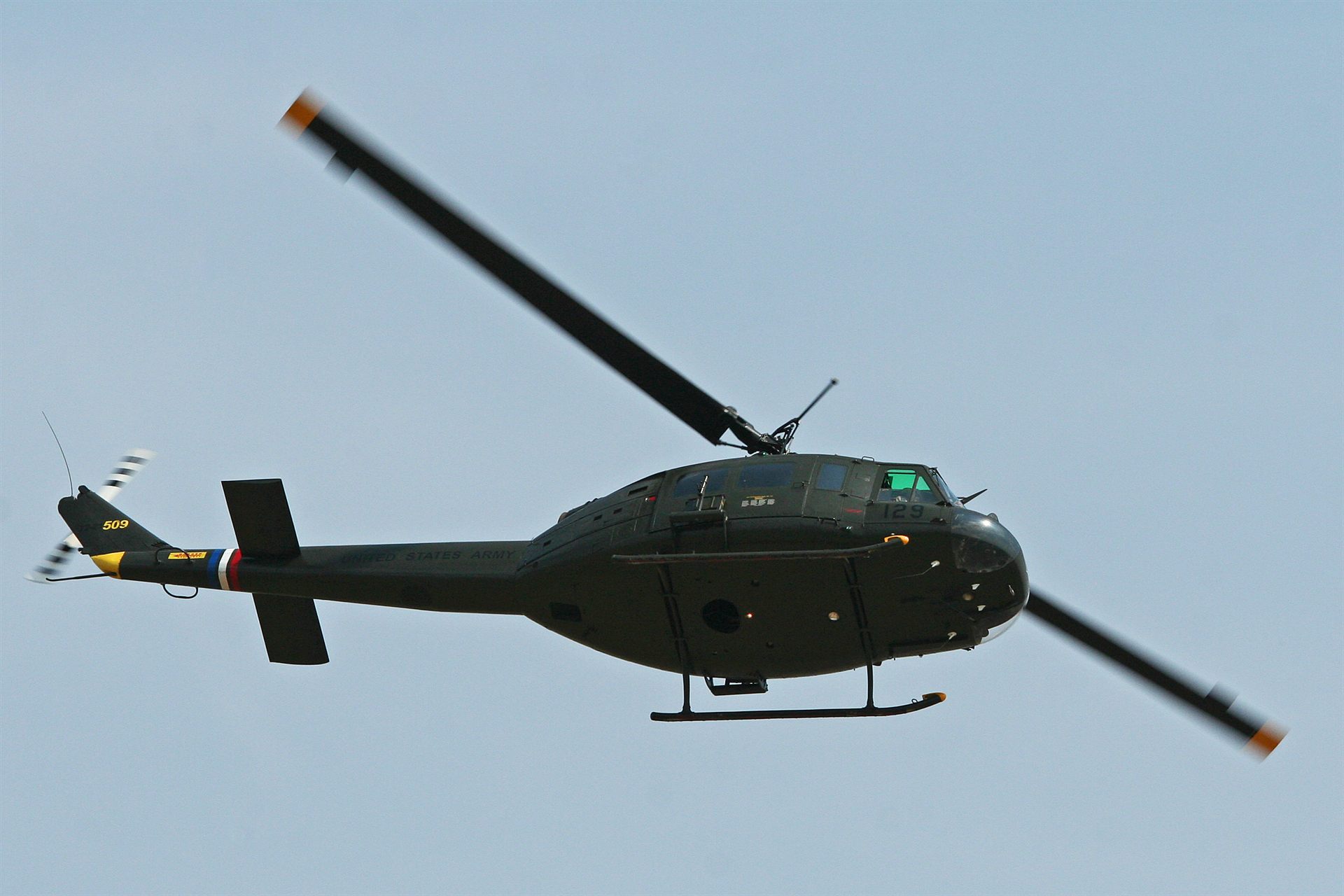
Pictured: a Bell UH-1H "Huey" helicopter in genuine U.S. Army olive-drab colors — the same airframe type Capt. Lawrence Coyne's Army Reserve crew was flying, but not their actual helicopter and not a photograph from the October 18, 1973 encounter near Mansfield, Ohio. The near mid-air collision happened at night in under five minutes with no camera aboard, so no image of the cigar-shaped object or the crew's specific aircraft from that night exists.
Theoretical Alignment
The Coyne case is unusual among UAP encounters in that it pairs an extremely high-credibility witness pool — four Army Reserve crewmen, none with any prior public interest in UFOs, three of whom described the object in closely matching terms, who signed a joint Army report within weeks — with an anomaly read from the aircraft's instruments: an altimeter and collective-pitch reading that, if taken at face value, describe a helicopter climbing with its collective bottomed. That combination pushes the case's ETH alignment higher than most "lights in the sky" reports, though it stops well short of confirming an extraterrestrial craft, since no propulsion mechanism, occupant, or physical trace was ever observed. The Psycho-Social Hypothesis explains comparatively little here: PSH accounts for social contagion and misperception well, but it does not easily explain a coordinated instrument reading witnessed simultaneously by two trained pilots in physical control of the aircraft, nor the matching descriptions supplied by ground witnesses near the lake who had no contact with the crew. The Interdimensional Hypothesis finds essentially no support in the case's physical or testimonial record, which describes a conventional atmospheric near-collision rather than any trans-dimensional or Vallée-style "high strangeness" element beyond the light and the climb themselves.
Background
By October 1973, official U.S. government UFO investigation had been formally closed for nearly four years. Project Blue Book, the U.S. Air Force's public UFO-investigation office, had ceased operations in December 1969 following the Condon Committee's largely dismissive 1968 report, leaving no standing federal apparatus dedicated to collecting or evaluating sighting reports. Into that vacuum stepped J. Allen Hynek, the Northwestern University astronomer who had served as Blue Book's scientific consultant for over two decades and had grown convinced, against his own early skepticism, that a meaningful fraction of reports resisted conventional explanation. In 1973 Hynek founded the Center for UFO Studies (CUFOS) in Evanston, Illinois, intending to apply more rigorous scientific method to sighting investigation than the Air Force ever had. The Coyne case, arriving within months of CUFOS's founding, would become one of the young organization's first major test cases and helped cement its reputation in the field.
The crew flying that night belonged to the 316th Medical Detachment (Helicopter Ambulance), an Army Reserve MEDEVAC unit based at Cleveland's fixed Army Reserve facility. Their Bell UH-1H "Huey," tail number 68-15444, had departed Port Columbus International Airport at approximately 10:30 PM on October 18, 1973, bound for Cleveland Hopkins International Airport roughly 96 nautical miles to the north-northeast, after the four-man crew completed routine annual flight physical examinations in Columbus. Command of the aircraft rested with 36-year-old Captain Lawrence J. Coyne, with nineteen years of flying experience and a Cleveland police officer in civilian life; at the controls in the left seat sat 26-year-old First Lieutenant Arrigo Jezzi, a chemical engineer. Behind Jezzi rode 35-year-old Staff Sergeant John Healey, a Cleveland police detective serving as flight medic, and behind Coyne 23-year-old Staff Sergeant Robert Yanacsek, a computer technician, as crew chief. It was an unremarkable Thursday-night administrative flight of exactly the kind military reservists fly routinely — until, cruising at 2,500 feet on a heading of 030 degrees at 90 knots over the darkened farmland southeast of Mansfield, Yanacsek noticed a single red light on the southeastern horizon.
Complete Timeline
| Date | Event |
|---|---|
| December 1969 | Project Blue Book, the U.S. Air Force's public UFO investigation office, formally closes following the Condon Committee report, leaving no standing federal UFO-reporting apparatus. |
| 1973 | J. Allen Hynek founds the Center for UFO Studies (CUFOS) in Evanston, Illinois, intending a more scientifically rigorous, Blue Book-independent investigative body. |
| October 1973 | UFO reports multiply across Ohio and the nation; on October 17 national news carries Ohio Governor John J. Gilligan's report of a UFO he and his wife saw while driving near Ann Arbor, Michigan. |
| October 18, 1973 — ~10:30 PM | Army Reserve UH-1H Huey (tail number 68-15444), crewed by Capt. Lawrence Coyne, 1Lt. Arrigo Jezzi, Sgt. John Healey, and Sgt. Robert Yanacsek, departs Port Columbus for Cleveland Hopkins after routine flight physicals. |
| ~11:00 PM | About ten miles south of Mansfield, Healey notices a single red light to the west, flying south; he does not recall mentioning it. |
| ~11:02 PM | Yanacsek spots a steady red light on the southeast horizon near Charles Mill Lake and watches it "a minute to ninety seconds" before pointing it out. About thirty seconds later it turns toward the helicopter on a converging course, closing at an estimated speed in excess of 600 knots. |
| ~11:02 PM (immediately following) | Coyne takes the controls from Jezzi, radios Mansfield tower (thinking the light might be an Air National Guard F-100), and begins a powered descent, increasing it from 500 to 2,000 feet per minute and the airspeed from 90 to 100 knots; the last altitude he notes is 1,700 feet. The tower acknowledges ("This is Mansfield Tower, go ahead Army 1-5-triple-4"), then nothing further is heard on UHF or VHF. |
| ~11:03 PM | Rather than colliding, the object stops above and in front of the helicopter — "for maybe ten to twelve seconds — just stopped," in Yanacsek's words — filling nearly the width of the windshield: Coyne, Healey and Yanacsek describe a gray, metallic-looking, slightly domed cigar shape, 50 to 60 feet long by Coyne's estimate, with a red light at the bow and a white light at the stern. |
| ~11:03 PM | A green, "pyramid shaped" beam from beneath the object swings up over the nose and through the windshield into the tinted upper window panels, and the cockpit is enveloped in green light. Copilot Jezzi reports seeing only a bright white light through the upper panels. |
| ~11:03–11:04 PM | On Route 430 near Charles Mill Lake, a woman (Mrs. E. C. in Zeidman's report) driving with four adolescents pulls over; two of them get out and see a helicopter and an object above it, and "everything turned green." Southeast of Mansfield, 14-year-old John Elias is woken by a loud helicopter and a green light that "lit up the bedroom." |
| ~11:04 PM | The object moves off to the west, showing only its white light, passes between Mansfield and its airport, and, according to Coyne and Healey, makes a 45-degree turn to the right toward Lake Erie before disappearing. Jezzi judged it faster than 250 knots but not as fast as the 600 knots the others estimated. |
| Immediately after | Jezzi and Coyne, checking instruments, find the altimeter reading approximately 3,500 feet and climbing at 1,000 feet per minute — despite the collective pitch control remaining in the full-down position the entire time, a configuration that should produce a descent, not a climb. |
| Moments later | With the collective already fully down, Coyne lifts it and, after a few seconds of careful control inputs during which the helicopter reaches nearly 3,800 feet, regains positive control. The crew recall a single "bump" as the object moved away. |
| Same time | Jezzi and Coyne note the magnetic compass disk rotating about four times a minute. The compass cannot be fixed and is later replaced. Radio contact is re-established with Akron/Canton approach and the flight continues to Cleveland. |
| October 18–19, 1973 | The crew closes its flight plan and notifies the FAA Flight Service Station, which refers Coyne to the FAA General Aviation District Office (GADO) at Cleveland Hopkins; the 83rd Army Reserve Command is notified at 1530 on 19 October. Mansfield tower is found to have no tape of even the initial transmission; the last Air National Guard F-100 had landed at 10:47 PM. |
| November 23, 1973 | Coyne's "Near Midair Collision with UFO Report" (Army Disposition Form, dated 23 Nov 73), attested by all four crewmen, records the near-collision, the descent to 1,700 feet, and an altimeter reading of 3,500 feet climbing 1,000 fpm "with the collective in the full down position." |
| 1973–1976 | Coyne's account reaches the press through his cousin at the Cleveland Plain Dealer, and J. Allen Hynek conducts the first CUFOS interview with him. In 1976 CUFOS asks Columbus-based investigator Jennie Zeidman, Hynek's research assistant from the early Blue Book years, to take over the investigation, which runs a year and a half (later described as more than 18 hours of interviews). The Route 430 ground witnesses come forward only in August 1976, when a teenage member of the family phones Columbus researcher Warren Nicholson after a Mansfield News Journal appeal; Nicholson and William E. Jones interview them. |
| 1973–74 | The National Enquirer's "Blue Ribbon Panel" awards the Coyne crew $5,000 for "the most scientifically valuable report of 1973." |
| By 1978 | Skeptic Philip J. Klass has attributed the sighting to an Orionid meteor fireball, with the climb put down to pilot input; James Oberg reports his view in OMNI's "UFO Update," and a reader's letter in the December 1978 issue attacks Klass's inquiry. Klass later set out the case in UFOs: The Public Deceived (1983). |
| 1979 | Jennie Zeidman publishes her CUFOS report, A Helicopter-UFO Encounter over Ohio, rejecting the meteor and aircraft explanations. |
| November 27, 1978 | Lt. Col. Lawrence Coyne, introduced as speaking in a private capacity, describes the encounter to the United Nations General Assembly's Special Political Committee in New York, at its 35th meeting, on Grenada's agenda item on UFOs; Hynek and Jacques Vallée also speak. |
| 2018 | The skeptical blog Parabunk proposes that the crew misread a military aerial-refueling tanker; no investigator who interviewed the crew has endorsed it. |
The Approach: "It's Going to Hit Us"
The UH-1H had been in the air for roughly half an hour, cruising uneventfully at 2,500 feet, when crew chief Robert Yanacsek, seated at the right rear of the cabin, noticed a single steady red light on the horizon to the southeast. He assumed it was a radio-tower beacon or an aircraft's port-wing light — most likely an aircraft, since it was not flashing — and watched it "for a long time, a minute to ninety seconds" before pointing it out. Coyne, smoking and relaxing, told him to "keep an eye on it." About thirty seconds later Yanacsek announced that the light had turned toward the helicopter and appeared to be on a converging course. (Coyne's 1978 account has the light first pacing the helicopter on a parallel course before turning toward it.)
Captain Coyne, in the right front seat as aircraft commander, confirmed the threat visually and took the controls from Lieutenant Jezzi. By his own later account and the Army report, the object was closing on a collision course at a speed estimated in excess of 600 knots. Coyne radioed Mansfield tower, ten miles to the northwest, thinking the light might be an Air National Guard F-100 from Mansfield; the tower acknowledged ("This is Mansfield Tower, go ahead Army 1-5-triple-4") and then nothing more was heard, although the channel and keying tones could be heard on both UHF and VHF. Coyne entered a powered descent at about 500 feet per minute, then, as the light kept coming, increased it to 2,000 feet per minute and his airspeed from 90 to 100 knots, and selected a field for an emergency landing; the last altitude he noted was 1,700 feet. "I then cursed to myself and told the crew on the intercom to brace for impact," he told the United Nations in 1978. A later check found that Mansfield had no tape of even the initial transmission, and that the last F-100 had landed at 10:47 PM.
The Hover and the Green Light
Rather than colliding or passing overhead as a conventional aircraft would, the object did something no aircraft of 1973 was capable of: it stopped above and in front of the UH-1H's nose, matching the helicopter's motion. "It wasn't cruising, it was stopped. For maybe ten to twelve seconds — just stopped," Yanacsek told Zeidman — Zeidman's later reconstruction, incorporating the ground-witness timeline, extended the total period the object remained continuously visible to roughly five minutes — Coyne, Healey and Yanacsek had a close view of a gray, metallic-looking structure, cigar-shaped and slightly domed, "precisely delineated against the background stars," with no wings, stabilizers or landing gear; Yanacsek reported "a suggestion of windows" along the dome. Coyne estimated its length at 50 to 60 feet, and its apparent width nearly filled the windshield. A red light glowed at the bow; a white light showed at a slightly indented stern. Copilot Jezzi, however, reported seeing only a bright white light through the upper window panels.
Then, in the accounts of Coyne, Healey and Yanacsek, a green, "pyramid shaped" beam, which Zeidman compared to a directional spotlight, emerged from beneath the object, swung up over the helicopter's nose, through the windshield and into the tinted upper window panels; "at that point (and not before)," Zeidman wrote, the cockpit was enveloped in green light. Coyne told the United Nations that "all colours inside the cabin of the helicopter were absorbed by that green light," including the instrument panel lights. Ground witnesses on Route 430 separately described a green light flaring from an object above a helicopter, turning "the helicopter, the trees, the road, the car" green.
Departure and the Anomalous Climb
After about ten seconds the object began to move off to the west, slowly at first and then accelerating, with only its white light showing; it passed between Mansfield and its airport, and according to Coyne and Healey made a decisive 45-degree turn to the right toward Lake Erie before disappearing. Healey watched it "for a couple of minutes." In the moments immediately following, Coyne and Jezzi both turned their attention back to the aircraft's own instruments — standard cockpit discipline after any near-miss — and found something that neither pilot could reconcile with normal flight dynamics: the altimeter read approximately 3,500 feet and was climbing at a steady 1,000 feet per minute, even though Coyne's collective pitch control remained exactly where he had left it during the evasive descent — full down, the configuration that produces a power-off descent, not a climb. In a fixed-wing aircraft an updraft or wind shear might explain an unplanned altitude gain; in a helicopter with the collective bottomed, sustained climb without a corresponding power input is aerodynamically anomalous. Coyne told the United Nations: "I had not during any time, to my recollection, increased power from a 2,000-foot-per-minute descent to a 1,000-foot-per-minute climb... There was no change in the controls or in the power setting." Zeidman noted that Coyne had been subliminally aware of the climb while the others were not, although all had felt the g-forces of the dive. With the collective already fully down, Coyne lifted it and, after a few seconds of careful maneuvering during which the helicopter reached nearly 3,800 feet, regained positive control; the crew recalled a single "bump" as the object moved away. The flight continued to Cleveland Hopkins without further incident.
The compass anomaly discovered afterward compounded the puzzle. Jezzi and Coyne noted the magnetic compass disk rotating about four times a minute (Coyne: "slowly but steadily spinning"); the compass could not be fixed and the unit had to be replaced — a small, mundane-sounding maintenance detail that nonetheless represents one of the case's few pieces of physical, verifiable aftermath evidence beyond eyewitness recollection. Coyne also reported that the rotors were checked by magnetic-particle testing the next day, with no sign of fatigue-producing stress.
Ground Witnesses at Charles Mill Lake
What distinguishes the Coyne case from many cockpit-only reports is that it did not depend solely on the airmen's word. Independent ground observers reported closely matching phenomena, though only after a delay: they came forward in August 1976, almost three years later, when a teenage member of the family phoned Columbus researcher Warren Nicholson in response to a Mansfield News Journal story appealing for witnesses, and were interviewed by Nicholson, William E. Jones and later Zeidman. At about 11:00 PM a woman identified in Jennie Zeidman's report as "Mrs. E. C." was driving south from Mansfield with four adolescents when they watched a steady red light fly south. About five minutes later, driving east on Route 430 toward the Charles Mill Reservoir, they saw a red and a green light descending rapidly toward them and heard "a beating sound, a lot of racket"; she pulled over, and two of the children, cousins aged thirteen, jumped out and saw both a helicopter and an object they described as "like a blimp," "as big as a school bus," "sort of pear shaped," hovering over it. The object's green light flared up: "The helicopter, the trees, the road, the car — everything turned green." The object then crossed behind the car, moved east for a few seconds, reversed and climbed toward the northwest and Mansfield — a path Zeidman found consistent with the crew's account. Southeast of Mansfield, Jeanne Elias, 44, heard an Army helicopter so loud and low she feared it would hit the house; her fourteen-year-old son John was woken by a bright green light that "lit up the bedroom." None of these ground observers had any contact with the flight crew, and Zeidman treated their reports as meaningful corroboration.
Reporting the Incident: FAA, Army, and the Absence of Blue Book
Because Project Blue Book had already been closed for nearly four years by October 1973, the Coyne crew's near mid-air collision followed an entirely different reporting chain than earlier Air Force-era cases like Washington, D.C. or Lakenheath-Bentwaters. As a near mid-air collision involving a military aircraft in civil airspace, the incident triggered two separate, mundane, non-UFO-specific reporting channels: FAA procedure, under which the crew notified the Flight Service Station and was referred to the FAA's General Aviation District Office (GADO) at Cleveland Hopkins — where, according to Ohio Magazine, Coyne told FAA operations chief P.J. Vollmer, who later said, "I personally have an extremely high regard for his integrity and capability" — and Army reporting, which produced Coyne's "Near Midair Collision with UFO Report," a disposition form dated 23 November 1973 and attested by all four crewmen, recording the descent and the climb with "the collective in the full down position." Neither agency was equipped or mandated to investigate the object's identity as a UFO matter; both simply logged the near-collision as reported. It was only afterward, through informal channels — word of the case reaching Ohio-based ufologists and, from there, Hynek's newly formed CUFOS — that any organization undertook to investigate what the crew had actually encountered, rather than simply record that a near-collision had occurred.
The CUFOS Investigation: Jennie Zeidman's Field Report
Jennie Zeidman, a Columbus-based researcher who had studied astronomy under Hynek at Ohio State and worked as his first secretary and research assistant during the early years of Project Blue Book, took on the Coyne case for CUFOS in 1976, after Hynek had conducted the first interview with Coyne. Her investigation was unusually thorough by the standards of contemporaneous ufology: a 1978 letter to OMNI described it as more than 18 hours of interviews; she cross-checked the crewmen's accounts against each other and against the Army's paperwork, brought in the ground witnesses found by Jones and Nicholson, and built a second-by-second reconstructed timeline of the encounter meant to test it against mundane explanations. Her central methodological finding was that the object remained continuously in view, in some form, for at least five minutes when the ground-witness observations were integrated with the crew's account — a duration Zeidman and later reviewers considered fundamentally incompatible with a meteor, which by definition burns through the atmosphere in a matter of seconds. Zeidman published her findings as the CUFOS monograph A Helicopter-UFO Encounter over Ohio in 1979, rejecting the meteor explanation on the grounds of the event's duration (an estimated 300 seconds), the object's deceleration and hard-angle turn, its defined shape and its horizon-to-horizon path, and the aircraft explanation on the grounds of its light configuration, its ability to hover and its silence.
Before the United Nations, 1978
The Coyne case achieved a level of formal international attention almost no other UFO encounter has matched. On November 27, 1978, at its 35th meeting, the United Nations General Assembly's Special Political Committee took up an agenda item on UFOs placed there by the government of Grenada under Prime Minister Eric Gairy, who had campaigned for the UN to take an official interest in the subject. Grenada's delegation presented statements from both J. Allen Hynek and Jacques Vallée, but its most striking moment came from a firsthand military witness: by then promoted to Lieutenant Colonel, Lawrence Coyne personally recounted the October 1973 encounter to the assembled delegates, explicitly speaking as a private citizen rather than as a representative of the U.S. military. "I am convinced this object was real," Coyne told the committee, "and that these types of incident require a thorough investigation," calling for coordinated international protocols to protect aircrews who might encounter similar phenomena. Grenada's delegate stressed that Coyne, by then a battalion commander supervising the Army's Cleveland flight facility, was there in a private capacity; no evidence has surfaced that his career suffered as a result of speaking publicly about the case.
Circumstantial Evidence
- Four military crewmen — a veteran pilot and police officer, a chemical engineer, a police detective, and a computer technician — reported the encounter to the FAA the next day and signed a joint Army report; three described the object in closely matching terms, with no apparent motive to fabricate.
- Two of those witnesses, Coyne and Jezzi, both qualified pilots, noted the same anomalous altimeter and compass readings from the cockpit.
- Ground witnesses at Charles Mill Lake and near Mansfield, with no contact with the flight crew, reported green illumination and, in one family's case, an object over the low-flying helicopter.
- The helicopter's magnetic compass could not be fixed and had to be replaced — a maintenance fact rather than eyewitness recollection alone.
- Radio contact with Mansfield tower was lost on both UHF and VHF after an initial acknowledgment, and the tower had no tape of even that transmission.
- J. Allen Hynek's Center for UFO Studies, applying its most rigorous available field-investigation methodology through Jennie Zeidman, concluded the case remained unexplained after examining and rejecting meteor and conventional-aircraft hypotheses.
- Lawrence Coyne's willingness to testify under his own name before the United Nations in 1978, years after the case could have quietly faded, is difficult to reconcile with a hoax or a simple misperception the crew privately doubted.
The Ohio UFO Wave of October 1973
The Coyne encounter did not occur in isolation. October 1973 brought a large wave of UFO reports across the United States — the same month as the Pascagoula abduction claim — and hundreds of reports in Ohio alone. On October 17, the night before the Mansfield encounter, national news carried Ohio Governor John J. Gilligan's report of a UFO he and his wife had seen while driving near Ann Arbor, Michigan — notable for coming from a sitting governor. Some local reports were pranks: according to Richland County historian Tim McKee, Mansfield firefighters launched a lighted balloon made of latex gloves over the city during the wave and kept quiet about it for years. Hynek, who had taught astronomy at Ohio State, had founded CUFOS that year, and the timing helped ensure that when the Coyne case specifically reached CUFOS, it did so within an organizational and public context already primed to take a credentialed military report seriously rather than treat it as an isolated curiosity.
The Klass-Oberg Controversy: Meteor, Pilot Error, or Something Else
The Coyne case's most prominent and durable skeptical challenge came from Aviation Week senior editor and veteran UFO debunker Philip J. Klass, who by 1978 had concluded that the crew had most likely been startled by a bright meteor fireball from the Orionid shower — whose activity period overlapped the night of the sighting — and that the climb reflected control input by one of the pilots rather than any external force. Klass, who set out the case in UFOs: The Public Deceived (1983), also argued that the green light came from the fireball shining through the helicopter's green-tinted upper window panels — and both Zeidman's report and Coyne's own UN statement do place the green light, and a later glimpse of the object, in those tinted panels. Researcher Kevin Randle has countered that the tinted "greenhouse" panels sit above the pilots, not in the windshield the crew was looking through. Klass's explanation received wide circulation and became, for years, the default "skeptical answer" cited whenever the Coyne case came up.
The "Oberg" half of the controversy comes from aerospace journalist and analyst James Oberg — then a NASA Johnson Space Center engineer, who wrote OMNI's "UFO Update" column from the magazine's first issue in October 1978 and would go on to author UFOs and Outer Space Mysteries: A Sympathetic Skeptic's Report (1982). Oberg's column described Klass's investigations as more careful and scientific than those of the case's proponents, a framing that drew pointed criticism. Writing in the letters pages of OMNI's December 1978 issue, reader Charles Labbe directly contrasted Klass's methodology with Jennie Zeidman's, noting that Klass's investigation "consisted of only three long-distance phone calls and a brief TV talk show conversation, with no face-to-face contact with the witnesses," while Zeidman's own fieldwork ran to more than eighteen hours of direct interrogation and identified five corroborating ground-based witnesses Klass's remote inquiry had never located. Investigators pointed to several specific facts difficult to reconcile with a meteor: Zeidman's timeline reconstruction placed the object continuously in view for roughly five minutes, far longer than any meteor fireball, which typically burns out in a few seconds; three of the crew described a structured morphology — a defined cigar-shaped hull, distinct red/white/green lighting, and a sweeping beam — none of which a meteor exhibits; and the object's reported stop and 45-degree turn are not meteor behavior.
Author Kevin Randle, himself a former Army helicopter pilot, separately challenged Klass's pilot-input explanation in a 2015 blog post, arguing that a pilot would not take the controls without announcing it. A 2018 post on the skeptical blog Parabunk proposed instead that the crew had misread a military aerial-refueling tanker positioning itself above and ahead of the helicopter; it has not been adopted by any investigator who interviewed the crew, and it does not by itself account for the compass and radio anomalies. Taken together, the debate over the Coyne case's conventional explanations remains, more than four decades later, genuinely unresolved rather than conclusively settled in either direction.
Legacy and Cultural Impact
The Coyne case became, within the field of ufology, a touchstone example of what a "good" case looks like: multiple credentialed witnesses, prompt official reporting through mundane institutional channels rather than sensationalized media, a documented instrumented anomaly, and a rigorous independent field investigation. It helped establish Hynek's newly founded CUFOS as a serious research organization capable of producing detailed, methodical case studies rather than mere anecdote collection, a reputation the organization carried through the following decades. The crew also told the story to national audiences: Coyne on The Dick Cavett Show, and the crew in Rod Serling's 1970s documentaries. The case has remained a staple of aviation-safety-oriented UAP literature — not because it proves an extraterrestrial craft, but because it is an unusually well-documented, professionally reported aviation anomaly that has never been conclusively explained.
Key Witnesses
Capt. (later Lt. Col.) Lawrence J. Coyne
A 36-year-old with nineteen years of flying experience and a civilian police officer, Coyne took the controls from Jezzi when the approaching light appeared to threaten collision, executed the evasive descent, and was one of the two pilots who noted the anomalous climb on the aircraft's instruments. He wrote the crew's Army disposition-form report, told the FAA in Cleveland the next day, cooperated with Jennie Zeidman's CUFOS investigation, and on 27 November 1978, by then a lieutenant colonel, described the encounter to the United Nations Special Political Committee: "I am convinced that this object was real and that these types of incident require a thorough investigation."
1st Lt. Arrigo Jezzi
At the controls in the left seat until Coyne took over for the evasive descent, Jezzi was the other pilot who noted the altimeter's 3,500-foot reading and 1,000-foot-per-minute climb, and the spinning compass, after the encounter. His account differs from the others' in important ways: according to Zeidman he saw only a bright white light through the upper window panels rather than the cigar-shaped object and green beam, and he judged the object's departure faster than 250 knots but not as fast as the 600 knots the others estimated.
Sgt. Robert Yanacsek
The first crew member to spot the approaching red light on the southeast horizon near Charles Mill Lake, Yanacsek watched it for a minute or more before alerting the cockpit, beginning the chain of events leading to Coyne's evasive maneuver. At 23 the youngest member of the crew, he described the object stopping "for maybe ten to twelve seconds" and "a suggestion of windows" along its dome, an account that closely matched Coyne's and Healey's.
Sgt. John Healey
A 35-year-old Cleveland police detective serving as the crew's medic, Healey noticed an earlier red light to the west, flying south, shortly before Yanacsek's report of the converging object, and it was his "Look at that" that made Coyne open his eyes to the hovering object. He later said, "It scared the living hell right out of me," and, with Coyne, watched the object's departure and 45-degree turn toward Lake Erie.
Jennie Zeidman
An Ohio State University English graduate (born 1932) who took Hynek's astronomy class in 1952 and served as his first secretary and research assistant in the early years of Project Blue Book, Zeidman conducted the case's fullest independent investigation: extensive crew interviews (more than 18 hours, by one 1978 account), the Charles Mill Lake ground witnesses found by William E. Jones and Warren Nicholson, and a second-by-second reconstructed timeline that became the primary basis for ruling out a meteor explanation. She died in 2020, aged 88. Her 1979 CUFOS monograph, A Helicopter-UFO Encounter over Ohio, remains the single most detailed primary investigative record of the case.
Ground Witnesses: The "Erma C." Family and the Elias Family
A woman identified in Zeidman's report as "Mrs. E. C.," driving on Route 430 with four adolescents, two of whom got out of the car, and separately the Elias family southeast of Mansfield — including 14-year-old John Elias, woken by a green light that "lit up the bedroom" — reported a loud helicopter and green light and, in the C. family's case, an object "like a blimp," "as big as a school bus," over the helicopter. They were found by researchers William E. Jones and Warren Nicholson; neither family had any contact with the flight crew before investigators connected their accounts.
The Five Observables Assessment
The Five Observables framework, developed by former AATIP director Luis Elizondo, is used to classify UAP encounters by performance characteristics exceeding known technology of their era:
Assessment: "Anti-Gravity Lift" is rated speculative: the climb was read from the altimeter by two trained pilots, with Coyne insisting the collective was fully down, but nothing recorded it, Coyne himself was only "subliminally aware" of the climb at the time, and Klass attributed it to pilot input. Instant Acceleration is likewise rated speculative: the object's stop from an estimated 600-plus-knot closing speed and its later acceleration were reported by three of the crew, but rest on visual estimates under stress, and Jezzi judged the speeds lower. Hypersonic Velocity is rated only speculative because the 600-knot closing-speed estimate rests on visual judgment under high stress rather than any radar or instrumented measurement — extraordinary if accurate, but unverifiable. Low Observability is rated absent: the object was, if anything, unusually conspicuous, brightly lit with red, white, and green lights and clearly visible to both the aircrew and multiple independent ground witnesses. Trans-Medium travel is rated absent, as no transition between air, water, or space was ever reported.
Evidence Assessment
Supporting Anomalous Origin
- Four military crewmen with no prior UFO interest reported the encounter promptly to the FAA and the Army; three described the object in closely matching terms.
- The anomalous climb was read from the aircraft's altimeter by two qualified pilots, with Coyne insisting the collective was fully down.
- Independent ground witnesses with no crew contact corroborated the green light and the object's presence near the helicopter.
- Jennie Zeidman's second-by-second timeline reconstruction found the object visible for approximately five minutes — far longer than any meteor.
- The magnetic compass, found spinning after the encounter, could not be fixed and was replaced — a physical (if secondary) piece of aftermath evidence.
- CUFOS's investigation, through Zeidman, concluded the case was unexplained rather than solved.
- Coyne's public, on-the-record United Nations statement in 1978, made under his own name and rank years after the event, is difficult to attribute to attention-seeking given the professional risk it represented.
Supporting Conventional Explanation
- The encounter occurred in the same general window as the Orionid meteor shower's annual activity period, offering a plausible mundane trigger for an initial misidentification.
- Skeptic Philip Klass argued the altitude/climb anomaly could reflect inadvertent or unconsciously applied control input by a startled pilot rather than any external force.
- Copilot Jezzi saw only a bright white light, not the cigar-shaped object or the green beam, and judged the object slower than the others did; the green cockpit light coincided with the beam entering the green-tinted upper panels, as Klass argued.
- No radar or other independent sensor data exists to corroborate the crew's estimated closing speed or the object's flight path, leaving the case dependent entirely on visual estimation under high stress.
- Klass's competing explanation received significant public attention, and some researchers have proposed the sighting could reflect a misidentified aircraft (including a 2018 tanker-refueling misidentification theory not adopted by any field investigator) rather than a genuinely anomalous craft.
Why "Credible"
The Coyne Helicopter Incident earns a CREDIBLE rating on this site's scale because it combines an unusually strong witness pool with a genuinely instrumented anomaly, while stopping short of the kind of independent, physical, or sensor-based corroboration that would justify a "Verified" rating. On the strength side: four Army Reserve servicemen with no prior interest in UFOs reported promptly to the FAA and the Army and signed a joint report; three described the object in closely matching terms; two qualified pilots noted the same anomalous altimeter reading; independent ground witnesses with no contact with the crew reported matching phenomena; and the compass had to be replaced. J. Allen Hynek's Center for UFO Studies, applying its most rigorous available field methodology through Jennie Zeidman's exhaustive investigation, concluded the case remained unexplained. On the other hand, the case lacks any radar track, photograph, film, or laboratory-testable physical sample; its central kinematic claims (the 600-knot closing speed, the climb) rest on visual and instrument readings under high stress rather than independently recorded measurement; the copilot did not see the object or beam; and a real, if contested, conventional explanation — Philip Klass's Orionid meteor and pilot-error hypothesis — has never been fully and uncontroversially ruled out, even though CUFOS's own timeline analysis argues strongly against it. That combination — exceptionally strong, multiply-corroborated witness testimony paired with a documented instrumented anomaly, but without independent sensor or physical confirmation — places the Coyne case solidly in "credible" territory: one of the strongest cockpit-crew UAP reports on record, but not a closed case.
Sensor & Instrumentation Detection Profile
Unlike many classic UFO cases, the Coyne incident was not captured by any external radar, camera, or government sensor network — Project Blue Book had closed in December 1969, nearly four years before the encounter, so there was no standing Air Force apparatus to receive or cross-reference the report. What the case does have, unusually, is onboard aircraft instrumentation functioning as an inadvertent sensor system: the helicopter's own altimeter, its collective-pitch control position, its magnetic compass, and its UHF/VHF radios all recorded anomalous behavior that two qualified pilots — Coyne and Jezzi — noted inside the cockpit. The altimeter registered a sustained 1,000-feet-per-minute climb, and Coyne testified the collective was bottomed in a full-power-off descent configuration the entire time, a combination that should have been aerodynamically impossible in still air. Radio contact with Mansfield tower, which had acknowledged the crew's initial call ("This is Mansfield Tower, go ahead Army 1-5-triple-4"), failed on both UHF and VHF although channel and keying tones could be heard; contact was regained later with Akron/Canton approach, and Mansfield had no tape of even the initial transmission. After the object departed, the helicopter's magnetic compass disk was observed rotating about four times a minute; it could not be fixed and the compass had to be replaced. The upper "greenhouse" window panels of the UH-1H are tinted green, a point central to Klass's explanation of the green cockpit light.
Environmental & Geospatial Context
The encounter unfolded on a clear, calm, starry mid-October night (moonless in Zeidman's 1979 report, though her later summary has a last-quarter moon just rising) over the gently rolling farmland of north-central Ohio, in the vicinity of Charles Mill Lake just southeast of Mansfield — open, rural terrain with scattered lakes and reservoirs, well outside any major metropolitan light pollution but directly beneath a regional general-aviation corridor connecting Port Columbus and Cleveland Hopkins International Airport. The night fell within the annual Orionid meteor shower's activity period, a timing coincidence that became central to the case's most prominent skeptical explanation. The sighting also came amid a national wave of UFO reports in October 1973: the evening before, national news had carried then-Ohio Governor John J. Gilligan's report of a UFO seen while driving near Ann Arbor, Michigan.
Observer Credibility & Occupational Profile
Few UAP cases anywhere in the historical record match the occupational credibility of the Coyne crew. All four men were serving members of the U.S. Army Reserve's 316th Medical Detachment (Helicopter Ambulance), a tenant reserve unit of the Cleveland U.S. Army Reserve Fixed Facility Army Center, returning from a mandatory flight physical examination — meaning all four had just been certified medically fit, with no evidence of fatigue-driven impairment, immediately before the encounter. Coyne himself was, in civilian life, a police officer, with nineteen years of flying experience and, by 1978, more than 3,000 flying hours across helicopters and fixed-wing aircraft; he would later be promoted to Lieutenant Colonel and spoke before the United Nations. Jezzi, at the controls until Coyne took over, was a chemical engineer by profession. Healey was a Cleveland police detective serving as the crew's flight medic. Yanacsek, the crew chief who first spotted the approaching light, worked as a computer technician. None of the four had any prior connection to ufology, and all four signed the Army report; three described the object in closely matching terms, while Jezzi saw only a bright light — a pattern investigators consider evidence against fabrication, though it does not by itself establish what the object actually was.
Physical & Material Assays
No debris, landing trace, or recoverable material of any kind is associated with the Coyne case, and none has ever been claimed. The case's physical evidentiary record instead consists of documented, secondary effects on the aircraft itself: the magnetic compass, found rotating about four times a minute, which could not be fixed and had to be replaced; the loss of UHF and VHF radio contact with Mansfield tower after its acknowledgment, for which the tower retained no tape; and the altitude gain itself, read by two qualified pilots from the same gauges. Magnetic-particle testing of the rotors the next day reportedly found no sign of fatigue-producing stress. None of these effects were independently laboratory-tested in the way a soil sample or metal fragment might be — there was nothing to submit for isotopic or metallurgical analysis — but they represent a rare category of quasi-physical evidence: verifiable, mechanical aircraft-system anomalies reported by trained operators immediately after the fact, rather than eyewitness recollection alone.
Historical Precedents & Archive Matches
The Coyne case sits at the head of a recognizable sub-genre of UAP reporting: the aircrew near-collision paired with instrumented or electromagnetic aftereffects. It shares its core structure with the Iranian Air Force's 1976 Tehran encounter, in which F-4 Phantom fighter crews reported weapons and communications systems failing during pursuit of an unidentified object, and with the 1957 RB-47 bomber chase, another U.S. military aircrew case involving simultaneous radar, visual, and signals-intelligence anomalies. It also echoes, in miniature, the physical/electromagnetic-effects profile later associated with cases like the Rendlesham Forest incident. Within Ohio itself, the case was the highest-profile report of the October 1973 wave, and it became one of the first flagship cases handled by the newly created Center for UFO Studies, which Hynek had founded that year.
Material Analysis
The Coyne case produced no physical debris, trace residue, or recoverable artifact of the object itself, and no witness or investigator has ever claimed otherwise. What it does contain is a narrower category of secondary physical evidence: documented, verifiable damage to the aircraft's own systems. The magnetic compass was found afterward rotating about four times a minute and could not be fixed, ultimately requiring replacement. The loss of UHF and VHF radio contact with Mansfield tower after its initial acknowledgment, with the tower holding no tape even of that transmission, is a second systems anomaly, though a mundane one is possible: the helicopter was descending toward 1,700 feet over rolling terrain. Neither effect has ever been laboratory-analyzed in the way a physical sample might be, since neither produced a substance or artifact that could be submitted for testing; their evidentiary value instead rests on being verifiable maintenance and communications-log facts rather than purely subjective testimony, distinguishing them from the far more common UFO case that offers eyewitness recollection alone.
Supporting a Genuine Anomalous Effect
- The compass fault was severe and persistent enough to require full unit replacement, rather than resolving on its own or reflecting a simple, pre-existing mechanical fault noticed only in hindsight.
- The tower's lack of any tape of the crew's call is consistent with the crew's account of the radio failure, though it does not explain it.
- Both effects align temporally and functionally with a close-range electromagnetic disturbance rather than being unrelated coincidental malfunctions.
Supporting a Mundane Origin
- No record of the compass's maintenance history before the flight has been published, so a pre-existing or coincidental fault cannot be excluded.
- Radio blackouts at low altitude over rural terrain can result from mundane line-of-sight limitations to ground stations.
- No independent electromagnetic-field measurement was taken during or immediately after the encounter, leaving the causal link between the object and the instrument anomalies inferential rather than measured.
The Conventional Explanation Candidate: Orionid Meteor Fireball
The most publicly prominent conventional explanation, advanced by Philip J. Klass by 1978 and set out in UFOs: The Public Deceived (1983), holds that the crew encountered an unusually bright meteor fireball associated with the Orionid meteor shower, whose activity period overlapped mid-to-late October, and that the startling brightness and apparent proximity of a bright bolide, combined with the disorientation of a sudden evasive maneuver at night, produced both the crew's perception of a structured, hovering craft and an inadvertent, panic-driven control input that produced the apparent climb. It deserves serious evaluation because bright fireballs genuinely can startle pilots into misjudging distance, size, and duration, and meteor activity was plausibly elevated around the date in question.
Where the Meteor Theory Falls Short
Its central weakness is duration and behavior. Jennie Zeidman's independently reconstructed timeline, built from both crew and ground-witness testimony, placed the object continuously visible for approximately five minutes — several orders of magnitude longer than any meteor fireball, which by definition burns out within a few seconds of atmospheric entry. A meteor also cannot decelerate, hover, reverse or redirect a beam of light, or depart under its own power in a new direction, all of which the crew and ground witnesses consistently described. Klass's inquiry, according to a 1978 letter to OMNI, consisted of three long-distance telephone calls and a brief television conversation, with no face-to-face contact with the witnesses. In Klass's favor, the green cockpit light coincided, by Zeidman's and Coyne's own accounts, with light entering the helicopter's green-tinted upper panels, and copilot Jezzi saw only a bright white light.
Pilot Error and Inadvertent Control Input
A second, related conventional candidate holds that the anomalous instrument climb resulted not from any external phenomenon but from a startled pilot unconsciously pulling up on the collective during the high-stress evasive maneuver, with the crew's shared adrenaline and expectation afterward causing them to misremember the control position. Against it, former Army helicopter pilot Kevin Randle has argued that a pilot would not take the controls without announcing it, and Coyne has consistently maintained that the collective was still bottomed when he noticed the climb. For it, Coyne told Zeidman he had been only "subliminally aware" of the climb, the others not at all, and no instrument recorded the control positions.
Misidentified Aircraft or Refueling Tanker
A third, less widely adopted theory, proposed on the skeptical blog Parabunk in 2018, holds that the crew mistook a military aerial-refueling tanker positioning itself above and ahead of the helicopter for a structured, hovering craft. It has never been endorsed by CUFOS, Zeidman, or any investigator who conducted primary fieldwork on the case; no record of a tanker in the area that night has been produced; the object's reported stop from an estimated 600-plus knots exceeds a tanker's performance; and the theory offers no mechanism for the compass and radio anomalies.
Orionid Meteor Fireball
ImplausibleIMPLAUSIBLE as a complete account: Zeidman's reconstructed timeline placed the object continuously visible for roughly five minutes, orders of magnitude longer than any meteor fireball, and a meteor cannot decelerate, hover, redirect a light beam, or depart under its own power the way the object was consistently described doing. Cannot be entirely ruled out as a contributing initial trigger for the sighting, and Klass's point about the green-tinted upper panels is consistent with the crew's own descriptions.
Pilot Error / Inadvertent Control Input
InconclusiveDoubtful but not excluded: Coyne has consistently maintained the collective was bottomed, and Randle argues a control change would not go unannounced; but no instrument recorded the control positions, and Coyne was only "subliminally aware" of the climb at the time.
Misidentified Aircraft / Refueling Tanker
ImplausibleIMPLAUSIBLE: never endorsed by any investigator who conducted primary fieldwork on the case; no tanker has been placed in the area that night; the reported stop from an estimated 600-plus knots exceeds a tanker's performance; and the theory offers no mechanism for the compass and radio anomalies.
Related Cases
Confirmed Documents & Official Records
National Archives finding aid covering UAP-related textual holdings; useful starting point for any surviving FAA or military correspondence connected to 1970s-era near mid-air collision reports, since the Coyne case predates Project Blue Book's own closed microfilm archive by four years.
UNCLASSIFIEDPartial verbatim record of the 27 November 1978 meeting at which Lt. Col. Lawrence Coyne, introduced as speaking in a private capacity, described the encounter, alongside statements by J. Allen Hynek and Jacques Vallée.
PUBLIC RECORDSearch Government Archives Directly
Further Reading — Recommended Literature
A Helicopter-UFO Encounter over Ohio
The original CUFOS field-investigation monograph, built from extensive crew interviews and the ground-witness accounts; the most detailed primary source on the case.
The Hynek UFO Report
Written by the Center for UFO Studies founder whose organization investigated the Coyne case from its earliest days, distilling decades of Blue Book-era case evaluation into the classification framework still used to assess cases like this one.
Project Blue Book Exposed
A history of the Air Force's UFO projects by a former Army helicopter pilot and intelligence officer who has, on his blog, disputed Philip Klass's explanation of the Coyne case.
DISCLOSURE: Some links above are affiliate links. If you purchase through them, OverClassified receives a small commission at no additional cost to you. This helps support independent research.
Essential Viewing
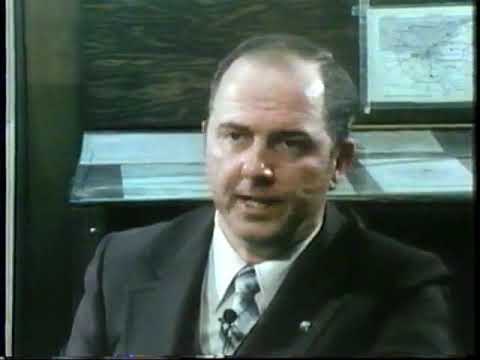
1973-10-18: Lt Col Coyne's UFO Mansfield Ohio
A focused case walkthrough covering the flight timeline, the near-collision, and the instrument anomaly.
Coyne Helicopter-UFO Encounter over Ohio 1973
A dedicated overview of the encounter, drawing on the crew's own testimony and the CUFOS investigation.
CASE FILES: 003 | The Coyne Helicopter UFO Incident
In-depth case-file style analysis from the "Somewhere in the Skies" UFO research podcast/channel.
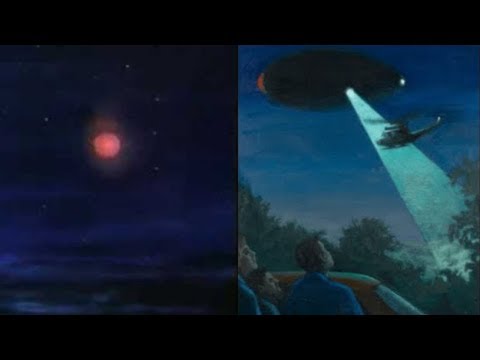
The Unexplained Coyne Helicopter UFO Incident with Military Pilots in 1973
A dedicated retrospective focused specifically on the military-pilot testimony at the center of the case.
Sources
- National Investigations Committee on Aerial Phenomena (NICAP). "Mansfield, Ohio Helicopter-UFO Encounter, October 18, 1973" — full case report. nicap.org
- NICAP. Coyne case directory / EMCAT electromagnetic-effects listing. nicap.org
- Gross, Patrick. "UFOs at Close Sight: The Coyne Case, Mansfield, Ohio, 1973." ufologie.patrickgross.org
- Gross, Patrick. "The Coyne Case, Mansfield, Ohio, 1973 — The Official Report" (transcription of the U.S. Army disposition-form report). ufologie.patrickgross.org
- Zeidman, Jennie. A Helicopter-UFO Encounter over Ohio, Center for UFO Studies, 1979 (CUFOS field investigation monograph); Zeidman's case summary reproduced by NICAP is listed above.
- United Nations General Assembly, Special Political Committee, 35th meeting, 27 November 1978, partial verbatim record A/SPC/33/PV.35 (statement of Lt. Col. Larry Coyne). digitallibrary.un.org
- Klass, Philip J. UFOs: The Public Deceived. Prometheus, 1983 (Orionid-fireball and tinted-panel explanation; as summarized on Metabunk).
- Center for UFO Studies (CUFOS). "J. Allen Hynek Biography." cufos.org
- Center for UFO Studies (CUFOS). "International UFO Reporter" archive index. cufos.org
- "Center for UFO Studies," Wikipedia. en.wikipedia.org
- Ohio Magazine. "The Case of Ohio's Best Documented UFO." ohiomagazine.com
- Richland Source. "Out of This World: Coyne Incident Focused UFO Attention on North Central Ohio in 1973," April 29, 2022. richlandsource.com
- Ashland Source. "Coyne Incident over Charles Mill Lake Was Most Credible UFO Sighting of 1973," October 4, 2020. ashlandsource.com
- Richland County History. "UFOs Over Richland County: 1973," September 2, 2019. richlandcountyhistory.com
- Cleveland Ufology Project. "Coyne Helicopter Incident — 1973." clevelandufo.com
- Cleveland Ufology Project. "Coyne Helicopter Incident — 1973 — Epilogue" (fate of tail number 68-15444 and crew follow-up). clevelandufo.com
- HuffPost. "Army Helicopter's UFO Scare Still A Mystery, 40 Years Later," October 18, 2013. huffpost.com
- Randle, Kevin D. "A Different Perspective: October 18, 1973: The Coyne Helicopter Case and Philip Klass," A Different Perspective blog, June 2015. kevinrandle.blogspot.com
- Parabunk. "The 1973 Coyne/Mansfield Helicopter UFO Incident Finally Explained," April 2018 (alternative skeptical analysis). parabunk.blogspot.com
- OMNI Magazine. "UFO Update" reader correspondence on the Klass-Zeidman Coyne case controversy, December 1978 issue, archived at UFO Magazines Archive. ufomagazines.com
- Free Press (Columbus, OH). "Ohio Against the Universe: 50th Anniversary of the UFO Wave During Halloween 1973." freepress.org
- Sprague, Ryan. "The Coyne Helicopter UFO Incident," Medium. medium.com
- Enigma Labs. "Mansfield, Ohio, October 18, 1973 (Coyne Sighting)" case library entry. enigmalabs.io
- Podcast UFO. "A Helicopter Crew Encounters a UFO" (episode page). podcastufo.com
- The Living Moon. "Captain Lawrence Coyne UFO Helicopter Case, 1973." thelivingmoon.com
- Copycat Effect (blog). "Project Blue Book's First Secretary Jennie R. Zeidman, 88, Dies," April 2020 (obituary and biography). copycateffect.blogspot.com
- Clark, Jerome. The UFO Encyclopedia, 4th Edition, Relevant Information LLC (entry on the Coyne/Mansfield helicopter case).
- Peebles, Curtis. Watch the Skies!: A Chronicle of the Flying Saucer Myth, Smithsonian Institution Press, 1994.
Corrections (October 2026)
This page was checked in October 2026 against the Army disposition form of 23 November 1973, Jennie Zeidman's CUFOS case summary, Lt. Col. Coyne's statement in the UN record of 27 November 1978, the December 1978 OMNI letters and contemporary reporting. Corrected: copilot Jezzi saw only a bright white light, not the object or the green beam (the page said "all four crewmen" saw the beam and that Jezzi described it); the ranks of Yanacsek and Healey (staff sergeants); the weather description (Zeidman's sources differ on whether the moon was up); the UN meeting date (27, not 28, November 1978); the ground witnesses were found by William E. Jones and Warren Nicholson; the Oberg column and the OMNI letter dates; the order of events in the climb (Coyne lifted the collective and regained control near 3,800 feet; the "bump" came as the object left); Zeidman's start date (1976, not late 1973); and the Ohio wave (Governor Gilligan's sighting was near Ann Arbor, Michigan, reported on October 17). Added: Klass's green-tinted-panel argument, which the crew's own accounts support in part, and the fact that the ground witnesses came forward only in 1976 after a newspaper appeal. Removed as unverified: a ten-minute radio blackout, a ground witness "Jim Carver," a 2011 Healey "hangar queen" remark, a Jezzi "could have been less" quote, a Coyne quotation about climbing "in a couple of seconds," Zanesville and Cincinnati reports, a Hynek "memorable wave" quote, Richard Haines's rating of the case, and the claim that no tanker was logged that night. The Five Observables lift and acceleration ratings were changed from Present to Speculative, and the pilot-input explanation from Implausible to Inconclusive.
Following this review, the rating was changed from Credible 81 to Credible 68 (October 26, 2026), because the higher rating had rested partly on claims corrected or removed above.
See something inaccurate? Have additional information or sources?
Suggest an Edit →Last Updated: October 2026