
Project Blue Book Exposed
How the Air Force's Own Declassified Files Undercut Project Blue Book's Official Verdicts
Core Thesis
Twenty-eight years after the U.S. Air Force closed Project Blue Book and roughly two decades after Kevin D. Randle first saw its unredacted case files in person at Maxwell Air Force Base, his 1997 book turns Blue Book's own paperwork into the instrument of its critique: rather than arguing from outside that a cover-up occurred, Randle works case by case through the declassified investigation record itself, showing where an official disposition — a planet, a balloon, ball-lightning plasma, a fireball meteor — is directly contradicted by radar logs, sworn statements, or instrument readings sitting in the very same file; his argument is not primarily that the government hid what it knew, but that Blue Book's investigators, especially in the project's later Quintanilla-era years, too often reached for whatever explanation would close a case rather than one the file's own evidence actually supported, and that the resulting residue of genuinely unresolved reports is larger and better documented than either Blue Book's public messaging or the 1968 Condon Report's dismissive framing ever acknowledged.
About the Author
Kevin D. Randle was born June 4, 1949, in Cheyenne, Wyoming. He enlisted in the Army and served in Vietnam piloting UH-1 helicopters, first with the 116th Assault Helicopter Company at Cu Chi and later with the 187th Assault Helicopter Company at Tay Ninh, flying as an aircraft commander during some of the war's heaviest years. His decorations from that service include the Distinguished Flying Cross, the Bronze Star Medal, and the Air Medal with Combat "V" device and forty-one oak leaf clusters — a volume of individual air-medal citations reflecting an unusually large number of combat sorties flown.
Between his Army service and the years that followed, Randle also served in the United States Air Force, on both active duty and in the active reserves, working as a public affairs officer, a general's aide, and an intelligence officer before completing his Air Force Reserve service as a captain and director of intelligence for an airlift group. He earned an undergraduate degree from the University of Iowa and later added master's and doctoral degrees in psychology along with a second master's degree in military studies. Randle's UFO research predates that second military career by decades: he began studying the subject as a teenager, published his first article in Saga's Annual UFO Report in 1972, and — traveling to Maxwell Air Force Base in Alabama with fellow researcher Robert Cornett not long after the Air Force released the Blue Book files to the public in the 1970s — became one of the first outside researchers to review the case files before the Air Force's own redaction pass had fully stripped them of witness names. Randle and Cornett copied enough of those names directly from the files, he has written, that he was later able to identify witnesses the Air Force's redaction had tried to hide.
After the September 11 attacks, Randle rejoined military service through the Iowa National Guard as an intelligence officer, deploying with the 234th Signal Battalion to Baghdad International Airport from June 2003 to May 2004 and earning the Combat Action Badge for participating in a firefight; he retired from the Army and the Iowa National Guard as a lieutenant colonel in 2009. Across a parallel career as a professional writer stretching back to the early 1970s, Randle has published more than eighty books spanning science fiction, military-adventure fiction under pseudonyms including Eric Helm and Steve MacKenzie, and more than twenty nonfiction UFO titles. He is best known within ufology as, alongside Stanton Friedman, one of the two most prominent researchers of the 1947 Roswell incident, co-authoring UFO Crash at Roswell (1991) and The Truth About the UFO Crash at Roswell (1997) with Donald Schmitt.
That prominence has come with an unusual, repeatedly documented willingness to revise his own conclusions: Randle has publicly withdrawn support for individual Roswell witnesses as their credibility problems emerged, and in a later profile interview with skeptic Robert Sheaffer for the Committee for Skeptical Inquiry's Skeptical Inquirer, he acknowledged giving more weight to firsthand testimony than most skeptics do while still walking back some of his own earlier Roswell claims — a reputation for methodological self-correction distinct from the blanket "cover-up" framing Project Blue Book Exposed is sometimes marketed alongside. Published in 1997 by Marlowe & Company, the book is best understood as the direct culmination of Randle's original 1970s access to the unredacted Blue Book microfilm: where most UFO authors work from the files as later released and redacted, Randle wrote this one as someone who had already seen what was underneath the blacked-out lines.
Historical Context & Origins
Project Blue Book Exposed arrived in 1997, twenty-eight years after the Air Force formally closed Project Blue Book in December 1969, a closure the Air Force justified by citing the University of Colorado's 1968 Condon Report, which concluded that further study of UFO reports was unlikely to add to scientific knowledge. Randle's book functions, page by page, as a direct rebuttal to that closing verdict: rather than disputing Condon's conclusion in the abstract, he returns to the roughly 12,600 sightings Blue Book investigated across its twenty-two-year run and argues that the several hundred cases the project's own investigators left formally "Unidentified" — after every institutional incentive to close the file with a conventional label — represent a larger and better-documented residue of genuine unknowns than either Blue Book's public messaging or the Condon Report's own framing ever acknowledged.
The book also arrived amid a specific 1990s split in UFO literature between insider-memoir and skeptical-cultural-history approaches this site's own reading list documents from other angles: Edward J. Ruppelt's 1956 The Report on Unidentified Flying Objects offered a firsthand account from Blue Book's own former director, while Curtis Peebles's 1994 Watch the Skies! treated the entire flying-saucer phenomenon as a culturally revealing myth worth explaining rather than adjudicating case by case. Randle's book occupies neither position: he was never a Blue Book insider, and unlike Peebles he does not treat individual case dispositions as beside the point. His method is closer to a case-file audit conducted by an outside investigator with unusually long-standing access to the underlying paperwork, testing each disposition against the file's own internal evidence rather than against institutional memoir or cultural theory.
The book's specific focus on late-era Blue Book, run under Lt. Col. Hector Quintanilla out of the Air Technical Intelligence Center at Wright-Patterson Air Force Base in the project's final years, reflects a specific historiographical gap Randle set out to fill: Ruppelt's celebrated account ends with his own 1953 departure, well before Blue Book's more institutionally defensive final decade, and Randle's own direct access to that later period's case files gave him a documentary basis for scrutinizing exactly the years Blue Book's defenders and detractors alike had argued over most without either side working from the full paper record.
Core Arguments & Key Concepts
Randle frames his central argument carefully, and it is worth stating precisely because it differs from the blanket "cover-up" claim often associated with UFO literature: his case is not primarily that the Air Force hid extraterrestrial evidence from the public, but that Project Blue Book's own investigators, working under real institutional pressure to close files quickly and avoid alarming the public, repeatedly reached for whatever conventional label would close a case rather than the explanation the file's own evidence actually supported. The book's method is accordingly forensic rather than speculative: Randle works from the declassified case files themselves — witness statements, radar logs, weather data, correspondence between investigating officers and Wright-Patterson — and shows, case by case, where the official disposition on a file's cover sheet is contradicted by the material inside the same folder.
The Minot AFB UFO Incident of October 1968 (Case #048) supplies one of the book's clearest illustrations of this method. Blue Book chief Quintanilla ultimately attributed a night of radar-visual, radio-interference, and missile-site intrusion-alarm reports to "plasma, similar to ball lightning" — an explanation that, as this site's own case file documents, even the Strategic Air Command investigating officer who forwarded the file, Lt. Col. Arthur Werlich, flagged in his own report as leaving four separate occurrences "unexplained at this level." Randle's argument is precisely that Quintanilla's closing disposition did not follow from the material Werlich himself had assembled — a gap between file and finding Randle treats as characteristic of Blue Book's later years rather than exceptional.
A second recurring argument concerns Blue Book's own internal statistics. Randle catalogs the roughly 12,600 sightings the project investigated across twenty-two years and argues that the several hundred cases still formally carrying an "Unidentified" disposition when Blue Book closed in 1969 represent a genuinely significant residue — not, as the Condon Report's public framing suggested, a rounding error explainable by incomplete data on a handful of oddities. Appendix B of the book, built from case listings Randle and researcher Robert Cornett copied directly from the Maxwell Air Force Base files in the 1970s before the Air Force's own redaction pass had fully removed witness names, functions as the book's own evidentiary backbone for this claim rather than a secondary reference list.
The book revisits several of Blue Book's earliest and most consequential "explained" cases with the same file-against-itself method. The Gorman Dogfight (Case #039), a North Dakota Air National Guard pilot's radar- and tower-corroborated pursuit of a maneuvering light over Fargo, was officially attributed in part to the planet Jupiter, an explanation Randle treats as characteristic of the strained fit between Blue Book's chosen labels and its own supporting data. The Chiles-Whitted Sighting (Case #066), in which two veteran Eastern Air Lines pilots reported a wingless, cigar-shaped object passing close aboard their DC-3, received Blue Book's "fireball meteor" disposition more than a decade after the fact, in 1959 — a delay and a label Randle argues the case's own witness testimony and flight-path geometry never actually supported.
Randle gives particular attention to physical and photographic evidence cases, arguing they are harder for a weak official explanation to survive than testimony-only reports. The Mariana UFO Film (Case #058), amateur 16mm footage of two fast-moving objects over Great Falls, Montana, was reclassified an "unknown" by Blue Book's own analysts in 1952 after they concluded intercepting F-94 jets "weren't anywhere close to where the two UFOs had been" — a finding Randle cites directly, having separately called the Mariana footage "one of the strongest cases supporting the existence of UFOs," as an instance where Blue Book's own technical analysis, left alone, actually supported the case's evidentiary strength rather than undermining it.
Key Cases & Evidence Discussed
The Minot AFB UFO Incident (Case #048, October 1968) anchors the book's late-Blue Book chapters, presented as the clearest example of an official "plasma, similar to ball lightning" disposition that the case's own investigating officer had already flagged as incomplete before Quintanilla closed the file.
The Kinross Incident (Case #061, November 1953) — in which an F-89C Scorpion sent to intercept an unidentified radar target over Lake Superior vanished along with its two-man crew after its blip merged with the target's on three separate ground radar scopes — receives sustained attention as a case whose official RCAF-transport explanation the Air Force's own Air Technical Intelligence Center later undercut by stating it held no record of the sighting at all.
The Chiles-Whitted Sighting (Case #066, July 1948) is treated as one of Blue Book's most consequential early cases; Randle has separately published an extended technical re-analysis of it beyond this book, reflecting his broader argument that the eleven-year gap between the sighting and Blue Book's eventual "fireball meteor" disposition reflects institutional foot-dragging rather than careful analysis.
The Gorman Dogfight (Case #039, October 1948), Lt. George Gorman's radar- and control-tower-corroborated pursuit of a maneuvering light over Fargo, North Dakota, is presented as an early template for the pattern Randle traces throughout the book: a well-corroborated case closed with an explanation — the planet Jupiter — that does not plausibly account for the maneuvering the case's own witnesses and tower log describe.
The Mariana UFO Film (Case #058, August 1950), amateur footage of two objects over Great Falls, Montana, gets a full case-by-case treatment as an example of physical evidence Blue Book's own 1952 technical review left as an "unknown" rather than force-fitting into a conventional label — precisely the kind of internally consistent unresolved case Randle's broader argument is built around.
Critical Reception & Controversies
Reader reception, visible on Goodreads where the book holds a 3.63-star average from nineteen ratings, is generally positive but modest in volume compared to some of this site's other Essential Reading titles. Reviewer Michael credited the book for doing "an excellent job of highlighting how the Air Force was not interested in finding the truth of UFO cases, but was instead focused upon 'explaining' away the reports," while reviewer Peter praised its structure — "a brief history of Project Blue Book followed by all the major cases they investigated" — and singled out its appendix as "outstanding." A 2025 review from Goodreads user Booklover made the book's central methodological claim explicit, writing that Randle "goes into the details on what was and was not done in investigating these cases" with "statements... backed up with an extensive bibliography."
Unlike Ruppelt's 1956 memoir or Peebles's 1994 cultural history, Project Blue Book Exposed does not appear to have drawn contemporary coverage in mainstream trade or academic history journals of the kind The American Historical Review gave Watch the Skies! — a genuine limitation in the book's documented critical footprint that this article notes directly rather than overstating the book's reception.
The clearest outside professional engagement with Randle's overall approach and credibility as a researcher, rather than with this specific title, comes from skeptic Robert Sheaffer's profile interview for the Committee for Skeptical Inquiry's Skeptical Inquirer, titled "UFOdom's Most Prolific Author? A Conversation with Kevin Randle," which frames Randle as ufology's most productive living author while noting that he gives markedly more weight to eyewitness testimony than professional skeptics typically do. That same broader reputation for revisiting his own conclusions — Randle has since publicly reversed his position on whether any craft crashed at Roswell at all — cuts both ways for a book like this one: it lends his specific, sourced case-by-case claims added credibility, since he is demonstrably willing to abandon weaker ones, while also meaning his later self-corrections have not been retroactively applied to this 1997 book's individual case verdicts.
A structural limitation independent reviewers have not fully addressed is the book's own evidentiary chain: its central Appendix B listing of unexplained cases rests on witness names and details Randle and researcher Robert Cornett copied by hand from the Maxwell Air Force Base files in the 1970s, more than two decades before the book's 1997 publication and well before the fuller National Archives digitization of Blue Book's microfilm that later researchers now use to independently check individual cases — a genuine strength in giving Randle access to material later redaction attempted to obscure, but also a data-collection method that cannot be as easily independently re-verified case by case as today's fully cross-referenced digital archive.
Influence & Legacy
The book's most concrete, independently verifiable influence is documented on this very site: this exact 1997 Marlowe & Company edition, under ISBN 1569247463, is cited across resources.html in connection with 16 separate case-file pages — from the Ellsworth AFB Sighting and the Kinross Incident to the Exeter UFO case — reflecting its ongoing use here as a working source specifically for how Blue Book's official case dispositions compare to the files' own underlying evidence, not a novelty citation. A separate paperback edition of the same book (ISBN 1569246912) is cited on two further pages, underscoring how frequently this site's own case-file library draws on Randle's case-by-case audit.
Within Randle's own decades-long bibliography, Project Blue Book Exposed functions as a hinge work: it was his first book built entirely around his own direct 1970s access to the unredacted Blue Book files rather than around Roswell witness testimony, and it established the case-by-case, file-versus-disposition method he would return to in later works, including The Best of Project Blue Book and his continued case-by-case blogging on individual Blue Book files through A Different Perspective, his ongoing research blog.
More broadly, the book stands as part of the wider FOIA-driven wave of UFO research that used the Freedom of Information Act release of Project Blue Book's records, beginning in the 1970s, to move the government-UFO debate away from testimony and toward documents — a shift this site's own essential-reading library documents from multiple angles, including UFOs and Government's broader institutional history and The Report on Unidentified Flying Objects's insider account of the same files from decades earlier.
More than a quarter-century after publication, the book remains in active print and audiobook circulation, and Randle continues to reference its case-by-case findings directly in his ongoing weekly research blog and radio appearances, keeping its specific file-level arguments about individual Blue Book dispositions in active circulation rather than letting them settle as a closed, dated argument.
The Book
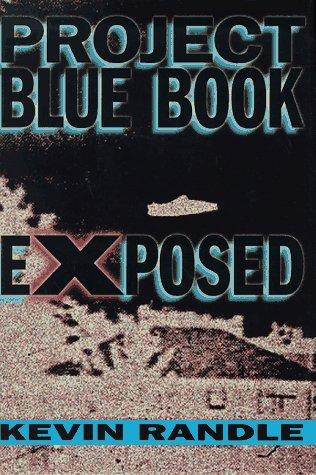
Project Blue Book Exposed
How the Air Force's Own Declassified Files Undercut Project Blue Book's Official Verdicts
Find on Amazon →As an Amazon Associate, OverClassified may earn from qualifying purchases made through this link, at no extra cost to you.
Why This Is Essential Reading
Project Blue Book Exposed earns its place on this list for a method few other books on it fully share: rather than arguing from outside that the Air Force covered something up, Kevin D. Randle goes back into Project Blue Book's own declassified paperwork — paperwork he had unusual, decades-early access to — and lets the files argue against their own official conclusions, case by case. That approach produces its most persuasive moments exactly where this article has focused, on cases like Minot AFB, where the investigating officer's own report contradicts the disposition Blue Book's chief eventually filed. It also carries real, honestly documented limitations: the book's critical footprint outside ufology's own literature is thin, and its central Appendix B rests on a 1970s data-collection method that predates the fuller digital Blue Book archive researchers can now cross-check directly. Read alongside Ruppelt's insider memoir of Blue Book's earlier years, Randle's book supplies exactly what that earlier account cannot: a documented, case-by-case audit of the program's institutionally defensive final decade, built by a researcher whose own record of walking back weaker claims elsewhere gives his specific, sourced case verdicts here real weight.
Related Cases & Theories
Essential Viewing

02-18-19 Kevin Randle, Project Blue Book, UFOs & More
Podcast UFO Live Shows — A 2019 interview in which Kevin Randle discusses Project Blue Book directly, drawing on the same case-by-case findings that anchor this book.
Interview with Kevin Randle, His Objective View on Roswell, and UFO Dossier
Podcast UFO Live Shows — A 2015 interview showcasing the methodologically self-correcting, evidence-first approach that runs through Randle's decades of UFO research, including this book.
Sources Cited
- "Kevin D. Randle." Wikipedia (biography: birth, Vietnam and Iraq military service, education, writing career, Roswell research). en.wikipedia.org
- "Project Blue Book Exposed." AbeBooks (Marlowe & Company, 1997 first edition, ISBN 9781569247464, bibliographic record). abebooks.com
- "Project Blue Book Exposed." Amazon.com (ISBN 1569247463 / 9781569247464, hardcover product listing). amazon.com
- "Project Blue Book exposed." Internet Archive (Marlowe & Co., New York, 1997, 1st ed., catalog record). archive.org
- "Project Blue Book Exposed by Kevin D. Randle." Goodreads (reader ratings and reviews, 3.63-star average, 19 ratings). goodreads.com
- "Kevin D. Randle." Center for UFO Studies (CUFOS biography: military service, education, UFO research career). cufos.org
- Sheaffer, Robert. "UFOdom's Most Prolific Author? A Conversation with Kevin Randle." Skeptical Inquirer, Committee for Skeptical Inquiry. skepticalinquirer.org
- Randle, Kevin. "Project Blue Book - Exposed..." A Different Perspective (personal research blog), July 2007 (author's own account of the book's Appendix B methodology and 1970s Maxwell AFB file research with Robert Cornett). kevinrandle.blogspot.com
- "Project Blue Book exposed." WorldCat.org (OCLC 37047544, bibliographic record). search.worldcat.org
- This site's own resources library: Full Reading List, where this exact edition (ISBN 1569247463) is cited across 16 separate case-file pages.
- This site's own case file: The Minot AFB UFO Incident, for the 1968 case whose own investigating officer's report the book treats as contradicting Blue Book's eventual explanation.
- This site's own case file: The Kinross Incident, for the 1953 case discussed among the book's official-explanation critiques.
- This site's own case file: The Chiles-Whitted Sighting, for the 1948 case Randle has separately published extended technical analysis on.
- This site's own case file: The Mariana UFO Film, for the 1950 case Randle has separately called "one of the strongest cases supporting the existence of UFOs."
- This site's own key-figures entry: Kevin Randle, for his full biography and case connections.
Have corrections, additional research, or peer-reviewed sources? Help improve this entry.
Suggest an Edit