
The Mariana UFO Film
At about 11:25 AM, on a day usually given as August 15, 1950, Nick Mariana, general manager of the Great Falls Electrics minor-league baseball club, was at the ball park at Legion Park with his secretary, Virginia Raunig, when he saw two bright lights in the sky to the north-northwest. He ran to his car, loaded his 16mm movie camera with Kodachrome, and filmed the two lights for about sixteen seconds as they moved away to the southwest and passed behind a water tower — one of the earliest motion-picture UFO records. Over the next eighteen years the footage was examined by the Air Force's Air Technical Intelligence Center (in 1950, when Project Grudge wrote the lights off as reflections from two F-94 jets, and again in 1952, when Edward Ruppelt's team called it an "unknown"), the CIA-convened Robertson Panel (aircraft reflections still possible), Douglas Aircraft scientist Robert Baker (the jet explanation "quite strained"), and the University of Colorado's Condon Committee, whose analyst William Hartmann wrote that it "strains credibility to suppose that these were airplanes" but that the possibility "cannot be entirely ruled out." Mariana said the Air Force kept about thirty of the film's best frames; the Air Force said it removed one damaged frame. The Condon investigators also found that the date itself is uncertain.
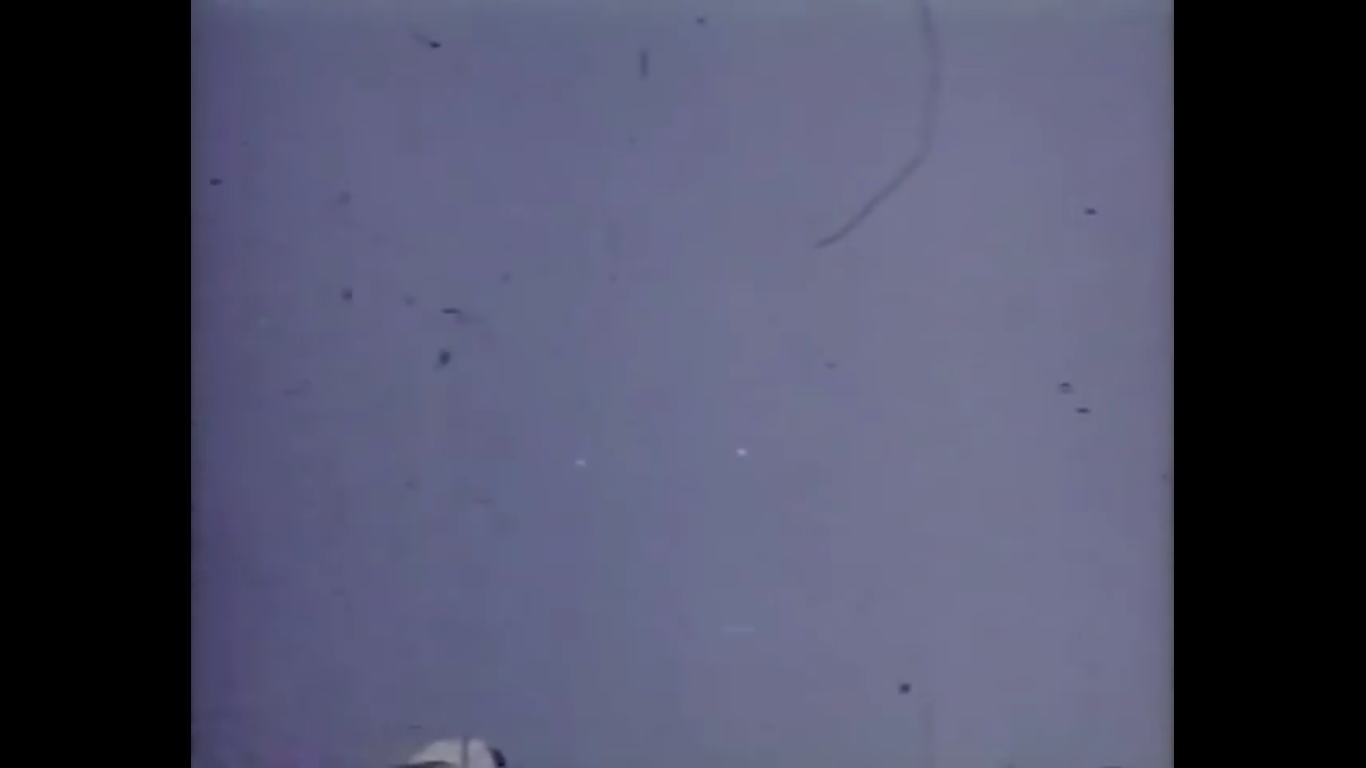
Pictured: an actual surviving frame from Nick Mariana's original 16mm Kodachrome footage, one of the two faint points of light he tracked across roughly sixteen seconds on August 15, 1950 — genuine primary evidence from the case itself, not a stand-in image. The frame is heavily degraded by decades of copying, scratching, and color shift, and, per Mariana's own account, is drawn from a reel he always maintained had already lost its clearest, closest-approach frames before it was returned to him by the Air Force.
Theoretical Alignment
Like McMinnville, this is fundamentally an authenticity-and-identification dispute over a small amount of physical film, not a case that maps cleanly onto the standard hypothesis triangle. The Extraterrestrial Hypothesis earns a modest rating because, if the objects genuinely were not the F-94 jets the Air Force initially blamed, the footage shows exactly the kind of structured, apparently controlled, non-ballistic motion ETH proponents point to — but that "if" is precisely what three technical reviews (Ruppelt's 1952 Air Technical Intelligence Center team, Baker in 1956, and Hartmann's 1968 Condon Committee study) could rule out the conventional aircraft explanation without being able to positively confirm. The Interdimensional Hypothesis finds no purchase whatsoever — nothing in the footage, the witness testimony, or seventy-five years of literature suggests materialization, portal activity, or any of IDH's usual explanatory territory. The Psycho-Social Hypothesis is rated low for the same structural reason it is low in the McMinnville file: this is a two-witness, single-camera case whose entire evidentiary weight rests on frame-by-frame measurements of film geometry and reflectivity, not on the kind of mass misperception, media contagion, or belief-driven testimony PSH is built to explain. To the extent social dynamics matter at all, they show up in how the case was handled afterward — a baseball promoter's showman instincts, a national magazine's mockery, a Hollywood documentary crew's commercial interest — rather than in what Mariana and Raunig actually saw.
Background
By August 1950, the American "flying saucer" phenomenon was just over three years old, dating to Kenneth Arnold's June 1947 sighting near Mount Rainier, and had already produced the Air Force's short-lived Project Sign, its more dismissive successor Project Grudge, and a national wave of press coverage that spring following the McMinnville photographs. Nick Mariana was, that summer, the general manager of the Great Falls Electrics, the city's entry in the Class-C Pioneer League, which that particular season played under the sponsor-branded nickname "Selectrics." Mariana had no documented connection to UFO reporting or the emerging saucer subculture before that August morning; he was, by every account, simply a baseball executive doing routine pre-game rounds of the club's home field.
By the Condon Report's summary of the Air Force records, Mariana walked into the grandstand at about 11:25 AM with his nineteen-year-old secretary, Virginia Raunig; his own 1953 statement says it was "approximately 11:30 a.m." and that his purpose "was to check the direction of the wind in preparation for the afternoon's game." As was his habit, he looked north-northwest toward the smokestack of the Anaconda Copper Company to read the wind, and in line with the stack he saw two bright lights, at first stationary. After a few seconds he decided they could not be airplanes, pointed them out to Raunig, and ran to his car 50 to 60 feet away. In the 1950 Air Force report he described two disk-shaped objects with a bright, clean "aluminum quality," about 50 feet in diameter and 3 feet thick, roughly 50 yards apart, with a definite spinning motion; in 1953 he called them "like two new dimes in the sky." His speed estimate was about 200 mph in 1950 and over 400 mph in late 1952. The Air Force report says Raunig saw the objects for about seven seconds.
At the car he spent five to eight seconds loading his Revere turret-type 16mm camera with daylight Kodachrome, then began filming, panning slowly from right to left; about thirty seconds had passed since the sighting began. By then the lights had moved from their stationary position toward the southwest, and the first frames show them already in the southwest, about 15° above the horizon and slowly descending. He filmed for about sixteen seconds at 16 frames per second as the two lights moved steadily across the sky, passed behind a water tower, and faded. The Air Force later established that two F-94 jets were near the city and landed a few minutes afterwards; Mariana and Raunig said the jets appeared in another part of the sky a minute or two after the objects had gone, and Mariana reported seeing two planes coming in to land behind him just after he stopped filming.
Complete Timeline
| Date | Event |
|---|---|
| June 1947 | Kenneth Arnold's sighting near Mount Rainier launches the American "flying saucer" era. |
| May 11, 1950 | Paul and Evelyn Trent photograph the McMinnville, Oregon disc, nine weeks before the Great Falls sighting, feeding the same national wave of press coverage. |
| August 15, 1950 (date questioned), ~11:25 AM | Nick Mariana and Virginia Raunig see two bright lights above the Anaconda smokestack from Legion Park; Mariana films about sixteen seconds of 16mm Kodachrome as the lights move southwest. |
| August–September 1950 | Mariana shows the processed film to friends and service clubs, including the Central Roundtable Athletic Club. The Condon Report found no mention of the sighting in either Great Falls newspaper before September 12, 1950; Clark's encyclopedia says the Great Falls Tribune reported it the next day. |
| October 1950 | A local newspaperman (of the Great Falls Leader, per the Condon Report) alerts officials. Captain John P. Brynildsen interviews Mariana; the initial Air Force report is dated October 5–6, 1950, and the film goes to the Air Technical Intelligence Center at Wright-Patterson AFB under Project Grudge. It is also examined by the U.S. Navy. |
| Late 1950 | Project Grudge writes the lights off, in Ruppelt's words, as "the reflections from two F-94 jet fighters that were in the area." The film is returned with an Air Materiel Command letter (signed by Lt. Col. Ray W. Taylor, per Clark) saying "our photo analysts were unable to find on it anything identifiable of an unusual nature." |
| After the film's return | Mariana says about the first thirty frames (thirty-five in some accounts), showing the objects largest and rotating, are missing. The Air Force says it removed only one damaged frame. |
| January 1951 | Journalist Bob Considine publishes "The Disgraceful Flying Saucer Hoax" in Cosmopolitan, mocking Mariana's account alongside other prominent early UFO cases. |
| 1951 | Mariana files a slander suit against Considine over the article's characterization of him. |
| July 1952 – January 1953 | At the Pentagon's request, Edward J. Ruppelt reopens the case; through an intelligence officer at Great Falls AFB Mariana is re-interviewed and a copy of the film obtained (Clark says Mariana first required an agreement that no frames be removed). ATIC rules out birds, balloons and meteors, finds the F-94s "just weren't anywhere close to where the two UFO's had been," and calls the film an "unknown." A supplementary report from Great Falls AFB is dated January 9, 1953. |
| January 14–17, 1953 | The CIA-convened Robertson Panel, chaired by Howard P. Robertson, views the Mariana film and the July 1952 Tremonton, Utah film. It judges that the objects were "reflections of aircraft known to have been in the area" (Clark); Ruppelt wrote that the panel "couldn't prove the UFO's were the jets, but neither could we prove they weren't." |
| 1954–1955 | Greene-Rouse Productions, making a documentary, obtains the film; Douglas Aircraft scientist Robert M. L. Baker Jr. borrows a 35mm reprint from Sam Goldwyn Studios in 1955 for photogrammetric analysis. |
| September 1955 | Mariana's slander suit against Bob Considine is formally dropped. |
| March–April 1956 | Baker's report, "Photogrammetric Analysis of the 'Montana' Film Tracking Two UFOs" (Douglas Aircraft), is completed; Wikipedia, citing it, gives his verdict on the jet-reflection explanation as "quite strained." |
| May 9, 1956 | United Artists releases Unidentified Flying Objects: The True Story of Flying Saucers, directed by Winston Jones and produced by Clarence Greene and Russell Rouse, with Mariana's footage and an on-camera account by Mariana. |
| 1967–1968 | The University of Colorado's Air Force-funded Condon Committee reinvestigates the case as Case 47. Roy Craig interviews the principals in 1967 and finds that the team played no home games between August 9 and 18, 1950; David Saunders regards the film as strong evidence; astronomer William K. Hartmann writes the case analysis. |
| January 1969 | The Condon Report is published. Hartmann's Case 47 concludes that "while it strains credibility to suppose that these were airplanes, the possibility nonetheless cannot be entirely ruled out," and the abstract calls the case "unexplained." |
| July 29, 1968 | In a statement to the House Committee on Science and Astronautics symposium, Baker says that after about 18 months of study "neither of these hypothesized natural phenomena explanations had merit" for the Montana and Utah films; his analysis is also published in the Journal of the Astronautical Sciences 15(1), 1968. |
| 1973–1974 | Philip J. Klass documents that the two F-94s were in the area and did not land until several minutes after the filming, and points to a Blue Book photo comparison showing a bright aluminum airliner producing a similar image (as summarised by Hall and Connors). |
| 2008 | Great Falls' Pioneer League baseball club renames itself the Great Falls Voyagers, a nod to the city's UFO legacy. |
| 2020s | Copies of the film and the underlying Project Blue Book case file are held by the U.S. National Archives and Records Administration and have since been digitized and made publicly viewable online, including on Wikimedia Commons. |
The Sighting at Legion Park
The core account comes from Mariana's statements to the Air Force in 1950 and 1953 and his later interviews. At about 11:25 AM he and his secretary Virginia Raunig were in the grandstand at Legion Park, the Electrics' home field, where he had gone to check the wind. Looking north-northwest to the Anaconda smokestack, he saw two bright lights, stationary at first. He told the Air Force in 1950 that they were disk-shaped, with a bright, clean "aluminum quality," about 50 feet across, 3 feet thick and 50 yards apart, and spinning. Raunig, the Air Force report says, saw them for about seven seconds. His account shifted in some details over the years: the duration grew from about thirty seconds (1950) to three and a half minutes (1953), his speed estimate from about 200 to over 400 mph, and in 1967 Raunig told the Condon Committee she remembered a single light, not two.
Mariana's Revere turret-type 16mm camera, fitted with a 3-inch f/1.9 lens, was in his car; he loaded it with daylight Kodachrome, set the diaphragm at f/22 and the focus at infinity, and filmed at 16 frames per second, panning from right to left. The film shows two bright spots moving steadily to the southwest at an elevation of about 15°, passing behind a water tower, and slowly fading and shrinking; the Condon analysis found they had faded out by about frame 225, and that the final fade was sudden enough that they "were not isotropic constant-luminosity reflectors" such as balloons. The film shows no hovering. Mariana reported seeing two planes coming in to land behind him just after he stopped filming, a detail that later analysts used both for and against the jet explanation.
From Legion Park to Wright-Patterson: The First Air Force Investigation
Mariana did not sit on his film: he had it processed and showed it to friends and service clubs, including the Central Roundtable Athletic Club. Sources differ on the press: Jerome Clark's encyclopedia says the Great Falls Tribune reported the sighting the next day, but the Condon Report found no mention in either Great Falls newspaper before September 12, 1950. The Condon Report says a newspaperman affiliated with the Great Falls Leader was the link to officials; Clark says a Tribune reporter called Wright-Patterson.
Captain John P. Brynildsen interviewed Mariana and Raunig at Great Falls Air Force Base; the initial Air Force report is dated October 5–6, 1950, and the film went to the Air Technical Intelligence Center (ATIC) at Wright-Patterson Air Force Base under Project Grudge (Blue Book file 1950-08-9615640-Great Falls-Mont.). According to Clark, Brynildsen told a reporter he had received about eight feet of film, while his message to Wright-Patterson said he was sending about fifteen feet; Clark writes that the discrepancy was never cleared up.
The film was also examined by the U.S. Navy. Ruppelt later wrote that "in 1950 there was no interest in the UFO so, after a quick viewing, Project Grudge had written them off as 'the reflections from two F-94 jet fighters that were in the area.'" The film went back to Mariana with an Air Materiel Command letter, signed according to Clark by Lieutenant Colonel Ray W. Taylor, which Hartmann later quoted as "an example of military obfuscation": "our photo analysts were unable to find on it anything identifiable of an unusual nature. Our report of analysis must therefore be negative."
The Missing-Frames Controversy
The case's most enduring dispute began when the reel came back. Mariana said that about the first thirty frames (thirty-five in some accounts) were missing, the frames that showed the objects largest; as Baker summarised his claim, "the first 30-odd frames showed larger images of the UFOs with a notch or band at one point on the periphery of the objects by which they could be seen to rotate in unison while on the rest of the film the objects show up only as unarticulated bright white dots." On the surviving film, the first ten to twenty frames show the objects at their brightest and largest. Mariana could not prove the original frame count; the film had been shown informally and never logged.
The Air Force's position was that it had removed a single frame damaged in analysis. When Roy Craig of the Condon Committee interviewed the principals in 1967, Mariana could not locate a letter in which, he said, the Air Force had admitted deleting film; some people who reportedly saw the film before it went to the Air Force agreed that not all of it came back, while several others said they had never seen it at all. Craig later recalled that when he pressed Mariana's former secretary about the clipping, she said, "What you have to remember in all this is ... that Nick Mariana is a promoter" (Craig, 1995). No document has resolved the frame count either way, so this file treats the missing-frames claim as Mariana's assertion, partly supported and partly contradicted by other witnesses.
Ruppelt's 1952 Re-Examination
In 1952, at the request of the Pentagon (Hall and Connors name Gen. John A. Samford), Edward J. Ruppelt, then heading the Air Force's UFO project, reopened the case. Working through an intelligence officer at Great Falls AFB, he had Mariana re-interviewed and obtained a copy of the film; Clark writes that Mariana agreed only after the Air Force undertook not to remove any frames. Because the objects passed behind the water tower, the photo lab had a reference point, and its calculations "quickly confirmed that the objects were not birds, balloons, or meteors": they moved too fast for birds, too slowly for meteors, and not with the wind. That left airplanes. The intelligence officer found that only two F-94s were near the city and that they had landed about two minutes afterwards; Ruppelt's team then studied their flight paths and landing pattern:
"The two jets just weren't anywhere close to where the two UFO's had been. Next we studied each individual light and both appeared to be too steady to be reflections. We drew a blank on the Montana Movie—it was an unknown."
That account, from Ruppelt's 1956 book The Report on Unidentified Flying Objects, made the Mariana film an "unknown." Al Chop, then at ATIC, told Baker in 1955 that "the analysis was considered inconclusive," which the Condon Report took as confirming Ruppelt's account.
The Robertson Panel and the Return to "Aircraft"
Ruppelt's "unknown" did not stand for long. In January 1953 (formal sessions January 14–17) the CIA convened a panel of scientists chaired by Caltech physicist Howard P. Robertson to review the Air Force's best evidence. The Robertson Panel viewed the Mariana film alongside the film Delbert Newhouse shot near Tremonton, Utah in July 1952, and, according to Clark, judged that the Mariana objects were "reflections of aircraft known to have been in the area." Ruppelt's own account is more equivocal: the panel rejected the film as positive proof because, although the witnesses said the jets were elsewhere and "our study backed them up, there was still a chance that the two UFO's could have been the two jets. We couldn't prove the UFO's were the jets, but neither could we prove they weren't."
It is worth being precise about what kind of finding this was. The Robertson Panel's charter and stated recommendations were substantially about public policy — the panel explicitly urged the Air Force to strip UFO reports of "the special status they have been given" and to undertake public education and, in its own members' words, "debunking" to reduce the volume and alarm associated with sighting reports. Its review of individual case files, including Mariana's, was conducted quickly, without the months of frame-by-frame photogrammetric measurement Baker or Hartmann would later apply, and its conclusions functioned as much to close the book on Blue Book's most publicized "best evidence" as to settle the underlying physics. That does not make the panel's aircraft conclusion wrong, but it does mean the 1953 verdict rests on a different, thinner evidentiary basis than either the more skeptical 1952 ATIC review that preceded it or the more rigorous technical analyses that followed.
Robert Baker's Photogrammetric Analysis and the 1956 Documentary
The most detailed technical defense of the film came from a scientist hired for a Hollywood production. In 1954 Greene-Rouse Productions, preparing a United Artists documentary, obtained the rights to Mariana's footage, and Robert M. L. Baker Jr., then consulting for Douglas Aircraft, analysed it; in 1955 he borrowed a 35mm reprint from Sam Goldwyn Studios. In his 1968 statement to Congress he described "about 18 months of rather detailed, albeit not continuous, study using various film-measuring equipments at Douglas and at UCLA, as well as analysis of a photogrammetric experiment." He also stressed the limits of the material: the films show "rather ill-defined blobs of light," so "linear distance, speed, and acceleration cannot be determined precisely, nor can size and mass."
His 1956 report, "Photogrammetric Analysis of the 'Montana' Film Tracking Two UFOs" (Douglas Aircraft; later published in the Journal of the Astronautical Sciences, 1968), found the official jet-reflection explanation "quite strained," according to Wikipedia's summary. As the Condon Report describes it, Baker concluded that the ellipticity of the images "is due exclusively to the movement of the camera," and that although the images fade, they fade out suddenly enough at the end that they "were not isotropic constant-luminosity reflectors." He also gathered the Air Force's 1950 interrogation of the F-94 pilots, the weather records, a March 1955 telephone conversation with Mariana and November 1955 correspondence with the commander of what had become Malmstrom AFB. Earlier versions of this file attributed specific distance-and-speed figures and a DC-3 test flight to Baker; this review could not confirm them and has removed them.
Baker's work reached a wide audience through Unidentified Flying Objects: The True Story of Flying Saucers (also released as U.F.O.), directed by Winston Jones and released by United Artists on May 9, 1956, which included Mariana's footage and an on-camera account by Mariana. Baker did not claim an extraordinary craft. In his July 29, 1968 statement to the House Committee on Science and Astronautics he said that preliminary analysis left "airplane fuselage reflections of the sun" as the only natural candidate for the Montana film (and birds for the Utah film), and that after detailed study "it appeared that neither of these hypothesized natural phenomena explanations had merit." At the 1969 AAAS symposium he described the film as unidentifiable and argued for better photographic data before speculating about the nature of UFOs.
The Condon Committee and Hartmann's Analysis
By the mid-1960s, sustained public and congressional pressure over UFO reports led the Air Force to fund an independent university-based review, formally titled the Scientific Study of Unidentified Flying Objects and commonly called the Condon Report after its director, physicist Edward U. Condon of the University of Colorado. The Mariana footage was reexamined as Case 47, immediately following the Committee's McMinnville investigation (Case 46) in the same Section IV of the published report, and written up by the same investigator, astronomer William K. Hartmann.
Roy Craig of the Colorado project raised a basic problem with the date. A January 9, 1953 letter from Great Falls AFB quotes Mariana's own statement as beginning, "On about the 5th or 15th of August, 1950," and a late-1956 Blue Book review lists the case as "5 or 15 August, 1950." Checking Great Falls newspapers, Craig found that no home game was scheduled for August 15 and that the team played that evening in Twin Falls, Idaho; at his request the Great Falls Public Library's reference librarian determined that the team played no home games in Great Falls between August 9 and 18. The Condon Report concluded that "the 15 August sighting date is therefore certainly open to question." That matters for the jet explanation, because the F-94 landing records and the wind data were assembled for August 15. Psychologist David Saunders, a principal investigator on the project, took a very different view of the case: he later wrote that the Mariana film "was the one sighting of all time that did more than any other single case to convince me that there is something to the UFO problem" (as quoted by Clark). Saunders was dismissed from the project in 1968 after the leak of Robert Low's internal memo; Craig wrote that he "would not like to have to defend Dr. Saunders's conviction that the Mariana film is strong evidence that we have extraterrestrial visitors."
Hartmann's analysis disagreed with Baker on one point: measuring the image shapes frame by frame, he concluded that, except for a few frames, the ellipticity was present "because the reflecting source is not circular," not because of camera motion, and that the objects were probably not resolved but were bright sources somewhat smaller than the images. He ruled out balloons (if the August 15 date was right, the objects were moving into the wind), birds (the linear path and uniform images over 16 seconds), and meteors. On airplanes he gave two arguments: short-term variations in image size were no more than about ±5%, and it was "very unlikely that two aircraft could maintain such constant reflections" over the 16 seconds and 20° of azimuth filmed and the minimum of 50 seconds observed visually; and the two F-94s were accounted for because "Witness I reported seeing two planes coming in for a landing behind him immediately following the filming." His conclusion: "Past investigations have left airplanes as the principal working hypothesis. The data at hand indicate that while it strains credibility to suppose that these were airplanes, the possibility nonetheless cannot be entirely ruled out." The case abstract reads: "The case remains unexplained."
The Skeptical Case: Klass, Sheaffer, and the Jets
The skeptical case for the Mariana film rests mainly on the original 1950 and 1953 aircraft-reflection findings. Philip J. Klass, the Aviation Week & Space Technology senior editor and the era's best-known UFO skeptic, documented in 1973 that the two F-94s were indeed in the area and did not land until several minutes after Mariana shot his footage, and pointed to a photo comparison in the Blue Book files in which a bright aluminum airliner reflecting sunlight produced a similar image (as summarised by Michael Hall and Wendy Connors, who note that the first F-94 landed at 11:33 AM). Proponents answer that a comparison photograph does not address Hartmann's argument about the steadiness of the reflections over sixteen seconds.
Robert Sheaffer has written skeptically about the classic photographic cases in The UFO Verdict (1981) and UFO Sightings: The Evidence (1998). This review could not confirm what, if anything, either book says specifically about the Mariana film, so no particular argument is attributed to him here.
Taken together, the skeptical case is serious: two F-94s were airborne near the city and landed within minutes, the Grudge analysts and the Robertson Panel both favoured reflections from them, and the date problem raised by Craig means that the flight records and wind data may not even refer to the day of the sighting. What it has not fully answered is the argument that Ruppelt's 1952 team and Hartmann each made in different ways: that the jets' known landing pattern did not put them where the objects were, and that two aircraft are unlikely to hold such steady reflections for so long.
The Considine Feud and Mariana's Lawsuit
In January 1951 Hearst columnist Bob Considine published "The Disgraceful Flying Saucer Hoax" in Cosmopolitan, a broadside against the best-known early UFO cases, Mariana's film among them. Mariana, who said the article implied he was "a liar, prankster, half-wit, crank, publicity hound and fanatic," filed a slander suit against Considine; according to Clark, the suit was dropped in September 1955. No verdict was reached on the underlying dispute.
Cultural Legacy
Great Falls has never entirely let go of its 1950 moment. According to the Great Falls History Museum, more than one hundred further UFO reports have been made in and around the city since, a reputation that owes something to the presence of a major Air Force base and its traffic. In 2008 the city's Pioneer League club, then the Great Falls White Sox, renamed itself the Great Falls Voyagers in honour of Mariana's film. Mariana, a 1938 journalism graduate of Montana State University who had edited the base newspaper at Great Falls AFB during the war, was also a radio sports commentator at the time of the sighting (Condon Report).
Circumstantial Evidence
- Mariana showed the developed film to friends and service clubs before it reached the Air Force, behavior more consistent with a witness eager to share a remarkable experience than with someone planning a secretive hoax.
- Mariana pursued a multi-year slander lawsuit against nationally syndicated columnist Bob Considine over the 1951 Cosmopolitan article mocking his account, a costly and sustained response inconsistent with a simple, low-stakes publicity stunt.
- The 1950 Air Force interrogator described Mariana as "reliable, trustworthy, and honest" and Raunig as "a fairly reliable individual and of good sound judgment," though some details of their accounts changed over the years (duration, speed, and, in Raunig's 1967 recollection, the number of lights).
- The Air Force's analysts reached different conclusions in 1950 (F-94 reflections) and 1952 ("unknown"), and the Robertson Panel returned to aircraft reflections in 1953 while, by Ruppelt's account, conceding it could not prove the identification.
- Two technical analysts outside the UFO movement — Douglas Aircraft's Robert Baker in 1955–56 and the Condon Committee's William Hartmann in 1968 — each found the F-94 reflection explanation unconvincing, Hartmann while acknowledging it "cannot be entirely ruled out."
- The claim that about thirty frames were removed during the first Air Force analysis has never been resolved; some witnesses supported it, and others said they had never seen the film.
- No analysis found evidence of optical fakery in the surviving footage; Ruppelt's team considered and rejected the possibility that the film had been faked.
Key Witnesses
Nick Mariana
Filmed the two lights while checking the wind at Legion Park, capturing about sixteen seconds of 16mm color footage. A journalism graduate, wartime base-newspaper editor and radio sports commentator as well as the baseball club's general manager, Mariana showed the film widely before it reached the Air Force, said that about thirty of its best frames were missing when it came back, and sued columnist Bob Considine for slander. His account varied in some details over the years, and in 1967 he could not find the letter in which he said the Air Force had admitted cutting the film.
Virginia Raunig
Nineteen years old at the time. The 1950 Air Force report says she saw the objects for about seven seconds and described them as Mariana did; the interrogator found her "a fairly reliable individual and of good sound judgment." She never saw the film. In 1967 she told the Condon Committee's Roy Craig that she remembered a single light, not two, and that its appearance was quite different from an airplane.
Edward J. Ruppelt
At the Pentagon's request, reopened the Mariana case in 1952 and had the film re-analysed; his team found the F-94s "just weren't anywhere close to where the two UFO's had been" and called the film an "unknown." His 1956 book also records that the Robertson Panel rejected the film as proof because the jets could not be excluded.
Robert M. L. Baker Jr.
Analysed the film for the Greene-Rouse documentary over about eighteen months in 1955–56, at Douglas and UCLA, reporting in "Photogrammetric Analysis of the 'Montana' Film Tracking Two UFOs" (1956) that the jet-reflection explanation was "quite strained." In 1968 he told a House committee symposium that "neither of these hypothesized natural phenomena explanations had merit," while stressing that distance, speed and size could not be determined precisely from the film.
William K. Hartmann
Wrote the Condon Committee's Case 47 analysis. Found that the images' ellipticity was intrinsic rather than (as Baker thought) a panning effect, argued that two aircraft were unlikely to hold such steady reflections, and concluded that "while it strains credibility to suppose that these were airplanes, the possibility nonetheless cannot be entirely ruled out."
Roy Craig
Interviewed the principals in 1967 and found that the Electrics played no home games between August 9 and 18, 1950 (they were in Twin Falls, Idaho on the evening of August 15), putting the date in question. Found the missing-frames testimony mixed and recorded Mariana's former secretary's remark that "Nick Mariana is a promoter."
The Five Observables Assessment
The Five Observables framework, developed by former AATIP director Luis Elizondo, is designed to classify witnessed UAP flight performance against the limits of known technology of their era. As with McMinnville, the Mariana case is a poor structural fit for that framework: it is roughly sixteen seconds of film shot by one witness, not an extended, instrumented flight-dynamics encounter, so most of the standard performance observables were never actually reported by anyone rather than genuinely absent from an observed craft. The assessment below reflects that honestly rather than inferring capabilities no one witnessed.
Assessment: Anti-Gravity Lift is rated speculative only because the objects were described as apparently stationary or hovering at first sighting — but that description comes from witness recollection rather than the surviving film, which begins after the objects were already in motion, so it cannot be treated as confirmed. Instant Acceleration and Hypersonic Velocity are both rated absent: Mariana's own speed estimate topped out around 400 mph, well within period jet aircraft performance, and no instrumentation beyond estimation by eye was ever available to measure it more precisely. Low Observability is rated absent because the objects were bright, reflective, and easily filmed on a consumer camera from a considerable distance — the opposite of a stealthy or hard-to-detect craft. Trans-Medium travel is rated absent, as no transition between air, water, or any other medium was reported. As in the McMinnville file, the larger point is structural: sixteen seconds of a receding light source simply does not generate the kind of sustained flight-performance data the Five Observables framework was built to organize, and assigning confident ratings to categories nobody actually witnessed would misrepresent what the film can and cannot show.
Evidence Assessment
Supporting Anomalous Origin
- Edward Ruppelt's 1952 ATIC reexamination found the F-94 jets "just weren't anywhere close to where the two UFO's had been" and called the film an "unknown."
- Robert Baker's 1955–56 analysis for Douglas Aircraft called the jet-reflection explanation "quite strained," and in 1968 he said neither natural explanation "had merit."
- William Hartmann's 1968 Condon Committee analysis found that "it strains credibility to suppose that these were airplanes," while acknowledging the possibility "cannot be entirely ruled out"; the case abstract calls it "unexplained."
- The 1950 Air Force interrogator judged both witnesses reliable, and Ruppelt's team rejected the possibility that the film was faked.
- Mariana pursued a costly, multi-year slander lawsuit against a nationally syndicated columnist rather than quietly accept mockery of his account, behavior inconsistent with a low-stakes publicity hoax.
- No investigation on any side of the dispute found evidence of optical fakery or in-camera trickery in the surviving footage.
Supporting a Conventional / Aircraft Explanation
- The Air Force's original 1950 Air Technical Intelligence Center analysis and the CIA-convened Robertson Panel's 1953 review both concluded the objects were reflections from two F-94 jets confirmed to have been airborne in the area that morning.
- Mariana himself reported seeing two aircraft land at the nearby Air Force base immediately after he finished filming, placing jets in the vicinity at the relevant time by his own account.
- Philip Klass documented that the F-94s were in the area and did not land until several minutes after the filming, and pointed to a Blue Book photo of a sunlit airliner producing a similar image.
- The Condon Committee found that the Electrics played no home games between August 9 and 18, 1950, and Mariana's own 1953 statement gives the date as "about the 5th or 15th"; if the date is wrong, the F-94 records and wind data used on both sides may not apply.
- The film's chain of custody was uncontrolled for years, and the missing-frames claim central to the case for anomalousness has never been documented.
- Mariana's former secretary told Roy Craig in 1967 that she remembered only one light, and remarked that "Nick Mariana is a promoter."
Why "Disputed"
The Mariana film is rated DISPUTED because its official record contradicts itself and the independent analyses do not settle it. Project Grudge wrote the lights off as F-94 reflections in 1950 after a quick viewing; Ruppelt's 1952 ATIC review found the jets were not where the objects had been and called the film an "unknown"; the Robertson Panel in 1953 favoured aircraft reflections while, by Ruppelt's account, admitting it could not prove them. Douglas Aircraft's Robert Baker (1956) and the Condon Committee's William Hartmann (1968), working independently, both found the jet explanation unconvincing, though neither claimed an extraordinary craft and Hartmann expressly left airplanes possible. Against that stand a missing-frames claim that cannot be proven, witness accounts that changed in some details (including Raunig's later memory of a single light), and a date problem found by the Condon Committee that undercuts the flight and weather records on which the arguments on both sides rely. The record is substantial and specific, but it points in more than one direction.
Sensor & Instrumentation Detection Profile
This case has exactly one instrument: Nick Mariana's personal Revere turret-type 16mm movie camera, fitted with an f/1.9, three-inch lens, its diaphragm set to f/22 and focus at infinity, loaded at the car with daylight Kodachrome color film and run at sixteen frames per second. There was no radar, no second camera, no audio recording (the camera had none), and no professional photographer or trained aerial observer present. Mariana shot about sixteen seconds of footage; the images had faded out by about frame 225. Every subsequent piece of "instrumentation" brought to bear on the case was applied to prints or copies of this same reel, years or decades after the fact: the Air Force's Air Technical Intelligence Center (ATIC) photo lab in 1950 and again in 1952, the U.S. Navy; Douglas Aircraft physicist Robert M. L. Baker Jr.'s eighteen-month photogrammetric study in 1955–56; and astronomer William Hartmann's 1968 analysis for the Condon Committee. As with McMinnville, this absence of any independent cross-check is the single most important structural fact about the case: every conclusion anyone has ever reached about the Mariana film is a conclusion about roughly sixteen seconds of 1950-vintage consumer film stock, not about a corroborated sensor track.
Environmental & Geospatial Context
Great Falls, Montana sits on the open plains of north-central Montana. The ball park lies on the northwestern outskirts of the city near the Missouri River and the Anaconda Copper Company works, about three miles northwest of what was then Great Falls Air Force Base (renamed Malmstrom Air Force Base in 1955), according to the Condon Report. The weather station recorded a clear sky with 60-mile visibility and a strong southwest surface wind of 25–28 mph during the late morning; the Sun was about 54° high in the south-southeast (JPL Horizons). The objects were first seen to the north-northwest and filmed moving toward the southwest, low in the sky. The geospatial fact that has shaped the whole debate is that two F-94 jets from the base were airborne near the city and landed a few minutes after the sighting; whether they could have been the objects depends on their flight paths, which Ruppelt's team concluded did not match.
Observer Credibility & Occupational Profile
Nick Mariana was a promoter by trade — a baseball general manager and radio sports commentator, and a journalism graduate who had edited the base newspaper at Great Falls AFB during the war. The 1950 Air Force interrogator described him as "a reliable, trustworthy, and honest individual" who was "highly respected in the community." His showmanship cuts both ways: it explains why he showed the film to service clubs for weeks, and it is the trait Roy Craig's Condon investigation seized on, quoting a former secretary's remark that "Nick Mariana is a promoter." Parts of his account changed over the years (the duration, his speed estimate, and the date, which he gave in 1953 as "about the 5th or 15th"), and in 1967 he could not produce the letter he said proved the Air Force had cut his film. He sued journalist Bob Considine for slander in 1951 over a Cosmopolitan article that he said painted him as "a liar, prankster, half-wit, crank, publicity hound and fanatic"; the suit was dropped in September 1955. Virginia Raunig, nineteen at the time, saw the objects for about seven seconds by the 1950 report, never saw the film, and in 1967 remembered only one light.
Physical & Material Assays
As with McMinnville, the only physical evidence in this case is the film itself — there is no debris, no soil sample, no metallurgical assay, and no claim of any recovered object. That makes the reel's own chain of custody unusually consequential, and it is, again, genuinely poor by any modern evidentiary standard: developed film sat with Mariana for weeks while he screened it informally for local groups; a local newspaperman, not Mariana himself, alerted officials; Captain John P. Brynildsen collected it in October 1950, and, according to Clark, his statements about how much footage he collected did not match; and the reel changed hands repeatedly over the following years — returned to Mariana by Lt. Col. Ray W. Taylor in late 1950, sent back to Wright-Patterson for a second look in 1952, examined via a 35mm duplicate borrowed from Sam Goldwyn Studios by Robert Baker in 1955, and finally reviewed again by the Condon Committee in 1966–68. At no point in that twenty-year odyssey was the film held under anything resembling a controlled chain of custody, and the one specific claim of physical tampering at the center of the case — that roughly thirty frames were removed — has never been resolved with documentary certainty on either side.
Historical Precedents & Archive Matches
The Mariana film arrived in the same 1950 "flying saucer" surge that had produced the McMinnville Trent photographs in Oregon three months earlier, and McMinnville is the closest comparison in this catalogue: both are two-witness, single-camera daylight cases, both were written up by astronomer William K. Hartmann for the Condon Report, as Case 46 (McMinnville) and Case 47 (Great Falls), and both were left without a confident conventional explanation by that study. The case's procedural twin is the July 1952 Tremonton, Utah film shot by Delbert Newhouse, which the Robertson Panel reviewed alongside Mariana's footage and which Baker analysed at the same time; Hartmann later accepted a bird identification for Tremonton but not an aircraft identification for Great Falls. Film evidence of any kind remained a small minority of Project Blue Book's roughly 12,600 cases, which is part of why these few seconds of film have attracted so much specialist analysis.
Material Analysis
As with McMinnville, the only "material evidence" that has ever existed in this case is the film itself — there is no debris, no soil sample, no metallurgical assay, and no claim of any recovered physical object. That makes the reel's own physical history unusually important, and, as detailed above, it was not controlled by any evidentiary standard for most of its existence: developed and screened informally for weeks before reaching the Air Force; handled by Mariana, Brynildsen, ATIC's photo lab and the Navy in its first year alone; duplicated onto 35mm stock and passed through a Hollywood production company in 1955; and examined again by an academic committee more than fifteen years after the sighting. Every technical finding in this case — the 1950 and 1952 ATIC assessments, the Robertson Panel's 1953 review, Baker's 1956 photogrammetric report, and Hartmann's 1968 Condon Committee analysis — was performed on prints, duplicates, or the original of this same reel, meaning the entire analytical debate has been conducted within the boundaries of what can be extracted from roughly sixteen seconds of 1950 consumer color film, without any additional physical evidence ever entering the case.
Supporting a Genuine, Unconventional Object
- Baker (1956) and Hartmann (1968), working independently, both found the F-94 reflection explanation unconvincing; Hartmann argued that two aircraft could hardly hold such steady reflections for sixteen seconds of film and at least fifty seconds of visual observation.
- Ruppelt's 1952 team found the jets' landing pattern did not place them where the objects were, and both witnesses said the jets appeared in another part of the sky after the objects had gone.
Supporting Aircraft Reflection
- Two F-94 jets were airborne near the city and landed within minutes of the sighting (the first at 11:33 AM, per Hall and Connors).
- Project Grudge in 1950 and the Robertson Panel in 1953 both favoured reflections from those aircraft, and Klass pointed to a Blue Book photo of a sunlit airliner producing a similar image; the date problem means the jet records may not even refer to the day of filming.
The Conventional Explanation Candidate: Reflections from F-94 Jet Interceptors
The leading terrestrial explanation, adopted by Project Grudge in 1950 and favoured by the Robertson Panel in 1953, is that Mariana filmed sunlight reflecting off two F-94 jets from the nearby base. It deserves serious evaluation because the jets were really there: Air Force records show two F-94s near the city that landed a few minutes after the sighting, and Klass found a Blue Book photograph in which a sunlit airliner produced a similar image. If the sighting was not on August 15 after all, as the Condon Committee's schedule check suggests it may not have been, the jets on record would be irrelevant, but so would much of the evidence against them.
Where the Jet-Reflection Theory Falls Short
Its weaknesses are the ones Ruppelt's team and Hartmann identified. Ruppelt's 1952 study of the jets' flight paths and landing pattern concluded they "just weren't anywhere close to where the two UFO's had been," and both witnesses said the jets appeared in another part of the sky after the objects had gone. Hartmann argued that aircraft reflections rarely stay so constant: image size varied by no more than about ±5%, and two aircraft would have had to hold steady reflections over 16 seconds of film and 20° of azimuth; in his own observations near Tucson airports, no aircraft held such a reflection for as long. Baker, for his part, found the reflection hypothesis "quite strained" and in 1968 said it lacked merit. Neither analyst could fix the objects' true distance from the film.
A Genuine Unconventional Object
The alternative explanation — that Mariana filmed an actual, unidentified craft, coincidentally in the same general sky as, but distinct from, the F-94s that landed shortly afterward — is the residual position both Ruppelt's 1952 team and Hartmann's 1968 Condon Committee analysis were left with after ruling out the specific aircraft-reflection mechanism. Neither investigator went further to claim an extraordinary origin; Hartmann's case abstract stops at "unexplained." This candidate is strengthened by the consistency of Mariana's and Raunig's testimony and by the absence of any established hoax motive, but it has never produced independent corroboration beyond the single reel of film.
A Simple, Undetected Misidentification or Partial Hoax
A third, more minimal explanation holds that Mariana genuinely filmed something ordinary — whether the F-94s after all, despite Baker's and Hartmann's reservations, or some other conventional aerial phenomenon — and that the case's persistent "unexplained" reputation owes more to the missing-frames controversy, the film's poor chain of custody, and Mariana's own promotional handling of the story than to any genuine anomaly in what was actually recorded. This candidate is difficult to rule out precisely because the disputed missing frames — the ones witnesses said showed the objects largest, closest, and most clearly rotating — are not available for any modern re-analysis; researchers on every side of the debate are limited to the surviving film, whose images had faded out by about frame 225.
Reflections from F-94 Jet Interceptors
Plausible ContestedThe only candidate tied to aircraft documented in the area, but contested by Ruppelt's 1952 flight-path study and by two independent analysts a decade apart; the Condon Committee's date problem complicates the evidence on both sides.
Related Cases
Confirmed Documents & Official Records
The declassified Air Technical Intelligence Center case file on the Mariana sighting, including correspondence, witness statements, and the original photo-analysis findings, digitized and hosted on Wikimedia Commons.
UNCLASSIFIED (declassified)The complete text of the Air Force-funded Condon Report, whose Section IV photographic case studies include the Mariana film as Case 47, investigated by William K. Hartmann.
UNCLASSIFIEDNational Archives finding aid for Project Blue Book (RG 341) and related UFO/UAP textual and film holdings, including the Mariana case materials referenced in this file.
UNCLASSIFIEDSearch Government Archives Directly
Further Reading — Recommended Literature
The Report on Unidentified Flying Objects
Written by the Project Blue Book chief who reopened the Mariana file in 1952; his account of the F-94 flight-path study and of the Robertson Panel's reaction is the main primary source for the 1952 "unknown" verdict.
UFOs Explained
Klass's skeptical survey of classic American cases; according to Hall and Connors, Klass documented that the F-94s were in the area and pointed to a Blue Book photo comparison supporting the jet-reflection explanation.
UFO Sightings: The Evidence
Sheaffer's skeptical casebook of classic UFO reports; this review has not confirmed what it says specifically about the Mariana film.
Project Blue Book Exposed
A case-by-case review of significant Blue Book files by Kevin Randle; this review has not confirmed the details of its treatment of the Mariana film.
Scientific Study of Unidentified Flying Objects
The full Condon Report, containing William Hartmann's Case 47 investigation of the Mariana footage and his carefully hedged conclusion that it "strains credibility to suppose that these were airplanes," though the possibility "cannot be entirely ruled out."
DISCLOSURE: Some links above are affiliate links. If you purchase through them, OverClassified receives a small commission at no additional cost to you. This helps support independent research.
Essential Viewing
Nick Mariana Talks About His 1950 UFO Sighting
Archival interview footage of Nick Mariana himself recounting the Legion Park sighting and the filming of the two objects, via Eyes On Cinema.
Nick Mariana UFO Footage (1950) — Great Falls, Montana
A focused case history covering the sighting, the film's chain of custody, and the competing Air Force explanations.
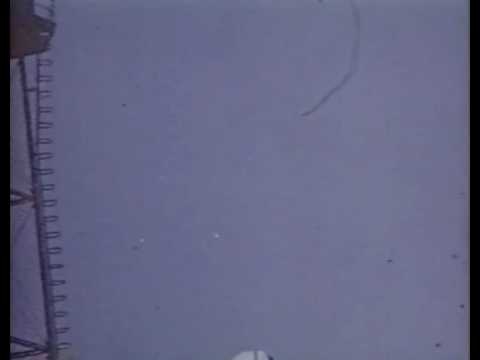
Nick Mariana UFO Footage — Footage Only
A direct presentation of the surviving 1950 film footage itself, without narration, for viewers who want to examine the primary evidence firsthand.
Sources
- "Mariana UFO film," Wikipedia. en.wikipedia.org
- NICAP. "The Great Falls (Montana) UFO Film." nicap.org
- Gross, Patrick. "UFOs at Close Sight: The Great Falls, Montana UFO Color Film, August 15, 1950." ufologie.patrickgross.org
- The Black Vault. "The Great Falls, Montana UFO Film" (Case Files). theblackvault.com
- UFO Casebook. "1950, The Great Falls, Montana UFO Film." ufocasebook.com
- UFOScans.com. "Great Falls, Montana Sighting Incident Report — 15 August 1950." ufoscans.com
- The History Museum (Great Falls). "Mariana UFO Incident: Great Falls' Visiting Voyagers." greatfallshistorymuseum.org
- MiLB.com. "Mariana spots, films UFO in 1950." milb.com
- Baseball Reference Bullpen. "Great Falls Electrics." baseball-reference.com
- "Great Falls Electrics," Wikipedia. en.wikipedia.org
- "Great Falls Voyagers," Wikipedia. en.wikipedia.org
- "Bob Considine," Wikipedia. en.wikipedia.org
- "Robert Sheaffer," Wikipedia. en.wikipedia.org
- "Robert M. L. Baker Jr.," Wikipedia. en.wikipedia.org
- "Condon Committee," Wikipedia. en.wikipedia.org
- Gross, Patrick. "Scientists and UFOs: Dr. David R. Saunders." ufologie.patrickgross.org
- Wikimedia Commons. Category: Mariana UFO incident. commons.wikimedia.org
- Wikimedia Commons. "File: Project Blue Book report - 1950-08-9615640-GreatFalls-Mont.pdf" (declassified case file, public domain). commons.wikimedia.org
- Wikimedia Commons. "File: Nick Mariana UFO Footage 1950 Great Falls Montana.webm" (public domain). commons.wikimedia.org
- Wikimedia Commons. "File: OVNI mariana.png" (public domain film frame, source of this file's hero image). commons.wikimedia.org
- National Archives and Records Administration. "Records Related to Unidentified Flying Objects (UFOs) and Unidentified Anomalous Phenomena (UAPs): Textual and Microfilm." archives.gov
- National Capital Area Skeptics. "Condon Report — Full Text, Table of Contents." files.ncas.org
- Project 1947 / National Capital Area Skeptics. "1968 UFO Symposium: Statement of Dr. Robert M. L. Baker, Jr." files.ncas.org
- Dr. Robert M. L. Baker Jr. Curriculum Vitae. drrobertbaker.com
- Charlie's Ballparks. "Legion Park, Great Falls, Mont." charliesballparks.com
- "Centene Stadium (Great Falls, Montana)," Wikipedia. en.wikipedia.org
- U.S. Air Force, Condon Committee. "Case 47: Great Falls, Montana," in Scientific Study of Unidentified Flying Objects (1968/1969), William K. Hartmann, investigator (witness data, weather, date problem, missing frames, analysis). files.ncas.org
- Ruppelt, Edward J. The Report on Unidentified Flying Objects. Doubleday, 1956, pp. 219–220 and the Robertson Panel chapter (the 1952 reanalysis and the panel's reaction).
- Clark, Jerome. The UFO Book: Encyclopedia of the Extraterrestrial. Visible Ink Press, 1998, pp. 397–401 (as cited by Wikipedia for the Tribune report, Brynildsen's film footage, Taylor's letter, the one-frame statement, the Considine suit, the Robertson Panel verdict and Saunders's quote).
- Craig, Roy. UFOs: An Insider's View of the Official Quest for Evidence. University of North Texas Press, 1995, pp. 230–231 (as quoted by Wikipedia).
- Hall, Michael David, and Wendy Connors. "The Montana Film — An Update from Newly Found Records," from Captain Edward J. Ruppelt: Summer of the Saucers — 1952 (Klass's 1973 findings, F-94 landing time, Samford request). ufology.patrickgross.org
- Baker, Robert M. L., Jr. Statement to the House Committee on Science and Astronautics, Symposium on Unidentified Flying Objects, July 29, 1968, p. 127 (excerpt). ufologie.patrickgross.org
- NASA JPL Horizons ephemeris service, Sun and Moon positions for 15 August 1950, 18:20–18:40 UTC, from 47.50°N, 111.30°W. ssd.jpl.nasa.gov
- StatsCrew. "Great Falls Selectrics" (1949–1950 name of the Electrics; general manager Nicholas Mariana). statscrew.com
Corrections (October 2026)
A fact-check against the Condon Report's Case 47, Ruppelt's 1956 book, Jerome Clark's encyclopedia (as cited by Wikipedia), Roy Craig's 1995 memoir, Hall and Connors's review of the Blue Book file, Robert Baker's 1968 congressional statement and JPL Horizons led to the following changes. The objects moved away to the southwest, not the northwest, and were first seen to the north-northwest over the Anaconda smokestack. Mariana loaded his camera at the car; it was not already loaded. The date itself is uncertain: Mariana's 1953 statement says "about the 5th or 15th," and the Condon Committee found the team played no home games between August 9 and 18, a point the page had understated. Raunig saw the objects for about seven seconds, never saw the film, and in 1967 recalled a single light; the claims that both witnesses "never altered" their accounts have been removed. Ruppelt's quotation has been corrected to his exact words. Hartmann's finding on the images' ellipticity had been reversed: Baker attributed it to camera panning and Hartmann to the shape of the source. The specific distance-and-speed figures, the DC-3 test filming, Baker's "UCLA-trained" and Klemperer details, the USC equipment, the "bird-reflection hypothesis" for the Montana film (birds were the Utah-film candidate), the "~315 frames" and "285 surviving frames" counts, the Air Force's "in all probability" wording, the "unidentified acquaintance" who wrote to Wright-Patterson, Mariana's "Nick's Picks" radio show, the "roughly ninety" Condon case studies, Kevin Randle's quoted praise of the film and specific claims about Robert Sheaffer's treatment of it could not be confirmed and were removed. The Moon was 5.4% lit (not 4%), per JPL Horizons.
Following this review, the rating was changed from Disputed 57 to Disputed 50 (October 27, 2026), because the higher rating had rested partly on claims corrected or removed above.
See something inaccurate? Have additional information or sources?
Suggest an Edit →Last Updated: August 2026