
UFO Sightings
The Evidence
Core Thesis
UFO Sightings: The Evidence is Robert Sheaffer's expanded, updated rewrite of his 1981 debut The UFO Verdict: Examining the Evidence, restating and extending the same governing method across a broader set of cases: that the specific, checkable, mundane explanation for a UFO report — a planet, a rocket test, a known aircraft, the ordinary unreliability of eyewitness testimony — should always be tested and ruled out before a claim is treated as evidence of anything extraordinary. Sheaffer's organizing argument, carried over and sharpened from the earlier book, is that the "UFO phenomenon" as popularly understood may not require any genuine anomaly at all to sustain itself: as one reader review of the book summarizes his position, "there need not be ANY 'genuine' UFOs for seemingly perplexing 'high-caliber' UFO reports to arise," because ordinary psychological suggestion, media framing, and the simple unreliability of memory and perception are, in his assessment, sufficient on their own to generate a steady supply of unexplained-looking cases. The book applies that framework across a deliberately wide net — from a sitting Georgia governor's own sky-watching account to a decades-old New England radar-visual flap to a still-active wave of sightings from Mexico City — making the case that a consistent skeptical method, applied patiently enough, keeps producing the same kind of mundane resolution regardless of a case's fame or its witness's credentials.
About the Author
Robert Sheaffer was born in 1949 in Chicago, Illinois, and graduated from Northwestern University in Evanston. By the time this book appeared in 1998, Sheaffer had already spent more than two decades building the case-by-case skeptical record it draws on: he had been a founding member, alongside aerospace journalist Philip J. Klass and engineer James Oberg, of the UFO Subcommittee of CSICOP (now the Committee for Skeptical Inquiry); he had co-founded and later chaired Bay Area Skeptics in 1982; and he had, by his own account on The Debunker's Domain (debunker.com), spent his career working "as a data communications engineer" in Silicon Valley rather than as a credentialed research scientist — a technical, not academic-scientific, background broadly typical of the skeptical ufology tradition he belongs to.
His single longest-running body of work, the "Psychic Vibrations" column for Skeptical Inquirer, had been running since 1977 by the time this book went to press and would continue for another two decades, through 2017 — giving him, by 1998, roughly the same span of case-tracking experience this book's expanded scope reflects relative to its 1981 predecessor. He also wrote for Fate magazine and the British Interplanetary Society's Spaceflight across this period.
This book is the direct sequel to, and substantial expansion of, Sheaffer's first book, The UFO Verdict: Examining the Evidence (Prometheus Books, 1981); both apply the identical claim-by-claim skeptical method that his later 2015 collection, Bad UFOs, would extend into the social-media era. Outside ufology, he separately published Resentment Against Achievement (1988) and The Making of the Messiah (1991), both with Prometheus Books, applying the same skeptical instinct to religion and to critiques of egalitarian politics — making him, by his own description elsewhere, an "equal-opportunity debunker" whose ufology writing was never his only subject.
This site's own Robert Sheaffer key-figures entry already documents that this book, together with The UFO Verdict, groups the Mariana film among the classic-era "best" UFO photographic cases his aircraft-reflection framework argues do not withstand close technical scrutiny, and that his July–August 1977 Humanist article first identified the planet Venus as the likely source of the Jimmy Carter sighting this book revisits at greater length.
Historical Context & Origins
Prometheus Books published UFO Sightings: The Evidence in 1998, at the peak of a UFO-culture moment its predecessor, The UFO Verdict, had appeared seventeen years too early to address. Fox's syndicated 1995 special Alien Autopsy: Fact or Fiction? had put a purported extraterrestrial-body dissection film in front of tens of millions of American households, and although the footage was substantially discredited by the time this book went to press, it had already reset the baseline for how far a single piece of dubious visual evidence could travel through mainstream television. The X-Files, then in the middle of its most-watched seasons, had made government-conspiracy framing of UFO claims a fixture of prime-time entertainment. And July 1997 — barely a year before this book's publication — had brought the fiftieth anniversary of the Roswell Incident, marked by both a massive commemorative crowd in Roswell, New Mexico, and the U.S. Air Force's own "Case Closed" report attributing the reported bodies to anthropomorphic test dummies dropped in later high-altitude programs — a report Sheaffer's skeptical community broadly welcomed and ufology's proponent wing broadly rejected.
The book also arrived shortly after a genuinely dark chapter in the same broader culture: the March 1997 Heaven's Gate mass suicide, in which thirty-nine members of a UFO-religious group took their own lives believing a spacecraft trailing Comet Hale-Bopp would carry their souls to a "Next Level" of existence. That event, still fresh in the national memory when this book was published, gave Sheaffer's central argument — that ordinary psychological and social mechanisms, not extraordinary physical phenomena, are usually sufficient to explain even deeply sincere UFO conviction — an unusually pointed real-world illustration, though the book's own case selection stays with more conventional sighting reports rather than the Heaven's Gate episode itself.
Structurally, expanding The UFO Verdict into this book let Sheaffer bring his skeptical case-tracking method up to date with cases and research that had emerged only after 1981: the barium-cloud research into Jimmy Carter's 1969 sighting, the ongoing Gulf Breeze, Florida photograph controversy that had run through the late 1980s and into the 1990s, and the early-1990s Mexican UFO wave the book's own publisher description calls the "UFO blitz of Mexico" — a reference almost certainly to the surge of Mexico City-area sightings, most famously the mass daylight video captures during the August 1991 solar eclipse, that had made Mexico one of ufology's most active regions in the years immediately preceding this book's publication.
Core Arguments & Key Concepts
The book's central methodological claim, carried forward and expanded from The UFO Verdict, is that a mundane, checkable candidate explanation should always be tested before a case is treated as evidence of something extraordinary — and that testing, done patiently enough, keeps succeeding even on cases that have accumulated decades of reputation as "unexplained." One reader review of the book distills this into Sheaffer's own recurring formulation: "there need not be ANY 'genuine' UFOs for seemingly perplexing 'high-caliber' UFO reports to arise," because the raw materials of a compelling UFO story — an ambiguous light, a startled witness, a media outlet eager to repeat the most dramatic version of events — are common enough on their own.
A recurring theme across the book's individual case treatments is the power of media framing to convert an ambiguous original account into a much more specific-sounding claim. The book revisits the foundational 1947 Kenneth Arnold sighting to make exactly this point: per the same reader review, "Arnold didn't say that they LOOKED like saucers… he said that they looked like boomerangs," a distinction Sheaffer treats as the origin point of "flying saucer" as a media-coined phrase rather than an accurate description Arnold himself ever gave — an early, foundational example of the suggestion effect the book's broader argument rests on.
A second consistent theme is astronomical misidentification, treated across multiple cases rather than as a one-off explanation. The book applies the same reasoning it uses on the Jimmy Carter sighting — where Sheaffer's own 1977 research first proposed the planet Venus — to the Betty and Barney Hill case as well: per the same reader review, Sheaffer argues "what Mrs. Hill was calling a 'UFO' was in fact the brilliant planet Jupiter," applying the identical bright-planet-misidentification logic across two of the book's highest-profile cases twelve years apart.
A third theme is photographic and physical-evidence skepticism, most fully developed in the book's treatment of the Gulf Breeze, Florida photographs. Per the same reader review, the book documents that a model flying saucer tied to the case was eventually discovered "hidden away under some insulation in the garage attic" of a person connected to the photographs — the kind of concrete physical discovery Sheaffer treats throughout the book as the strongest possible resolution a skeptical investigation can reach, stronger even than a well-argued conventional-explanation candidate like the Venus or Jupiter identifications.
A fourth, more contextual theme runs through the book's international case material, including its coverage of the early-1990s Mexican UFO wave: that mass sighting events, however striking in aggregate, are still built out of individually explainable component reports — astronomical bodies, aircraft contrails, atmospheric optics — and that a wave's sheer size or media prominence is not itself evidence that any individual sighting within it resists conventional explanation.
Key Cases & Evidence Discussed
Per the book's recurring publisher description (consistent across AbeBooks, Barnes & Noble, and ThriftBooks listings of this edition), UFO Sightings: The Evidence covers the Jimmy Carter UFO sighting (Case File #071, 1969), the "abduction" of Betty and Barney Hill (Case File #006, 1961), the incidents at Exeter, New Hampshire (Case File #083, 1965), Men in Black accounts, claimed "messages from space," the early-1990s "UFO blitz of Mexico," and comparisons between modern UFO reports and colonial-era fairy and witch sightings.
The Jimmy Carter chapter extends Sheaffer's own foundational research on the case: his July–August 1977 Humanist article, "President Carter's 'UFO' Is Identified as the Planet Venus," had already matched Carter's reported elevation and compass direction to Venus's calculated position over Leary, Georgia that January 1969 evening — a finding this site's own case file on the sighting documents alongside a competing, independently discovered explanation, atmospheric scientist Carl Justus's Eglin Air Force Base barium-cloud rocket release, which Sheaffer's own blog would later publish in 2016.
Ten of this site's own case files cite this exact 1998 edition directly, spanning five continents and four decades of UFO history: the Mariana UFO Film (Case File #058, 1950) and McMinnville UFO Photographs (Case File #037, 1950), both grouped by this book among the classic-era "best" photographic cases Sheaffer's aircraft-reflection framework argues do not withstand close technical scrutiny; the Tremonton, Utah UFO Film (1952), where the book reasserts Sheaffer's gull-misidentification explanation first argued in The UFO Verdict; and a cluster of internationally diverse sightings — the Hopeh Province Sighting (Case File #057, 1942), the Barra da Tijuca Sighting (Case File #093, 1952), the Island of Trindade Sighting (Case File #105, 1958), the Araçariguama Sighting (Case File #121, 1946), the John Sheppard Sighting (Case File #080, 2014), and the STS-75 Tether Incident (Case File #316, 1996) — that cite this book as further reading for the general skeptical, case-by-case evidentiary framework it applies to photographic and video UFO claims.
Per the same Goodreads reader review that documents the book's Kenneth Arnold and Jimmy Carter material, the book also devotes substantial attention to the Betty and Barney Hill case, proposing the planet Jupiter as the source of Betty Hill's original sighting, and to the Gulf Breeze, Florida photograph controversy (Case File #098, 1987–90), documenting the discovery of a model flying saucer connected to the case hidden in a garage attic — the same case this site's own citation record shows Sheaffer would return to at greater length in his 1991 Skeptical Inquirer column and again in Bad UFOs.
Critical Reception & Controversies
This 1998 edition did not draw the same dedicated skeptical-press review coverage that Sheaffer's later Bad UFOs received from Skeptical Inquirer in 2017 — no period review from that magazine, Publishers Weekly, Kirkus, or a major library journal turned up in this site's research, and that absence is disclosed here honestly rather than papered over with an uncited claim. What survives instead is a smaller body of reader response, consistent enough across venues to be treated as representative rather than anomalous.
On Goodreads, the book carries a 4.38-out-of-5 average from eight ratings. Its one detailed written review, posted by reader "Steven H" in April 2025, praises the book's specificity, walking through its Kenneth Arnold, Jimmy Carter, Betty and Barney Hill, and Gulf Breeze material approvingly and concluding that the book "will be of great interest to those seeking a critique of UFO reports" — a review this site's own Core Arguments and Key Cases Discussed sections above draw on directly for its case-specific claims.
On Amazon, the book's current listing shows a lower but still generally positive 4.0-out-of-5 average from nine ratings (checked August 2026) — a modest divergence from its Goodreads score that this site treats as consistent with the book's small, self-selecting audience of readers already interested in skeptical case analysis specifically, rather than as evidence of any real critical dispute.
Reader reviews aggregated on ThriftBooks' listing for this edition describe the book as one that "sets forth an examination of Ufology that looks at the subject's most cherished evidence and finds it wanting," and separately recommend it, on the basis of its application of "scientific laws and principles, like Occam's Razor," as offering "a more balanced view of UFO phenomenon" than more credulous survey titles — language that echoes, in miniature, the same case-by-case skeptical method this book's own publisher description promises and its reader reviews consistently confirm it delivers.
The clearest measure of the book's lasting reference value, rather than its contemporary critical reception, is this site's own citation record: ten separate case files across this catalogue cite this exact 1998 edition, more than any other single skeptical secondary source on the site except Sheaffer's own later Bad UFOs — a pattern of ongoing research utility that a single missing contemporary trade review does little to diminish.
Influence & Legacy
The most directly measurable evidence of this book's ongoing influence is on this site itself: this exact 1998 edition is cited across ten separate case-file pages spanning five continents and four decades — the Mariana UFO Film, McMinnville UFO Photographs, Tremonton, Utah UFO Film, Jimmy Carter Sighting, Hopeh Province Sighting, Barra da Tijuca Sighting, Island of Trindade Sighting, Araçariguama Sighting, John Sheppard Sighting, and STS-75 Tether Incident — making it this site's single most cross-referenced skeptical secondary source among its own case-file library.
The book's more direct legacy runs through the research it carried forward rather than through new arguments of its own: its expanded Jimmy Carter chapter kept Sheaffer's original 1977 Venus identification in print through the 2000s and 2010s, a period during which Carter himself, in a 2005 GQ interview, publicly reaffirmed his sighting and disputed the Venus explanation on the basis of his own amateur-astronomy background — an ongoing public exchange this book's continued availability helped keep documented on the skeptical side of the record.
As the second and final installment of Sheaffer's original book-length survey project — following The UFO Verdict (1981) and preceding his return to book-length ufology writing only in 2015 with Bad UFOs — this book represents the last time Sheaffer attempted a single-volume, broad case-by-case survey of the field before shifting his primary output to the shorter-form "Psychic Vibrations" column and, later, blog posts. That structural shift makes this book a specific historical marker in Sheaffer's own bibliography: the point at which his skeptical case analysis moved from periodic book-length surveys to the continuous, case-as-it-breaks column format that would define the remaining three decades of his career.
Within this site's own research specifically, this book functions as a foundational rather than a peripheral source: the Robert Sheaffer key-figures entry cites it, alongside The UFO Verdict, as the specific origin of his Mariana-film analysis, and this site's own Bad UFOs essential-reading entry independently identifies this book, rather than the later 2015 volume, as the source of his McMinnville and Mariana skepticism — a citation relationship in which this earlier book, not the more recently reviewed one, supplies the underlying case research the newer book's own reputation partly rests on.
The Book
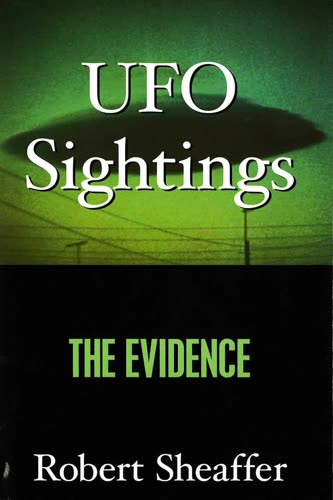
As an Amazon Associate, OverClassified may earn from qualifying purchases made through this link, at no extra cost to you.
Why This Is Essential Reading
UFO Sightings: The Evidence earns its place on this list as the fuller, more mature expression of the same skeptical case-tracking method Robert Sheaffer first laid out in 1981's The UFO Verdict, updated with two additional decades of research and applied across a genuinely wide net of cases — a sitting governor's own sighting, a landmark abduction claim, a New England radar-visual flap, and an entire international UFO wave, among others. Its real, lasting value on this site's own evidence is not a single contemporary review, which this book's period does not appear to have generated in any major skeptical or trade outlet, but a citation record spanning ten separate case files and five continents, second among this site's skeptical secondary sources only to Sheaffer's own later Bad UFOs. Read as a pair with that 2015 volume, this book supplies the foundational case research — the Mariana and McMinnville skepticism, the original Jimmy Carter Venus identification, the Gulf Breeze photograph unraveling — that the later book's own reputation substantially depends on, making this earlier, less-reviewed title the more essential of the two for anyone tracing Sheaffer's core arguments back to their original source.
Related Cases & Theories
Essential Viewing

Skeptic refutes classic UFO claims - Bad UFOS with Robert Sheaffer 07-05-2016
DrJ Radio Live — A 2016 on-camera interview in which Sheaffer lays out the same skeptical standard of evidence — and revisits several of the classic cases, including Jimmy Carter and the Hills — that this 1998 book first assembled into a single survey, verified via YouTube oEmbed before inclusion.
A Different Perspective with Kevin Randle: Guest: Robert Sheaffer
The 'X' Zone TV Channel — UFO researcher Kevin D. Randle interviews Sheaffer directly, a rare recorded exchange between a leading skeptic and a leading proponent that illustrates the same skeptic/proponent divide this book's case-by-case method navigates, verified via YouTube oEmbed before inclusion.
Sources Cited
- Sheaffer, Robert. UFO Sightings: The Evidence. Prometheus Books, 1998 (ISBN 1-57392-213-7, cited here). archive.org
- "Robert Sheaffer." Wikipedia (biography and full bibliography, including this book's exact citation: "Sheaffer, Robert (1998). UFO Sightings: The Evidence. Buffalo, N.Y: Prometheus Books."). en.wikipedia.org
- "Robert Sheaffer." Skeptical Inquirer author page (official contributor bio). skepticalinquirer.org
- The Debunker's Domain (debunker.com), Robert Sheaffer's personal site (career self-description and affiliations). debunker.com
- "Robert Sheaffer's Books." The Debunker's Domain (full bibliography with publishers and years, including both The UFO Verdict and this expanded edition). debunker.com
- "UFO Sightings." Goodreads (rating 4.38/5, 8 ratings; reader review by "Steven H," April 2025, discussing the book's Kenneth Arnold, Jimmy Carter, Betty and Barney Hill, and Gulf Breeze material). goodreads.com
- "UFO Sightings: The Evidence." ThriftBooks (listing, reader-review excerpts, and pricing for this edition). thriftbooks.com
- "UFO Sightings: The Evidence." AbeBooks (publisher description of this edition). abebooks.com
- "UFO Sightings: The Evidence." Barnes & Noble (publisher description and edition details). barnesandnoble.com
- "UFO Sightings: The Evidence." Amazon.com (ISBN 1573922137, current rating and product listing, checked August 2026). amazon.com
- "UFO Sightings: The Evidence." Internet Archive catalog record (publisher, ISBN, page count, LCCN 98006410). archive.org
- Sheaffer, Robert. "President Carter's 'UFO' Is Identified as the Planet Venus." The Humanist, July–August 1977 (original research underlying this book's Jimmy Carter chapter).
- This site's own resources library: Full Reading List, where this exact 1998 edition (ISBN 1573922137) is cited across 10 separate case-file pages.
- This site's own key-figures entry: Robert Sheaffer, for his full biography and site-wide case connections.
- This site's own case file: Jimmy Carter Sighting, which documents Sheaffer's original 1977 Venus identification this book's chapter expands on.
- This site's own case file: The Mariana UFO Film, which this book groups among the classic-era cases Sheaffer's aircraft-reflection framework addresses.
- This site's own essential-reading entry: Bad UFOs by Robert Sheaffer, the 2015 companion volume that extends this book's method into a newer generation of cases.
Have corrections, additional research, or peer-reviewed sources? Help improve this entry.
Suggest an Edit