
The Roswell Incident
In the summer of 1947, a rancher found a field of debris on a ranch about 75 miles northwest of Roswell, New Mexico. On July 8 the U.S. Army Air Forces at Roswell announced the recovery of a "flying disc"; within hours Eighth Air Force headquarters in Fort Worth identified the material as a weather balloon with a radar target. From 1978 onward, researchers interviewed hundreds of people (Carey and Schmitt say more than 600) about the event, decades after the fact. One sealed affidavit, signed in 2002 by the base's former press officer and published in 2007, claims direct observation of a craft and non-human bodies. The Air Force has given three successive official explanations: a weather balloon (1947), a classified Project Mogul balloon train (1994–95), and, for the later body stories, 1950s test dummies (1997). The full truth of what crashed on the J.B. Foster Ranch — and what was recovered — remains the most debated question in UFO history.
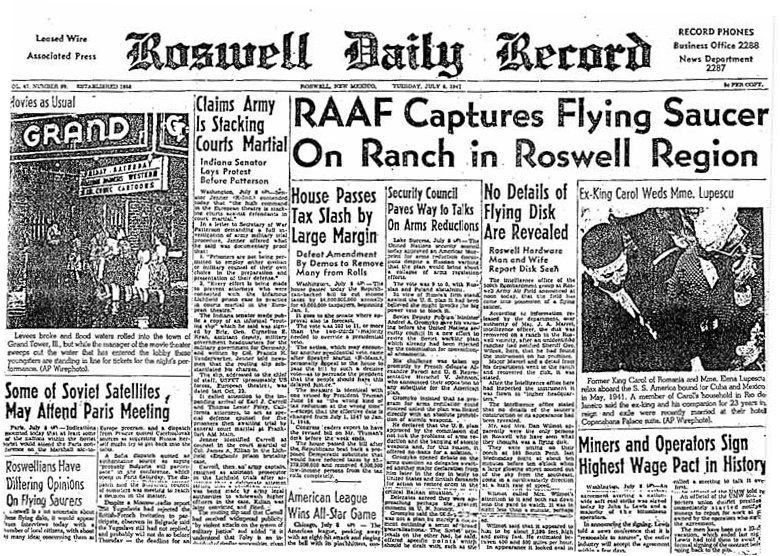
Pictured: the front page of the Roswell Daily Record from July 8, 1947, carrying the story based on the Roswell Army Air Field's press release — retracted within hours — announcing the recovery of a "flying disc." This is a direct, contemporaneous photograph of the case's actual founding document, not a reconstruction. No verified photograph of the recovered debris or of the craft itself is known to exist; none was released in 1947, and none has surfaced in the decades of research and testimony since.
Theoretical Alignment
Seminal alignment with the Extraterrestrial Hypothesis (ETH) based on debris properties and military recovery actions, with Government Deception (Project Mogul) as the primary counter-theory.
Background
The Roswell incident occurred during the first great wave of "flying saucer" sightings sweeping the United States. Just two weeks earlier, on June 24, 1947, private pilot Kenneth Arnold reported nine unusual objects (mostly disc-shaped, with one crescent-shaped) flying in formation at extraordinary speed near Mount Rainier, Washington — an account whose press coverage gave rise to the term "flying saucer" and triggered a national media frenzy. By early July, hundreds of sightings had been reported across the country (researchers have since catalogued over 800 for the 1947 wave).
A claim that appeared in an earlier draft of this page, describing declassified military radar tracking logs from White Sands Proving Grounds and Alamogordo Army Air Field tracking an anomalous target over the Capitan Mountains for three nights before it vanished near Roswell, has been removed. This site's research found no independent source for such logs, no citation for them anywhere in this file's own Sources list, and a detailed technical assessment (C.B. Moore, writing on the only known basis for a similar anecdotal account) concluding that no ground radar capable of tracking an aircraft-sized target existed at Roswell in 1947, and that the SCR-584 radar at White Sands had only ~40-mile range and no moving-target indication.
Roswell Army Air Field (RAAF) was home to the 509th Bombardment Group — the only nuclear-armed military unit in the world at the time, having dropped the atomic bombs on Hiroshima and Nagasaki just two years earlier. Proponents stress that the officers who handled the debris belonged to the unit entrusted with America's atomic bombs and were not untrained observers; skeptics reply that nobody at Roswell had been told about the classified balloon project the Air Force later identified as the source.
The base commander was Colonel William "Butch" Blanchard, who would later rise to the rank of four-star general and Vice Chief of Staff of the United States Air Force — the second-highest-ranking officer in the service (he held that post from 1965 until his death in 1966). The intelligence officer was Major Jesse A. Marcel, a World War II combat intelligence officer trained at the Army Air Forces Intelligence School as a photo interpreter.
Complete Timeline
| Date | Event |
|---|---|
| June 14, 1947 | First discovery. According to his interview in the Roswell Daily Record of July 9, 1947, ranch foreman William "Mac" Brazel, riding his rounds with his 8-year-old son Vernon about 7 or 8 miles from the ranch house of the J.B. Foster Ranch (some 30 miles southeast of Corona and about 75 miles northwest of Roswell), comes upon "a large area of bright wreckage made up of rubber strips, tinfoil, a rather tough paper and sticks." He is in a hurry and pays it little attention. Brazel's 1947 account mentions no storm or explosion; the thunderstorm and the later crash dates of July 2–4 come from accounts gathered from 1978 onward. |
| June 24, 1947 | Kenneth Arnold reports nine objects near Mount Rainier. "Flying saucer" craze begins nationally. Brazel's ranch had no telephone or radio, and he later told the Roswell Daily Record he did not hear about the flying disks until July 5. |
| Late June | The debris lies where Brazel found it. On the Air Force's 1994–95 reconstruction, it came from Project Mogul's NYU Flight No. 4, a train of neoprene balloons and radar reflectors launched from Alamogordo Army Air Field on June 4 and not recovered by the balloon group. |
| ~July 4, 1947 | Per the July 9 Record, Brazel returns to the spot with his wife, son Vernon, and daughter "Betty," 14 (Bessie), and they gather up "quite a bit of the debris." In a 1993 affidavit, Bessie Brazel Schreiber described the material as looking "like pieces of a large balloon which had burst": foil-like on one side and rubber-like on the other, with sticks attached by tape bearing faint, pastel flower-like designs. She recalled no gouges in the ground. |
| July 5, 1947 | Brazel first hears about the flying disks (Roswell Daily Record, July 9) and wonders whether his debris might be one. Around this time, according to Loretta Proctor's 1991 affidavit, he showed her and her husband Floyd Proctor, his neighbors, a brown, plastic-like piece that he and Floyd could not cut or burn; she later said they advised him to report it. |
| July 6, 1947 | Brazel drives into Roswell and reports the debris to Chaves County Sheriff George Wilcox (the July 9 Record says he came to town "Monday," i.e. July 7, to sell wool). Wilcox contacts RAAF. Major Jesse Marcel, the base intelligence officer, is dispatched along with Counter-Intelligence Corps (CIC) officer Captain Sheridan Cavitt; the Record describes Marcel's companion only as "a man in plain clothes." |
| July 6 (evening) | Marcel and Cavitt follow Brazel back to the Foster Ranch. In Marcel's later accounts, they spent the night at the ranch before examining the debris field the next morning. |
| July 7, 1947 | Marcel and Cavitt gather the debris. Quoted in Fort Worth on July 8, 1947, Marcel said they "spent a couple of hours Monday afternoon looking for any more parts of the weather device" and found "a few more patches of tinfoil and rubber." From 1978 on, Marcel described a much larger field, about three-quarters of a mile long and several hundred feet wide; in 1947 Brazel put the scattered rubber at "an area about 200 yards in diameter" and the whole lot at "maybe five pounds." According to Brazel, they tried and failed to reconstruct the object, even as a kite. |
| July 7 (late evening) | According to Jesse Marcel Jr.'s later accounts, his father stopped at home on the way back to the base and woke his wife Viaud and son Jesse Marcel Jr., then 10, to show them some of the debris. In a 1991 affidavit Jesse Jr. described foil-like metal, a brittle brownish-black plastic-like material, and fragments of I-beams with purple-violet, embossed geometric "writing" on their inner surface. |
| July 7–9, 1947 | Claim removed: heavy-machinery soil scraping. An earlier draft of this page stated that road graders and earth-movers were checked out under armed escort to scrape the top six inches of soil at the site. This site found no witness, book, or record that supports it, and it has been removed. The Air Force's 1994 review of RAAF unit histories and morning reports for July 1947 found no increase in operations or security activity. |
| July 8, 1947 (AM) | Colonel Blanchard has public information officer Lieutenant Walter Haut issue a press release announcing that the 509th's intelligence office had gained "possession of a disc"; in his 1993 affidavit Haut said Blanchard called him at about 9:30 a.m. The material is flown to Fort Worth Army Air Field (later Carswell AFB), headquarters of the Eighth Air Force, with Marcel aboard; flight engineer Robert Porter's 1991 affidavit says it went on a B-29 in a few light, paper-wrapped packages that "could have fit into the trunk of a car." (An earlier draft of this page also described a C-47 "medical shuttle" carrying cooled containers to Wright Field; no source for that flight was found, and it has been removed.) |
| July 8, 1947 (noon) | The Roswell Daily Record reports that the RAAF intelligence office "announced at noon today" that it had come into possession of a flying saucer, under the headline "RAAF Captures Flying Saucer On Ranch in Roswell Region." The story spreads over the wire services within hours. (An earlier draft of this page said 509th officers then barred evening editions from running civilian statements; no source was found, the Record itself ran Brazel's interview the next day, and the claim has been removed.) |
| July 8 (afternoon) | At Fort Worth, General Ramey, his chief of staff Colonel Thomas DuBose, and weather officer Irving Newton identify the material for the press as a weather balloon and radar target; Newton, in a 1994 sworn statement, called it "a balloon and a RAWIN target." Photographs show Marcel, Ramey and DuBose with the debris. Starting with The Roswell Incident (Berlitz & Moore, 1980), Marcel was reported as saying the real debris had been swapped for balloon wreckage before the photographs; Haut's 2002 affidavit repeats this as something Marcel told him. The Air Force's 1994 review of the original negatives found the same material in the photographs of Marcel and of Ramey, and Cavitt identified it as what he had recovered. |
| July 8 (6:17 PM) | The FBI Dallas Teletype. The FBI's Dallas office sends an "urgent" teletype to the Director and to the Cincinnati office, relaying that Eighth Air Force headquarters reported a "hexagonal" disc suspended by cable from a balloon about 20 feet across. The object "resembles a high altitude weather balloon with a radar reflector," it adds, "but that telephonic conversation between their office and Wright Field had not borne out this belief." The disc and balloon were being sent to Wright Field "by special plane for examination." No further FBI investigation was conducted. |
| July 8 (evening) | The Sleppy teletype account. In accounts first reported by Berlitz and Moore (1980) and in a 1993 affidavit, Lydia Sleppy, a teletype operator at KOAT radio in Albuquerque, said that on a weekday morning in early July 1947, while typing a crashed-saucer story phoned in by John McBoyle of Roswell's KSWS for the ABC network, she received an incoming message "something to this effect": "THIS IS THE FBI. YOU WILL IMMEDIATELY CEASE ALL COMMUNICATION." No record of such FBI monitoring has been found, and Karl Pflock (2001) argued the interruption she described was not possible on her teletype model. |
| July 8 (evening) | According to the next day's Roswell Daily Record, Brazel is brought into town "late yesterday" by W. E. Whitmore of KGFL radio, has his picture taken, and is interviewed by the Record and by Jason Kellahin of the Associated Press. KGFL announcer Frank Joyce later said he spoke to Brazel by phone on July 6 and that he received a threatening call from a man claiming to be a Pentagon officer. In later accounts, Brazel's son Bill and neighbor Loretta Proctor said the Army kept Brazel for several days (Proctor: "five or six days"); no contemporaneous record of a detention exists, and people reported seeing him around Roswell during that period. |
| July 9, 1947 | The Roswell Daily Record runs "Harassed Rancher who Located 'Saucer' Sorry He Told About It." Brazel describes "rubber strips, tinfoil, a rather tough paper and sticks," "considerable scotch tape and some tape with flowers printed upon it," and no metal that could have been an engine. He adds: "I am sure what I found was not any weather observation balloon," and says he would not report anything again short of a bomb. The same day, papers carry Ramey's weather-balloon explanation. |
| July 9 onward | A portion of the material is flown on to Wright Field (later Wright-Patterson AFB) in Dayton, Ohio, as the FBI teletype said it would be. According to Project Mogul officer Albert Trakowski's 1994 statement, Colonel Marcellus Duffy at Wright Field told him by phone that it looked like the balloon equipment launched at Alamogordo. Haut's 2002 affidavit says teams returned to "each site" for months to search for remaining evidence; the 1994 Air Force records review found no sign of such an operation. |
| Summer 1947 | Claim removed: "civil archive erasures." An earlier draft of this page stated that Lincoln County brand books for summer 1947 went missing and that pages of Sheriff Wilcox's logbook were cut out with a razor blade. This site found no source for either claim, and both have been removed. |
| 1978 | Ufologist Stanton Friedman interviews Jesse Marcel (then living in Houma, Louisiana). Marcel, speaking publicly about the case for the first time in 31 years, says the weather balloon explanation was a cover story and that he now believes the debris was extraterrestrial. The interview revives the case. |
| 1980 | On September 20, 1980, Marcel appears on the television series In Search Of... (hosted by Leonard Nimoy), episode "UFO Coverups." In October, Charles Berlitz and William Moore publish The Roswell Incident, the first book on the case, which quotes Marcel calling the debris "nothing made on this earth." |
| 1986 | Jesse Marcel Sr. dies (June 1986). He never recanted his statement that the debris was not a weather balloon. |
| 1991 | Retired Brigadier General Thomas DuBose, Ramey's chief of staff in 1947, signs an affidavit (September 16, 1991) stating that the material in the Fort Worth photographs "was a weather balloon" and that the weather balloon explanation "was a cover story to divert the attention of the press." He said that Major General Clements McMullen, deputy commander of Strategic Air Command, had him send the material from Roswell on to McMullen in Washington, D.C., under "the strictest secrecy." |
| 1994 | Acting on a request from Congressman Steven Schiff (R-NM), the General Accounting Office opens an audit in February 1994. In response, the U.S. Air Force issues its Report of Air Force Research Regarding the "Roswell Incident" (July 1994), concluding that the debris most likely came from a Project Mogul balloon train. The supporting documents were published in 1995 as The Roswell Report: Fact vs. Fiction in the New Mexico Desert, which identifies NYU Flight No. 4 (June 4, 1947) as the probable source. |
| 1995 | The GAO reports (July 28, 1995) that RAAF administrative records from March 1945 to December 1949 and RAAF outgoing messages from October 1946 to December 1949 were destroyed, with the disposition form not showing who destroyed them, when, or under what authority. It located two 1947 records: the July 1947 509th Bomb Group/RAAF history, which says the "flying disc" "turned out to be a radar tracking balloon," and the July 8 FBI teletype. |
| 1997 | On June 24, 1997, the Air Force releases The Roswell Report: Case Closed, attributing "alien bodies" reports to memories of anthropomorphic test dummies dropped in the 1950s (Projects High Dive and Excelsior, 1953–1959) and of later aircraft and balloon accidents — events that began six years after 1947. |
| Dec 26, 2002 | Walter Haut signs a sealed affidavit, not to be released until after his death. It claims he saw a recovered egg-shaped craft and bodies in Building 84 at RAAF. Donald Schmitt and Haut's daughter Julie Shuster later said Schmitt drafted the text from Haut's conversations, and Haut signed it without changes. In a 1993 affidavit Haut had mentioned no craft, bodies or second site. |
| 2005 | Walter Haut dies on December 15, 2005. His 2002 affidavit is published in Witness to Roswell (2007) by Thomas Carey and Donald Schmitt. |
The Debris
The physical characteristics of the recovered debris are central to the Roswell controversy. The 1947 descriptions (Brazel in the Roswell Daily Record; Cavitt and Newton in later sworn statements) are of rubber, foil, paper, tape and sticks. Accounts given from 1978 onward describe materials with properties that, those witnesses said, matched no known technology of the era:
- Memory metal: A thin, metallic foil-like material that, witnesses said decades later, returned to its original flat shape with no creases after being crumpled. Marcel described such a foil in 1979 interviews and said it could not be dented even with a sledgehammer. Frankie Rowe, in interviews given decades later, said a piece dropped on a table spread out "like it was liquid or quicksilver." These are later recollections; no such material was described in 1947.
- I-beam structural members: Small, lightweight beams resembling I-beams or T-beams, with hieroglyphic-like or geometric symbols in a purple/violet hue running along their inner surfaces. Jesse Marcel Jr. described the symbols in a 1991 affidavit, in many later interviews, and in his book: "curved, geometric shapes" with "an embossed appearance" in a purple-violet hue. (An earlier draft of this page also attributed to him a "Maltese Cross enclosed within a circular border"; no source for that detail was found, and it has been removed.) In 1947 Brazel told the Record of "tape with flowers printed upon it," and weather officer Irving Newton later said Marcel tried to convince him that faded "lavender or pink" figures on the target sticks were alien writing.
- Parchment-like material: A tough, paper-like substance that, according to later witness accounts, could not be burned. Brazel in 1947 described "a rather tough paper."
- Monofilament fiber: Thin, thread-like material of unusual strength, described in some later accounts. (The 1994 Air Force report notes that the radar targets used nylon twine; Brazel in 1947 said no string or wire was found.)
- Balsa-like material: Lightweight wood-like sticks that, in later accounts by Loretta Proctor, Bill Brazel Jr. and others, could not be cut or burned. Cavitt in 1994 described "bamboo type square sticks" that were "very light."
- Heavy-Duty Lead Sheeting and Shielding Foil: A claim that appeared in an earlier draft of this page, describing base supply records and invoices documenting a 509th Bomb Group procurement order for industrial-grade lead sheeting, has been removed as unsupported; this site's research found no independent source for such records, and the RAAF's own finance and supply records for this period are, per the 1995 GAO report discussed below, documented as destroyed.
The size of the debris field depends on the source. Marcel, from 1978 on, described it as about three-quarters of a mile long and several hundred feet wide, and some later accounts add a long gouge in the earth. In 1947 Brazel said the rubber was scattered "over an area about 200 yards in diameter"; Cavitt in 1994 described "a small area of debris"; and Bessie Brazel Schreiber's 1993 affidavit says she did not remember seeing gouges in the ground.
The "Memory Metal" and Nitinol Connection
Researchers have noted that the "memory metal" described by multiple Roswell witnesses — a metallic foil that returns to its original shape after deformation — closely matches the properties of Nitinol (nickel-titanium alloy), a shape-memory alloy developed at the Naval Ordnance Laboratory between 1959 and the early 1960s. Nitinol was not available in 1947. Skeptics note that the memory-foil descriptions first appear in accounts given three decades after the event. Some researchers, including Anthony Bragalia, have investigated connections between Battelle Memorial Institute (which, Bragalia argues, conducted metallurgical studies for Wright-Patterson AFB in the late 1940s) and early shape-memory alloy research, suggesting a possible reverse-engineering chain. This connection remains speculative but is frequently cited in the literature.
Skeptical Response to the Debris
Skeptics and the Air Force have argued that the debris descriptions match materials used in Project Mogul balloon trains: neoprene weather balloons, and radar targets made of foil or foil-backed paper on balsa beams, assembled with tape. According to Project Mogul engineer Dr. Charles Moore and project officer Albert Trakowski (1994), some early targets were made by a toy or novelty company and used "purplish-pink tape with flower and heart symbols" — which could account for the "hieroglyphics." Brazel himself told the Record in 1947 of "considerable scotch tape and some tape with flowers printed upon it." Moore also reconstructed a plausible trajectory for the balloon train.
Proponents counter that a trained intelligence officer at the world's only nuclear-armed base would have immediately recognized weather balloon components. Skeptics reply that the Mogul trains, with multiple balloons and radar targets, were unlike an ordinary weather balloon, and that no one at Roswell had been told the project existed.
The Ramey Photo Strategic Deception & The Ramey Memo
The most analyzed photographs in the case were taken in Brigadier General Roger Ramey's office at Fort Worth Army Air Field on the afternoon of July 8, 1947, by the Fort Worth Star-Telegram. Proponents treat them as a record of a cover-up; the Air Force and skeptics treat them as a record of the actual debris.
The substitution claim: Marcel flew with the debris from Roswell to Fort Worth on July 8. In his accounts from 1978 onward, and as reported in The Roswell Incident (Berlitz & Moore, 1980), the material he was photographed with had been substituted with weather-balloon wreckage; Walter Haut's 1993 and 2002 affidavits say Marcel told him the same, the latter adding that the swap happened while Marcel was out of the room. In 1980 Marcel told In Search Of... that Ramey told the press it was a weather balloon: "Of course, we both knew differently." Against this: in Fort Worth on July 8, 1947 Marcel himself was quoted describing "parts of the weather device"; the Air Force's 1994 review of the original negatives found that "the same wreckage appeared in the photos of Marcel and Ramey"; Cavitt, who gathered the debris with Marcel, identified the photographed material as what he had recovered; and weather officer Irving Newton stated in 1994 that Marcel tried to persuade him that markings on the sticks were alien writing.
The Ramey Memo: A key detail in the photographs is a telegram or memo visible in General Ramey's hand. Scans of the original negatives (held at the University of Texas at Arlington) have been the subject of repeated digital enhancement. David Rudiak's analysis claims to identify the phrases "the victims of the wreck" and "disc" along with instructions to forward wreckage to Wright Field. Other analysts read the text differently or consider it illegible, and no reading is generally accepted. Proponents regard the memo as potential evidence of a real-time cover-up; that remains unproven.
The Three Crash Sites & Skip Theory
Some researchers have proposed that there were multiple crash locations, explaining the scattered debris and recovery operations:
Site 1: The Debris Field (Foster Ranch)
The primary site discovered by Brazel and investigated by Marcel and Cavitt. Proponents, relying on Marcel's later description of a field three-quarters of a mile long, argue that the scatter suggests a craft breaking apart in flight; Brazel's 1947 description (rubber over about 200 yards, about five pounds of material in all) fits a balloon train. A claim in an earlier draft of this page that road graders and earth-movers were checked out under armed guard to scrape the topsoil here has been removed; this site found no source for it.
Site 2: The "Body Site"
The location where the main fuselage of the craft came to rest along with occupants. The Roswell Incident (1980), relying on second-hand accounts of the late Grady "Barney" Barnett, placed it on the Plains of San Agustin, about 150 miles west of the debris field. Kevin Randle and Donald Schmitt (UFO Crash at Roswell, 1991) moved the proposed second site to about 2.5 miles southeast of the Foster Ranch debris field, and in 1994 to a site north of Roswell (see Site 3). Walter Haut's 2002 affidavit does not corroborate the 1991 location: it places a second site "approx. 40 miles north of town."
Site 3: The Hub Corn Ranch / Jim Ragsdale Site
In The Truth About the UFO Crash at Roswell (1994), Randle and Schmitt proposed an impact site about 35 miles north of Roswell, the location later shown to visitors on the Hub Corn ranch, based on statements from Jim Ragsdale and Frank Kaufmann. Ragsdale said that he and a companion, Trudy Truelove, saw a craft come down and found it crashed against a cliff. This account gave rise to the "Skip Theory": that the craft skipped at Foster Ranch (depositing the debris field), bounced, and finally impacted farther on. Ragsdale's two sworn statements described two different sites many miles apart (the later one near Pine Lodge in the Capitan Mountains, a site favored by Roswell's UFO museum), and his story grew over time; Kaufmann's testimony was later shown to rest on fabricated documents (see below). Neither site is supported by any contemporaneous record.
The Official Explanations
1947: Weather Balloon
The original retraction, announced by General Ramey's Eighth Air Force headquarters on July 8 after weather officer Irving Newton examined the material, attributed the debris to a weather balloon and a "RAWIN" radar target (the Air Force later identified the target type as the ML-307). This explanation was issued within hours of the "flying disc" press release and stood as the official position for 47 years. The Air Force's 1994 report said the weather-balloon story may have been meant to deflect interest from Project Mogul, or may simply have been the weather officer's honest identification, since Mogul used the same materials.
1994: Project Mogul (Air Force Report)
The U.S. Air Force's July 1994 Report of Air Force Research Regarding the "Roswell Incident" (by Col. Richard L. Weaver), published with its supporting documents in 1995 as The Roswell Report: Fact vs. Fiction in the New Mexico Desert, concluded the debris was most likely from a Project Mogul balloon train. Project Mogul was a classified program using high-altitude balloon arrays to listen for Soviet nuclear tests via acoustic sensors. NYU Flight #4, launched from Alamogordo on June 4, 1947, was identified as the likely source.
However, records for Flight #4's trajectory are incomplete. Flight 4 was one of the unlogged "service flights," so it is absent from the project's published flight summaries. The diary of geophysicist Albert Crary, who led the project's advance team, says for June 4: "No balloon flights again on account of clouds. Flew regular sono buoy up in cluster of balloons." Proponents read this as showing the scheduled flight was cancelled due to cloud cover; Moore and the Air Force read the second sentence as the launch of Flight 4. Project Mogul engineer Dr. Charles Moore reconstructed a plausible trajectory that could place balloon debris on the Foster Ranch, but proponents such as David Rudiak dispute the wind data his reconstruction assumes.
1997: Case Closed (Air Force Report)
A second Air Force report, The Roswell Report: Case Closed, addressed reports of alien bodies by suggesting witnesses had conflated memories of anthropomorphic crash test dummies dropped from aircraft and high-altitude balloons in the 1950s (Project High Dive / Project Excelsior), and of later military accidents, with the 1947 events. Critics immediately noted that the dummy drops did not begin until 1953 (the balloon drops ran from 1954 to 1959) — six years after Roswell — making the "time compression" explanation difficult to accept, particularly for witnesses who provided specific 1947 contextual details. The report replies that the body stories surfaced only decades later and that their details (dummies, insulated "body bags," recovery vehicles) match the 1950s programs; Jim Ragsdale himself said, "They was using dummies in those damned things."
The GAO Investigation
Congressman Steven Schiff (R-NM) asked the General Accounting Office to search for Roswell records; the GAO opened its audit in February 1994. Its report of July 28, 1995 (GAO/NSIAD-95-187) found that RAAF outgoing messages from October 1946 through December 1949 and RAAF administrative records (finance, supply and similar) from March 1945 through December 1949 had been destroyed, and that the disposition form "does not indicate what organization or person destroyed the records and when or under what authority." The Chief Archivist of the National Personnel Records Center told the GAO that many Air Force records of the period were destroyed without a citation of the governing authority. The GAO found two 1947 records on the event: the 509th Bomb Group/RAAF history for July 1947, which says the "flying disc" "turned out to be a radar tracking balloon," and the FBI teletype of July 8. The record destruction is often cited by proponents as evidence of a deliberate cover-up; skeptics note the archivist's statement that such undocumented destruction was common.
Witness Intimidation & Media Censorship
Several people said, in accounts given decades later, that they or their relatives had been threatened or intimidated by military personnel, and local broadcasters described interventions. None of these claims is documented in a contemporaneous record:
- Mac Brazel: His son Bill and neighbor Loretta Proctor later said the Army kept him for several days (Proctor's 1991 affidavit: "five or six days") and that he would not talk about it afterward. The Roswell Daily Record reported that KGFL's W. E. Whitmore brought him to town on the evening of July 8, and people reported seeing him in Roswell during the period of the alleged detention.
- Frankie Rowe: Said in interviews given decades later that a man in plain clothes visited the Dwyer home and warned the family they could be "taken out into the desert and never be found."
- Sheriff George Wilcox: Granddaughter Barbara Dugger (1991 video interview; 1995 affidavit) said her grandmother, Inez Wilcox, told her that military police had threatened to kill the Wilcoxes and their family if they ever talked. This is second-hand, reported decades later.
- Glenn Dennis: Claimed, from 1989 onward, that military personnel warned him: "Somebody will be picking your bones out of the sand."
- Dennis said the threat came from a "red-headed captain"; Dennis later admitted giving researchers false names for his key witness (see his card below).
Chaves County Court House 'Record Cleansing'
An earlier draft of this page stated that researchers (naming Carey and Schmitt) found pages for the week of the incident cut out of Sheriff George Wilcox's logbooks with a razor blade, and presented this as evidence that the cover-up extended to civil records. This site found no source for the claim in Carey and Schmitt's work or elsewhere, and it has been removed. The documented record loss in this case concerns RAAF military records, described in the GAO section above.
The KSWS Radio Teletype Kill-Switch
Lydia Sleppy was a teletype operator at KOAT radio in Albuquerque, a station associated with Roswell's KSWS. Her account was first reported by Berlitz and Moore (1980); in a 1993 affidavit she said that on a weekday morning in early July 1947, while she was typing a crashed-saucer story phoned in by KSWS manager John McBoyle for the ABC network, the teletype rang and printed a message "something to this effect": "THIS IS THE FBI. YOU WILL IMMEDIATELY CEASE ALL COMMUNICATION." She took the rest of the story in shorthand, and it was never sent because the newspapers had the story first. No record of FBI monitoring of her station has been found, and Karl Pflock (2001) argued that the interruption she described was not possible on the teletype model she used. (An earlier draft of this page placed her at KSWS on the evening of July 8, called the message an FCC directive, and said military personnel confiscated carbon copies; none of those details appears in her account, and they have been removed.)
Skeptics attribute these reports to standard security measures protecting classified Project Mogul information, not an organized campaign to suppress evidence of extraterrestrial contact.
MJ-12 / Majestic 12 Documents
In December 1984, TV writer-producer Jaime Shandera received an anonymous roll of 35mm film in the mail containing what purported to be briefing papers for "Operation Majestic-12" — a secret committee allegedly established by President Truman in 1947 to manage the recovery and investigation of extraterrestrial technology after Roswell.
The documents listed 12 alleged members, including CIA Director Roscoe Hillenkoetter, scientist Vannevar Bush, Secretary of Defense James Forrestal, and several generals and scientists. The papers were investigated by multiple agencies:
- The FBI, after the Air Force Office of Special Investigations told it in 1988 that no such committee had been authorized or formed, declared the document "completely bogus"
- A GAO letter of July 28, 1995 found "no evidence that the material constituted actual documents which originated in the executive branch"; the Air Force told the GAO that a 1980 message mentioning "MJ Twelve" was a forgery
- The National Archives noted that the "Top Secret Restricted Information" marking on one MJ-12 item (the 1954 Cutler/Twining memo) was not in use until long after its purported date, and that Cutler was overseas on the day he supposedly wrote it; researchers also found Truman's signature on one document identical to one on an October 1, 1947 letter to Vannevar Bush
Stanton Friedman and Timothy Good championed the documents' authenticity, but the vast majority of analysts — including most UFO researchers — consider them elaborate hoaxes. Suspicion has fallen on William Moore (co-author of The Roswell Incident) and AFOSI agent Richard Doty, who has admitted to participating in disinformation operations targeting the UFO community. Moore told a 1989 MUFON conference that he had knowingly passed false information to UFO researchers. The FBI's file calls the MJ-12 document "completely bogus," but who created the documents has never been established.
Physical Evidence: The Metamaterials
While no debris from the 1947 crash has been publicly produced for independent testing, a separate thread of claimed physical evidence has emerged involving alleged crash-retrieval materials, one of which was analyzed for the government by Oak Ridge National Laboratory. Any connection to the 1947 Roswell debris rests entirely on the claims of the people who supplied the samples.
"Art's Parts" — The Bismuth-Magnesium Samples
In 1996, radio host Art Bell (Coast to Coast AM) received metal fragments from an anonymous sender who claimed that a relative had been involved in the cleanup of a 1947 crash site in New Mexico and had kept pieces of the wreckage. These samples became known as "Art's Parts." The sender's identity and story have never been verified.
Analyses commissioned by investigative journalist Linda Moulton Howe, who obtained some of the pieces, reported thin layers of bismuth, a few microns thick, alternating with much thicker layers of magnesium alloy. In 2019 Tom DeLonge's To The Stars Academy (TTSA) announced it had acquired such "metamaterial" samples. (An earlier draft of this page gave an exact count of 26 layers and said six pieces came from a "U.S. Army source"; this site could not confirm either detail, and both have been removed.)
Dr. Garry Nolan's Stanford Analysis
Dr. Garry Nolan, an immunologist who holds an endowed chair in the Department of Pathology at Stanford University School of Medicine, has studied materials alleged to be associated with UFOs. With Jacques Vallée and others he published a 2022 paper in Progress in Aerospace Sciences on isotopic and other instrumental techniques for characterizing such materials. Claims associated with this work include:
- Anomalous isotopic ratios: Nolan has said in interviews that some samples he examined show isotope ratios differing from standard Earth materials, which he takes as a sign of an unknown manufacturing process or origin; these claims have not been independently confirmed
- Fine structuring: Proponents argue that the fine bismuth–magnesium layering would have been difficult to produce with 1940s technology
- Terahertz waveguide hypothesis: Some researchers have theorized that the specific layered structure could act as a terahertz-frequency waveguide — an engineered metamaterial designed to interact with electromagnetic radiation in ways that could relate to propulsion
- In 2023 Nolan co-founded the Sol Foundation, an organization that advocates scientific study of UAP and holds an annual symposium
The New Mexico Crash Site Expedition
In her book American Cosmic (Oxford University Press, 2019), religious studies professor Dr. Diana Pasulka (UNC Wilmington) describes visiting a purported crash site in New Mexico with sources she identifies by pseudonyms, including an aerospace figure she calls "Tyler D."
Later press and online coverage has attached real names to Pasulka's pseudonymous sources and linked the same circle to the contactee Chris Bledsoe (author of UFO of God). This site has not been able to confirm those identifications, the details of what was found at the site, or the date of the alleged crash, and an earlier draft's specifics on these points have been removed.
Government Analysis
In 2022 the U.S. government's All-domain Anomaly Resolution Office (AARO) contracted Oak Ridge National Laboratory to test a layered magnesium alloy specimen "publicly alleged to be a component recovered from a crashed extraterrestrial vehicle in 1947." ORNL (April 2024) and AARO (July 2024 supplement) concluded that the specimen is terrestrial in origin: its magnesium and lead isotope ratios are "unremarkable" and within normal terrestrial values; its bismuth layers are intermixed with nearly equal parts lead, so it cannot work as the claimed terahertz waveguide; and its composition (1–4% zinc, bismuth/lead banding) is consistent with mid-20th-century magnesium-alloy research and experimental manufacturing. (An earlier draft of this page attributed a "Betterton-Kroll process" origin to AARO; the AARO report does not say that, and the claim has been removed.)
The Debate
Supporting Anomalous Origin
- Nolan maintains that the structuring and isotopic composition of some fragments he has examined are unusual for Earth-based manufacturing
- Proponents argue the fine layering was not achievable with 1940s-era technology
- The samples' claimed provenance (a 1947 New Mexico crash cleanup) would connect them temporally and geographically to Roswell, if it could be verified
- If the waveguide hypothesis is correct, the material represents engineered metamaterial technology far beyond anything available in the 1940s
Supporting Terrestrial Origin
- Oak Ridge and AARO concluded the tested specimen is terrestrial, with unremarkable isotope ratios
- AARO found its composition consistent with documented mid-20th-century magnesium-alloy research, which studied lead and bismuth additives that concentrate at the surface in bands
- The intermixed lead rules out the claimed terahertz-waveguide function
- Chain of custody for the samples is broken — they passed through multiple hands over decades
- The findings have not been widely published in peer-reviewed materials science journals
Connection to Roswell: The "memory metal" described by multiple Roswell witnesses (a thin metallic foil that returns to its original shape after deformation) and the bismuth-magnesium metamaterials represent two separate but potentially related threads of physical evidence from the same era and region. If the samples were ever authenticated as non-terrestrial, they would constitute the most significant physical evidence in the history of the UFO phenomenon. The one specimen tested by a government laboratory was found to be terrestrial, and the samples' link to Roswell rests only on the anonymous sender's story, which makes them a cautionary tale about evidence that has passed through decades of handling and narrative-building.
Circumstantial Evidence
- The debris was handled by the only nuclear-armed military unit in the world — which proponents link to a claimed pattern of UAP activity near nuclear facilities described in UFOs and Nukes by Robert Hastings
- Proponents argue the military response was disproportionate to a weather balloon recovery: the material was flown to Fort Worth and on to Wright Field, and later witnesses describe armed guards, Brazel's detention and threats to civilians. The detention and threats are known only from accounts given decades later, and the 1994 Air Force review of July 1947 records found no unusual security activity
- The 1947 sighting wave (hundreds of reports nationally) provides temporal context for anomalous aerial activity
- The GAO finding that RAAF outgoing messages from October 1946 to December 1949 were destroyed, with no record of who authorized it, has no specific explanation (the GAO was told that undocumented destruction of records from this period was common)
- Colonel Blanchard — who authorized the "flying disc" press release — was subsequently promoted, eventually becoming a four-star general and Vice Chief of Staff. No reprimand is known, which proponents read as inconsistent with a reckless false public statement and consistent with following orders; skeptics note that the Mogul explanation also implies an honest mistake about a classified project rather than recklessness
- Proponents note that several later witnesses described similar unusual debris properties; skeptics note that these accounts were given decades later, after the story had been widely published, and that some came from people with ties to the Roswell UFO museum
Key Researchers
- Stanton Friedman (1934–2019) — Nuclear physicist and ufologist who revived the Roswell case in 1978 through his interview with Jesse Marcel. Co-author of Crash at Corona (1992) and one of the most persistent Roswell investigators. Advocated for MJ-12 authenticity.
- Kevin Randle — U.S. Army veteran (Vietnam and Iraq) and prolific author; co-author with Donald Schmitt of UFO Crash at Roswell (1991) and The Truth About the UFO Crash at Roswell (1994). Later reassessed some of his earlier conclusions after witness fabrications were exposed, including Frank Kaufmann's (Randle and Mark Rodeghier, 2002).
- Donald Schmitt — Co-author with Randle and later with Thomas Carey. Conducted extensive fieldwork and witness interviews.
- Thomas Carey — Co-author of Witness to Roswell. Focused on deathbed testimony and sealed affidavits.
- Karl Pflock (1943–2006) — Former CIA intelligence officer and Deputy Assistant Secretary of Defense who began his Roswell research as, in his words, a "hopeful agnostic" and concluded the debris was from Project Mogul (Roswell in Perspective, 1994). His book Roswell: Inconvenient Facts and the Will to Believe (2001) is widely regarded as the strongest skeptical case.
- Charles Berlitz & William Moore — Authors of The Roswell Incident (1980), the book that brought the case to public attention. At a 1989 MUFON conference Moore admitted to feeding false information to other UFO researchers while in contact with AFOSI agent Richard Doty and others, severely damaging his credibility.
Cultural Impact
Regardless of what actually crashed at Roswell, the incident's impact on culture and the UFO field has been enormous. Roswell became the defining "crash retrieval" story (absorbing elements of earlier tales such as the 1948–50 Aztec crashed-saucer hoax), a narrative that continues to dominate UFO/UAP discourse nearly 80 years later. The town of Roswell has embraced its identity: it has held a yearly UFO festival since 1995 and is home to the International UFO Museum and Research Center, founded in 1991 by Walter Haut, Glenn Dennis and Max Littell.
The case has inspired hundreds of books, documentaries, television shows (including the Roswell TV series, 1999–2002), and films. More significantly, it established the template of a crashed craft hidden by the government, which David Grusch's 2023 congressional testimony echoed when alleging ongoing crash retrieval and reverse-engineering programs. Many in the disclosure movement regard Roswell as its origin point.
Key Witnesses
Primary Military Witnesses
Major Jesse A. Marcel Sr.
The first military officer to examine the debris field. Marcel traveled to the Foster Ranch with CIC agent Cavitt, collected the debris, and transported it to RAAF, then flew with it to Fort Worth. In Fort Worth on July 8, 1947 he was quoted describing "parts of the weather device." From 1978 on, he said the material displayed in General Ramey's office was not what he had recovered (the Air Force's 1994 review of the negatives found the same material in his photos and Ramey's). Marcel broke 31 years of silence in a 1978 interview with Stanton Friedman, saying the weather balloon story was a cover and that he believed the debris was extraterrestrial; The Roswell Incident (1980) quotes him calling it "nothing made on this earth." He maintained this position until his death in 1986. His service record shows letters of commendation from Ramey and Major General W. E. Kepner for Operation Crossroads (1946), two Air Medals and a Bronze Star, and a December 1947 promotion to lieutenant colonel in the Air Force Reserve. Researcher Robert Todd, followed by Kal Korff and Karl Pflock, found that several of Marcel's later biographical claims (a college degree, shooting down enemy planes, a pilot's license and thousands of flying hours) are contradicted by his records. Cross-case connection: Marcel's revival of the Roswell case through Friedman directly led to the modern UFO disclosure movement that culminated in David Grusch's 2023 testimony.
Lt. Walter Haut
Wrote and issued the July 8, 1947 press release announcing recovery of a "flying disc" — on orders from Colonel Blanchard. For decades, Haut publicly said he knew nothing beyond the press release: in a March 1989 interview he said he knew "nothing" about what was recovered, and his signed affidavit of May 14, 1993 describes only the press release and his belief that the material was "some type of craft from outer space." However, a sealed affidavit signed December 26, 2002 (not to be released until after his death) makes far larger claims: that Ramey and DuBose attended a July 8 staff meeting at Roswell where debris was passed around, and that Colonel Blanchard personally took him to Building 84 (a B-29 hangar), where he saw an object recovered "north of town" — metallic, egg-shaped, approximately 12–15 feet long and about 6 feet high, with no visible windows, wings, tail section, or landing gear — and, from a distance, "a couple of bodies" under a canvas tarpaulin, with only the heads showing, which appeared larger than normal. The canvas contour suggested the size of a 10-year-old child. The affidavit also says there was a second site about 40 miles north of town and that he was told of a temporary morgue. Donald Schmitt and Haut's daughter Julie Shuster later said Schmitt drafted the text from Haut's conversations with him and Haut signed it unchanged; critics, including skeptic David Clarke and Forbes, note its inconsistencies with his 1993 affidavit. Haut died on December 15, 2005; the affidavit was published in Witness to Roswell (2007). In 1991 he co-founded the International UFO Museum and Research Center in Roswell.
Colonel Thomas DuBose
Present in the photographs taken in Ramey's office showing the "weather balloon" debris. In a signed affidavit dated September 16, 1991 (he retired as a brigadier general and died in 1992), DuBose stated that "the material shown in the photographs taken in Maj. Gen. Ramey's office was a weather balloon" and that "the weather balloon explanation for the material was a cover story to divert the attention of the press." He said that Major General Clements McMullen, deputy commander of Strategic Air Command (headquartered at Andrews Field, Maryland), phoned about the object; that DuBose had Blanchard send the material to Fort Worth in a sealed container; and that the Fort Worth base commander then flew it to McMullen in Washington, D.C., under "the strictest secrecy," for forwarding to Wright Field. (An earlier draft of this page quoted DuBose as saying "The whole balloon story was a cover. We were ordered to ship the material to Washington immediately"; that wording does not appear in the affidavit and has been removed.)
Captain Sheridan Cavitt
Accompanied Marcel to the Foster Ranch to collect the debris. Cavitt was interviewed under oath by Air Force investigators on May 24, 1994, after being released from any security obligation. He stated that the material consisted of reflective, foil-like material and light "bamboo type square sticks," that "I thought at the time and think so now, that this debris was from a crashed balloon," and that the Fort Worth photographs show material consistent with what he recovered. He told the Air Force he had talked with many private researchers over the years and felt he had often been misrepresented, and that he had never been threatened or sworn to secrecy. Proponents regard his earlier dealings with researchers as evasive and note that no report by him from 1947 has been found. (An earlier draft of this page said FOIA requests had shown his 1947 CIC reports and dossier to be missing; no source was found for that, and it has been removed.)
Colonel Patrick Saunders
Saunders had been the 509th's adjutant for only a few weeks in July 1947. When Kevin Randle first phoned him in June 1989, Saunders joked about "little green men," called the whole thing a big joke, and said he could not specify anything. After Saunders died in November 1995, Randle reported (1999 and 2009) that Saunders had written on the flyleaf of a copy of Randle and Schmitt's The Truth About the UFO Crash at Roswell (1994): "Here's the truth and I still haven't told anybody anything! Pat," and that one of his children wrote to Randle that he had once "bragged" about how well he had covered the "paper trail" of the cleanup. This is a wry, ambiguous note rather than an explicit statement, and skeptic Tim Printy has questioned what can be read into it. (An earlier draft of this page said Saunders admitted altering flight logs and manifests, kept a "black book" of real flight routes, and that his son confirmed the inscription in 2023; no source for those details was found, and they have been removed.)
Jesse Marcel Jr.
Said that, at age 10, he handled the debris when his father brought it home the night of July 7. In a 1991 affidavit and many later interviews he described I-beam fragments with purple-violet, embossed geometric symbols and a foil-like metal. Skeptics note that the symbols he described match the flower-patterned tape used on Project Mogul radar targets. Jesse Jr. became a medical doctor, served in the U.S. Navy, then became a flight surgeon in the Montana Army National Guard, reaching the rank of colonel; he served in Iraq for just over a year from October 2004, at age 68. He wrote The Roswell Legacy (2007; New Page Books edition 2009) and spoke about the case for some 35 years until his death in August 2013. Proponents regard him as one of the most credible Roswell witnesses because of his career and long-standing account.
Primary Civilian Witnesses
William "Mac" Brazel
The first person to discover the debris. According to the July 9 Roswell Daily Record, he told Sheriff Wilcox "kinda confidential like" that he might have found a flying disk. In that interview he described rubber, tinfoil, tough paper, tape and sticks, about five pounds in all, yet insisted, "I am sure what I found was not any weather observation balloon." Later accounts by his son Bill and neighbor Loretta Proctor say the Army held him for several days (Proctor: "five or six days") and that he would not talk about it afterward; there is no contemporaneous record of a detention, and he was seen around Roswell during that time. Brazel died in 1963, before the case was revived. There has been speculation, never substantiated, that he was compensated for his silence.
Floyd and Loretta Proctor
In her affidavit of May 5, 1991, Loretta Proctor said that in July 1947 Brazel showed her and her husband a piece of the material: brown, "similar to plastic," "extremely light," and something Brazel and Floyd "tried to cut and burn" without success. Brazel told them the rest included foil-like material and tape with purple printing. She later said they advised him to report his find. Proponents value the account as describing the debris before any military involvement; it was, however, given some 44 years later.
Glenn Dennis
Ballard Funeral Home held the mortuary services contract for RAAF. Dennis first told his story to Stanton Friedman in August 1989. He claimed he received phone calls from the base mortuary officer asking about the availability of small, hermetically sealable caskets and about preservation techniques for bodies exposed to the elements. He also claimed that while visiting the base hospital for an unrelated matter, he encountered a nurse he knew who was in a hysterical state. She told him she had accidentally walked into an autopsy room where doctors were examining several "mangled," small, non-human bodies. She later drew him a sketch of the beings. Dennis said the nurse was subsequently transferred to England and killed in a plane crash. Credibility issues: Dennis gave researchers a fictitious name for the nurse (Naomi Maria Selff); when no such nurse was found, he said he had used a false name to protect her, then offered a second name that also could not be found. No records have corroborated the nurse's existence or the described events. Karl Pflock, who called the story something that "sounds like a B-grade thriller conceived by Oliver Stone," concluded that no bodies were recovered at Roswell (Pflock, 2001). (An earlier version of this card quoted Carey and Schmitt as saying Dennis "must technically stand impeached as a witness" and said Randle had come to believe no bodies were recovered. This site could not verify either statement, and both have been removed pending a check against the books.) Dennis co-founded the International UFO Museum and Research Center in Roswell in 1991, giving him a financial interest in the case. His core claims remain unverified.
Frankie Rowe
Rowe, who said she was 12 in 1947, told her story to researchers decades later; it appears in books by Kevin Randle and Donald Schmitt and by Carey and Schmitt. She said her father, Dan Dwyer, of the Roswell Fire Department, went to the crash site and saw a crashed craft and "little people" among the wreckage, and that at the fire station a state trooper showed those present a piece of metallic debris that, when dropped on a table, spread out "like it was liquid or quicksilver," with no wrinkles. She also said a man in plain clothes visited the Dwyer home and warned the family they could be "taken out into the desert and never be found" if they spoke about what they had seen. Her father's account reaches us only through her. Skeptics have questioned whether the city fire department would have responded to a site far outside city limits. (An earlier draft of this page said Randle and Schmitt found 1947 fire department logs confirming out-of-city responses; this site found no source for that, and it has been removed.)
Sheriff George Wilcox
The first law enforcement official contacted by Brazel. Wilcox relayed the report to RAAF; the July 9 Record says an AP wire chief sent out his photograph along with Brazel's. His granddaughter, Barbara Dugger, said in a 1991 video interview and a 1995 affidavit that her grandmother, Inez Wilcox, told her military police had threatened to kill the Wilcoxes and their family if they talked, that Wilcox had seen debris and four "space beings" at a site, and that "he never wanted to be sheriff again after that." These claims are second-hand, recalled decades later, and uncorroborated.
Later Witnesses and Contested Testimony
Brigadier General Arthur Exon
In 1947 Exon was a student in the two-year industrial administration course at the Institute of Technology at Wright Field. In interviews with Kevin Randle in 1990, he spoke of hearing that Roswell crash materials had been delivered to Wright Field for testing, including attempts to cut, machine, and analyze the metal, and referred to an "unholy thirteen" oversight group. Exon later disputed how he was depicted in UFO Crash at Roswell (Pflock, 2001), and much of what he described came from what he had heard rather than seen. He was a World War II fighter pilot and former prisoner of war, held the Distinguished Service Cross, and commanded Wright-Patterson AFB from 1964 to 1966.
Robert Shirkey
In a 1991 affidavit, Shirkey, then a first lieutenant and the base's assistant flight safety officer, said he watched people carry what appeared to be pieces of metal onto a B-29 readied for Fort Worth on Blanchard's orders. In a later newspaper interview he said Jesse Marcel was among those carrying material; he also published a book, Roswell 1947: I Was There (1999). Robert Porter's 1991 affidavit, by contrast, describes only a few light, paper-wrapped packages.
Frank Kaufmann (DISCREDITED)
A former Army staff sergeant (discharged in 1945) who was working at the Roswell base as a civilian in 1947, Kaufmann claimed to have tracked the object on radar, to have been part of a nine-man recovery team, and to have seen a crashed craft and alien bodies north of Roswell. Randle and Schmitt relied on him heavily in their 1994 book (initially under the pseudonym "Steve MacKenzie"). After his death in February 2001, Mark Rodeghier, with Schmitt and another researcher, examined his papers and found that he had altered his discharge record and fabricated supporting documents, apparently on a World War II–era typewriter he owned (Randle and Rodeghier, International UFO Reporter, Fall 2002). His testimony contaminated the evidentiary record and forced significant retractions. This is a cautionary example of why OverClassified flags disputed testimony.
Gerald Anderson (DISCREDITED)
Claimed he was five years old on a rock-hunting trip with his family when they discovered a crashed disc and small, non-human bodies on the Plains of San Agustin. His story emerged in the early 1990s and was featured in Crash at Corona (1992). Significant inconsistencies were found in his testimony over time, and he was unable to corroborate key details. Most researchers, including those sympathetic to the Roswell case, have dismissed his account. The Air Force's 1997 report notes that he said of the beings, "I thought they were plastic dolls."
Jim Ragsdale (CONTESTED)
Claimed that he and a female companion (Trudy Truelove) saw something fall from the sky one night in early July 1947 and, on going to look, found a crashed craft against a cliff, with small bodies ("either bodies or dummies," he said in one interview) and military vehicles arriving. Accounts differ on whether they were camping or driving home on Highway 285. Ragsdale's account was initially used by researchers Kevin Randle and Donald Schmitt to support a crash site about 35 miles north of Roswell (the Hub Corn site). However, his two sworn statements place the crash at two different sites many miles apart, and in later interviews his story grew to include removing gold helmets from the craft. Proponents view his story as a contaminated but notable part of the geographical Skip Theory debate, while skeptics classify it as unreliable. (An earlier draft of this page said he tried to sell "debris fragments" from his truck; no source was found, and it has been removed.)
The Five Observables Assessment
The Five Observables framework, popularized by former Pentagon official Luis Elizondo (who says he directed AATIP; the Pentagon has disputed his role), is used to classify UAP encounters based on performance characteristics that exceed known technology:
Assessment: The Roswell incident predates instrumented UAP data by decades. No radar tracks, FLIR footage, or sensor data exist. If one accepts the Haut affidavit's description of an egg-shaped craft with no visible wings, tail, or propulsion system, this would imply anti-gravity lift and possibly low observability — but this is anecdotal testimony, not instrumented observation. The Five Observables framework is most meaningfully applied to modern, sensor-documented cases like the USS Nimitz encounter. Roswell is classified as speculative on two observables based solely on witness description of the alleged craft.
Evidence Assessment
Supporting Anomalous Origin
- The 509th's intelligence officer (Marcel) — a trained officer at the world's only nuclear base — said from 1978 on that he did not recognize the material
- The "flying disc" press release was authorized by Colonel Blanchard, who became a four-star general — not someone prone to reckless public statements
- Colonel (later General) DuBose's 1991 affidavit calls the weather balloon explanation "a cover story to divert the attention of the press" and says the material was sent under strict secrecy to SAC's deputy commander in Washington
- Walter Haut's 2002 sealed affidavit claims direct observation of a craft and alien bodies in Building 84
- Hundreds of people interviewed from 1978 onward by several research teams (more than 600, according to Carey and Schmitt)
- Several witnesses reported, decades later, threats and intimidation from military personnel
- Brazel's son and neighbors later said Mac Brazel was held by the Army for several days, and he insisted in 1947 that what he found was "not any weather observation balloon"
- The Ramey Memo may contain the words "victims of the wreck" and "disc" (contested)
- GAO found RAAF outgoing messages for October 1946–December 1949 were destroyed, with no record of who authorized it
- Later debris descriptions match no known 1947 technology; the "memory metal" described predates Nitinol by more than a decade
- Several later witnesses (Marcel, Proctor, Rowe) described unusual material properties
- Blanchard was promoted, not reprimanded, after the press release
Supporting Conventional Explanation
- Project Mogul was classified; its unusual balloon configurations may not have been recognizable even to intelligence officers
- The debris photographed in Ramey's office appears consistent with a standard weather balloon and radar reflector
- Several key witnesses (Frank Kaufmann, Gerald Anderson) were proven fabricators, contaminating the evidentiary record
- Glenn Dennis's nurse witness was given a fictitious name and may not exist; he had financial interest via the UFO museum
- Memory contamination over 30+ years is a legitimate concern (most witnesses were first interviewed in the late 1970s–1990s); the 1947 descriptions by Brazel and in the FBI teletype are of balloon materials
- No physical debris has been publicly produced or independently tested
- Dr. Charles Moore reconstructed a plausible Mogul flight trajectory to the Foster Ranch
- The "hieroglyphics" may match decorative tape on Mogul-era radar targets from a toy manufacturer
- The MJ-12 documents — long cited as supporting evidence — were found by the FBI to be "completely bogus" and are widely regarded as forgeries
- Haut's 2002 affidavit was drafted by researcher Donald Schmitt and conflicts with Haut's own 1993 affidavit, raising questions about influence
- The 509th Bomb Group's own July 1947 history says the "flying disc" "turned out to be a radar tracking balloon"
- Cavitt, the other officer at the debris field, stated under oath in 1994 that the material was from a crashed balloon and matched the Fort Worth photographs
- No photographic evidence of anomalous debris or bodies has ever surfaced despite alleged involvement of hundreds of personnel
Why "Disputed"
The Roswell incident receives a DISPUTED classification because the evidence supports contradictory conclusions depending on which witnesses and documents are prioritized. The case has been contaminated by proven fabricators (Kaufmann, Anderson), the MJ-12 forgeries, memory degradation over decades, and the difficulty of separating genuine testimony from narratives shaped by decades of books, films, and media coverage.
What is not disputed: debris came down on the Foster Ranch in the summer of 1947; the Roswell base initially called it a "flying disc"; Eighth Air Force headquarters replaced that with a weather balloon explanation within hours; the material was flown to Fort Worth and, according to the FBI teletype, on to Wright Field; and the Air Force later admitted that the weather balloon story concealed a classified project. Several later witnesses — including the base intelligence officer, Jesse Marcel, and Ramey's chief of staff, Thomas DuBose, who signed an affidavit — said the official 1947 account was not the full story, though DuBose's affidavit itself says the photographed material was a weather balloon. Brazel's detention, the bodies and the second site rest entirely on testimony given decades later.
Sensor & Instrumentation Detection Profile
No radar or instrument record of the event is known. The page's earlier statement that RAAF radar logged anomalous tracks has been removed as unsupported; claims of radar tracking come only from later testimony such as Frank Kaufmann's, which was found to rest on fabricated documents. The relevant instrumentation is the Project Mogul balloon trains themselves, which carried radar reflectors and acoustic sensors.
Environmental & Geospatial Context
Remote ranch land in Lincoln County, about 30 miles southeast of Corona. A severe thunderstorm with lightning at the time of the "crash" appears only in accounts given from 1978 onward; Brazel's 1947 interview mentions no storm and says he found the debris on June 14.
Observer Credibility & Occupational Profile
Major Jesse Marcel, William "Mac" Brazel, Sheriff Wilcox, Lt. Walter Haut, CIC officer Sheridan Cavitt, weather officer Irving Newton, and later civilian witnesses. Only Brazel's 1947 newspaper interview and the 1947 military statements are contemporaneous; most other testimony dates from 1978 or later.
Physical & Material Assays
No debris is available for testing. Contemporaneous 1947 descriptions are of rubber, foil, tough paper, tape and balsa-like sticks weighing about five pounds in all; later witnesses described memory-metal properties (foil returning to shape) and unusual strength.
Historical Precedents & Archive Matches
The foundation of modern UAP crash-retrieval lore, which drew on earlier stories such as the 1948–50 Aztec crashed-saucer hoax. The 1997 Air Force report links the later body accounts to documented 1950s dummy-drop and balloon recoveries in New Mexico.
Material Analysis
The physical evidence debate at Roswell centers on two distinct categories of material: the debris recovered from the Foster Ranch in July 1947, and the bismuth-magnesium metamaterial samples ("Art's Parts") later linked to a 1940s New Mexico crash site.
1947 Debris Field Materials
Witnesses interviewed from 1978 onward described debris with extraordinary properties that, they said, defied any known material of the era. None of these properties appears in the 1947 accounts:
- Memory Metal: A thin, foil-like metallic material that, when crumpled, returned to its original flat shape without a crease. Major Jesse Marcel Sr. (1979 interviews) and Frankie Rowe described this property; neighbor Loretta Proctor's 1991 affidavit reports Brazel saying the foil-like material "wouldn't crush or burn," and Jesse Marcel Jr. described "a thick, foil like metallic gray substance."
- I-Beam Structural Members: Small, lightweight I-beam fragments with embossed symbols described as resembling hieroglyphics or geometric patterns in a purple-violet hue. Proponents say these matched no known military markings; Project Mogul's engineers said some radar targets were assembled with purplish-pink tape printed with flower and heart symbols.
- Extreme Tensile Strength: Despite being very light, the material, in these later accounts, could not be cut, burned, or permanently deformed. Marcel said in 1979 that the foil was indestructible "even with a sledgehammer."
- Fiber-Optic-Like Filaments: Later versions of the story added "fiber optic-like materials," as the 1994 Air Force report notes; the claim is associated with books such as Philip Corso's The Day After Roswell (1997). No first-hand 1947 description mentions them.
Isotopic Analysis & Metamaterial Testing
Dr. Garry Nolan of Stanford University and colleagues have promoted isotopic and other instrumental analysis of materials alleged to come from UFO incidents, and proponents claim that layered bismuth-magnesium-zinc samples said to come from a 1947 New Mexico crash show anomalous isotope ratios and layering beyond 1940s manufacturing capability. These claims have not been confirmed by independent, peer-reviewed analysis.
Government Counter-Analysis
AARO and Oak Ridge National Laboratory (2024) tested one such specimen and concluded it is terrestrial: its magnesium and lead isotope ratios fall within normal terrestrial values, its bismuth layers are mixed with lead, and its composition is consistent with mid-20th-century magnesium-alloy research and manufacturing.
Supporting Non-Terrestrial Origin
- Proponents claim isotopic ratios in some samples deviate from terrestrial values (not confirmed; ORNL found the tested specimen's ratios normal)
- Proponents argue the fine layering exceeds 1940s-era manufacturing technology
- The waveguide hypothesis suggests engineered terahertz-frequency electromagnetic interaction
- The samples' anonymous sender claimed they came from a 1947 New Mexico crash cleanup
- Memory metal described by later Roswell witnesses predates the invention of Nitinol by more than a decade
Supporting Terrestrial Origin
- AARO/Oak Ridge analysis found the tested specimen terrestrial and consistent with mid-20th-century magnesium-alloy work
- Chain of custody is broken — samples passed through multiple handlers over 50+ years
- No peer-reviewed publication in materials science journals confirming anomalous properties
- The intermixed lead found by ORNL rules out the claimed terahertz-waveguide function
- The USAF identified debris as consistent with Project Mogul balloon train components
The Conventional Explanation Candidate: Project Mogul
The official U.S. government explanation for the Roswell debris is Project Mogul — a classified program to monitor Soviet nuclear tests using high-altitude balloon trains carrying low-frequency acoustic sensors. The USAF formally endorsed this explanation in its July 1994 report, and the GAO's 1995 report summarized it as the Air Force's conclusion. It deserves serious evaluation because it is the only proposed conventional explanation with documented hardware, a confirmed operational period, and a geographic footprint that overlaps with the 1947 recovery site.
What Project Mogul Actually Was
Project Mogul was a top-secret Army Air Forces program, run with New York University's constant-level balloon group (balloon engineering), Columbia University (acoustic sensors) and Watson Laboratories, from 1947 until early 1949. In New Mexico it launched long balloon trains from Alamogordo Army Air Field — some more than 600 feet in length — carrying microphones or sonobuoys, radar reflectors, and instrument packages designed to float at constant altitude within a hypothesized upper-atmosphere sound channel. The debris recovered at the Foster Ranch was identified in the 1994–95 Air Force reports as consistent with the materials used in NYU Flight No. 4, launched June 4, 1947: neoprene balloons, radar targets of foil or foil-backed paper on balsa beams, and tape that, according to Mogul engineer Charles Moore and project officer Albert Trakowski, on some targets bore purplish-pink flower and heart symbols because early targets were made by a toy or novelty company. The materials were unfamiliar to rancher Mac Brazel and to RAAF officers, none of whom had any "need to know" about Mogul. The classification of the program would have prevented any officer who knew of it from volunteering the explanation at the time.
Where Project Mogul Falls Short
The balloon debris explanation has a fundamental problem: it addresses only one of the two distinct narratives from Roswell. The debris field account — a scatter of lightweight metallic foil, balsa, and rubber across a wide pasture — is reasonably consistent with a Mogul balloon train. But researchers since 1980 have proposed a second, separate location (placed variously on the Plains of San Agustin, 2.5 miles southeast of the debris field, or 35–40 miles north of Roswell, depending on the author and witness) that allegedly contained a craft and non-human bodies. Project Mogul, by definition, cannot explain structured hardware, impact craters, or biological material, if such things existed. The USAF's 1997 follow-up report attributed body accounts to anthropomorphic test dummies dropped in the 1950s and to later accidents — a timeline discrepancy that proponents reject. The skeptical reply is that every body account emerged decades after 1947 and that several of the key ones (Kaufmann, Anderson, Dennis) have been discredited. The base's initial "flying disc" announcement also remains poorly explained: the Air Force's 1994 research "failed to locate any documented evidence as to why that statement was made."
The Assessment: A Tale of Two Sites
Project Mogul
Plausible (debris field only) Implausible (complete incident)Plausible as an explanation for the debris field specifically — its hardware matches, its classification explains the cover story, and its launch trajectory from Alamogordo plausibly intersects the Foster Ranch location. Implausible as a complete explanation for the Roswell incident only if the later impact-site accounts are credible, because no version of a balloon train produces structured wreckage, an impact crater, or non-human occupants; no contemporaneous evidence for such a site has been found. The honest assessment: Mogul explains what Brazel described in 1947 well, while the questions of why the base announced a "flying disc" and whether any second site existed remain open only to the extent one credits testimony given decades later.
Related Cases
Confirmed Documents & Official Records
Memo from Guy Hottel, head of the FBI's Washington field office, to Director Hoover passing on a second-hand claim, attributed to an Air Force investigator, that three "flying saucers" with occupants had been recovered in New Mexico. It is the most viewed file in the FBI Vault. The FBI said in 2013 that the memo "does not prove the existence of UFOs; it is simply a second- or third-hand claim that we never investigated," and that it has no connection to Roswell.
UNCLASSIFIED (released via FOIA)Official USAF investigation, prepared during the GAO audit, concluding the debris was most likely from a Project Mogul balloon train. The 1995 volume adds the supporting documents, sworn statements and interviews. Proponents dispute its conclusions. (The linked National Archives page describes the publication.)
UNCLASSIFIEDSecond USAF report addressing alien-body claims, attributing them to 1950s anthropomorphic test dummies and later accidents. Released June 24, 1997, shortly before the 50th anniversary of the incident.
UNCLASSIFIEDNational Archives guide to its UFO/UAP textual holdings, including the Air Force's "Roswell Report Source Files, 1987–1996" and the Project Blue Book records. Roswell itself does not appear in the Blue Book files, as the Air Force's 1994 report notes.
UNCLASSIFIED (declassified)Search Government Archives Directly
Further Reading — Recommended Literature
The Roswell Incident
The book that broke the Roswell story wide open. The first published investigation; the authors said they interviewed more than 90 people, though only 25 are quoted, and later researchers found many of its elements unsupported.
UFO Crash at Roswell
One of the most influential civilian investigations, drawing on interviews with hundreds of people and adding testimony from about 100 new witnesses. Some of its key witnesses were later discredited, and the authors revised its scenario in 1994.
Witness to Roswell
A witness-focused account by two proponents. Features late-life testimony from military personnel and families, including Walter Haut's sealed 2002 affidavit (drafted by Schmitt from Haut's statements) claiming direct observation of the craft and bodies.
The Day After Roswell
Controversial memoir by a retired Army intelligence officer who claims he seeded recovered Roswell technology into American industry. Corso's military service was real, but the book contains many factual errors, and Senator Strom Thurmond disowned the foreword he had been led to believe was for a different book.
DISCLOSURE: Some links above are affiliate links. If you purchase through them, OverClassified receives a small commission at no additional cost to you. This helps support independent research.
Essential Viewing
National Geographic: The Roswell Incident
Full episode from NatGeo's Undercover History series. Comprehensive documentary covering the crash, the cover-up, and the investigation with archival footage and expert analysis.
Mysteries Decoded: The Roswell Incident (Part 1)
Official investigative documentary from The CW's Mysteries Decoded, in which investigator Jennifer Marshall examines claims about the 1947 incident.
Roswell: 74 Years Later — Col. Kevin Randle Explains
A 2021 interview with Kevin Randle, one of the most prolific Roswell investigators and co-author of multiple books on the case, giving his account of what happened.
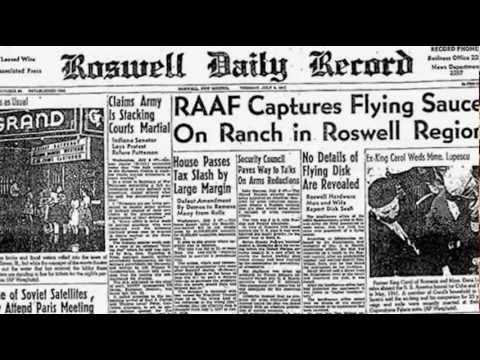
Unsolved Mysteries: The Roswell Incident (1947)
Classic Unsolved Mysteries segment on the Roswell crash, blending witness testimony with the show's signature investigative reenactment style.
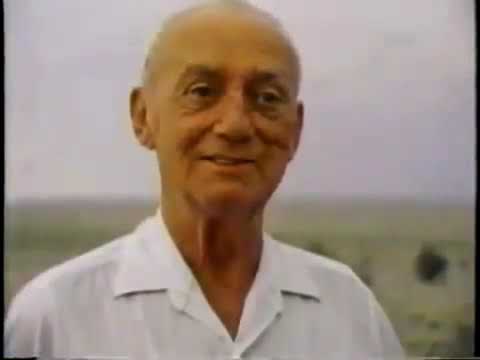
Jesse Marcel Sr. — Roswell Interview (1980)
Archival footage of Major Marcel's interview for In Search Of... (aired September 20, 1980), describing the debris and the Fort Worth press conference. Marcel had first gone public in 1978 interviews with Stanton Friedman.
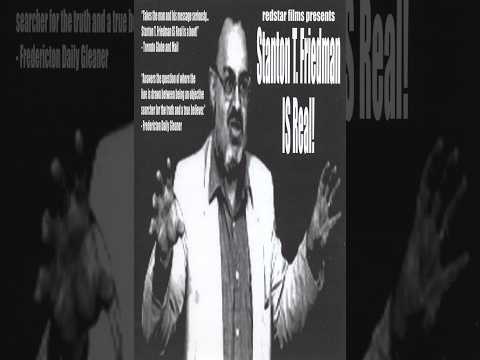
Stanton T. Friedman IS Real! (2002)
Documentary portrait of nuclear physicist Friedman, the researcher whose 1978 interviews with Jesse Marcel revived the Roswell case. Covers his "Cosmic Watergate" thesis and decades of research.
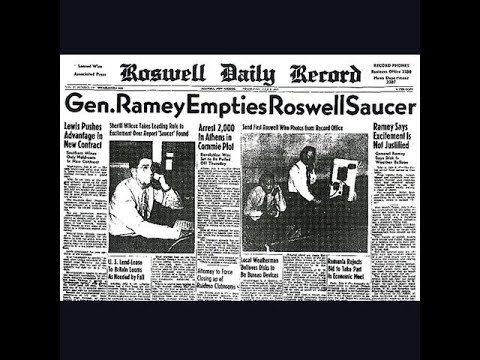
Roswell Witness Panel — 50th Anniversary (1997)
A panel of Roswell witnesses recorded on July 4, 1997, during the 50th-anniversary events in Roswell.
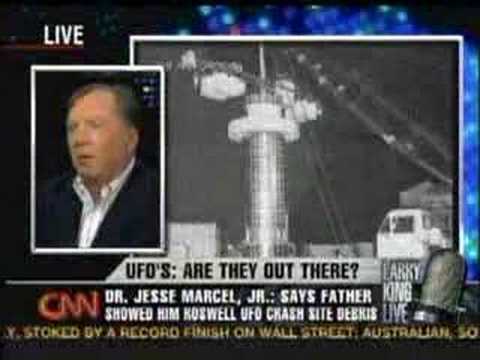
Larry King Live — UFOs Special (July 2007)
CNN's Larry King Live episode on UFOs from July 2007, around the 60th anniversary of the incident.
Sources
- Haut, Walter. Press Release, Roswell Army Air Field, July 8, 1947. Original text reproduced in multiple sources. nicap.org
- Roswell Daily Record, "RAAF Captures Flying Saucer On Ranch in Roswell Region," July 8, 1947. en.wikisource.org
- Roswell Daily Record, "Harassed Rancher who Located 'Saucer' Sorry He Told About It," July 9, 1947 (Brazel interview). Reproduced as fig. 7 in the Air Force's The Roswell Report: Case Closed (1997) and quoted in the 1994 Air Force report
- FBI Dallas teletype to the Director and SAC Cincinnati, "Flying Disc, Information Concerning," July 8, 1947, 6:17 PM. vault.fbi.gov
- Marcel, Jesse A. Interview with Stanton Friedman, 1978 (Houma, Louisiana). The interview that revived the Roswell case
- Marcel, Jesse A. In Search Of... television appearance, "UFO Coverups," Season 5 Episode 1, aired September 20, 1980. imdb.com
- Haut, Walter. Affidavit, May 14, 1993, and sealed affidavit, signed December 26, 2002 (released after his 2005 death; drafted by Donald Schmitt from Haut's statements, per Schmitt and Julie Shuster, MUFON UFO Journal, September 2007). Published in Carey & Schmitt (2007). roswellproof.com
- DuBose, Thomas. Signed affidavit, September 16, 1991. States that the photographed material was a weather balloon and that the balloon explanation was "a cover story to divert the attention of the press," and describes the shipment of the material to Maj. Gen. Clements McMullen (Strategic Air Command) in Washington. roswellproof.com
- Berlitz, Charles & Moore, William. The Roswell Incident, Grosset & Dunlap, 1980
- Randle, Kevin & Schmitt, Donald. UFO Crash at Roswell, Avon Books, 1991
- Carey, Thomas & Schmitt, Donald. Witness to Roswell: Unmasking the 60-Year Cover-Up, New Page Books, 2007 (later revised editions)
- Corso, Philip. The Day After Roswell, Pocket Books, 1997
- Pflock, Karl. Roswell: Inconvenient Facts and the Will to Believe, Prometheus Books, 2001
- Marcel, Jesse Jr. The Roswell Legacy, New Page Books, 2009
- Weaver, Richard L. (U.S. Air Force). Report of Air Force Research Regarding the "Roswell Incident", July 1994; published with supporting documents as Weaver & McAndrew, The Roswell Report: Fact vs. Fiction in the New Mexico Desert, U.S. Government Printing Office, 1995. media.defense.gov (archived)
- McAndrew, James (U.S. Air Force). The Roswell Report: Case Closed, 1997. archive.org (DTIC ADA326147)
- U.S. General Accounting Office. Government Records: Results of a Search for Records Concerning the 1947 Crash Near Roswell, New Mexico, GAO/NSIAD-95-187, July 28, 1995. govinfo.gov
- Rudiak, David. Ramey Memo analysis. roswellproof.com
- FBI. Investigation of MJ-12 documents, 1988. Documents available via FBI Vault. vault.fbi.gov
- Friedman, Stanton & Berliner, Don. Crash at Corona, Paragon House, 1992
- Good, Timothy. Above Top Secret, William Morrow, 1988
- Rowe, Frankie. Testimony documented in Carey & Schmitt (2007) and multiple documentary appearances
- "Roswell incident," Wikipedia (comprehensive summary of published sources). en.wikipedia.org
- "Jesse Marcel," Wikipedia. en.wikipedia.org
- Exon, Arthur. Interviews with Kevin Randle, 1990. Documented in Randle & Schmitt (1991); Exon's objection to his depiction noted in Pflock (2001)
- Proctor, Loretta. Affidavit, May 5, 1991; excerpted in the Air Force's 1994 report. ufologie.patrickgross.org
- Brazel family testimony. Bessie Brazel Schreiber (affidavit, September 22, 1993, excerpted in the Air Force's 1994 report) and Bill Brazel Jr. First interviewed for Berlitz & Moore (1980); also in Randle & Schmitt (1991) and Carey & Schmitt (2007)
- Dugger, Barbara (granddaughter of Sheriff Wilcox). Second-hand account from her grandmother Inez Wilcox: 1991 video interview and affidavit of February 24, 1995, published in Pflock (2001); also in Friedman & Berliner (1992)
- Sleppy, Lydia. Affidavit, September 14, 1993 (published in Pflock, Roswell in Perspective, Fund for UFO Research, 1994). roswellproof.com
- Randle, Kevin D. & Rodeghier, Mark. "Frank Kaufmann Reconsidered: Two Scenarios," International UFO Reporter, Fall 2002. physics.smu.edu
- All-domain Anomaly Resolution Office (AARO). Supplement to Oak Ridge National Laboratory's Analysis of a Metallic Specimen, July 2024. theblackvault.com
- U.S. General Accounting Office. "[Comments on Majestic 12 Material]," letter, July 28, 1995
- FBI statement on the Guy Hottel memo, March 2013, as reported by Live Science. livescience.com
- Hastings, Robert. UFOs and Nukes: Extraordinary Encounters at Nuclear Weapons Sites, 2017
See something inaccurate? Have additional information or sources?
Suggest an Edit →Last Updated: October 2026