
Witness to Roswell
Unmasking the Government's Biggest Cover-Up
Core Thesis
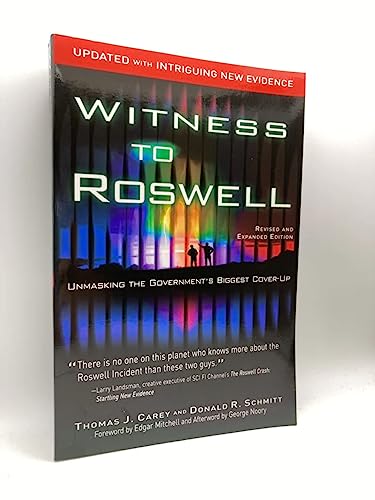
Witness to Roswell: Unmasking the Government's Biggest Cover-Up is Thomas J. Carey and Donald R. Schmitt's attempt to settle the 1947 Roswell Incident once and for all in the crash-retrieval believers' favor, by assembling the largest single collection of named-witness and deathbed testimony ever published on the case — more than 600 interviews conducted over roughly two decades — into a single narrative of a genuine extraterrestrial craft recovered northwest of Roswell, its small alien occupants (one, the authors claim, briefly alive), and a sustained, multi-generational government effort to intimidate the people who saw it into silence. First published in 2007 and revised and expanded in 2009, the book became the best-selling UFO title in the world for two consecutive years and remains the single most influential "believer" account of Roswell in print. It belongs on this list for exactly the reason this site's own Roswell: Inconvenient Facts entry belongs on it: the two books argue the same case to opposite conclusions, drawing on overlapping witness pools and overlapping documentary record, and reading them together is the closest thing available to a fair hearing of Roswell's central, decades-old argument.
About the Author
Thomas J. Carey, born in 1940 and a native Philadelphian, holds a B.S. in business administration from Temple University and an M.A. in anthropology from California State University, Sacramento, and separately attended the University of Toronto's doctoral program in anthropology without completing it. He served in the U.S. Air Force and held a Top Secret/Crypto security clearance, then spent his working career as a Philadelphia-area businessman before retiring to research full-time. Carey's organized UFO work predates his Roswell involvement: he served as Mutual UFO Network (MUFON) State Section Director for Southeastern Pennsylvania from 1986 to 2001, as a Special Investigator for the J. Allen Hynek Center for UFO Studies (CUFOS) from 1991 to 2001, and on Vault's board of directors from 1997 to 2001. He joined the Roswell investigation in 1991 as a member of the team then led by Kevin Randle and Donald Schmitt, and since 1998 has worked the case exclusively alongside Schmitt. Carey has published more than three dozen articles on Roswell and appeared on Larry King Live, Coast to Coast AM, and numerous television documentaries; he lives in Huntingdon Valley, Pennsylvania, with his wife, Doreen.
Donald R. Schmitt came to Roswell, New Mexico, from Chicago in 1989 as, by his own later account, a skeptic who changed his mind after interviewing witnesses and reviewing the case's evidence. He has since described himself as a former director of special investigations for CUFOS, a role he held for roughly a decade, and today serves as lead investigator for the International UFO Museum and Research Center in Roswell. His first book, UFO Crash at Roswell (1991), co-authored with Kevin Randle, became the basis for the Golden Globe-nominated 1994 television movie Roswell, and the pair followed it with The Truth About the UFO Crash at Roswell (1994). Those two books, more than any others, built the elaborate multiple-crash-site, recovered-bodies version of the Roswell narrative that both this book and this site's own Roswell Incident case file describe as ufology's dominant modern account of the case.
Schmitt's record carries a documented and serious credibility problem that this site addresses directly rather than passing over: in the mid-1990s, Kevin Randle — his own research partner at the time — discovered that Schmitt had misrepresented significant parts of his professional background and education to reporters and colleagues, including claims about a graduate degree and professional credentials that did not match his actual employment. Randle's response was blunt and public. In a widely circulated 1995 open letter he wrote that Schmitt "will lie about anything. He will lie to anyone," adding that Schmitt "has revealed himself as a pathological liar," and announced he would have nothing further to do with him professionally. In a 2002 email later made public, Randle further alleged that Schmitt had misrepresented aspects of the Roswell investigation itself and had told other researchers that Randle was "a government agent planted on him" — an attempt, in Randle's characterization, at character assassination against his own former partner. Schmitt's later biographical materials list a Concordia University liberal-arts degree earned cum laude, though published sources do not establish when that credential was obtained relative to the 1990s disputes. Randle and Schmitt's professional rift, whatever its origin, proved temporary in practice: the two continued to appear at the same UFO conferences in the years that followed, and Randle has since offered qualified praise for parts of the Carey-Schmitt research even while continuing to dispute specific claims and witnesses in it, a tension this entry's Critical Reception section addresses in full. Readers should weigh this record the same way this site's own Roswell: Inconvenient Facts entry asks readers to weigh Richard Doty's testimony in Project Beta: not as grounds to dismiss everything Schmitt has since reported, but as a documented reason to require independent corroboration before treating his account of any specific witness encounter as settled.
Carey's own credentials carry no equivalent public dispute; no published source reviewed for this entry documents any comparable challenge to his stated military service, education, or MUFON and CUFOS record. The book's authority therefore rests on an asymmetric foundation — Carey's comparatively unchallenged background paired with Schmitt's documented history of misrepresentation — a combination this site's Critical Reception section treats as directly relevant to how individual witness claims in the book should be weighed.
Historical Context & Origins
Witness to Roswell arrived at the end of a nearly three-decade arc in Roswell literature. Charles Berlitz and William Moore's The Roswell Incident (1980) first revived the case for a modern audience after Stanton Friedman's 1978 interview with retired intelligence officer Jesse Marcel. Kevin Randle and Donald Schmitt's own UFO Crash at Roswell (1991) and The Truth About the UFO Crash at Roswell (1994) then built the elaborate, multiple-witness, multiple-crash-site narrative that has dominated popular treatments of the case ever since. The U.S. Air Force answered with two official reports — The Roswell Report: Fact vs. Fiction in the New Mexico Desert (1994), identifying Project Mogul debris as the mundane source of the Foster Ranch wreckage, and The Roswell Report: Case Closed (1997), attributing alien-body accounts to anthropomorphic parachute test dummies — without persuading most of ufology's own Roswell specialists. Karl Pflock's Roswell: Inconvenient Facts and the Will to Believe, this site's own ER-033 entry, delivered the most credentialed skeptical rebuttal to the crash-retrieval case in 2001, arguing from inside the believer community that the physical evidence and testimony together pointed to Mogul rather than a crashed craft.
Randle and Schmitt's original partnership did not survive the 1990s intact. Following the mid-decade discovery of Schmitt's misrepresented credentials, Randle ended their working relationship, and Schmitt teamed instead with Carey, who had joined the investigation as a MUFON- and CUFOS-affiliated researcher in 1991. Carey and Schmitt worked the case together from 1998 onward, and in 1999 re-issued material originally developed with Randle as "52 Years of Unanswered Questions" under their own names — a direct product of the field's internal reshuffling that this book's acknowledgments and structure still reflect.
By the time Witness to Roswell appeared in 2007, the case's most prominent witnesses had already been through a public reckoning that Pflock's 2001 book had helped force: figures like Frank Kaufmann and Gerald Anderson, once treated as central corroborating sources, had been exposed as unreliable or outright fabricated after 2000 through research that, notably, involved Schmitt himself alongside CUFOS's Mark Rodeghier and researcher Mark Chesney. Carey and Schmitt's book was explicitly framed, in this climate, as a rebuilding of the crash-retrieval case on firmer ground — a promise the book's title and marketing ("unmasking" a cover-up rather than merely re-asserting one) made directly to a readership that had watched several of its earlier star witnesses collapse under scrutiny.
The book's own publication history mirrors that rebuilding effort: the original 2007 edition, subtitled Unmasking the 60-Year Cover-Up (New Page Books, ISBN 9781564149435), became the best-selling UFO book in the world for 2007 and 2008. A Revised and Expanded Edition followed in 2009, retitled Unmasking the Government's Biggest Cover-Up (New Page Books, ISBN 9781601630667, the edition cited throughout this entry and already cited on this site's own resources library), adding a foreword by Apollo 14 astronaut Edgar Mitchell and an afterword by Coast to Coast AM host George Noory. Carey and Schmitt later extended the same project further still with The Children of Roswell (2016), Roswell: The Ultimate Cold Case (2019, with Joseph G. Buchman), and a 75th Anniversary Edition of Witness to Roswell itself in 2022.
Core Arguments & Key Concepts
The book's organizing claim is that the Roswell debris field was not a single, contained event but the product of a real recovery operation spanning multiple sites — the Foster Ranch debris field itself, a separate site the authors place roughly two to three miles away where a damaged craft and bodies were found, and an additional, previously unpublicized location the authors call "Site No. 7," which they place approximately 40 miles north-northwest of Roswell without providing precise coordinates. Carey and Schmitt argue that Roswell researchers on both sides of the debate have long undercounted the number of distinct locations involved, and that this multiplicity, rather than undermining the crash-retrieval case, reflects how a real, chaotic, multi-day military recovery operation would actually have unfolded.
The book's evidentiary core is deathbed and late-life testimony, a category the authors treat as uniquely credible precisely because it was given by people with nothing left to gain and, in several cases, decades of prior silence to explain. Its most prominent examples are Brigadier General Arthur Exon, former commander of Wright-Patterson Air Force Base, and Brigadier General Thomas DuBose, both of whom the authors present as having held to their oaths of secrecy for most of their lives before offering fuller accounts late in life. The book treats this pattern — senior officers breaking silence only near the end — as itself evidence of the story's gravity, though it is also, as this entry's Critical Reception section notes, exactly the kind of late-emerging testimony that Pflock's Roswell: Inconvenient Facts and Randle's own later writing both single out as the category of evidence most vulnerable to memory reconstruction and social pressure over sixty intervening years.
Walter Haut's sealed affidavit, opened only after his December 2005 death per his own instructions, anchors the book's most direct documentary claim: Haut, the Roswell Army Air Field public information officer who issued the original July 8, 1947, "flying disc" press release, stated in the affidavit that he had personally viewed both wreckage and a recovered craft with bodies inside a hangar, a claim that goes considerably further than his earlier, more cautious public statements about the episode had ever gone. Carey and Schmitt present the affidavit as Haut's final, unpressured word on the record; this site's own Roswell: Inconvenient Facts entry and outside reviewers alike have noted the harder problem the affidavit poses — that it was published the year after Pflock's 2001 book and directly contradicts Haut's own more measured 1993 statement, without Haut alive to reconcile the two accounts himself.
A recurring thread throughout the book is government intimidation of witnesses across six decades: the authors document alleged instances of threatened careers, warned-off family members, and, in some accounts, direct financial inducements to stay silent, framing the book's title claim — a "cover-up," not merely a secret — as resting as much on this pattern of pressure as on the original 1947 recovery itself. The book also engages the disputed physical-evidence claims associated with the case, including witness descriptions of unusually light, self-restoring "memory metal" debris, which the authors treat as independent corroboration of non-terrestrial materials rather than, as Pflock's book argues at length, a plausible description of the foil and balsa-wood components of a Project Mogul balloon train.
Key Cases & Evidence Discussed
The Roswell Incident (Case File #001, July 1947) is this book's entire subject, and its account tracks the same debris-field discovery by rancher Mac Brazel near Roswell, New Mexico, and the Roswell Army Air Field's same-day reversal from "flying disc" press release to weather-balloon retraction, that this site's own case file documents — but where that case file and Pflock's skeptical entry present the evidence both ways, Carey and Schmitt's book is written explicitly to close the question in the crash-retrieval narrative's favor.
This site's own Roswell: Inconvenient Facts and the Will to Believe entry (ER-033), covering Karl Pflock's 2001 skeptical rebuttal, is this book's most direct point of comparison anywhere in this library. Pflock and Carey/Schmitt draw on an overlapping pool of named witnesses — Jesse Marcel, Walter Haut, Glenn Dennis, and others — and reach opposite conclusions from substantially the same raw testimony; reading the two entries together, rather than either alone, is this site's own recommended way to evaluate the Roswell case's central, still-unresolved argument.
Walter Haut's 2002 sealed affidavit receives close individual attention in both this book and this site's own case file and Pflock entry, since its posthumous publication timing — a year after Pflock's book, and after Haut himself was no longer available to clarify or be cross-examined on it — is a recurring point of scrutiny across the Roswell literature regardless of which side of the debate a given researcher occupies.
The book's treatment of Frank Kaufmann as a discredited witness intersects directly with this site's own coverage of the case's internal reckoning: Kaufmann, once presented by Randle and Schmitt's earlier books as a key corroborating source, was exposed after 2000 as having invented much of his account, in part through research Schmitt himself participated in alongside CUFOS's Mark Rodeghier — a genuine instance, distinct from the credential dispute covered in this entry's About the Author section, of Schmitt correcting the believer-side record rather than distorting it.
Critical Reception & Controversies
Trade coverage at publication focused less on the book's factual reporting than on its central structural weakness. Forbes contributor William P. Barrett's July 9, 2007 review, published under the headline "Those Roswell Aliens Dropped In Everywhere," credited the book as competently written and entertaining for believers, but identified the same problem that has dogged crash-retrieval literature for decades: across the different books and researchers, Roswell's alleged crash sites now number seven, spread across roughly 200 miles of New Mexico desert, with Carey and Schmitt's own previously unpublicized "Site No. 7" — offered without specific coordinates — adding an eighth data point to a pattern Barrett argued "only serve[s] to reinforce the advocacy mentality" rather than resolve it. Barrett also flagged the direct contradiction between Haut's cautious 1993 statement and his more dramatic 2002 sealed affidavit as a problem the book does not fully resolve, and recommended reading Pflock's 2001 book alongside it for balance — the same pairing this site's own library now offers its readers directly.
Reader reception, aggregated at 3.94 out of 5 across roughly 930 Goodreads ratings for the original edition, splits along predictable lines but surfaces a genuine, recurring methodological complaint even among moderately positive reviewers: multiple readers noted that the authors appear to treat a witness's refusal to talk as confirmation of government intimidation while treating a witness's willingness to talk as confirmation of the crash, a structure that leaves the book's core thesis effectively unfalsifiable regardless of how any given witness actually responds. Other recurring reader criticisms include the heavy reliance on secondhand and thirdhand accounts — testimony from children or relatives of original witnesses rather than direct participants — and a repetitive structure in which broadly similar stories recur under different names without clearly differentiated evidentiary weight.
The most substantive named criticism of the book's underlying research method comes from within the crash-retrieval camp itself, not from skeptics. Kevin Randle, Schmitt's former co-author and the person most responsible for exposing his credential misrepresentations in the 1990s, has separately and repeatedly disputed specific witnesses this book and its companion volumes rely on. Writing about Jim Ragsdale, a self-described witness whose account changed materially across multiple statements — his vehicle, the weather conditions, and the crash site's location (eventually relocated some 53 miles from his original claim) all shifted between his 1993 and 1995 affidavits — Randle noted that Carey and Schmitt's own investigative standard, applied consistently, should have disqualified Ragsdale the same way it disqualified other discredited witnesses: "How many lies and how many forged documents must we discover before we decide that a witness is unreliable?" Randle asked in a related critique of the similarly discredited Frank Kaufmann. The complaint echoes, almost point for point, the "triumph of quantity over quality" charge Pflock's Roswell: Inconvenient Facts levels at the believer camp generally: that testimonial volume has repeatedly substituted for individual witness scrutiny in Roswell research on the crash-retrieval side, this book included.
That overlap in criticism, arriving from a believer-side insider rather than an outside skeptic, is the clearest evidence available that the core methodological weakness Pflock's book identifies in 2001 was not resolved by this book's more extensive 2007/2009 witness base. Unlike the dispute this site's own Roswell: Inconvenient Facts entry documents between Pflock and the wider believer community he left, the Randle-Carey-Schmitt disagreements happen entirely within the crash-retrieval camp, between researchers who agree an extraordinary event occurred at Roswell and disagree only about which specific witnesses can be trusted to describe it — a genuinely different, and in some ways more damaging, kind of internal critique for this specific book to carry.
Influence & Legacy
Witness to Roswell's most concrete measure of influence is commercial: it was the best-selling UFO book in the world for 2007 and 2008, a scale of readership few other titles in this site's Essential Reading library, on either side of the extraterrestrial-hypothesis debate, can claim. That reach, more than any single piece of evidence in it, is why the book remains the default modern reference point for the crash-retrieval version of Roswell in popular culture, television specials, and mainstream press coverage of the case's anniversaries.
Carey and Schmitt's continued collaboration after this book's success produced an entire subsequent shelf of related titles — The Children of Roswell: A Seven-Decade Legacy of Fear, Intimidation, and Cover-Ups (2016) and Roswell: The Ultimate Cold Case (2019, with Joseph G. Buchman) — extending this book's witness-testimony method to new generations of family members and claimed government contacts. A 75th Anniversary Edition of Witness to Roswell itself, published in 2022 with an afterword again from George Noory, indicates the original book's commercial and cultural staying power fifteen years after first publication.
Within this site's own catalogue, this exact 2009 edition (ISBN 1601630662 / 9781601630667) is already cited in resources.html in direct connection with the Roswell Incident case file, where it is described as "the definitive witness-focused account" featuring the Haut affidavit and deathbed testimony — language that reflects the book's real-world standing as the field's most comprehensive believer-side witness compilation, independent of the specific critical disputes covered in this entry.
Perhaps this book's most useful role on a site that also hosts Roswell: Inconvenient Facts is as the fullest possible statement of the position Pflock's book was written to answer. Where Pflock argued case-by-case and witness-by-witness that the crash-retrieval narrative did not hold up, Carey and Schmitt's book is the crash-retrieval narrative's own most complete and most widely read modern defense — and the fact that even a fellow believer-side researcher, Kevin Randle, has publicly disputed specific witnesses within it demonstrates that this book's influence has not settled the underlying argument so much as kept it alive for a new generation of readers on both sides.
The Book
As an Amazon Associate, OverClassified may earn from qualifying purchases made through this link, at no extra cost to you.
Why This Is Essential Reading
Witness to Roswell earns its place on this list not because its central claims withstand the same scrutiny Karl Pflock brought to the same case in Roswell: Inconvenient Facts, but because it is, by a wide margin, the most-read and most influential published statement of the position Pflock's book exists to rebut. Thomas J. Carey's comparatively unchallenged background and Donald R. Schmitt's documented history of misrepresenting his own credentials sit uneasily side by side in this book's authorship, and its most serious critics — Kevin Randle chief among them — are drawn not from the skeptical camp but from within the crash-retrieval research community itself, disputing specific witnesses like Jim Ragsdale on grounds strikingly similar to the "quantity over quality" charge Pflock levels at the believer case generally. None of that erases the book's real cultural weight: the best-selling UFO title of its era, the vehicle that brought Walter Haut's sealed affidavit and the Exon and DuBose deathbed accounts to a mass audience, and the fullest, most current believer-side case this site's library offers. Read alongside Pflock's opposing account, it completes something this site is well positioned to offer that neither book manages alone: a fair, two-sided hearing of Roswell's central, still-unresolved argument, presented by the two researchers — one skeptical, one crash-retrieval — who each made the fullest case their side of it has produced.
Related Cases & Theories
Essential Viewing
Roswell UFO Crash, Interview With Donald Schmitt And Tom Carey | #147
The Moore Show — A long-form interview with both authors discussing the Roswell case and the research behind Witness to Roswell. Verified via YouTube oEmbed before inclusion.
USP 47: Donald Schmitt & Tom Carey | The Roswell Conversation
Universal Secrets — A dedicated conversation with Schmitt and Carey covering their decades of Roswell witness research. Verified via YouTube oEmbed before inclusion.
Sources Cited
- Carey, Thomas J., and Donald R. Schmitt. Witness to Roswell: Unmasking the Government's Biggest Cover-Up. Revised and Expanded Edition. Foreword by Edgar Mitchell, afterword by George Noory. New Page Books, 2009 (ISBN 9781601630667 / 1601630662, matching this site's own resources library citation under this exact edition). amazon.com
- Carey, Thomas J., and Donald R. Schmitt. Witness to Roswell: Unmasking the 60-Year Cover-Up. New Page Books, 2007 (original edition, ISBN 9781564149435 / 1564149439). amazon.com
- "Witness to Roswell, Revised and Expanded Edition." Open Library / AbeBooks edition record (New Page Books, 2009, 318 pp., ISBN 1601630662 / 9781601630667). openlibrary.org
- Barrett, William P. "Those Roswell Aliens Dropped In Everywhere." Forbes, July 9, 2007 (contemporary review identifying the book's proposed additional crash site and the wider multiple-crash-site problem in Roswell literature). forbes.com
- "Witness to Roswell: Unmasking the 60-Year Cover-Up." Goodreads (aggregate reader rating of 3.94/5 across roughly 930 ratings, and reader-review commentary on witness-testimony methodology). goodreads.com
- Kimball, Paul. "The Other Side of Truth: The Roswell Dream Team, Donald Schmitt, and the Broken Ethical Compass of Ufology." Redstar Films blog, September 2013 (quotes Kevin Randle's 1995 open letter and 2002 email documenting Schmitt's misrepresented credentials and conduct toward Randle). redstarfilms.blogspot.com
- Randle, Kevin. "Re: Frank Kaufmann Exposed." Reprinted at SMU Physics Dept. pseudoscience archive (Randle's critique of witness reliability standards applied to Kaufmann, Frank Joyce, and other Roswell witnesses promoted by Carey and Schmitt). physics.smu.edu
- Randle, Kevin. "Jim Ragsdale's Roswell Tale." A Different Perspective blog, April 2015 (documents the material inconsistencies across Ragsdale's changing affidavits and Randle's assessment of Carey and Schmitt's handling of the witness). kevinrandle.blogspot.com
- "Donald R. Schmitt." Center for UFO Studies (CUFOS), official biography (career history, CUFOS role, Roswell investigation background). cufos.org
- "The Roswell Incident: An Eyewitness Account" and "Witness to Roswell." Internet Archive catalog records for Thomas J. Carey (b. 1940), author biographical and bibliographic detail. archive.org
- This site's own case file: The Roswell Incident (Case File #001), the 1947 debris-field discovery and government response this book reconstructs from the crash-retrieval perspective.
- This site's own essential-reading entry: Roswell: Inconvenient Facts and the Will to Believe, Karl Pflock's opposing skeptical account of the same case and witnesses.
- This site's own key-figures entries: Thomas Carey, Donald Schmitt, and Kevin Randle, for full biographical detail and further case connections beyond this book.
- This site's own resources library: Full Reading List, where this exact 2009 edition (ISBN 1601630662) is cited in connection with the Roswell Incident case file.
Have corrections, additional research, or peer-reviewed sources? Help improve this entry.
Suggest an Edit