
Roswell: Inconvenient Facts and the Will to Believe
A Former CIA Officer and Onetime Roswell Believer's Eight-Year Case Against the Crashed-Saucer Narrative
Core Thesis
Roswell: Inconvenient Facts and the Will to Believe makes a claim its own author spent eight years resisting before he could bring himself to publish it: that after exhaustively re-examining the witness testimony, the declassified paper trail, and the physical evidence behind the 1947 Roswell Incident, Karl T. Pflock — a former CIA intelligence officer who had begun his own Roswell research as a believer sympathetic to the crash-retrieval narrative — concluded no extraterrestrial spacecraft crashed there, and that the debris recovered from the Foster Ranch was, in all likelihood, wreckage from Project Mogul, a classified high-altitude balloon array built to detect Soviet atomic tests. Pflock's book is deliberately not a simple believer-versus-skeptic tract, however: he argues just as pointedly that the Army Air Forces' own secrecy and its shifting, evasive public explanations were genuinely real and genuinely improper, separating — more sharply than almost any other Roswell book on either side — the question of whether something classified and mishandled happened at Roswell (yes) from the question of whether it involved a crashed alien craft (no).
About the Author
Karl Tomlinson Pflock (1943–2006) was born January 6, 1943, in San Jose, California, and graduated cum laude from San Jose State University in 1964 with a bachelor's degree in philosophy and political science. He joined the Central Intelligence Agency as an intelligence officer in 1966, serving until 1972 — the credential this site's own key-figures entry on him already leads with, and one that gives his later Roswell work an institutional vantage point almost no other writer on either side of the case has ever had. After the CIA, Pflock worked as a senior editor at the American Enterprise Institute, then moved into Republican defense politics during the Reagan years: publications director for the House Republican Conference (1981–83), senior legislative assistant to Congressman Ken Kramer (1983–85), and, from 1985 to 1989, Deputy Assistant Secretary of Defense for Operational Test and Evaluation at the Pentagon, for which he received the Defense Department's Outstanding Public Service Medal in 1989. He spent 1989 to 1992 as a senior strategic planner for BDM International, working on environmental restoration of former nuclear test sites, before leaving government-adjacent work entirely in 1992 to research and write about UFOs full-time.
Pflock's UFO interest long predated his full-time career switch, and it began, by his own account, as sympathetic rather than skeptical: a childhood memory of adults discussing a supposed flying-saucer crash with "little alien guys" in the Southwest, which he later said was the kind of thing that "if something like this captures your imagination at that stage of life . . . you never get rid of it." That sympathy carried into his actual investigative work. In the early 1990s Pflock partnered with fellow researcher Fred Whiting on a Fund for UFO Research (FUFOR)-sponsored push for congressional and General Accounting Office inquiries into Roswell, hoping the case would hold up to documentary scrutiny. His first book-length publication on the subject, the 1994 FUFOR report Roswell in Perspective, was the direct product of two years of that research — and it was in this report, not the 2001 book profiled here, that Pflock first broke from the believer camp in print, concluding "no flying saucer or saucers crashed in the general vicinity of Roswell or on the Plains of San Agustin in 1947" and identifying Project Mogul as the likely source of the recovered debris, a finding he made public in June 1994, months before the Air Force's own September 1994 report reached a similar conclusion. Pflock later wrote candidly that he and Whiting had both been, in his own phrase, "victims of the 'will to believe'" — a self-diagnosis that gives this book's subtitle its double meaning.
The 1994 FUFOR report earned Pflock the derisive label "debunker" from within a UFO community that had spent the 1980s building an increasingly elaborate crash-retrieval case around Roswell, and it set up the seven additional years of research, interviews, and document-hunting that produced Roswell: Inconvenient Facts and the Will to Believe in 2001. Pflock was named Ufologist of the Year by the National UFO Conference in 1998, a recognition that, however skeptical his specific Roswell conclusions had become, credited the seriousness and duration of his investigative work rather than any particular verdict. He went on to co-author Shockingly Close to the Truth! Confessions of a Grave-Robbing Ufologist (2002) with longtime Saucer Smear editor James W. Moseley, and his final book, Encounters at Indian Head, a fresh look at the Betty and Barney Hill abduction case, was published posthumously. Diagnosed with amyotrophic lateral sclerosis (ALS) in 2005, Pflock died at his home in Placitas, New Mexico, on June 5, 2006, at age 63, survived by his wife, Mary Martinek, and five children.
Historical Context & Origins
Pflock published Roswell: Inconvenient Facts and the Will to Believe in 2001, at the tail end of a fifteen-year explosion in Roswell literature that the 1980 publication of Charles Berlitz and William Moore's The Roswell Incident had touched off, and that Kevin Randle and Donald Schmitt's UFO Crash at Roswell (1991) and The Truth About the UFO Crash at Roswell (1994) had escalated into the case's dominant, multiple-crash-site, recovered-alien-bodies narrative. By 2001 the U.S. Air Force had already published two lengthy official reports attempting to close the case — The Roswell Report: Fact vs. Fiction in the New Mexico Desert (1994), which identified Project Mogul as the source of the Foster Ranch debris, and The Roswell Report: Case Closed (1997), which attributed alien-body accounts to Air Force parachute-test dummies and unrelated accidents — without persuading either most of the public or most of ufology's own Roswell specialists.
The book's own origin point predates its 2001 publication by nearly a decade: Pflock's 1994 Fund for UFO Research report Roswell in Perspective had already broken from the believer consensus and named Project Mogul, doing so months before the Air Force's own 1994 report reached the same conclusion — a sequence this site's own research confirms made Pflock, not the Air Force, the first person to advance the Mogul explanation in print. That early, independently reasoned position gave the 2001 book unusual standing when it finally appeared: it arrived not as one more Air Force-aligned skeptical account, but as the mature, seven-years-further-researched expansion of a position its author had already staked out and defended against sustained pushback from his own community.
Roswell: Inconvenient Facts and the Will to Believe also arrived carrying an insider's credibility its skeptical predecessors largely lacked: unlike Philip J. Klass, an aviation trade journalist who investigated Roswell from outside ufology's believer establishment, Pflock had been a working member of that establishment — a FUFOR-sponsored investigator who had personally lobbied for congressional and GAO inquiries into the case in the hope those inquiries would validate the extraordinary version of events. His reversal therefore read, to supporters and critics alike, as a defection from within rather than an attack from without, a distinction the book's foreword author, science-fiction writer and engineer Jerry Pournelle, and contemporary reviewers both treated as central to the book's impact.
The book also entered a Roswell-literature landscape in the middle of its own internal reckoning: Kevin Randle, one of the case's most prolific crash-retrieval advocates, was in these same years beginning to walk back specific witnesses and claims — including material tied to discredited figure Frank Kaufmann — that this site's own Roswell Incident case file documents as later abandoned even by researchers on the believer side. Pflock's book, published into that reassessment, offered both a rival, non-extraterrestrial explanation and a direct, witness-by-witness accounting of exactly which parts of the believer case Pflock judged no longer held up.
Core Arguments & Key Concepts
The book's central and most quoted methodological complaint is what Pflock called Roswell's "triumph of quantity over quality": his argument that crash-retrieval advocates had spent two decades treating the sheer volume of testimony and secondhand claims as itself a form of evidence, rather than subjecting each individual claim to the same scrutiny a single, contested witness statement would ordinarily receive. In Pflock's own words, quoted repeatedly in reviews and reader accounts of the book, "the advocates . . . simply shovel everything that seems to support their views into the box labeled 'Evidence'" without weighing whether any specific piece of it can withstand independent checking.
Applying that standard, Pflock devotes substantial sections of the book to systematically testing the credibility of Roswell's most prominent named witnesses — among them Jesse Marcel, whose 1978 interview with Stanton Friedman revived the modern Roswell case; mortician Glenn Dennis, whose alien-autopsy account Pflock finds internally inconsistent and undercut by the nurse he named never having been located; and figures like Gerald Anderson and Frank Kaufmann, both of whom this site's own Roswell Incident case file separately documents as later discredited or contested even among believer-side investigators. Pflock's verdict on the state of eyewitness testimony by the late 1990s — that Roswell's "principal advocates," including Kevin Randle, had "come to realize that, as the credibility of 'witness' after 'witness' falls by the wayside . . . they have no case" — is the book's most pointed single line about the state of the believer position it was written to answer.
On the physical-evidence side, Pflock builds his Project Mogul case largely on the sworn statements of Charles B. Moore, the NYU project engineer who worked on the actual Mogul balloon flights launched from Alamogordo in June and early July 1947, and whose recollection of the balloon train's radar-reflector construction — foil, tape, wooden sticks, and a novelty company's leftover stock of decorative tape bearing pinkish-purple symbols — matches, point for point, the witness descriptions of "foil," "sticks," and mysterious "hieroglyphics" that crash-retrieval advocates had long treated as evidence of exotic, non-terrestrial materials and writing. This site's own key-figures entry on Charles Moore independently documents the same physical-evidence match Pflock's book builds its central conventional explanation around.
The book's most distinctive argument, and the one its own subtitle points toward, is Pflock's refusal to let the mundane physical explanation erase the case's genuine secrecy: he argues at length that the Army Air Forces' own July 1947 flip from an initial "flying disc" press release to same-day, same-base retraction, its decades of shifting and sometimes contradictory follow-up explanations, and its acknowledged classified handling of Mogul itself all constitute real, documented government evasiveness that deserved the scrutiny Roswell advocates gave it — he simply concludes that scrutiny points to a classified balloon program rather than a captured spacecraft.
Key Cases & Evidence Discussed
The Roswell Incident (Case File #001, July 1947) is this book's entire subject, and Pflock's account tracks the same documentary spine this site's own case file lays out in detail — from rancher Mac Brazel's discovery of debris on the Foster Ranch outside Roswell, New Mexico, through the Roswell Army Air Field's same-day reversal from "flying disc" press release to weather-balloon retraction at the Fort Worth press conference, to the case's 1978 revival through Stanton Friedman's interview with Jesse Marcel — but Pflock's book diverges from this site's own case file's more evidence-both-ways presentation by reaching a firm, stated conclusion: that the physical evidence and credible testimony together point to Project Mogul, not a crashed craft.
Pflock devotes direct, skeptical attention to the Operation Majestic-12 documents, the purported 1947 Truman-authorized briefing papers that this site's own Roswell Incident case file documents as received anonymously by television producer Jaime Shandera in December 1984 and investigated by multiple agencies since; Pflock's research into the related Cutler-Twining memo, conducted in part through his own 2003 on-record interviews, fed directly into the book's broader argument that several of Roswell's most dramatic documentary "smoking guns" do not survive close examination.
The book gives close, individual attention to the credibility of Walter Haut's public affairs officer role in issuing the original July 8, 1947, flying-disc press release, an episode this site's own case file documents in detail alongside Haut's later, posthumously opened 2002 sealed affidavit — a document published the year after Pflock's book and therefore not something the 2001 text could evaluate directly, though later editions and Pflock's subsequent public comments engaged with it skeptically.
Pflock's treatment of Project Mogul itself — the classified balloon-borne acoustic array designed to detect Soviet atmospheric nuclear tests, flown from Alamogordo Army Air Field beginning in June 1947 — connects his book directly to this site's own broader Government Deception Hypothesis coverage of Cold War secrecy programs whose genuine classification, rather than any extraterrestrial cover-up, fed decades of UFO suspicion; Pflock's own account of Mogul is one of the most detailed single-case applications of that broader pattern found anywhere in this site's Essential Reading library.
Critical Reception & Controversies
Trade reception was strongly positive on the book's rigor. Publishers Weekly called it a "definitive book on facts and fantasies" surrounding the 1947 events, crediting Pflock's assembly of formerly classified documents, 1947 United Press wire transmissions, contemporaneous weather data, and 28 witness affidavits, and concluding he "succeeded . . . in a major fashion, creating an unusual and authoritative study." The book was also reviewed in Isis, the journal of the History of Science Society (Vol. 93, No. 2, June 2002), an academic notice few other Roswell-focused books on either side of the debate have received.
Reception from within ufology's own Roswell research community was, as Pflock himself anticipated, considerably more hostile, and it was compounded by his standing as a defector rather than an outside critic: having spent years as a FUFOR-sponsored investigator hoping the crash-retrieval case would hold up, Pflock's published reversal was received by many of his former believer-side colleagues less as honest reconsideration than as betrayal, and the "debunker" label first applied to his 1994 FUFOR report followed him through the 2001 book's reception as well.
That said, even researchers who continued to disagree with Pflock's ultimate Mogul conclusion frequently distinguished his methodology from that of a simple dismissive skeptic. Kevin Randle, whose own UFO Crash at Roswell and The Truth About the UFO Crash at Roswell represent exactly the crash-retrieval case this book was written to answer, maintained a personal friendship with Pflock and attended UFO conferences alongside him even as the two argued the case publicly — a working relationship this site's own research found no equivalent of in the more openly adversarial disputes between other Roswell believers and skeptics. Randle and Pflock even co-published research questioning whether one contested witness, Barney Barnett, had genuinely seen wreckage on the Plains of San Agustin at all, illustrating that Pflock's skepticism operated case-by-case and witness-by-witness rather than as a blanket dismissal.
Some later commentary has noted a detail that complicates any simple believer-versus-skeptic framing of Pflock's reputation: despite his firm rejection of the Roswell crashed-saucer narrative specifically, Pflock did not describe himself as a categorical UFO skeptic, and secondary profiles of his work have noted he remained personally open to the broader possibility that some UFO reports reflect genuine anomalies — a nuance that separates his position from the flat extraterrestrial-hypothesis rejection found in more general skeptical works like Philip J. Klass's UFOs Explained.
Influence & Legacy
The book's most concrete, site-verifiable influence is documented directly on this site's own Roswell Incident case file, where Pflock is profiled by name among the case's principal researchers and this exact book is identified as "considered the strongest skeptical case" for the incident — placing Pflock, in this site's own editorial judgment, in a different tier of skeptical credibility than the broader Air Force reports his research helped anticipate.
Pflock's specific historical role — being the first researcher to publicly identify Project Mogul as the likely source of the Roswell debris, doing so in his 1994 FUFOR report months ahead of the Air Force's own report reaching the same conclusion — means the Mogul explanation that has since become the U.S. government's official position and the default mundane explanation cited across skeptical Roswell literature traces directly back to Pflock's own independent research rather than to official channels alone.
Within organized skepticism more broadly, Roswell: Inconvenient Facts and the Will to Believe is regularly cited alongside Philip J. Klass's earlier work and the Air Force's own two official reports as one of the three or four indispensable skeptical references on Roswell specifically, distinguished from the others by Pflock's insider credibility as a former CIA officer and by his refusal to dismiss the case's genuine secrecy alongside its extraterrestrial claims.
Pflock's own subsequent career extended this book's method rather than resting on it: he continued Roswell-adjacent research through his 2003 on-record investigation of the Cutler-Twining memo, and his posthumously published final book, Encounters at Indian Head, applied the same witness-credibility-first approach to the Betty and Barney Hill abduction case, a comparative application this site's own research treats as evidence the book's method, not just its Roswell conclusion, outlived its author.
The Book
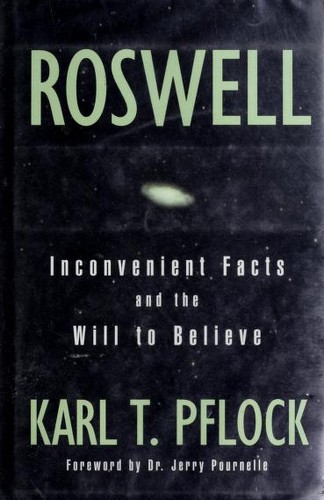
Roswell: Inconvenient Facts and the Will to Believe
A Former CIA Officer and Onetime Roswell Believer's Eight-Year Case Against the Crashed-Saucer Narrative
Find on Amazon →As an Amazon Associate, OverClassified may earn from qualifying purchases made through this link, at no extra cost to you.
Why This Is Essential Reading
Roswell: Inconvenient Facts and the Will to Believe earns its place on this list less for the specific Project Mogul conclusion it reaches — which is now the U.S. government's own official position and appears throughout this site's Roswell Incident case file already — than for the unusual credibility of the person reaching it. Karl T. Pflock was not an outside journalist or a career professional skeptic; he was a former CIA intelligence officer and Reagan-era Pentagon official who spent his early Roswell research years actively hoping the crash-retrieval case would hold up, lobbying for the congressional and GAO inquiries that he believed might validate it. That his own eight-year investigation instead led him to become the first researcher to publicly identify Project Mogul, months ahead of the Air Force's own report, and that he did so while still insisting the government's decades of evasive, shifting secrecy around the case was real and genuinely improper, makes this book something rarer than either a believer's brief or a debunker's takedown: a documented, unusually credentialed change of mind, arrived at case-by-case and witness-by-witness, that both sides of Roswell's now decades-old argument have had to answer on its own terms rather than dismiss out of hand.
Related Cases & Theories
Essential Viewing
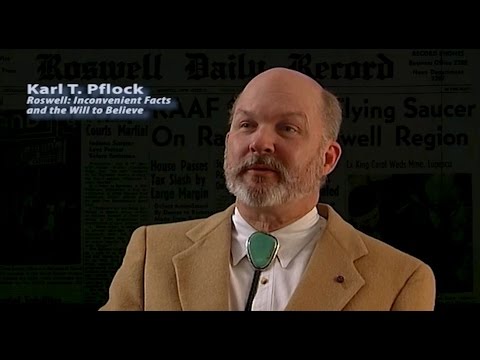
Karl Pflock - Deconstructing the Roswell UFO Myth
Paul Kimball — An on-camera interview with Karl Pflock discussing his case against the Roswell crashed-saucer narrative and his Project Mogul conclusion, verified via YouTube oEmbed before inclusion.
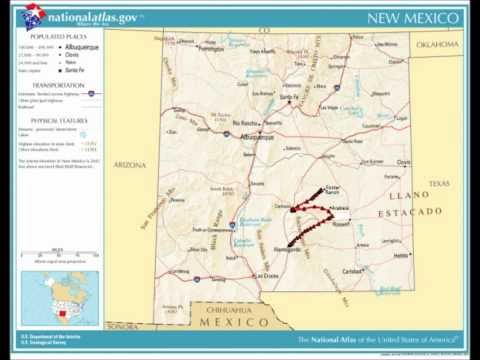
Genesis of Roswell: Flight #4, NYU, June 4, 1947
TheNMSR — A documentary examination of the actual Project Mogul balloon flight launched from Alamogordo in June 1947, the flight this book identifies as the likely source of the Roswell debris, verified via YouTube oEmbed before inclusion.
Sources Cited
- Pflock, Karl T. Roswell: Inconvenient Facts and the Will to Believe. Foreword by Jerry Pournelle. Prometheus Books, 2001 (ISBN 9781573928946 / 1573928941, cited here, matching the edition already cited on this site's own Roswell Incident case file). archive.org
- "Karl T. Pflock." Wikipedia (biography: birth/death, education, CIA and Pentagon career, entry into UFO research, Roswell in Perspective, this book, later works, death from ALS). en.wikipedia.org
- "Roswell: Inconvenient Facts and the Will to Believe." Wikipedia (book-specific page: publication details, thesis, structure, contents, reception). en.wikipedia.org
- "Pflock, Karl T. 1943-." Encyclopedia.com (career chronology, bibliography, awards including the 1989 Defense Outstanding Public Service Medal and 1998 Ufologist of the Year honor). encyclopedia.com
- "ROSWELL: Inconvenient Facts and the Will to Believe by Karl T. Pflock." Publishers Weekly (contemporary 2001 trade review: "definitive book on facts and fantasies"; details on the book's 28 witness affidavits and declassified documents). publishersweekly.com
- Karl T. Pflock. Roswell: Inconvenient Facts and the Will to Believe. Reviewed in Isis, Vol. 93, No. 2 (June 2002), History of Science Society. journals.uchicago.edu
- "In Memoriam of Karl T. Pflock." The UFO Chronicles, June 2006 (obituary and career retrospective, including his self-description of being a "victim of the 'will to believe'" alongside collaborator Fred Whiting). theufochronicles.com
- "Karl Pflock's Official Obituary." Cryptomundo, June 2006 (death details, ALS diagnosis, survivors). cryptomundo.com
- "Roswell: Inconvenient Facts and the Will to Believe." Amazon.com product listing for ISBN 1573928941 / 9781573928946 (edition cited here, matching this site's own resources library citation). amazon.com
- "Roswell; Inconvenient Facts and the Will to Believe." AbeBooks first-edition listing (Prometheus Books, 2001, ISBN 9781573928946; bibliographic details). abebooks.com
- Kimball, Paul. "Karl Pflock - Deconstructing the Roswell UFO Myth." Redstar Films / YouTube (on-camera interview with Pflock discussing his case against the crashed-saucer narrative). youtube.com
- This site's own case file: The Roswell Incident, which profiles Pflock by name among the case's principal researchers and cites this exact book as "the strongest skeptical case."
- This site's own key-figures entry: Karl Pflock, for his broader site-wide case connections beyond this book.
- This site's own key-figures entry: Charles Moore, the Project Mogul engineer whose sworn statements underpin this book's central physical-evidence argument.
- This site's own key-figures entry: Kevin Randle, for the crash-retrieval research this book directly disputes and the personal, ongoing collegial relationship between Randle and Pflock despite that disagreement.
- This site's own essential-reading entry: UFOs Explained, Philip J. Klass's 1974 skeptical classic and this site's other primary point of comparison for Roswell-adjacent skeptical methodology.
- This site's own theory page: Government Deception Hypothesis, for the broader Cold War classified-program pattern this book's Project Mogul argument exemplifies.
- This site's own resources library: Full Reading List, where this exact 2001 edition (ISBN 1573928941) is cited on the site's Roswell Incident case file.
Have corrections, additional research, or peer-reviewed sources? Help improve this entry.
Suggest an Edit