
Top Secret/Majic
Operation Majestic-12 and the United States Government's UFO Cover-up
Core Thesis
Top Secret/Majic: Operation Majestic-12 and the United States Government's UFO Cover-up is nuclear physicist Stanton T. Friedman's dedicated, book-length case for the authenticity of the MJ-12 documents — the batch of purported 1947–1954 government papers, first surfacing as an undeveloped roll of film in December 1984, describing a secret twelve-member committee President Truman supposedly formed to manage the recovery of a downed non-human craft near Roswell, New Mexico. Where this site's own Above Top Secret entry treats MJ-12 as one explosive chapter inside a broader international UFO-secrecy survey, this book is the fuller, dedicated brief for the documents specifically: decades of archival research, answering the FBI's own 1988 "completely bogus" finding and named critics like Philip Klass point by point, by the single most persistent and best-credentialed public defender the MJ-12 documents ever had. It belongs on this list as exactly that — Friedman's own argued position in one of ufology's most contested internal disputes — not as evidence the documents, or the committee they describe, were ever real.
About the Author
Stanton T. Friedman was born July 29, 1934, in Elizabeth, New Jersey, and earned M.Sc. degrees in physics from the University of Chicago before spending fourteen years as a nuclear physicist for General Electric, Aerojet General Nucleonics, General Motors, Westinghouse, TRW Systems, and McDonnell Douglas, working on classified nuclear and fusion-rocket propulsion programs. In 1970 he left industry entirely to become what is generally regarded as the first full-time professional UFO lecturer, eventually giving more than 700 lectures at over 600 colleges and universities across the U.S., Canada, and abroad. His single most consequential piece of fieldwork came in 1978, when a chance radio-interview referral led him to Major Jesse Marcel, the intelligence officer who had handled the original 1947 Roswell debris; Marcel's account to Friedman that the material was "not of this earth" single-handedly revived the Roswell case after three decades of public silence and set the direction of most of Friedman's subsequent career, including his own book Crash at Corona (1992, with Don Berliner). He also coined the phrase "Cosmic Watergate" to describe his broader thesis that the U.S. government has knowingly concealed proof of alien visitation since 1947.
Friedman learned of the newly surfaced MJ-12 documents from William Moore and Jaime Shandera in 1984 and spent the rest of his career as the documents' most prominent and most persistent defender, publishing fifteen annual research updates through the Fund for UFO Research between 1990 and 2005 before folding that research into book form. Top Secret/Majic first appeared from Marlowe & Company in 1996 with a foreword by Communion author Whitley Strieber; Da Capo Press reissued it in expanded paperback form in 2005 with a new afterword addressing another decade of debate, including his ongoing public dispute with fellow Roswell researcher Kevin Randle — the 2005 edition, cited under this exact ISBN elsewhere on this site, is the one this article covers. Some retailer listings credit Strieber as a full co-author on the cover; the book's own title page and every library catalog record consulted for this article list Strieber's contribution specifically as the foreword, with Friedman as sole author of the text. Friedman remained MJ-12's most visible public advocate for the rest of his life, continuing to lecture and debate the subject until his death on May 13, 2019, in Toronto, Ontario.
Friedman held no advanced credential in questioned-document examination, forensic linguistics, or historical archival analysis — the specific expertise the MJ-12 authenticity dispute ultimately turns on — and reviewers of this book, sympathetic and hostile alike, have consistently noted the gap between his own back-cover description as a "disinterested physicist" who is "NOT a UFO buff" and the reality of a man who had, by the time of writing, earned his living for a quarter-century on the full-time flying-saucer lecture circuit.
Historical Context & Origins
The MJ-12 documents entered ufology in mid-December 1984, when Los Angeles television producer Jaime Shandera received an anonymous, unmarked roll of undeveloped 35mm film in the mail bearing only a New Mexico postmark. Developed, it showed photographs of two purported documents: a September 24, 1947 memo from President Truman to Defense Secretary James Forrestal establishing a twelve-member committee, and a November 18, 1952 briefing paper for President-elect Eisenhower summarizing the group's work. Shandera, Moore, and Friedman spent roughly the next three years quietly investigating the material's authenticity without going public, before researcher Timothy Good's independent receipt of a copy from his own source forced their hand: Good's Above Top Secret, published in May 1987, became the first place most of the public ever saw the documents, prompting Moore and Shandera to release their own copies to the press soon after.
The federal government's own response followed close behind. When Congress and reporters asked directly in the summer of 1987, the White House and National Security Council denied that any group called Majestic-12 had ever existed. A more formal accounting came the following year: after skeptic Philip Klass raised the matter directly with the Bureau, the FBI opened a 1988 inquiry, forwarding the material to the Air Force Office of Special Investigations, which reported back on November 30, 1988 that no such committee had ever been authorized by any president. The FBI's own case file, closed shortly after, was marked in handwriting across the front: "completely bogus." That finding — consistent with the account this site's own Above Top Secret entry gives of the same episode — has never been reversed by any federal body, and it is the baseline every claim in this book has to be read against.
Friedman's own investigation ran in parallel with, and largely against, that official conclusion for the rest of his life. His fifteen annual FUFOR research updates between 1990 and 2005 fed directly into this book's two editions: the 1996 Marlowe & Company original and the expanded 2005 Da Capo Press paperback this site cites, whose new afterword folded in nearly another decade of forensic argument and a deepening rift with fellow Roswell crash-retrieval researcher Kevin Randle, whose own competing account of the case had by then moved in the opposite direction on MJ-12 specifically.
Core Arguments & Key Concepts
Friedman's central and recurring method across the book is to answer the FBI's and named skeptics' specific forgery objections one at a time rather than to argue for the documents' authenticity in the abstract — a structure Friedman frames as painstaking vindication and at least one sympathetic reviewer has instead described as exhausting, list-like proof-by-accumulation. His most original contribution grew out of April 1986 archival research at Harvard, where he obtained access to the papers of Donald Menzel — a Harvard astronomer, prominent public UFO debunker, and one of the twelve names on the Eisenhower Briefing Document's roster — and discovered that Menzel had secretly held a three-decade consulting relationship with the National Security Agency and a Top Secret Ultra clearance with the CIA. Friedman argues this double life makes Menzel's presence on a classified committee considerably less implausible than critics assumed, and it remains, even among researchers who reject MJ-12 outright, one of the more genuinely documented pieces of Friedman's own original research.
On the disputed 1954 "Cutler-Twining" memo — a document distinct from, and often confused with, Gen. Nathan Twining's genuinely declassified September 1947 memorandum this site covers independently in its own Twining Memo case file — Friedman directly addresses the National Archives' finding that its purported author, presidential aide Robert Cutler, was traveling outside the country on the date it bears. He argues the surviving copy is only an unsigned carbon that could plausibly have been issued in Cutler's name by his own staff, most likely aide James Lay, while Cutler was away, and that Cutler's absence therefore does not by itself disprove the memo. On the related objection that the memo's typeface (pica) was inconsistent with genuine period government correspondence, Friedman collected a standing wager with Klass: producing ten authenticated 1950s memoranda from Cutler's own National Security Council staff typed in matching pica, and collecting on Klass's own written pledge of $100 per verified example.
On the Truman-Forrestal memo's contested signature — which Klass's own forensic comparison found to be a photocopy pasted from an October 1, 1947 Truman memo to Vannevar Bush, scratch marks and all — Friedman argues that Truman's frequent use of an autopen for routine correspondence makes duplicate signatures unremarkable rather than damning, and separately disputes Klass's claim that the documents' day-month-year date format was anachronistic for 1947–1952 government usage by citing other period papers using the same order. Neither argument has persuaded the document examiners and archivists who originally raised the objections, and Friedman does not claim in the book to have resolved either dispute definitively — only that the objections are, in his own assessment, weaker than critics presented them.
The book devotes substantial space to disputing named critics directly: extended argument against Philip Klass's forensic case chapter by chapter, a shorter but pointed exchange with physicist and fellow University of Chicago alumnus Carl Sagan, and — more unusually for a book defending one set of purported leaked government UFO documents — a skeptical chapter of his own dismantling Ray Santilli's 1995 "Alien Autopsy" film as a separate hoax, along with public disagreement with Kevin Randle and Donald Schmitt's own, differently sourced account of the Roswell crash. That combination is genuinely double-edged: it shows Friedman applying real scrutiny to other UFO-adjacent claims even while defending MJ-12, but reviewers have also noted that several of the same rhetorical tactics he criticizes in his opponents — selective emphasis, expertise-by-association, and treating unresolved questions as points already won — recur in his own chapters.
Key Cases & Evidence Discussed
The Roswell Incident (Case File #001, July 1947) is the book's foundational case: the 1947 debris recovery near Roswell, New Mexico that MJ-12's purported charter describes the committee as having been formed to manage, and the same case Friedman's own 1978 interview with Jesse Marcel had already revived six years before the documents themselves surfaced.
This site's own Twining Memo case file (#276) covers a different, genuinely declassified document than the one at the center of this book's forgery dispute: Gen. Nathan Twining's real September 23, 1947 "AMC Opinion Concerning Flying Discs" memorandum, easy to confuse with the unrelated, disputed 1954 "Cutler-Twining" memo inside the MJ-12 set. This book draws on both, separately: Friedman cites Twining's own archival travel records — an unscheduled trip near Alamogordo and Kirtland Field in the immediate aftermath of the Roswell recovery, a connection that case file addresses independently and on its own terms — as circumstantial support for a crash-retrieval reading of Roswell, while mounting an entirely separate defense of the disputed 1954 memo against the specific objection that its purported author was out of the country when it was supposedly written.
The book's treatment of Donald Menzel's secret NSA and CIA consulting relationship, discovered through Friedman's own 1986 archival research at Harvard, functions as its own quasi-case-study within the larger MJ-12 argument — a documented instance of a public UFO debunker holding an undisclosed high-level security clearance, cited by Friedman as circumstantial support for Menzel's plausibility as an MJ-12 member regardless of what one concludes about the committee itself.
The book also takes up Ray Santilli's 1995 "Alien Autopsy" film as a separate matter Friedman personally investigated and rejected as fabricated, a contrast this site's own case-file research treats as a useful illustration of Friedman applying real scrutiny to some UFO claims — while defending, at book length, a different and far more consequential set of contested documents.
Critical Reception & Controversies
The book's single most important context is the finding it was written to overturn: the FBI's own November 30, 1988 conclusion, following an Air Force Office of Special Investigations inquiry, that no committee called Majestic-12 or Majic-12 had ever been authorized by any U.S. president, and that the documents were, in the Bureau's own handwritten case-file notation, "completely bogus." That finding has never been reversed by any federal body, and it is the position the majority of ufology researchers — including many, like Klass, unsympathetic to extraterrestrial-visitation claims generally, but also researchers genuinely open to the Roswell crash-retrieval hypothesis, like Kevin Randle — ultimately came to share about this specific document set.
Philip Klass conducted the most extensive forensic case against the documents, and this book is substantially organized around answering it. Klass identified the Truman signature on the Truman-Forrestal memo as a pasted-on photocopy — including matching accidental scratch marks — lifted from a genuine October 1, 1947 Truman memo to Vannevar Bush; flagged the day-month-year date format as inconsistent with standard period government usage and matching habits found in Moore's own personal correspondence; and, through National Archives records, established that Robert Cutler, the Cutler-Twining memo's purported author, was outside the United States on the date it bears. Friedman's book answers each point directly, but none of his counter-arguments has persuaded the archivists, document examiners, or the FBI's own investigators who originally raised them.
Kevin Randle, a fellow Roswell crash-retrieval researcher rather than a general UFO skeptic, became Friedman's most sustained critic specifically on MJ-12, culminating in Randle's own book Case MJ-12: The True Story Behind the Government's UFO Conspiracies (HarperCollins/Avon, 2002; updated 2018), which concludes the documents are an elaborate hoax and disputes several of Friedman's specific authentication claims. The dispute became a genuinely public, years-long exchange of rebuttals on both researchers' own blogs and at UFO conferences through the 2010s, with Randle noting pointedly that Friedman, despite his physics credentials, had no formal training as a forensic document examiner — a distinction Randle argued mattered a great deal for claims resting on signature and typeface analysis.
A 2001 review by Rick Kleffel for The Agony Column offers a more literary verdict, and a genuinely mixed one: it credits the book with accidentally telling a fascinating story — Friedman's Kafkaesque Freedom of Information Act battles with federal agencies, the discovery of Donald Menzel's secret NSA ties, and his separate, entertaining pursuit of Ray Santilli over the Alien Autopsy film — while faulting Friedman's actual prose for burying that story under exhaustive, hard-to-follow chains of names, dates, and travel-record cross-referencing. The review's sharpest line is aimed at Friedman's own rhetorical habits rather than his conclusions: "Friedman makes some good points against all of his detractors, but falls victim to the same vices he points out." The same review also flags the specific gap between the book's own back-cover description of Friedman as a "disinterested physicist" who is "NOT a UFO buff" and the reality of a man who had, by 1996, spent a quarter-century earning his living as a full-time flying-saucer lecturer.
It is worth stating plainly, given how contested this subject is: this book presents Friedman's own case for the documents' authenticity, not an independently verified account of a real MJ-12 program. The FBI's 1988 finding, the National Archives' own documentation problems with the Cutler-Twining memo, Klass's signature and typeface analysis, and the skepticism of researchers like Randle who otherwise share Friedman's belief that Roswell involved a genuine non-human crash all point the same direction: the great majority of researchers who have examined the MJ-12 documents, across the full range of positions on UFOs generally, regard them as fabricated.
Influence & Legacy
Friedman remained the MJ-12 documents' single most prominent public defender for the rest of his life, from his first FUFOR research updates in 1990 through his death in 2019 — a continuity of advocacy no other researcher on either side of the dispute matched. This book, across its 1996 and 2005 editions, is the fullest published expression of that three-decade defense, and remains the standard citation for the pro-authenticity position in any serious discussion of the controversy.
Read alongside this site's own Above Top Secret entry, the two books trace the controversy's full arc: Timothy Good's 1987 book gave the MJ-12 documents their first mass public exposure and, notably, Good's own later position on them grew more equivocal than his book's original presentation; Friedman's book, by contrast, is the fuller, dedicated, never-equivocal defense, making the two together the most complete book-length record of how one explosive claim split ufology's most prominent researchers against each other for decades rather than settling the question.
The Friedman-Randle dispute this book helped sustain became its own minor case study in UFO-research historiography: two researchers who agreed Roswell likely involved recovered non-human wreckage nonetheless split sharply, and publicly, over one specific set of documents — a division commentators on both sides of the broader UFO debate have since cited as evidence that ufology's internal disagreements can run as deep as its disagreements with mainstream science.
New purported MJ-12-related documents have continued to surface periodically since Friedman's death, including a 2017 batch some researchers labeled "Ultra Top Secret"; without Friedman's sustained, name-recognized advocacy, none has generated anything close to the original 1984–1988 controversy's public reach, underscoring how much of MJ-12's continued cultural life ran specifically through his decades of work rather than through the documents' own evidentiary weight.
The Book
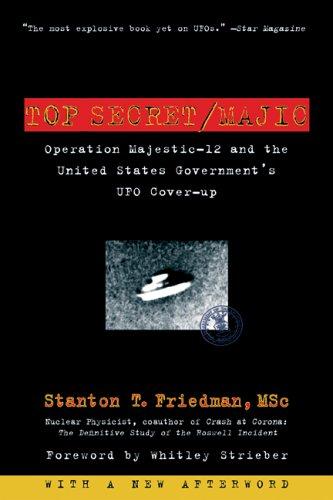
Top Secret/Majic
Operation Majestic-12 and the United States Government's UFO Cover-up
Find on Amazon →As an Amazon Associate, OverClassified may earn from qualifying purchases made through this link, at no extra cost to you.
Why This Is Essential Reading
Top Secret/Majic earns its place on this list not as reliable evidence that a real Majestic-12 program ever existed — the FBI's own 1988 investigation, the National Archives' documentation problems with the Cutler-Twining memo, and Philip Klass's forensic case against the Truman signature all argue strongly against that, and the great majority of ufology researchers, including many otherwise sympathetic to the Roswell crash-retrieval hypothesis, have concluded the documents are fabricated. It belongs here instead as the single fullest, most sustained, most specific argument ever made for the other side, by the researcher who devoted more of his career to that argument than anyone else, right up to his death in 2019. Read next to this site's own Above Top Secret entry, it completes the record of how one anonymously mailed roll of film in December 1984 produced a controversy that outlived the men who first investigated it, split ufology's own most credentialed researchers against each other, and has never, in four decades, produced a single piece of physical evidence the FBI, the National Archives, or an independent document examiner has accepted as genuine.
Related Cases & Theories
Essential Viewing
Stanton Friedman | Majestic 12, Project Blue Book, Roswell | EODR 38
End of Days Radio — A Stanton Friedman interview covering his MJ-12 research, Project Blue Book, and Roswell, verified via YouTube oEmbed before inclusion.
Majestic 12 EXPOSED: The Story Behind the Hoaxed UFO Documents
TheSneezingMonkey — A critical breakdown of the MJ-12 documents' origins and the forensic case against their authenticity, verified via YouTube oEmbed before inclusion.
Sources Cited
- Friedman, Stanton T., foreword by Whitley Strieber. Top Secret/Majic: Operation Majestic-12 and the United States Government's UFO Cover-up. Da Capo Press, 2005 pbk. reprint (ISBN 9781569243428 / 1569243425, matching this site's own resources library citation under this exact edition; originally Marlowe & Company, 1996). amazon.com
- "Majestic 12." Wikipedia (documents' 1984 surfacing, the 1987 NSC denial, the FBI/OSI 1987–88 investigation and "completely bogus" finding, and Philip Klass's forensic critique). en.wikipedia.org
- "Stanton T. Friedman." Wikipedia (biography: nuclear-physics career, 1970 career change, MJ-12 research, death May 13, 2019). en.wikipedia.org
- "Top secret/MAJIC." Open Library edition record (ISBN 1569248303 / 9781569248300, Marlowe & Co., 1996, 272 pp.; distinct printing history from the 2005 Da Capo edition cited on this site). openlibrary.org
- "Top Secret/Majic." Da Capo Press title page (2005 paperback edition, publisher description and "twenty-one year search" framing). dacapopress.com
- Kleffel, Rick. "Top Secret/MAJIC," review. The Agony Column, 2001 (detailed critical review: Donald Menzel research, Klass/Sagan/Randle disputes, Santilli Alien Autopsy chapter, and prose-style criticism). trashotron.com
- Klass, Philip J. "The MJ-12 Crashed-Saucer Documents." Skeptical Inquirer, 1988 (contemporary forensic case against the documents' authenticity). skepticalinquirer.org
- "The FBI debunked the Majestic 12 UFO documents in the most childish way possible." Slate, 2016 (FBI's 1988 "completely bogus" case-file finding). slate.com
- "Conspiracy Weary: FBI's real-life 'X-Files' document one of the Bureau's laziest investigations." MuckRock, 2017 (FBI/OSI 1988 investigation records via FOIA). muckrock.com
- "Who Wrote the Majestic 12 Papers?" Skepticblog, 2009 (forensic authorship analysis, including the Klass–Friedman pica-typeface wager). web.archive.org
- Randle, Kevin D. Case MJ-12: The True Story Behind the Government's UFO Conspiracies. HarperCollins/Avon, 2002 (updated ed. 2018) — the most sustained researcher-side rebuttal of this book's specific authentication claims. amazon.com
- "MJ-12: Kevin Randle Rails Against Stanton Friedman's Rebuttal." The UFO Chronicles, 2014 (documenting the public Friedman–Randle exchange over MJ-12 authentication). theufochronicles.com
- This site's own case file: The Roswell Incident, the 1947 recovery MJ-12's purported charter describes the committee as having been formed to manage.
- This site's own case file: The Twining Memo, for the genuinely declassified 1947 document distinct from, and often confused with, the disputed 1954 Cutler-Twining memo this book defends.
- This site's own essential-reading entry: Above Top Secret, for Timothy Good's 1987 first public release of the MJ-12 documents and his own later, more equivocal position on them.
- This site's own key-figures entry: Stanton Friedman, for his full biography and further case connections beyond this book.
- This site's own resources library: Full Reading List, where this exact 2005 edition (ISBN 1569243425) is cited in connection with the Fox Lake/Yukon case file.
Have corrections, additional research, or peer-reviewed sources? Help improve this entry.
Suggest an Edit