
Above Top Secret
The Worldwide UFO Cover-Up
Core Thesis
UFO secrecy is not a uniquely American phenomenon confined to Roswell and Project Blue Book, but a coordinated, decades-long pattern of official concealment spanning Britain, the Soviet Union, France, and a dozen other governments — evidenced, Good argues, by his own two decades of interviews with military and intelligence sources across those countries, and capped by the most explosive claim in the book: a purported 1947 presidential committee, "Majestic 12," formed to manage the aftermath of a recovered crashed disc.
About the Author
Timothy Good was born on July 28, 1942, in Islington, London. His path into ufology ran through music rather than science or journalism: Good trained and worked as a professional violinist, performing for fourteen years with the London Symphony Orchestra and other European orchestras, a career he maintained in parallel with his research for most of his life. His interest in UFOs traces to two specific books read a few years apart — Major Donald Keyhoe's account of sightings by qualified military and civilian pilots, which he read in 1955, and Captain Edward J. Ruppelt's insider history of the Air Force's own investigation, which he read in 1961 and which prompted him to begin independent research of his own.
Good's first book was not Above Top Secret but a 1983 collaboration with Lou Zinsstag, George Adamski: The Untold Story, examining the contact claims of the famous 1950s "contactee" — an early indicator of a credulity toward difficult-to-verify witness testimony that later reviewers would flag as a recurring weakness in his work. Above Top Secret, published four years later, was Good's breakthrough: by 1987 The Observer was already describing him as "Britain's leading UFO researcher," and the book's commercial success reshaped the rest of his career.
Good's authority rested on volume of contact rather than academic credential: he held no science degree and conducted no peer-reviewed research, but built a network of military, intelligence, and political sources over decades of correspondence and interviews, and was invited to the Pentagon in 1998 and to lecture at French Air Force headquarters in 2002. In January 1989 he became the first Western UFO researcher interviewed on Soviet television, a detail he later cited as evidence of the book's international reach.
He went on to write Alien Liaison (1991), Beyond Top Secret (1996) — a revised and updated successor to this book — Alien Base (1998), Unearthly Disclosure (2000, serialized in the Daily Mail), Need to Know (2006), and Earth: An Alien Enterprise (2013), sustaining a public career built almost entirely on the credibility this first book established.
Historical Context & Origins
By the mid-1980s, mainstream American ufology was in a fairly depressed state: Project Blue Book had been closed since 1969, the Condon Report had given the subject an official scientific brush-off, and the field's most visible activity was a scattered mix of contactee mythology and increasingly baroque Roswell crash-retrieval claims circulating mostly within specialist newsletters. What the field lacked was a single, internationally sourced synthesis that treated official secrecy itself — rather than any specific craft or crash — as the subject worth investigating government by government.
Good spent roughly two decades before publication building exactly that kind of cross-border source network, corresponding with retired military officers, intelligence officials, and politicians across Britain, the United States, France, the Soviet Union, and elsewhere. The book's organizing structure reflects that method directly: Part One surveys Great Britain from the Second World War through 1981, Part Two moves country by country through France, Italy, Portugal, Spain, Australia, Canada, China, and the USSR, and Part Three turns to the United States, building toward the book's most consequential chapters.
The book's timing also intersected with a specific, already-simmering controversy. In December 1984, Los Angeles producer Jaime Shandera had received an undeveloped roll of film in an anonymous package purporting to document a secret 1947 presidential committee called "Majestic 12"; Shandera, William Moore, and physicist Stanton Friedman had spent nearly three years quietly investigating the documents' authenticity without going public. In May 1987, weeks before Above Top Secret appeared, Good announced he had independently received a copy of the same material from his own intelligence source — and his book became the first place most of the public ever saw it, prompting Moore and Shandera to release their own copies to the press soon after rather than let Good's version stand alone.
A foreword by Admiral of the Fleet Peter Hill-Norton, Baron Hill-Norton — the United Kingdom's Chief of the Defence Staff from 1971 to 1973 and, before that, Chairman of NATO's Military Committee — gave the book a degree of institutional legitimacy no prior UFO bestseller had carried. Hill-Norton went on to spend much of the rest of his life in the House of Lords formally pressing the Ministry of Defence on UFO secrecy and the Rendlesham Forest case in particular, generating hundreds of pages of correspondence and making his association with this book a genuine, if minor, piece of UK parliamentary history in its own right.
Core Arguments & Key Concepts
Good's central argument is explicitly global rather than American: the subtitle's "worldwide" is not marketing gloss but the book's actual thesis, built from country-specific chapters arguing that Britain, France, the Soviet Union, and other governments had each independently developed their own systems for collecting, classifying, and suppressing UFO reports, and that the pattern's consistency across otherwise uncooperative Cold War rivals was itself evidence of a phenomenon serious enough to warrant coordinated secrecy.
Within the book's American section, Chapter 16 ("Down to Earth") argues directly that the United States had, by the time of writing, physically recovered non-human craft and technology — a claim Hill-Norton's own foreword paraphrases without fully endorsing, framing it instead as one of the book's more startling assertions for readers to weigh themselves.
Chapter 17, which gives the book its title, is where Good presents the Majestic 12 documents: a purported September 24, 1947 memorandum from President Truman to Defense Secretary James Forrestal establishing a twelve-member committee to manage the aftermath of a recovered crashed disc and, in Good's telling, non-human occupants. This is the most consequential — and most contested — material in the book, and needs to be read with real caution: the FBI's own investigation, opened after skeptic Philip Klass raised the matter with the Bureau in 1988, concluded in November 1988 that no such committee had ever existed and the documents were fabricated, citing forgery indicators including an anachronistic Truman signature apparently copied from an unrelated memo. Good himself was notably not a fixed defender of the documents' authenticity going forward; even skeptic Klass later acknowledged that Good came to question at least some of the material himself, a more equivocal position than the book's own initial presentation of it.
The book's treatment of Roswell specifically argues that the wreckage recovered near Roswell, New Mexico in July 1947 was genuine debris from a non-human craft, that the material was subsequently shipped to Wright Field for analysis, and that the weather-balloon components photographed with Major Jesse Marcel at Fort Worth were a substitution staged for the press — a claim consistent with, though independently reached from, this site's own case file account of the Ramey office switch, though Good offers no documentation proving the swap took place beyond witness recollection gathered decades after the fact.
Running underneath the book's specific claims is a genuine methodological weakness later reviewers would return to repeatedly: Good treats government-investigated-the-subject and aliens-actually-visited-Earth as a single, continuous argument rather than two separable claims requiring different standards of evidence, accepting anecdotal testimony from unnamed or hard-to-verify sources with roughly the same weight he gives to declassified documents and named official statements.
Key Cases & Evidence Discussed
The Roswell Incident (Case #001, 1947) anchors much of the book's American section, both for the recovered-debris claim itself and as the launching point for the Majestic 12 material in Chapter 17 — the specific chapter that gives Above Top Secret its title and its most lasting, most disputed legacy.
The December 1980 Rendlesham Forest Incident (Case #004) appears within the book's Part One survey of Great Britain, a case with particular resonance for Good given his own account, recorded in the book, of personally observing an unexplained aerial object near his home in Bromley, London that same December — and given that the book's own foreword writer, Lord Hill-Norton, made Rendlesham his signature parliamentary cause for the rest of his life.
The 1975 SAC Base Intrusion Wave (Case #205) — the multi-base wave of unexplained intrusions at Malmstrom, Minot, Loring, and other Strategic Air Command nuclear-weapons installations — receives one of the book's earliest general-readership summaries of the full base list, drawing on the same Ground Saucer Watch FOIA documentation that researcher Lawrence Fawcett and Barry Greenwood had compiled three years earlier in Clear Intent (1984); this site's own case file for the wave treats Good's chapter as a secondary compilation of that same underlying Air Force and NORAD paper trail rather than independent new evidence.
Beyond these, the book's Part Two survey moves through internationally significant cases and official UFO-handling patterns in France, Italy, Portugal, Spain, Australia, Canada, China, and the Soviet Union — a genuinely unusual breadth for a single 1987 volume, and the structural basis for the book's own claim to be a worldwide, rather than American, survey of the subject.
Critical Reception & Controversies
Kirkus Reviews captured the book's central tension precisely: "there's no smoking gun here, but enough circumstantial evidence to convince that governments have, and are, withholding important data about UFOs," while warning that Good's "encyclopedic approach blurs the eyes even as it overwhelms skepticism" — a noteworthy contribution to the field, in the review's own words, but "not a grand read."
Reaction elsewhere split sharply along predictable lines. The book carried enthusiastic jacket blurbs from the Wall Street Journal ("the Bible for UFO watchers") and the Toronto Star, which called it "the most significant book ever written about UFOs" — the kind of praise a publisher selects rather than a representative critical sample. The Spectator supplied the opposite extreme, dismissing the 590-page volume as "an evil book" written by a man whose ideas were, in the reviewer's own hostile framing, those of a "maniac."
The more measured skeptical case came from academic reviewers. Martin Bridgstock, reviewing the book for The Skeptic in 1989, concluded it "is not a clear, rigorous survey of the evidence for UFOs" but rather "a polemical volume" built to make the strongest possible case for both extraterrestrial visitation and an active cover-up, rather than to weigh the evidence even-handedly. A later retrospective review made a closely related point: Good conflates the well-supported claim that governments investigated UFO reports with the far more tenuous claim that those investigations confirmed actual alien visitation, and shows a documented willingness to accept discredited testimony — including continuing sympathy toward George Adamski's contact claims — that undercuts his own credibility as an evaluator of evidence.
The book's single most consequential and most publicly refuted claim is its presentation of the Majestic 12 documents. Skeptic Philip Klass pursued the FBI investigation that led the Bureau, in November 1988, to declare the documents "completely bogus" after the Air Force Office of Special Investigations found no record any such committee had existed; Klass and other researchers identified specific forgery indicators, including a Truman signature that appeared to be a photocopy pasted in from an unrelated document. That MJ-12 is now widely regarded — by skeptics and by many of Good's fellow ufologists alike — as a hoax is the single most important context a reader needs before treating any of the book's Chapter 17 material as established fact, and it is worth noting that Good's own later position on the documents grew more equivocal than the book's original 1987 presentation of them.
Influence & Legacy
Above Top Secret became an international bestseller and, per its publisher's own account, remained closely associated with Good's reputation as "Britain's leading UFO researcher" for the rest of his career, directly enabling the commercial success of his subsequent books: Alien Liaison (1991) spent thirteen weeks on the Sunday Times bestseller list, and Beyond Top Secret (1996) — an explicitly updated, expanded replacement for this book — spent five weeks on the same list.
The book's influence on official institutional memory is unusually well documented for a UFO title: in a 1997 Studies in Intelligence article, CIA historian Gerald Haines cited Above Top Secret directly as one of the sources contributing to "the idea that CIA has secretly concealed its research into UFOs" — the Agency's own acknowledgment, decades later, that Good's book had measurably shaped public perception of its conduct.
Its most unexpected downstream effect surfaced nearly three decades after publication: former Blink-182 guitarist Tom DeLonge has said reading Above Top Secret while on tour fundamentally changed his view of the subject, telling Fox News the book "opened my eyes to the enormity of Unidentified Aerial Phenomena... and propel[led] me on a hunt for knowledge that quite literally changed the course of my life" — a chain of influence DeLonge traces directly to his 2015 founding of To The Stars Academy of Arts & Science.
Within British ufology specifically, the book's foreword gave Lord Hill-Norton's own subsequent advocacy real institutional weight: his decades of formal parliamentary questions to the Ministry of Defence about Rendlesham Forest and UFO secrecy generated hundreds of pages of correspondence now held in UK national archives, a body of work that exists in large part because Above Top Secret first connected his name publicly to the subject.
The Book
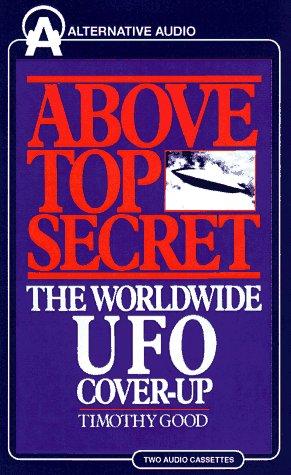
As an Amazon Associate, OverClassified may earn from qualifying purchases made through this link, at no extra cost to you.
Why This Is Essential Reading
Above Top Secret earns its place on this list as the book that first made UFO secrecy a genuinely international story rather than an American one, and as the unavoidable historical source for the Majestic 12 documents — for better and for worse. Its reach was real: a foreword from a former UK Chief of the Defence Staff, a CIA historian citing it decades later as shaping public perception of the Agency, and a direct, traceable line to Tom DeLonge's founding of To The Stars Academy in 2015. Its flaws are equally real and should not be waved away by that influence: Good's uncritical initial presentation of documents the FBI's own investigation would later call fabricated is the book's single most important cautionary lesson, and its broader habit of treating anecdotal testimony and declassified documents as roughly equivalent evidence is a methodological weakness every reader should watch for throughout. Read it for what it accomplished — the first serious attempt to treat government UFO secrecy as a genuinely global pattern — and alongside a clear-eyed account of the MJ-12 controversy, not instead of one.
Related Cases & Theories
Essential Viewing
Timothy Good UFO Interview – Video 5 of 6
mrix — An extended interview segment with Timothy Good discussing his research and the sources behind his books, including this one.
TIMOTHY GOOD ~ "Secrets of UFO Existence"
Age Of Truth TV — A later-career interview with Good revisiting the case for official UFO secrecy and his decades of source-building across multiple governments.
Sources Cited
- "Timothy Good." Wikipedia. en.wikipedia.org
- "Majestic 12." Wikipedia. en.wikipedia.org
- Haines, Gerald K. "CIA's Role in the Study of UFOs, 1947-90." Studies in Intelligence, 1997, via Federation of American Scientists archive. sgp.fas.org
- "Above Top Secret: The Worldwide UFO Cover-Up." Kirkus Reviews. kirkusreviews.com
- "Above Top Secret." Andrew Lownie Literary Agency (official author representation, publisher blurbs). andrewlownie.co.uk
- "Above Top Secret: The Worldwide U.F.O. Cover-Up." AbeBooks (bibliographic listing, William Morrow 1st U.S. ed.). abebooks.com
- "Above top secret: the worldwide UFO cover-up." Smithsonian Institution Libraries and Archives (SIRIS) catalog record. si.edu
- Kelly, Chris. "Blink-182's Tom DeLonge talks his quest to prove aliens exist." Fox News. foxnews.com
- "British Admiral was tireless UFO advocate at the House of Lords." Open Minds. openminds.tv
- "Above Top Secret, But Not Beyond Reasonable Doubt." Jumbled Thoughts of a Fake Geek Boy (blog review). fakegeekboy.wordpress.com
- "Above top secret: the worldwide U.F.O. coverup." Internet Archive (digitized first edition). archive.org
- Bridgstock, Martin. Review of Above Top Secret: The Worldwide UFO Cover-Up. The Skeptic (Australian Skeptics), 1989.
- "Peter Hill-Norton." Wikipedia. en.wikipedia.org
- This site's own case file: The Roswell Incident, for the Ramey photo switch this book's Roswell chapter describes.
- This site's own case file: The Rendlesham Forest Incident, for the case this book's foreword-writer Lord Hill-Norton pursued for decades in the House of Lords.
- This site's own case file: 1975 SAC Base Intrusion Wave, for this book's early republication of the wave's FOIA documentation.
- This site's own key-figures entry: Timothy Good, for his full biography and case connections.
Have corrections, additional research, or peer-reviewed sources? Help improve this entry.
Suggest an Edit