
The Rendlesham Forest Incident
Over three nights in late December 1980, United States Air Force personnel stationed at the twin NATO bases of RAF Woodbridge and RAF Bentwaters in Suffolk, England, reported lights and, in later accounts, a landed craft in the adjacent Rendlesham Forest. The case produced an official memo, an 18-minute real-time audio recording made by the deputy base commander, the airmen's written statements and a police log. It is Britain's best-known UFO case. Its contemporaneous record also supports a conventional explanation: a fireball, the Orford Ness lighthouse and bright stars.
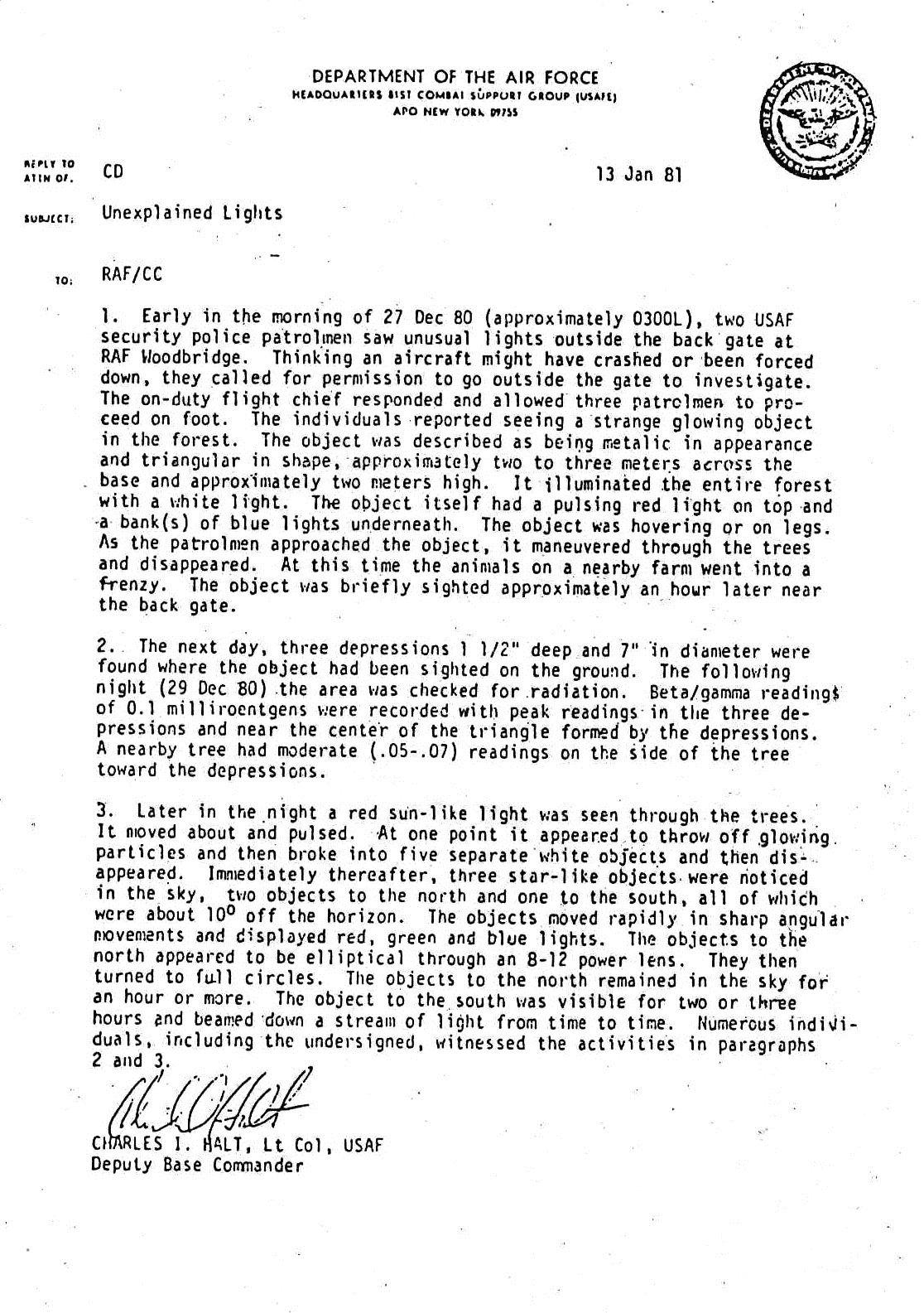
Pictured: the declassified "Unexplained Lights" memorandum that Lt. Col. Charles Halt sent to RAF/CC on January 13, 1981, describing the object and lights encountered near RAF Woodbridge — a genuine primary document from the case, but not a photograph of the forest, the triangular object, or any of the lights it describes. No photograph of the phenomenon itself was ever taken; the patrolmen who first approached the object on the night of December 26–27, 1980 carried no camera.
Theoretical Alignment
The Rendlesham Forest Incident aligns most strongly with the Extraterrestrial Hypothesis (ETH) on the basis of the physical craft described by trained USAF security personnel, the multi-night pattern of activity, and the extraordinary Halt tape that documents active investigation in real time. However, the case also presents features consistent with the Interdimensional Hypothesis (IDH), particularly the binary code “download” reported by Jim Penniston and the GPS coordinates embedded in that download that point to a location in the Atlantic Ocean associated with the mythological island of Hy-Brasil — a phenomenon that suggests information transfer rather than simple physical observation. The Time-Travel or Ultra-Terrestrial hypothesis has been proposed by some researchers due to the temporal coordinates apparently embedded in Penniston’s binary code sequence.
Background
The bases of RAF Bentwaters and RAF Woodbridge in Suffolk, England, were RAF stations operated by the United States Air Force during the Cold War. Both were home to the 81st Tactical Fighter Wing, which flew A-10s. Rendlesham Forest, a Forestry Commission pine plantation, lies between and around them.
The bases were important American installations in Europe. They are widely reported, though never officially confirmed, to have stored nuclear weapons. If true, that would place Rendlesham among the cases that proponents link to UFO activity near nuclear weapons sites.
Complete Timeline
| Date | Event |
|---|---|
| Dec 25, 1980 (9:07 PM) | The Cosmos 749 rocket stage re-enters over north-west Europe and is widely reported as a UFO; there is no evidence of a connection with what follows (Ridpath). |
| Dec 26, 1980 (c. 3:00 AM) | A patrol at the East Gate of RAF Woodbridge sees lights apparently descending into the forest, as a bright fireball is recorded over southern England. Penniston, Burroughs and Cabansag go into the forest on foot and follow a flashing light. |
| Dec 26, 1980 (c. 4:00 AM) | Suffolk police called to the scene see only the Orford Ness lighthouse. Burroughs and Cabansag later write that the light they chased turned out to be a lighthouse or "beacon light." |
| Dec 26, 1980 (morning) | Servicemen find three small depressions in a clearing; MSgt Ray Gulyas photographs them, and police called at 10:30 think they could have been made by an animal. |
| Dec 28, 1980 (c. 1:25–4:00 AM) | Deputy Base Commander Charles Halt leads a team into the forest, takes geiger counter readings at the marks, and records a flashing light to the east and star-like objects low in the sky, one of which appears to beam light down. RAF Watton radar, called at 03:25, sees nothing. |
| Jan 13, 1981 | Halt writes his memo "Unexplained Lights" to the RAF commander for the MoD, giving both dates one day late. |
| June–Oct 1983 | The memo is released under the U.S. FOIA to Citizens Against UFO Secrecy; the News of the World breaks the story on October 2. |
| 1984 | Copies of Halt's tape are released by Col. Sam Morgan. |
| c. 2010 | Penniston reveals his "binary code"; Halt signs a notarized affidavit (June 2010) adding details not on his tape or memo. |
Night One: December 26, 1980
Initial Contact
At around 3:00 AM on December 26, 1980 (Halt's memo says the 27th), Airman First Class John Burroughs and Bud Steffens, on patrol at the East Gate of RAF Woodbridge, saw lights that seemed to descend into Rendlesham Forest. Thinking an aircraft had crashed, the duty flight chief allowed a three-man patrol to go out on foot: Staff Sergeant Jim Penniston, Burroughs, and Airman Edward Cabansag. A brilliant fireball was recorded over southern England at 02:50 UT (±5 minutes) that morning (British Astronomical Association).
Penniston and Burroughs
The patrol went into the forest while Master Sergeant J. D. Chandler relayed their radio reports to Central Security Control. In the statements all five men wrote for Halt within days, the patrol follows a light through the trees and across a field. Burroughs wrote that they "followed it for about 2 miles before we could see it was coming from a lighthouse," and Cabansag that it was "only a beacon light off in the distance." Penniston's statement describes a light and an object. Chandler's records Penniston radioing that he got no closer than about 50 metres because it kept moving ahead of him (statements via James Easton, 1997; Ridpath). Halt's memo, based on these statements and interviews, describes a "metallic," triangular object, two to three metres across, with a red light on top and blue lights underneath, that "maneuvered through the trees and disappeared."
Penniston's later accounts go much further. In them he approached a craft about 3 metres wide and 2 metres tall with a smooth, glass-like surface, touched it, felt raised symbols "like hieroglyphics," and made sketches in his notebook during some 45 minutes before it lifted off silently. Burroughs, who was a few yards from him throughout, told Ian Ridpath that Penniston "did not have time to make any sketches in a note book while this was going on and did not walk around it for 45 min." Shortly after 4:00 AM the Suffolk police arrived; the only lights they could see were those of the Orford Ness lighthouse.
Physical Traces
After daybreak on December 26, servicemen found three small depressions in a clearing near the eastern edge of the forest, along with marks and broken branches on nearby trees. MSgt Ray Gulyas photographed the marks with police officer Brian Cresswell, and Penniston took plaster casts. The police, called again at 10:30, thought the marks could have been made by an animal. The local forester, Vince Thurkettle, later identified them as rabbit diggings and the tree marks as foresters' axe cuts.
Night Two: December 27–28, 1980
On the evening of December 27, Lt. Col. Charles Halt, the deputy base commander, was at an officers' dinner at RAF Woodbridge when Lt. Bruce Englund came in and said "the UFO is back." Halt changed and joined a group in the forest some time after midnight, carrying a micro-cassette recorder. His team brought a geiger counter, a Starscope night-vision device and "Light-all" floodlights.
The Halt Tape
Halt recorded his observations on and off over about two and a half hours; the surviving tape runs 18 minutes 12 seconds. Most of it covers the team's examination of the supposed landing marks with the geiger counter. About two-thirds of the way through, Englund points out a flashing light to the east. Key moments include:
"There is no doubt about it — there's some type of strange flashing red light ahead." [Englund: "Sir, it's yellow."] ... "It's coming this way. It is definitely coming this way." ... "It looks like an eye winking at you. Still moving from side to side."
— Lt. Col. Charles Halt, tape of December 28, 1980 (Ridpath transcript; separate exchanges, joined by ellipses)
The team followed the light past a farmhouse and across two fields. At 03:05 Halt reported two "half moon shape" objects "dancing about, with coloured lights" about ten degrees above the northern horizon, and at 03:15 a third to the south; later, "now we're observing what appears to be a beam coming down to the ground." At 04:00 he recorded "one object still hovering over Woodbridge base at about five to ten degrees off the horizon... beaming down as earlier." (An earlier draft of this page presented a single composite quotation assembled from separate exchanges, and said Halt described a beam going "into the weapons storage area" on the tape. The tape does not say that; the claim first appears in Halt's later accounts.)
Radiation Readings
Halt's team used an AN/PDR-27 survey meter to take readings at the site. On the tape the readings are low: "minor clicks," "three to four units," and a brief jump to "seven tenths." The significance of these readings has been debated:
- Halt's memo reports "beta/gamma readings of 0.1 milliroentgens... with peak readings in the three depressions"; it does not call them "significant"
- A 1981 MoD intelligence memo said 0.1 milliroentgens "seems significantly higher than the average background of about 0.015 mr," taking Halt's figure at face value
- The meter's makers said in 1997 that 0.1 mR/h was "the bottom reading on the lowest range" and "of little or no significance"; the AN/PDR-27 was built to measure fallout and workplace fields, not background levels (Ridpath)
The Halt Memo
On January 13, 1981, Halt wrote a one-page memorandum headed "Unexplained Lights" to the RAF commander at Bentwaters, who forwarded it to the UK Ministry of Defence. It describes both nights in plain military language but gets both dates one day late (27 and 29 December). It was unclassified. In June 1983 the U.S. Air Force released it under the Freedom of Information Act to Citizens Against UFO Secrecy, and it remains one of the few official military documents describing a UFO encounter.
The memo's key passage states: "The object was described as being metallic in appearance and triangular in shape, approximately two to three meters across the base and approximately two meters high. It illuminated the entire forest with a white light." This is a second-hand description: Halt was relaying what the patrolmen told him, and of their written statements only Penniston's describes an object. Proponents compare it with the black triangles reported in Belgium in 1989–1990.
Night Three and Larry Warren
Airman Larry Warren has claimed that a third night of activity occurred, during which he was taken to a clearing at Capel Green near the base where he observed a landed craft and alleged non-human entities. Warren co-authored the book Left at East Gate (with Peter Robbins) detailing his account.
Editorial note: Warren's account is disputed within the UFO research community. His co-author Peter Robbins publicly disowned the book's account in 2017, saying Warren had misled him; Halt, Penniston and Burroughs have said Warren was not present for the events he describes. Warren's account should be treated as contested testimony, not established fact.
The Binary Code
Around 2010, about thirty years after the incident, Jim Penniston publicly revealed that he had recorded sixteen pages of binary code in a notebook. He said the code was "downloaded" into his mind when he touched the craft on Night One. Decoded as text, it gives a message beginning "EXPLORATION OF HUMANITY," an "origin date 8100," and coordinates including the Giza pyramids and Hy-Brasil (see below).
Significant caveats:
- Penniston did not mention the binary code for about 30 years after the incident
- His 1980 written statement describes no contact with a craft, and Burroughs says Penniston kept no notebook at the scene
- The notebook entry's date (December 27) and time (12:20) do not match the events
- Even some supporters of the case, including Halt, have distanced themselves from the binary code claims
The Orfordness Lighthouse Theory
Ian Ridpath was the first journalist to investigate the case after it became public in 1983. He has argued that the flashing light the witnesses followed was the beam of the Orford Ness lighthouse, about 5 miles east of the forest's edge. The lighthouse flashed every five seconds and, seen between the trees, appeared to pulse and move. He filmed it doing so for BBC television in 1983.
Proponents of the case have countered:
- USAF personnel stationed at the bases would have been familiar with the lighthouse. Against this, Burroughs said he had never been in the woods before, and his colleague Chris Armold said in 1997 that "almost none of us knew there was a lighthouse at Orford Ness."
- A lighthouse does not explain the physical traces, radiation readings, or Penniston's close-range description of a structured craft. Skeptics reply that the traces and readings were ordinary and that Penniston's close-range account came later.
- Halt has said he could see the lighthouse and the object at the same time, up to 40 degrees apart. The tape and memo do not mention the lighthouse at all, and photographs from his position show it almost in line with the farmhouse he was looking toward.
- The lighthouse does not account for the star-like objects that Halt said beamed light to the ground. Skeptics attribute those to bright stars, not to the lighthouse.
The Burroughs VA Case
In later years John Burroughs said he suffered heart and other health problems that he attributes to the encounter, and he sought disability benefits from the U.S. Department of Veterans Affairs. According to Burroughs and his supporters, the VA repeatedly denied the claim; his attorney, Pat Frascogna, could not obtain part of his service medical records, which were described as classified; and he sought help first from Senator Jon Kyl's office and then from Senator John McCain's. The VA granted him benefits in 2015 (account as summarized in the Roswell Daily Record, 2023). The VA's decision has not been published, and it has not publicly linked any condition to a UFO. The case shows that Burroughs's claim was accepted as service-connected. It is not, as an earlier draft of this page put it, an official acknowledgment of "the physical reality and physiological effects of the event," and references to "radiation-consistent cardiac damage" could not be sourced and have been removed.
The Binary Code and the Penniston Notebook
One of the most contested elements of the case is Jim Penniston’s claim that touching the craft on December 26, 1980 transferred a stream of binary digits into his mind, which he says he wrote down soon afterward. He first disclosed it about thirty years later, around 2010. Decoded as ASCII text, the sixteen pages produce a message beginning "EXPLORATION OF HUMANITY," an "origin date 8100," and coordinates for sites of interest to ancient-astronaut writers, among them the Giza pyramids and the mythical Atlantic island of Hy-Brasil. Supporters see the coordinates as information Penniston could not have known. Skeptics point out that encoding text in ASCII binary was trivial for anyone with a computer manual, and that the message's cultural references are those of the 2000s UFO literature (Boone). They also note that the notebook's date (December 27) and time (12:20) do not fit the events, and that Burroughs says no notebook was kept at the scene. Halt has distanced himself from the binary claims. (An earlier draft named a decoder, "Nick Ciske," and argued that GPS was not publicly available until 1995; the decoder could not be confirmed, and the GPS point is irrelevant, since latitude and longitude long predate GPS. Both have been removed, as has a claim that the notebook showed "different inks.")
The Ministry of Defence Files and Government Response
The MoD's position, given in answers to Parliament, the press and the public, has always been that the events had no defence significance. The released files show how that conclusion was reached. Halt wrote his memo two weeks after the events at the suggestion of the RAF's liaison officer at Bentwaters, Squadron Leader Donald Moreland, who forwarded it to the MoD. Having established that nothing had been seen on radar, the department took no further action (David Clarke, "New light on Rendlesham," 2010; Ridpath). Nick Pope, who ran the UFO desk from 1991 to 1994, argues that a case involving a radiation reading and a base's deputy commander should have triggered a scientific investigation. Ridpath and Clarke argue that the MoD, having found no radar contact and no threat, had nothing to investigate.
The MoD's Rendlesham file, DEFE 24/1948, was released in 2001, and the department's UFO files were transferred to The National Archives between 2008 and 2013. They show officials answering repeated questions about the case, including a long exchange with Lord Hill-Norton, a former Chief of the Defence Staff. They record no investigation of the site or the witnesses. (An earlier draft of this page described "correspondence showing officials discussing how to respond... without disclosing the full content of the Halt memo" and how to avoid "acknowledging" the radiation readings. This site found no such documents, and the claim has been removed.)
American Government Records
American records are thin. The memo was released in June 1983 under the U.S. Freedom of Information Act to Robert Todd of Citizens Against UFO Secrecy (CAUS); the Air Force had discarded its own copy and had to get one from the MoD. The airmen's 1980 statements were later passed to CAUS by Halt. This site has found no released NSA, DIA or CIA document on the incident. (An earlier draft said the NSA had acknowledged holding Rendlesham records but withheld them, that its involvement implied the objects were emitting signals, and that the DIA had released "minimal documentation." No primary source was found for these claims, and they have been removed. The page's earlier removal of an unsupported claim about a CIA officer named "John Masson" stands.)
This site found no evidence that Halt has ever testified before Congress. The sworn witnesses at the July 26, 2023 House Oversight UAP hearing were David Grusch, Ryan Graves and David Fravor.
The Halt Memo and Its Significance
The Halt memo is a one-page memorandum from Lt. Col. Charles I. Halt, deputy base commander, to "RAF/CC," the RAF commander at Bentwaters, dated January 13, 1981 and headed "Unexplained Lights." It is the most important single document in the case. It was written on USAF letterhead and was not classified. It reports what the patrolmen said they saw on the first night and what Halt saw on the second, in plain military language, without speculating about origin. It was released to CAUS in June 1983 and made the front page of the British News of the World on October 2, 1983 ("UFO lands in Suffolk — and that's official"). The MoD confirmed it was genuine. (An earlier draft said it was a "classified communication," released under UK FOIA and obtained by "Americans for Information on Extraterrestrials"; those details were wrong and have been corrected.)
The memo describes, on the first night, "a strange glowing object in the forest... metallic in appearance and triangular in shape, approximately two to three meters across the base and approximately two meters high. It illuminated the entire forest with a white light. The object itself had a pulsing red light on top and a bank(s) of blue lights underneath. The object was hovering or on legs. As the patrolmen approached the object, it maneuvered through the trees and disappeared." On the second night it describes "a red sun-like light... through the trees" that "appeared to throw off glowing particles and then broke into five separate white objects and then disappeared," followed by three "star-like objects" about 10 degrees above the horizon, two to the north and one to the south, which "moved rapidly in sharp, angular movements." The one to the south "was visible for two or three hours and beamed down a stream of light from time to time." It does not mention night-vision equipment in connection with the beams, the weapons storage area or radar. Halt relied on memory for the dates and got both wrong by one day; he gives the readings in milliroentgens without "per hour."
Halt’s Testimony in the Modern Era
Charles Halt retired from the Air Force in 1991 as a colonel. Since then he has been the case's most prominent witness, giving interviews, appearing in documentaries, speaking at a National Press Club event on nuclear-site UFOs in September 2010, and appearing at the 2013 Citizen Hearing on Disclosure. His accounts have grown over time. In his 2010 affidavit, and at the September 2010 press conference, there are more objects (three or four in the north instead of two), a beam that fell at the men's feet, and beams into the Bentwaters weapons storage area. He also says the lighthouse was visible separately, 40 degrees to the right of the object. None of these details is on his tape or in his memo (Ridpath).
Rendlesham Forest has become a local attraction. In 2005 the Forestry Commission, using Lottery funding, opened a waymarked "UFO Trail" because of public interest, and in 2014 an artwork was installed at its end (BBC, 2005). (An earlier draft said that Suffolk County Council had "recognized the incident's importance" and that the Forestry Commission had produced educational materials about it. No source was found for these claims, and they have been removed.)
Penniston’s Account: Then and Now
Penniston's account has changed more than any other. His typed statement for Halt in late December 1980 describes following a light and seeing an object, without touching it. His supervisor, MSgt Chandler, recorded at the time that Penniston radioed that he never got closer than about 50 metres because it kept moving ahead of him. Col. Ted Conrad, who debriefed him, said Penniston confirmed he did not get close enough for a detailed look (Clarke, 2010). In later accounts Penniston describes a smooth, warm surface "like black glass," raised symbols about six inches tall, and 45 minutes spent walking around the craft and sketching it in a notebook. He has placed the landing at different spots over the years: first the traditional site at the east of the forest, later a site close to East Gate, and in 2010 a site in a farmer's field.
(An earlier draft of this page said Penniston's original field notes "predate any hypnosis sessions, any media coverage" and that their "consistency with his subsequent testimony" made them "one of the strongest pieces of primary evidence in any UAP encounter case." The notebook first appeared publicly decades later, its date and time do not match the events, Burroughs says no notebook was kept at the scene, and Penniston's own 1980 statement does not describe a close encounter. The claim has been removed.)
The Radiation Evidence at the Landing Site
The radiation readings were once called "the most tangible proof that something extraordinary happened" (Pope, 1996). The contemporaneous record does not support that. On Halt's tape, the readings at the supposed landing marks are "minor clicks" and "three to four units" (0.03–0.04 mR/h) on the lowest scale, with a brief "seven tenths" (0.07) at the centre, and the team gets similar readings after crossing two fields half a mile away. The memo's peak of 0.1 is the lowest marked reading on the instrument's lowest range. Its makers told the NRPB in 1997 that it was "of little or no significance," and the NRPB concluded that the instrument could not establish a level of ten times background. The base's public affairs officer, Capt. Victor Warzinski, wrote in 1984 that "these reported readings fall within the range of normal background radiation counts." Checks of the site by SCUFORI in 1982, by USAF Major James McGaha in 1987 and by an environmental scientist for the Sci Fi Channel in 2003 found nothing above background (Ridpath).
(An earlier draft of this page said the readings were confirmed by "UFORA (UFO Research Australia, which had a British chapter)" and MUFON, declined over months, and peaked in the depressions in a radial pattern. It also said the instrument was "calibrated for accurate measurement in the range encountered." None of this is supported by any source, and it has been removed.)
The Case in the Modern Disclosure Era
Since 2017 the case has been cited alongside the U.S. Navy videos and David Grusch's 2023 testimony as an early example of military witnesses to UAP. Advocates such as Luis Elizondo and Christopher Mellon argue that governments have long managed such reports rather than investigated them. On the British side, the released files show a ministry that judged the events to have no defence significance and did nothing more. The case therefore illustrates both arguments: that officials failed to investigate, and that there was little to investigate.
Cultural Impact
The Rendlesham Forest incident is often called "Britain's Roswell" and is the best-known UFO case in Britain. The Forestry Commission opened a "UFO Trail" in Rendlesham Forest in 2005, and the case has been the subject of many documentaries, books and television programmes.
Nick Pope, who ran the MoD's UFO desk from 1991 to 1994, has called Rendlesham the most significant case he encountered there, and co-wrote a book on it with Penniston and Burroughs.
Key Witnesses
Staff Sergeant Jim Penniston
Led the three-man patrol into the forest on December 26, 1980. In his written statement for Halt he described a light and a mechanical object, and his supervisor's statement records him radioing that he got no closer than about 50 metres because it kept moving away. In later accounts he says he walked around a dark, triangular craft about 9 feet across and 6.5 feet high for some 45 minutes, touched its warm surface, and sketched raised symbols in his notebook. Around 2010 he added that touching it had "downloaded" sixteen pages of binary code into his mind. Burroughs, who was with him, says Penniston did not keep a notebook during the event. Co-author of Encounter in Rendlesham Forest (2014).
Airman First Class John Burroughs
On patrol at the East Gate with Bud Steffens when the lights were first seen, then went into the forest with Penniston and Cabansag. His 1980 statement says they "followed it for about 2 miles before we could see it was coming from a lighthouse." He now says he saw a craft and that he suffered lasting health problems as a result. He and his supporters say that, after a long dispute over medical records he describes as partly classified, and with help from the offices of Senators Jon Kyl and John McCain, the VA granted him disability benefits in 2015. The VA has not publicly linked any condition to a UFO. (An earlier draft called this the first time the U.S. government had "officially granted" compensation for a UAP injury, "effectively acknowledging the physical reality" of the event; that overstates the record and has been removed.)
Lt. Colonel Charles Halt
Led the investigation in the early hours of December 28, 1980. His micro-cassette recording documents the geiger counter readings, a flashing light to the east and star-like objects in the sky, with his team's reactions in real time. His memo of January 13, 1981 is the primary official document; it gets both dates one day late. Since retiring as a colonel in 1991 he has said he believes the objects were extraterrestrial and that both governments covered up the event (affidavit, June 2010). His later accounts add a beam at the men's feet and beams into the weapons storage area, which are not on the tape. His rank, tape and memo make him the case's most important witness; the tape itself is also the strongest evidence for the conventional explanation.
The Five Observables Assessment
The Five Observables framework is applied to the performance of the objects encountered in Rendlesham Forest:
Assessment: No observable is established. The memo's "sharp, angular movements" were of star-like points low on the horizon, watched for hours, and hovering or landing rests on accounts given later. No radar tracked anything. (An earlier version of this assessment said that "radar tracking confirmed high velocities"; there was no radar contact.)
Evidence Assessment
Supporting Anomalous Origin
- An official memo by the deputy base commander describing a "metallic," triangular object (relayed from the patrolmen) and lights that "beamed down a stream of light," sent to the MoD through the British base commander
- An 18-minute audio recording made in real time on the second night, in which experienced personnel track lights they cannot identify
- Three depressions found and photographed the morning after the first sighting
- Multiple USAF witnesses on two nights, including the deputy base commander
- Penniston's later close-range description of a structured craft with symbols (Penniston)
- Halt, Penniston and Burroughs all reject the lighthouse explanation
- Location beside a strategically important USAF base during the Cold War
Supporting Conventional Explanation
- A bright fireball was recorded over southern England at 02:50 UT on December 26, when the patrol saw lights apparently descending into the forest
- In their 1980 statements, Burroughs and Cabansag say the light they chased turned out to be a lighthouse or "beacon light"; the police called to the scene saw only the Orford Ness lighthouse
- Halt's flashing light lay in the lighthouse's direction and, by the tape's timings, flashed every five seconds, the lighthouse's rate
- The geiger counter readings on the tape are background levels (0.03–0.07 mR/h), matched half a mile away
- The police and the local forester identified the depressions as rabbit diggings and the tree marks as axe cuts
- Eastern Radar saw nothing while Halt was watching the objects
- The star-like objects hovered low for hours like stars; the brightest, to the south, was where Sirius was
- The binary code was not reported for about 30 years; Larry Warren's third-night account has been disowned by his co-author
Why "Disputed"
Rendlesham receives a DISPUTED classification because:
- The core events are unusually well documented by contemporaneous records: the airmen's written statements, a police log, Halt's memo and his real-time tape. Several military witnesses saw lights they could not identify.
- That same record mostly supports a conventional reading: a fireball at the time of the first sighting, a flashing light the airmen themselves identified as a lighthouse, background radiation readings, marks identified as rabbit diggings, star-like objects where bright stars were, and nothing on radar.
- The most anomalous elements (Penniston touching a landed craft, the binary code, Halt's beams into the weapons storage area, Larry Warren's third night) first appear in accounts given years or decades later, and some contradict the contemporaneous record.
- The senior witnesses, Halt, Penniston and Burroughs, reject the conventional explanation, so there is real evidence and testimony on both sides.
Rating change (October 2026). This case was previously rated CREDIBLE, 85/100. That rating rested in part on claims that are false or could not be sourced: radar tracking from RAF Watton, follow-up measurements that "confirmed" radiation at ten times background, a Defence Intelligence Staff assessment, independent civilian witnesses, a radial pattern of tree damage documented by the Forestry Commission, and the base commander's support for Halt's account. With those claims removed, the record gives a genuinely contested picture. Score: 85 → 55.
Sensor & Instrumentation Detection Profile
The instruments in this case are a geiger counter, a Starscope night-vision device, an 8–12 power lens and Halt's tape recorder. No radar ever detected anything. While Halt was watching the star-like objects in the early hours of December 28, he had his command post call Eastern Radar at RAF Watton, which logged the call at 03:25. "Twice they reported that they didn't see anything," Halt told Omni in 1994. The senior operations officer on duty, Squadron Leader Derek Coumbe, told BBC Radio 4 in 2003: "We scrutinized the radar time and time again completely... and nothing was seen. Nothing at all." In October 1983, after the News of the World claimed that Watton had tracked the object, the MoD replied that "no unidentified object was seen on any radar recordings during the period in question," and it said again in 1994 that nothing had been seen on radar (Ridpath). (An earlier draft of this page said Eastern Radar tracked an object on December 26 and that this was confirmed in interviews by Nick Pope and Georgina Bruni. No radar record supports this, and the claim has been removed.)
On the tape, Halt's team reads the geiger counter at the site and across the fields, and Halt looks at the flashing light through the Starscope, which amplified light about a thousandfold and magnified four times: "like a pupil of an eye looking at you, winking. And the flash is so bright to the Starscope that it almost burns your eye." (An earlier draft quoted the tape as saying "we're getting a reading of 0.2 on the digital ION meter," and said the tape had been authenticated by forensic audio analysts. Neither statement could be sourced; the readings on the tape are given in "clicks" and "units" on an analog meter. Both have been removed.)
The base commander was Col. Ted Conrad, with Col. Gordon Williams commanding the 81st Tactical Fighter Wing. Conrad debriefed Penniston in the days after the event. He told David Clarke in 2010 that Penniston confirmed he had not got close enough for a detailed look. Conrad said he watched the sky from outside his quarters at Woodbridge on the second night and saw nothing resembling Halt's description, and he has called Halt's later claims of a US–UK cover-up something Halt "should be ashamed and embarrassed by" (Ridpath). The MoD's UFO desk received Halt's memo, judged that the events had no defence significance, and made no further investigation. Nick Pope, who ran the desk from 1991 to 1994, has argued that this was a failure. (An earlier draft said Conrad believed Halt's report genuine and that the Directorate of Air Staff issued a 1983 report on the memo; neither could be sourced, and both have been removed.)
Environmental & Geospatial Context
Rendlesham Forest is a Forestry Commission conifer plantation of about 5.8 square miles, about 8 miles east of Ipswich. RAF Bentwaters and RAF Woodbridge were RAF stations operated by the U.S. Air Force's 81st Tactical Fighter Wing, flying A-10s; Bentwaters lies just north of the forest, and Woodbridge extends into it from the west. Bentwaters is widely reported to have held nuclear weapons, although this has never been officially confirmed. Proponents link the case to other reports near nuclear sites, such as the 1967 events at Malmstrom Air Force Base.
The supposed landing site is near the eastern edge of the forest, beyond which open farmland runs toward the coast at Capel Green. The Orford Ness lighthouse, then one of the brightest in Britain, stands about 5 miles further east along the same line of sight. A shield blocked its beam from the town of Orford but not from the forest. (An earlier draft of this page said that weather records showed clear skies, ruling out fog, and that "multiple investigators" standing at the site had "uniformly concluded" that the lighthouse did not match. No such weather record is cited in the case documents. Ridpath filmed the lighthouse flashing between the trees for BBC television in 1983. Both claims have been removed.)
Observer Credibility & Occupational Profile
The first night's witnesses were young security policemen: Staff Sergeant Jim Penniston, Airman First Class John Burroughs and Airman Edward Cabansag, who went into the forest, with Master Sergeant J. D. Chandler and Lt. Fred "Skip" Buran monitoring their radio reports. All five wrote statements for Halt within days. Those statements describe pursuing a light through the trees. Only Penniston describes a mechanical object, and his supervisor's statement records Penniston radioing that he got no closer than about 50 metres because it kept moving away. Burroughs wrote that they "followed it for about 2 miles before we could see it was coming from a lighthouse." No statement mentions touching a craft, lost radio contact or missing time; those elements entered the story later (statements via James Easton, 1997; Ridpath). Burroughs had never been in the woods before that night, and Penniston and Cabansag were new to the base.
Lt. Col. Charles Halt, the deputy base commander, is the case's most senior witness. He led the investigation on the second night, recorded the tape, and wrote the memo. In June 2010 he signed a notarized affidavit stating: "I believe the objects that I saw at close quarter were extraterrestrial in origin and that the security services of both the United States and the United Kingdom have attempted — both then and now — to subvert the significance of what occurred." The same affidavit adds details that are absent from his tape and memo: a beam that fell at the men's feet, beams into the Bentwaters weapons storage area, and three objects in the north instead of two. Airman Tim Egercic, on duty at the weapons storage area that night, has denied that any beams came down there (Ridpath). (An earlier draft attributed Halt's statement to a 2010 National Press Club conference and spoke of "Congressional briefings." The quotation is from the affidavit, and this site found no record of congressional testimony by Halt.)
Others present on the second night include Lt. Bruce Englund, who guided Halt and first pointed out the light; Sgt. Monroe Nevels, who operated the geiger counter; and Sgt. Bobby Ball. Sgt. Adrian Bustinza’s name is heard in the radio traffic on the tape. (An earlier draft said "approximately 80 other USAF personnel" were involved and that British civilians in Woodbridge and Rendlesham reported the lights on both nights. No source supports either claim. The only civilians known to have attended, Suffolk police officers called at about 4 a.m. on December 26, reported that the only lights they could see were from the Orford Ness lighthouse.)
Physical & Material Assays
The physical evidence consists of three shallow depressions photographed on the morning of December 26, Penniston's plaster casts of them, marks on nearby trees, and Halt's geiger counter readings on the second night. All three have been examined (see Material Analysis below). The police and the local forester attributed the depressions to rabbits and the tree marks to foresters' axes, and the readings recorded on the tape are background levels. (An earlier draft gave the depressions as found on December 27 by Penniston, Burroughs and Cabansag, "measured, photographed and documented" with radiation "10 times background"; the marks were found on December 26 and photographed by MSgt Ray Gulyas, and the radiation readings were taken two nights later. It also said investigators had found "no plausible conventional source" for the readings and that physicist Jack Sarfatti examined them; these claims have been removed.)
Halt's memo states: "The next day, three depressions 1.5 inches deep and 7 inches in diameter were found where the object had been sighted on the ground. The following night (29 Dec 80) the area was checked for radiation. Beta/gamma readings of 0.1 milliroentgens were recorded with peak readings in the three depressions and near the center of the triangle formed by the depressions." Both dates are one day late: the marks were found on December 26 and the readings taken on December 28.
Historical Precedents & Archive Matches
Rendlesham is often called "Britain's Roswell." The comparison is apt in one respect: in both cases the most dramatic claims surfaced years after the event, while the contemporaneous records are mundane. The MoD's position has always been that the events had no defence significance. Nick Pope argues that this reflected a failure to investigate. Ridpath and David Clarke argue that the MoD, having learned there was no radar contact, saw nothing to investigate.
The MoD's Rendlesham file (DEFE 24/1948), released in 2001, and the UFO files transferred to The National Archives from 2008 to 2013 show that the department received Halt's memo through the British base commander, Squadron Leader Donald Moreland, answered parliamentary and press questions about it, and did no scientific investigation. In the U.S., the Air Force had thrown away its own copy of the memo by 1983 and had to obtain one from the MoD to answer the CAUS request (Ridpath). (An earlier draft said the NSA had acknowledged holding Rendlesham documents and that the DIA had "released nothing." It also cited Senator Barry Goldwater's 1975 request to Gen. Curtis LeMay. This site found no primary source for the NSA claim, and the Goldwater episode is unrelated to Rendlesham; both have been removed.)
Material Analysis
Rendlesham is one of the few UFO cases where trained personnel took instrument readings at a supposed landing site within days. That makes it possible to check the material evidence against the contemporaneous record. The record is Halt's memo, his tape, the airmen's 1980 statements, the police log and photographs of the marks.
Landing Site Marks
After daybreak on December 26, servicemen found three small depressions in a clearing near the eastern edge of the forest; Halt's memo gives them as 1.5 inches deep and 7 inches in diameter. Master Sergeant Ray Gulyas photographed them that morning with Suffolk police officer Brian Cresswell, and Penniston made plaster casts. The police, called out at 10:30, thought the marks could have been made by an animal. Vince Thurkettle, the local forester, saw them in February 1981 and identified them as old rabbit diggings that did not form a regular triangle (his sketch shows oval marks of 4–5 inches). When Halt first saw them on his tape, he asked: "Where are the impressions? Is that all the bigger they are?" (An earlier draft of this page said soil core samples were taken from the triangle and control sites for comparative analysis. Halt's team mentioned a sample bottle on the tape, but no sampling programme or analysis is known, and the claim has been removed.)
Radiation Readings
Halt's team used an AN/PDR-27 survey meter, operated by Sgt. Monroe Nevels, a Disaster Preparedness instructor. On the tape the readings at the site are "minor clicks" and "three to four units" (0.03–0.04 mR/h) on the "point five scale," with a brief jump to "seven tenths" (0.07) at the centre, and the same levels half a mile away across the fields. Halt's memo gives "0.1 milliroentgens" with "peak readings in the three depressions"; he did not call them "significant." In 1997 the meter's manufacturers told the UK's National Radiological Protection Board that 0.1 mR/h was "the bottom reading on the lowest range" and "of little or no significance," and the NRPB concluded that such an instrument could not credibly establish a level of ten times background. Nick Pope's figure of "ten times background" came from a private conversation with a radiation specialist, Giles Cowling, who later wrote that the data were questionable for that reason. An MoD intelligence memo of 1981 did say that 0.1 milliroentgens "seems significantly higher than the average background of about 0.015 mr," but it simply took Halt's figure as a steady reading. Checks of the site in 1982, 1987 and 2003 found nothing above background (Ridpath). (An earlier draft attributed a contrary quotation, "slightly above background but not significantly so," to the Defence Intelligence Staff; no source for it was found, and it has been removed.)
Tree Damage
On the tape, Lt. Bruce Englund points out that trees facing the site "all have an abrasion facing in the same direction, towards the centre," and Halt notes "there's some sap marks" and that "it may be old." Forester Vince Thurkettle identified the marks as axe cuts made by foresters to mark trees for felling. (An earlier draft said the Forestry Commission documented a radial pattern of broken, scorched branches; no such record is known, and the claim has been removed.)
Lt. Col. Halt's Audio Recording
Halt recorded his investigation on a hand-held Lanier micro-cassette recorder, switching it on and off many times; the surviving tape runs 18 minutes 12 seconds and covers roughly 01:25 to 04:00 on December 28. Copies were first released in 1984 by Col. Sam Morgan, who found the tape in a desk when he succeeded Col. Ted Conrad as base commander. It is a genuine contemporaneous record of what Halt and his men saw and said. For most of its length it concerns the marks and the geiger counter; the flashing light appears about two-thirds of the way through, and the star-like objects near the end. It does not mention a craft, a landing, or beams into the weapons storage area.
Binary Code from Penniston's Notebook
Staff Sergeant Jim Penniston says that touching the craft on Night One transferred a stream of binary digits into his mind, which he wrote down in a notebook. He first disclosed it about thirty years later, around 2010. The sixteen pages of ones and zeros decode, as ASCII text, to a message beginning "EXPLORATION OF HUMANITY" with an "origin date 8100" and coordinates of places popular in ancient-astronaut literature, among them the Giza pyramids and the mythical island of Hy-Brasil. Software developer Kevin Boone, who decoded it independently, considers it a hoax, without saying who perpetrated it. Burroughs, who was with Penniston throughout, told Ridpath in 2006 that "Penniston was not keeping a notebook as it went down." The notebook's entry is dated December 27 and timed 12:20, which does not match the events.
Supporting Anomalous Origin
- A real-time audio recording by a senior officer captures lights that he and his men could not identify
- Halt's official memo, written two weeks later, reports a "metallic," triangular object on Night 1 and objects that "beamed down a stream of light"
- Three depressions were found and photographed the morning after the first sighting
- Penniston, Burroughs and Halt have all maintained for decades that what they saw was not the lighthouse
Supporting Conventional Explanation
- The radiation readings on the tape are background levels; the meter's makers called the memo's peak figure "of little or no significance"
- The police and the local forester identified the depressions as rabbit diggings and the tree marks as axe cuts
- The airmen's 1980 statements describe chasing a light they identified as a lighthouse
- Eastern Radar saw nothing during Halt's sightings
- The binary code was not reported for about 30 years, and the notebook's date and time do not match the events
The Conventional Explanation Candidate: A Fireball, the Orford Ness Lighthouse and Bright Stars
The most developed conventional explanation, worked out by astronomer and science writer Ian Ridpath from 1983 on, treats the case as three ordinary stimuli misread in sequence. It is the explanation Brian Dunning (Skeptoid, 2009) and Wikipedia's summary describe as the most widely accepted. It deserves examination because each part can be checked against the contemporaneous record.
The Orford Ness Lighthouse Theory
The trigger on the first night was a bright fireball. The British Astronomical Association recorded one over southern England at 02:50 UT (±5 minutes) on December 26, 1980, about as bright as a gibbous Moon, at the time the East Gate patrol saw lights apparently descending into the forest. Expecting a crash, the airmen then followed a flashing light through the trees. In their written statements, Burroughs said they "followed it for about 2 miles before we could see it was coming from a lighthouse," and Cabansag that it was "only a beacon light off in the distance." The police, called at about 4 a.m., saw only the Orford Ness lighthouse. On the second night, Halt's flashing light lay east, almost in line with a farmhouse and with the lighthouse beyond it, and the timings on his tape give a flash about every five seconds, the lighthouse's rate. The three "star-like" objects he logged hovering about 10 degrees above the horizon for hours were, on this account, bright stars; the brightest, to the south, sat where Sirius was.
Halt's Objection
Halt rejects the lighthouse. In later interviews and in his June 2010 affidavit he said he could see the lighthouse at the same time as the object, up to 40 degrees to its right. That claim does not appear on the tape or in the memo, where the light is simply unidentified. Ridpath's photographs from Halt's position show the lighthouse almost in line with the farmhouse, in the direction Halt was looking. Proponents also argue that men stationed at the bases would have known the lighthouse. But Burroughs said in 2009 that he had never been in those woods before that night, and Chris Armold, who went out with him, told James Easton in 1997 that "at the time almost none of us knew there was a lighthouse at Orford Ness." (An earlier draft of this page quoted Halt's tape as saying "I see it too... it's back again" in a passage that also contained a lighthouse identification. The tape contains no such identification; the quoted words are from separate exchanges.)
Other Proposed Explanations
Two other ideas have been raised. Kevin Conde, a former USAF policeman at Woodbridge, said in 2003 that he once frightened a gate guard by driving around with coloured lenses on his patrol car's lights. There is no evidence that this happened on the nights in question (BBC, 2003). A Soviet re-entry, the Cosmos 749 rocket stage, came down over north-west Europe at 21:07 GMT on December 25, six hours before the first sighting. It was widely reported as a UFO, but there is no evidence of any connection. A classified American aircraft or drone has also been suggested; no evidence for one exists.
The Assessment
The fireball, lighthouse and star explanation fits the contemporaneous record (the airmen's written statements, the police log, Halt's tape and the radar log) better than it fits the accounts given years later. It does not explain Penniston's later account of touching a landed craft. That account, however, is not in his own 1980 statement, in which, according to his supervisor's statement, he got no closer than about 50 metres to a light that kept moving away.
Fireball, Orford Ness Lighthouse and Stars
PlausiblePLAUSIBLE for both nights. It matches the fireball timing on Night 1, the airmen's own identification of the lighthouse in their statements, the police observation, the direction and five-second flash rate of Halt's light, and the low, hours-long "star-like" objects. It is rejected by Halt and by the first night's witnesses as they now tell their story.
Classified Aircraft / USAF Black Program
ImplausibleNo evidence: no classified aircraft or drone of 1980 has been linked to the events, nothing was seen on radar, and the physical traces are ordinary.
Related Cases
Confirmed Documents & Official Records
Halt's official memo to the UK MoD describing the December 1980 Rendlesham Forest encounters. The primary government document in the case. It was unclassified, was released under the U.S. Freedom of Information Act in June 1983 to Citizens Against UFO Secrecy, and gives the dates of both nights one day late.
UNCLASSIFIED (FOIA released)The National Archives' guide to the MoD UFO files released 2008–2013. The MoD's main Rendlesham file (DEFE 24/1948) was first released in 2001. The files contain correspondence and the MoD's conclusion that the events had no defence significance; they record no scientific investigation.
UNCLASSIFIED (released)The National Archives' research guide to U.S. Air Force records, including finding aids for Project Blue Book (the USAF's official UFO investigation program) and general Air Force unit records — the primary American-side archival resource relevant to the USAF personnel stationed at RAF Bentwaters and RAF Woodbridge.
Unclassified (public finding aid)Search Government Archives Directly
Further Reading — Recommended Literature
Encounter in Rendlesham Forest
The proponents' account, co-authored by the MoD's former UFO desk officer and two of the first night's witnesses. It presents Penniston's and Burroughs's later recollections, which go well beyond their written statements of 1980.
You Can't Tell the People
A long proponent investigation based on years of interviews with base personnel and others, with copies of the airmen's statements. The title comes from a remark Bruni says Margaret Thatcher made to her about UFOs. Some of its claims, including radar tracking, have not been substantiated.
Sky Crash: A Cosmic Conspiracy
The first book on the case, by the local researchers who first heard of it in early 1981. It predates the release of Halt's tape and the airmen's statements, and it includes stories later abandoned by its own co-author, Jenny Randles.
Above Top Secret: The Worldwide U.F.O. Cover-Up
Places Rendlesham in the context of global government secrecy around UFOs. Good's chapter on the incident includes original source material and remains one of the most referenced analyses.
Open Skies, Closed Minds
Pope's first book about his time on the UK MoD's UFO desk (1991–1994), arguing that Rendlesham was not properly investigated. Its claim that the radiation readings were ten times background was later qualified by Pope's own source (see the radiation section above).
DISCLOSURE: Some links above are affiliate links. If you purchase through them, OverClassified receives a small commission at no additional cost to you. This helps support independent research.
Essential Viewing
Primary Case Video
The Why Files episode exploring the USAF landing encounter at Bentwaters.
Sgt James Penniston Discussing The Rendlesham Forest Incident and the Craft of Unknown Origin
Retired USAF Security Police Sgt. Jim Penniston recounts his direct contact with the landed craft on the first night of the incident.
Witnesses of the Rendlesham Forest Incident
An anniversary documentary special in which sixteen first-hand witnesses give their own accounts of what they saw over the three nights.
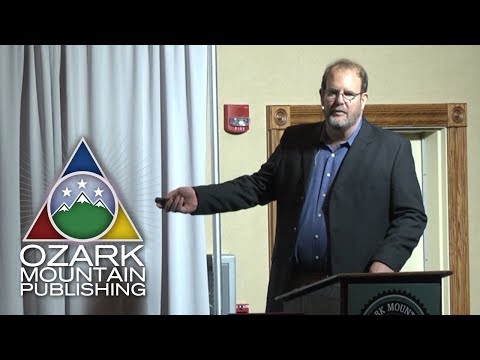
John Burroughs - Rendlesham Forest UFO Military Witness Comes Forward
Retired USAF Security Policeman John Burroughs presents his account of the encounter at the 2016 Ozark Mountain UFO Conference.
Sources
- Halt, Charles I. "Unexplained Lights" (memorandum to RAF/CC, RAF Bentwaters, for the UK MoD), January 13, 1981. Unclassified; released under the U.S. Freedom of Information Act in June 1983 to Robert Todd of Citizens Against UFO Secrecy; original in MoD file DEFE 24/1948 at The National Archives. Text: ianridpath.com; record: nationalarchives.gov.uk
- Halt, Charles I. Audio recording made in the early hours of December 28, 1980 ("The Halt Tape"), 18 min 12 s; copies first released in 1984 by Col. Sam Morgan. Transcript by Ian Ridpath with Halt's help. ianridpath.com
- Written statements by Penniston, Burroughs, Cabansag, Chandler and Buran on the first night, December 1980 (obtained from CAUS by James Easton, 1997). ianridpath.com
- Suffolk Constabulary. "Unusual Lights Incident Rendlesham" (police file on the calls of December 26, 1980), released under FOI. As described by Ridpath and cited in the Wikipedia article.
- Ridpath, Ian. "The Rendlesham Forest UFO Case" and linked pages (the fireball, the flashing light, the other lights, the radiation readings, the landing marks, the radar claims, the Cosmos 749 re-entry, the Halt affidavit). ianridpath.com
- British Astronomical Association, Meteor Section Newsletter no. 4, February 1981 (fireball at 02:50 UT, December 26, 1980), as cited by Ridpath.
- UK Ministry of Defence. Rendlesham file DEFE 24/1948 (released 2001) and later UFO files transferred to The National Archives, 2008–2013. nationalarchives.gov.uk
- Halt, Charles I. Notarized affidavit, June 2010. Text and critique: ianridpath.com
- Pope, Nick; Burroughs, John; & Penniston, Jim. Encounter in Rendlesham Forest: The Inside Story of the World's Best-Documented UFO Incident, Thomas Dunne Books, 2014
- Warren, Larry & Robbins, Peter. Left at East Gate: A First-Hand Account of the Rendlesham Forest UFO Incident, Marlowe & Company, 1997 (later editions)
- Bruni, Georgina. You Can't Tell the People, Sidgwick & Jackson, 2000
- Butler, Brenda; Street, Dot; & Randles, Jenny. Sky Crash: A Cosmic Conspiracy, Neville Spearman, 1984. First published investigation of the case
- Pope, Nick. Open Skies, Closed Minds, Simon & Schuster, 1996
- Good, Timothy. Above Top Secret: The Worldwide U.F.O. Cover-Up, Sidgwick & Jackson, 1987; William Morrow, 1988
- Dunning, Brian. "The Rendlesham Forest UFO." Skeptoid, January 6, 2009. skeptoid.com
- BBC News. "New UFO trail follows sightings," August 9, 2005; "UFO lights were 'a prank'," June 30, 2003. bbc.co.uk
- Boone, Kevin. "The Rendlesham binary message" (analysis of Penniston's notebook). kevinboone.me
- "Rendlesham Forest incident," Wikipedia (used as a pointer to sources only). en.wikipedia.org
Corrections (October 2026)
A fact-check of this page against the primary records (Halt's memo and tape, the airmen's 1980 statements, the Suffolk police file and the MoD file) found that a number of claims were wrong or could not be traced, and they have been corrected or removed. Removed: radar tracking of the object by RAF Watton (Watton reported nothing on radar, and the MoD said in 1983 that no unidentified object was seen); a Halt-memo reference to radar (there is none); follow-up radiation measurements by "UFORA" and MUFON that "confirmed" elevated readings (checks in 1982, 1987 and 2003 found only background); a Defence Intelligence Staff assessment of "slightly above background but not significantly so" (the one MoD memo on the subject said the opposite, on the assumption that Halt's figures were accurate); British civilian witnesses in Woodbridge and Rendlesham who corroborated the lights (the police called to the scene saw only the lighthouse); a 1983 Directorate of Air Staff report; Col. Ted Conrad's support for Halt's account (Conrad has been sharply critical of it); a radial pattern of tree damage documented by the Forestry Commission (a forester identified the marks as axe cuts); soil cores; "compass anomalies" and disrupted radio; a GPS argument for the binary code; NSA records "acknowledged" under FOIA; a 1975 Goldwater–LeMay request; county-council recognition; and the "first-ever" U.S. acknowledgment of a UAP injury in Burroughs's VA case. Corrected: the memo was unclassified and was released in the U.S., not the UK, to CAUS, not "AFIE"; Halt was a lieutenant colonel and deputy base commander, not a "Wing Commander"; the composite Halt-tape quotation has been replaced with the actual wording; the dates of the nights; and the description of Halt's 2010 statement (a notarized affidavit, not a National Press Club speech). The rating was changed from Credible (85) to Disputed (55); the reasons are given under "Why Disputed."
See something inaccurate? Have additional information or sources?
Suggest an Edit →Last Updated: October 25, 2026