
The Cash-Landrum Incident
On the night of December 29, 1980, Betty Cash, Vickie Landrum and seven-year-old Colby Landrum reported a huge, glowing, diamond-shaped object shooting flames above a wooded road between New Caney and Huffman, Texas, followed by a swarm of twin-rotor helicopters. All three said they fell ill afterwards, and Cash was hospitalized within days. Their $20 million suit against the United States was dismissed in 1986 after every agency involved denied owning such a craft. Whether their illnesses were caused by what they saw remains the central dispute: Cash's own hospital records, as later published, diagnosed cellulitis and alopecia areata rather than radiation injury.
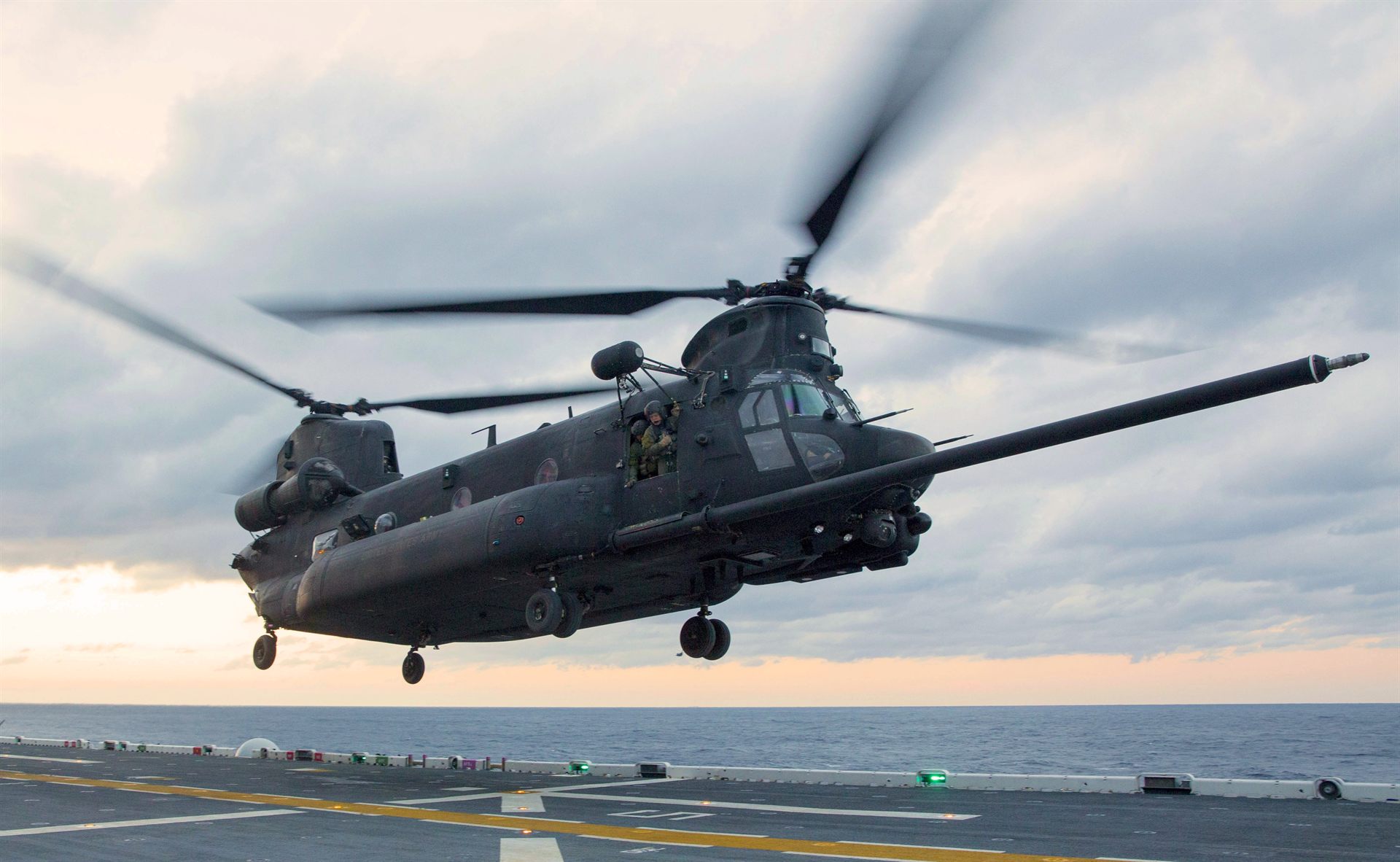
Pictured: a U.S. military CH-47 Chinook helicopter in flight — not a photograph from the actual December 29, 1980 encounter near Huffman, Texas. No camera captured the diamond-shaped object or the roughly two dozen twin-rotor helicopters Betty Cash, Vickie Landrum, and Colby Landrum described escorting it; the sighting happened on a dark rural road in under a few minutes, and no photographic or film evidence from the incident itself has ever surfaced.
Theoretical Alignment
The Cash-Landrum Incident is usually discussed in terms of covert military activity rather than extraterrestrial craft, because the witnesses themselves believed they had seen a U.S. government device and because of the helicopters they described. Betty Cash said she counted 23 twin-rotor helicopters and that they carried "United States Air Force" markings. If a formation of that kind was there, it would point to government activity, but no military record of it has ever been found, and the only independent helicopter sightings on record were reported months later and do not include the object. The Psycho-Social Hypothesis is not as easily dismissed as earlier versions of this page claimed: the witnesses' illnesses were real, but whether they were caused by the object is exactly what is contested, and Cash's hospital records point to cellulitis and alopecia areata rather than radiation injury.
Background: The Pine Woods and the Search for Bingo
On the evening of December 29, 1980, Betty Cash, a 51-year-old restaurant owner from Dayton, Texas, was driving her 1980 Oldsmobile Cutlass Supreme. With her were her friend Vickie Landrum, 57, and Vickie's seven-year-old grandson, Colby Landrum. They had been out to eat and were heading home to Dayton. Popular retellings add that they had spent the evening looking for a bingo game in New Caney; the earliest recorded accounts say only that they had been out to dinner.
In her account to Air Force officials at Bergstrom Air Force Base in August 1981, Cash put the start of the sighting at about 9:15 p.m., as she turned onto a narrow country road between the towns of New Caney and Huffman, some 30 to 40 kilometers northeast of Houston. John Schuessler's later reconstruction placed them southbound on FM 1485, just south of Inland Road, although skeptic Robert Sheaffer has argued, on the basis of a 1981 Texas Department of Health report, that neither the witnesses nor Schuessler knew precisely where the incident took place. It was a cold night: Cash later described using the pocket of her leather jacket to open the car door.
Complete Timeline
| Date | Event |
|---|---|
| ~9:00–9:15 PM CST Dec 29, 1980 | Driving home toward Dayton on a country road between New Caney and Huffman, the witnesses see a bright light above the trees, at first taken for an aircraft approaching Houston Intercontinental Airport. |
| ~9:15 PM CST Dec 29, 1980 | A large, brilliant, diamond-shaped object descends to near treetop level ahead of them, periodically shooting flame from its base. Cash stops the car; the heat is intense. |
| ~9:15–9:30 PM CST Dec 29, 1980 | Betty Cash and Vickie Landrum get out to look. Vickie soon returns to the car to comfort Colby Landrum; Betty stays outside for several minutes and later says the door handle was too hot to touch with her bare hand. |
| ~9:30 PM CST Dec 29, 1980 | The object rises and moves away, and the witnesses report a large group of helicopters around it. Betty says she counted 23, mostly twin-rotor types. They estimate the whole sighting at 15 to 20 minutes. |
| Night of Dec 29–30, 1980 | Back in Dayton, all three report nausea, vomiting, diarrhea, burning eyes and a sunburn-like feeling, Betty most severely. |
| January 2, 1981 | Betty Cash is admitted to Parkway Hospital in Houston (discharged January 19; readmitted January 25 to February 9). Her physicians diagnose cellulitis of the face and scalp and, on the second admission, alopecia areata. |
| August 17, 1981 | After letters to Senators John Tower and Lloyd Bentsen, the witnesses are interviewed by Air Force legal and claims officers at Bergstrom AFB, Austin. Attorney Peter Gersten volunteers his services at about the same time. |
| September 16, 1981 | Texas Department of Health staff survey the road the witnesses described and take soil samples; no significant deviation from background radiation is found. |
| March–May 1982 | Lt. Col. George Sarran of the Department of the Army Inspector General conducts an inquiry into whether Army helicopters were involved. He finds no evidence that they were, but judges the witnesses credible. |
| Late 1982–1983 | Gersten files administrative claims totaling $20 million against the government; the Air Force denies the appeal on September 2, 1983, finding "no evidence of involvement by any military personnel, equipment or aircraft." |
| 1984–1986 | The witnesses sue the United States (Civil Action No. H-84-348, S.D. Tex.). On August 21, 1986, U.S. District Judge Ross N. Sterling signs an order dismissing the suit. |
| Dec 29, 1998 | Betty Cash dies, aged 69, on the 18th anniversary of the incident, after years of illness including breast cancer. Vickie Landrum dies on September 12, 2007, aged 83. |
The Encounter: The Fiery Diamond Above the Asphalt
The witnesses first saw a bright light above the trees ahead and assumed it was an aircraft approaching Houston Intercontinental Airport, about 15 miles to the southwest. As they drew nearer, it descended. Cash told the Air Force in 1981 that the object, which "lit up the entire sky," suddenly came down "almost level with the treetops," and that they could not go on because "fire was shooting out the bottom of it." Accounts based on Schuessler's investigation describe a large, intensely bright, dull-silver object shaped like an upright diamond with flattened top and bottom, about the size of the Dayton water tower, with small blue lights around its middle; each burst of flame made it drop toward the road and then rise again. Cash considered turning around but decided the narrow shoulders, soft from rain, would trap the car.
Cash said that inside the car "the heat was so intense" that she got out. Standing in front of the car, she judged the object to be "as large, if not larger, than a water tower," and watched it for several minutes.
"Fire was shooting out the bottom of it." — Betty Cash, interviewed at Bergstrom Air Force Base, August 17, 1981 (as quoted by Gary Posner, 2023)
Vickie Landrum also got out but, by her own account to the Air Force, stayed only "just a few minutes," most of the time half inside the car with one arm holding Colby in and the other resting on the car, which she said was burned. When Colby became frightened she went back to comfort him, while Betty stayed outside. When Betty tried to get back in, the door handle was "so hot I couldn't stand it with my bare hand," and she used the pocket of her leather jacket to open the door. In a later television interview she said grabbing the handle had pulled "all the meat off my hand," a more dramatic version than she gave in 1981.
Vickie later said that the dashboard had grown so soft from the heat that, when she touched it, her hand pressed into the vinyl and left an imprint still visible weeks afterwards; the claim was repeated on camera in a 1985 HBO documentary. No photograph or examination of the imprint is known, and skeptics have pointed to that gap. The object eventually rose above the trees and moved away, the helicopters with it, giving off what Betty called a "shrill beeping sound." She estimated the whole event at "about 15 to 16, 17 minutes," and Colby put it at 15 to 20.
The Helicopter Escort and Corroborating Witnesses
As the object rose, the witnesses said, helicopters appeared and surrounded it. Betty told the Air Force in 1981 that within moments there were "helicopters completely around the object," of the type "with two rotors," and that she counted twenty-three. The witnesses later identified them as tandem-rotor CH-47 Chinooks; some accounts add a few smaller single-rotor helicopters. Betty also said they bore "United States Air Force" markings, although the Air Force had no twin-rotor helicopters in its inventory at the time, a point raised both by the Air Force's own congressional liaison inquiry and by later skeptics. Vickie later added that a second group of large helicopters with searchlights flew over them further along the drive home.
The helicopters became the cornerstone of the case, because a formation of that size would point to an organized government operation. Every service, however, denied having any aircraft there, and no flight record has ever been found. Corroboration from outside the car is limited and came late. In May 1982, about seventeen months after the incident, investigators interviewed Dayton police officer Lamar Walker and his wife, Marie, who said they had seen about a dozen Chinook-type helicopters that night, near the same area, with one or more shining a bright light downward; they did not see the object. In September 1982 Schuessler's group also interviewed John Plaster, a Huffman resident who reported helicopters. Schuessler's 1983 report that an Army helicopter pilot had admitted being called out "because of the UFO" was later traced by researcher Curt Collins to a mix-up with a different, earlier UFO event; the pilot denied any involvement.
Earlier versions of this page said that "several other local residents" confirmed a "major, low-altitude military deployment" and that the Walkers' helicopters were searching the forest with powerful searchlights. The record supports something narrower: a handful of later-reported helicopter sightings that night, none of them including the object, and no documentation of where any such helicopters came from.
Physical Trauma and Medical Aftermath
According to the witnesses, all three fell ill the same night: nausea, vomiting, diarrhea, general weakness, burning eyes and a feeling like sunburn. Betty Cash, who had spent the most time outside the car, was worst affected. She told the Air Force that within 30 minutes she began developing "blisters all over my head, my face, my back, my neck," with swelling of her lips and ears and, later, patches of hair loss.
Her hospital record is better documented than any other part of the case, because John Schuessler reproduced long extracts from it in his 1998 book. Betty was admitted to Parkway Hospital in Houston on January 2, 1981, four days after the incident, as an apparent burn patient complaining of swelling of the eyes, scalp and face and a severe headache, and was discharged on January 19. The admitting physician, Dr. V. B. Shenoy, noted little if any hair loss at admission. The consulting dermatologist, Dr. Solomon Brickman, diagnosed cellulitis with secondary swelling and treated it with antibiotics and steroids; an EEG, a CT scan of the head and sinus X-rays were normal, and a neurologist, Dr. K. Kumar, attributed her headache most probably to severe tension headache. She was readmitted on January 25 with diarrhea and two large patches of hair loss and stayed until February 9. Dr. Brickman's clinical diagnosis was alopecia areata, an autoimmune condition, and a scalp biopsy was read the same way. Schuessler's MUFON medical consultant, radiologist Dr. Peter Rank, disputed the pathologist's interpretation and favored radiation exposure, and the radiation question has never been settled by any test. Earlier versions of this page named a "Parkway General Hospital," a "Dr. Brian McClellan" as her attending physician there, a 12-day stay in a sterile unit, and a radiation-sickness diagnosis; none of that appears in the published records. A family practitioner named Dr. Bryan McClelland treated her later, in Alabama, and said on television in 1998 that her illness was "an absolute classic radiation injury."
Betty's health remained poor. In March 1981 she moved to her mother's home in Birmingham, Alabama, and was hospitalized there repeatedly over the following years for skin lesions, chest pain, bronchitis and other problems; biopsies of her skin lesions found common benign conditions. She had had heart surgery before the incident, and she was later treated for breast cancer, undergoing a mastectomy by 1983. She died on December 29, 1998, eighteen years to the day after the encounter. Supporters attributed her decline to radiation; skeptics, including physician Gary Posner and writer Brian Dunning, have pointed out that her pre-existing heart condition and the diagnoses actually recorded do not require it.
Vickie Landrum told the Air Force in August 1981 that her hair had started falling out about a month after the incident but had grown back, that blisters on her arms came and went, and that her eyes had teared for about three months and still felt "like they've got sand in them"; her eye doctor had told her she might need surgery. Brian Dunning found that her only documented illness was a cataract. Colby Landrum, asked in 1981 how he had felt, said he "didn't feel nothing until I got up the next morning" with stomach pain and diarrhea. Earlier versions of this page also described lasting skin sores, hair thinning and recurrent eye infections for Colby; no source for them was found.
The Sarran DAIG Investigation
The witnesses' search for help began with telephone calls to local officials and military installations, which went nowhere. On May 31, 1981, the Center for UFO Studies suggested they contact Texas Senators John Tower and Lloyd Bentsen, whose July 28 letters directed them to the Judge Advocate claims office at Bergstrom Air Force Base in Austin. On August 17, 1981, the three were interviewed there, on tape, by Air Force legal and claims staff, and were told they could file a claim if they found a lawyer. Prompted by a congressional inquiry, Captain Jenny Lampley of the Air Force congressional liaison office began a brief inquiry but dropped it on finding that the Air Force did not operate twin-rotor helicopters.
The Department of the Army Inspector General then took an interest, and Lt. Col. George Sarran conducted an inquiry between about March and May 1982. Its stated purpose was to determine whether Army helicopters had been involved, not to investigate the object. Sarran contacted Schuessler and the medical consultants and made numerous calls to military aviation units, without finding any record of Army or other military helicopters in the area that night. He nonetheless wrote that "Ms. Landrum and Ms. Cash were credible," and he later told a reporter he had no reason to doubt Vickie, Colby or the policeman. That is a finding about the witnesses' sincerity, not an official conclusion that an unidentified craft caused their injuries; the report does not endorse any cause. Earlier versions of this page dated Sarran's assignment to August 1981 and described audits of every base in Texas and Louisiana and an inspection of the car; the August 1981 interviews were the separate Air Force session at Bergstrom, and the published accounts of Sarran's inquiry do not describe those audits. As with any official finding, the Army's negative result is one input to weigh rather than proof: outside researchers have no way to audit how complete its search of flight records was.
The $20 Million CAUS Federal Lawsuit
Attorney Peter Gersten, a New York lawyer and director of Citizens Against UFO Secrecy (CAUS), volunteered his services in the summer of 1981. Late in 1982 he filed administrative claims totaling $20 million on behalf of Betty, Vickie and Colby. The Air Force denied them, and on September 2, 1983, denied the appeal, stating that its investigation had revealed "no evidence of involvement by any military personnel, equipment or aircraft" in the alleged incident. The witnesses then sued the United States in federal court: Cash et al. v. United States, Civil Action No. H-84-348, in the Houston Division of the U.S. District Court for the Southern District of Texas.
The plaintiffs argued that the government had negligently allowed the craft and its helicopter escort to fly over a public road. The government moved to dismiss, or alternatively for summary judgment, supported by sworn affidavits from Robert W. Sommer of NASA, Colonel William E. Krebs of the Air Force, Vice Admiral Robert F. Schoultz of the Navy and Richard L. Ballard of the Army, stating that no object of the kind described was owned, operated or controlled by the United States. Assistant U.S. Attorney Frank Conforti told UPI in September 1985: "You can't hold the government liable for actions it doesn't control." U.S. District Judge Ross N. Sterling signed the order of dismissal on August 21, 1986, granting the government's motion under Federal Rules of Civil Procedure 12(b)(1), 12(b)(6) and 56.
The Lawsuit and the Legal Record
The lawsuit brought by Peter Gersten on behalf of Betty Cash, Vickie Landrum and Colby Landrum is one of very few UFO-related claims ever to reach a federal court in the United States. Gersten had previously represented CAUS in Freedom of Information litigation, and the $20 million figure carried over from the administrative claims.
The government's defense was a categorical denial of ownership. The affidavits from NASA, the Air Force, the Navy and the Army stated that the object was not owned, operated or controlled by the United States, and the Air Force had already found no evidence that any military personnel, equipment or aircraft were involved. Judge Sterling dismissed the suit on August 21, 1986. The order itself gives no written reasoning beyond the rules under which the motion was granted; later accounts, including Texas Monthly's, describe the outcome as a dismissal because no government agency owned or operated any aircraft fitting the witnesses' description. Earlier versions of this page said the suit was dismissed "without prejudice" and that the government did not dispute the injuries; neither statement is supported by the order or by the published accounts.
The legal record is valuable mainly for what it preserves: sworn government denials, on the record, that any U.S. agency had such a craft. It does not settle whether the helicopters existed. If a large helicopter formation was there, it left no paper trail that anyone has found; if it was not, the witnesses' descriptions of it are mistaken. Earlier versions of this page said that subpoenaed military logbooks were produced in discovery and that either the records or the government's sworn statements must therefore be false. No source located for this page describes such a discovery production, and that argument has been removed.
Legacy and Investigative Significance
The Cash-Landrum Incident remains one of the best-known American cases in which civilians claimed physical harm from a UFO encounter and sought compensation from the government. It has been retold in Unsolved Mysteries, HBO's America Undercover and many books, and it was among the cases reviewed by the 1997 Sturrock panel of scientists, which suggested it merited medical research. It is also one of the cases skeptics have examined most closely, and the gap between its popular telling and its documented record is part of its legacy. Earlier versions of this page said the case had been cited in academic literature on government accountability, legal scholarship and bioethics; no such citations were located, and the claim has been removed.
The Helicopter Witnesses and the Military Connection
The helicopters the witnesses described, about 23 of them by Betty's count, were seen escorting the object only by Betty Cash, Vickie Landrum and Colby Landrum. MUFON investigator John Schuessler documented other people who reported helicopters that night, most notably Dayton police patrolman Lamar Walker and his wife, Marie, who said in May 1982 that they had seen about a dozen Chinook-type helicopters near the same area, though not the object. That testimony, independent of the three primary witnesses, supports the presence of helicopters in the region that night, but it was given well after the case had been publicized, and the documented corroborating record is much narrower than many retellings suggest.
Schuessler spent years trying to trace the helicopters, publishing his findings on helicopter activity in the MUFON UFO Journal in September 1983. No unit, flight log, operations order or pilot has ever been tied to a flight over the area that night, and the one apparent lead, a pilot said to have admitted being called out "because of the UFO," was later shown by Curt Collins to have been talking about a different event. Earlier versions of this page said Schuessler had identified specific CH-47 units at Fort Hood and Fort Rucker capable of the flight and had confirmed that it would have required regimental-level coordination; no source for those statements was found, and they have been removed. The absence of records can be read two ways: as evidence that the flight was concealed, or as evidence that the formation was not what the witnesses believed. The record alone does not decide between them.
Medical Testimony and Expert Assessment
The medical question has been argued over for four decades, largely on the basis of the hospital extracts Schuessler published. On the proponents' side, Schuessler and radiologist Dr. Peter Rank, his MUFON consultant, argued that the pattern of symptoms fitted exposure to ionizing radiation, and Rank disputed the biopsy reading of alopecia areata. Dr. Richard Niemtzow, an Air Force physician who corresponded with investigators, also wrote about the case as a possible radiation injury in the MUFON UFO Journal in 1983. Betty's later family doctor in Alabama, Dr. Bryan McClelland, called it "an absolute classic radiation injury" on television in 1998. On the other side, Brad Sparks, a researcher sympathetic to UFO reports, argued in 1999 that the rapid onset of symptoms would have required a radiation dose that would almost certainly have killed the witnesses within days, and proposed chemical contamination instead. Physician Gary Posner, reviewing the records in detail in 2023, noted that the treating physicians in Houston diagnosed cellulitis and alopecia areata, that hair loss was not seen at the first admission, and that the regrowth was black rather than the white or grey typical after irradiation.
The later course of Betty Cash's health is often cited as consistent with long-term radiation effects, but the specific diagnoses recorded, including benign skin growths, iron-deficiency findings, bronchitis and heart problems in a patient who had already had heart surgery, are common in their own right, and her breast cancer cannot be linked to the incident without a dose measurement that does not exist. No physician's record located for this page diagnoses radiation injury in Houston, and the state's radiation survey of the road found nothing. Earlier versions of this page said that experts in radiation medicine, toxicology and emergency medicine found no conventional explanation, and that her physicians were "consistent" in judging radiation the likeliest cause; no source supports those statements, and they have been removed.
Key Witnesses
Betty Cash
Betty Cash was a 51-year-old restaurant owner in Dayton at the time of the sighting. She spent the longest time outside the car and reported the most severe symptoms. She was admitted to Parkway Hospital in Houston on January 2, 1981, where her physicians diagnosed cellulitis and, on readmission, alopecia areata; she later moved to Birmingham, Alabama, and was hospitalized there repeatedly. She was later treated for breast cancer. She maintained her account until her death on December 29, 1998, exactly 18 years after the incident.
Vickie Landrum
Vickie Landrum was the front-seat passenger, with her grandson Colby Landrum. By her own account to the Air Force in 1981 she was out of the car for "just a few minutes," mostly holding Colby in with one arm, before returning to comfort him. She later said her hand left an imprint in the heat-softened dashboard vinyl, which she said remained visible for weeks; no photograph of it is known. She reported temporary hair loss, recurring blisters and eye problems; the only illness documented in her records, according to Brian Dunning, was a cataract. She was a plaintiff in the federal lawsuit and died on September 12, 2007, aged 83.
Colby Landrum
Colby Landrum was seven years old at the time of the encounter and stayed in the car for most of it, frightened. Asked at Bergstrom Air Force Base in 1981 what he had felt, he said he "didn't feel nothing until I got up the next morning," with stomach pain and diarrhea, and he described the object as "kinda yellowish-red." He was interviewed by Air Force staff, by MUFON investigators and later by documentary crews, and is the only one of the three witnesses still living.
Lamar Walker
Lamar Walker was a police officer in Dayton, Texas. Interviewed by investigators in May 1982, about seventeen months after the incident, he and his wife, Marie, said they had seen about a dozen Chinook-type helicopters on the night of December 29, 1980, near the same area, with one or more shining a bright light down. They did not see the diamond-shaped object. Their account is the most often cited independent support for the presence of helicopters that night, though it was given after the case had been widely publicized and does not establish where the helicopters came from.
The Five Observables Assessment
The Five Observables framework, developed by former AATIP director Luis Elizondo, is used to classify UAP encounters based on performance characteristics that exceed known technology:
Assessment: As described by the witnesses, the object hovered near treetop level for several minutes with no wings or other lifting surfaces, rising and dropping with each burst of flame; that is the basis for the anti-gravity lift rating, which rests entirely on witness description. The other observables were not reported: the object moved slowly, was extremely bright and noisy, and did not enter water.
Evidence Assessment
Supporting Anomalous Origin
- Three witnesses reported falling ill the same night, and Betty Cash's hospitalization four days later is documented in the extracts of her records Schuessler published.
- Betty's later physician in Alabama, Dr. Bryan McClelland, and MUFON's consultant Dr. Peter Rank both described her illness as consistent with radiation injury.
- The witnesses reported heat severe enough to make the car body and door handle painful to touch.
- Dayton police officer Lamar Walker and his wife reported seeing about a dozen Chinook-type helicopters near the area that night.
- The Army Inspector General's investigator, Lt. Col. George Sarran, judged Cash and Landrum credible.
- No military record has ever accounted for the helicopters the witnesses and the Walkers described.
Supporting Conventional Explanation
- A Texas Department of Health survey of the road in September 1981, including soil samples, found no significant deviation from background radiation; Schuessler found no radioactivity in Cash's car.
- The Army's 1982 inquiry and the Air Force's claims review found no evidence that any military aircraft were involved.
- The federal suit was dismissed in 1986 after NASA and all three military departments swore that no such craft was theirs.
- Cash's Houston physicians diagnosed cellulitis and alopecia areata, confirmed by scalp biopsy, not radiation injury; she had a history of heart surgery before the incident.
- A 1981 report for the Fund for UFO Research found no marks on the pavement, and no photograph exists of the claimed road damage or the dashboard handprint.
- The independent helicopter sightings were reported months after the incident was publicized, and none includes the object.
Why "Disputed"
The Cash-Landrum incident is rated DISPUTED because the sincerity of the witnesses is widely accepted, and their illnesses were real, but nearly every physical claim attached to the case is contested. The radiation interpretation rests on the witnesses' symptoms and on the opinions of proponents' consultants, while the treating physicians in Houston recorded cellulitis and alopecia areata, and the state found no residual radiation. The helicopter formation is supported by the witnesses and, months later, by a police officer and his wife, but no record of it exists. Skeptics such as Brad Sparks, Gary Posner, Robert Sheaffer and Brian Dunning have proposed chemical exposure, misattributed ordinary illness, or a mistaken or embellished account, and none of those explanations has been ruled out. The case remains unexplained, but the evidence that would make it more than a sincere three-witness report has never been produced.
Sensor & Instrumentation Detection Profile
No radar data from the Cash-Landrum incident has ever been publicly released, and no record of any military flight plan covering the area that night has been found. The Air Force, Army and Navy all denied having any aircraft there. Proponents read the absence of records for a formation of more than twenty helicopters as evidence of concealment or of a classified flight authority; skeptics read it as evidence that the formation was not what the witnesses believed. The documented record cannot settle which.
In the absence of instruments, the medical record has often been treated as the case's "sensor." Its value is limited by what it actually says. Betty Cash's Houston records, as reproduced by Schuessler, describe a burn-like presentation with swelling of the face, scalp and eyelids, diagnosed as cellulitis, followed weeks later by patchy hair loss diagnosed as alopecia areata; tests of her head, sinuses and blood did not identify radiation injury, and her later Alabama records describe common conditions. The witnesses themselves reported a gradient of symptoms matching the time each spent exposed, Betty most and Colby least, which proponents cite as fitting a point source. Earlier versions of this page said a "Dr. Brian McClellan" and Dr. Peter Rank treated the witnesses and documented acute radiation sickness; Rank, a radiologist in Wisconsin, reviewed records for MUFON rather than treating anyone, and the McClellan attribution does not match the Houston records.
MUFON investigator John Schuessler, an aerospace engineer who worked on NASA's Space Shuttle program, led the civilian investigation for nearly two decades and published the most complete account, The Cash-Landrum UFO Incident, in 1998. He concluded that the object had emitted both intense heat and ionizing radiation. Skeptics have questioned parts of his work, notably his statements that the witnesses led him to a burned spot on the road: a 1981 report by Allan Hendry for the Fund for UFO Research found no marks on the pavement, and the Texas Department of Health's investigator recorded that the precise location was uncertain.
Environmental & Geospatial Context
The encounter occurred on a rural two-lane road through woodland between New Caney and Huffman, northeast of Houston, identified in Schuessler's reconstruction as FM 1485. In 1980 the area was sparsely populated, the kind of stretch that sees little traffic at night, which is consistent with the absence of other witnesses to the object itself. The road runs through low-lying, wooded terrain, so a low object would have been visible mainly along the road corridor.
The proximity of the greater Houston area matters in two ways. Houston is home to NASA's Johnson Space Center and the region hosted military aviation units, including Army National Guard aviation at Ellington Field, about 25 miles to the south, so military helicopter traffic in the region was not unusual in itself, although none has been tied to that night. The Houston area's petrochemical industry has also been mentioned as a source of bright flares and of possible chemical exposure, but no specific industrial source has been linked to the case. Earlier versions of this page said that civilian radiation monitoring stations in the area recorded nothing that night; no source for that statement was found.
Observer Credibility & Occupational Profile
Betty Cash (age 51 at the time) ran a small restaurant in Dayton, Texas, and had no documented interest in UFOs before December 29, 1980; she and Vickie believed they had seen a U.S. government device, not an alien craft. Vickie Landrum (age 57) was a devout Christian, and accounts of the case say she first wondered whether the light was a sign of the Second Coming. Dayton's police chief, Tommy Waring, told Schuessler that he did not know Betty well but had known Vickie for years and that she had never lied to him. The Army's investigator found both women credible.
Colby Landrum (age 7) is often cited as the most significant witness because a child has little reason to invent such a story. His account to the Air Force in 1981 agreed with the adults' on the duration, although he described the object as "yellowish-red" and was not asked about its shape. Earlier versions of this page said his symptoms were confirmed by his physician and by school attendance records; no such records have been published.
John Schuessler has said that all three witnesses were interviewed many times over the years and that their accounts stayed consistent in their main points. Skeptics have documented some changes in the details, such as Betty's later, more dramatic description of the door handle, and Posner has argued that the descriptions of the object itself varied considerably. Earlier versions of this page attributed statements about the witnesses' credibility to "law enforcement officers in the Huffman area" and to attorney Peter Gersten; the sources for those statements could not be found.
Physical & Material Assays
The physical evidence in the Cash-Landrum case is less extensive than its reputation. The most significant item is the medical record of Betty Cash's hospitalizations, which documents that she was genuinely ill but, in the extracts published, diagnoses cellulitis and alopecia areata rather than radiation injury. The witnesses reported a gradient of symptoms by exposure, Betty most, Vickie Landrum less, Colby Landrum least, but the documentation for Vickie and Colby is thin.
Betty's hair loss was first recorded at her second admission, about four weeks after the incident, as two large patches on either side of the head, with black hair regrowing in round spots. Her car, a 1980 Oldsmobile Cutlass Supreme, was checked with a Geiger counter by Schuessler in early 1981 and showed no radioactivity. The softened dashboard and Vickie's handprint in it are known only from the witnesses' accounts; no photograph or examination of them is known. Earlier versions of this page said a Dallas dermatologist found her lesions unlike any burn or disease, that she lost fingernails, and that the dashboard and handprint were photographed and preserved; no sources for those statements were found.
Claims about the road are also weaker than often stated. Schuessler later said that both women independently led him to the same spot and that the road there was visibly burned, and the story that road crews re-paved the site soon afterwards became part of the case's folklore. But Allan Hendry's 1981 report for the Fund for UFO Research recorded that later examination showed no marks on the pavement, the Texas Department of Health's September 1981 survey found no residual radiation, and no photographs of any road damage exist. No record of a re-paving has been produced.
Historical Precedents & Archive Matches
The Cash-Landrum Incident is one of very few cases in which civilian witnesses sued the United States government over a UFO encounter. The suit claimed the government was negligent in operating the craft and its helicopter escort over a public road. It was dismissed in 1986 after NASA, the Air Force, the Navy and the Army swore that no such craft was theirs. Earlier versions of this page said the government did not dispute the injuries and that the dismissal "set a precedent" cited in later UAP-related lawsuits; neither statement could be supported, and both have been removed.
The nearest parallel often drawn is the 1977 Colares flap in Brazil, where residents reported being struck by beams of light and a local physician later described burns and other symptoms. The parallel is weaker than sometimes claimed. No Operation Prato medical report has been released; the Brazilian Air Force files leaked or shown to researchers, starting with a meeting with ufologists in May 2005 and transfers to the National Archives from 2008, mention burns only in a few places; and the physician's accounts of how many patients she saw and what she found grew considerably between her 1977 statement and her later interviews. Both cases rest heavily on testimony about injuries rather than on published clinical records linking them to an external energy source.
John Schuessler also catalogued the case, with dozens of others in which witnesses reported physical effects after close encounters, in UFO-Related Human Physiological Effects (1996), which remains a widely cited reference in that literature.
Material Analysis
The Cash-Landrum incident is unusual among UAP cases because its physical claims center on the witnesses' bodies rather than on a landing site or debris. The claimed heat from the object, the illnesses that followed, and the reported effects on the car are the case's material evidence, and each needs to be weighed at the level of documentation that actually exists.
Heat Output & Thermal Radiation
All three witnesses described intense heat from the object as it hovered over the road. Betty Cash, who stood closest to it, said the door handle was too hot to hold with her bare hand. Vickie Landrum later said the dashboard vinyl softened enough to take the imprint of her hand. No photograph or measurement of either effect exists. Earlier versions of this page also described heat-blistered paint on the hood and roof and softened asphalt at the site; no source for the paint damage was found, and a 1981 report found no marks on the pavement.
Radiation-Like Injuries & Medical Records
Betty Cash was admitted to Parkway Hospital in Houston on January 2, 1981, four days after the encounter, with swelling of the eyes, scalp and face and a severe headache. The admitting physician, Dr. V. B. Shenoy, noted little if any hair loss; the consulting dermatologist, Dr. Solomon Brickman, diagnosed cellulitis and treated it with antibiotics and steroids. On her readmission from January 25 to February 9, patchy hair loss was recorded and Dr. Brickman diagnosed alopecia areata, supported by a scalp biopsy. Earlier versions of this page said Dr. Brickman noted the burns' similarity to ionizing radiation injury and that a "Dr. Brian McClellan" documented radiation-like burns; the published records say otherwise. Cash later had breast cancer and many hospital admissions in Alabama. Vickie Landrum reported burns, temporary hair loss and eye problems, and was found to have a cataract. Seven-year-old Colby Landrum reported stomach pain and diarrhea the next morning. The witnesses' medical records were not made public in full; Schuessler's book reproduces extracts of Betty's.
CH-47 Chinook Helicopters
The witnesses reported about 23 helicopters, most of them twin-rotor types they identified as CH-47 Chinooks, accompanying the object. Peripheral support came later: police officer Lamar Walker and his wife said in May 1982 that they had seen about a dozen Chinook-type helicopters in the area that night, and another Huffman resident reported helicopters to Schuessler's group in September 1982. The Army's 1982 inquiry by Lt. Col. George Sarran and the Air Force's review of the witnesses' claims found no evidence that any military aircraft were involved. As with any official finding of this kind, the negative result reflects records the services chose and were able to search, and outside researchers have no means of auditing it.
Vehicle Damage
MUFON investigator John Schuessler examined Betty Cash's 1980 Oldsmobile Cutlass Supreme in early 1981 and found no radioactivity with a Geiger counter. The softened dashboard and handprint are known only from the witnesses' descriptions. Earlier versions of this page said that the dashboard, heat-blistered paint and handprint impressions were photographed and preserved, and that no conventional malfunction could produce the damage; no source for those statements was found.
Supporting Anomalous Origin
- Betty Cash was hospitalized four days after the incident, and three witnesses reported falling ill the same night
- Proponents' medical consultant Dr. Peter Rank and her later physician Dr. Bryan McClelland judged her illness consistent with radiation injury
- The witnesses reported heat severe enough to make the car body and door handle too hot to touch
- The witnesses reported symptoms graded by how long each was exposed
Supporting Conventional Explanation
- No radiological measurements were taken at the site immediately after the event
- The Texas Department of Health's September 1981 survey and soil samples found no deviation from background radiation
- Cash's Houston physicians diagnosed cellulitis and alopecia areata, not radiation injury
- Brad Sparks argued the rapid onset fits chemical exposure better than ionizing radiation
- No physical debris, photograph of the claimed road or dashboard damage, or material from the object exists
The Conventional Explanation Candidate: Experimental Military Device, Misperception, or Chemical Exposure
The U.S. government denied operating any craft or aircraft matching the witnesses' description. Investigators and skeptics have nonetheless proposed several conventional explanations, which must be weighed alongside the anomalous interpretation. As with every official denial in this case, the government's statements are one input, not proof: agencies investigating claims against themselves have an institutional interest in the least troubling answer, and outside researchers cannot audit how complete their record searches were.
Classified Aerospace Prototype (Mobile Nuclear/Thermal Reactor)
PossibleThe witnesses themselves believed they had seen a U.S. government device, and some proponents have suggested a classified test vehicle, possibly nuclear- or rocket-powered, with the helicopters as an escort or recovery team. Writers on this theme point to earlier programs such as the Aircraft Nuclear Propulsion program and Project Pluto, both cancelled long before 1980. Such a device could account for the flames, the noise, the heat and the helicopters. Against it: no evidence of any such program operating in 1980 has emerged, all four agencies swore no such craft was theirs, flying a hazardous experimental vehicle over a public road near Houston would have been extraordinary, and the radiation injuries the theory was originally meant to explain are themselves disputed. It remains possible but unsupported.
Misperception of a Distant Light (Steuart Campbell Hypothesis)
ImplausibleIn 1994 the Scottish skeptic Steuart Campbell suggested that the witnesses may have seen a mirage of the bright star Canopus, which he calculated lay in line with the road (The UFO Mystery Solved, pp. 82–83). Atmospheric distortion of a bright light low on the horizon can produce dramatic, flame-like effects. But this explanation does not account for the witnesses' descriptions of an object close overhead, the heat they reported, or the helicopters, and few researchers on either side have found it persuasive. An earlier version of this page attributed a petrochemical-flare refraction hypothesis to a "Wim van Utrecht" and cited a 1983 paper; no such paper could be found, and the attribution has been removed.
Chemical Exposure or Misattributed Illness (Sparks; Posner; Dunning)
PossibleBrad Sparks argued in 1999 that the witnesses' symptoms appeared too quickly to be ionizing radiation at any survivable dose, and proposed chemical contamination, probably from an aerosol, as the cause. Skeptics Gary Posner and Brian Dunning go further: Betty Cash's Houston physicians diagnosed cellulitis and alopecia areata, Vickie Landrum's documented condition was a cataract, and Cash had a serious heart condition before the incident, so the witnesses may have honestly attributed later illnesses to a frightening experience. This explains the medical record without any exotic source, but it does not by itself explain what the witnesses saw on the road or the helicopters they and others reported.
The Assessment: Why This Case Remains Open
No single explanation accounts for everything the witnesses reported. A classified device would explain the object and helicopters but has no supporting evidence and does not fit the official denials; a misperception explains little; and the medical alternatives explain the illnesses better than the radiation hypothesis but leave the sighting itself unexplained. Because the witnesses' sincerity is generally accepted, the helicopter formation has never been traced, and the physical claims have never been documented, the Cash-Landrum incident remains unresolved and disputed. It is one of the most discussed cases of claimed UAP-related physical harm, but its documented record is much thinner than its reputation.
Related Cases
Confirmed Documents & Official Records
Department of the Army Inspector General inquiry conducted by Lt. Col. George Sarran, about March–May 1982, into whether Army helicopters were involved. It found no evidence that they were, while recording that "Ms. Landrum and Ms. Cash were credible." Copies released to researchers are collected and discussed by Curt Collins (blueblurrylines.com).
UNCLASSIFIEDFederal suit by Betty Cash, Vickie Landrum and Colby Landrum seeking $20 million. Dismissed on August 21, 1986, by U.S. District Judge Ross N. Sterling, granting the government's motion under Rules 12(b)(1), 12(b)(6) and 56. The scan also includes the Air Force's September 2, 1983 denial of the witnesses' administrative claims.
PUBLIC RECORDSearch Government Archives Directly
Further Reading — Recommended Literature
The Cash-Landrum UFO Incident
The book-length account of the incident by its principal MUFON investigator, an aerospace engineer on NASA's Space Shuttle program, first self-published in 1998. It reproduces long extracts from Betty Cash's hospital records, which are the main documentary basis for the medical debate.
Secrets of Antigravity Propulsion
LaViolette's argument that classified electrogravitic propulsion research existed, useful background for the theory, held by the witnesses themselves, that what they saw was a secret U.S. government device.
The UFO Book: Encyclopedia of the Extraterrestrial
A comprehensive reference volume containing detailed case analyses and investigations of historical close encounters, including the Cash-Landrum incident.
The Government UFO Files
Randle's survey of what declassified U.S. government files actually contain across nearly 100 sightings, abductions and encounters — useful for placing any single case inside the wider documentary record rather than treating it in isolation.
UFO Briefing Document
The 1995 UFO Research Coalition casebook of what its compilers judged the strongest UAP evidence. Useful context, though Cash-Landrum is not among the case histories named in its table of contents.
DISCLOSURE: Some links above are affiliate links. If you purchase through them, OverClassified receives a small commission at no additional cost to you. This helps support independent research.
Essential Viewing

Unsolved Mysteries: Texas UFO
The classic Robert Stack episode covering the Cash-Landrum incident, witness interviews, and legal battles.

The Cash-Landrum UFO Incident (Documentary)
Detailed modern UAP research documentary tracing the case timeline, Sarran's report, and medical evidence.
Rare Interview With Researcher John F. Schuessler
A rare interview with MUFON investigator John F. Schuessler, the lead researcher who documented the case, interviewed the witnesses, and pursued the Chinook helicopter escort claims.
Sources
- Schuessler, John F. The Cash-Landrum UFO Incident. La Porte, TX: Geo Graphics Printing Co., 1998 (reissued by UFO Books Press, 2022). Medical-record extracts, pp. 88–112; court and Air Force documents, pp. 197, 222, 300, 302 (scan, PDF).
- Schuessler, John F. "Cash-Landrum UFO Case File: The Issue of Government Responsibility." MUFON Symposium Proceedings, June 1986.
- U.S. Air Force. Transcript of interviews of Betty Cash, Vickie Landrum and Colby Landrum, Bergstrom Air Force Base, Austin, Texas, August 17, 1981 (as quoted in Posner, 2023).
- U.S. Army, Department of the Army Inspector General (DAIG). Inquiry into the Cash-Landrum helicopter allegations, Lt. Col. George C. Sarran, 1982 (released copies discussed by Collins, below).
- U.S. District Court, Southern District of Texas, Houston Division. Order of Dismissal, Betty Cash, et al. v. United States of America, Civil Action No. H-84-348, signed by Judge Ross N. Sterling, August 21, 1986 (reproduced in Schuessler, 1998, p. 302).
- Stewart, Col. Charles M., U.S. Air Force, Office of The Judge Advocate General. Letter to Peter A. Gersten denying the appeal of the personal injury claims, September 2, 1983 (reproduced in Schuessler, 1998, p. 300).
- United Press International. "Three suing government over UFO radiation." September 3, 1985. upi.com
- Posner, Gary P. "The Legendary Cash-Landrum Case: Radiation Sickness from a Close Encounter?" In V.-J. Ballester-Olmos and R. W. Heiden (eds.), The Reliability of UFO Witness Testimony, 2023, pp. 166–179. gpposner.com (PDF)
- Sheaffer, Robert. "Between a Beer Joint and a Highway Warning Sign: The 'Classic' Cash-Landrum Case Unravels." Skeptical Inquirer, Vol. 38, No. 2, March/April 2014, pp. 28–29. skepticalinquirer.org (PDF)
- Collins, Curt. "The Cash-Landrum UFO Encounter of 1980." Blue Blurry Lines, December 2023. blueblurrylines.com
- Dunning, Brian. "The Cash-Landrum UFO Incident." Skeptoid, episode 652, 2018. skeptoid.com
- Campbell, Steuart. The UFO Mystery Solved. Edinburgh: Explicit Books, 1994, pp. 82–83.
- Colloff, Pamela. "Close Encounters of the Lone Star Kind." Texas Monthly (publication year uncertain; the author believes 1996 or 1997).
- Randle, Kevin D. The Government UFO Files: The Conspiracy of Cover-Up. Visible Ink Press, 2014.
- Swords, Michael, & Powell, Robert. UFOs and Government: A Historical Inquiry. Anomalist Books, 2012.
- Berliner, Don. UFO Briefing Document: The Best Available Evidence. Dell Publishing, 2000.
- Clark, Jerome. The UFO Encyclopedia: The Phenomenon from the Beginning, Volume 1. Omnigraphics, 1998.
Correction note (October 2026): This page was corrected against Schuessler's published extracts of Betty Cash's hospital records, the Order of Dismissal and other primary documents. Earlier versions named a "Parkway General Hospital" and a "Dr. Brian McClellan" as her treating physician there, dated Lt. Col. Sarran's Army inquiry to August 1981 (it ran in spring 1982; the August 1981 interviews were the Air Force's session at Bergstrom AFB), attributed a radiation finding to dermatologist Dr. Solomon Brickman, and presented a road re-paving, photographed dashboard handprint and subpoenaed flight logs as established. Citations that could not be found (Parkway records under McClellan's name, a 1981 Skeptical Inquirer article by Philip Klass, a 1983 paper by Wim van Utrecht, and several newspaper and Texas Monthly titles) were replaced with verifiable sources. Judge Ross N. Sterling, who signed the 1986 dismissal, is confirmed by the order itself. The Data Integrity Score was revised from 80 to 55; the Disputed stamp is unchanged.
See something inaccurate? Have additional information or sources?
Suggest an Edit →Last Updated: October 2026