
UFO Briefing Document
The Rockefeller-Funded “Best Available Evidence” Compendium Don Berliner Assembled for Congress
Core Thesis
UFO Briefing Document: The Best Available Evidence is not, in the ordinary sense, a book at all — it is a case compendium that Don Berliner assembled through 1995 at the direction of Marie Galbraith, funded by philanthropist Laurance S. Rockefeller, with international case material contributed by Antonio Huneeus, and formally endorsed on December 15, 1995 by the heads of the Center for UFO Studies (CUFOS), the Fund for UFO Research (FUFOR), and the Mutual UFO Network (MUFON) under the banner of the newly formed UFO Research Coalition. Its original print run of roughly 1,000 copies went not to bookstores but to a hand-picked list of "important people who know little of the subject" — members of Congress, foreign heads of state, and the Clinton White House's own science advisor — built around some twenty chronologically organized case histories selected for witness credibility, physical corroboration, and the same strangeness-and-reliability logic J. Allen Hynek had formalized decades earlier. Only in June 2000 did Dell Publishing reissue the report commercially, as a mass-market paperback credited to Berliner "with Marie Galbraith and Antonio Huneeus" and carrying a new introduction by Whitley Strieber, folded into Strieber's own "Hidden Agendas" paranormal imprint — the edition, under ISBN 044023638X, that this site's own Amaury Rivera and Cash-Landrum case files cite today.
About the Author
Don Berliner came to ufology from aviation journalism rather than the reverse. A full-time writer for more than three decades after starting as a newspaper reporter and photographer, an assistant editor, and a Capitol Hill correspondent for a group of scientific newsletters, he authored more than 300 magazine articles and some 25 books on aviation history and aerospace subjects — among them Airplane Racing, Helicopters, and Record-Breaking Airplanes — establishing a byline credibility in mainstream aviation writing that few of his fellow UFO researchers could claim. His path into the field ran through the National Investigations Committee on Aerial Phenomena (NICAP) in the 1960s, where he worked as a staff writer under director Donald Keyhoe. That relationship ended badly: a surviving 1968 letter from Berliner to British ufologist Julian Hennessey, later preserved in MUFON's own archives, accuses Keyhoe of not having personally investigated a UFO case "in some ten years," of prioritizing his own book royalties over the organization's casework, and of sitting on a Blue Book reprint project Berliner had already prepared the tools for "for two months" rather than the two weeks it required — a dispute that, by Berliner's own account, led directly to his dismissal from NICAP staff.
Berliner's most consequential UFO book bears a co-author's name more famous than his own: Crash at Corona: The U.S. Military Retrieval and Cover-Up of a UFO, written with nuclear physicist and Roswell's original civilian investigator Stanton T. Friedman, first published in 1992 and reissued in expanded form as recently as 2010, remains one of the most frequently cited English-language treatments arguing for a genuine military crash-retrieval near Corona, New Mexico, in July 1947. By the time he assembled the Briefing Document in 1995, Berliner had also stepped into the Fund for UFO Research's own leadership, succeeding Richard H. Hall — the NICAP veteran and author of this site's own The UFO Evidence — as FUFOR's director and board chairman, a post he held from 1998 until the organization's public presence lapsed around 2011, after Bruce Maccabee's founding tenure from 1979 to 1993 and Hall's own from 1993 to 1997. That succession put Berliner, over roughly three decades, in direct institutional continuity with two of the very researchers whose own "best evidence" case-compilation instincts this site's Essential Reading list already documents.
Historical Context & Origins
The Briefing Document was one piece of a broader, lesser-known campaign: through the 1990s, billionaire conservationist and Rockefeller family scion Laurance S. Rockefeller personally funded a cluster of UFO-related initiatives aimed at moving the subject out of tabloid territory and into serious institutional review. The most scientifically ambitious of these was a September–October 1997 workshop at the Rockefeller family's own Pocantico Conference Center in Tarrytown, New York, organized by the Society for Scientific Exploration and led by Stanford physicist Peter A. Sturrock, which convened a panel of nine physical scientists to review purported UFO physical evidence and produced Sturrock's 1999 book The UFO Enigma. The Briefing Document was the other half of that same funding relationship, coordinated by Marie Galbraith — wife of former U.S. Ambassador to France Evan Galbraith — and built specifically as a lobbying instrument rather than a scientific review: a curated, footnoted case file addressed to policymakers rather than physicists.
Its intended audience shaped its entire design. Rather than publish broadly, the UFO Research Coalition restricted the original December 1995 printing to roughly 1,000 copies distributed personally to what Berliner's own retrospective commentary called "important people" — heads of state, intelligence officials, and scientists — culminating in Rockefeller personally forwarding a copy to White House Science and Technology Advisor Dr. John Gibbons on February 29, 1996 — the same institutional target this site's own Capitol Hill hearing rooms entry documents for later congressional UAP testimony. That closed-distribution model meant the UFO research community's own rank and file, the readership every one of Berliner's aviation books and Friedman's Roswell titles had been written for, had genuine difficulty obtaining copies of a document explicitly not written for them.
The document reached a general readership only in June 2000, when Dell Publishing issued it as a mass-market paperback under the byline "Don Berliner, with Marie Galbraith and Antonio Huneeus," newly equipped with an introduction by Communion author Whitley Strieber and folded into Strieber's own branded "Hidden Agendas" paperback line — a series that, in the same year and the next, also carried Roger Leir's Casebook: Alien Implants and Don Ledger's Dark Object. That repackaging placed a five-year-old congressional lobbying document, originally built around Hynek-style evidentiary screening, into the same commercial shelf space as considerably more speculative alien-abduction and implant literature — a genre context this site's own Essential Reading catalog treats as worth noting rather than glossing over.
Core Arguments & Key Concepts
Because the Briefing Document is a compilation addressed to skeptical policymakers rather than a sustained narrative, its real argument lives in its selection criteria. The introduction states plainly that "most sightings of UFOs can be explained as honestly mistaken responses to bright stars and planets, unusual clouds, unfamiliar airplanes, balloons and satellites" — and that the roughly twenty cases the document actually presents were chosen specifically because they fall, in the compilers' judgment, "well outside the limits of known technology." The stated screening dimensions — credibility (the training and reliability of the witnesses), strangeness (how far the observation departs from mundane explanation), corroboration (multiple independent witness types, ideally including trained military or scientific observers), and physical evidence (radar returns, photographs, ground traces, or physiological effects) — track closely with the same evaluative framework J. Allen Hynek had formalized in his own writing, redeployed here as an explicit checklist for a document built to survive congressional scrutiny rather than persuade an already-sympathetic readership.
Structurally, the document runs in three parts: an overview section ("Government Secrecy," "The Case for UFO Reality," "The UFO Cover-Up," and a "Summary of Quotations"), a central set of roughly twenty chronological case histories running from wartime "foo fighter" reports through cases from the early 1990s, and a closing section of quotations and reference appendices. That case-history spine is the document's real evidentiary core, and it is unmistakably Hynek-adjacent in its organizing logic: each chapter pairs a specific incident with the specific evidence type that, in the compilers' judgment, elevated it above the ordinary run of misidentifications.
The document backs its argument with a specific statistical scaffold rather than raw anecdote: it cites more than 100,000 cumulative reported sightings by the mid-1990s, points to the UFOCAT database's more than 50,000 catalogued cases as of 1993, and leans most heavily on the U.S. Air Force's own Project Blue Book record — roughly 12,500 investigated cases, of which the Air Force itself could not explain approximately 585 — treating that residual "Unknown" category as the government's own admission that its dismissive public posture was not fully earned by its own investigative record.
Antonio Huneeus's specific contribution was the document's international reach: expanded case material from Russia, Spain, Canada, Brazil, Belgium, and France, broadening a case file that might otherwise have skewed heavily toward American Air Force and NICAP-era material into something closer to a genuinely global evidentiary survey — a structural choice that gave the document, as later events would show, an unexpected second life well outside the United States.
Key Cases & Evidence Discussed
The document's own case-history chapters map directly onto several of this site's case files: its 1956 "Radar/Visual Jet Chase" chapter is this site's own Lakenheath-Bentwaters Incident (Case File #015), its 1964 "Socorro, New Mexico" chapter is the Socorro UFO Landing (Case File #029), its 1967 "Falcon Lake, Canada" chapter is the Falcon Lake Incident (Case File #017), its 1976 "Tehran" chapter is the Tehran UFO Incident (Case File #018), its 1980 chapter is Rendlesham Forest (Case File #004), its 1981 "Trans-en-Provence" chapter is Trans-en-Provence (Case File #099), its 1986 chapter is Japan Air Lines Flight 1628 (Case File #150), and its 1958 "Brazilian Navy" chapter is the Island of Trindade Sighting (Case File #105).
The document's 1989 "Russian Missile Base" chapter is this site's own Kapustin Yar UAP Sighting (Case File #107, at the Kapustin Yar test range in Russia) — and it is worth being precise about which edition of the book actually did that work. That case file's primary English-language source is the document's original December 1995 UFO Research Coalition text, cited on this site under a separate ebook ASIN (B001O1O6VI) and full author credit to Berliner, Galbraith, and Huneeus jointly; this article covers the 2000 Dell mass-market reissue under ISBN 044023638X, a distinct catalog entry for what is substantially the same underlying case material.
This site's own Amaury Rivera Abduction (Case File #023, 1988, near Hormigueros, Puerto Rico) and Cash-Landrum Incident (Case File #011, 1980, near Huffman, Texas) further reading sections both cite this exact 2000 Dell edition under ISBN 044023638X — but in the interest of the same rigor this site applies elsewhere, it is worth noting plainly that neither case appears by name among the roughly twenty case histories in the book's own table of contents recovered from the original 1995 text. Both citations reflect the book's broader genre-level relevance as a general "best evidence" compendium of the era rather than a chapter-length treatment of either specific case.
This site's own The UFO Evidence (ER-013) is this book's closest thematic sibling on this list: Richard H. Hall's 1964 NICAP report screened over 5,000 reports down to 746 organized by witness category and evidence type for circulation to Congress, three decades before Berliner's own Rockefeller-funded compilation did essentially the same institutional work — a case-compilation-as-lobbying-instrument tradition in ufology that this book extends rather than originates.
Critical Reception & Controversies
The Briefing Document never received the kind of trade-press review coverage this site's other Essential Reading titles typically draw; no Kirkus or Publishers Weekly notice of either the 1995 original or the 2000 Dell reissue turned up in this article's research, consistent with its origin as an advocacy-organization lobbying document rather than a book commissioned for a general readership. Its clearest public reception instead comes from Goodreads, where the 2000 Dell edition holds a 3.69-star average across 49 ratings (20% five-star, 36% four-star, 34% three-star, 8% two-star, no one-star ratings) — solidly positive but visibly more mixed than this site's more narrative-driven Essential Reading titles. Reader comments there call it "the best primer on UAPs" and praise it as "very dense on facts and quotes from ppl who should know," while others note specifically that seeing statements from credible political and military figures made it "hard to believe that the government isn't hiding UFO technology" — reception that engages with exactly the evidentiary-weight argument the book's own compilers were making.
Researcher Isaac Koi's own long-running "Best UFO Cases" survey project treats the Rockefeller/Berliner document as one of only two lists that can genuinely be called a "consensus list" in ufology, precisely because it carries the joint institutional endorsement of CUFOS, FUFOR, and MUFON rather than reflecting one author's individual case-selection taste — a structural distinction that gives it more institutional authority than a typical single-author "best cases" book, even as Koi's own survey notes the document is rarely cited in later discussions of the field's strongest cases.
The most candid assessment of the document's real-world impact came from Berliner himself. In 2007 retrospective commentary, he acknowledged the Briefing Document had, in his own words, "very little impact," explaining that it was deliberately written not for the existing UFO research community but for policymakers "who know little of the subject" — and that while the project drew "some good comments from impressive names," it never "turned the world on its ear." He noted the further irony that UFO enthusiasts themselves had genuine difficulty obtaining copies, precisely because reaching them had never been the document's purpose.
That verdict, however, was specifically a verdict about the document's impact in the United States. As the Influence & Legacy section below details, the same compilation that Berliner says barely moved Washington became, almost immediately, the direct working model for one of the most consequential government-adjacent UFO documents France ever produced — a genuinely different reception story playing out on the other side of the Atlantic at the same time.
Influence & Legacy
The Briefing Document's most concrete institutional legacy runs through France. Marie Galbraith's own Parisian connections — she was married to former U.S. Ambassador to France Evan Galbraith — put copies of the 1995 document directly into the hands of French President Jacques Chirac and the French space agency CNES. Former high-ranking French military and intelligence officers subsequently formed a study group called COMETA (Comité d'Études Approfondies) that explicitly modeled its own methodology on the Rockefeller document, producing the 1999 report UFOs and Defense: What Should We Prepare For? — this site's own COMETA Report case file (Case File #124) covers that document's contents directly. COMETA's own authors praised the American compilation by name, crediting Galbraith with having "traveled the world to meet the principal scientists interested in UFOs and to collect the best cases" for distribution "to more than a thousand prominent figures throughout the world" — and a French translation of the Briefing Document, published in 2005, was marketed explicitly on its own cover as "the American counterpart of the COMETA Report," inverting the actual chronology but confirming how tightly French researchers had come to associate the two documents.
Within the broader Rockefeller-funded UFO initiative of the 1990s, the Briefing Document functioned as the evidentiary-compilation half of a two-part strategy, with Peter Sturrock's 1997 Pocantico Conference Center workshop and 1999 book The UFO Enigma serving as its more rigorously scientific counterpart — together representing Laurance Rockefeller's most sustained personal attempt to move the UFO question toward institutional legitimacy using two very different registers of evidence review aimed at two different audiences.
Commercially, the 2000 Dell reissue extended the document's reach well past its original VIP-only distribution list, placing it — via Whitley Strieber's "Hidden Agendas" imprint — on the same mass-market paperback shelves as Roger Leir's alien-implant casebook and other considerably more speculative titles of that era, a genre repositioning that likely did more to put the document into ordinary UFO readers' hands than its original 1,000-copy VIP mailing ever achieved.
On this site specifically, the book's citation footprint splits cleanly along its two editions: the 2000 Dell mass-market edition under ISBN 044023638X is cited in the Amaury Rivera Abduction and Cash-Landrum Incident case files' Further Reading sections, while the original 1995 UFO Research Coalition text, catalogued separately, remains the primary English-language source underlying the Kapustin Yar UAP Sighting case file — and Don Berliner's own key-figures entry already documents that Kapustin Yar connection directly.
The Book
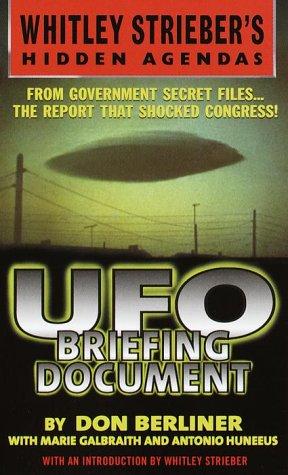
UFO Briefing Document
The Rockefeller-Funded “Best Available Evidence” Compendium Don Berliner Assembled for Congress
Find on Amazon →As an Amazon Associate, OverClassified may earn from qualifying purchases made through this link, at no extra cost to you.
Why This Is Essential Reading
UFO Briefing Document earns its place on this list less for any single revelatory case than for what it demonstrates about how ufology's institutional wing tried, and largely failed, to move the American political establishment in the 1990s — and how the very same document succeeded, almost by accident, in doing exactly that in France. Its genuine strengths are real: a Hynek-adjacent credibility-and-strangeness screening method applied by three of the era's most established research organizations acting jointly, international case material from Antonio Huneeus that broadened its scope well past the usual American Air Force casework, and a documented, verifiable role as the direct model for France's 1999 COMETA Report. Its limitations are equally real and, to Don Berliner's own credit, he has been the first to say so: a closed VIP distribution model that kept the document out of the hands of the very UFO research community it might have most benefited, no meaningful engagement from the U.S. government officials it was actually written for, and a 2007 retrospective in which its own compiler candidly rated its American impact as "very little." Read alongside this site's own The UFO Evidence, Berliner's compendium is the 1990s' version of the same institutional instinct Richard Hall's NICAP pursued three decades earlier — proof that the case-compilation-as-lobbying-document approach can occasionally move history, just not always the government it was addressed to.
Related Cases & Theories
Essential Viewing

The Paracast: August 10, 2014 — Don Berliner
The Official Paracast Channel — A long-form radio interview with Don Berliner discussing his decades of UFO research, including his NICAP and Fund for UFO Research background. Verified via YouTube oEmbed before inclusion.

Antonio Huneeus - UFO Briefing Document: The Best Available Evidence
Exopolitical Archive — Co-author Antonio Huneeus discussing this exact book directly. Verified via YouTube oEmbed before inclusion.
Sources Cited
- Berliner, Don, with Marie Galbraith & Antonio Huneeus. UFO Briefing Document: The Best Available Evidence. Dell Publishing, 2000 (ISBN 9780440236382 / 044023638X, with an introduction by Whitley Strieber, matching this site's own Amaury Rivera and Cash-Landrum case-file citations under this exact edition). amazon.com
- "UFO briefing document: the best available evidence." Internet Archive (bibliographic record: Dell Publishing, 2000, 243–256 pp., ISBN 044023638X/9780440236382, bibliographical references pp. 239–241). archive.org
- "Unidentified Flying Objects Briefing Document [The Best Available Evidence]." Full digitized text of the original 1995 UFO Research Coalition edition, including the December 15, 1995 CUFOS/FUFOR/MUFON endorsement letter, table of contents, and case-selection methodology. Internet Archive. archive.org
- "Rockefeller Briefing Document." Internet Archive (separate scanned collection of the original 1995 report). archive.org
- "UFO Briefing Document: The Best Available Evidence by Don Berliner." Goodreads (reader ratings: 3.69-star average, 49 ratings; publication details for the June 2000 Dell paperback edition). goodreads.com
- "UFO Briefing Document by Don Berliner with Marie Galbraith and Antonio Huneeus, with an introduction by Whitley Strieber." Penguin Random House (publisher listing, Dell imprint, contributor and introduction credits). penguinrandomhouse.com
- "The Rockefeller UFO Briefing Document." Openminds.tv (history of the 1995 document's creation, Marie Galbraith's coordination and French distribution to Jacques Chirac and CNES, the February 1996 White House submission to Dr. John Gibbons, and its direct influence on France's 1999 COMETA Report). openminds.tv
- "COMETA report." Wikipedia (1999 French report on UFOs and defense; independent corroboration of its 1996–1999 formation and 1999 delivery to Prime Minister Lionel Jospin). en.wikipedia.org
- "Fund for UFO Research." Wikipedia (organizational history; Don Berliner's directorship from 1998, succeeding Richard H. Hall (1993–1997) and founding director Bruce Maccabee (1979–1993)). en.wikipedia.org
- "11. Consensus lists: The Rockefeller Briefing Document." IsaacKoi Best UFO Cases project (the document's status as one of ufology's few genuine multi-organization "consensus lists"; Don Berliner's 2007 retrospective quote describing the document's "very little impact" in the United States). web.archive.org
- "Keyhoe Has Not Investigated a UFO Case in Ten Years: 1968 Don Berliner Letter." Expanding Frontiers Research (transcription and context for Berliner's 1968 letter to Julian Hennessey documenting his falling-out with NICAP director Donald Keyhoe). expandingfrontiersresearch.org
- Friedman, Stanton T., & Berliner, Don. Crash at Corona: The U.S. Military Retrieval and Cover-Up of a UFO. Paraview Pocket Books, 1992 (rev. ed. New Page Books, 2010; bibliographic record for Berliner's best-known Roswell-focused book). amazon.com
- "Sturrock Panel." UFO Evidence (background on the September–October 1997 Pocantico Conference Center workshop, funded by Laurance Rockefeller and led by physicist Peter A. Sturrock, cited here for the Briefing Document's place within Rockefeller's broader 1990s UFO-funding initiative). ufoevidence.org
- This site's own case file: The Amaury Rivera Abduction (Case File #023), which cites this exact 2000 Dell edition and ISBN.
- This site's own case file: The Cash-Landrum Incident (Case File #011), which cites this exact 2000 Dell edition and ISBN.
- This site's own case file: The Kapustin Yar UAP Sighting (Case File #107), whose primary English-language source is this book's original 1995 edition.
- This site's own case file: The COMETA Report (Case File #124), the 1999 French report this book's 1995 edition directly inspired.
- This site's own key-figures entry: Don Berliner, for his full biography and the book's role in the Kapustin Yar case connection.
- This site's own essential-reading entry: The UFO Evidence (ER-013), for Richard H. Hall's 1964 NICAP precedent this book's own case-compilation-for-Congress approach extends.
Have corrections, additional research, or peer-reviewed sources? Help improve this entry.
Suggest an Edit