
The Socorro UFO Landing
At about 5:45 PM on April 24, 1964, Socorro police officer Lonnie Zamora broke off a speeding chase south of Socorro, New Mexico, after hearing a roar and seeing a flame in the sky. In a gully below the mesa he saw a white, oval object on legs and, briefly, two figures in white coveralls, "possibly small adults or large kids." The object then rose on a blue-and-orange flame and flew away. State Police Sgt. Sam Chavez arrived within minutes and found burned brush and four depressions in the ground. Army, FBI and Air Force investigators found no aircraft, helicopter or balloon to account for it. Project Blue Book carried the case as "UNIDENTIFIED pending additional data," and its chief, Hector Quintanilla, called it "the best-documented case on record." It has also attracted a lunar-lander test explanation and, since 2009, a disputed claim that New Mexico Tech students staged it.
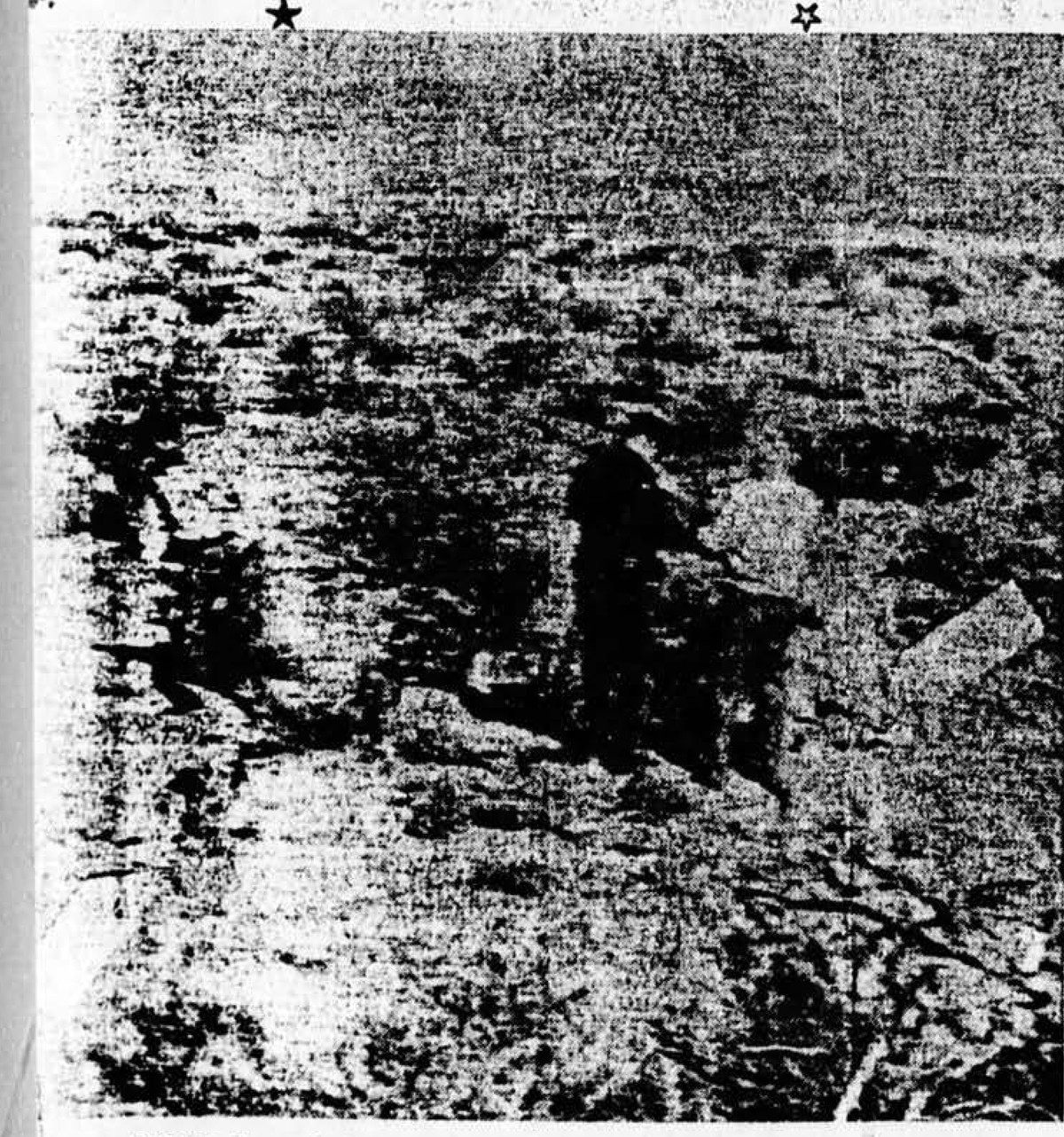
Pictured: New Mexico State Police Sgt. Sam Chavez and El Defensor Chieftain publisher Lewis Reddell examining one of the stone-ringed depressions in the Socorro arroyo, photographed within days of the April 24, 1964 encounter. Officers had circled the four marks with stones. It is a contemporaneous photograph of the physical traces, not a reconstruction. No photograph of the object or the figures exists; Officer Lonnie Zamora was the only person who saw them at close range, and he had no camera.
Theoretical Alignment
These figures describe how the case is usually read. Proponents read Socorro as a landed, piloted craft: an engineered object on legs, two figures beside it, a flame-borne lift-off, and marks left in the ground. That is the strongest physical-trace case of its era. The case has never been resolved, however, and the alternatives are terrestrial rather than psychological. One is a test vehicle from the White Sands area: Blue Book's first working theory was a "lunar module type configuration," and a White Sands range log later turned up a Surveyor-related helicopter test the same day. The other is a hoax, suggested by Socorro's mayor-and-tourism critics and by a 1968 note from the president of New Mexico Tech. Interdimensional readings have little to work with: the object behaved like a physical vehicle, rising on a flame and leaving marks. Purely psychological readings are weak because Zamora is consistently judged sincere and there were physical traces. The real choice is between an unidentified physical object, a misunderstood terrestrial vehicle and a staged event.
Zamora gave investigators an object that looked engineered. It was oval "like a football" and "like aluminum—it was whitish against the mesa background, but not chrome." He saw two legs slanting outward to the ground and a red insignia about two feet across. Before it lifted off he heard two or three loud thumps, "like someone possibly opening or shutting a door hard." The flame and roar suggest a chemical rocket, and Hynek later reasoned from the burn marks that the thrust was too small to lift a large heavy vehicle. That tension, between a rocket-like lift-off and a craft no one could identify, has kept the case open for six decades.
The secret-test reading deserves to be stated fairly. Socorro lies just north of the White Sands Missile Range, which then hosted Apollo escape-system tests (a Little Joe II shot was being prepared that spring) and lunar-landing work. The Air Force canvassed the obvious sources: Quintanilla's 1966 account lists Geiger-counter checks from Kirtland AFB, the Holloman balloon control center, weather-balloon releases, and helicopter activity throughout New Mexico, all negative. Blue Book also wrote to aerospace contractors with lunar landing-gear experience; their replies are in the case file. No contractor or range admitted to a vehicle at Socorro. But the 1995 discovery of a range-log entry for a helicopter-carried Surveyor test on the same day, discussed below, means the test explanation has never been fully closed.
Background
Socorro in 1964 was a small town of a few thousand people on the Rio Grande in central New Mexico, home to the New Mexico Institute of Mining and Technology (New Mexico Tech). To the south and east lay the restricted ranges of White Sands Missile Range, whose Stallion Range Center was close to Socorro, with Holloman AFB further south near Alamogordo. Rocket launches, balloons and military aircraft were part of local life.
On the afternoon of Friday, April 24, 1964, Zamora was patrolling in his police car, a 1964 Pontiac, when he began chasing a speeding car south out of town. In his statement it was a new black Chevrolet about three blocks ahead, heading along Old Rodeo Street (the southward extension of Park Street) toward the rodeo grounds. Then, he said, he "heard a roar and saw a flame in the sky to the southwest some distance away—possibly a 1/2 mile or a mile." Knowing that a dynamite shack stood in that direction, he thought it might have blown up. He let the speeder go and turned onto a gravel road leading up a hill toward the shack.
The flame he described was funnel-shaped, "bluish and sort of orange," narrower at the top, and he saw no smoke. Its base was hidden behind a hill. The road was steep and covered in loose gravel; as Quintanilla summarised it, Zamora "had to try three times before he made it" to the top. The Air Force's own summary has him chasing the car "north on US 85," which conflicts with his statement; most accounts follow the statement.
His decision to leave the chase is the first detail that later analysts weigh. On one reading it shows an officer reacting to a possible explosion with no expectation of anything unusual. Critics of the case point out that it also means Zamora's movements were not predictable, which is a difficulty for any staged hoax. Hynek, examining the hoax idea in 1964, found that Zamora had "no particular schedule for patrolling the town."
Complete Timeline
| Date | Event |
|---|---|
| April 24, 1964, about 5:45 PM | The chase. Zamora chases a speeding black Chevrolet south out of Socorro, hears a roar and sees a flame to the southwest, and leaves the chase to check the dynamite shack. |
| Minutes later | The object. At his third attempt he gets his car up the gravel hill. He sees a shiny object about 150 to 200 yards away in the gully, which he first takes for an overturned car, and two figures in white coveralls. He radios the sheriff's office: "10-44 (accident) ... checking a wreck down in the arroyo." |
| Moments later | Lift-off. As he approaches on foot he hears two or three thumps, then a roar; a blue and orange flame appears under the object, which rises. Zamora runs, loses his glasses and ducks below the hill. The object flies off low, clearing the dynamite shack. |
| Shortly after | Help arrives. Zamora radios dispatcher Nep Lopez and asks for State Police Sgt. Sam Chavez. Chavez arrives with State Policeman Ted Jordan and Undersheriff James Luckie, and they find burned brush and four depressions. |
| April 24–25, 1964 | Army and FBI. Army Capt. Richard T. Holder, up-range commander of the White Sands Stallion Range Center, and FBI agent D. Arthur Byrnes Jr. take Zamora's statement and measure the site with Socorro officers. |
| April 25–26, 1964 | Sightseers and Geiger counters. By Sunday afternoon hundreds of curious people have trampled the scene. Kirtland AFB personnel check the site for radiation and find none above normal. |
| April 28, 1964 | Hynek arrives. Project Blue Book consultant J. Allen Hynek visits, interviews Zamora and Chavez, and concludes that Zamora "saw a tangible, physical object." He returns for a follow-up in August 1964. |
| April 29, 1964 | Iowa witnesses. The Dubuque Telegraph-Herald reports that two Dubuque men, Paul Kies and Larry Kratzer, saw something near Socorro that afternoon. |
| May–June 1964 | Lunar-lander inquiries. Blue Book writes to aerospace firms about lunar landing-gear projects; contractors refer the inquiry onward, and none places a vehicle at Socorro. |
| 1964–1969 | Blue Book verdict. "Case carried as UNIDENTIFIED pending additional data." |
| Fall 1966 | Quintanilla's article. In the CIA journal Studies in Intelligence, Blue Book chief Hector Quintanilla calls Socorro "the best-documented case on record," unsolved despite a thorough investigation. |
| 1968 | The Colgate note. On a letter from Linus Pauling asking about Socorro, New Mexico Tech president Stirling Colgate writes: "I have a good indication of the student who engineered the hoax. Student has left." The note is publicised in 2009. |
| 1974–1976 | Rival books. Philip J. Klass (UFOs Explained, 1974) argues for a hoax to promote tourism. Ray Stanford (Socorro "Saucer" in a Pentagon Pantry, 1976) argues for a genuine craft. |
| 1995–2001 | The Surveyor lead. Balloon specialist Bernard "Duke" Gildenberg learns that a White Sands range log records special tests with a helicopter carrying a lunar Surveyor on April 24, 1964. Dave Thomas discusses it in Skeptical Inquirer (2001). |
| November 2, 2009 | Zamora dies in Socorro, aged 76. |
The Encounter
As Lonnie Zamora drove slowly west along the rough gravel road atop the mesa, looking for the dynamite shack he thought had blown up, he suddenly noticed a shiny object to the south, off the road at a distance he estimated at about 150 to 200 yards. At first glance he took it for a car turned upside down and thought some kids might have turned it over. He saw what appeared to be two legs of some type from the object to the ground, but, still thinking it was an accident, paid them little attention. Zamora also saw two figures in white coveralls very close to the object; the Blue Book case notes describe them as "small adults or large kids." One of them, he said, seemed to turn and look straight at his car and seemed startled, moving quickly. He had stopped for only a couple of seconds, and according to the Air Force summary this was the only time he saw the figures.
Zamora, still believing he was responding to an accident, drove on and stopped at a clearing just before the ground descends into the arroyo. The Air Force summary puts that stop about 150 feet from the gully; Hynek wrote that at the closest Zamora was "almost as little as 100 feet" from the object. As he got out of the car, knocking the radio microphone down, he heard "two or three loud 'thumps,' like someone possibly opening or shutting a door hard," a second or less apart. He had started toward the object when a roar began. In his statement he said it was not like a jet: it started at a low frequency, then rose in frequency and in loudness, "from loud to very loud." At the same time he saw flame under the object, light blue and sort of orange at the bottom, and the object began to rise slowly, straight up. He noted no smoke, only dust in the immediate area.
Thinking from the roar that the object might blow up, Zamora turned and ran. He bumped his leg on the back fender area of his car, his glasses fell off, and he kept running north with the car between himself and the object. Glancing back, he saw it rise to about the level of the car, which he guessed at 20 to 25 feet, apparently directly over the place it had risen from. About fifty feet from the car he ducked down just over the edge of the hill and lay on the ground, covering his face with his arms while the roar continued. When the roar stopped he heard a sharp-toned whine, falling from high to low, that lasted maybe a second. Zamora described the object as smooth, with no windows or doors, and like aluminum, "whitish against the mesa background, but not chrome." On its side he noted red lettering or an insignia of some type; his sketch shows an arc over a horizontal line, with a vertical arrow pointing upward from the line to the arc.
"It seemed to just clear the Box Canyon... It disappeared as it went over the mountain. It had no flame whatsoever as it was traveling over the ground, and no smoke or noise." — Officer Lonnie Zamora, statement in the Project Blue Book case file, April 1964
When Zamora raised his head, the object was going away from him. It did not come any closer; it appeared to travel in a straight line at the same height, possibly 10 to 15 feet off the ground, and to clear the dynamite shack, about eight feet high, by about three feet. The record does not agree on its direction. Zamora's statement, as typed into the case file, has it going away to the southwest, the Air Force summary says it "flew off in a southerly direction following the contour of the gully," and Hynek wrote that "the object went west." Zamora said it seemed to rise up and take off immediately, growing small in the distance very fast. He ran back to his car, keeping an eye on the object, picked up his glasses (leaving his sunglasses on the ground), and radioed Nep Lopez, the radio operator at the police station, asking him to look out the window to see if he could see an object. Zamora did not know whether Lopez saw it, and noted that Lopez's window faced north. He then gave directions to Lopez and to Sergeant Chavez of the State Police to get to the scene.
Zamora did not see what produced the flame. He wrote that it might have come from the underside of the object, at the middle, possibly a four-foot area, but called this a "very rough guess" and said he could not describe the flame further except as blue and orange. When Hynek interviewed him days later, he noted that Zamora no longer described the pitch of the roar in as much detail as he had for Captain Holder. Hynek took Zamora's flight, in which he lost his glasses and did not stop to retrieve them, as "an indication of the state of panic he was in."
The Insignia Mystery
The red marking Zamora saw on the object is one of the most debated details of the case. The Blue Book file records it as red and about 2 feet wide by 2½ feet high, on an object Zamora estimated at 12 to 15 feet long. The sketch in the file shows an arc over a horizontal line, with a vertical arrow running up from the line to the arc. That version has been reproduced in most accounts since 1964.
Later writers say the symbol was handled with deliberate secrecy. Ray Stanford, who investigated the case from 1964 and published Socorro "Saucer" in a Pentagon Pantry in 1976, and later writers have said that Zamora was asked not to describe the marking publicly, so that it could be used to screen out copycat reports. Versions that differ from the file sketch, often described as an inverted "V" with bars, have circulated as the "real" one. Other investigators report early comments by Zamora that he had been told not to discuss the marking, and different versions circulated in the press. A Dubuque witness, Larry Kratzer, later described "a red Z" marking near one end of the object he saw. The documentary record does not settle which drawing, if either, is the more faithful one.
Earlier versions of this page said that Project Blue Book under Hector Quintanilla deliberately published a false "circle with a diagonal line" symbol, that Zamora later confirmed the arc-and-arrow version, that the true symbol was released only under FOIA, and that "a thorough review of all military project logos and contractor emblems in 1964" found no match. None of these claims has been traced to a source, and they have been removed. The file does show inquiries about markings: the Federal Aviation Agency, for example, replied that it knew of no country using symbols as aircraft registration marks.
Key Witnesses
Lonnie Zamora
The only witness to the landed object and the figures. Zamora gave statements to Army Capt. Holder and FBI agent Byrnes, and later to Hynek. Each found him sincere. Hynek concluded that he "saw a tangible, physical object, under good daylight illumination, and from fairly close range." Quintanilla described him in 1966 as "a serious police officer, a pillar of his church, and a man well versed in recognizing airborne vehicles in his area." The publicity was hard on him, and he largely avoided interviews in later life. He died in Socorro on November 2, 2009, aged 76. Earlier versions of this page said he had "never changed his account" and later worked at a service station; neither claim has been verified, and both have been removed.
Sergeant Samuel Chavez
The first officer to reach Zamora after his radio call, arriving with State Policeman Ted Jordan and Undersheriff James Luckie. Zamora recalled that Chavez told him he was "white, very pale." Chavez went down with him to the burned brush, and it was Chavez who pointed out the tracks. Accounts differ on the state of the brush. Chavez and Luckie told the press that burned clumps of grass and greasewood were still hot, but the Air Force summary records that “the brush was cold to the touch.” Chavez told Hynek that Zamora had never described the object as looking like a balloon. Hynek considered the hoax hypothesis and noted that it would have to involve Chavez himself.
Opal Grinder
Manager of the Whiting Brothers service station on U.S. 85 north of Socorro. According to the El Defensor Chieftain, an unidentified tourist traveling north stopped at the station and remarked that aircraft flew low around there. When Grinder replied that there were many helicopters in the area, the man said it was a funny-looking helicopter that had flown over his car, and that he had seen a police car heading up the hill. Interviewed by the Air Force, Grinder could add little: he did not remember the car or its licence plate, the man was alone, and he seemed to be on vacation. Earlier versions of this page described a "couple from Colorado"; the file describes a single, unidentified man. Klass later argued that the tourist could not have seen both the craft and the police car as described.
Paul Kies & Larry Kratzer
Two Dubuque men who were driving near Socorro that afternoon. The Dubuque Telegraph-Herald reported their sighting on page one on April 29, 1964. In statements sent to Hynek in 1968, Kratzer described a round, silvery object rising from smoke, with what looked like portholes and a red "Z" marking, which he thought might be an experimental vertical-lift aircraft. Kies saw only a shiny spot and the smoke. Their accounts are independent of Zamora's, but the detailed descriptions were written four years later. Earlier versions of this page called them local residents named "Paul Kies & Larry Gipson" working near the cemetery; the name and the setting were wrong.
The Five Observables Assessment
The performance characteristics described at Socorro are analyzed here using the Five Observables framework popularised by former AATIP director Luis Elizondo:
Assessment: The lift-off Zamora described was accompanied by a roar and a flame, which suggests reaction propulsion rather than "anti-gravity," so Anti-Gravity Lift is rated speculative. He then described the object moving away silently, low over the ground, "with no flame whatsoever ... and no smoke or noise," which is the anomalous part. Instant Acceleration is also speculative. Zamora said the object "seemed to rise up and take off immediately" and grew small "very fast," but he was lying on the ground without his glasses for part of the time, and no speed or distance was measured. Hypersonic velocity, low observability and trans-medium travel were not reported. Earlier versions of this page scored lift and acceleration as "Present" and described silent hovering, "field propulsion" and g-forces beyond human tolerance. Those were inferences, not observations, and they have been removed.
The sequence Zamora reported is worth stating precisely, because later retellings compress it. There was a roar with flame as the object rose to roughly car height. The roar stopped and he heard a brief whine. Then he saw silent, level flight away, low over the gully. A conventional rocket-powered vehicle could explain the first phase but not obviously the last. A helicopter would explain the low flight but not the flame or the absence of rotor noise. That mismatch is the core of the puzzle, more than any claim about performance beyond 1964 technology.
Evidence Assessment
Supporting Anomalous Origin
- A police witness judged sincere by every investigator who met him (Holder, Byrnes, Hynek, Quintanilla), with no apparent motive and a clear emotional reaction noted by Chavez.
- Physical traces found within minutes: four depressions and burned brush, later documented by Army, FBI and Air Force investigators.
- An Air Force search that found no helicopters, aircraft, balloons or radar targets to account for the object, and no contractor or range that would admit to a vehicle at Socorro.
- Laboratory analysis found no foreign material or radiation above normal in the soil, and no propellant chemicals in the burned brush, so the traces were not those of a known rocket.
- Peripheral reports: a tourist who told Opal Grinder of a low-flying "funny-looking helicopter," and the Dubuque visitors Kies and Kratzer.
- Blue Book carried the case as "UNIDENTIFIED," and Quintanilla called it "the best-documented case on record."
- Hynek considered the hoax hypothesis in 1964 and found no one locally who gave it credence; "no paraphernalia of a hoax were ever found."
Supporting Conventional Origin
- The roar and the blue-orange flame point to a chemical rocket, and Blue Book's first working idea was "a lunar module type configuration."
- According to a White Sands range log found in 1995, special tests involving a helicopter carrying a lunar Surveyor took place at the north end of the range on April 24, 1964 (the log calls for morning tests).
- In 1968 the president of New Mexico Tech, Stirling Colgate, wrote that he had "a good indication of the student who engineered the hoax." In 2009 he told Anthony Bragalia by email that he still considered it a hoax.
- Only Zamora saw the object on the ground; the Air Force summary records that "no other witnesses to the object ... could be located."
- The site was trampled by hundreds of sightseers by the Sunday, limiting what later inspection could show; Hynek found charred particles and "some charred cardboard" in the soil.
- The Air Force summary records the brush as "cold to the touch" when Chavez arrived, which conflicts with press accounts of smouldering brush.
Why "CREDIBLE" / Blue Book "Unknown" Rating
Socorro is rated CREDIBLE because the core of the report is unusually well anchored for a single-witness case. Zamora was a sober, serious police officer whom every investigator believed. He radioed in at once, a State Police sergeant reached him within minutes, and there were fresh physical traces. The Army, the FBI and the Air Force all investigated within days. Project Blue Book, whose institutional bias ran toward explanation, could not find one: "Case carried as UNIDENTIFIED pending additional data." In his 1966 article for the CIA's Studies in Intelligence, Blue Book chief Hector Quintanilla wrote: "There is no doubt that Lonnie Zamora saw an object which left quite an impression on him. There is also no question about Zamora's reliability. He is a serious police officer, a pillar of his church, and a man well versed in recognizing airborne vehicles in his area. He is puzzled by what he saw, and frankly, so are we. This is the best-documented case on record, and still we have been unable, in spite of thorough investigation, to find the vehicle or other stimulus that scared Zamora to the point of panic."
The rating does not mean the object was proven anomalous. Socorro rests on one witness's observation of the object. In his later memoir, Quintanilla added that he had "always had some doubt about this case, even though it is the best documented case on record." Two conventional explanations were never closed: a test vehicle connected with White Sands, and a hoax. In 1968 the president of the local college wrote that he had a good indication of the student responsible, though no one has ever been named and no hoax apparatus was ever found. Earlier versions of this section described an "unprecedented" interagency response “within hours,” claimed that Hynek "calculated the weight and flight dynamics of the craft," and said Socorro was "the definitive example" of Hynek's CE2 category. These overstated the record and have been revised.
Hynek's own view was careful. In his 1964 report he concluded that Zamora "saw a tangible, physical object, under good daylight illumination, and from fairly close range," and that it was "essential that we discover what" it was. He studied the burn marks and the pod-like depressions, and he reasoned from the burns that the thrust was insufficient to lift a large vehicle. The case contributed to his growing view that some reports deserved serious scientific attention. He was not, however, an investigator who had proven a non-human craft.
Sensor & Instrumentation Detection Profile
No instrument recorded the object. The Air Force inquiry found that "observers at radar installations had observed no unusual or unidentified blips." The only measurements are of the site: the depressions and burn areas measured by Holder, Byrnes and the Socorro officers, the Geiger-counter checks by Kirtland AFB personnel on April 26, and the later laboratory analyses of soil and brush. Earlier versions of this page said that telephone lines reported static during the sighting, that the military's radar logs were "highly classified," that "the official explanation that 'no radar contact was made' likely reflects the classified nature of military tracking," and that declassified documents showed military command "deeply concerned" about an airspace intrusion. None of this is sourced, and it has been removed.
Some peripheral observations were logged. Holder's report mentions about three telephone reports of a blue light in the area at similar times. A tourist told Opal Grinder about a low-flying object, and the Dubuque visitors described a flame and smoke and, in Kratzer's case, an object. In the days that followed, the press carried a wave of other New Mexico reports. They included an egg-shaped object at La Madera on April 26 and lights over the hills southwest of Socorro, reported to Officer Bill Pyland. Those reports show how quickly the story spread, but none is independent instrumental confirmation.
Zamora's own observation is the primary record. It was made in daylight, at an estimated 150 to 200 yards and then at around 100 to 150 feet, and lasted a short time, from first sight of the object to its departure over the hill. He lost his glasses as he ran, and for much of the departure he was lying on the ground covering his face. Those conditions do not undermine his sincerity, but they limit how much fine detail, such as the insignia, the figures and the speed, can bear.
Environmental & Geospatial Context
The site is a gully (arroyo) on the southern outskirts of Socorro, about a mile south of town, below a mesa reached by a gravel road that ran past a dynamite shack. Hynek noted that the shack is "plainly visible from the site of the sighting, but about 500 feet to the west." The ground is sandy and gravelly, with creosote (greasewood), mesquite and grass. The object "had landed astride a narrow, rock-strewn dry wash in the gully," and officers circled the four marks with stones. The Air Force summary describes the weather as "windy but clear," with "no unusual meteorological activity; no thunderstorms." The wire-service file on Socorro notes that an Apollo Little Joe II launch at White Sands that spring was postponed by "gusty winds and a sandstorm," a reminder of how windy the region can be. Earlier versions of this page gave a temperature of about 70°F and south-west gusts of 25–30 mph; no source for those figures has been found.
Two features of the setting matter to the explanations. First, Socorro sat beside the Stallion Range Center of White Sands Missile Range. The Army officer called in, Capt. Holder, was its up-range commander, and helicopter and test activity on the range was routine. Second, the site was close to town and to New Mexico Tech, a campus with expertise in explosives. Hoax theorists have pointed to that, and the Colgate note makes the point directly. Earlier versions of this page described the creosote as charred "only on the sides facing the center of the landing pattern," which "allowed investigators to map the exact pattern of the exhaust blast." That analysis has not been traced. The file records four burned areas, three of them inside the pattern of depressions, and Hynek found the area too badly trampled by the time he saw it to assess the burns.
The landing site was later developed for visitors. In 1966 the president of the Socorro County Chamber of Commerce proposed promoting it, and walkways and benches were built about a quarter mile from the actual site. A commemorative mural followed in 2012. Klass treated the tourism angle as a motive for a hoax, and others treat it simply as local pride.
Observer Credibility & Occupational Profile
Lonnie Zamora was a Socorro police officer whom his colleagues and the investigators regarded as sober, industrious and not given to fantasy. Quintanilla called him "a pillar of his church." An FBI report described him as a sober, credible officer, and Hynek found him and Chavez "devoted to duty and ... basically simple and honest." His radio call shows that he first thought he was dealing with an accident: "10-44 (accident) ... checking a wreck down in the arroyo." He reached for ordinary comparisons throughout, describing an overturned car, kids, and a "funny" object. When Lopez asked for a description, he said "it looks like a balloon," although Chavez later told Hynek that Zamora never described the thing to him that way.
His reaction is well attested. He ran, lost his glasses, and lay down covering his face. Chavez found him pale and shaken. Hynek noted his panic, and also that his description of the roar was less detailed by the time of the Air Force interview than it had been for Holder. That is the ordinary decay of memory that investigators of a single-witness case have to allow for. Earlier versions of this page called Zamora a "deputy sheriff" with a "spotless five-year record," said he had no interest in astronomy or science fiction, and said he was "accused of being drunk," "refused to speak to reporters for the rest of his life" and became a mechanic. None of these details has been traced, and they have been removed.
Chavez and the other officers were witnesses to the traces, not to the object. The value of their testimony lies in its timing: the marks and burns were found within minutes, before anyone else could have reached the gully. That is the strongest argument against a hoax by Zamora himself. It does not exclude a hoax by others carried out before he arrived.
Physical & Material Assays
The physical evidence was documented by the Socorro officers and the State Police on the day, by Capt. Holder and FBI agent Byrnes that night and the next day, by Kirtland AFB personnel with Geiger counters on April 26, and by Hynek from April 28. By Sunday afternoon, April 26, "hundreds of curious persons had trampled the scene," according to the local press.
- Depressions: Four squarish depressions in a roughly trapezoidal pattern, astride a small dry wash. Accounts of their size vary: about a foot long by six inches wide in one press account, 12 by 6 inches in an Air Force summary, and 14 by 5 inches in another report. The FBI described each as made by an object entering the earth at an angle and pushing soil to the far side. Earlier versions of this page gave depths of 3–4 inches, a 12 by 14 foot layout and a calculated weight of 8,000–15,000 pounds attributed to "civil engineers and military investigators." None of these figures has been traced to a source, and they have been removed.
- Burned brush: Four burned areas, three inside the pattern of depressions. Chavez and Undersheriff Luckie told the press the burned grass and greasewood were still hot, though the Air Force summary says the brush was "cold to the touch." Laboratory analysis of the burned brush "showed no chemicals which would indicate a type of propellant" (Air Force).
- Soil: Laboratory analysis of soil samples "disclosed no foreign material or radiation above normal for the surrounding area" (Air Force). Hynek found a fair amount of charred particles in the dirt and "some charred cardboard." James McDonald later reported, at second hand, that a radiological chemist had said she found melted and resolidified sand under the landing area and unidentified organic material in plant fluids, and that Air Force personnel took her notes. Her analysis has never been published.
- Radiation: Kirtland AFB personnel checked the landing area with Geiger counters on April 26 and found no radiation present. Earlier versions of this page attributed the radiation survey to Capt. Holder and claimed later confirmation "by the New Mexico State Police and Project Blue Book."
- Small circular marks: The Air Force file labels several small, shallow, circular marks as "footprints." Press reports described round tracks about four inches across and said officers estimated, from the depressions, beings of about 120–160 pounds.
Earlier versions of this page also reported clay minerals whose crystalline structure had "partially collapsed" under heat, soil "baked into a hardened, crust-like state," and a later study finding fused silica and calcium carbonate in the depressions. No source for any of these findings has been found, and they have been removed.
Historical Precedents & Archive Matches
Socorro came at the start of a spring 1964 flurry of New Mexico reports. In the following days the press carried an egg-shaped object at La Madera, north of Santa Fe, where State Police found scorched ground. There were also lights over the hills near Socorro and an Albuquerque girl treated for eye burns after watching an "egg-shaped" object. Most were never confirmed. Socorro is often compared with later landing cases. At Valensole, France, in July 1965, farmer Maurice Masse described an egg-shaped craft on legs and two small beings in his lavender field. At Falcon Lake, Manitoba, in May 1967, Stefan Michalak was burned by exhaust from an object that had landed. The parallels (an oval craft, legs or supports, ground traces, small occupants) are real, but each case rests largely on a single witness.
The 1954 French wave had produced many reports of landed craft on legs, and by 1964 that imagery was well established in the UFO literature. That cuts both ways. It may show a consistent phenomenon, or it may show a consistent cultural template that a witness or a hoaxer could draw on. Masse's case also illustrates how later details accumulate. He described an object on six thin legs and a central pivot, and said the ground where it had stood stayed barren afterwards, claims which, as at Socorro, depend on one witness and later inspection. At Falcon Lake, Michalak's burns were medically documented and radioactivity was later reported at the site, a different kind of trace from Socorro's.
Earlier versions of this page said that visual and radar contacts were logged at Holloman AFB three weeks before Zamora's sighting, involving "an unidentified target performing rapid altitude changes," and that the recurring trace markers across these cases "provide strong evidence" of a single technological phenomenon. The Holloman contacts could not be traced. The conclusion went further than the evidence allows, and both have been removed.
Material Analysis
The Physical & Material Assays above document what the event did to its environment: depressions, burned brush and charred particles. A separate question is what, if anything, the object itself left behind in the way of recoverable material, such as metal, paint or manufactured debris. On that count Socorro is unlike crash-retrieval cases such as Roswell: no fragment of the object has ever been recovered, examined or catalogued by any investigating agency.
The Absence of Craft-Derived Material
Every physical assay at the arroyo examined the ground and vegetation, not the object. No paint chip, metal fragment or manufactured component was recovered. Hynek's "charred cardboard" is the only manufactured material mentioned, and its relevance is unknown. This is consistent with an object that left intact under its own power, as Zamora described, rather than one that crashed. It also means the material record is entirely indirect.
The Insignia Question
Zamora's red marking exists only as a witness sketch, drawn under stress and later surrounded by claims of a withheld "true" version. No physical sample of any marking was ever obtained. Inquiries in the Blue Book file, such as one to the Federal Aviation Agency about registration symbols, were documentary comparisons, not laboratory ones.
Sample Custody and the Limits of 1964-Era Testing
The soil and brush samples were analyzed with 1964 techniques, adequate to detect gross radioactivity and common propellant chemicals but not the trace-element or isotopic methods available today. Whether any of the original samples survive is not established in the public record. The radiological chemist's notes that McDonald mentioned have never surfaced. So the case's physical evidence, while unusually well documented for its era, cannot now be re-tested.
Supporting an Anomalous Physical Event
- Depressions and burns were found within minutes of the sighting and documented by several agencies within days
- No propellant chemicals in the burned brush and no foreign material or abnormal radiation in the soil, according to the Air Force
- No known vehicle was placed at the site, despite inquiries to the ranges, bases and lunar-lander contractors
Supporting a Terrestrial or Staged Origin
- No fragment, paint or manufactured material from the object itself was recovered; charred cardboard was found in the soil
- The insignia exists only as a sketch, and accounts of it conflict
- The site was trampled by sightseers within two days, and the burned-brush evidence is recorded inconsistently (hot in press accounts, cold in the Air Force summary)
- 1964 methods could not perform the trace analysis that might have identified an industrial or pyrotechnic source
Conventional Explanation Candidates (CEC)
Several conventional explanations have been proposed for the Socorro landing, attributing the object and the traces to a terrestrial source. The main candidates are evaluated below.
Lunar Surveyor / Lander Test from White Sands
InconclusiveBlue Book's own first thought, recorded on its summary card, was a "lunar module type configuration." In May and June 1964 Quintanilla's office wrote to aerospace firms with lunar landing-gear experience, and the replies in the file referred him onward; none placed a vehicle at Socorro. In 1995 balloon specialist Bernard "Duke" Gildenberg learned from Capt. James McAndrew that a White Sands range log recorded special tests involving a helicopter carrying a lunar Surveyor at the north end of the range on April 24, 1964. Dave Thomas set out the case in Skeptical Inquirer in 2001. A helicopter would account for the low, silent departure and perhaps the figures, the Surveyor's slanted legs for the marks, and its vernier engines for the flame. Against: the log calls for morning tests, not late afternoon; the Surveyor had three legs, not four; no helicopter was heard; and the Air Force reported checking helicopter activity throughout New Mexico without result. Earlier versions of this page rated this "Implausible," on the grounds that "White Sands military command formally reviewed all flight logs for April 24, 1964, and confirmed that no Surveyor tests ... occurred." That statement is contradicted by the range-log entry, and the rating has been changed.
Student Hoax (New Mexico Tech)
InconclusiveThe hoax idea was considered from the start. In 1964 Hynek asked around Socorro and found that "none of the people I talked with gave any credence to the hoax hypothesis," judging it beyond the hoaxers' capabilities and motives. He noted that "no paraphernalia of a hoax were ever found" and that Zamora kept no fixed patrol schedule. The idea revived in September 2009, when researcher Anthony Bragalia published a 1968 letter from Linus Pauling to New Mexico Tech president Stirling Colgate asking about Socorro. On it Colgate had written: "I have a good indication of the student who engineered the hoax. Student has left." Asked by Bragalia in 2009, Colgate replied that he still considered it a hoax and that a friend "and other students did not want their cover blown." Skeptic Robert Sheaffer has favored a student hoax. Against: no student has been named, no apparatus was found, and Colgate later could not recall details when Dave Thomas asked him. Kevin Randle calls the note ambiguous and the email cryptic. A hoax would also have had to produce a flame, a roar and an object that flew away, in daylight beside a road, in front of a police officer whose route was not predictable. Earlier versions of this page rated a hoax "Implausible," saying the depressions required "several thousand pounds" and that "Project Blue Book and local police investigated this theory thoroughly." Neither claim is supported by the record.
Hoax for Tourism (Klass)
ImplausibleIn UFOs Explained (1974), Philip J. Klass argued that the landing was staged to promote Socorro, pointing to the town's later development of the site for visitors and arguing that the unidentified tourist could not have seen both the craft and the police car. In 1966 the Chamber of Commerce did propose developing the site, and walkways were later built nearby. Against: no evidence links town officials to staging anything. The tourism came after the publicity rather than before it. And the theory requires Zamora's participation, which every investigator who met him rejected. Earlier versions of this page described a "Secret Hughes Tool Company helicopter test" proposed by "some aviation historians." No source for that theory has been found, and it has been replaced here by the hoax theory Klass actually proposed.
Balloon, Mirage or Other Natural Cause
ImplausibleSeveral low-energy explanations have been offered. Larry Robinson of Indiana University suggested a manned hot-air balloon. Steuart Campbell proposed that the sighting was "almost certainly" a mirage of the star Canopus. Colgate is also quoted as summing up the hoax as "a candle in a balloon." A balloon would explain the "it looks like a balloon" remark to dispatcher Lopez. Against: Hynek calculated in 1964 that a balloon released at the time "would have gone directly over town," and would have had to be released after Zamora arrived. A star cannot produce a roar, burned brush or depressions in the ground. The Air Force checked the Holloman balloon control center and all weather-balloon releases without result. Earlier versions of this page said the Air Force and FBI "quickly dismissed" atmospheric explanations as "completely inadequate" and "confirm[ed] that the object was a solid, heavy, structured vehicle." No such official finding exists, and that wording has been removed.
Related Cases
Confirmed Documents & Official Records
The Air Force case file: Zamora's statement and sketch, Capt. Holder's report, the Hynek reports, press clippings, the lunar-module inquiries to contractors, the Air Force press summary ("no foreign material or radiation above normal"; "no chemicals which would indicate a type of propellant") and the status card, "Case carried as UNIDENTIFIED pending additional data." The Blue Book records are held at NARA (Record Group 341, microfilm T-1206).
UNCLASSIFIED (declassified)Blue Book chief Hector Quintanilla's account of the Socorro investigation, with the "Diagnosis: Unsolved" and "best-documented case on record" passages and the list of checks made: Geiger counters from Kirtland AFB, the Holloman balloon center, weather-balloon releases and helicopter activity.
UNCLASSIFIED (declassified)FBI documents on the case, including agent D. Arthur Byrnes Jr.'s involvement and a report describing Zamora as a sober, credible officer. The FBI described the depressions as made by an object entering the ground at an angle.
UNCLASSIFIED (declassified)Search Government Archives Directly
Further Reading — Recommended Literature
The UFO Experience: A Scientific Inquiry
Astronomer Hynek's seminal scientific work, by the Blue Book consultant who visited Socorro twice in 1964 and interviewed Lonnie Zamora.
Project Blue Book
A compilation of Project Blue Book material, including the Air Force's account, Zamora's account and Hynek's reports on the Socorro landing.
The Hynek UFO Report
Hynek's review of Blue Book's successes and failures, by the investigator whose 1964 Socorro reports are in the Air Force file.
UFO Exist!
A comprehensive historical survey of the UAP phenomenon, discussing Socorro among its many cases, though this site could not confirm the case receives a dedicated standalone chapter.
DISCLOSURE: Some links above are affiliate links. If you purchase through them, OverClassified receives a small commission at no additional cost to you. This helps support independent research.
Essential Viewing
FBI Documents on the Lonnie Zamora Case
Inside The Black Vault's John Greenewald Jr. reviews FBI files released on the Socorro landing, including a May 1964 report describing Zamora as a sober, credible officer "not given to fantasy."
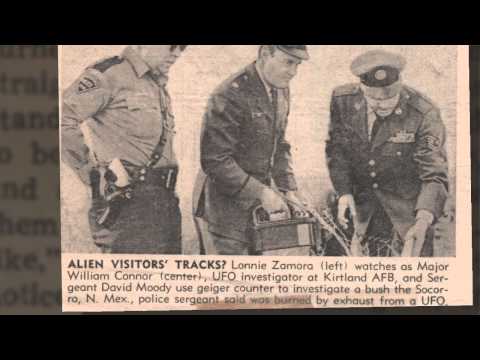
April 1964, Socorro New Mexico UFO Encounter with Police Officer
Documentary filmmaker James Fox, director of "The Phenomenon," draws on his National Archives research into the Socorro case to examine Lonnie Zamora's encounter with the landed craft.
Lonnie Zamora UFO Incident (Socorro, New Mexico; Aliens?)
Jimmy Akin's Mysterious World breaks down the Socorro sighting, weighing Zamora's testimony and the physical landing traces against the conventional explanations offered at the time.
Sources
- [1] Project Blue Book Case File, "Socorro, New Mexico – April 24, 1964" (Zamora's statement and sketch; Holder's report; Hynek's reports; Air Force press summary; status card). archive.org
- [2] Quintanilla, Hector. "The Investigation of UFO's." Studies in Intelligence 10(4), Fall 1966, pp. 95–110. cia.gov
- [3] Quintanilla, Hector. UFOs: An Air Force Dilemma (unpublished memoir, 1975; released by NIDS). patrickgross.org (PDF)
- [4] Hynek, J. Allen. Socorro investigation files (CUFOS). cufos.org
- [5] FBI files on the Socorro landing, 1964 (D. Arthur Byrnes Jr.). theblackvault.com
- [6] Holder, Capt. Richard T. Report on the Socorro sighting, White Sands Missile Range (Stallion Range Center), April 1964 (in the Blue Book file).
- [7] El Defensor Chieftain (Socorro), April 1964 (Opal Grinder and the tourist), as reproduced in the Blue Book file.
- [8] Telegraph-Herald (Dubuque, Iowa), April 29, 1964, p. 1 (Kies and Kratzer); Kies and Kratzer statements to Hynek, 1968 (in the Blue Book file).
- [9] Gross, Patrick. "Socorro, New Mexico, April 24, 1964" (case summary drawing on the Blue Book, FBI and Hynek files and McDonald). patrickgross.org
- [10] Hynek, J. Allen. The UFO Experience: A Scientific Inquiry. Henry Regnery Company, 1972.
- [11] Steiger, Brad. Project Blue Book: The Top Secret UFO Files. Ballantine Books, 1976.
- [12] Stanford, Ray. Socorro "Saucer" in a Pentagon Pantry. Blueapple Books, 1976.
- [13] Klass, Philip J. UFOs Explained. Random House, 1974.
- [14] Thomas, David E. "A Different Angle on the Socorro UFO of 1964." Skeptical Inquirer, July 2001; revised at NMSR. nmsr.org
- [15] Bragalia, Anthony. "The Socorro UFO Hoax Exposed" (September 2009), with the Pauling–Colgate letter and Colgate's 2009 email replies. ufoexplorations.com
- [16] Randle, Kevin D. "Lonnie Zamora, Socorro UFO, and New Theories," A Different Perspective, October 2009. kevinrandle.blogspot.com; and Encounter in the Desert, New Page Books, 2017.
- [17] Angiola, Tony & Moss, Ben. Socorro UFO! Not Of This World. AP Publishing, 2025.
- [18] Flammonde, Paris. UFO Exist!. G.P. Putnam's Sons, 1976.
- [19] "Lonnie Zamora incident." Wikipedia (used as a pointer only: Campbell, Robinson, Colgate "candle in a balloon," site development, date of death).
Corrections (October 2026)
This page was checked against the Project Blue Book case file, Quintanilla's 1966 article and memoir, and the published hoax and Surveyor research in October 2026. Removed as untraceable or contradicted by the file: the witness "Mitchel Woods"; "Larry Gipson" (the second Dubuque man was Larry Kratzer, and the pair were visitors from Iowa, not local residents); the "couple from Colorado" at Opal Grinder's station (a single unidentified man); Blue Book's supposed publication of a decoy "circle with a diagonal line" insignia; a weight estimate of 8,000–15,000 lb; depression depths and layout figures; clay "crystalline collapse," "vitrification" and fused-silica findings; directional scorching "mapping" the exhaust; telephone-line static; Holloman radar contacts three weeks earlier; the claim that White Sands confirmed no Surveyor tests (a range log records one); a "Hughes Tool Company helicopter" theory; Hynek's weight calculations and a "simple man" quotation; Zamora as a "deputy sheriff" with a "spotless five-year record"; and fabricated sources (a Battelle soil report by "Dr. Richard Deforge," a "Case #029" investigation log, and witness statements "logged" by police). Corrected: the radiation survey (Kirtland AFB, April 26, not Capt. Holder); the timeline; Quintanilla's quotation (now given verbatim from the 1966 article); and the conflicting record on whether the brush was still hot.
Following this review, the rating was changed from Credible 84 to Credible 68 (October 26, 2026), because the higher rating had rested partly on claims corrected or removed above.
See something inaccurate? Have additional information or sources?
Suggest an Edit →Last Updated: June 2026