
UFOs: Generals, Pilots, and Government Officials Go on the Record
The Book That Broke the Media's UFO Taboo
Core Thesis
A specific, credentialed subset of UFO witnesses — military generals, commercial and fighter pilots, and government officials whose professional judgment is trusted in every other context — have gone on the record describing encounters that resist conventional explanation, often with radar or instrument corroboration; compiled and journalistically vetted rather than argued from personal theory, their testimony makes the case that the phenomenon deserves serious, non-sensationalized investigation regardless of what it ultimately turns out to be.
About the Author
Leslie Kean grew up in New York City, attended the Spence School, and earned her bachelor's degree from Bard College in 1973. She comes from a prominent political family — her grandfather was Congressman Robert W. Kean, her uncle former New Jersey Governor Thomas Kean, and her father the environmentalist and philanthropist Hamilton Fish Kean — but her own early career ran through journalism rather than politics: she worked as a photographer at Cornell University's Lab of Ornithology, traveled to Burma in the 1990s to interview political prisoners, co-authored Burma's Revolution of the Spirit: The Struggle for Democratic Freedom and Dignity (Aperture, 1994), and worked as an investigative producer and on-air host at Berkeley's KPFA, covering criminal justice on the program Flashpoints.
Kean's entry into UFO journalism traces to a specific 2000 assignment: a Boston Globe feature on France's 1999 COMETA report, an unofficial but defense-establishment-linked French study that concluded a genuine unexplained aerospace phenomenon existed and recommended it be taken seriously. The story pulled her into the field, and for a period she worked alongside Dr. Steven Greer's Disclosure Project — until Greer's May 9, 2001 National Press Club event, at which witnesses made unsupported claims about recovered alien bodies alongside genuinely credentialed testimony, left her uneasy enough to chart a different course: treat the subject as a documentary evidence problem, not an advocacy campaign.
In 2002 she co-founded the Coalition for Freedom of Information (CFi) with filmmaker James Fox, and in 2003 filed a federal Freedom of Information Act lawsuit against NASA seeking the agency's withheld "fragology" records on the 1965 Kecksburg, Pennsylvania incident. The suit ran four years before NASA settled, acknowledging in 2007 that the relevant Project Moon Dust files had been transferred to the National Archives and subsequently lost — a real, if incomplete, institutional admission that anchored Kean's reputation as a journalist who worked through legal process rather than anecdote. That same reputation is what let her convene, with Fox, the November 2007 National Press Club event that directly seeded this book: fourteen witnesses from seven countries, including several of the retired generals and officials who would go on to contribute their own chapters.
UFOs: Generals, Pilots, and Government Officials Go on the Record followed in 2010, published by Harmony Books with a foreword by John Podesta, the former Clinton White House chief of staff. It became a New York Times bestseller, was translated into multiple foreign editions, and was adapted the following year into the two-hour History Channel special Secret Access: UFOs on the Record (2011), which Kean produced with Break Thru Films.
Kean's subsequent career extended the same credentialed-testimony method into new territory: her 2017 book Surviving Death: A Journalist Investigates Evidence for an Afterlife became a Netflix documentary series, and in December 2017 she co-authored, with Ralph Blumenthal and Helene Cooper, the New York Times story that revealed the Pentagon's Advanced Aerospace Threat Identification Program (AATIP) — widely credited as the moment UAP reporting crossed into mainstream American journalism. In June 2023, again with Blumenthal, she broke the story of David Grusch's intelligence-community whistleblower complaint, reporting that led directly to a July 2023 House Oversight subcommittee hearing.
Kean's authority rests specifically on this résumé: a working investigative journalist with a documented FOIA-litigation record and two decades of sourcing inside the same government and military institutions she reports on, rather than a credentialed physicist, engineer, or intelligence officer making a technical case of her own.
Historical Context & Origins
Kean began the book's underlying research at a genuinely awkward moment for the UFO subject's public credibility. On one side sat the 1999 French COMETA report, produced by a private but defense-establishment-connected group of retired generals and aerospace officials, which concluded UFOs represented an "almost certain physical reality" and recommended serious government study — a document with real institutional weight. On the other sat Steven Greer's May 2001 Disclosure Project press conference, which mixed genuinely credentialed witnesses with unsupported and sensational claims about recovered extraterrestrial bodies and reverse-engineered propulsion, a combination that let the mainstream press dismiss the entire subject as a package deal.
Kean's own break from Greer's approach after that 2001 event is the book's real origin point: rather than abandon the subject, she spent the following six years building an alternative evidentiary model — a federal lawsuit that forced an institutional paper trail out of NASA, and a 2007 press club event that let credentialed witnesses speak for themselves, on the record, without her or anyone else packaging their testimony alongside unverifiable claims. The book is the direct written extension of that same discipline: contributors write their own chapters in their own words, sourced to their own careers and reputations.
By 2010, when the book appeared, Project Blue Book had been closed for four decades and the subject still carried heavy media stigma; the 2017 AATIP story, the Navy's own acknowledgment of "unidentified aerial phenomena," and the 2023 congressional hearings were all still years away. Kean's strategy — building the book's entire evidentiary case around people whose professional judgment institutions already trusted in every other context, generals, commercial captains, and government investigators — was a deliberate attempt to make the subject harder for mainstream media and scientific gatekeepers to dismiss on credibility grounds alone, whatever they made of the underlying claims.
Core Arguments & Key Concepts
The book's central methodological move is a threshold argument close in spirit to the one J. Allen Hynek made almost forty years earlier: Kean states plainly that some 90 to 95 percent of UFO reports have conventional explanations, and confines the book entirely to the residual minority that involve multiple witnesses, corroborating data, and no available mundane account. The book does not argue this residue proves an extraterrestrial origin — Kean and her contributors are pointedly agnostic about what the phenomenon actually is, insisting only that the process of investigating it should be taken seriously.
Structurally, the book is unusual for the field: rather than Kean narrating other people's accounts in her own voice, roughly nineteen outside contributors from nine countries — including five retired generals — write their own chapters as first-person testimony, under their own names and titles. Kean functions as compiler and journalistic vetter rather than narrator, a structural choice meant to put each witness's own professional credibility directly on the page rather than filtered through a single author's interpretation.
John Podesta's foreword frames the book's institutional argument explicitly: writing as, in his own words, "a curious skeptic," Podesta uses his access to the FOIA process and his post inside a presidential administration to argue for a formal, non-stigmatized government mechanism for evaluating UAP reports — a policy argument that sits alongside, but is distinct from, the book's evidentiary one.
Specific contributor chapters carry most of the book's actual case-level argument: retired Belgian Air Force Major General Wilfried De Brouwer writes on the 1989–1990 Belgian F-16 wave; retired Iranian Air Force General Parviz Jafari writes on the 1976 Tehran intercept; former Arizona Governor Fife Symington III writes on the Phoenix Lights; Portuguese Air Force flight instructor Captain Júlio Guerra contributes a 1982 encounter; and former FAA official James Callahan contributes a 1986 Alaska case involving a Japan Air Lines cargo flight. Kean's own chapter returns to the Kecksburg case her FOIA lawsuit had already made her the leading documentary authority on.
The book leans specifically on cases with instrument or radar corroboration rather than testimony alone wherever it can — jet interceptor gun-camera and radar data, control-tower logs, physical ground traces — treating uncorroborated eyewitness recollection as the weakest tier of evidence even among its own credentialed contributors, and reserving its strongest claims for cases where independent physical or electronic data exists alongside firsthand testimony.
Key Cases & Evidence Discussed
The Belgian UFO Wave (1989–1990) supplies the book's most extensively documented chapter, written directly by Major General Wilfried De Brouwer, who ran the Belgian military's own investigation and personally coordinated the F-16 intercept attempts. His first-person account of the March 30–31, 1990 scramble and the radar data behind it is presented largely without editorial gloss, consistent with the book's contributor-essay structure.
The Tehran, Iran intercept of September 1976, in which two Imperial Iranian Air Force F-4 Phantom IIs scrambled from Mehrabad airspace experienced weapons and instrument failures approaching an unidentified object, appears as General Parviz Jafari's own chapter — one of the clearest examples in the book of a case combining credentialed military testimony with an independent U.S. Defense Intelligence Agency assessment calling it "a classic" case.
The Phoenix Lights (1997) chapter, written by former Arizona Governor Fife Symington III, is notable for what it represents rather than what it adds evidentially: Symington had publicly mocked the sighting as governor in a staged 1997 press conference, then reversed course years later, and his book chapter is part of a broader public reversal that included moderating Kean's own 2007 National Press Club event.
Kean devotes her own chapter to the Kecksburg Incident (1965), the case her 2003–2007 FOIA lawsuit against NASA had already made her the field's leading documentary authority on, and the book also revisits the November 2006 Chicago O'Hare sighting, a case Kean had separately reported on for the online outlet Unknown Country before folding it into the book's broader argument about credentialed aviation witnesses.
Critical Reception & Controversies
The book drew unusually broad attention for a UFO title, including reviews or notices in the Sarasota Herald-Tribune (Billy Cox, August 2010), the Washington Post (Joshua Blu Buhs, October 2010), the International UFO Reporter (Jerome Clark, July 2010), the Journal of Scientific Exploration (Billy Cox, Vol. 24, 2010), and Quest: The History of Spaceflight Quarterly, published by the Smithsonian's National Air and Space Museum (Roger D. Launius, August 2011) — a spread of specialist, mainstream, and academic-adjacent venues most books in this genre never reach.
The most substantive skeptical response came from space analyst James Oberg, writing for MSNBC/NBC News in August 2010, who argued the book rested on "a questionable assumption: that airline pilots make the best witnesses of unidentified flying objects," challenging Kean's core evidentiary premise that professional flight credentials translate directly into reliable UFO-observation credibility.
Skeptic researcher Robert Sheaffer's review for Skeptical Inquirer (March/April 2011) went further, arguing Kean's case selection ignored existing debunking literature: he noted the 1956 Lakenheath radar case had already been addressed in Philip Klass's UFOs Explained, yet Klass does not appear in Kean's index at all, and that Kean quotes J. Allen Hynek extensively while omitting his own published caveat that "commercial and military pilots appear to make relatively poor witnesses." Sheaffer also flagged that the sole photographic evidence from the Belgian wave was publicly admitted, in July 2011, to have been a hoax staged with a styrofoam model by photographer Patrick Marechal — after the book's original 2010 publication, but before some later printings.
A structural limitation runs underneath both critiques: because contributors write their own chapters as first-person testimony, decades removed from the original events in several cases, the book's strongest chapters are also its least independently checkable — readers largely have to take each named contributor's own account of their own credibility, rather than an outside investigator's cross-examination of it, which is precisely the trade-off Kean's compiler-not-narrator structure makes throughout.
Influence & Legacy
The book's most direct downstream product was the 2011 History Channel documentary Secret Access: UFOs on the Record, a two-hour special Kean produced with Break Thru Films that translated several of the book's chapters into broadcast television, reaching an audience well beyond the book's own readership.
More significant is the throughline to Kean's later reporting career: the same credentialed-testimony method she developed for this book — treat professional standing as an evidentiary asset, insist on institutional corroboration wherever possible, avoid claims about ultimate origin — is directly visible in her December 2017 New York Times story revealing AATIP, co-written with Ralph Blumenthal and Helene Cooper, widely credited as the story that moved UAP reporting out of tabloid territory and into mainstream American journalism for the first time.
That same method runs through her June 2023 reporting, again with Blumenthal, on intelligence-community whistleblower David Grusch's claims — reporting that led directly to a July 2023 House Oversight Committee hearing, the first open congressional UAP hearing in decades. The line from the 2007 National Press Club event, through this book, to the 2023 hearings is a fairly direct one: credentialed witnesses speaking on the record, vetted by a working journalist, built enough institutional credibility over seventeen years to reach the floor of Congress.
Within this site's own archive, the book functions as a working evidentiary reference rather than a historical curiosity: it is cited across more than twenty of this site's own case files, from the Belgian Wave to Kecksburg to the Araçariguama Sighting, precisely because its contributor-essay structure preserved primary-source testimony that would otherwise exist only in scattered interviews and government files.
The Book
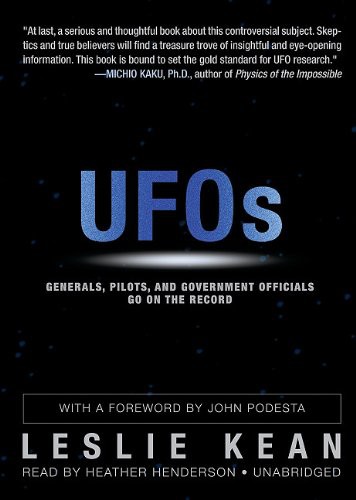
UFOs: Generals, Pilots, and Government Officials Go on the Record
The Book That Broke the Media's UFO Taboo
Find on Amazon →As an Amazon Associate, OverClassified may earn from qualifying purchases made through this link, at no extra cost to you.
Why This Is Essential Reading
UFOs: Generals, Pilots, and Government Officials Go on the Record earns its place on this list not for a novel theory but for a novel evidentiary strategy that measurably worked: by compiling credentialed witnesses' own first-person testimony rather than arguing a personal thesis, Kean built a document mainstream media and, eventually, Congress found harder to dismiss than anything the field had produced before it. Its weaknesses are real and specific — a structure that trades independent verification for primary-source authenticity, a reliance on decades-old personal recollection in several chapters, and at least one case whose sole photographic evidence was later admitted to be a hoax — and a careful reader should hold those alongside the book's genuine achievement rather than instead of it. Read next to The UFO Experience, published almost forty years earlier by a scientist working the same threshold argument from inside the Air Force's own program, this book shows how the same evidentiary logic — a genuine, credentialed residue resists explanation and deserves study — eventually reached the New York Times and the floor of Congress.
Related Cases & Theories
Essential Viewing
Secret Access: UFOs on the Record (2011)
History Channel special, produced by Break Thru Films — The two-hour History Channel documentary Kean produced directly from this book, translating several of its contributor chapters into broadcast television.
The Reality of UFOs UAP with Leslie Kean
Ralph Bunche Institute for International Studies — Kean discusses her journalistic approach to UAP reporting and the evidentiary standard she developed for this book and her later New York Times work.
Sources Cited
- "Leslie Kean." Wikipedia. en.wikipedia.org
- "The Author." lesliekean.com (official author site). lesliekean.com
- "UFOs: Generals, Pilots, and Government Officials Go on the Record." lesliekean.com. lesliekean.com
- "Contributors' Chapters." lesliekean.com. lesliekean.com
- "Reviews of the book UFOs: Generals, Pilots, and Government Officials Go on the Record." lesliekean.com. lesliekean.com
- "Q&A: UFO Journalist Leslie Kean." Columbia Journalism Review. cjr.org
- Oberg, James. "UFO book based on questionable foundation." NBC News / MSNBC, August 27, 2010. nbcnews.com
- Sheaffer, Robert. "'Unexplained' Cases—Only If You Ignore All Explanations." Skeptical Inquirer, March/April 2011 (rev. 2017). debunker.com
- Huneeus, Antonio. "Kean's new UFO book includes top officials." Open Minds, August 11, 2010. openminds.tv
- "COMETA report." Wikipedia. en.wikipedia.org
- Cooper, H., Blumenthal, R., & Kean, L. "Glowing Auras and 'Black Money': The Pentagon's Mysterious U.F.O. Program." The New York Times, December 16, 2017. nytimes.com
- "UFOs: Generals, Pilots and Government Officials Go On the Record." Biblio.com (bibliographic listing, hardcover 1st ed.). biblio.com
- "Secret Access: UFOs on the Record (2011)." IMDb. imdb.com
- This site's own case file: The Kecksburg Incident, for Kean's FOIA lawsuit and her own chapter in this book.
- This site's own case file: The Belgian UFO Wave, for General De Brouwer's contributed chapter.
- This site's own case file: The Tehran UFO Incident, for General Jafari's contributed chapter.
- This site's own case file: The Phoenix Lights, for Governor Symington's contributed chapter.
- This site's own key-figures entry: Leslie Kean, for her full biography and case connections.
Have corrections, additional research, or peer-reviewed sources? Help improve this entry.
Suggest an Edit