
Project Blue Book
The Top Secret UFO Findings Revealed! — Brad Steiger's 1976 Edited Presentation of the Air Force Files
Core Thesis
Project Blue Book: The Top Secret UFO Findings Revealed! is Brad Steiger's 423-page edited compilation of material from the United States Air Force's successive UFO investigations — Project Sign, Project Grudge, the statistical Special Report No. 14, and Project Blue Book itself — published by Ballantine in November 1976 with thirty-two pages of official photographs. Its cover claims that after nearly thirty years the Air Force files were open and the UFO whitewash was over. The framing is pure 1976 paperback, and the underlying achievement is real: this is the book that put primary Air Force UFO material in front of a mass audience, seven years after Blue Book closed and at the moment its records were becoming genuinely accessible. It is also an edited compilation, and the editing is where the questions are.
About the Author
Brad Steiger (1936–2018), born Eugene E. Olson in Iowa, taught literature at Luther College until 1967 and then wrote full time, producing or co-producing almost 170 books across UFOs, ghosts, reincarnation and true crime, selling some seventeen million copies. This library covers his first UFO title, Strangers from the Skies (1966), separately.
The standing criticism of Steiger applies to most of his output and matters less here than anywhere else in it. He was consistently faulted by academics and sceptics for advancing far-reaching claims without evidence; a compilation of government documents is the one format where that tendency has limited room to operate, because the documents are the content.
His role here is editorial rather than authorial, and the title page says so: this is Steiger as editor. What he supplied was selection, arrangement, connective commentary and a mass-market publisher — and of those, the fourth may have mattered most. Ballantine could put 423 pages of Air Force material into every drugstore in America at $1.95.
The two books bracket his UFO career usefully. Strangers from the Skies in 1966 was a contemporaneous survey of a wave in progress, written from press reports with no apparatus at all. Project Blue Book ten years later is document-based, and the improvement is substantial. These are the two Steiger UFO titles worth a serious reader's time.
The honest qualification concerns what a reader cannot check. An edited compilation stands or falls on what was left out, and the book contains no statement of selection criteria, no indication of the proportion of available material used, and no way to reconstruct what a different editor would have chosen. That is the structural problem with every anthology of this kind and it is unresolved here.
Historical Context & Origins
The Air Force ran three successive UFO investigations and their sequence is the book's real subject. Project Sign operated from 1948; Project Grudge succeeded it in 1949 with a markedly more dismissive posture; and Project Blue Book, administered from Wright-Patterson Air Force Base, ran from 1952 until December 1969, when it was closed on the recommendation of the Condon Report.
The most contested episode in that history is the 'Estimate of the Situation' — a Project Sign document reported to have concluded that the objects were interplanetary, and to have been rejected and destroyed by Air Force Chief of Staff Hoyt Vandenberg. No copy has ever surfaced. Whether it existed in the form described is disputed; that the Sign staff's conclusions were unwelcome is not.
Special Report No. 14 is the least-read and most substantive item in the whole corpus. Prepared by the Battelle Memorial Institute and released in 1955, it was a large statistical study of Blue Book's own case data, and its finding — that the best-quality reports were the most likely to remain unexplained, a relationship the opposite of what a misidentification hypothesis predicts — sat uncomfortably with the Air Force's public position.
The Robertson Panel of January 1953 is the third pillar. Convened by the CIA and chaired by the physicist H. P. Robertson, it recommended that the subject be stripped of its special status and that public interest be actively reduced. Its recommendations shaped Air Force communications policy for the rest of Blue Book's life.
By 1976 the files were opening. Blue Book's records had been transferred to the National Archives and were becoming accessible to researchers, the Freedom of Information Act amendments of 1974 had strengthened public access, and for the first time it was possible to write a book from the documents rather than about them. Steiger's volume is a direct product of that opening.
The publishing moment was also favourable in a way that has to be understood. The mid-1970s were a peak for popular interest in government secrecy: Watergate had ended two years earlier, the Church Committee had just finished exposing intelligence-agency abuses, and a mass-market paperback promising that official files revealed a suppressed truth was pushing at an open door.
What the files actually show is more interesting than the cover slogan, and worth stating because the book's framing obscures it. Blue Book left roughly 700 cases classified as unidentified out of more than 12,000 — a small proportion, and one the Air Force treated as a residual rather than as a finding. The argument has always been about what that residue means, not about whether it exists.
Core Arguments & Key Concepts
The primary documents exist and the public had never seen them. The book's foundational claim and its actual contribution. Before 1976 the Air Force investigations were known to general readers only through the accounts of participants and critics; this put the material itself, with official photographs, into a mass-market format.
Investigators' conclusions were suppressed when they did not suit the institutional position. The book's central argument, and it is the strongest version of the cover-up case because it does not require anything exotic. Sign's staff reached conclusions that were rejected; Special Report 14's statistical findings were downplayed; the Robertson Panel recommended reducing public interest. All three are documented, and none of them requires recovered hardware.
Special Report No. 14 is the most important single document and the least read. The point most worth taking from the book. A large Battelle statistical study of the Air Force's own data found that the better a report's quality, the more likely it was to remain unexplained. That relationship is genuinely difficult for a pure-misidentification account and it has never had the attention it deserves.
Photographic material from the official files is evidence in a way summaries are not. Thirty-two pages of official photographs in a mass-market paperback was a real editorial achievement in 1976 and gave readers something they could examine themselves rather than being told about.
The cover-up claim in the book is administrative, not extraterrestrial. A distinction the packaging obliterates and the contents largely preserve. What the documents support is that an institution managed public perception of an inconvenient subject, discouraged reporting, and marginalised staff who reached unwelcome conclusions. That is a serious charge and it is not the charge the cover makes.
The weakest structural feature is that selection is invisible. An edited compilation of an enormous document corpus is only as good as its editing, and nothing in the book tells a reader what proportion of available material was used, on what basis, or what was excluded. A compilation assembled to demonstrate a thesis will find material demonstrating it.
The 'top secret' framing is false and should be named as such. Blue Book's records were not top secret; they were a low-classification investigative file that had been transferred to the National Archives and was becoming publicly available, which is precisely how Steiger got them. The cover sells access to secrets that the book's own existence disproves.
Key Cases & Evidence Discussed
Project Sign, 1948–49. The first Air Force investigation, its staff's reported conclusions, and the transition to a markedly more dismissive successor.
The Estimate of the Situation. The Sign document reported to have concluded the objects were interplanetary and to have been rejected and destroyed at Air Force Chief of Staff level. No copy has ever surfaced and its existence in the form described remains disputed.
Project Grudge, 1949–51. The successor programme, its explicitly debunking posture, and the period Edward J. Ruppelt inherited when he took over the reconstituted effort.
Project Blue Book, 1952–1969. The longest-running of the three, its roughly 12,000 case files, the approximately 700 left classified as unidentified, and its closure on the Condon Report's recommendation. Covered in this site's separate essential-reading article on Randle's later treatment.
Special Report No. 14, 1955. The Battelle Memorial Institute's statistical analysis of Blue Book's data and its finding that higher-quality reports were more likely to remain unexplained — the compilation's most consequential inclusion.
The Robertson Panel, January 1953. The CIA-convened scientific panel whose recommendations to strip the subject of special status and reduce public interest governed Air Force communications for the rest of the programme's life.
The official photographic file. The thirty-two pages of Air Force photographs reproduced in the paperback — primary visual material that general readers had had no access to.
The 1969 closure and the Condon Report. The University of Colorado study whose conclusion that further investigation was unjustified ended the programme, treated in this library through its own article.
Critical Reception & Controversies
The book sold well as a mass-market paperback, was reissued by Ballantine in 1987, and received no reviews of record. Its reception was commercial rather than critical, which is what a $1.95 Ballantine title in 1976 was designed for.
Its standing in the field has been better than most of Steiger's output, for the straightforward reason that the content is documents. Where his other books were criticised for asserting more than the evidence supported, a compilation's claims are constrained by what is on the reproduced page.
The substantive criticism is about the packaging, and it is worth separating from the contents. The cover's claim that these were top secret findings and that the whitewash was over describes a book that does not exist; the actual volume reproduces material from a low-classification investigative file that was becoming publicly accessible through the National Archives. That mismatch has done the book's reputation lasting damage among careful readers.
The second criticism is editorial invisibility. Nobody can assess a compilation without knowing its selection principles, and this one supplies none. Blue Book alone comprises many thousands of case files; 423 pages is a very small window, and a reader has no way to know whether it is representative.
There is also a persistent problem with the framing of the unidentified residue. Blue Book classified roughly 700 of more than 12,000 cases as unexplained. A compilation drawn heavily from that residue accurately reflects the interesting material and inaccurately reflects the file as a whole, and readers should hold both facts.
What has aged best is the Special Report No. 14 material. The Battelle finding — better reports being likelier to remain unexplained — is the single most analytically robust thing to come out of the entire Air Force effort, and Steiger giving it space in a mass paperback did more to circulate it than any specialist treatment.
The fair placement is as a document sampler from before the archive was easily searchable. In 1976 this was the only practical way for a general reader to see Air Force UFO material at all. Today the Blue Book records are digitised and publicly accessible, which makes the compilation historically interesting rather than necessary — and makes its selection choices checkable in a way they were not for its first readers.
Influence & Legacy
The book's principal effect was distributional, and it was substantial. A mass-market paperback carrying official Air Force documents and photographs reached an audience that would never have visited the National Archives, and it established for a generation of readers that the primary material existed and could be looked at.
It also helped fix the terms of the modern cover-up argument. The claim that investigators' conclusions were suppressed when institutionally inconvenient — rather than that hardware was recovered and hidden — is the more defensible version of the case, and this book put the documents supporting it into general circulation.
Special Report No. 14's survival in the field's memory owes a great deal to this volume. The Battelle study is technical, was published without fanfare in 1955, and would plausibly have been forgotten outside a small specialist readership had a mass paperback not carried it.
Its cautionary legacy is about compilations. A book of primary documents feels like unmediated access to the record and is nothing of the kind: someone chose these pages out of thousands, and the choosing is the argument. That applies to every document anthology in this field, including the ones assembled by people whose conclusions a reader shares, and this is a good specimen on which to notice it.
One last point about timing, because it is the thing that dates the book most sharply and most usefully. Steiger was working at the exact moment the archive opened — after the 1974 Freedom of Information Act amendments and the transfer of the records — and the whole genre of the popular document compilation exists in that window between a file becoming available and a file becoming searchable. Once the Blue Book records were digitised and indexed, the compilation stopped being the only way in and became instead a specimen of how one editor read the file in 1976. That is a more modest role than the cover claims and a considerably more durable one.
The Book
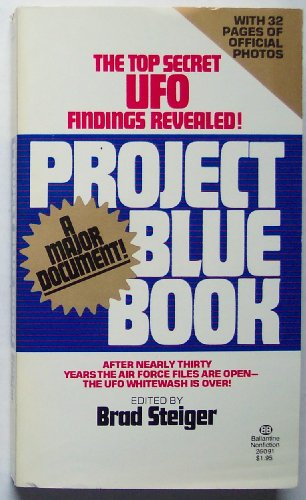
Project Blue Book
The Top Secret UFO Findings Revealed! — Brad Steiger's 1976 Edited Presentation of the Air Force Files
Find on Amazon →As an Amazon Associate, OverClassified may earn from qualifying purchases made through this link, at no extra cost to you.
Why This Is Essential Reading
Read it for Special Report No. 14 and read the cover with contempt. Steiger's compilation was, in 1976, the only practical way for a general reader to see Air Force UFO material at all, and its 423 pages plus thirty-two pages of official photographs did real work in establishing that the primary record existed. Its framing is dishonest — the Blue Book files were not top secret, they were a low-classification investigative record becoming publicly available through the National Archives, which is exactly how Steiger obtained them — and its selection principles are invisible, which is the standing defect of every document anthology. What survives is the substance: the documented pattern of investigators' conclusions being set aside when institutionally inconvenient, and above all the Battelle Memorial Institute's finding in Special Report No. 14 that the best-quality reports were the most likely to remain unexplained. That single result is more interesting than anything on the cover. The files are now digitised and public; read the compilation as history, and go to the archive for the evidence.
Related Cases & Theories
Sources Cited
- Steiger, Brad (ed.). Project Blue Book: The Top Secret UFO Findings Revealed! Ballantine Books, November 12, 1976. 423 pp. with 32 pages of official photographs. ISBN-10 0345260910 / ISBN-13 9780345260918. amazon.com
- Open Library edition record, Project Blue Book by Brad Steiger — bibliographic verification for the Ballantine edition. openlibrary.org
- Google Books record, Project Blue Book: The Top Secret UFO Findings Revealed — publisher, date and extent. books.google.com
- AbeBooks catalogue record, ISBN 9780345260918 — edition verification, the Ballantine 1976 first printing and 1987 reissue, the cover-art source, and the publisher description of the book as revealing the suppressed findings of Project Sign, Project Grudge, Special Report No. 14 and Project Blue Book. abebooks.com
- Goodreads edition record — edition data and reader reception. goodreads.com
- US National Archives, "Air Force UFO records (Project Blue Book)" — the official holding of the Blue Book, Sign and Grudge files, their accessibility, and the case totals. archives.gov
- Wikipedia, "Project Blue Book" — the programme's 1952–1969 operation, its roughly 12,000 case files, the approximately 700 classified unidentified, and its closure on the Condon Report's recommendation. en.wikipedia.org
- Wikipedia, "Project Sign" — the 1948 first investigation whose staff conclusions the compilation treats as suppressed. en.wikipedia.org
- Wikipedia, "Project Grudge" — the 1949 successor programme and its explicitly dismissive posture. en.wikipedia.org
- Wikipedia, "Estimate of the Situation" — the Project Sign document reported to have concluded the objects were interplanetary and to have been rejected at Chief of Staff level, of which no copy has ever surfaced. en.wikipedia.org
- Wikipedia, "Robertson Panel" — the January 1953 CIA-convened panel whose recommendations to reduce public interest shaped Air Force policy for the rest of Blue Book's life. en.wikipedia.org
- Wikipedia, "Edward J. Ruppelt" — the officer who ran the reconstituted programme and whose own 1956 account this library covers separately. en.wikipedia.org
- Wikipedia, "Condon Committee" — the University of Colorado study whose report ended Project Blue Book in December 1969. en.wikipedia.org
Have corrections, additional research, or peer-reviewed sources? Help improve this entry.
Suggest an Edit