
The Report on Unidentified Flying Objects
The Man Who Ran Project Blue Book Tells What He Found
Core Thesis
Unlike every other early UFO book written from the outside looking in, this one was written by the man who was, for two years, the inside: Captain Edward J. Ruppelt directed the U.S. Air Force's official UFO investigation — first the moribund Project Grudge, then its March 1952 reorganization into Project Blue Book — and his 1956 account argues, chapter by documented chapter, that a genuine minority of well-witnessed reports (Lubbock, the Gorman Dogfight, the July 1952 Washington flap) resisted every conventional explanation his own investigators could find, even as an Air Force public-relations apparatus above him pushed steadily toward blanket dismissal; Ruppelt's own conclusion, stated plainly in his final 1956 chapter, is not that the objects are extraterrestrial but that the question remained honestly, provably open — a position he would controversially reverse four years later in the book's expanded 1960 second edition.
About the Author
Edward James Ruppelt was born July 17, 1923, in Grundy Center, Iowa. He enlisted in the Army Air Corps in 1942 and served in World War II as a B-29 bombardier and radar operator flying missions over India, China, and the Pacific, earning five battle stars, two theater combat ribbons, three Air Medals, and two Distinguished Flying Crosses. After the war he returned to Iowa State College, earning a Bachelor of Science in aeronautical engineering in 1951 — just as the outbreak of the Korean War recalled him to active duty. The Air Force assigned him to the Air Technical Intelligence Center (ATIC) at Wright-Patterson Air Force Base in Ohio, ATIC's home and the eventual headquarters of the UFO project he would come to run.
Ruppelt inherited Project Grudge, the Air Force's UFO investigation, in late 1951 after Lt. Col. N. R. Rosengarten recommended him partly on his reputation as "a good organizer" who had helped straighten out other troubled projects. When Gen. Charles P. Cabell's October 1951 Pentagon meeting — triggered by the Fort Monmouth radar-visual case and Lt. Jerry Cummings's candid account of Grudge's dysfunction — led to the project's overhaul, Ruppelt was kept on as director, and in March 1952 the renamed Project Blue Book began operating under his charge, still only a captain. It was during this period that Ruppelt coined the term "unidentified flying object," specifically to replace "flying saucer" and "flying disk," terms the Air Force considered "misleading when applied to objects of every conceivable shape and performance."
Ruppelt led Blue Book through its most active stretch, including the July 1952 Washington, D.C. flap, before the January 1953 Robertson Panel recommended a public-education and debunking posture that Ruppelt found increasingly at odds with his own open investigative approach. He requested reassignment in late 1953, shortly after his Blue Book staff was cut from more than ten personnel to three, and left the Air Force not long after. He worked as a research engineer for Northrop Aircraft Company starting in 1956, the same year Doubleday published The Report on Unidentified Flying Objects. When Donald Keyhoe asked him that year to advise the newly formed National Investigations Committee on Aerial Phenomena (NICAP), Ruppelt declined, citing a recent heart attack. In what turned out to be the final months of his life, he released an expanded, twenty-chapter second edition in 1960 with a notably more skeptical tone. He died of a second heart attack on September 15, 1960, in Long Beach, California, at age 37.
Ruppelt's own scientific consultant on Blue Book, astronomer J. Allen Hynek, later wrote of him: "In my contacts with [Ruppelt] I found him to be honest and seriously puzzled about the whole phenomenon." UFO historian Jerome Clark, whose own UFO Encyclopedia appears elsewhere on this site's reading list, put it more bluntly: "Most observers of Blue Book agree that the Ruppelt years comprised the project's golden age, when investigations were most capably directed and conducted. Ruppelt was open-minded about UFOs, and his investigators were not known, as Grudge's were, for force-fitting explanations on cases."
Historical Context & Origins
By 1956, UFO literature already had a well-established genre of advocacy writing, led by retired Marine Corps Major Donald Keyhoe's bestselling books arguing the Air Force was actively concealing an extraterrestrial cover-up. Ruppelt's book arrived as something genuinely different in kind rather than degree: not a journalist's or outsider-advocate's argument about what the government must be hiding, but a firsthand account from the specific officer who had run the actual investigation, written after he had left the Air Force and was free to describe its internal workings without a superior's approval. No comparable insider account existed before it, and Ruppelt's book was the first publication to reveal the existence of Project Sign and to publish the text of the September 1947 Twining Memo, in which Lt. Gen. Nathan Twining had told the Army Air Forces that the phenomenon being reported was "something real and not visionary or fictitious."
The book was also written at a specific institutional hinge point. The January 1953 Robertson Panel, convened by the CIA in the wake of the 1952 Washington flap, had recommended a public "training and debunking" campaign rather than continued open scientific investigation — a recommendation Ruppelt watched reshape Blue Book's posture from the inside before he requested reassignment in late 1953. Writing three years later as a private citizen, Ruppelt was positioned to describe that shift candidly: he recorded his own unease at the time, writing that "this change in the operating policy of the UFO project was so pronounced that, I like so many other people, wondered if there was a hidden reason for the change. Was it actually an attempt to go underground — to make the project more secretive?"
The book's reception was also shaped by what happened after its initial 1956 printing. Four years later, in 1960 and in declining health, Ruppelt released an expanded twenty-chapter edition adding three new closing chapters in a markedly more skeptical register, ultimately declaring UFOs a "space age myth" and stating flatly, "I'm positive they don't" exist. Reviewers and later historians have never fully resolved why: some have wondered whether Air Force or industry pressure was involved, while others point to Ruppelt's own exhaustion with the contactee circuit and the media circus that had grown up around the subject by the end of the 1950s. This site's citation of the book, discussed below, is drawn from a modern paperback reprint of the original 1956 text and edition — the open-question version of the book, not the 1960 revision.
Core Arguments & Key Concepts
Ruppelt frames his account around a specific institutional confession: Blue Book's own investigative machinery ran on a triage system in which most reports were filed as "Insufficient Data for Evaluation" or dumped into a "Crackpot" file for people who claimed to have ridden in flying saucers or met their crews, while reports from trusted, trained observers — senior military pilots, radar operators, scientists — received the project's serious attention. That two-tier system, Ruppelt argues, is what let a genuine residue of unexplained cases survive years of institutional pressure to explain everything away.
A central argument concerns the "Estimate of the Situation," a classified analysis Ruppelt says Project Sign personnel produced arguing for an interplanetary explanation of the phenomenon, which Air Force Chief of Staff Gen. Hoyt Vandenberg personally rejected in October 1948 for insufficient evidence — a document Ruppelt says was later destroyed, that top Air Force officials subsequently denied ever existed, and for which no independent copy has ever surfaced. Ruppelt's book remains the only source for the Estimate's existence, a genuine evidentiary limitation later writers, including Popular Mechanics historian M. J. Banias, have noted directly, calling the account "probably more mythological than real" absent corroborating documentation.
The book devotes an entire chapter, "The Classics," to the three cases Ruppelt treats as 1948's foundational unexplained reports: the Mantell Incident, in which a Kentucky Air National Guard pilot died chasing an object; the Chiles-Whitted sighting, an airline crew's near-collision report; and the Gorman Dogfight, a North Dakota Air Guard pilot's engagement with a maneuvering light. Ruppelt also devotes a full chapter, "The Lubbock Lights, Unabridged," to the September 1951 sighting by Texas Technological College professors, writing that "if a group had been hand-picked to observe a UFO, we couldn't have picked a more technically qualified group of people" — the same assessment this site's own key-figures entries on the Lubbock professors quote directly.
Ruppelt's most sustained institutional argument concerns the July 1952 Washington, D.C. flap, covered across two chapters, "The Big Flap" and "The Washington Merry-Go-Round." He describes fielding a personal phone call from Brig. Gen. Robert Landry, President Truman's Air Force aide, while Truman himself listened silently on a second line, and he later defended Gen. John Samford's July 29 press conference response while privately acknowledging, in his own words, that "his [Samford's] people had fouled up in not fully investigating the sightings" before reaching for the temperature-inversion explanation that became the Air Force's public position.
The book closes, in its original 1956 seventeenth chapter, without a verdict: Ruppelt writes that he "wouldn't want to hazard a guess as to what the final outcome of the UFO investigation will be," listing genuine misidentification and genuine interplanetary visitation as equally open possibilities pending more data — a deliberately unresolved ending that stands in direct tension with the three additional chapters he appended in 1960, where he reversed himself and declared the subject a "space age myth."
Key Cases & Evidence Discussed
The Lubbock Lights (Case #041, September 1951) receive the book's single most detailed case treatment, an entire chapter built around Ruppelt's own interviews with the Texas Technological College professors he considered the most technically qualified witness group of his entire tenure.
The Washington, D.C. UFO Flap (Case #015, July 1952) anchors two full chapters, documenting Ruppelt's firsthand role fielding the Truman White House's inquiry and his private doubts about the temperature-inversion explanation ultimately given at Gen. Samford's Pentagon press conference.
The Gorman Dogfight (Case #039, October 1948) is one of the three cases Ruppelt singles out as a foundational "classic" — a National Guard pilot's radar- and tower-corroborated pursuit of a maneuvering light over Fargo, North Dakota.
The Thomas Mantell Incident (Case #038, January 1948) and the Chiles-Whitted Sighting (Case #066, July 1948) round out the book's "Classics" chapter, presented alongside Gorman as the trio of 1948 cases that first forced the Air Force to take the phenomenon seriously.
Project Blue Book Special Report No. 14 (Case #281), the statistical study Ruppelt commissioned during his tenure, is discussed in the book's later chapters as the data-driven capstone of his own investigative approach — a study whose central finding, that better-documented sightings were more likely to be ruled unexplained, sits uneasily beside the Air Force's simultaneous public claim that only a small percentage of cases remained unsolved.
Critical Reception & Controversies
Contemporary 1956 press notices were strikingly favorable for a book on this subject. The Cleveland Plain Dealer called it "the sober reporting of a man who was in charge of one of the official investigations," while the Baltimore Sun wrote that Ruppelt's book "is an objective, calmly written work that should be in the hands of every sober student of the UFO mystery." The Buffalo News ran its January 1956 coverage under the headline "You Saw a Spaceship? Air Force Won't Deny It," reporting that Ruppelt's own account of the Air Force's position was one of rejecting the spaceship theory "on the ground that there is no definite proof" while still urging continued investigation. The book was notable enough to draw a review in the Royal Aeronautical Society's own Aeronautical Journal in December 1956 — a level of attention from a technical, non-ufological venue that few subsequent UFO books have matched.
Ruppelt's own former colleague on Blue Book, astronomer J. Allen Hynek, gave the book its most consequential scholarly endorsement, writing in his own 1972 book The UFO Experience that Ruppelt's account "should be required reading for anyone seriously interested in the history of this subject." UFO historian Jerome Clark separately credited the "Ruppelt years" specifically as Blue Book's "golden age," a characterization built substantially on the documentary record this book itself established.
The book's central limitation is one no reviewer has fully resolved: its account of the "Estimate of the Situation" — the alleged Project Sign document endorsing an interplanetary explanation, supposedly destroyed after Gen. Vandenberg's rejection — rests entirely on Ruppelt's own word, since no corroborating copy has ever been located. Popular Mechanics historian M. J. Banias, writing in 2019, called the claim "probably more mythological than real" absent independent documentation, a caution later UFO historians, including Curtis Peebles in Watch the Skies!, have echoed while still crediting Ruppelt's broader account as foundational.
Peebles's own assessment, cited on this site's separate breakdown of Watch the Skies!, is double-edged in a way that captures the book's mixed legacy: Peebles concluded the book "should have ended the speculation about an Air Force cover-up," but observed that, in practice, "Ruppelt's statements were converted into support for the cover-up idea" by later writers — a genuine irony, since Ruppelt's own stated goal was candor rather than either advocacy or denial.
Modern reader reception, visible on Goodreads where the book holds a 3.80-star average from nearly 300 ratings, remains largely admiring but notes the same structural tension found by scholarly reviewers: reviewer Steve called it "the genuine granddaddy of all UFO books," while reviewer Martin Hill specifically flagged the book's unusual split structure — seventeen chapters largely sympathetic to the phenomenon's genuine mystery, followed in the expanded edition by three added chapters dismissing it — as one of the most striking contradictions in the UFO literature.
Influence & Legacy
The book's most concrete, independently verifiable influence is documented on this very site: a modern reprint of this exact 1956 text, under ISBN 1477456481, is cited across resources.html in connection with 17 separate case-file pages — from the Carson Sink Incident and the Chiles-Whitted Sighting to the Wonsan-Sunchon UFO Incident — reflecting its ongoing use here as a primary-source account of how Blue Book's investigative apparatus actually functioned, not a novelty citation.
Ruppelt's most lasting and most easily verified legacy is linguistic rather than evidentiary: the term "UFO" itself, which he coined specifically to replace the more sensational "flying saucer" and "flying disk," is now the standard designation used by the Air Force's own successor agencies, by scientific researchers, and by the general public worldwide — a single-word legacy no other book on this site's Essential Reading list can claim to have originated.
As the first publication to reveal the existence of Project Sign and to publish the text of the Twining Memo, Ruppelt's book also became a foundational primary source for virtually every subsequent government-focused UFO history, including this site's own essential-reading breakdowns of Curtis Peebles's Watch the Skies!, David Jacobs's The UFO Controversy in America, and Michael Swords and Robert Powell's UFOs and Government, all of which draw on Ruppelt's firsthand account of Sign, Grudge, and Blue Book's internal workings.
Because the original 1956 edition's U.S. copyright was never renewed, the book fell into the public domain, and its full text is now freely available through Project Gutenberg, the Internet Archive, and NICAP's own online library — an unusually durable form of open access that has kept Ruppelt's firsthand account continuously in circulation for readers and researchers for nearly seven decades, including through the free public-domain audiobook now available via LibriVox.
The Book
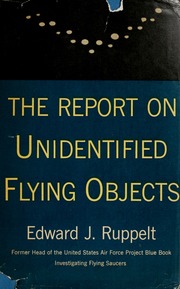
The Report on Unidentified Flying Objects
The Man Who Ran Project Blue Book Tells What He Found
Find on Amazon →As an Amazon Associate, OverClassified may earn from qualifying purchases made through this link, at no extra cost to you.
Why This Is Essential Reading
The Report on Unidentified Flying Objects earns its place on this list for a reason none of this site's other Essential Reading titles can claim: it is the only book here written by the actual chief of the government's own official UFO investigation, describing his own program from the inside, in his own words, after he was free of the chain of command that had directed it. That vantage point produced genuine firsthand disclosures — the existence of Project Sign, the text of the Twining Memo, detailed first-person accounts of the Lubbock Lights, the Gorman Dogfight, and the Washington flap — that no outside journalist or advocate could have obtained. It also produced the book's most lasting legacy, the word "UFO" itself, coined by Ruppelt to replace a term he considered too sensational for serious investigation. Its limitations are real and well-documented by its own reviewers: the pivotal "Estimate of the Situation" rests on Ruppelt's word alone, and the sharply more skeptical 1960 revised edition complicates any simple reading of where its author ultimately stood. Read in its original 1956 form — the edition this site cites — it remains exactly what J. Allen Hynek called it: required reading for anyone seriously interested in the history of this subject, precisely because its author was the subject's history for two consequential years.
Related Cases & Theories
Essential Viewing

UFO Archives: Project Blue Book - Captain Edward Ruppelt
UFO Archives — A 1956 radio interview with Captain Edward J. Ruppelt, recorded around the publication of this book, in which he discusses his time running Project Blue Book directly in his own voice.
The Report on Unidentified Flying Objects by Edward J. Ruppelt, Part 1/3 (Full Audiobook)
LibriVox Audiobooks — A free public-domain audiobook reading of the book's actual 1956 text, made possible because the original edition's U.S. copyright was never renewed.
Sources Cited
- "The Report on Unidentified Flying Objects." Wikipedia (publication details, chapter-by-chapter contents, 1960 revised edition, contemporary reviews and citations). en.wikipedia.org
- "Edward J. Ruppelt." Wikipedia (biography: WWII service, education, Project Grudge/Blue Book tenure, post-Air Force career, death). en.wikipedia.org
- "The Report on Unidentified Flying Objects." Amazon.com (ISBN 1477456481 / 9781477456484, 2012 reprint edition, 270 pp.). amazon.com
- "The report on unidentified flying objects." Internet Archive (digitized scan of the 1956 Doubleday first edition, cover image, full text). archive.org
- Ruppelt, Edward J. "The Report on Unidentified Flying Objects." Project Gutenberg (public-domain full text, eBook #17346). gutenberg.org
- Ruppelt, Edward J. "The Report on Unidentified Flying Objects," Chapter Eight ("The Lubbock Lights, Unabridged"), full text. Internet Sacred Text Archive. sacred-texts.com
- "Recommended Books." Center for UFO Studies (CUFOS's own description: "Captain Ruppelt's inside look at the Air Force's Project Blue Book never ages... Accurate and unemotional."). cufos.org
- Banias, M. J. "50 Years Ago, the Air Force Tried to Make UFOs Go Away. It Didn't Work." Popular Mechanics, December 17, 2019 (assessment of the "Estimate of the Situation" claim; page no longer live as of Aug 2026, no archived mirror found).
- Hynek, J. Allen. The UFO Experience: A Scientific Inquiry. Chicago: Henry Regnery Company, 1972 (source of Hynek's "required reading" assessment of Ruppelt's book).
- Clark, Jerome. The UFO Book: Encyclopedia of the Extraterrestrial. Detroit: Visible Ink Press, 1998 (source of the "golden age" characterization of the Ruppelt-era Blue Book).
- "The Report on Unidentified Flying Objects by Edward J. Ruppelt." Goodreads (reader ratings and reviews, 3.80-star average, 299 ratings). goodreads.com
- This site's own resources library: Full Reading List, where this exact edition (ISBN 1477456481) is cited across 17 separate case-file pages.
- This site's own case file: The Lubbock Lights, for the 1951 case given the book's single most detailed treatment.
- This site's own case file: The Washington, D.C. UFO Flap of 1952, for the flap Ruppelt personally managed as Blue Book's director.
- This site's own key-figures entry: Edward J. Ruppelt, for his full biography and case connections.
Have corrections, additional research, or peer-reviewed sources? Help improve this entry.
Suggest an Edit