
The Washington, D.C. UFO Flap of 1952
On two consecutive weekends — July 19–20 and July 26–27, 1952 — unidentified targets appeared on radarscopes at Washington National Airport and Andrews Air Force Base, in some of the most sensitive airspace in the United States. Civilian controllers tracked targets that loafed along and then shot off at high speed. Airline crews and tower operators reported lights where the radar showed targets, and F-94 interceptors were sent up on both weekends without ever closing on anything. The press called it the "Washington Merry-Go-Round." The affair prompted an inquiry from President Truman's air aide, and on July 29 it led to the largest Air Force press conference since World War II. There Major General John A. Samford called the temperature-inversion theory “about a fifty-fifty proposition” and admitted of the airline sightings, “I can't explain that.” Blue Book chief Edward Ruppelt wrote in 1956 that the sightings were “still carried as unknowns.” A 1953 CAA study and the 1969 Condon Report attributed the radar targets to anomalous propagation, a conclusion the physicist James McDonald disputed.
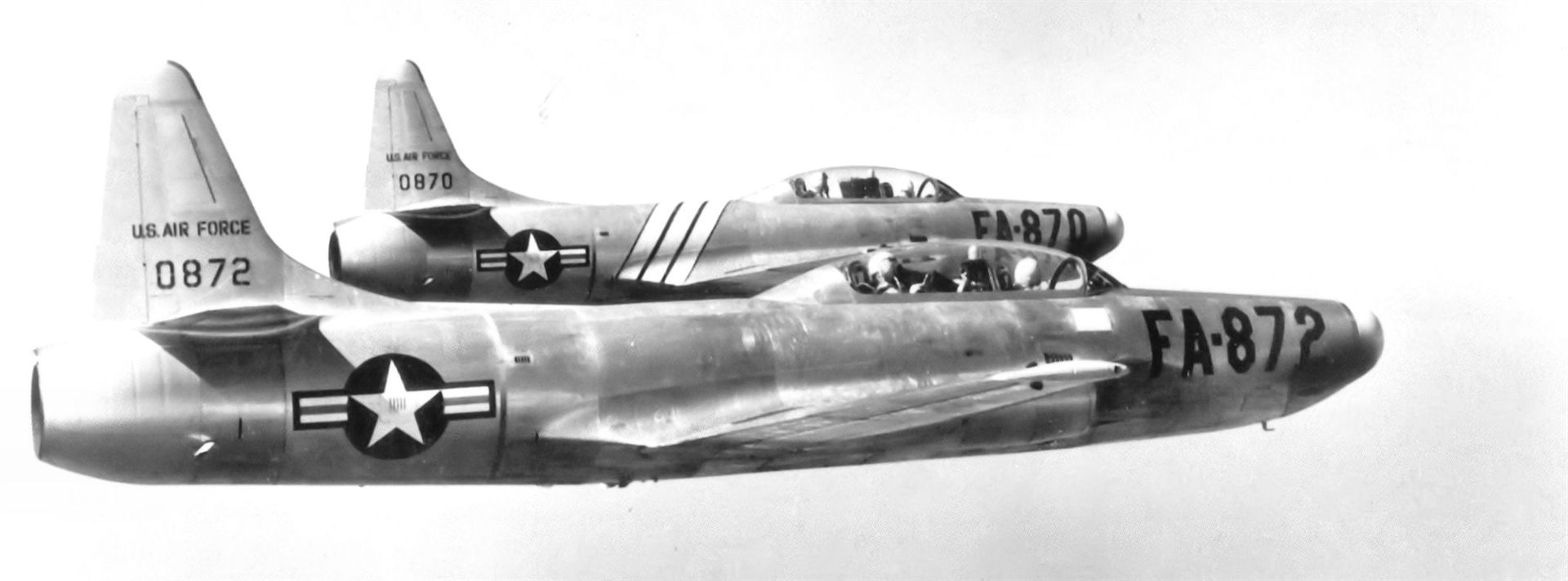
Pictured: a pair of U.S. Air Force Lockheed F-94 Starfire interceptors of the same type scrambled from New Castle Air Force Base, Delaware, during the July 1952 radar chases. This is a generic official Air Force publicity photo of the aircraft type, not the specific jets or pilots involved in the incident, and it shows no radar targets or unidentified craft; no photograph of the objects themselves is known to exist.
Theoretical Alignment
The Washington flap presents a genuinely difficult alignment problem. Witnesses reported radar blips and lights, never a structured vehicle, and that absence of any reported craft caps how strongly the case can support the Extraterrestrial Hypothesis, however anomalous the tracking data appear. The Psycho-Social Hypothesis also explains only part of the record. Media excitement plausibly inflated the volume of marginal reports that summer: Project Blue Book logged 1,501 reports in 1952, against fewer than 250 in any earlier year. But it does not account for on-duty radar controllers watching targets on their scopes and an airline captain reporting lights where the controllers said targets were. That correlation (radar call, visual report, radar call again) is the hardest fact for both camps to absorb. The best reading of the case is instrumented-but-unexplained rather than assignable to any one framework.
Background
By the summer of 1952, the American "flying saucer" phenomenon was five years old and had never been more intense. The U.S. Air Force's investigative arm, first called Project Sign and then Project Grudge, had been reorganized in March 1952 as Project Blue Book under Captain Edward J. Ruppelt, a decorated World War II B-29 crewman who insisted on a more rigorous, less dismissive approach than his predecessors. Blue Book's own statistics show the scale of what followed. Between 1947 and 1951 the program had logged between 122 and 210 reports a year. In 1952 it logged 1,501, most of them in the summer. Ruppelt recalled that by late July reports were arriving at thirty to forty a day.
Washington, D.C. was no stranger to isolated reports that summer — scattered sightings had been logged in the capital region as early as July 12 — but nothing had prepared the CAA's National Airport radar room, a relatively new facility using state-of-the-art long-range and approach-control radarscopes, for what began just before midnight on Saturday, July 19. The airspace directly overhead was among the most heavily defended in the country: National Airport's traffic corridor threaded between the Pentagon, the White House, and the Capitol, all inside restricted zones that made any unauthorized aircraft activity a matter of immediate national-security interest. It was against this backdrop — a newly reorganized, more skeptical Blue Book; a capital city primed by a summer of saucer headlines; and some of the most sensitive airspace on the continent — that the events of the next two weekends unfolded.
Complete Timeline
| Date | Event |
|---|---|
| March 1952 | The Air Force reorganizes its UFO investigation as Project Blue Book under Capt. Edward J. Ruppelt, replacing the smaller, more dismissive Project Grudge. |
| July 12–13, 1952 | Scattered UFO reports begin circulating in the Washington, D.C. area as part of the national summer wave. Ruppelt later noted that radar targets had also been tracked over Washington on May 23 and on other nights before and after the two famous weekends. |
| July 19, 1952 — 11:40 PM | CAA radar operator Edward Nugent, alone at the long-range ARTC scope at Washington National Airport, sees a group of seven unidentified targets. Most accounts place them 15 miles south-southwest of the city; the Bolling AFB briefing Ruppelt heard put them “just east and a little south of Andrews AFB.” Senior controller Harry Barnes and colleagues agree they are not airplanes, and a technician finds the radar working normally. |
| July 19–20, ~midnight | Tower controllers Howard Cocklin and Joe Zacko independently spot a hovering, whitish-orange light outside the tower window that departs at extreme speed — correlating with a simultaneous radar disappearance. |
| July 20, shortly after midnight | An ARTC controller asks the pilot of a Capital Airlines flight just out of National, Capt. S.C. "Casey" Pierman (Flight 807, heading west), to watch for lights. Pierman calls out, “There's one—off to the right—and there it goes,” and the target beside him disappears from the scope. Over the next fourteen minutes he reports six more lights. Barnes said each sighting coincided with a radar pip near the plane. |
| July 19–20, overnight | At Andrews Air Force Base, ten miles away, Airman William Brady and Staff Sgt. Charles Davenport observe an orange-red light making abrupt changes of direction and altitude. When ARTC tells Andrews tower it has a target over the Andrews radio range station, the tower operators see a “huge fiery-orange sphere” there. Ruppelt later learned that, under interrogation, they said it was “merely a star.” |
| July 20, ~3:00 AM | In the account most later writers follow, two F-94 Starfire interceptors from New Castle County AFB, Delaware, arrive over Washington and the radar returns vanish. Ruppelt, relaying the Bolling AFB briefing, says only that after repeated calls a single F-94 arrived “just about daylight,” when the targets were already gone. |
| July 20, ~3:30–5:30 AM | According to later accounts, the targets return after the jets leave, and Barnes concludes the objects were monitoring radio traffic. The last unknown radar contact is logged at 5:30 AM. Once during the night all three radars pick up a single target north of the Riverdale beacon for thirty seconds, and it vanishes from all three at once (Ruppelt). |
| July 21, 1952 | Capt. Ruppelt, arriving in Washington on other business, learns of the sightings from a newspaper bought at the airport. He is refused a staff car to investigate, gives up and flies back to Dayton. |
| July 24, 1952 | Two Air Force colonels flying a B-25 from Hamilton AFB, California, to Colorado Springs report three objects over Carson Sink, Nevada, which they compare to delta-wing aircraft. It is one of many reports adding to pressure on the Pentagon that week. |
| July 26, 1952 — 8:15 PM | A National Airlines pilot and stewardess report lights maneuvering above their aircraft as it approaches Washington, opening the second weekend's activity hours before nightfall. |
| July 26, ~10:30 PM | The same ARTC controllers pick up several slow-moving targets in an arc from Herndon, Virginia, to Andrews AFB, and mark each with a plastic marker; the tower and Andrews also have them (Ruppelt). Controllers calculate speeds of up to 7,000 mph. Ruppelt places that figure on the first night, later accounts on the second, and it is among the most disputed data points in the case. |
| July 26–27, ~midnight | Two F-94s from New Castle are airborne by midnight. As they arrive the targets disappear, then return after the jets leave. A second pair is sent. Flight leader Capt. John McHugo sees nothing, while Lt. William Patterson chases several bright lights at full speed without closing. Al Chop later recalled him radioing, “I see them now and they're all around me. What should I do?” |
| July 27, after midnight | Blue Book's Pentagon liaison, Maj. Dewey Fournet, and Navy electronics specialist Lt. John Holcomb are in the radar room with Al Chop. Holcomb learns from the Weather Bureau of only a slight inversion, “not nearly strong enough to explain the ‘good and solid’ returns.” Fournet reports that everyone present thought the targets “very probably caused by solid metallic objects.” |
| July 27, dawn | The returns fade as the sun rises. Headlines follow: the Cedar Rapids Gazette's “SAUCERS SWARM OVER CAPITAL,” and, by Monday evening, “FIERY OBJECTS OUTRUN JETS OVER CAPITAL” (as recalled by Ruppelt). |
| July 29, 1952, ~10:00 AM | According to Ruppelt, President Harry Truman's air aide, Brig. Gen. Robert Landry, calls Air Force Intelligence “at President Truman's request” to find out what is going on. Ruppelt takes the call and tells him the targets “could have been caused by weather but that we had no proof.” Some later accounts add that Truman listened in on the call. |
| July 29, 1952 — 4:00 PM | Maj. Gen. John A. Samford, USAF Director of Intelligence, holds a press conference in Room 3E-869 of the Pentagon, the largest and longest the Air Force had held since World War II (Ruppelt). Maj. Gen. Roger M. Ramey, Col. Donald Bower and Capt. Roy James of ATIC take part. Samford calls the inversion theory “about a fifty-fifty proposition,” and James fields the radar questions. The press reports the inversion theory as the Air Force's answer. |
| Late July–August 1952 | Reported sightings nationwide decline within weeks of the press conference. The Air Force and skeptics later cited the decline as evidence the explanation had worked; proponents argued it merely discouraged reporting. Ruppelt says targets were seen over Washington eight more times in August. |
| September 1952 | CIA's Office of Scientific Intelligence, alarmed by the volume and profile of the summer's reports, drafts a memo to Director of Central Intelligence Walter Bedell Smith recommending a formal scientific review of Blue Book's methods. |
| January 14–18, 1953 | The CIA convenes the Robertson Panel, chaired by physicist Howard P. Robertson, to review selected Blue Book cases and films. The panel recommends a public “debunking” and education program to reduce public interest in UFOs. |
| May 1953 | A CAA technical development report by Richard C. Borden and T. K. Vickers concludes that such unidentified targets “do not represent new phenomena; nor are they peculiar to the Washington area,” and attributes them to temperature inversions. It is based mainly on observations of August 13–14, 1952 rather than the July weekends. |
| 1956 | Ruppelt publishes The Report on Unidentified Flying Objects. In it he describes inversions on almost every summer night in Washington but “solid” targets on only a few, and concludes, “So the Washington National Airport Sightings are still unknowns.” |
| 1968–1970 | Physicist James E. McDonald discusses radar cases at the July 1968 House symposium. In a 1970 American Meteorological Society paper he reports that the refractive gradients of the weak inversion in July 1952 were only about half the value needed for ducting. |
| 1969 | The Condon Report's radar analyst, Gordon Thayer, attributes the July 1952 Washington episodes to anomalous propagation, although his own data show only a thin duct at about 1 km on July 26 (McDonald). |
| December 1969 | Project Blue Book closes, with 12,618 reports, 701 of them unidentified. A Blue Book listing marks the July 26 Washington and Andrews reports “UNIDENTIFIED” (Gilgoff, 2001), although the Air Force's public explanation remained temperature inversion. |
| 2002 | On the 50th anniversary, former tower controller Howard Cocklin tells the Washington Post, “I saw it on the [radar] screen and out the window.” Skeptic Philip Klass and researcher Bruce Maccabee give opposing assessments in the anniversary coverage. |
The First Weekend: July 19–20, 1952
Just before midnight on Saturday, July 19, CAA radar operator Edward Nugent was alone at the long-range Air Route Traffic Control (ARTC) scope at Washington National Airport when seven unidentified targets appeared. Most later accounts put them about fifteen miles south-southwest of the city. The Bolling AFB intelligence officer whose briefing Ruppelt attended placed them “just east and a little south of Andrews AFB.” They loafed along at 100 to 130 mph, then two of them shot off the scope. Nugent called over his supervisor, senior controller Harry Barnes, who became the most quoted witness of the flap. In his own later newspaper account Barnes wrote: “We knew immediately that a very strange situation existed,” and called the targets' movements “completely radical compared to those of ordinary aircraft.” A technician checked the set and found it working normally.
The sighting was not confined to one radar room. The airport's control tower had its own shorter-range radar, and controllers Howard Cocklin and Joe Zacko reported both blips on it and a bright light out of the tower window that left at great speed. Cocklin is reported to have asked, “Did you see that? What the hell was that?” Fifty years later he told the Washington Post his account had not changed: “I saw it on the [radar] screen and out the window.” Once during the night all three radars (the ARTC set, the tower set and Andrews) held the same target, north of the Riverdale radio beacon, for thirty seconds, and it vanished from all three at once. Ruppelt also notes, though, that although the coverage of the Washington and Andrews radars overlapped and many targets appeared in the overlap, that was the only occasion on which all three held a target simultaneously.
Ten miles away at Andrews Air Force Base, Airman William Brady in the base control tower and Staff Sgt. Charles Davenport on the ground separately reported an orange-red light making sharp changes of direction and altitude. Brady described “an orange ball of fire, trailing a tail,” that took off at an unbelievable speed. Later, when ARTC told the Andrews tower it had a target directly over the Andrews radio range station, the tower operators saw a “huge fiery-orange sphere” there. Ruppelt records that when they were later interrogated they “completely changed their story and said that what they saw was merely a star,” adding that the charts showed no exceptionally bright star in that position, and that he had heard the men had been “persuaded” a bit.
The most scientifically important moment of the night came shortly after midnight. An ARTC controller called the pilot of a Capital Airlines flight that had just taken off from National, Captain S.C. "Casey" Pierman of Flight 807, heading west, and asked him to watch for unusual lights. Soon after Pierman cleared the traffic pattern he called out, “There's one—off to the right—and there it goes,” and the target the controller had been watching to the right of the airliner was gone from the scope. Over the next fourteen minutes Pierman reported six more lights, which he described as like falling stars without tails. Barnes later said each sighting coincided with a pip near the plane. At the July 29 press conference a reporter put this sequence, and Barnes's vectoring of other airline pilots on the second weekend, to General Samford. He answered: “I can't explain that.” Asked how he explained the directing of the pilots, he added: “I can't explain it at all.” Earlier versions of this page placed Pierman “near Martinsburg, West Virginia” at 12:40 AM. Ruppelt and the 1952 reporter both describe a flight just out of National.
The interceptors are where the sources diverge. In the version most later writers follow, two F-94 Starfire jets from New Castle County AFB, Delaware, arrived over the capital at about 3:00 AM, every target vanished as they arrived, and the targets returned after the jets left, low on fuel. Barnes inferred that the objects were “monitoring radio traffic.” Ruppelt, relaying the Bolling AFB intelligence officer's briefing, tells it differently. The controllers called repeatedly for interceptors, but they “didn't show,” and finally, “just about daylight, an F-94 arrived, but by that time the targets were gone.” The last unidentified return was logged at 5:30 AM. Earlier versions of this page described these jets as F-94Cs of the Delaware Air National Guard; that detail has not been confirmed and has been removed.
The Week Between: Escalating National Pressure
Capt. Edward J. Ruppelt, head of Project Blue Book, flew into Washington with Col. Donald Bower on Monday morning, July 21, and learned of the sightings from a newspaper bought in the airport terminal. Intelligence had not been told; reporters had found out first. After a Bolling AFB intelligence officer briefed them, Ruppelt wanted to investigate, but he was refused a staff car (reserved for senior colonels and generals) and told that his travel orders did not cover the trip. He gave up and flew back to Dayton without interviewing a single radar operator or controller. He later presented this as an example of how confused the Air Force's handling of the case had been.
The story did not fade during the week. On July 24, two Air Force colonels flying a B-25 from Hamilton Air Force Base in California to Colorado Springs reported three objects over Carson Sink, Nevada, which they compared to delta-wing aircraft. According to Ruppelt, both men had earlier been openly skeptical of UFOs. Ruppelt records that targets also returned over Washington on the Wednesday night between the two famous weekends. Newspapers ran saucer stories daily, and by the second weekend the Pentagon was under intense public pressure to produce an explanation.
The Second Weekend: July 26–27, 1952
The second weekend began even earlier than the first. At 8:15 PM on July 26, a National Airlines pilot and stewardess reported lights above their aircraft as it approached the capital. At about 10:30 PM, according to the account Fournet gave Ruppelt the next morning, the same ARTC controllers picked up several slow-moving targets spread in an arc from Herndon, Virginia, to Andrews AFB. This time they marked each blip with a plastic marker and called the tower and Andrews, which also had them. By 11:30 PM four or five targets were being tracked continuously. Controllers calculated speeds for some returns of up to 7,000 mph. Ruppelt attributes that figure to the first night, later accounts to the second, and either way it is best treated with caution, since anomalous propagation can produce large, non-physical apparent speeds.
This time the Pentagon's civilian press officer for UFO inquiries, Albert M. Chop, was at National Airport. Reporters were asked to leave the radar room on the grounds that classified radio frequencies and procedures were being used to vector the interceptors. Ruppelt called that pretext “absurd” and wrote that the real reason was that people in the room expected this to be “the big night in UFO history” and did not want the press present.
By midnight two F-94s from New Castle were airborne. Just as they arrived, the targets disappeared from the scopes, and the jets searched without seeing anything. Minutes after they left, the targets returned. Meanwhile, near Langley AFB in Virginia, an F-94 was vectored toward a light that went out “like somebody turning off a light bulb,” and got brief radar lock-ons that broke within seconds. A second pair of F-94s then came to Washington, and this time the targets stayed. Flight leader Captain John McHugo was vectored toward contacts but saw nothing. His wingman, Lieutenant William Patterson, a Korean War veteran, saw several bright lights and gave chase. He told the press the next morning: “I was at my maximum speed, but even then I had no closing speed. I ceased chasing them because I saw no chance of overtaking them.” Al Chop later recalled Patterson radioing, “I see them now and they're all around me. What should I do?” and said no one answered because “we didn't know what to tell him.” Ruppelt adds a twist that is rarely repeated: in his official report, the F-94 pilot later said that “all he saw was a ground light reflecting off a layer of haze.”
After midnight, Blue Book's Pentagon liaison officer, Major Dewey Fournet, and Lieutenant John Holcomb, a Navy electronics specialist assigned to the Air Force Directorate of Intelligence, were at the National Airport radar room with Chop. They watched the targets and heard the intercepts. Holcomb learned from the Washington National Weather Station that a slight temperature inversion was present, but judged it “not nearly strong enough to explain the ‘good and solid’ returns.” Fournet told Ruppelt at five that morning that “everybody in the radar room was convinced that the targets were very probably caused by solid metallic objects,” and that weather targets, which were also on the scope and common in the area, were being ignored. Ruppelt noted that at the press conference three days later, Fournet and Holcomb were “extremely conspicuous by their absence.”
As dawn broke on July 27 the returns faded from the scopes, ending the second weekend. Headlines followed: the Cedar Rapids Gazette ran “SAUCERS SWARM OVER CAPITAL,” and when Ruppelt landed in Washington on Monday evening, July 28, the papers read “FIERY OBJECTS OUTRUN JETS OVER CAPITAL—INVESTIGATION VEILED IN SECRECY FOLLOWING VAIN CHASE.” Not every pilot saw something. An airline captain who had flown in and out of Washington since 1936 later told Ruppelt that, on a flight the tower vectored after a UFO, the “target” turned out to be the Wilson Lines moonlight steamboat on the Potomac.
The Truman Telephone Call
According to Ruppelt, at about 10:00 AM on Tuesday, July 29, the President's air aide, Brigadier General Robert Landry, “called intelligence at President Truman's request to find out what was going on.” Ruppelt took the call and “told General Landry that the radar target could have been caused by weather but that we had no proof.” Several later accounts add that Truman himself listened in on the call without speaking; Ruppelt does not say so. Landry later recalled, in an oral history for the Truman Library, that the President had asked him for regular reports on UFO intelligence from 1948. Earlier versions of this page dated the call to July 27 and placed Ruppelt at Wright-Patterson; Ruppelt's own account puts it in Washington on the morning of the press conference. Wire services that week also carried stories that interceptor pilots had been told to shoot down objects that ignored orders to land. No credible evidence has surfaced that any such order was formally issued.
The Pentagon Press Conference, July 29, 1952
At 4:00 PM on Tuesday, July 29, Major General John A. Samford, the Air Force's Director of Intelligence, opened a press conference in Room 3E-869 of the Pentagon. Ruppelt called it the largest and longest the Air Force had held since World War II. With him were Major General Roger M. Ramey, USAF Director of Operations; Colonel Donald L. Bower and Captain Roy L. James of the Air Technical Intelligence Center; and other ATIC staff. James, who handled the radar questions, had arrived in Washington that morning and, Ruppelt wrote, knew little more about the sightings than he had read in the papers.
Samford acknowledged the character of the reports without dismissing them: “there have remained a percentage of this total, in the order of twenty per cent of the reports, that have come from credible observers of relatively incredible things.” Asked where reports came from, he estimated “sixty-odd per cent” from the civilian population, “something like eight percent” from airline pilots and “in the order of twenty-five” percent from military pilots. That breakdown underlined that the phenomenon was not confined to inexperienced observers (minutes of the press conference).
On the central question of a security threat, Samford was unambiguous: “there has been no pattern that reveals anything remotely like purpose or remotely like consistency that we can in any way associate with any menace to the United States.” Pressed on what the Air Force did think, he said: “I think that the highest probability is that these are phenomena associated with the intellectual and scientific interests that we are on the road to learn more about but that there is nothing in them that is associated with material or vehicles or missiles that are directed against the United States.” Asked whether the sightings could be a secret American weapon, he replied: “We have nothing that has no mass and unlimited power!”
For the radar targets, the explanation discussed was temperature inversion, already associated publicly with Harvard astronomer Donald Menzel, who had proposed mirages from inversions in a June 1952 Look article. An inversion is a layer of warm air above cooler, denser air, and it can bend radar beams and produce false returns from distant ground clutter. Samford did not present it as settled: “I don't think that we are quite sure that the Menzel theory of temperature inversion or that scientists are sure that that is a good theory. It's supported by some people. Other people who have equal competence, it would appear, discredit it. So the gamble as to whether that is the cause or not is about a fifty-fifty proposition.” When a reporter set out the Pierman sighting and Barnes's vectoring of airline pilots into the blips, Samford said: “I can't explain that,” and then, “I can't explain it at all.” Asked about Lieutenant Patterson, he said: “He has no measurement that you can put in scientific hands.” Ruppelt observed that Captain James's remarks about inversions were “construed by the press to mean that this was the Air Force's answer,” and the next morning's headlines read “AIR FORCE DEBUNKS SAUCERS AS JUST NATURAL PHENOMENA.”
An Army Signal Corps film in the National Archives, dated July 31, 1952 (NARA 111-LC-30875), pairs a filmed statement by Samford with one by Marine Corps Major Donald Keyhoe, author of The Flying Saucers Are Real (1950), who is shown arguing that the saucers are of interplanetary origin and citing pilot reports. Earlier versions of this page described this as a joint press session and quoted Keyhoe verbatim. The archive's shot list paraphrases the two men, and no transcript of a joint appearance has been found. Keyhoe became director of the National Investigations Committee on Aerial Phenomena (NICAP) in 1957, the year after T. Townsend Brown founded it. He did not found it, as this page previously said.
Circumstantial Evidence
- The sightings occurred over some of the most heavily monitored, security-restricted airspace in the country, directly astride the approach corridors serving the Pentagon, the White House, and the Capitol.
- Targets were tracked by three radars: National Airport's long-range ARTC scope, the tower's shorter-range scope, and the Andrews Air Force Base radar. On one occasion all three held the same target for thirty seconds before it vanished from all three at once. Ruppelt notes that this was the only time all three held a target simultaneously.
- The Capital Airlines Pierman sighting represents a rare, controlled, real-time radar-to-visual correlation, called out contact-by-contact over live radio rather than reconstructed after the fact.
- On the second weekend, and in many accounts of the first, radar targets vanished when interceptor jets arrived and reappeared after they departed. Senior controller Harry Barnes interpreted this as deliberate, responsive behavior.
- The officers on the scene for the Pentagon, Maj. Dewey Fournet and Lt. John Holcomb, doubted the temperature-inversion explanation. Ruppelt wrote that they were “extremely conspicuous by their absence” at the press conference.
- The case prompted an inquiry from President Truman's air aide and, six months later, contributed to a CIA-convened scientific review (the Robertson Panel), a level of institutional escalation with few parallels among UFO cases of the era.
- Ruppelt, who ran Blue Book, wrote in 1956 that the Washington sightings were “still carried as unknowns,” and a Blue Book listing marks the July 26 reports “UNIDENTIFIED,” even though the Air Force's public explanation was temperature inversion.
The Temperature Inversion Controversy
No single explanation in UFO history has been more publicly offered, more immediately contested by the people closest to the event, and more durably unresolved than the Washington temperature-inversion hypothesis. Harvard astronomer Donald Menzel championed it publicly, in Look in June 1952 and in his 1953 book Flying Saucers, arguing that most UFO reports, including Washington's, reduced to mirages, misidentified planets and radar effects caused by inversions. Researcher Stanton Friedman later argued, from Menzel's papers, that Menzel had for many years quietly held high-level security clearances as a consultant to the National Security Agency and other agencies. Friedman presented this as a reason to doubt Menzel's independence. It does not by itself invalidate his physics: inversion effects on radar are real and well understood. It does complicate any simple reading of "an independent scientist happened to agree with the Air Force."
The most immediate critique came from within the Air Force's own investigative structure. Capt. Edward J. Ruppelt, who had told Truman's aide that weather was possible but unproven, checked the inversions himself using the Air Defense Command Weather Forecast Center's methods. He wrote that “on each night that there was a sighting there was a temperature inversion but it was never strong enough to affect the radar the way inversions normally do,” and that “hardly a night passed in June, July, and August in 1952 that there wasn't an inversion in Washington, yet the slow-moving, ‘solid’ radar targets appeared on only a few nights.” Lt. John Holcomb reached the same conclusion on the spot on July 26–27.
The official studies went the other way. A May 1953 CAA Technical Development Report by Richard C. Borden and T. K. Vickers, A Preliminary Study of Unidentified Targets Observed on Air Traffic Control Radars, proposed that moving “glints” from waves on an inversion surface could create apparently moving targets. It concluded that such targets “do not represent new phenomena; nor are they peculiar to the Washington area,” though it drew mainly on observations of August 13–14, 1952. In 1969 the Condon Report's radar specialist, Gordon D. Thayer, attributed the July episodes to anomalous propagation. The most sustained scientific rebuttal came from physicist James E. McDonald of the University of Arizona's Institute of Atmospheric Physics. In a 1970 paper for the American Meteorological Society's Radar Meteorology Conference, he reported that his own computations of the refractive gradients in the weak surface inversion showed “a value of only about half the ducting value.” He noted that an earlier estimate of “exceedingly super-refractive” conditions had been off by a factor of two, and that Thayer's own computations showed only a thin duct at about 1 km on July 26, which “essentially rules out trapping.” Thayer’s attribution to AP was, McDonald wrote, “difficult to understand,” and the Borden–Vickers report had been cited “as if it settled” the Washington episodes on the strength of a “very sketchy and entirely qualitative” model. Earlier versions of this page quoted McDonald as calling the explanation “physically impossible” and quoted Barnes telling him the targets were “not shapeless blobs”; neither quotation has been traced, and both have been removed.
The dispute resurfaced at the 50th anniversary in 2002. Navy optical physicist Bruce Maccabee defended the reality of the radar targets. Skeptic Philip Klass argued that “radar technology in 1952 wasn't sophisticated enough to filter out many ordinary objects,” and that many visual reports came from people “looking too hard at the sky.” Dan Gilgoff's 2001 Washington City Paper investigation quotes a 1969 Air Force study, Quantitative Aspects of Mirages, as saying “we have been unable to find any UFO sighting explained as mirages.” The dispute was never settled, and it remains the central fault line in how historians assess the case.
The Robertson Panel and Institutional Aftermath
The Washington sightings did not end with the Samford press conference. By September 1952, the CIA's Office of Scientific Intelligence had grown sufficiently concerned about the volume, profile, and potential for panic or foreign exploitation of the summer's UFO wave that it recommended Director of Central Intelligence Walter Bedell Smith commission an independent scientific review of Project Blue Book's methods and conclusions.
That review took shape as the Robertson Panel, convened by the CIA from January 14 to 18, 1953, and chaired by Caltech physicist Howard P. Robertson. Over four days the panel reviewed selected Blue Book cases and films, including Maj. Fournet's study of the motions reported in the strongest cases. Its conclusions, made public in sanitized form in the 1960s and more fully in the 1970s, found no evidence that UFOs were a direct threat to national security. It did identify an indirect risk: continued public fascination with unexplained sightings could clog military communication channels during a real crisis, and could in theory be exploited by a hostile power to trigger false alarms.
The panel's most consequential recommendation was cultural rather than scientific: that the Air Force undertake a public “training and debunking” program to reduce public interest in UFO reports, and that civilian UFO groups be watched because of their potential influence on mass thinking. In the following years Blue Book's public posture shifted toward de-emphasizing unsolved cases, a shift Ruppelt himself later criticized. When Blue Book closed in December 1969 it had logged 12,618 reports, 701 of them officially unidentified. The Washington weekends remained the best-known example of a case the Air Force had explained publicly but, by its own former chief's account, not internally.
Modern Re-Analysis: The VASCO Transient Study
In January 2024, more than seven decades after the flap, the Washington case acquired an unexpected footnote from astronomical archive research. Enrique Solano, Beatriz Villarroel and colleagues (including Geoffrey Marcy) published “A bright triple transient that vanished within 50 min” in Monthly Notices of the Royal Astronomical Society (Vol. 527, Issue 3). It documents an anomaly found on digitized plates from the First Palomar Sky Survey (POSS-I) as part of Villarroel's VASCO project (Vanishing & Appearing Sources during a Century of Observations), which compares 1950s sky-survey photography with modern imaging to find sources that have appeared or disappeared.
The anomaly itself: three bright, roughly 16th-magnitude point sources within about 10 arcseconds of each other, recorded on a POSS-I exposure taken at Palomar Observatory in California on July 19, 1952. That is the same calendar date as the first night of the Washington wave, though in California and hours earlier. The sources were gone within an hour and have never been seen since. Deep imaging with the 10.4-meter Gran Telescopio Canarias in 2023 found nothing down to about magnitude 25.5. The authors consider background flaring sources combined with gravitational lensing a plausible explanation, and the paper makes no claim about UFOs.
In 2025 Villarroel and colleagues published a separate search for aligned multiple transients on single POSS-I plates (Publications of the Astronomical Society of the Pacific). One candidate is on plate XE141, which the STScI plate archive dates to July 27, 1952 (the paper gives July 28), overlapping the flap's second weekend. The authors say rare optical ghosting cannot be fully excluded, and they and others describe the date matches as coincidences worth noting, not as evidence linking anything seen at Palomar to the Washington radar returns. Earlier versions of this page said the VASCO team had found the two dates to be the “two most statistically improbable multi-transient events” in its whole dataset, among “more than 298,000” candidates. No source for either claim has been found, and both have been removed.
Key Researchers
- Edward J. Ruppelt (1923–1960) — Head of Project Blue Book during the flap. His 1956 book remains the single most important primary account of the Air Force's internal handling of the case, including his own doubts about the temperature-inversion explanation.
- Donald H. Menzel (1901–1976) — Harvard astronomer and the most prominent public advocate of the temperature-inversion and optical-mirage explanation for the Washington sightings and UFO reports generally.
- James E. McDonald (1920–1971) — Atmospheric physicist whose 1970 American Meteorological Society paper computed the July 1952 inversion gradients at about half the ducting value and criticized the CAA and Condon explanations. It is the most technically detailed rebuttal of the official explanation.
- Bruce Maccabee — Navy optical physicist and longtime UFO researcher who defended the Washington radar data against the inversion explanation, including in 50th-anniversary coverage in 2002.
- Philip J. Klass (1919–2005) — Aviation Week senior editor and leading UFO skeptic who argued that 1952 radar could not filter out many ordinary objects and that witnesses were “looking too hard at the sky.”
- Kevin D. Randle — Retired military intelligence officer and author of Invasion Washington: UFOs Over the Capitol (2001), the most detailed book-length civilian investigation of the case.
- Donald Keyhoe (1897–1988) — Retired Marine major and UFO author who rejected the Air Force's explanation; director of NICAP from 1957.
- Beatriz Villarroel — Nordita astronomer and leader of the VASCO project. A 2024 paper she co-authored reports a vanishing triple transient on a Palomar plate dated to the first night of the flap.
- Enrique Solano — Astronomer and lead author, with Villarroel, of the 2024 MNRAS "bright triple transient" paper connecting VASCO's archival findings to the Washington case.
Cultural Impact
The press quickly nicknamed the affair the "Washington Merry-Go-Round," a name that stuck. It later gave its title to a 2019 dramatized episode of the History Channel series Project Blue Book, which is a dramatization and not a source for this file. The case remains one of the most frequently cited "hard" UFO incidents in American history because it does not depend on a single questionable witness or a disputed piece of physical evidence. At bottom it is a dispute over how to read radar data and pilots' reports collected by working professionals in real time. It is often cited as an early example of the radar-visual pattern that recurs in cases like Lakenheath-Bentwaters and the 2004 USS Nimitz encounter, both of which also pair radar detection with pilot testimony.
Key Witnesses
Harry G. Barnes
The most consistently quoted witness in the case. Barnes supervised the ARTC radar room on the night of July 19–20, had the set checked, alerted the tower and Andrews, and called out radar contacts to airline pilots including Capital Airlines Capt. Casey Pierman, saying that each of Pierman's sightings “coincided with a pip.” In a newspaper article he wrote that the targets' movements were “completely radical compared to those of ordinary aircraft.” He concluded from their pattern of vanishing when interceptors arrived that the objects were monitoring radio traffic.
Edward Nugent
The first person to detect the July 19 targets, a group of seven unidentified blips that appeared at 11:40 PM while he was alone at the ARTC scope. Most accounts put them fifteen miles south-southwest of the city; the briefing Ruppelt heard placed them east and a little south of Andrews AFB. His call brought in Barnes, the tower crew, Andrews AFB and ultimately the Pentagon.
Howard Cocklin
A tower controller who reported both blips on the tower's radar and a bright light out of the tower window that left at great speed. In 2002 he told the Washington Post his account had not changed: “I saw it on the [radar] screen and out the window.”
Capt. S.C. "Casey" Pierman
A veteran airline captain whose Capital Airlines flight had just taken off from National, heading west, when an ARTC controller asked him to watch for lights. He called out, “There's one—off to the right—and there it goes,” as a target beside him vanished from the scope, and over fourteen minutes he reported six more lights, “like falling stars without tails.” Barnes said each coincided with a radar pip near the plane. It is the case's most cited radar-visual correlation, and the one General Samford said he could not explain.
Lt. William Patterson
A Korean War veteran flying one of the second pair of F-94s sent to Washington on July 26–27. He chased several bright lights at full speed and told the press, “I was at my maximum speed, but even then I had no closing speed.” Al Chop later recalled him radioing, “I see them now and they're all around me. What should I do?” At the press conference General Samford said of him, “He has no measurement that you can put in scientific hands.” According to Ruppelt, Patterson later said in an official report that “all he saw was a ground light reflecting off a layer of haze.”
Capt. John McHugo
Flight leader of the second pair of F-94s on July 26–27. He was repeatedly vectored toward radar contacts but saw nothing, in contrast to his wingman Patterson. Pilots flying the same intercept in the same airspace did not see the same things.
Airman William Brady
Observed from the Andrews AFB tower on the night of July 19–20 what he described as “an orange ball of fire, trailing a tail,” which took off at an unbelievable speed. Ruppelt records that the Andrews tower operators, when later interrogated about the “fiery-orange sphere” over the radio range station, said it had been “merely a star.”
Staff Sgt. Charles Davenport
Watched an orange-red light make abrupt changes in altitude and direction from ground level at Andrews AFB, a description consistent with, but independent of, Airman Brady's simultaneous sighting from the tower.
Maj. Dewey Fournet
Went to the National Airport radar room on the night of July 26–27 with Lt. Holcomb, after Ruppelt asked the Pentagon duty officer to call him. He told Ruppelt at five the next morning that “everybody in the radar room was convinced that the targets were very probably caused by solid metallic objects,” and that weather targets on the scope were being ignored. Ruppelt wrote that Fournet and Holcomb were “extremely conspicuous by their absence” at the July 29 press conference, “since it was common knowledge among the press that they weren't convinced the UFO's picked up on radars were weather targets.”
Lt. John Holcomb
A Navy electronics specialist assigned to the Air Force Directorate of Intelligence, who was in the radar room on July 26–27 with Fournet and Chop. He received the Washington National Weather Station's report of a slight temperature inversion and judged it “not nearly strong enough to explain the ‘good and solid’ returns.”
Albert M. Chop
The Pentagon press officer who handled UFO inquiries in 1952. He was in the National Airport radar room on July 26–27 when reporters were asked to leave and the F-94s were vectored. He later recalled Lt. Patterson's transmission, “I see them now and they're all around me. What should I do?”, and said no one answered because “we didn't know what to tell him.” Decades later he told the Washington City Paper, “At the time, I felt that we were being visited by somebody from another planet.”
The Five Observables Assessment
The Five Observables framework, developed by former AATIP director Luis Elizondo, is used to classify UAP encounters by performance characteristics exceeding known technology of their era:
Assessment: Radar operators described targets that loafed along at 100–130 mph and then shot off the scope, and a speed of 7,000 mph was calculated on one night. Taken as a literal record of a physical object's motion, that behavior would satisfy both Instant Acceleration and Hypersonic Velocity. Both are rated speculative, however. Radar of the period could produce large, non-physical apparent speeds under anomalous propagation, which is the mechanism the CAA and the Condon Report invoked, and which McDonald, Fournet and Holcomb argued was too weak in July 1952 to explain the targets. Anti-Gravity Lift is likewise speculative: the hover-and-depart pattern is consistent with it, but no witness described a craft, only lights and blips. Low Observability is rated absent because the targets were, if anything, conspicuous on radar and sometimes reported visually. Trans-medium travel was never reported.
Evidence Assessment
Supporting Anomalous Origin
- Radar at National Airport (two sets) and at Andrews tracked unexplained targets on both weekends; once, all three held the same target for thirty seconds before it vanished from all three at once.
- Capt. Pierman reported a light as a target beside his aircraft vanished from the scope, then reported six more lights in fourteen minutes, a real-time radar-visual sequence called over the radio.
- The officers on the scene for the Pentagon, Fournet and Holcomb, doubted the temperature-inversion explanation, and Ruppelt found the inversions on the sighting nights “never strong enough” to affect radar the usual way.
- General Samford, asked about Pierman and the airline pilots Barnes vectored into the blips, said: “I can't explain that,” and “I can't explain it at all.”
- Targets reportedly vanished when interceptors arrived and reappeared after they departed, a pattern controllers read as behavioral rather than coincidental.
- Witnesses at several independent locations (the National Airport tower, the ARTC radar room, the Andrews AFB tower, Andrews ground personnel and airline crews) reported broadly similar lights.
- Physicist James E. McDonald computed the July 1952 inversion gradients at about half the value needed for ducting, and found the Condon Report's own data showed only a thin duct at about 1 km.
- Ruppelt wrote that the sightings were “still carried as unknowns,” and a Blue Book listing marks the July 26 Washington and Andrews reports “UNIDENTIFIED.”
Supporting Conventional Explanation
- Inversions were present on the sighting nights (Weather Bureau; Ruppelt). A May 1953 CAA study (Borden and Vickers) attributed such targets to inversions and said they “do not represent new phenomena,” and the Condon Report (1969) attributed the July episodes to anomalous propagation.
- 1950s-era CAA and military radar was well documented to be susceptible to anomalous propagation, generating false, non-physical returns from ground clutter, temperature layers, and even flocks of birds.
- The calculated 7,000 mph speeds, if accepted as literal, exceed any known aircraft technology of 1952 by an enormous margin — itself circumstantial evidence that the radar was recording an artifact rather than a physical vehicle.
- Visual sightings on some nights may have included ordinary stars, meteors, and aircraft lights misidentified amid a media-driven atmosphere of heightened public alertness for "flying saucers."
- No pilot had any means of measuring the size, distance or speed of what he saw. As Samford said of Patterson, “He has no measurement that you can put in scientific hands.” According to Ruppelt, Patterson later reported officially that all he saw was a ground light reflecting off haze.
- Witnesses retracted or qualified their reports. The Andrews tower operators later said their “fiery-orange sphere” was “merely a star,” and an airline captain vectored onto a “UFO” found it was a Potomac excursion steamboat (Ruppelt). Philip Klass argued that 1952 radar could not filter out many ordinary objects.
Why "Credible"
The Washington flap earns a CREDIBLE classification rather than "Verified" or "Disputed" because its record is unusually strong by the standards of 1952, yet it does not establish an anomalous craft. It resolves instead into a genuine, still-unsettled scientific disagreement about how to read the radar data. What is not seriously disputed: experienced CAA controllers tracked targets they did not believe were weather on two weekends; airline crews and tower operators reported lights where the radar showed targets; the event prompted a White House inquiry and the Air Force's largest press conference since World War II; and the officers the Pentagon had on the scene doubted the inversion explanation the press took away. What is contested is whether those returns and sightings reflect a physical, unexplained phenomenon or radar propagation effects combined with stars, meteors, city lights and a saucer-primed summer. The 1953 CAA study and the 1969 Condon Report favored the latter; McDonald and Ruppelt disputed them; some of the visual witnesses later retracted. Strong corroboration paired with a serious, unresolved conventional candidate is what "credible" means on this site's rating scale.
Sensor & Instrumentation Detection Profile
This is fundamentally a sensor case. Three radars were involved: the long-range Air Route Traffic Control (ARTC) scope at Washington National Airport, with a 100-mile range; the shorter-range radar in the National Airport control tower; and the short-range radar at Andrews Air Force Base, ten miles east. All were linked by intercom. They tracked slow-moving targets that sometimes accelerated sharply, on both weekends. Once, for thirty seconds, all three held the same target before it vanished from all three at once; Ruppelt notes this happened only once. Visual reports came from the National Airport tower, the Andrews tower and ground personnel, at least one Capital Airlines crew, a National Airlines crew, and F-94 crews from New Castle County AFB, Delaware, and near Langley AFB, Virginia. No photograph, film or recording of the targets is known. The radar evidence survives only as controllers' accounts and summaries in Blue Book files and later studies. The July 29 press conference was transcribed, and an Army film of statements by Samford and Keyhoe dated July 31 is in the National Archives.
Environmental & Geospatial Context
Washington in mid-to-late July sits under exactly the humid, hazy conditions that produce night-time temperature inversions along the Potomac basin, and both sides of the later dispute agreed on that. The disagreement was over degree. The 1953 CAA study by Borden and Vickers treated inversions as sufficient. Captain Edward J. Ruppelt pointed out that inversions occurred on almost every Washington summer night without producing the “solid” targets, and that on the sighting nights they were not strong enough to affect radar the way inversions normally do. Geographically, the sightings were over some of the most tightly controlled airspace in the country. Ruppelt says the targets moved through the prohibited areas over the White House and the Capitol, near the Pentagon and directly over National Airport's approach corridor. That location did as much as anything to force a response from the highest levels of the Air Force and the Truman administration.
Observer Credibility & Occupational Profile
The witness pool is unusually credentialed for a UFO case. The core reporters were on-duty aviation professionals: CAA senior controller Harry Barnes and radar operator Edward Nugent at National Airport; tower controllers Howard Cocklin and Joe Zacko; Capital Airlines captain S.C. "Casey" Pierman; F-94 pilots William Patterson and John McHugo; and the Pentagon's observers on the second night, Major Dewey Fournet and Navy Lieutenant John Holcomb. Ruppelt stressed the controllers' experience: these were men who used their radar to bring thousands of people into National every day. The visual record is weaker than the professional standing suggests, though. The Andrews tower operators later called their sighting a star. Patterson later reported a ground light reflecting off haze. Not every pilot vectored toward a target saw anything. Barnes and Cocklin kept to their accounts in later years.
Physical & Material Assays
No physical debris, trace material, or recovered artifact of any kind is associated with this case, and none has ever been claimed. The entirety of the instrumented record consists of radar plots (calculated target speeds, headings, and positions logged by controllers and later summarized in Project Blue Book's files and Ruppelt's writings) and the observational testimony of the witnesses above. This absence is itself analytically important: unlike crash-retrieval cases, the Washington flap's evidentiary weight rests entirely on the correlation and consistency of independent, real-time sensor and eyewitness data rather than on any object that could be tested in a laboratory.
Historical Precedents & Archive Matches
The Washington sightings were the climax, not the origin, of the great 1952 UFO wave, which came five years after Kenneth Arnold's 1947 sighting near Mount Rainier (see the Arnold case) and a few months after Project Blue Book was founded in March 1952. Blue Book logged 1,501 reports that year. Ruppelt records that radar targets had been tracked over Washington before (fifty on May 23) and were seen eight more times in August. In September 1952 the NATO exercise Operation Mainbrace produced its own cluster of sightings over allied naval forces. The pattern of radar-and-visual detection followed by inconclusive jet intercepts recurred at Lakenheath-Bentwaters (1956) and in the RB-47 bomber chase (1957). The Washington flap's most direct institutional legacy was the CIA-convened Robertson Panel of January 1953, discussed above.
Material Analysis
Unlike crash-retrieval cases such as Roswell, the Washington flap produced no physical debris, trace residue, or recoverable artifact of any kind, and no credible witness has ever claimed otherwise. Every piece of evidence in this case is either instrumented (radar plots and logged speeds/headings) or testimonial (eyewitness accounts from controllers, pilots, and military personnel). This absence of physical material is analytically significant in both directions: it removes an entire category of evidence that could be independently tested, measured, or dated in a laboratory, but it also removes an entire category of evidence that could be faked, contaminated, or planted. The case's credibility therefore rests entirely on the number, training, and independence of the human and instrumented observers involved, and on how well the leading conventional explanation (atmospheric radar ducting via temperature inversion) actually accounts for what those observers recorded.
Supporting an Anomalous Radar/Visual Phenomenon
- Three independently operated radar systems recorded correlated targets, reducing the odds of a single equipment malfunction or operator error.
- Trained Navy and Air Force radar specialists sent specifically to evaluate the returns (Holcomb, Fournet) both concluded, in real time, that the measured inversion was too weak to explain the targets.
- The Pierman radar-visual correlation was conducted live, contact-by-contact, over open radio — a methodology that is difficult to attribute to coincidence, hoax, or memory drift.
Supporting a Terrestrial/Atmospheric Origin
- A temperature inversion was independently confirmed present by the Weather Bureau on both nights in question, providing a real, documented physical mechanism.
- 1950s ground-based radar lacked the digital filtering that later, demonstrably, reduced UFO-type radar reports once introduced in the 1970s.
- No physical trace evidence of any kind exists to corroborate a solid, structured craft, which is consistent with (though does not prove) a purely atmospheric/optical origin for at least some of the reports.
The Conventional Explanation Candidate: Temperature Inversion & Anomalous Propagation
The explanation the press took from the July 29, 1952 press conference, which Samford himself called “about a fifty-fifty proposition,” is that temperature inversions over the Potomac basin caused anomalous propagation (“AP”) of the radar beams, producing false returns from ground clutter, inversion-layer boundaries or distant ordinary objects. The May 1953 CAA study by Borden and Vickers and the 1969 Condon Report both took this view. It deserves serious evaluation: AP is a real, well-documented radar phenomenon, and inversions were present on the sighting nights.
Where the Inversion Theory Falls Short
Its central weakness is the one Ruppelt himself identified. Inversions occurred on almost every Washington summer night in 1952, yet the “solid” targets appeared on only a few nights, and on those nights the inversions were “never strong enough to affect the radar the way inversions normally do.” Holcomb judged the same on the scene. McDonald's 1970 computations put the refractive gradient at about half the ducting value, and noted that the Condon Report's own profiles showed only a thin duct at about 1 km on July 26. The explanation also does not directly address the radar-visual sequences such as Pierman's. AP affects only the radar; it says nothing about what a pilot sees, unless those sightings were themselves stars, meteors or ground lights that happened to coincide with false targets.
Misidentified Astronomical Objects & Meteors
The Air Force's explanation for the visual sightings was that witnesses had seen stars, meteors and city lights in a summer of saucer excitement. That is more plausible than proponents usually allow. Pierman himself described lights “like falling stars without tails” in late July, when meteor showers are active. The Andrews tower operators later said their sighting was a star. Patterson later reported a ground light reflecting off haze. An airline captain found that one “target” was a Potomac steamboat. Against that, Pierman's first light coincided with a target vanishing from the scope, and the controllers were experienced at recognising weather returns.
Mundane Aircraft, Ground Clutter, or Birds
A third, more general candidate holds that ordinary aircraft, ground clutter, boats and birds account for some returns, given the limits of 1950s radar. It is the weakest candidate for the core incidents. The National Airport scopes were run by career controllers whose job was to tell such returns from real traffic, and they told the Bolling AFB officer the targets were “caused by the radar waves' bouncing off a hard, solid object” (Ruppelt). But the steamboat episode shows that ordinary objects did produce “UFO” targets that summer. Earlier versions of this page quoted an Andrews master sergeant, Charles E. Cummings, and a civilian, Joseph Gigandet, who reported a cigar-shaped object. Neither account has been traced to a source, so both have been removed.
Temperature Inversion & Anomalous Propagation
Plausible ImplausiblePLAUSIBLE as a partial explanation for isolated radar returns. IMPLAUSIBLE as a complete account of the coordinated, multi-scope, radar-visual-correlated core incidents.
Related Cases
Confirmed Documents & Official Records
Official National Archives history of Project Blue Book with specific discussion of the July 1952 Washington radar-visual sightings and their role in the program's development.
UNCLASSIFIEDNational Archives overview of the ~130,000 pages of Project Blue Book case files (Record Group 341) transferred to NARA in 1976, including the Washington case materials.
UNCLASSIFIED (declassified)CIA Center for the Study of Intelligence historical study documenting the Agency's involvement in evaluating the 1952 Washington sightings and its role in convening the Robertson Panel.
UNCLASSIFIED (declassified)National Archives finding aid for Project Blue Book's 94 rolls of microfilm (T-1206) and related UAP textual holdings, the primary repository for the original Washington case documentation.
UNCLASSIFIEDSearch Government Archives Directly
Further Reading — Recommended Literature
Captain Edward J. Ruppelt: Summer of the Saucers — 1952
Built from Ruppelt's private papers and unpublished material, this is a detailed account of how the head of Project Blue Book experienced the summer of 1952, including the Washington case.
Invasion Washington: UFOs Over the Capitol
A book-length civilian investigation devoted specifically to the 1952 Washington flap, by a former Air Force intelligence officer and prolific UFO author.
The Report on Unidentified Flying Objects
The first serious insider account of official U.S. UFO investigation, by the Project Blue Book chief who took the call from Truman's air aide. Its Washington chapter is the main primary account of the Air Force's handling of the case.
DISCLOSURE: Some links above are affiliate links. If you purchase through them, OverClassified receives a small commission at no additional cost to you. This helps support independent research.
Essential Viewing
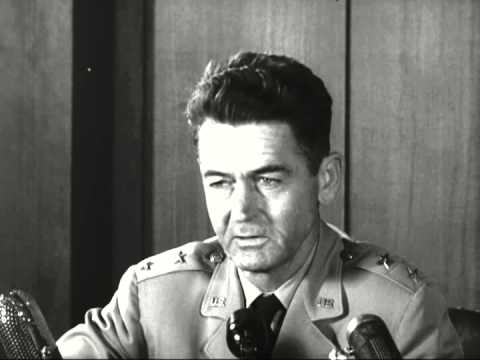
Maj. Gen. John A. Samford's Statement on "Flying Saucers" (July 31, 1952)
Army Signal Corps footage from the U.S. National Archives (111-LC-30875), dated July 31, 1952, with filmed statements by Samford and, separately, Donald Keyhoe. It is distinct from the July 29 press conference.
UFO — The Washington Merry-Go-Round
A focused walkthrough of the two 1952 Washington weekends, the radar timeline, and the jet interceptions.
1952: The Invasion of Washington — Full Documentary
A full-length documentary treatment of the July 1952 wave, from the initial radar contacts through the Pentagon press conference.
Sources
- "1952 Washington, D.C., UFO incident," Wikipedia (comprehensive summary with citations to primary sources). en.wikipedia.org
- Ruppelt, Edward J. The Report on Unidentified Flying Objects, Doubleday, 1956 (multiple later editions). Full text, ch. 12: gutenberg.org
- Borden, Richard C. & Vickers, T. K. A Preliminary Study of Unidentified Targets Observed on Air Traffic Control Radars. CAA Technical Development Report, May 1953.
- Thayer, Gordon D. “Optical and Radar Analyses of Field Cases.” In E. U. Condon (ed.), Scientific Study of Unidentified Flying Objects, Bantam, 1969.
- McDonald, James E. “Meteorological Factors in Unidentified Radar Returns.” 14th Radar Meteorology Conference, American Meteorological Society, November 17–20, 1970. patrickgross.org (PDF)
- Gilgoff, Dan. “Saucers Full of Secrets.” Washington City Paper, December 14, 2001. washingtoncitypaper.com
- U.S. Army Signal Corps. “Maj. Gen. John A. Samford and Maj. Donald Keyhoe's Statement on ‘Flying Saucers’,” July 31, 1952. NARA 111-LC-30875 (via The Black Vault). theblackvault.com
- Villarroel, Beatriz, et al. “Aligned, Multiple-transient Events in the First Palomar Sky Survey.” Publications of the Astronomical Society of the Pacific, 2025.
- Minutes of Press Conference Held by Major General John A. Samford, Director of Intelligence, USAF, The Pentagon, July 29, 1952. Transcript reproduced at saturdaynightuforia.com
- Chop, Albert M. & Fournet, Dewey. Accounts of the July 26–27, 1952 radar room, as reported in Ruppelt (1956) and later secondary histories
- McDonald, James E. Statement to the House Committee on Science and Astronautics, Symposium on Unidentified Flying Objects, July 29, 1968. files.ncas.org
- "James E. McDonald," Wikipedia. en.wikipedia.org
- Central Intelligence Agency. "Report of Meetings of Scientific Advisory Panel on Unidentified Flying Objects Convened by Office of Scientific Intelligence, CIA, January 14–18, 1953" (the Robertson Panel Report). Full text at en.wikisource.org
- Haines, Gerald K. "CIA's Role in the Study of UFOs, 1947–90," Studies in Intelligence, Semi-Annual Edition No. 1, 1997. cia.gov
- "Robertson Panel," Wikipedia. en.wikipedia.org
- National Archives and Records Administration. "Saucers Over Washington: The History of Project Blue Book," Pieces of History blog, December 19, 2019. prologue.blogs.archives.gov
- National Archives and Records Administration. "Public Interest in UFOs Persists 50 Years After Project Blue Book Termination." archives.gov
- Ghosts of DC. "1952 Washington UFO Sightings: Jets Scrambled Over the Capitol," February 26, 2018 (reproduces extended Samford press-conference transcript excerpts). ghostsofdc.org
- CNN. "In 1952, DC's skies were littered with US fighter jets chasing UFOs. More than 70 years later, the mystery persists," December 28, 2025. cnn.com
- MUFON. "UFOs over Washington, DC — 1952," May 14, 2021. mufon.com
- Seattle Times. "Something in the Air: 50 Years Ago, UFOs Streaked Over D.C.," July 27, 2002 (includes retrospective quotes from Philip Klass and Bruce Maccabee). archive.seattletimes.com
- Blue Blurry Lines. "General John A. Samford's 1952 UFO Disclosure," August 2017 (analysis of the Samford press conference and the disputed See magazine follow-up interview). blueblurrylines.com
- "John A. Samford," Wikipedia. en.wikipedia.org
- "Donald Keyhoe," Wikipedia. en.wikipedia.org
- Peebles, Curtis. Watch the Skies!: A Chronicle of the Flying Saucer Myth, Smithsonian Institution Press, 1994
- Randle, Kevin D. Invasion Washington: UFOs Over the Capitol, HarperTorch, 2001
- Hall, Michael D. & Connors, Wendy A. Captain Edward J. Ruppelt: Summer of the Saucers — 1952, Rose Press International, 2000
- Clark, Jerome. The UFO Encyclopedia, 4th Edition, Relevant Information LLC
- Richard Crist. "The Washington, D.C. UFO Overflights of July, 1952," Medium. medium.com
- Enigma Labs. "Washington D.C. Incident" case library entry. enigmalabs.io
- United States Air Force. Major General John A. Samford, remarks and Q&A, Pentagon press conference, July 29, 1952; archival footage preserved by the National Archives and Records Administration.
- Solano, Enrique & Villarroel, Beatriz, et al. "A bright triple transient that vanished within 50 min." Monthly Notices of the Royal Astronomical Society, Vol. 527, Issue 3, January 2024, pp. 6312–6320. academic.oup.com / preprint: arxiv.org/abs/2310.09035
Corrections (October 2026)
This page was checked against Ruppelt's 1956 account, the minutes of the July 29, 1952 press conference and the later technical literature in October 2026. Corrected: Pierman's position (just out of National, not near Martinsburg); the date and setting of the Landry call (July 29 in Washington, per Ruppelt); the 7,000 mph figure (Ruppelt places it on the first night); Samford's quotes on the report breakdown and on Patterson; the claim that three radars repeatedly tracked targets simultaneously (Ruppelt says once); Blue Book's report totals; Keyhoe and NICAP (he became director in 1957 and did not found it); the July 31 Samford–Keyhoe "press session" (an Army film pairing two statements); the July 24 colonels' sighting; and the VASCO material. Removed as untraceable: the witnesses Joseph Gigandet and Charles E. Cummings and their quotes; McDonald's "physically impossible" and Barnes's "not shapeless blobs" quotations; a CAA "indicated in almost every instance" quotation; the "Delaware Air National Guard" identification of the F-94s; and VASCO claims of 298,000 candidates and the "two most improbable" dates. Added: the Andrews tower operators' and Patterson's later retractions, the steamboat episode, the 1953 CAA study, the Condon Report's view, and McDonald's 1970 analysis.
Following this review, the rating was changed from Credible 82 to Credible 68 (October 26, 2026), because the higher rating had rested partly on claims corrected or removed above.
See something inaccurate? Have additional information or sources?
Suggest an Edit →Last Updated: August 2026