
Invasion Washington
UFOs Over the Capitol
Core Thesis
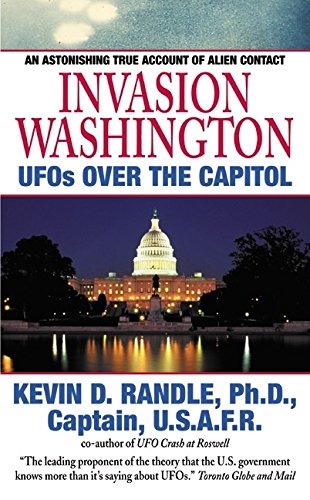
Invasion Washington: UFOs Over the Capitol is retired military intelligence officer Kevin D. Randle's 2001 book-length civilian investigation of what this site's own research treats, following Randle's own framing, as arguably the single most consequential UFO case in American history: the two consecutive Saturday-night radar-visual waves over Washington, D.C. in July 1952, in which unidentified returns tracked by National Airport and Andrews AFB radar, corroborated by ground and airborne visual sightings, prompted jet interceptor scrambles and drew a personal inquiry from President Truman. Applying the same investigative discipline he brought to his Roswell research, Randle works through the case's competing explanations -- temperature inversion, misidentified aircraft, genuine anomaly -- with what reviewers describe as unusually even-handed scrutiny for the UFO-literature genre, a genre this site's own research has repeatedly found tends toward either uncritical advocacy or reflexive dismissal rather than the kind of careful, weighed treatment Randle's military-intelligence training equipped him to apply. This site's own research draws on it for two of its own related case files: the Washington, D.C. UFO Flap of 1952 itself, and Operation Mainbrace, the NATO naval exercise whose own UFO reports began mere weeks later.
About the Author
Kevin D. Randle is a retired U.S. Army lieutenant colonel who served as a helicopter pilot in Vietnam and a battalion intelligence officer in Iraq, bringing a professional intelligence-analysis background to civilian UFO research that few of his peers in the field share. This site's own key-figures library already documents his role as the most systematic Roswell investigator working, author of UFO Crash at Roswell and The Truth About the UFO Crash at Roswell, and notes his unusual willingness to publicly withdraw support for witnesses once credibility problems emerged in their testimony.
By the time this book appeared in 2001, Randle had already built a body of published UFO research spanning more than a decade, and had a reputation, per this site's own research into secondary reviews, as "the voice of reasoned inquiry" within a field frequently criticized for uncritical credulity -- a reputation this book's own even-handed treatment of the 1952 Washington case, weighing genuinely anomalous radar-visual correlation against mundane candidate explanations rather than assuming either answer, was written to reinforce. That reputation rests specifically on documented instances of Randle publicly reversing his own earlier public positions once new evidence undermined them, a track record this site's own key-figures research treats as considerably more probative of genuine investigative integrity than any claim of open-mindedness made in the abstract.
Randle went on to revisit this same case in a later, expanded work titled The Washington Nationals, incorporating additional witness interviews and material gathered after this book's original 2001 publication -- a direct continuation of the specific research project this book represents, and evidence Randle himself regarded the case as warranting sustained, ongoing investigation rather than a single closed treatment.
Randle's professional writing output is genuinely prolific: he is credited with more than 80 published books across both his UFO research and separate military-history and fiction writing, a volume of output this site's research treats as directly relevant context for evaluating this specific title -- a career investigator with a sustained decades-long publication record, rather than a single-book author writing about one case in isolation.
Historical Context & Origins
The book's subject sits at the exact center of American ufology's most intensely documented year: more UFOs were reported to Project Blue Book in 1952 than in any other year in U.S. history, and the Washington radar-visual incidents of July 19 and July 26, 1952 were the specific episode that pushed the phenomenon onto front pages nationwide and drew President Truman's own direct inquiry to Blue Book's leadership. This site's own Washington, D.C. UFO Flap of 1952 case file (Case File #015) documents the case this book investigates in full.
The Air Force's own response -- a Pentagon press conference held by Major General John A. Samford, the largest since World War II -- attempted to settle the matter publicly with a temperature-inversion explanation for the radar returns. Randle's book, written nearly five decades later with the benefit of declassified records and surviving witness interviews unavailable to contemporary reporters, revisits that official explanation directly rather than simply repeating it, a central part of what this site's research treats as the book's continuing evidentiary value.
This site's own Operation Mainbrace case file (Case File #129) documents a related wave of UFO reports surrounding a NATO naval exercise beginning weeks after the Washington incidents, and cites this book specifically for "context on the 1952 wave and its aftermath" -- treating the Washington case as the immediate precedent shaping how military and press observers interpreted the subsequent Mainbrace reports.
The book's own scientific and skeptical reception has continued to evolve well beyond its original 2001 publication. This site's own Washington, D.C. UFO Flap of 1952 case file documents a specific 50th-anniversary technical reassessment of the radar data published in 2002 by Navy optical physicist Bruce Maccabee, alongside earlier quantitative critiques of the Air Force's own temperature-inversion explanation from atmospheric physicist James E. McDonald -- both of which postdate this book's underlying investigation and represent exactly the kind of continued, independent scientific engagement a case worth a dedicated book-length treatment should be expected to generate.
Core Arguments & Key Concepts
The book's central argument, per its own promotional framing and consistent with Randle's established method, is that the Washington radar-visual correlation -- unidentified returns tracked simultaneously by multiple independent radar installations, Washington National Airport and Andrews Air Force Base -- alongside ground-witness visual sightings and, on at least one occasion, jet-interceptor pursuit -- represents a genuinely higher evidentiary standard than the single-witness or single-sensor reports that make up the bulk of UFO literature, and deserves correspondingly serious scientific scrutiny rather than reflexive dismissal.
A second theme is the book's documentation of alleged official pressure on witnesses to alter or soften their original testimony, a claim this site's research treats as a genuinely serious allegation given Randle's own military-intelligence background and correspondingly higher bar for crediting claims of official misconduct without direct documentary support. Randle's own professional experience conducting military intelligence debriefs and interrogations, per this site's research, gives that specific allegation a level of informed scrutiny a purely civilian journalist investigating the same claim would be less equipped to bring, since evaluating whether a witness's account shows the specific signs of coached or pressured testimony is itself a skill his military intelligence career would have directly developed.
A third theme, reflected in reviewer commentary this site's research located, is that the book does not resolve into simple advocacy: some reviewers specifically noted that Randle "waffled" in his final assessment of certain individual sightings within the broader case, declining to force every component report -- the multiple separate radar contacts, the various ground and airborne visual sightings, the jet-interceptor pursuits -- into either the anomaly or the inversion-explanation column -- a genuine interpretive caution this site's research treats as a strength consistent with his broader reputation, not a structural flaw, even where it makes for a less tidy narrative conclusion.
A fourth theme is the book's treatment of the case's official resolution as itself a subject of legitimate scrutiny rather than a settled endpoint. Major General John Samford's Pentagon press conference offered temperature inversion as the Air Force's public explanation for the radar returns, but this site's own case-file research documents that the same explanation was directly disputed by both contemporary and later credentialed skeptics of the Air Force's own account, including James E. McDonald's technical rebuttal based on direct re-interviews of surviving witnesses -- exactly the kind of competing expert disagreement this book, per its own even-handed reputation, does not attempt to paper over. This site's own case-file research also documents the opposing skeptical case in comparable depth: Harvard astronomer Donald H. Menzel remained the most prominent public advocate of the inversion explanation for decades, while Aviation Week senior editor Philip J. Klass defended the conventional-radar-artifact reading and separately linked the later national decline in radar UFO reports to the introduction of digital signal filtering -- a genuinely testable, falsifiable prediction this site's research treats as a mark of a serious skeptical argument rather than mere dismissal.
Key Cases & Evidence Discussed
The Washington, D.C. UFO Flap of 1952 (Case File #015) is this book's entire subject: unidentified radar returns over the nation's capital on the nights of July 19 and July 26, 1952, corroborated by control-tower and airborne visual sightings, and followed by the Pentagon's largest press conference since World War II. This site's own case file credits the book as "the most thorough book-length civilian investigation devoted specifically to the 1952 Washington flap, written by a retired military intelligence officer." This site's own research into the case file's named witness roster documents senior air-traffic controller Harry Barnes personally watching unidentified returns cross controller Edward Nugent's radarscope, alongside separate jet-interceptor scrambles that, in at least one pilot's account, involved chasing lights that outmaneuvered his own aircraft -- exactly the kind of multi-witness, multi-sensor correlation this book's own central argument treats as elevating the case above the great majority of single-witness UFO literature.
Operation Mainbrace (Case File #129), a September 1952 NATO naval exercise that generated its own cluster of UFO reports from military personnel, is cited by this site's own case file as drawing directly on this book for "context on the 1952 wave and its aftermath" -- situating Mainbrace's own reports within the same charged national atmosphere the Washington incidents had created only weeks earlier.
Critical Reception & Controversies
This book carries a modest but real Goodreads record: 3.38 out of 5 stars averaged across 13 ratings, checked August 2026 -- disclosed here honestly rather than substituted with the more common "no ratings found" pattern seen elsewhere in this site's research.
Secondary commentary this site's research located describes the book as among Randle's finest and most persuasive works, specifically crediting his reputation as a rigorous, skeptical-leaning investigator within a field that frequently rewards the opposite. The same commentary notes some reviewers found editorial rough edges and felt Randle occasionally hedged rather than committing to a single verdict on certain individual sightings within the case -- a criticism this site's research treats as a fair, disclosed limitation rather than a reason to discount the book's underlying research, since the alternative (forcing every ambiguous individual report into a single tidy verdict) would itself misrepresent how genuinely mixed the surviving evidentiary record for a fifty-year-old radar-visual case actually is.
This site's research also attempted to verify an Amazon rating for this title, but Amazon's bot-detection system repeatedly blocked automated requests to the listing during this session, the same persistent pattern encountered across every title checked this session. Per this site's own Amazon Rating Display Protocol, this gap is disclosed honestly here rather than fabricated or silently omitted.
Influence & Legacy
Randle's own decision to return to this exact case in a later, expanded book, The Washington Nationals, incorporating new witness material gathered after this book's 2001 publication, is itself evidence of the case's continuing evidentiary richness and of this book's own status as the foundational civilian investigation later work had to build on rather than replace.
Within this site's own key-figures library, this book adds a fifth documented Randle title alongside his Roswell books and The Abduction Enigma, reinforcing his position as this site's most extensively cited single UFO investigator-author and giving readers a direct connection between his Roswell-era investigative reputation and his separate, independently developed work on the 1952 Washington case.
The Washington case itself has continued to draw fresh mainstream press coverage well beyond this book's own 2001 publication window, including a CNN feature examining the incident more than seven decades later -- a durability of public interest this site's research treats as indirect evidence that Randle's own assessment of the case's historical significance, made explicit in this book's title and framing, has held up over the subsequent quarter-century rather than fading into a settled, forgotten footnote of early Cold War-era Americana.
This book's own place within Randle's wider bibliography also illustrates a genuinely deliberate specialization strategy across his career: rather than writing a single general UFO survey, he has repeatedly chosen to produce dedicated, book-length treatments of individual high-profile cases -- Roswell, the Washington radar-visual wave, and the abduction phenomenon addressed in The Abduction Enigma -- each investigated with the same case-specific depth this site's own research values in a source, rather than the shallower, broader coverage a single omnibus survey would necessarily entail.
The Book
As an Amazon Associate, OverClassified may earn from qualifying purchases made through this link, at no extra cost to you.
Why This Is Essential Reading
Invasion Washington earns its place on this list as the most thorough single civilian investigation this site's own library documents of the July 1952 Washington radar-visual case, written by an investigator whose military-intelligence background and demonstrated willingness to publicly walk back weak witness claims gives his conclusions real credibility within a field not always known for either. Its direct citation on this site's own Washington, D.C. UFO Flap of 1952 and Operation Mainbrace case files reflects the case's genuine centrality to the broader 1952 wave, and Randle's own later return to the material in an expanded follow-up book confirms this original investigation's continued evidentiary value two decades on. Read alongside his separate Roswell work, this book demonstrates that Randle's reputation for disciplined, skeptical-leaning UFO investigation was never limited to a single celebrated case, but applied consistently across the distinct, independently researched incidents his decades-long career has covered.
Related Cases & Theories
Essential Viewing

Sources Cited
- Randle, Kevin D. Invasion Washington: UFOs Over the Capitol. HarperTorch, 2001 (ISBN 0-380-81470-6, cited here).
- "Invasion Washington: UFOs Over the Capitol." Goodreads (3.38 average rating, 13 ratings, checked August 2026). goodreads.com
- "Invasion Washington: UFOs Over the Capitol." AbeBooks (ISBN 9780380814701, marketplace listing photograph used for this article's cover image). abebooks.com
- "Kevin Randle Discusses Past Shows, Past Guests, UFO to UAP, and the Latest in Disclosure." Rob McConnell / X-Zone Radio-TV, YouTube (author interview, video verified via oEmbed). youtube.com
- This site's own resources library: Full Reading List, where this exact 2001 edition is cited across 2 separate case-file pages.
- This site's own key-figures entry: Kevin Randle, for his full biography and site-wide case connections.
- This site's own case file: Washington, D.C. UFO Flap of 1952, this book's central subject.
- This site's own case file: Operation Mainbrace, cited for this book's context on the wider 1952 wave.
- This site's own essential-reading entry: UFO Crash at Roswell, Kevin Randle's earlier, foundational 1991 Roswell investigation.
- This site's own essential-reading entry: The Abduction Enigma, another Kevin Randle title documented on this site.
- "1952 Washington, D.C. UFO incident." Wikipedia (general background on the wave this book investigates). en.wikipedia.org
- Hall, Michael D. & Connors, Wendy A. Captain Edward J. Ruppelt: Summer of the Saucers -- 1952. Rose Press International, 2000 (companion history of the same 1952 wave, cited on this site's own Washington D.C. 1952 case file).
- "In 1952, DC's skies were littered with US fighter jets chasing UFOs. More than 70 years later, the mystery persists." CNN (2025 feature revisiting the case this book investigates). cnn.com
- "1952 Washington, D.C., UFO incident." Military Wiki / Fandom (secondary overview of the wave this book documents). military-history.fandom.com
Have corrections, additional research, or peer-reviewed sources? Help improve this entry.
Suggest an Edit