
The Abduction Enigma
The Truth Behind the Mass Alien Abductions of the Late Twentieth Century
Core Thesis
The Abduction Enigma is the book Kevin D. Randle wrote two years after Project Blue Book Exposed turned the Air Force's own declassified files against its official verdicts — except this time Randle, documentarian Russ Estes, and clinical psychologist William P. Cone turn the same case-by-case, evidence-against-itself method on ufology's own investigative apparatus rather than the government's. Drawing on Estes's videotaped interviews with more than 150 self-identified abductees and Cone's clinical practice, the three authors argue that hypnotic regression — the technique Budd Hopkins and John E. Mack had by 1999 made abduction research's standard evidence-gathering tool — does not recover suppressed memories so much as construct them, through leading questions asked of suggestible subjects by hypnotists who, in Randle's own words, end up "directing the stories as they are being told." Their proposed alternative is not fraud or delusion but ordinary physiology: in their own sample of 316 interview subjects, nearly half described an initial experience consistent with sleep paralysis, a well-documented REM-sleep phenomenon that, filtered through a pop-culture-supplied abduction script and then elaborated under hypnosis, can manufacture a conviction indistinguishable from genuine memory. As Randle put it on his own blog years later, "the point of The Abduction Enigma was to suggest that the research, as it has been done, is flawed" — not that abductions never happened, but that the case for them, built almost entirely on hypnotically recovered testimony, "is far from proven."
About the Author
This site's own Essential Reading entry on Project Blue Book Exposed covers Kevin D. Randle's military service, education, and decades-long Roswell career in full; this entry does not repeat that ground. What matters here is a narrower and, on its face, counterintuitive point: in 1999, the same year this book appeared, Randle was still very much a Roswell believer, three years away from any public doubt about a crashed craft near New Mexico. His turn toward skepticism on hypnotically recovered abduction testimony was a separate, earlier development, running on its own track alongside his continued belief in a very different category of UFO claim — a distinction this book's reception rarely credits him for making.
That abduction-specific skepticism was not abstract. Randle has written that he personally listened to hypnosis sessions in which a subject, under regression, second-guessed his own recovered memory in real time — telling the hypnotist, in one case Randle cites directly, "I think it's my imagination" — and concluded that the technique itself, not any individual investigator's bad faith, was the structural problem: hypnotists, he argued, inevitably end up "directing the stories as they are being told," regardless of their intentions. That is a methodological complaint about a specific evidence-gathering tool, distinguishable from a verdict on any specific case's underlying reality, and it is the reason this book reads less like a renunciation of Randle's earlier UFO advocacy than like an investigator applying the same document-versus-disposition scrutiny he brought to Project Blue Book's files to a different kind of file: the hypnotic-regression transcript.
His co-authors brought two other vantage points. Russ Estes, an artist and documentary filmmaker who produced a multi-part television documentary on the UFO subject, supplied the book's evidentiary base: videotaped interviews with more than 150 people who identified as abductees, conducted before any of the book's three authors reached a settled conclusion about what the interviews meant. William P. Cone, a clinical psychologist whose own interest in the subject reportedly began with unusual personal experiences of his own, brought the clinical framework the book leans on for distinguishing genuine traumatic recall from hypnotically constructed narrative — and, as a Committee for Skeptical Inquiry sympathizer, a professional skepticism toward the therapeutic community's handling of recovered-memory claims generally. Publisher's-jacket biographical copy for the book describes all three authors as having reported paranormal experiences of their own, a detail the book's reviewers on both sides of the abduction debate have treated as relevant to weighing its argument.
Historical Context & Origins
The Abduction Enigma arrived in June 1999, midway through a decade in which hypnotic regression had gone from a fringe investigative technique to abduction research's dominant methodology. Budd Hopkins's 1981 Missing Time had formalized the approach; Whitley Strieber's 1987 Communion had made the large-eyed grey a mass-market fixture; and Harvard psychiatrist John E. Mack's 1994 Abduction: Human Encounters with Aliens had given the technique its most credentialed clinical endorsement yet, following directly on the heels of the June 1992 MIT Abduction Study Conference that had brought hypnotic-regression researchers together under one institutional roof. Randle, Estes, and Cone published into that specific climate — not against a fringe practice but against what had, by 1999, become abduction research's evidentiary mainstream.
The book also arrived just two years after Randle's own Project Blue Book Exposed (1997), which had built its case entirely on testing an official government disposition against a file's own internal evidence. The Abduction Enigma repeats that structural move against a different institution: rather than auditing Blue Book's case dispositions against Air Force paperwork, it audits abduction researchers' hypnotic-regression transcripts against what clinical psychology and sleep research already knew by the late 1990s about suggestibility, confabulation, and REM-intrusion phenomena like sleep paralysis.
It landed, too, at a specific moment in the broader "memory wars" that had consumed clinical psychology through the 1990s — the same dispute over recovered-memory therapy's reliability for childhood trauma claims that would soon inform Harvard psychologist Susan Clancy's own research program. Where Clancy's Abducted arrived in 2005 from inside academic cognitive science, with a laboratory research pedigree behind its false-memory model, The Abduction Enigma arrived six years earlier from inside ufology itself — written by researchers who had spent years, in Estes's case on videotape, taking abduction claims seriously as an investigative subject before concluding the field's central evidence-gathering tool could not support the weight being placed on it.
Core Arguments & Key Concepts
The book's central argument is narrower than its marketing sometimes suggests, and Randle has been explicit about that distinction in his own later writing: the claim is not that abductions never happened, but that hypnotic regression — the technique on which nearly every well-known abduction case's most vivid testimony depends — cannot reliably distinguish a recovered memory from a hypnotically constructed one. The authors' operating premise, drawn from Cone's clinical background and Estes's interview archive, is that a hypnotist working with a suggestible subject in a trance state, especially one who already expects an abduction narrative to emerge, inevitably shapes the resulting testimony rather than neutrally excavating it — what Randle elsewhere summarized as hypnotists "directing the stories as they are being told."
Against that discredited evidence-gathering method, the book proposes sleep paralysis as the more parsimonious explanation for a large share of reported abduction experiences. Sleep paralysis is a well-documented REM-sleep phenomenon in which a person regains consciousness while the brain's paralysis mechanism remains active, often accompanied by a sensed presence, pressure on the chest, and hypnopompic hallucination. In the authors' own sample of 316 interview subjects, they report that nearly half described an initial experience consistent with this phenomenon — a real, physiologically grounded starting point the book treats as genuine rather than fabricated, with the abduction interpretation supplied afterward by cultural scripting and then elaborated, detail by detail, under hypnosis.
The book categorizes its interview subjects into two broad types — "contactees," who describe benign ship tours and communicative encounters, and "abductees," who report invasive physical examinations, implants, and, in some accounts, reproductive material collection — and traces how the earlier, more benign contact narrative common in 1950s reports evolved, decade by decade, into the more elaborate and frequently traumatic abduction narrative that dominated by the 1990s. The authors treat this evolution itself as evidence: a genuinely external phenomenon should not track pop-culture film and television imagery as closely as the reported entity descriptions and examination-room details do.
Kirkus Reviews summarized the book's overall argumentative posture precisely: "these three self-proclaimed believers have actually debunked every paranormal abduction phenomenon with a well-reasoned terrestrial explanation." That framing captures the book's specific rhetorical position within ufology — not outside skeptics dismissing the field, but researchers who had each reported paranormal experiences of their own, working from inside the abduction-research tradition to challenge its central investigative tool without claiming the underlying mystery was necessarily nothing at all.
Key Cases & Evidence Discussed
This book does not organize itself around a small set of famous named cases the way a single-incident investigation would; its evidentiary base is Russ Estes's own archive of more than 150 videotaped abductee interviews, examined collectively for the sleep-paralysis, cultural-scripting, and hypnotic-suggestion patterns the book's argument depends on. Two of this site's own case files nonetheless cite this exact 1999 edition directly, and both illustrate the book's central methodological concern from opposite directions.
This site's own Stanford, Kentucky Abduction (Case File #216, 1976) cites The Abduction Enigma as directly relevant to "the exact methodological issue raised by this case's own polygraph examiner": Lexington Police detective James C. Young, a self-described prior skeptic who found no evidence of deception in any of the three women he tested, nonetheless flagged in his own written report that MUFON investigators had shown the witnesses standardized entity sketches before any hypnosis session took place — precisely the sort of pre-hypnotic contamination risk this book's critique of leading-question methodology is built to identify. The case took place near Stanford, Kentucky, and its detailed examination narrative, like most cases this book discusses, exists only because of hypnotic regression conducted months after the original sighting.
This site's own Emilcin Abduction (Case File #166, 1978) cites this book as relevant to evaluating both Jan Wolski's original testimony and the case's separate, unproven 2012–13 allegation that a rival researcher had orchestrated the entire narrative through hypnotic suggestion — a claim that inverts this book's usual direction of concern (hypnosis manufacturing a false abduction memory) into hypnosis allegedly being used to implant one deliberately. The case occurred near Emilcin, Poland, and its own investigating team's multi-week psychological battery on Wolski is the kind of pre-hypnosis clinical screening this book's argument implies should happen more often, not less.
The book's real companion piece on this site is not a case file but another Essential Reading entry: Abducted, Susan A. Clancy's 2005 Harvard University Press study, which arrived six years later and from a very different institutional position — academic cognitive psychology rather than insider ufology — but converges on nearly the identical explanatory mechanism: sleep paralysis, cultural scripting, and hypnotic suggestion combining to manufacture a sincerely held, vivid, and false memory. Read together, the two books trace the same argument being independently reached from opposite ends of the UFO-research and academic-psychology worlds a decade apart.
Critical Reception & Controversies
Kirkus Reviews, in its original May 1999 notice, called the book "a well-written anti-abduction perspective on alien encounters that systematically examines and refutes each argument used by abduction proponents," while noting the specific irony that its three authors were "self-proclaimed believers" in other paranormal experiences even as they debunked the abduction phenomenon specifically with "well-reasoned terrestrial explanation." Reader reception on Goodreads has settled in the low-to-mid 3-star range across several dozen ratings — solidly positive but, like Project Blue Book Exposed's own reception, modest in volume rather than a genre-defining bestseller.
The sharpest published critique came from within abduction-research circles itself, in a joint review by Keith Rowell, psychologist Janet Colli, and clinical hypnotherapist Deborah Lindemann published on the researcher-run site alienjigsaw.com. The reviewers argued the authors lacked the specific clinical and investigative standing to adjudicate the questions they were asking — Rowell wrote pointedly that Randle was "only 'qualified' because the academic establishment... has failed in its duty to study this phenomenon" — and disputed the book's memory-science claims directly: Colli challenged the assertion that there is "no difference between a real memory and an induced memory," citing PET-scan research distinguishing traumatic-memory processing, while Lindemann drew on Carleton University research to argue that even successfully suggested false memories tend to retain a residue of doubt the subject can recognize, which the book's account of confident, detailed hypnotic recall did not fully address. Their overall verdict called the book's psychological analysis "a half-baked affair."
That critique is worth reading against William Cone's own documented position specifically, since it bears directly on the alienjigsaw.com reviewers' qualifications objection: Cone has separately described much of the abduction-research field's investigative practice as "atrociously bad," arguing that poorly trained researchers routinely impose their own beliefs on hypnotized subjects — a criticism aimed at the same leading-question dynamic this book's central argument turns on, made by a co-author reviewers elsewhere identify as a Committee for Skeptical Inquiry sympathizer rather than a neutral clinician without institutional priors of his own.
A further limitation, distinct from any reviewer's specific objection, is structural: the book's central claim that sleep paralysis explains a large share of reported abductions rests on the authors' own 316-subject interview sample rather than on an independently peer-reviewed clinical study, a data-collection method that, like the Appendix B case listing in Randle's own Project Blue Book Exposed, cannot be as readily cross-checked by outside researchers as later, more rigorously controlled academic work on the same question — including the peer-reviewed research program Susan Clancy would publish six years later.
Influence & Legacy
This book's most concrete, independently verifiable influence is documented on this very site: this exact 1999 Forge first edition, under ISBN 0312867085, is cited directly on this site's own resources library and on two of its case files, the Stanford, Kentucky Abduction and the Emilcin Abduction, each drawing on it specifically to evaluate the reliability of hypnotically recovered testimony central to their own subjects' accounts.
Within Randle's own bibliography, the book sits alongside Faces of the Visitors and The Spaceships of the Visitors as one of three collaborations with Russ Estes, and it stands as the clearest documented marker of his abduction-specific skepticism running in parallel with, rather than replacing, his continued Roswell advocacy of the same period — a distinction that matters for reading his later, much more publicized 2010s reversal on whether any craft crashed at Roswell at all as a separate, later development rather than part of the same 1999 turn.
More broadly, the book represents an early instance of a specific and fairly rare category within ufology literature: a skeptical challenge to abduction testimony's central evidentiary method written by researchers embedded in the field rather than dismissing it from outside, a category that grew substantially six years later when Susan Clancy's Abducted arrived from a different direction entirely — academic cognitive psychology rather than insider ufology — and converged on nearly the same sleep-paralysis-plus-cultural-scripting explanatory model, giving the mechanism this book proposed in 1999 an independent, more rigorously peer-reviewed confirmation by 2005.
The book remains in active secondhand and digital circulation more than a quarter-century after publication, and Randle continues to reference its central arguments about hypnotic regression's unreliability in his ongoing research blog and podcast appearances, keeping the book's specific methodological critique in circulation well past its original publication window.
The Book
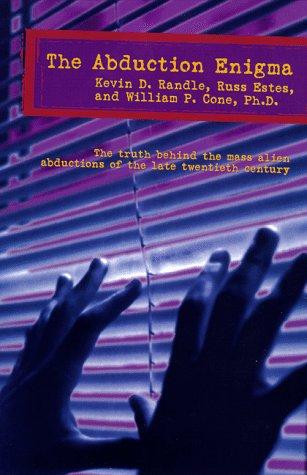
The Abduction Enigma
The Truth Behind the Mass Alien Abductions of the Late Twentieth Century
Find on Amazon →As an Amazon Associate, OverClassified may earn from qualifying purchases made through this link, at no extra cost to you.
Why This Is Essential Reading
The Abduction Enigma earns its place on this list for a position few other books manage to occupy convincingly: a skeptical challenge to alien-abduction testimony's central evidentiary method, written not by outside debunkers but by a documentarian who spent years on videotape with abductees, a clinical psychologist who treated them, and a Roswell investigator who, even as this book was published, still believed a craft had gone down in New Mexico in 1947. That combination gives Kevin D. Randle, Russ Estes, and William P. Cone's critique of hypnotic regression real standing inside the tradition it challenges, and Randle's own later, blunt summary of the project — that abduction research "as it has been done, is flawed" and "the case is far from proven" — still reads as a precise statement of the book's actual, narrower claim rather than the blanket dismissal its marketing sometimes implied. The book's own real limitations, documented honestly in this entry's Critical Reception section, are the alienjigsaw.com reviewers' pointed challenge to its authors' clinical qualifications and its reliance on an internal, non-peer-reviewed 316-subject sample rather than controlled academic research. Read against those objections, and alongside Susan Clancy's later, more rigorously sourced Abducted, this book is essential less for settling the sleep-paralysis question definitively than for being the moment a working abduction-research insider first made the case, from inside the field, that its own signature investigative technique could not bear the evidentiary weight being placed on it.
Related Cases & Theories
Essential Viewing

Hypnotherapy Used To Uncover Hidden Memories Of Alien Abduction | UFOs: The Lost Evidence
Discovery Australia — A general-audience segment examining how hypnotherapy sessions are used to recover reported abduction memories — a direct illustration of the evidence-gathering method this book's central argument challenges, verified via YouTube oEmbed before inclusion.

Kevin Randle - Reflections of a UFO Investigator
Rob McConnell / The 'X' Zone — A reflective interview with Kevin Randle on his decades-long UFO investigation career, spanning the Roswell advocacy and abduction-research skepticism that ran side by side through the years surrounding this book's publication, verified via YouTube oEmbed before inclusion.
Sources Cited
- Randle, Kevin D., Estes, Russ & Cone, William P. The Abduction Enigma: The Truth Behind the Mass Alien Abductions of the Late Twentieth Century. Forge/Tom Doherty Associates, New York, 1999 (ISBN 0312867085 / 9780312867089, cited here, matching the edition already cited by Amazon link on this site's resources library). archive.org
- "THE ABDUCTION ENIGMA." Kirkus Reviews (original review: release date June 1, 1999, publisher Forge, ISBN 0-312-86708-5, 416 pp.; critical summary and verdict). kirkusreviews.com
- "Kevin D. Randle." Wikipedia (biography: military service, education, Roswell research career, later reversal on Roswell). en.wikipedia.org
- Randle, Kevin. "The Abduction Enigma." A Different Perspective (personal research blog), August 2007 (author's own account of the book's purpose, methodology, the Philip Osborne hypnosis example, and the 316-subject sleep-paralysis finding). kevinrandle.blogspot.com
- Rowell, Keith, with Colli, Janet, Ph.D. & Lindemann, Deborah, CHT. "Abduction Enigma — A Debunking Book" (joint critical review). alienjigsaw.com. alienjigsaw.com
- "The Abduction Enigma." AbeBooks (Forge/Tom Doherty Associates, 1999 first edition, ISBN 9780312867089, bibliographic record). abebooks.com
- "The Abduction Enigma: An Investigation of the Alien Abduction Phenomenon." Amazon.com (ISBN 0312867085 / 9780312867089, hardcover product listing and publisher jacket-copy author bios). amazon.com
- "The Abduction Enigma: The Truth Behind the Mass Alien Abductions of the Late Twentieth Century." Amazon.com (ISBN 0312872704 / 9780312872700, Tor Books 2000 trade paperback reprint listing, confirming the cover tagline used as this printing's formal subtitle). amazon.com
- "The Abduction Enigma." Goodreads (reader ratings and reviews). goodreads.com
- "Russ Estes." UFO Watchdog (biographical note: documentary filmmaking background, videotaped abductee interviews, collaborations with Kevin Randle). ufowatchdog.com
- "The Spaceships of the Visitors: An Illustrated Guide to Alien Spacecraft." Bookshop.org / publisher listing (Randle/Estes author bios, referencing Estes's documentary and interview background). amazon.com
- "The abduction enigma." Internet Archive (Forge, New York, 1999, catalog record and full-text borrowing access). archive.org
- This site's own resources library: Full Reading List, where this exact edition (ISBN 0312867085) is cited directly.
- This site's own case file: Stanford, Kentucky Abduction (Case File #216), which cites this book on the hypnotic-contamination issue raised by its own polygraph examiner.
- This site's own case file: The Emilcin Abduction (Case File #166), which cites this book on evaluating Jan Wolski's testimony and the 2012–13 hypnotic-implantation hoax allegation.
- This site's own essential-reading entry: Project Blue Book Exposed by Kevin D. Randle, the 1997 book whose file-versus-disposition method this book applies to a different institution.
- This site's own essential-reading entry: Abducted by Susan A. Clancy, the 2005 book that independently converges on nearly the same sleep-paralysis-plus-cultural-scripting explanatory model.
- This site's own key-figures entry: Kevin Randle, for his full biography and case connections beyond this book.
Have corrections, additional research, or peer-reviewed sources? Help improve this entry.
Suggest an Edit