
The Emilcin Abduction
On the morning of May 10, 1978, a 70-year-old farmer named Jan Wolski was driving a horse-drawn cart back to his farm near Emilcin, a small village in eastern Poland, when he reported being approached by two short, green-faced humanoid beings who climbed onto his cart and rode with him to a clearing where a white, bus-like craft hovered a few metres off the ground. Wolski said he was lifted aboard on a small platform, told by gestures to undress, examined with a device like two small plates, offered something like an icicle to eat (he declined), and let go after a few minutes, bowing to the beings as he left. What sets the case apart from most single-witness abduction claims is what happened next: sociologist Zbigniew Blania-Bolnar and psychologist Dr. Ryszard Kietliński of the University of Łódź put Wolski through psychological, intelligence, polygraph-style and medical testing and background checks, and concluded he was sincere and could not invent stories. The record is complicated by Blania-Bolnar's own admission that he and Kietliński had Wolski give deliberately false details about the beings as a "trap" for copycat witnesses, and, from 2012–13, by a researcher's unproven theory that a rival ufologist hypnotically implanted the whole narrative. Wolski died in 1990, still insisting he had told the truth, and in 2005 a memorial — reportedly the first monument anywhere to an alleged alien abduction — was erected near the village.
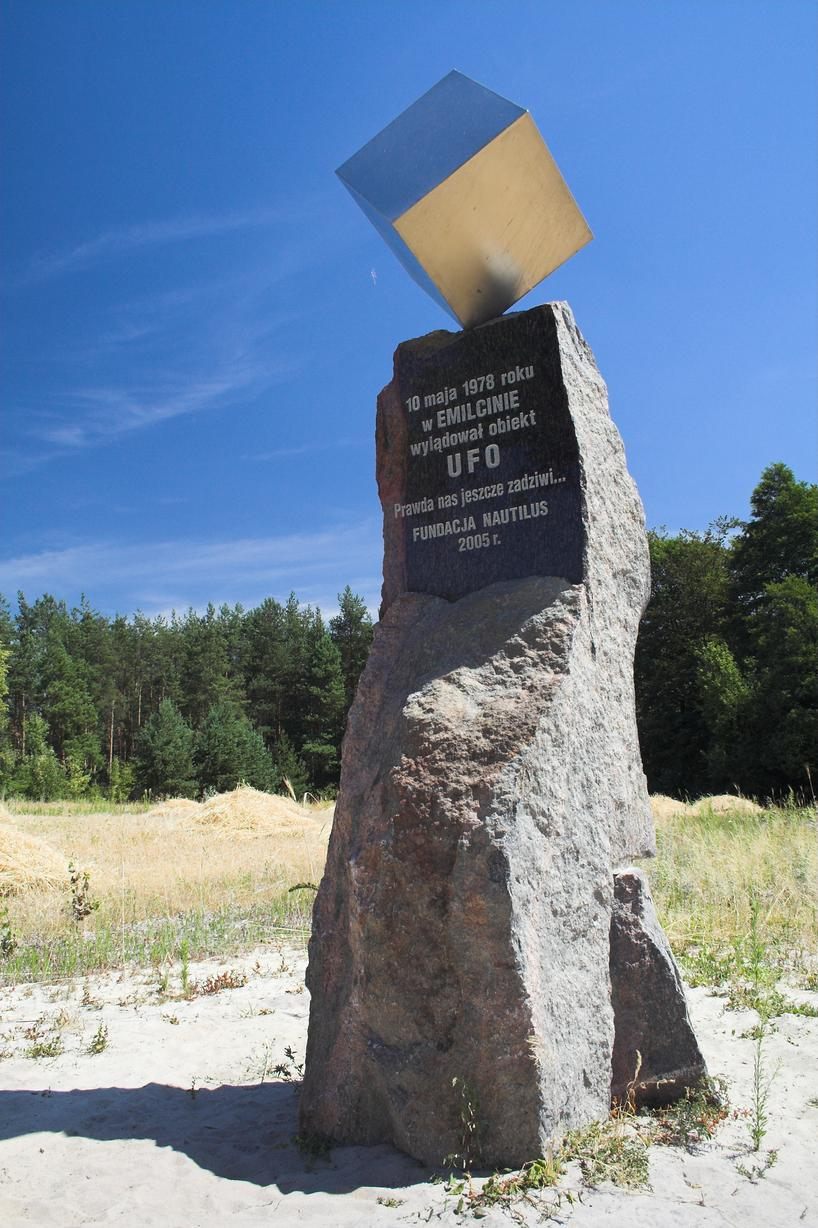
Pictured: the stone-and-steel UFO memorial erected near Emilcin in 2005 by the Nautilus Foundation — not a photograph of the 1978 encounter itself or of Wolski, and, according to Krzysztof Drozd and local residents, not at the exact place where the events were said to occur. This is the closest case-specific, freely licensed image available.
Theoretical Alignment
Emilcin sits at an unusual intersection for this catalogue: a narrative rich in the classic morphology of the 1970s "abduction" wave (small humanoids, a disc-examination procedure, missing time, a food offering) delivered by a single, elderly, uncorroborated witness, investigated with a rigor that is itself part of the story. The modest ETH figure reflects the internal consistency and physiological detail of Wolski's account and the genuine effort the University of Łódź team made to rule out lying, delusion, and obvious suggestibility. The comparatively high Psycho-Social figure is the more decisive number in this file: it reflects not that Wolski was hysterical or part of a crowd event, but that the case's own lead investigator, Zbigniew Blania-Bolnar, described in his own book how he and Kietliński had Wolski give deliberately false details about the beings as an authenticity "trap," that a subsequent researcher's audio analysis suggested leading questions shaped at least one corroborating child's testimony, and that a serious, if unproven, hypnotic-implantation hoax allegation surfaced in 2012–13 naming a specific rival investigator. None of this proves fabrication — but it means the psycho-social contamination pathway is substantially more evidenced here than in most cases this site rates higher.
Background
Jan Wolski was born May 29, 1907, and by 1978 had spent his entire life as a farmer in the countryside around Emilcin, a small village in the Gmina Opole Lubelskie district of the Lublin Voivodeship in eastern Poland, roughly 40 kilometers west of the regional capital, Lublin. He was, on the morning of May 10, 1978, seventy years old — nineteen days short of his seventy-first birthday, though many later English-language retellings round him up to "71" at the time of the encounter, a small but recurring discrepancy in the case's popular literature. Poland in 1978 was a communist state under Edward Gierek's government, more than a decade before the fall of the Iron Curtain; UFO research existed there only as an informal, largely amateur pursuit conducted by a handful of enthusiasts, without the institutional government backing enjoyed by contemporaries like France's GEPAN or even the residual public memory of the U.S. Air Force's Project Blue Book. Rural communities like Emilcin's were also thoroughly Catholic and socially conservative, a context that shaped how neighbors initially reacted to Wolski's story — with a mixture of ridicule, gossip, and, notably, an unwillingness by many to dismiss him outright given his known sobriety and lack of any history of exaggeration.
Wolski rose before dawn on May 10, as was his habit, and left his farm at approximately 5:00 AM with a horse and cart, reportedly to graze or breed his mare in a nearby pasture. He returned along a dirt track through wooded countryside a little over two hours later. It was on this return trip — not, as some retellings imply, on an unusual errand — that he reported his encounter. What makes Emilcin distinct within this catalogue is not the initial event but everything that followed: within roughly two weeks, word of Wolski's story reached amateur ufologist Witold Wawrzonek, and soon afterward, sociologist Zbigniew Blania-Bolnar of Łódź, who assembled a multidisciplinary panel from the University of Łódź to formally evaluate the witness — an investigative response with no real parallel elsewhere in Cold War-era Eastern Bloc ufology, and the central reason this obscure rural encounter became, and remains, Poland's single most discussed UFO case.
Complete Timeline
| Date | Event |
|---|---|
| May 29, 1907 | Jan Wolski is born in the Emilcin area, Lublin region, then part of the Russian Empire's Congress Poland. |
| May 10, 1978 — ~5:00 AM | Wolski departs his farm by horse-drawn cart to graze or breed his mare, as was his habit. |
| May 10, 1978 — ~7:20 AM | Returning home along a forest track near Emilcin, Wolski reports encountering two small, green-faced humanoid beings roughly 120 feet away in a meadow. |
| May 10, 1978 — ~7:30 AM | The beings allegedly board Wolski's cart and direct him to a nearby clearing, where he observes a large, white, hovering craft; he says he was led or lifted aboard and examined. |
| May 10, 1978 — morning | At a farm about 800 m west, six-year-old Adaś Popiołek, playing outside with his four-year-old sister, later says he saw a bus-like aircraft fly low over the barn and climb away; his mother, indoors, heard "a tremendous noise of thunder." |
| May 10, 1978 — ~8:00 AM | Wolski arrives home and tells his wife; his two sons and four neighbors visit the clearing and report trapezoidal footprints in the mud and trodden grass. |
| Mid-May 1978 | Local militia lieutenant Stanisław Plis, commander of the militia station in Opole Lubelskie, visits the site, questions Wolski and reports that he dreamed the event. |
| Late May 1978 | Amateur ufologist Witold Wawrzonek, in contact with the Wolski family, alerts Zbigniew Blania-Bolnar by telegram; the first investigators reach Emilcin about two weeks after the event. |
| Late May–June 1978 | Sociologist Zbigniew Blania-Bolnar learns of the case and travels to Emilcin, beginning what becomes an extended investigation involving repeat visits and interviews. |
| 1978 | Blania-Bolnar assembles a multidisciplinary team from the University of Łódź, including psychologist Dr. Ryszard Kietliński and psychiatrist Dr. Ryszard Krasilewicz, to formally test and evaluate Wolski (intelligence, thematic apperception, psychogalvanometric, eye and medical tests, plus background checks). |
| July 1978 | Journalists Krystyna Adamczyk (also spelled "Adamska" in some sources) and Henryk Pomorski conduct and tape-record an extensive interview with Wolski, later becoming a key primary source for the case. |
| 1978 | Wolski's account is the subject of a Polish television documentary (Odwiedziny, czyli u progu tajemnicy); it is later dramatized in the comic Przybysze ("The Visitors"), written by Henryk Kurta and drawn by Grzegorz Rosiński, published in the magazine Relax. |
| 1978 (later) | The University of Łódź team concludes its assessment, rating the hypothesis that the event was "an objective reality" at 90% (Kietliński) and 98% (Blania-Bolnar), against 1–2% for hoax, dream, suggestion or a helicopter, and concluding that the case "indicates the existence of a phenomenon unknown to science." |
| Later | Blania-Bolnar publishes his account of the case in book form as Zdarzenie w Emilcinie ("The Event in Emilcin"), one of two books he wrote on the case; his report also appears in Felix Zigel's UFO Landings in the USSR and Other Countries, Vol. 5. An English-language report by the Wrocław UFO club is published in Flying Saucer Review 36(1), March 1991. |
| January 8, 1990 | Jan Wolski dies, months after the fall of the Berlin Wall and shortly before Poland's own post-communist transition is complete, having maintained his account until the end of his life. |
| Autumn 2003 | Zbigniew Blania-Bolnar dies, leaving behind a personal research archive that later becomes central to a posthumous reinterpretation of the case. |
| October 15, 2005 | The Warsaw-based Nautilus Foundation unveils a memorial at the alleged encounter site — a stone marker with a suspended steel cube — reportedly the first monument in the world dedicated specifically to an alleged alien abduction. |
| 2012–2013 | Writer Bartosz Rdułtowski, using Blania-Bolnar's interview tapes and correspondence, publicly alleges (in Tajne operacje. PRL i UFO) the case was an elaborate hoax orchestrated by rival ufologist Witold Wawrzonek, who allegedly hypnotized Wolski and implanted false memories as an act of professional revenge; the claim remains unproven and contested. |
| 2025 | The Polish Netflix series Projekt UFO, reported to be inspired by the case, is released. |
The Encounter: A Meeting on a Forest Road
According to Wolski's own account — given to his family within the hour, then to the investigators who arrived about two weeks later and to journalists Krystyna Adamczyk and Henryk Pomorski that July — he was returning home by horse-drawn cart along a country road some time after 7:00 AM when he saw two figures walking in the same direction and at first took them for hunters. He described them as about 1.5 metres tall, with greenish faces, slanted eyes and prominent cheekbones, wearing tight one-piece dark coveralls with hoods that extended into something like flippers on the feet ("People say that such outfits are worn by divers, but I never saw a diver so I cannot say"). Two further details often repeated in the case's literature — webbed membranes between the fingers and red circles on the chest — were, by Blania-Bolnar's own later account, false details deliberately introduced as a "trap" for copycat witnesses and are not part of the genuine description.
Wolski said the two beings walked alongside the cart, then jumped up and sat on either side of him; he was surprised that, though small, they were heavy. He recalled that they spoke to each other, not to him, in quick, dense syllables he imitated as "ta-ta-ta-ta," and that he felt no fear: "Nothing, what is there to think? I see some freaks. So what?" Guided by gestures, Wolski drove on to a clearing where he saw the object: in his words not a spaceship but "a bus hovering in the air," some 3–5 metres above the ground, "lower than the top of birches," near a dense wall of trees. At each corner was a barrel-shaped fitting with pairs of rapidly rotating screws that gave off a buzzing sound. Estimates of its size vary across Polish sources, from about 5 m long, 3 m wide and 2.5 m high (the Wrocław club's report) to as much as 10 m long.
Aboard the Craft
A small platform came down on cords and one of the beings invited Wolski to step on it; the other turned to the horse, which had begun to graze. Inside, Wolski described a dark, bare, rectangular room with walls the color of Bakelite, a few small benches and no other furniture; the English summary of the case says the only light came from the open doorway. On the floor lay about ten black birds (crows or jackdaws by his description) that seemed alive but paralyzed, moving as if in convulsions.
Two more beings of the same appearance were inside. By gestures they told Wolski to undress completely (it was a cold morning, and he was wearing a jacket, sweater and shirt). The examination, as he told Blania-Bolnar, consisted of one being holding "something like two plates" and clicking them together in front of him while another turned him to the side and raised his arms. The beings showed particular interest in his trouser belt, buckling and unbuckling it. One of them, according to the Wrocław club's report, repeatedly put a small black rod into holes in a wall and turned it "as one turns a key in a lock." The beings were eating something "like an icicle" that broke like pastry and offered Wolski a piece; he declined and they did not insist. Told by gestures that he could go, he took off his hat at the door, said goodbye and bowed, and the beings bowed and smiled in return. He went down on the platform, climbed onto his cart and left with the craft still hovering; the frightened horse galloped home, a ride of about ten minutes. Polish summaries describe the time aboard as a few minutes.
Immediate Aftermath and the Distant Corroborating Sighting
Wolski arrived home at around 8 AM and told his wife; when his sons came back he sent them to the clearing. Independently, at a farm about 800 metres west of the site, six-year-old Adaś Popiołek, who had been playing outside with his four-year-old sister, told his mother he had seen an aircraft like a bus flying very low over the barn, with a single window through which he saw the pilot, before it climbed vertically and vanished; his mother, indoors, had heard "a tremendous noise of thunder," which two other people also reported hearing. Researcher Bartosz Rdułtowski, who later listened to Blania-Bolnar's recorded interviews, says the boy told adults about the sighting only after Wolski's story was already the talk of the village, and that the interview with him was leading. None of the Popiołek family reported any contact with the beings; their account corroborates at most that something unusual may have been seen or heard nearby.
When Wolski's two sons and four neighbors visited the clearing that morning, they reported footprints in the mud (it had rained recently) — described by one investigator as "trapezoidal, almost rectangular, in shape" and "very slightly longer than a human foot" — and grass that was trodden down with paths in all directions. No casts or photographs were made, and by the time the first investigators arrived about two weeks later the prints were gone, so only drawings based on the witnesses' descriptions survive. This loss is one of the case's most consequential failures: even a modest contemporaneous record might have settled some of the physical questions debated since.
Local Officialdom's First Response
The earliest formal investigation came not from ufologists but from the local militia (police). Lieutenant Stanisław Plis, commander of the militia station in Opole Lubelskie, visited the site and questioned Wolski, and wrote in his report that the farmer had dreamed the whole event. A press photograph of Wolski being questioned by militiamen in May 1978 appeared in W Służbie Narodu (July 30, 1978). Plis's verdict, offered without psychological or medical evaluation, is the earliest documented conventional explanation in the case's history.
Zbigniew Blania-Bolnar and the University of Łódź Investigation
What separates Emilcin from the great majority of single-witness Eastern Bloc UFO reports is the response of Zbigniew Blania-Bolnar, a sociologist based in Łódź who had already built a modest reputation as an independent UFO researcher by the late 1970s. After learning of Wolski's story — by most accounts through the earlier interview conducted by Witold Wawrzonek — Blania-Bolnar traveled to Emilcin and, rather than simply collecting a statement and moving on, committed to an extended investigation. He assembled a genuinely multidisciplinary panel drawn substantially from the University of Łódź, including psychologist Dr. Ryszard Kietliński, who had trained at the University of Poznań and worked at the Educational-Vocational Counseling Center in Łódź and the Psychometric Workshop of the Polish Academy of Sciences before joining the University of Łódź's Institute of Sociology, and psychiatrist Dr. Ryszard Krasilewicz, whose clinical opinion on Wolski's mental state became one of the investigation's most-cited findings. This was an unusual commitment of professional time to a single rural witness for the period and region.
The Testing Protocol
The University of Łódź team's evaluation battery, as later described by Blania-Bolnar and by researchers who reviewed his archive, included a Wechsler intelligence-scale administration to establish Wolski's baseline cognitive functioning; a Thematic Apperception Test, a projective psychological instrument used to probe underlying thought patterns and detect tendencies toward fantasy or confabulation; psychogalvanometric measurement — essentially a polygraph-style skin-conductance protocol — applied during repeated cross-examination sessions; an ophthalmological examination to verify normal visual function; and a general clinical physical checkup assessing his overall health, reflexes, and sensory faculties for a man of his age. Beyond the formal testing, the team conducted extensive background verification within the community, interviewing neighbors, family, and local clergy about Wolski's reputation, habits, and history — efforts that consistently reported he had never been seen drunk, did not smoke, had no record of exaggeration or dishonesty, and was regarded as a devout, reliable member of the community.
Findings
Blania-Bolnar's report, a 30-page document later included in Felix Zigel's UFO Landings in the USSR and Other Countries (Vol. 5), was emphatic in Wolski's favor: "results of the thematic perception test fully indicates that the witness has no ability whatsoever to invent stories of any kind," and "the witness is an honest, truthful, decent person, and this was confirmed in cross-examinations." The physical check-up found him in excellent health with unusually good eyesight for his age. Dr. Ryszard Kietliński found no symptoms of mental illness and no sign that he was lying, and the Polish-language accounts report that psychiatrist Dr. Ryszard Krasilewicz likewise concluded that Wolski had not invented the story. Kietliński and Blania-Bolnar then rated a list of hypotheses — hoax, hallucination or dream, religious apparition, suggestion by a third party, a helicopter or experimental craft — mostly at 1–2%, and rated the hypothesis that "the event with the witness was an objective reality" at 90% (Kietliński) and 98% (Blania-Bolnar), with a "concluding hypothesis" that "this case indicates the existence of a phenomenon unknown to science." Wolski also signed an oath before two witnesses that his account was "absolutely true."
It is important to be precise about what this established. A careful psychological clearance of a witness as sincere and sane rules out several common, mundane explanations for fabricated testimony, and the team went further than that, rating an anomalous "objective reality" at 90–98% and concluding that the case pointed to "a phenomenon unknown to science." Those percentages are, however, the investigators' own judgments, not measurements, and Rdułtowski argues that Blania-Bolnar reported the psychological results selectively and that Wolski was in fact highly suggestible. An unusually well-tested witness is still, in the end, a single witness describing an event with no independent physical confirmation, which is central to why this file treats Emilcin as disputed rather than credible.
The Investigative Gaps and Methodological Criticism
Even setting aside the later hoax controversy, the investigation has drawn specific methodological criticism. Former Lublin militia officer Krzysztof Drozd, in his book Emilcin. W poszukiwaniu prawdy, points out gaps in Blania-Bolnar's work, including the failure to check helicopter flights from two nearby airfields — the air-ambulance base at Radawiec near Lublin and the air force school at Dęblin — though Drozd has said he does not himself argue that helicopters explain the encounter. More seriously, Blania-Bolnar openly described in his book Zdarzenie w Emilcinie how he and Dr. Kietliński devised a "trap for UFO liars": under his influence Wolski gave two deliberately false details about the beings — webbed membranes between the fingers and red circles on their chests — so that later reports repeating them could be identified as copied. Whatever its intent, the practice muddies the record: it shows that the principal witness would add invented details to his own account at an investigator's suggestion, and any later testimony containing those details cannot be read as independent. A separate criticism, raised by Bartosz Rdułtowski after listening to Blania-Bolnar's interview tapes, is that the interview with the young Adaś Popiołek was leading and that the boy spoke up only after Wolski's story was already known in the village.
The 2012–13 Hoax Allegation: Wawrzonek, Hypnosis, and a Researchers' Feud
In 2012–13, writer Bartosz Rdułtowski, who obtained Blania-Bolnar's interview cassettes and correspondence, set out the case's most dramatic counter-narrative in his book Tajne operacje. PRL i UFO: that the Emilcin story was a mystification arising from a feud between Blania-Bolnar and Witold Wawrzonek, a fellow ufologist and until then his collaborator, who had alerted Blania-Bolnar to the case by telegram and who, Rdułtowski says, already knew the Wolski family. In March 1978 Blania-Bolnar had invited Wawrzonek to the recording of a television program about UFOs (according to a correction published with one article, Wanda Konarzewska's "Kto widział UFO?", with the hypnotist Lech Emfazy Stefański taking part) and, during an experiment in implanting false memories, Wawrzonek was hypnotized against his will. Rdułtowski argues that Wawrzonek, hurt by this, took revenge by hypnotizing Wolski and implanting the encounter, meaning to confess the trick to Blania-Bolnar after a few days, but kept silent once doctors and the press became involved.
The allegation comes with serious evidentiary problems of its own. The Nautilus Foundation interviewed Wawrzonek's son and widow, who both denied that he was ever interested in hypnosis (his widow had at first confirmed it). The television recording is said to have taken place but the program was never broadcast. Rdułtowski himself said in 2015 that the hypnosis of Wolski "cannot be confirmed directly," calling it his hypothesis, though in his view a very probable one, and his account has been sharply criticized in the Polish ufological community for inaccuracies. The hoax theory is therefore as unverified, on its own terms, as the abduction claim it seeks to explain — a serious research thread, but not a resolved explanation.
Wolski's Later Life and Death
Jan Wolski never wavered from his account for the remaining twelve years of his life, even as the story brought him a mixture of minor local celebrity and outright mockery — some neighbors and the wider Polish press occasionally suggesting, without evidence, that he had been drinking or was simply confused. In a remark quoted in English-language retellings (not traced to a primary source here), Wolski is said to have told an interviewer: "You should know that I came to the conclusion that I should have kept my mouth shut about it." He died on January 8, 1990, at the age of 82, just weeks after the definitive collapse of Poland's communist government and months after the fall of the Berlin Wall — a political transformation that would, within a few years, make Western-style open UFO research and international attention to cases like his own far more possible than it had ever been during his lifetime. He did not live to see the 2005 memorial built in his honor, nor the renewed international interest the case has attracted in the English-language UFO literature since Poland's accession to the European Union in 2004.
The Memorial and Modern Recognition
On October 15, 2005, the Warsaw-based Nautilus Foundation, a UFO-research organization, unveiled a memorial near Emilcin: a natural stone with a balanced metal cube on top, bearing the Polish inscription "On 10 May 1978 in Emilcin a UFO object landed. The truth will astonish us in the future." Reportedly the first monument built anywhere to commemorate an alleged alien abduction, it has become a minor destination for visitors to the Lublin Voivodeship, though Krzysztof Drozd and local residents say it stands in a different place from where the events were said to occur. The 2025 Polish Netflix series Projekt UFO is reported to be inspired by the case.
Key Researchers
- Zbigniew Blania-Bolnar (d. 2003) — The Łódź sociologist who led the central investigation, assembled the University of Łódź evaluation team, and published Zdarzenie w Emilcinie, still the richest primary source on the case, in which he also described the "trap" of deliberately false details that complicates the record he built.
- Dr. Ryszard Kietliński — University of Łódź psychologist who administered and interpreted the formal psychological testing battery applied to Jan Wolski.
- Dr. Ryszard Krasilewicz — Psychiatrist who, according to Polish-language accounts, concluded that Wolski had not invented the story.
- Bartosz Rdułtowski — Writer whose 2012–13 review of Blania-Bolnar's interview tapes and correspondence produced both the case's most serious methodological critique and its most dramatic, still-unproven hoax counter-theory.
- Witold Wawrzonek — The amateur ufologist who alerted Blania-Bolnar to the case in 1978, and later, decades on, the central figure named in Rdułtowski's unproven hoax allegation.
- Krzysztof Drozd — Former Lublin militia officer and author of Emilcin. W poszukiwaniu prawdy, which identified the failure to check helicopter flights from the Radawiec and Dęblin airfields as a gap in the original inquiry.
Cultural Impact
Within Poland, Emilcin occupies roughly the cultural position that Roswell or the Hill abduction hold in American UFO lore: the default reference point any general audience recognizes, regardless of how closely they have followed the case's actual details. It was the subject of a 1978 television documentary, dramatized in the comic Przybysze (written by Henryk Kurta, drawn by Grzegorz Rosiński, published in Relax), and has been revisited repeatedly by Polish print and broadcast journalism at nearly every significant anniversary since. The 2005 Nautilus Foundation memorial — reportedly the first monument anywhere built specifically to commemorate an alleged alien abduction — has made the otherwise unremarkable village of Emilcin a minor fixture on informal Polish "strange places" tourism itineraries. Internationally, the case remained relatively obscure in English-language UFO literature for decades, a product both of the language barrier and of Poland's isolation behind the Iron Curtain at the time of the original investigation, though an English-language report by the Wrocław UFO club appeared in Flying Saucer Review in 1991 and J. Antonio Huneeus covered it in Fate; wider Western attention grew after Poland's 2004 European Union accession made travel to the site easier.
Key Witnesses
Jan Wolski
A 70-year-old lifelong farmer with no prior interest in UFOs, no history of alcohol use, and a reputation among neighbors for honesty and sobriety. Reported being approached by two humanoid beings while driving his horse cart on May 10, 1978, and led aboard a hovering craft for an examination lasting a few minutes. Underwent psychological, psychiatric, medical and background evaluation by a University of Łódź team, which concluded he was sincere and could not invent stories; he also, at the investigators' suggestion, added two deliberately false details to his description of the beings as a "trap" for copycat witnesses. Maintained his account until his death in 1990.
Adaś Popiołek
Said he saw a bus-like aircraft fly very low over the barn at his family's farm, about 800 metres west of Wolski's encounter site, with a single window through which he saw the pilot, before it climbed vertically and vanished; his mother heard a thunder-like noise. His account emerged only after Wolski's story was known in the village; as an adult he declined to comment, and researcher Bartosz Rdułtowski has specifically questioned whether Zbigniew Blania-Bolnar's own interview technique shaped his testimony through leading questions.
Zbigniew Blania-Bolnar
A Łódź-based sociologist and independent UFO researcher who assembled the University of Łódź evaluation team and led the case's central investigation, later publishing his findings as Zdarzenie w Emilcinie, the case's richest primary source. In it he described how he and Kietliński had Wolski give deliberately false details about the beings as an authenticity test, a practice that has drawn methodological criticism for contaminating the case's own evidentiary record. Died in autumn 2003.
Dr. Ryszard Kietliński
Trained at the University of Poznań and later affiliated with the University of Łódź's Institute of Sociology, Kietliński administered psychological testing to Wolski as part of Blania-Bolnar's team and concluded that Wolski showed no symptoms of mental illness and did not appear to be lying (and said the same of the boy Adaś Popiołek). With Blania-Bolnar he rated the "objective reality" hypothesis at 90%, and he helped devise the "trap" of false details.
Dr. Ryszard Krasilewicz
Provided the case's psychiatric opinion, concluding, according to Polish-language accounts, that Wolski had not invented the story — a clinical finding that became one of the investigation's most frequently cited results, though one addressing Wolski's sincerity and sanity rather than the objective truth of his account.
Witold Wawrzonek
The amateur ufologist who, already in contact with the Wolski family, alerted Blania-Bolnar to the case by telegram in May 1978. Decades later, publicist Bartosz Rdułtowski accused Wawrzonek of having orchestrated the entire episode through hypnotic suggestion as an act of professional revenge against Blania-Bolnar — an allegation Wawrzonek's own family has disputed and that remains unproven.
Bartosz Rdułtowski
Obtained Zbigniew Blania-Bolnar's interview tapes and correspondence and, in 2012–13 (in the book Tajne operacje. PRL i UFO), publicly proposed that the Emilcin case was an elaborate hoax involving hypnotic memory implantation orchestrated by Witold Wawrzonek. Also flagged specific methodological problems in Blania-Bolnar's own interview technique, including leading questions with the young Popiołek witnesses. Has said the hypnosis itself "cannot be confirmed directly" but considers it very probable.
Lt. Stanisław Plis
Conducted the case's first formal investigation as commander of the militia station in Opole Lubelskie in May 1978, visiting the site and questioning Wolski, and reported, without psychological or medical evaluation, that he had dreamed the event — the case's earliest and least rigorously supported conventional-explanation hypothesis.
The Five Observables Assessment
The Five Observables framework, developed by former AATIP director Luis Elizondo, is used to classify UAP encounters by performance characteristics exceeding known technology of their era. Applied to a single-witness narrative account with no instrumented data, the framework can only be assessed from Wolski's own uncorroborated testimony — a significant caveat that applies to every rating below:
Assessment: Anti-Gravity Lift is rated speculative because Wolski described the craft as silently hovering at a fixed altitude with no visible support structure, but he never described any dramatic ascent, descent, or maneuver that would demonstrate an active propulsion mechanism in action — only a static hover, consistent equally with an unremembered mundane support (even a misperceived stationary object) as with anti-gravity technology. Instant Acceleration and Hypersonic Velocity are both rated absent: no witness, including Wolski himself, ever described the craft departing at high speed or maneuvering abruptly; it was simply present, then reportedly gone by the time others arrived at the clearing. Low Observability is rated absent in the classical stealth sense — the object was, if Wolski's account is accurate, brightly visible in daylight to at least two independent parties roughly a mile apart — though some English-language retellings add a claim that the craft cast no shadow, a detail not found in the investigators' reports reviewed here. Trans-Medium travel is rated absent; no transition between air, ground, water, or space was ever reported. Overall, the Five Observables data is thin and entirely testimonial, offering little independent leverage on the case either for or against an exotic technological explanation.
Evidence Assessment
Supporting Anomalous Origin
- A genuinely multidisciplinary team of psychologists, a psychiatrist, and a sociologist from the University of Łódź tested Wolski and found no evidence of delusion, dementia or dishonesty, and rated an anomalous "objective reality" at 90–98% — a level of contemporary formal scrutiny almost unmatched among Cold War-era single-witness UFO cases.
- Wolski maintained his account until his death in 1990 and signed an oath before two witnesses that it was "absolutely true."
- Wolski had no discernible motive: he sought no payment, no publicity beyond what came to him unsought, and by his own later words regretted ever having spoken publicly about the experience.
- A second party — the Popiołek family, about 800 metres away — reported a low-flying bus-like aircraft (the six-year-old boy) and a loud thunder-like noise (his mother and two others) that morning.
- Footprint-like impressions and trodden grass were reported by Wolski's sons and four neighbors who visited the site that morning, even though nothing was preserved.
Supporting Conventional Explanation
- The entire narrative rests on one uncorroborated primary witness; no one else claims to have seen the craft's interior, the occupants up close, or the examination procedure Wolski described.
- Lead investigator Zbigniew Blania-Bolnar described how he and Kietliński had Wolski give deliberately false details about the beings (webbed fingers, red chest circles) as an authenticity "trap," showing that the witness would add invented details at an investigator's suggestion.
- Audio analysis by a later researcher suggests Blania-Bolnar's own interview technique may have used leading questions with the case's only other named witnesses, the young Popiołek children.
- Helicopter flights from the nearby Radawiec air-ambulance base and Dęblin air force school were never checked, despite this being a basic, feasible investigative step.
- The footprints had disappeared before any investigator arrived, leaving nothing today that can be independently examined.
- A specific, if itself unproven, 2012–13 hoax allegation names a plausible suspect (Witold Wawrzonek) and a plausible mechanism (hypnotic suggestion on a suggestible elderly witness) for a deliberately fabricated account.
Why "Disputed"
This file rates the Emilcin case DISPUTED, with a modest credibility score, because it sits at a genuinely unusual crossing point between two facts that pull in opposite directions and neither of which this catalogue will minimize. On one hand, the University of Łódź investigation represents real, substantive contemporary rigor almost never seen applied to a single rural witness anywhere in Cold War-era Eastern Bloc ufology — a multidisciplinary team of credentialed professionals carried out formal psychological, psychiatric, medical and background evaluation, and came away persuaded of Wolski's basic sincerity and sound mind. That is a genuinely different, more careful outcome than the reflexive local-police dismissal ("he fell asleep and dreamed it") the case might otherwise have received, and it is why Emilcin deserves serious documentation rather than casual dismissal as tabloid fodder. On the other hand, sincerity is not the same as accuracy, and every other pillar an evidentiary case would need is either missing or actively compromised here: there is exactly one primary witness and no meaningful independent corroboration of what happened inside the craft; no photograph, recording, radar return, or preserved physical sample survives; the lead investigator has admitted deliberately contaminating the public record with false details as a methodological device; a later researcher's audio analysis raises real questions about leading interview techniques with the case's only other named witness; and a specific, serious hoax allegation — itself unproven, but naming a real person and a real, if unconfirmed, motive and mechanism — has sat unresolved in the Polish UFO research community since 2012. A case this thoroughly investigated psychologically, yet this thin on independent physical or corroborating evidence, and carrying this much documented investigator-side contamination of its own record, is precisely what this site's "Disputed" rating exists to describe honestly.
Sensor & Instrumentation Detection Profile
Emilcin is a purely human-observation case with no instrumented data of any kind. There was no radar coverage of the rural clearing, no photograph or film of the object, no audio recording made during the encounter itself, and no contemporaneous law-enforcement report filed in real time — the local militia (police) only became involved after Wolski told neighbors and word spread through the village. The closest thing to instrumentation in the case's documentary record is the University of Łódź team's own testing apparatus, applied not to the object but to the witness: a psychogalvanometer (a polygraph-style skin-conductance device) used during Wolski's cross-examination sessions, alongside standardized psychological instruments (a Wechsler intelligence scale administration and a Thematic Apperception Test) intended to establish his baseline truthfulness and suggestibility rather than to detect the craft itself. A tape-recorded interview conducted in July 1978 by journalists Krystyna Adamczyk and Henryk Pomorski is the earliest surviving audio record of Wolski's own voice describing the event, though it postdates the encounter itself by roughly two months.
Environmental & Geospatial Context
No formal meteorological station data for the immediate Emilcin area on the morning of May 10, 1978 is known to survive in the public record. Wolski's own account describes a cold morning (he was wearing a jacket, sweater and shirt), and the investigators noted that it had rained recently, leaving mud on the road and in the clearing; the ERA5 reanalysis for the date, given below, is likewise cold and wet. Wolski had set out from his farm around 5:00 AM and was returning along a country road some time after 7:00 AM, well after sunrise. Geospatially, Emilcin sits in the Lublin Voivodeship's Vistula lowlands, a flat, partly forested agricultural area roughly 40 km west of Lublin and about 5 km east of the town of Opole Lubelskie. Krzysztof Drozd notes that helicopter flights from two airfields within reach — the air-ambulance base at Radawiec near Lublin and the air force school at Dęblin — were never checked for that morning.
Observer Credibility & Occupational Profile
Jan Wolski was, by every account gathered about him at the time, an unremarkable and unlikely candidate for a hoax: a lifelong subsistence farmer in his early seventies, practicing Catholic, with no history of alcohol abuse, no prior interest in UFOs or the paranormal, and by neighbors' consistent testimony no reputation for storytelling or attention-seeking. That very ordinariness cuts both ways in assessing his credibility. On one hand, the University of Łódź evaluation team — a genuinely multidisciplinary panel including sociologist Zbigniew Blania-Bolnar, psychologist Dr. Ryszard Kietliński, and psychiatrist Dr. Ryszard Krasilewicz — found no clinical evidence of delusion, dementia, confabulation disorder, or heightened suggestibility, and rated his sensory faculties, reflexes, and general physical condition as excellent for his age. On the other hand, Wolski was elderly, alone, was not a trained observer of any kind, gave his most detailed accounts only after weeks of repeated interviews and media attention, and, by the investigators' own account, was willing to add invented details to his description at an investigator's suggestion — a combination of factors that, in isolated-witness cases generally, is well-documented to correlate with both genuine anomalous experiences and, separately, with confabulated or externally-shaped memories. The sole other named witness, six-year-old Adaś Popiołek, reported only an aircraft-like object passing over a farm about 800 metres away, mentioned it only after Wolski's story was known in the village, and never claimed any direct encounter, limiting how much independent corroborating weight his account can carry.
Physical & Material Assays
The case's physical evidence record is thin and was never preserved. Wolski's two sons and four neighbors reported footprint-like impressions in the mud at the clearing — described by one investigator as "trapezoidal, almost rectangular, in shape" and "very slightly longer than a human foot" — and trodden-down grass with paths in all directions. None of this was cast, measured or photographed; by the time the first investigators arrived about two weeks later the prints were gone, and only drawings based on the witnesses' descriptions were made. No physical sample from the Emilcin site is known to survive. Unlike cases such as Trans-en-Provence or Rendlesham Forest, where imperfect physical samples were collected and later re-examined, Emilcin's physical record exists only in secondhand descriptions from 1978.
Historical Precedents & Archive Matches
Emilcin arrived in the middle of a wider mid-to-late-1970s wave of close encounter and abduction reports across both sides of the Iron Curtain — a period that includes the Travis Walton case in Arizona (November 1975) and, closer to Poland geographically and chronologically, the September 1977 Petrozavodsk Phenomenon in the Soviet Union, a mass sighting event over the Karelian capital that briefly made "UFO" a permissible subject in the Soviet press. Poland's own domestic UFO research culture was younger and more improvised than its Western counterparts — there was no Polish equivalent of NICAP or GEPAN with institutional government backing — which makes the University of Łódź team's decision to apply formal psychological and psychiatric testing methodology to a rural witness genuinely unusual for the region and era, closer in spirit to the multi-witness polygraph protocol later used in the Travis Walton case than to the ad hoc newspaper-driven investigations typical of contemporary Eastern Bloc UFO reports. The case's humanoid morphology — small stature, large dark eyes, minimal facial features, one-piece suits — also sits within the broader "Gray" and quasi-Gray entity typology reported across dozens of 1960s–1980s Western cases, from Betty and Barney Hill (1961) through Pascagoula (1973), lending it a certain narrative familiarity that skeptics have cited as evidence of cultural cross-contamination via Western media reaching behind the Iron Curtain, and that proponents have cited as evidence of a genuinely consistent phenomenon independent of geography or political system.
Material Analysis
No physical material connected to the Emilcin encounter has survived for modern testing of any kind — a significant gap this file states plainly. The footprint-like impressions that Wolski's sons and neighbors reported at the clearing on the morning of the event were never cast or photographed and had disappeared by the time investigators arrived about two weeks later. (Further details found in some English-language retellings — disturbed corn stalks, small soil holes, uniform black feathers and a sulfur smell lingering on Wolski's coat — could not be traced to the investigators' reports and are not relied on here.) This stands in sharp contrast to cases this catalogue rates more highly on physical grounds, where at least some trace material was collected and has remained available for re-examination.
Supporting a Genuinely Unusual Stimulus
- Wolski's sons and four neighbors, not just Wolski himself, reported observing the footprint-like impressions and trodden grass at the site that morning, suggesting something physically unusual was present even if its ultimate nature cannot now be determined.
- The described footprint morphology — trapezoidal, almost rectangular, very slightly longer than a human foot — does not obviously match any commonly proposed mundane source that has been specifically documented for this site.
Supporting a Mundane or Unverifiable Origin
- No sample of any kind was preserved for laboratory testing, meaning no modern analytical technique can be applied to confirm or rule out any explanation for the physical traces reported.
- The prints were described only by Wolski's family and neighbors, after recent rain had left the clearing muddy, and no investigator saw them.
- No comparably documented physical evidence exists for the craft itself; every claim about its material, propulsion, or interior rests entirely on one witness's uncorroborated verbal testimony.
The Conventional Explanation Candidate: Confabulation, Suggestion & Investigator Contamination
The most parsimonious conventional explanation for Emilcin does not require Jan Wolski to have lied. It holds instead that an elderly man, alone on an early-morning cart ride, experienced a genuine but ordinary perceptual event — a misperceived aircraft, an unusual light, or even a period of microsleep or dream-like confusion while driving a slow, familiar route — and that the richly detailed abduction narrative later associated with his name was substantially elaborated afterward through the normal, well-documented psychological process of memory reconstruction under repeated interview, compounded here by an investigator, Zbigniew Blania-Bolnar, who has himself admitted deliberately introducing false confirmatory details into the public conversation about the case as a methodological device. This candidate deserves serious weight precisely because it does not require any dishonesty from Wolski himself — consistent with the University of Łódź team's own finding that he was sincere — while still accounting for the internal consistency, the escalating detail across successive retellings, and the troubling presence of investigator-introduced contamination that makes parts of the record impossible to fully trust.
The 2012–13 Hoax and Hypnotic-Implantation Theory
Publicist Bartosz Rdułtowski's alternative theory — that rival ufologist Witold Wawrzonek deliberately hypnotized Wolski and implanted the entire narrative as an act of professional revenge against Blania-Bolnar — is the case's most dramatic proposed conventional explanation, and the one that, if proven, would most decisively resolve the case as a fabrication. It deserves inclusion here because it is a specific, falsifiable claim naming a real person and a real (if unconfirmed) motive, not vague hand-waving. It falls short of a fully established explanation for exactly the same reason the abduction claim itself does: no direct, conclusive evidence has been produced that Wawrzonek possessed hypnosis training, that the television program said to have motivated his alleged revenge ever aired, or that any hypnotic session with Wolski ever actually took place. Rdułtowski's own final assessment — that the complete truth may never be knowable — is itself an implicit admission that this candidate remains unproven rather than demonstrated.
Aircraft or Helicopter Misidentification
Local officials in 1978 and the general press both floated the possibility that Wolski, and separately the Popiołek children, had misidentified a military or civilian helicopter or aircraft operating in the area that morning. Former Lublin militia officer Krzysztof Drozd has noted that Blania-Bolnar never checked helicopter flights from the air-ambulance base at Radawiec near Lublin or the air force school at Dęblin (while saying he does not himself argue that helicopters explain the case); the investigators did rate a helicopter or experimental craft at only 1–2%, but without a documented check of flight records — meaning the aircraft-misidentification candidate has neither been confirmed nor genuinely ruled out by any documented, checkable record, more than four and a half decades later.
Simple Dream or Microsleep
The case's very first official explanation, offered by militia lieutenant Stanisław Plis after he visited the site and questioned Wolski, was the simplest possible: that the farmer had dreamed the entire encounter. This candidate is difficult to reconcile with the University of Łódź team's finding of Wolski's excellent physical and cognitive health for his age, with the encounter's timing (after 7 AM, on the return leg of a routine trip) and with the footprints his sons and neighbors reported, though it remains, in its favor, the explanation requiring the fewest additional assumptions about deception or third-party manipulation.
Confabulation, Suggestion & Investigator Contamination
PlausibleBest fits the documented methodological problems in the case's own record.
The 2012–13 Hoax and Hypnotic-Implantation Theory
InconclusiveA specific, serious allegation, but unproven.
Aircraft or Helicopter Misidentification
InconclusiveNever rigorously checked either way.
Simple Dream or Microsleep
Implausible (As a Complete Explanation)Does not account for the independent distant sighting.
Related Cases
Confirmed Documents & Official Records
Poland's national archive of Communist-era security service (SB) and state records. No IPN file specifically referencing the Emilcin case or its 1978 local militia investigation is known to have been publicly identified or released to date; researchers with Polish-language access may search directly here.
UNCLASSIFIED (public search)The CIA's full declassified UFO document collection, including Cold War-era reports on sightings behind the Iron Curtain generally; no document specifically referencing Emilcin or Jan Wolski by name has been identified, but the collection remains the standard first stop for any U.S. intelligence angle on Eastern Bloc UFO activity in this period.
UNCLASSIFIED (declassified)Search Government Archives Directly
Further Reading — Recommended Literature
The UFO Encyclopedia, 4th Edition
The definitive UFO reference work, situating Emilcin within the broader international context of 1970s abduction-era encounters and Cold War-era Eastern Bloc ufology.
UFO's From Behind the Iron Curtain
The earliest English-language survey of UFO reports from Poland, the USSR, and other Eastern Bloc states, establishing the reporting culture and institutional vacuum Blania-Bolnar's team operated within just a few years before Emilcin.
The Soviet UFO Files: Paranormal Encounters Behind the Iron Curtain
A detailed account of Cold War-era UFO reporting and official secrecy across the Soviet bloc, useful regional and political context for understanding why a case like Emilcin received no state institutional investigation of the kind Western cases sometimes did.
Passport to Magonia: On UFOs, Folklore, and Parallel Worlds
Vallée's landmark study connecting modern humanoid-encounter reports to older folkloric traditions, directly relevant to assessing how much of Emilcin's entity and craft imagery reflects a genuinely independent report versus culturally transmitted narrative patterns.
The Abduction Enigma
A critical examination of the alien-abduction phenomenon, including the role of hypnosis, suggestion, and memory reconstruction in shaping abduction narratives — directly relevant to evaluating both Wolski's testimony and the 2012–13 hypnotic-implantation hoax theory.
DISCLOSURE: Some links above are affiliate links. If you purchase through them, OverClassified receives a small commission at no additional cost to you. This helps support independent research.
Essential Viewing
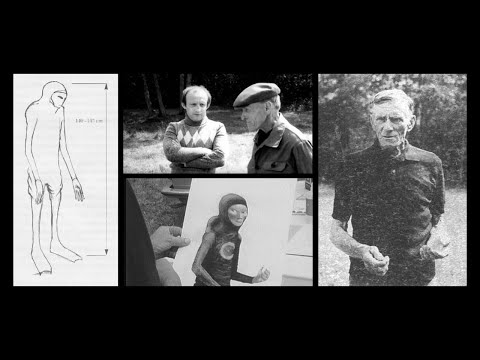
The Emilcin, Poland, UFO Encounter (Eyes On Cinema)
A detailed narrated overview of Wolski's account, the University of Łódź investigation, and the case's place in Cold War-era Eastern Bloc UFO history, from a reputable long-form UFO documentary channel.
Czy ktoś zmanipulował świadka UFO? (National Geographic Poland)
National Geographic's Polish edition examines whether the Emilcin witness was manipulated, weighing the University of Łódź findings against the later hoax and suggestion theories.
Emilcin: Największe UFO oszustwo PRL? (naTemat / Biuro Tajemnic #16)
An investigative segment from established Polish news outlet naTemat's "Biuro Tajemnic" series, directly examining the 2012–13 hoax allegation against the case.

Czy Jan Wolski spotkał kosmitów? Emilcin zbadany "do dna" (Sekielski Brothers Studio)
An in-depth investigative documentary from the studio of noted Polish journalist Tomasz Sekielski, examining the case "to the bottom" — including the original investigation and its later controversies.
Sources
- "Emilcin Abduction," Wikipedia (English). en.wikipedia.org
- "UFO w Emilcinie," Wikipedia (Polish). pl.wikipedia.org
- "Emilcin," Wikipedia (village entry, administrative details). en.wikipedia.org
- "UFO sightings in Poland," Wikipedia. en.wikipedia.org
- Openminds.tv. "Poland's first abduction case is monumental." openminds.tv
- UFO Insight. "Jan Wolski And The Emilcin Alien Encounter." ufoinsight.com
- My Dark Path. "In 1978 a Polish farmer claimed to have been taken aboard an alien spacecraft — examined by aliens." mydarkpath.com
- Astonishing Legends. "Emilcin Abduction." astonishinglegends.com
- CiekawostkiHistoryczne.pl. "Emilcin: hipnoza i fałszywi kosmici. Czy w 'polskim Roswell' doszło do oszustwa?" (2021). ciekawostkihistoryczne.pl
- historia.dorzeczy.pl. "UFO w Polsce? UFO w Emilcinie — Wolski i kosmici." historia.dorzeczy.pl
- Atlas Obscura. "Emilcin UFO Memorial in Opole Lubelskie County." atlasobscura.com
- How and Why's. "Green Aliens Welcomed Polish Farmer On Their Spacecraft And Offered Him Honey-Like Food In 1978." howandwhys.com
- Latest UFO Sightings. "The Emilcin, Poland, UFO encounter and alien abduction of farmer Jan Wolski." latest-ufo-sightings.net
- Cryptid Wiki (Fandom). "Emilcin Aliens." cryptidz.fandom.com
- 3 Seas Europe. "The Polish Monument Marking a UFO Landing." 3seaseurope.com
- Wikimedia Commons. "File:Emilcin-pomnik.jpg" (memorial photograph, CC BY-SA 2.5, photographer "Lukke"). commons.wikimedia.org
- Wikimedia Commons. "Category:Emilcin UFO memorial." commons.wikimedia.org
- Institute of National Remembrance (IPN). Official archival search portal. ipn.gov.pl
- CIA FOIA Electronic Reading Room. "UFOs: Fact or Fiction?" collection. cia.gov
- YouTube (Eyes On Cinema). "The Emilcin, Poland, UFO encounter and alien abduction of farmer Jan Wolski, May 10, 1978." youtube.com
- YouTube (National Geographic Poland). "Czy ktoś zmanipulował świadka UFO? 'Takiej historii nie da się łatwo zmyślić.'" youtube.com
- YouTube (naTemat / Biuro Tajemnic). "Emilcin: Największe UFO oszustwo PRL? Prawda wychodzi na jaw!" youtube.com
- YouTube (Sekielski Brothers Studio). "Czy Jan Wolski spotkał kosmitów? Emilcin zbadany 'do dna'." youtube.com
- Blania-Bolnar, Zbigniew. Zdarzenie w Emilcinie — original Polish-language book on the investigation (publisher and year not confirmed in this review), cited via secondary summaries; his report is also reproduced in Felix Zigel, UFO Landings in the USSR and Other Countries, Vol. 5 (English translation, Joint USA-CIS Aerial Anomaly Federation).
- Huneeus, J. Antonio. "Poland's first abduction case is monumental." Openminds.tv (earlier version in Fate), drawing on Blania-Bolnar's report and the Wrocław Club for UFO Popularization and Exploration (WCPE-UFO) report, Flying Saucer Review 36(1), March 1991. openminds.tv
- Rdułtowski, Bartosz. Tajne operacje. PRL i UFO (2013); Drozd, Krzysztof. Emilcin. W poszukiwaniu prawdy — both as summarized by CiekawostkiHistoryczne.pl (2021), including the author comments appended to that article.
- Clark, Jerome. The UFO Encyclopedia, 4th Edition, Relevant Information LLC (general reference for European abduction-era cases and Cold War-era UFO research culture).
- Hobana, Ion & Weverbergh, Julien. UFO's From Behind the Iron Curtain, Souvenir Press, 1974 (context on Eastern Bloc UFO reporting culture predating Emilcin).
Corrections (October 2026)
A fact-check against J. Antonio Huneeus's account of Blania-Bolnar's report and the 1991 Flying Saucer Review report, CiekawostkiHistoryczne.pl's 2021 review of the Rdułtowski and Drozd books, and the Polish and English Wikipedia articles found that the earlier version of this page presented several details of the encounter that do not appear in those accounts, and described two of them as genuine when they were not. The webbed fingers (and red chest circles) were, by Blania-Bolnar's own account in Zdarzenie w Emilcinie, false details that he and Dr. Kietliński had Wolski add as a "trap" for copycat witnesses; the page had listed the webbing as part of Wolski's description. Details including nose slits, lipless mouths, a shoulder "hump," glass-like black walls, suction-pad instruments that hummed, a mouth examination, a second food offer, a "smile or grimace," a sulfur smell lingering on his coat, uprooted corn stalks, soil holes, uniform feathers, the craft casting no shadow, missing time inferred from the mare's grazing, "more than 500 hours" of research and the Kietliński and Krasilewicz quotations could not be traced and were removed or attributed to later retellings. The page also said the team's "objective reality" language was only about Wolski's sincerity; in fact Kietliński and Blania-Bolnar rated the event itself an "objective reality" at 90% and 98% and concluded it indicated "a phenomenon unknown to science."
Following this review, the rating was changed from Disputed 24 to Disputed 20 (October 28, 2026), because the higher rating had rested partly on claims corrected or removed above.
Other corrections: the encounter took place after 7 a.m. on a cold morning after rain, not "just after dawn" on a clear one; Wolski reached home around 8 a.m.; the footprints had already gone by the time investigators arrived about two weeks later, rather than being trampled by crowds and police; the Popiołek farm was 800 m west, the boy described a low-flying bus-like aircraft with one window, and his mother heard thunder-like noise; Plis was the commander of the Opole Lubelskie militia station and reported that Wolski dreamed it (the "complaints to school officials" detail was unsourced); Wawrzonek alerted Blania-Bolnar by telegram (the "May 26" interview date was unsourced); Drozd's criticism concerns helicopter flights from the Radawiec air-ambulance base and the Dęblin air force school; Rdułtowski calls the hypnosis "very probable" though not directly provable, rather than concluding the truth may never be known; the monument's inscription is now translated, and Drozd and local residents say it stands away from the actual site; the Przybysze comic was written by Henryk Kurta; the 1978 publication date and publisher given for Zdarzenie w Emilcinie could not be confirmed; an unsourced 2023 anniversary entry was removed; and the computed lunar field is marked not applicable for a daylight event.
See something inaccurate? Have additional information or sources?
Suggest an Edit →Last Updated: October 2026