
The Valensole UFO Incident
At about 5:45 AM on July 1, 1965, lavender farmer Maurice Masse stopped hoeing a field of young lavender outside Valensole, in the Alpes-de-Haute-Provence region of southern France, heard a whistling, and went to look, thinking a helicopter had landed. He described an object the size of a Renault Dauphine car, shaped like a rugby ball, standing on six thin legs around a central pivot. In his first statement to the gendarmes, on the evening of July 2, he said he saw one small figure from about 60 meters away, which jumped into the craft before it left. Only in a supplementary statement on August 18 did he describe approaching to seven meters, seeing two beings, and being immobilized by an object one of them pointed at him. He explained that he had held back at first for fear of being taken for a madman. What keeps the case prominent is the ground trace. Gendarmes examined it on the night of July 2 and photographed it the next morning: a shallow depression about 1.2 meters across, with a central hole 18 centimeters wide and about 40 centimeters deep and four furrows about 2 meters long forming a cross. They found the soil there compact while the rest of the freshly hoed field was loose. Masse is the only witness. GEIPAN, France's official UAP office, has never investigated the case itself, and it calls those gendarmerie reports the most reliable documents on the affair.
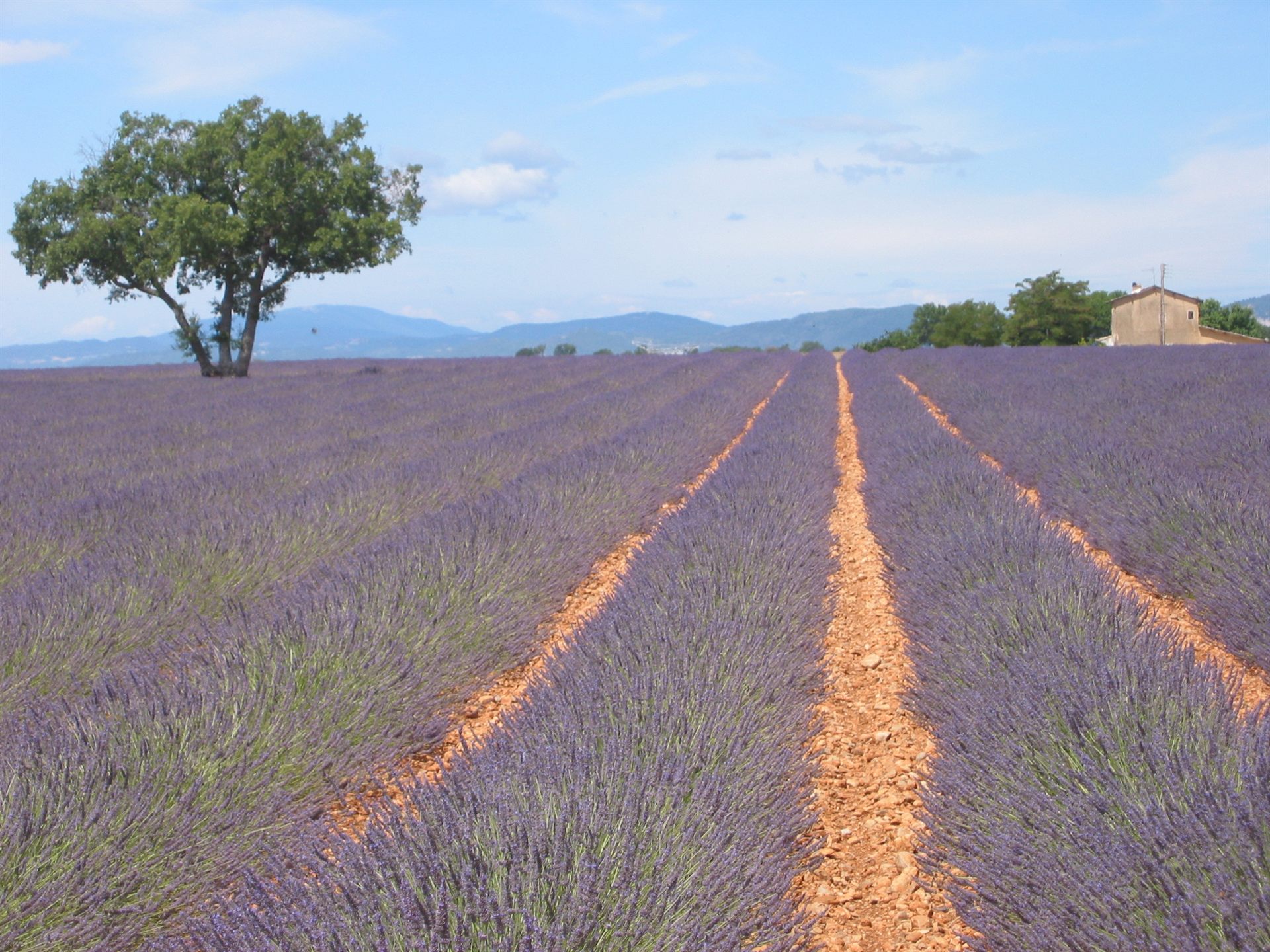
Pictured: a lavender field on the Plateau de Valensole, Alpes-de-Haute-Provence, photographed in 2005 — the same lavender-growing terrain in which Maurice Masse's encounter occurred, not a photograph of the actual landing site or Masse's own field, whose precise plot was never made public. No public-domain or rights-clear photograph of the real 1965 site, the ground trace, or Maurice Masse himself is known to exist; the original Digne gendarmerie site photographs remain part of the case's archival paper record rather than freely licensed for reuse.
Theoretical Alignment
Valensole is an unusually pure test case for competing UAP frameworks precisely because it combines high strangeness — a landed craft and two humanoid occupants, the very archetype of the Extraterrestrial Hypothesis — with a physical evidentiary record that is real but thin by this catalogue's instrumented standards. ETH scores highest because the report itself is a textbook structured-craft-and-occupant encounter with an independently verified ground trace, but the moderate rather than high alignment reflects the total absence of any recovered material, propulsion signature, or corroborating sensor data. The Interdimensional Hypothesis scores a meaningful 27% for reasons specific to this case's own historiography: cases like Valensole — entities that behaved less like conquering visitors and more like furtive, almost embarrassed trespassers who fled once discovered — were among those that pushed Vallée's thinking away from a straightforward extraterrestrial framework and toward the multidimensional model he began publishing later in his career. The Psycho-Social Hypothesis scores lowest but is not zero. Masse is this case's only witness, and his account changed substantially between his first gendarmerie statement of July 2, 1965 (one figure seen from about 60 meters, no paralysis) and his supplementary statement of August 18 (two beings seen from seven meters, and immobilization). He attributed the change to fear of ridicule, but the most striking elements of the case rest on that later telling.
Background
In the summer of 1965, the Plateau de Valensole was, as it remains today, one of the great lavender-growing landscapes of Provence — a broad limestone tableland in the department then called Basses-Alpes, given over largely to lavender, lavandin, wheat, and almond cultivation, and organized around small agricultural communes whose economic life ran on the seasonal rhythms of planting, distillation, and harvest. Valensole itself was, and is, a modest hilltop village overlooking that plateau, its population numbering only in the low thousands, connected to the wider region chiefly through the administrative and gendarmerie seat at Digne. Nothing about the community or the moment suggested any particular vulnerability to a UFO scare: France in 1965 had experienced a real but comparatively modest wave of "flying saucer" reports since the early 1950s, tracked informally by private research groups such as the Groupe d'Étude des Phénomènes Aérospatiaux (GEPA, not to be confused with the later government GEPAN) and chronicled by independent writers including Aimé Michel, but the French state itself had no dedicated UAP investigation office of any kind — that would not exist until the Centre National d'Études Spatiales (CNES) created GEPAN in 1977, twelve years after the events described in this file.
Maurice Masse, born in 1924, was a Valensole farmer, 41 years old at the time, married with two children, who lived on the Place du Marché in the village (Le Provençal, July 3, 1965). By his own statement to the gendarmes, he left home at about 5:00 AM on Thursday, July 1, 1965 for his field in the quarter of l'Olivol, about two kilometers northwest of the village. He had taken nothing to eat or drink. He began hoeing his young lavender at about 5:40, and at about 5:45 he stopped to take off his jacket and smoke a cigarette, sitting out of sight behind a mound of earth and stones. What he reported next made him, however reluctantly, one of the most cited single witnesses in French ufology, and the ground trace he showed the gendarmes is still being discussed sixty years later.
Complete Timeline
| Date / Time | Event |
|---|---|
| ~5:00–5:45 AM, July 1, 1965 | Maurice Masse leaves home at about 5:00 AM for his field at l'Olivol, about 2 km northwest of Valensole. He starts hoeing at about 5:40, stops at 5:45 to smoke behind a mound of stones, hears a whistling, and thinks a helicopter has landed (PV 445). |
| ~5:45 AM | He sees a matte object the size of a Renault Dauphine, shaped like a rugby ball, standing in his lavender on six legs and a central pivot. His July 2 statement describes one small figure on the ground, seen from about 60 m, and another inside; his August 18 statement describes two beings crouched over a lavender plant. |
| Moments later | (August 18 statement) He walks toward the object along the edge of the vineyard. At about 7 m, one being turns, sees him, and points an object at him. |
| Immediately after | He finds himself unable to make a single movement, though he is neither numb nor cramped and can still see. The beings watch him for some minutes, making gurgling sounds. |
| After 4–5 minutes | The two beings climb back into the craft. A sliding door rises shut from bottom to top, like the door of a filing cabinet, and he can see them behind the dome. |
| Departure | With a dull thump the craft lifts 50 cm to 1 m, and the central tube comes out of the ground as the six legs turn. It leaves obliquely toward Voix and Manosque, with no smoke and no dust raised. He loses sight of it within 15–30 m (August statement) or 10–15 m (July statement). |
| ~15 minutes later | Masse can move again (PV 145). He lights a cigarette, works on until about 7:30–8:00 AM, and goes home at about 8:30–9:00. |
| July 1, 1965, ~8:30 PM | Returning to the field with his daughter, he finds that the soil around the hole, waterlogged that morning, has become hard as cement. He tells a friend about the sighting, leaving out the beings, and word spreads through the village. |
| July 2, 1965 | Crowds visit and trample the field. The Valensole gendarmerie brigade learns of the story through public rumour at 7:30 PM, takes Masse's statement at 8:00 PM (PV 445), and at 10:00 PM goes to the site with the company captain from Digne. A supplementary statement follows from 11:15 to 11:30 PM. |
| July 3, 1965 | At 8:30 AM the Brigade de Recherches photographs the trace and draws a site plan (PV 105, closed July 5), and soil samples are taken. Le Provençal runs the story, and military sources suggest an army light-aviation (ALAT) Alouette helicopter from the "Provence 65" manoeuvres. |
| July 4–6, 1965 | Le Monde, Le Dauphiné Libéré, Le Méridional, the Journal-American and the Washington Post (July 5) cover the case. Masse tells Le Provençal the craft had "neither rotor, nor blades". |
| From July 3, 1965 | Masse begins sleeping nearly twice his usual six to seven hours a night; in mid-August he still sleeps about ten hours (PV 145). |
| August 18, 1965 | Masse returns to the brigade with a detailed supplementary statement (PV 145, closed August 23): two beings, an approach to 7 m, and immobilization. |
| Late 1965 onward | Aimé Michel's account appears in Flying Saucer Review 11(6), November–December 1965. Michel and Pierre Guérin take up the case, and Michel and Charles Bowen later publish "A Visit to Valensole" (FSR 14(1)). |
| Until about 1975 | Lavender reportedly does not grow back on the spot until 1975 (Julien Gonzalez, RR3, 2014, as cited by French Wikipedia) — "about ten years," in Futura-Sciences' account. |
| 1977 | CNES creates GEPAN, France's first government UAP study office — twelve years after the Valensole encounter, and too late to conduct a contemporaneous, on-site scientific investigation of it. |
| June 26, 2015 | On the case's fiftieth anniversary, GEPAN's successor agency GEIPAN publicly releases the case's three original gendarmerie procès-verbaux for the first time, while explicitly stating it classified the case "D" by default, given its strangeness, rather than through a fresh GEPAN field investigation of its own. |
| 2004 | Maurice Masse dies (Futura-Sciences, 2026; French Wikipedia gives 1924–2004). |
| 2025 | Dominique Filhol's feature film Valensole 1965 plays in a number of French cinemas in summer 2025 and is later released on video on demand (Futura-Sciences, 2026). |
What Masse Saw: The Craft and Its Occupants
Masse's first statement was taken at the Valensole gendarmerie at 8:00 PM on July 2, 1965, and recorded in procès-verbal no. 445. It began with sound rather than sight. Sitting behind a mound of stones, he heard a whistling close by, saw nothing, and walked toward where the sound seemed to come from. There, in his lavender field, he saw a machine "the size of a Dauphine car" and matte in colour, shaped like a rugby ball, with a sliding door on its side. Its top was made of a transparent material through which he could see a person inside. When he caught sight of it, he said, "a man" was already on the ground beside it, about sixty meters from him: about a meter tall but "fairly stout," apparently wearing a one-piece suit, bareheaded and empty-handed. That figure, he supposed, was warned by the one inside and climbed back aboard; Masse heard a dull noise and the craft vanished almost at once toward Manosque. At rest, he added, the object stood on six legs and a steel-coloured central pivot. It had no porthole, only a door sliding from top to bottom. He could not describe the occupants' skin colour, but they seemed to him of European type. Early press accounts, from reporters who spoke to him on July 2, describe four legs and a distance of about thirty meters. The Washington Post reported that the gendarmes said he had at first mentioned four legs, and he later told Le Provençal he had "clearly counted six."
The beings as most readers know them come from Masse's second, much more detailed statement of August 18, 1965 (PV 145). There he described two beings, both crouched on the ground, one with its back to him and the other facing it, apparently looking at a lavender plant. They were under a meter tall. Their heads were pumpkin-shaped and about three times the volume of a man's head, with fairly large ears, no chin, a round hole where a mouth would be, and eyes like ours but without eyebrows. They had large hairless skulls, smooth skin with no beard, and a complexion close to that of a white man. Their shoulders were barely wider than their heads, and they had almost no neck. Their hands were small, and he could make out only the thumb. They wore a fairly dark one-piece suit and carried two cases on a belt, a small one on the left and a larger one on the right. They made a kind of gurgling sound, "certainly" from the throat. "They seemed to be mocking me," he told the gendarmes, but their attitude did not frighten him, "because I did not have the impression that they wished me any harm." Later popular accounts describe grey-green coveralls, slanted eyes, pointed chins and lipless slit mouths. Those details do not match his sworn statement and should be treated as the product of later retellings.
The Paralysis and the Silent Departure
In the August statement, Masse said that he had not, as he first claimed, stayed at a distance. He had walked up along the vineyard bordering his field to about seven meters from the object. When he got there, the being facing his way saw him and "must have made a sign to the other." Both stood up, and the one facing him made a gesture with its right arm and hand, in which he made out an object; at that moment, he said, "I was immobilized, without being able to make a single movement." He stressed that he felt nothing, was neither numb nor cramped, and simply could not move his head, arms, legs or body. Afterwards he saw the being put the object back into the case on its left. The two stayed several minutes, apparently talking while looking at him, before climbing into the craft after four or five minutes, one hand after the other. The door, which he estimated would force a man to turn sideways to get through, slid shut from bottom to top "like a filing-cabinet door," apparently on its own. Behind the dome he could still see them. He heard a dull noise lasting two or three seconds as the craft rose half a meter to a meter; the tube beneath it came out of the ground and the six legs began to turn clockwise, with no smoke and no dust raised. While the beings were still facing him, the craft left backwards and obliquely, toward the area between Voix and Manosque. He said it went faster than a jet aircraft at take-off and that he lost sight of it after fifteen to thirty meters. He could not move his head but could see as far as the hills of Voix, about ten kilometers away as the crow flies.
He remained immobilized "for quite a long time" after the craft had gone, about a quarter of an hour by his estimate, and was afraid he would stay that way. Then he could move his hands, and almost at once the rest of his body. What he did next is not what most retellings describe. He did not run home in a panic. He went to his tractor, lit a cigarette, and carried on working until about 7:30 or 8:00, hoeing a small vineyard before going home at about 8:30 or 9:00. He told the gendarmes the times were rough estimates, because he had not thought to look at his wristwatch. He returned to the field that evening at about 8:30 with his daughter. Popular accounts in which he ran into the village and was questioned by a café owner come from later secondary sources, not from the procès-verbaux.
Reporting It: Rumour, the Gendarmerie, and Three Statements
Masse did not go to the gendarmes. According to his July 2 statement, he mentioned the sighting to a friend, the news spread, and on July 2 so many people came to his field that most of the marks were wiped out. The Valensole brigade's own report records that it learned of the matter "through public rumour" at 7:30 PM on July 2. It called Masse in and took his statement at 8:00 PM; at 10:00 PM, with the captain commanding the Digne company and the head of the Brigade de Recherches, it went to the site, where the officers confirmed a hole at the spot Masse pointed out but no other visible trace, because the ground had been trampled. A second short statement was taken from 11:15 to 11:30 PM. The Brigade de Recherches came back at 8:30 AM on July 3, re-measured the trace, photographed it, and drew a plan; its report (PV 105) was closed on July 5. Le Provençal of July 4 reported that the inquiry on site went on almost all night and that the Brigade de Recherches took soil samples the next morning, and Le Dauphiné Libéré reported that an engineer from the Marcoule atomic site came to look. The third statement (PV 145) was taken on August 18 when Masse came back of his own accord with "additional information," and was closed on August 23. GEIPAN later released all three documents, with the names removed. The often-repeated claim that the gendarmes questioned Masse for eight hours does not match their reports, which record two sessions on July 2 of about forty and fifteen minutes plus the site visit. The gendarmes' assessment of him survives only through the press: the Washington Post reported that they "described Masse as a sober, level-headed person," and Valensole's town clerk told Le Dauphiné Libéré there was "surely something true in this."
Press coverage was immediate. Le Provençal carried the story on page one on July 3, under Victor Nathan's byline. Le Dauphiné Libéré, Le Méridional, Le Monde ("The flying saucer was undoubtedly a helicopter") and the New York Journal-American followed on July 4, and the Washington Post followed on July 5, in a report by Waverley Root. On July 6 Le Méridional reported that villagers were steering journalists away from Masse, who was said to be suffering from nervous exhaustion. Masse told Le Provençal that his first impulse had been to plough the field and erase the marks: "I should have obeyed my first impulse."
How the Account Changed Between July and August
Read in order, the three gendarmerie documents show a story that grew between the first telling and the third. On July 2, Masse said he saw one occupant on the ground from about sixty meters and another inside, did not approach because he was "at first upset," and saw the craft leave "almost immediately." He told Le Provençal on July 4 that about thirty seconds passed between his discovering the scene and the craft's disappearance, and that he was about fifty meters away. On August 18 he said he had walked to within seven meters, that there were two beings outside, that one of them immobilized him with an object, that they watched him for several minutes, that they boarded after four or five minutes, and that he remained paralysed for about a quarter of an hour. He opened the August statement by explaining the difference: "When you questioned me on July 2, 1965, I did not reveal everything I had seen, because it was so extraordinary that I was afraid of being taken for a madman and locked up. Having since regained confidence, I have decided to describe to you everything I saw." He confirmed the shape and size of the craft and what he had found on the ground.
Masse's explanation is plausible: a farmer who had already seen his field overrun and read himself described as having a breakdown had good reason to hold back. But the change matters to how much weight the account can bear. The elements that make Valensole a close encounter of the third kind and not simply a landing report are the close-range description of the beings, the paralysing device, and the long, mutual observation. All of them first appear in the record seven weeks after the event, after national and international press coverage and after civilian investigators had begun visiting. The elements that are in the record from the start are the object's general shape and size, the six legs and pivot, the whistling and dull noise, the rapid departure, and the trace. Some details also shifted between July and August. In July he lost sight of the craft within ten to fifteen meters, and in August within fifteen to thirty. In July he said the occupants seemed "of European type," while in August he gave a detailed description of pumpkin-shaped heads. Both statements were read back to him and signed.
The Physical Trace: A Hardened, Geometric Ground Mark
What has kept Valensole in serious discussion for sixty years is the trace in the field, and here the gendarmerie record is specific. The Brigade de Recherches found, in a lavender field whose soil was "loose and freshly hoed," "an unusual, more recent trace": a shallow bowl about 1.20 meters across, with a cylindrical hole at its center 18 centimeters in diameter and about forty centimeters deep. Four shallow furrows, each about 8 centimeters wide and close to two meters long, formed "a sort of cross" centred on the hole. "The earth at this spot was compact," the report says, and the next morning the officers found it "still compact" while the rest of the field was loose. The trace lay 22.5 meters from an older lavender field, 34 meters from a vineyard and 59 meters from a dirt road, about 2 km northwest of the village between the roads to Oraison and Manosque. The stone mound behind which Masse said he had been sitting was about 90 meters northeast of the trace. Eight photographs and a 1:500 sketch plan accompany the report. Masse himself told the gendarmes that just after the departure the soil in the hollow was waterlogged, and that by about 8:30 that evening it had become "hard as cement." The next day at noon he and some friends found the edges of the hole blackened on the north side, the direction in which he had been standing. Press figures for the hole vary: 20 by 50 centimeters in Le Provençal on July 3, and 80 centimeters deep in Le Monde and in Le Provençal on July 5. The gendarmes' measurement is the one to rely on. The widely repeated story that a gendarme broke his knife blade trying to take a sample does not appear in the reports. Futura-Sciences (2022) gives the milder village version that "it was impossible even to stick a knife in." Lavender at the spot did not grow back for years: until 1975 according to Julien Gonzalez (2014), as cited by French Wikipedia, and for about ten years in Futura-Sciences' account. No laboratory record of that regrowth failure has been published.
The soil-chemistry question is where this file must be most careful about overstating what is known. Secondary sources say soil from the site was analysed and showed a calcium anomaly, but they disagree on its direction. The French Wikipedia article on the case reports that calcium was negligible in the surrounding soil but reached 18.3 percent at the landing site, and that the astronomer Pierre Guérin attributed both the calcium level and the soil's infertility to the craft; it does not say who performed the analysis. Futura-Sciences (December 2022), by contrast, writes of "un taux anormalement bas de calcium," an abnormally low level, attributing it only to "later analyses." This file has not found a primary laboratory report, with a named laboratory and a documented chain of custody, that would settle which claim, if either, is accurate. The July 1965 press reported that the gendarmerie's Brigade de Recherches took soil samples, but the procès-verbaux do not mention them and no result has been published. What the gendarmes did document is the trace's geometry and the compactness of the soil there compared with the rest of the field.
Aftermath: Hypersomnia and a Reticent Witness
Masse told the gendarmes in August that he had felt nothing unusual in his body, either while immobilized or afterwards, and had no trouble with his vision. The one change he reported was sleep: from July 3 he wanted to sleep far more than before. He had slept six to seven hours a night and now slept almost twice as much, a little less by mid-August, when he was sleeping about ten hours a night plus a siesta. He had never taken medication, had not lost weight, and his eyesight was "still excellent." Some later retellings add poltergeist-like disturbances at his home. That claim appears in secondary sources such as Patrick Gross's summary, not in the gendarmerie record, and this file treats it with caution.
Later accounts by investigators who met Masse, including Aimé Michel and Jacques Vallée, describe him as unwilling to say more about what passed between him and the beings, and as sure they had meant no harm. This file has not been able to check the exact wording of those later conversations. The gendarmerie record does contain his own words from 1965: the beings "seemed to be mocking me," but "I did not have the impression that they wished me any harm." His reluctance is usually read as evidence against a hoax, because a fabricator would be expected to add detail rather than withhold it. That reading has to be balanced against the record, which shows the opposite movement within the first seven weeks: a short account in July and a much fuller one in August.
Independent Investigation: Michel, Guérin, and Vallée
Because no French government UAP office existed in 1965, the deeper non-gendarmerie work on Valensole fell to private researchers. Aimé Michel, a French science writer known for his "orthoteny" theory of aligned sighting patterns, wrote up the case for the British Flying Saucer Review (vol. 11, no. 6, November–December 1965) and later revisited the site with the magazine's editor Charles Bowen ("A Visit to Valensole," FSR 14(1)). The civilian group GEPA's bulletin Phénomènes Spatiaux also covered the case; Pierre Lagrange quotes it in Science et Vie (June 1997) as saying "we are inclined to think that M. Masse's lavender field was the object of an unusual visit." Pierre Guérin, an astronomer at the CNRS's Institut d'Astrophysique de Paris, investigated the case and wrote about it in Lumières dans la nuit and Inforespace (1980), interpreting the soil findings as an effect of the craft. GEIPAN's 2015 note names Guérin and Jacques Vallée as the principal investigators after the gendarmerie.
Jacques Vallée, the French-American astronomer and computer scientist who became one of the most influential UAP researchers of the twentieth century, and a partial model for the French scientist in Steven Spielberg's Close Encounters of the Third Kind, met Masse and discussed the case in his books, including Passport to Magonia (1969) and Dimensions (1988). Valensole is often quoted as Vallée's choice for "the best-authenticated close encounter incident in continental Europe." This file could not trace that sentence to any of his books and no longer presents it as his words. Vallée's broader career is relevant context: cases combining a physical trace with strange, non-hostile occupant behaviour, of the kind Valensole is usually taken to be, were part of what moved him away from a simple extraterrestrial-visitation model and toward the folkloric and "control system" frameworks for which he became best known.
GEPAN, GEIPAN, and Fifty Years of Official Silence
The French state's relationship to the Valensole case is, in its own way, as important to understanding this file's credibility assessment as anything Masse himself reported. CNES, the French national space agency, created GEPAN — the Groupe d'Étude des Phénomènes Aérospatiaux Non-identifiés — in 1977, twelve years after Masse's encounter; the office was later renamed SEPRA in 1988 and GEIPAN in 2005, the name under which it continues to operate today as part of CNES. Because GEPAN simply did not exist in July 1965, it never had the opportunity to dispatch its own investigators to the fresh site, collect its own soil samples under a documented chain of custody, or interview Masse while the encounter was recent — the kind of contemporaneous, agency-led response that, as discussed above, the much later Trans-en-Provence case did receive.
GEIPAN's own public statement on the matter, issued on the case's fiftieth anniversary on June 26, 2015, is unusually candid about this limitation. The agency's release states plainly that GEPAN/SEPRA/GEIPAN's successive leadership had always taken an interest in the case, collecting documents about it over the decades, but had never published an in-depth investigation of their own — and adds that a fresh GEPAN inquiry, so long after the fact and after the Gendarmerie and independent investigators including Guérin and Vallée had already done their own work, would likely have been unproductive. Rather than a rigorous new scientific review, what the fiftieth-anniversary release actually delivered was public access to the case's three original gendarmerie procès-verbaux, described by GEIPAN itself as "the most reliable documents" available on the affair. The release states outright that, given the case's strangeness, it is classified "D" by default, specifically to make the case easier for researchers and the public to locate — not as the product of fresh GEPAN fieldwork or a new laboratory workup. In GEIPAN's classification system, a "D" case is one that remains unidentified after investigation; the agency's own published statistics describe D-classified cases as a small minority, roughly a few percent, of its full database of several thousand reports. GEIPAN's own case-database entry for the file — whose documents are filed as "Synthese.pdf" and "PV n°445 (1965309761).pdf," with an update date of June 26, 2015 and the phenomenon type "strange phenomenon of medium or high consistency" — summarizes it as an "observation of an unknown craft and close encounter; ground traces: unidentified phenomenon."
The case page's own description tracks the procès-verbaux closely, and it differs from many popular retellings. It says that Masse observed "for 4 to 5 minutes" two figures who quickly got back into the craft, which "took off and left obliquely before rapidly disappearing in the direction of Manosque." About ten minutes later he found the star-shaped marks with a cylindrical hole "in waterlogged earth." He returned at about 8:30 PM with his daughter and found the earth "hard as cement." The local gendarmerie learned of the matter "by public rumour" at about 7:30 PM on July 2, and "no other testimony was collected" and "no other clue" was found around the site.
This history matters directly to how this file scores the case. Valensole's "unexplained" status is real, but it is fundamentally a default administrative classification inherited from a pre-GEPAN investigation, not the product of the kind of rigorous, multi-laboratory, agency-led forensic workup GEPAN performed on Trans-en-Provence sixteen years later. Readers who encounter Valensole described online as "investigated and confirmed unexplained by the French government" should understand that claim more precisely: the French government's own UAP office inherited, endorsed by default, and made public an investigation that gendarmerie and private civilian researchers had already substantially completed twelve years before that office existed.
Skeptical Counter-Arguments and Maurice Masse's Own Rebuttal
Valensole has drawn specific skepticism, not only casual dismissal. The first conventional explanation came from the military itself, within two days. On July 4, 1965 Le Dauphiné Libéré reported that "military circles" in Marseille believed the object was an army light-aviation (ALAT) helicopter, "very probably" an Alouette II or III. The 9th Military Region's "Provence 65" manoeuvres had been under way since June 29, with army helicopters taking part, and the eastern edge of the manoeuvre area was the Saint-Étienne-les-Orgues–Forcalquier–Manosque line, about 20 km from Valensole. The paper added that "several aircraft based at Saint-Auban" had taken off at about the time Masse gave. Le Monde headlined its report "The flying saucer was undoubtedly a helicopter." Masse rejected the idea when reporters put it to him. "The craft had neither rotor, nor blades," he told Le Provençal (July 5, 1965, as translated by Patrick Gross). "I claim all the same to be able to recognize a helicopter. It wasn't one. I am formal." The same paper pointed out that the Alouette sat on a three-wheel undercarriage, which could not make an 80-centimeter hole. Later skeptics have refined the helicopter idea. Dominique Caudron (Communications, 1990) argued that the whistling fitted an Alouette II's turbine as the rotor slows, and Claude Maugé (2004), crediting the idea to Yves Rocard, suggested a U.S. Sixth Fleet helicopter on an intelligence mission, a hypothesis that requires Masse to have misdescribed what he saw. Other skeptics have argued that Masse invented the whole account and made the trace himself, a position that has to explain his reluctance to come forward and the compacted soil the gendarmes found within two days. Raoul Robé, writing in a 2023 volume edited by Vicente-Juan Ballester-Olmos and Richard Heuden, proposed that the story was modelled on "Passagers de soucoupes volantes," an illustrated story published in À travers le monde in 1950 and reprinted in 1960, which shares a Provence setting, a landed saucer, small occupants and a paralysing ray. The skeptic Gilles Fernandez judged that scenario improbable but not impossible, given how many differences there are. A suggestion that farm chemicals or a fertilizer spill produced the trace is a poor match for its symmetry.
Circumstantial Evidence
- Masse's basic description of the craft — Dauphine-sized, rugby-ball-shaped, on six legs and a central pivot — is the same in his July 2 and August 18 statements to the gendarmes, though the encounter itself grew considerably between them.
- Gendarmes went to the site on the night of July 2 and returned at 8:30 AM on July 3, measuring, photographing and drawing a plan of a cross-shaped trace; press reports quote them describing Masse as sober and level-headed.
- The trace itself — a 1.2 m bowl with an 18 cm central hole about 40 cm deep and four 2 m furrows in a cross, in soil the gendarmes found compact while the rest of the freshly hoed field was loose — is a distinctive pattern not obviously attributable to routine farm work.
- Lavender reportedly did not grow back at the spot for years (until 1975 by one account), although no laboratory study of this was published.
- Masse did not seek publicity: he did not report to the gendarmes himself, considered ploughing the trace under, and avoided reporters, who wrote of his nervous exhaustion within days.
- Credentialed investigators — CNRS astronomer Pierre Guérin and astronomer and computer scientist Jacques Vallée among them — treated the case as a serious data point, and GEIPAN named their work alongside the gendarmerie's in 2015.
Key Witnesses
Maurice Masse
The case's sole witness. A 41-year-old farmer, married with two children, described in the press as serious and sober, Masse did not report the encounter himself: the gendarmes heard of it through village rumour. He gave a short account on July 2, 1965 and a much fuller one on August 18, saying he had held back at first for fear of being thought mad. The close-range encounter with two beings and the paralysis appear only in the later statement. He died in 2004.
The Five Observables Assessment
The Five Observables framework, developed by former AATIP director Luis Elizondo, is used to classify UAP encounters by performance characteristics exceeding known technology of their era:
Assessment: Anti-Gravity Lift is rated speculative rather than present: Masse described the craft's legs retracting and a silent, apparently unpowered-looking liftoff, but as a single untrained observer with no instrumentation, he could not rule out a conventional, if unusually quiet, propulsion method. Instant Acceleration is likewise rated only speculative: Masse described the object departing with a speed and silence he found remarkable, but that description is subjective and unmeasured, resting on one witness's impression rather than any timed or instrumented observation. Hypersonic Velocity is rated absent, since no distance, altitude, or duration data exists from which any actual speed could be calculated. Low Observability is rated absent: the craft was plainly visible at close range in daylight conditions, not stealthy in any sense. Trans-Medium travel is rated absent, as no witness reported any transition between air, land, or water.
Evidence Assessment
Supporting Anomalous Origin
- A geometrically distinctive ground trace was examined by gendarmes on the night of July 2 and measured, photographed and mapped by the Brigade de Recherches on the morning of July 3; it does not rest on the witness's description alone.
- The gendarmes found the soil at the trace compact while the surrounding freshly hoed field was loose; Masse's own description is of waterlogged soil turning "hard as cement" by evening.
- Masse's description of the craft itself was consistent across his statements, and contemporaries, from gendarmes quoted in the press to the town clerk, considered him serious and sober.
- Masse had no apparent motive for fabrication: he did not go to the gendarmes himself, considered destroying the trace, and avoided the press.
- Credentialed investigators, including CNRS astronomer Pierre Guérin and Jacques Vallée, treated the case as a serious anomaly, and GEIPAN classes it as unidentified, though only by default.
Supporting Conventional Explanation
- The case rests on a single witness for every detail of the craft, the beings and the paralysis; the gendarmes recorded that there was no other witness and found no other clue around the site.
- The soil-calcium analysis often cited as corroboration has no published laboratory report, and secondary sources disagree on whether the calcium was abnormally high or abnormally low.
- No French government scientific body investigated the case contemporaneously; GEPAN did not exist until 1977, and its later "D" classification was applied by default rather than through fresh field investigation, a materially weaker provenance than cases GEPAN investigated in real time.
- Army helicopters from the "Provence 65" manoeuvres were active in the region that week, and aircraft from Saint-Auban were reported airborne at about the time of the sighting; Masse rejected the helicopter explanation, but it was never closed out with flight records.
- The account grew between July 2 (one figure at about 60 m, no paralysis, a departure "almost immediately") and August 18 (two beings at 7 m, immobilization, several minutes of mutual observation); the most striking elements first appear seven weeks after the event.
Why "Disputed"
Valensole is rated DISPUTED on this site's scale because a real, gendarme-documented physical trace sits alongside an encounter account that rests on one witness and that grew substantially between his first and third statements. On the strength side, gendarmes saw the site on the night of July 2 and measured, photographed and mapped a cross-shaped trace the next morning. They recorded the soil there as compact in an otherwise loose, freshly hoed field. Masse did not seek attention, did not report the sighting himself, and gave the same basic description of the craft in July and August. Credentialed investigators, including Pierre Guérin and Jacques Vallée, took the case seriously. On the other side, a single witness cannot corroborate himself. The defining close-encounter elements — two beings at close range, a paralysing device, and minutes of mutual observation — first appear in the August 18 statement, after his July 2 statement had described one figure seen from about 60 meters and a near-immediate departure. Army helicopters were manoeuvring in the area that week, and the helicopter explanation was never closed out with flight records. The often-cited soil-calcium anomaly has no published laboratory report, and its sources disagree on its direction. GEIPAN's "D" classification was applied by default in 2015 to make the case easy to find, not after an investigation of its own, unlike the agency's laboratory work on the Trans-en-Provence case sixteen years later. Together these place Valensole in disputed territory: one of Europe's most cited close-encounter cases, with a real trace, but not a closed or independently confirmed one.
Sensor & Instrumentation Detection Profile
Valensole possesses no instrumented detection record of any kind. There was no radar coverage of the site, no photograph or film of the craft or its occupants, no audio recording of the whistling sound Masse described, and no independent optical or electronic sensor of any type within range of the encounter. Every account of what appeared in the sky and on the ground rests on Maurice Masse's unaided testimony, given first to a friend, then on the evening of July 2 to the gendarmes, with a fuller statement on August 18, and later to independent civilian researchers including Aimé Michel, Pierre Guérin, and Jacques Vallée. The case's only non-testimonial data is physical rather than sensor-based: the ground trace itself, examined, measured and photographed in place by the gendarmerie, and soil samples whose analysis results have never been published. That distinction matters for how this file weighs the case against instrumented, multi-witness files elsewhere in this archive — Valensole's evidentiary strength lies entirely in a physical trace and a single witness's testimony, not in any recorded signal.
Environmental & Geospatial Context
Valensole sits on a broad limestone plateau in what was, in 1965, the French department of Basses-Alpes (renamed Alpes-de-Haute-Provence in 1970). It is a rural farming region about 55 kilometers northeast of Aix-en-Provence, dominated by lavender, lavandin, wheat and almond cultivation. The gendarmerie photographs show open, gently rolling fields with scattered trees, a vineyard and a small stone hut. Masse's field lay in the quarter of l'Olivol, about 2 km northwest of the village between the D15 to Oraison and the D16 to Manosque. At 5:45 AM local time (UTC+1) on July 1, 1965, the Sun stood about 7 degrees above the east-northeast horizon (azimuth about 64 degrees), roughly 45 minutes after sunrise, and the Moon, a 6-percent crescent, was below the horizon (NASA JPL Horizons). This was full daylight, not dawn. No weather observation is in the case file. Masse told reporters it had not rained "for a long time," which made the waterlogged soil he described at the trace all the more puzzling to him. The gendarmes recorded that "there exists no other eyewitness" and found nothing else around the site. A green glow seen over the Rhône at Port-Saint-Louis at about 3 AM that morning, which Le Provençal connected to the case, was some 100 km away and nearly three hours earlier.
Observer Credibility & Occupational Profile
Maurice Masse was described by the reporters who met him in July 1965 as "a solid mind, a serious man who generally does not talk in vain" (Le Provençal) and as known in the village "for his sobriety" (Le Dauphiné Libéré); according to the Washington Post, the gendarmes called him "a sober, level-headed person." He did not go to the authorities: he told a friend, the news spread, and the gendarmes summoned him after hearing the rumour. Within days he was avoiding reporters, and Le Méridional reported that he was suffering from nervous exhaustion. None of this suggests a man seeking publicity. The record also shows something that the usual portrait of a "materially consistent" witness leaves out. His July 2 statement and his August 18 statement describe substantially different encounters, and he explained the difference himself as a deliberate omission out of fear of ridicule. Investigators who met him later describe him as unwilling to elaborate further. This file treats his sincerity as likely but notes that his own account changed in the weeks when the case was most public.
Physical & Material Assays
Valensole's physical record rests on a single ground trace, measured by the gendarmerie's Brigade de Recherches on the morning of July 3, 1965. It consisted of a shallow bowl about 1.20 meters across; a central cylindrical hole 18 centimeters in diameter and about 40 centimeters deep; and four shallow furrows, each about 8 centimeters wide and close to 2 meters long, forming a cross. It lay in a freshly hoed field of young lavender where the soil was loose everywhere except at the trace, which was compact. The officers photographed it from several angles and drew a 1:500 plan. Samples were taken, according to the July 4 press, but no analysis result from them has been published. The calcium figures that circulate — 18.3 percent at the site against negligible levels nearby, per the account summarized by French Wikipedia and associated with Pierre Guérin, or an abnormally low level according to Futura-Sciences — cannot be tied to a named laboratory or a documented chain of custody. French Wikipedia also reports that no radioactivity was found. The story of a gendarme breaking his knife on the hardened soil does not appear in the gendarmerie reports. Because GEPAN did not exist until 1977, no state scientific body analysed anything from the site, in sharp contrast with the later Trans-en-Provence case, discussed below.
Historical Precedents & Archive Matches
Valensole is the classic French landed-craft, physical-trace close encounter, and the case most often set beside it is the January 1981 Trans-en-Provence Sighting. There a single witness, Renato Nicolaï, reported a landed object in his garden and left a ring-shaped trace that GEPAN, by then a functioning CNES office, had analysed in laboratories, including a biochemical study of the plants by biologist Michel Bounias. The contrast is instructive. Trans-en-Provence shows what a French landing case looks like when a national scientific agency can collect and analyse samples. Valensole shows what one looks like when only a rural gendarmerie and, later, private researchers are available. Beyond France, Valensole is often compared with the April 1964 Socorro, New Mexico encounter, in which police officer Lonnie Zamora reported a landed egg-shaped object with two small figures beside it, and left landing marks. Both involve an oval craft on legs, small occupants near it, a quick departure and ground marks. An earlier version of this page said Masse, shown material on Zamora's case, remarked that "someone else has seen my UFO," and that J. Allen Hynek cited this; this file could not find a source for either claim.
Material Analysis
Valensole's physical evidence begins and largely ends with the ground trace: a shallow 1.2-meter bowl with a central hole 18 centimeters wide and about 40 centimeters deep, and four radiating furrows in a cross, in soil the gendarmes found compact against the loose earth of a freshly hoed field. The gendarmes saw the site about 40 hours after the event, by which time, they noted, crowds had trampled the ground and no other trace was visible. That compactness, in a field Masse had been hoeing that morning, is the case's best-documented physical fact. The more dramatic "hard as cement" description is Masse's, from the evening of July 1. Vegetation effects are reported but not documented: the spot reportedly resisted new lavender for years, but no replanting study or soil report has been published. The calcium question remains unresolved, with secondary sources split between abnormally high and abnormally low and no laboratory report available to settle it.
Supporting a Genuine Anomalous Effect
- The trace's geometry — four 2 m furrows in a cross around an 18 cm central hole in a shallow bowl — is a poor match for routine farm work, animal activity or casual vandalism.
- The gendarmes found the soil at the trace compact while the rest of the freshly hoed field was loose, an observation independent of Masse's own account.
- The reported failure of lavender to grow back at the spot until about 1975 recurs in independent accounts, though no laboratory record of it exists.
Supporting a Mundane Origin
- No state laboratory analysed the soil under a documented chain of custody; the gendarmes' samples have no published results, and the calcium claims conflict on direction.
- Crowds trampled the field on July 2, before the gendarmes arrived; their report says no trace other than the hole was visible that night, and the full pattern was measured the next morning.
- No expert has ruled out the trace being made by hand or by a machine's legs or skids; the compact soil is harder, but not impossible, for that explanation to account for.
Conventional Explanation Candidates
Three distinct conventional explanations have been seriously proposed for the Valensole case, and each deserves evaluation on its own terms.
Military Helicopter Misidentification
Partially Plausible, IncompleteThe most seriously advanced conventional explanation holds that Masse saw a helicopter. The military proposed it themselves on July 3, 1965: "military circles" told the press that the object was very probably an army light-aviation Alouette II or III. The 9th Military Region's "Provence 65" manoeuvres, with army helicopters taking part, had been running since June 29 west of a line through Manosque, about 20 km away. Le Dauphiné Libéré reported that several aircraft based at Saint-Auban had taken off at about the time Masse gave. Dominique Caudron later argued that the whistling fitted an Alouette II's turbine, and Claude Maugé suggested a U.S. Sixth Fleet helicopter on a covert mission. The candidate has two weaknesses. Masse rejected it in specific mechanical terms ("neither rotor, nor blades"). And the trace does not fit an Alouette's three-wheel undercarriage, as Le Provençal pointed out in 1965. No flight record matching the time and place has been published, so the theory is plausible in general but unconfirmed here.
Deliberate Hoax
Partially Plausible, IncompleteSome French skeptics have argued that Masse invented the encounter and made the ground trace himself. Raoul Robé (2023) proposed that the story was modelled on "Passagers de soucoupes volantes," an illustrated story published in 1950 and reprinted in 1960. Claude Maugé's position is different: that Masse saw a real helicopter and misdescribed it. A hoax cannot be dismissed outright, and the August statement's large additions give it something to work with. Against it are Masse's reluctance to come forward, his avoidance of the press, and the gendarmes' finding that the soil at the trace was compact in an otherwise loose, freshly hoed field. That last point is harder, though not impossible, for a hand-made trace to explain.
Agricultural Equipment or Chemical Spill
Partially Plausible, IncompleteA less frequently discussed alternative proposes that a leaking liquid-fertilizer tank or piece of farm equipment, possibly from an adjoining field, produced both the ground hardening and the vegetation die-off without any craft being involved at all. This candidate deserves mention because agricultural chemical damage to soil and crops is a genuine, documented phenomenon, but it fails to explain the trace's specific, symmetrical cross-pattern geometry with a precise central cylindrical hole — a poor structural match for an irregular chemical spill footprint — and no investigator identified any leaking equipment, container, or logged agricultural operation at that field around the relevant date.
Each candidate explains part of the record. The helicopter accounts for the noise, the manoeuvres and the rapid departure, but not Masse's description or the trace geometry. A hoax accounts for the way the story grew, but sits poorly with Masse's behaviour and the compact soil. A chemical spill accounts for neither the shape of the trace nor the sighting. None accounts for the whole record, which is why the case remains disputed and not explained.
Related Cases
Confirmed Documents & Official Records
The French national UAP research office's official case-database entry, classifying the sighting "D" (unidentified) and summarizing the ground-trace evidence and witness account.
UNCLASSIFIED / PUBLICGEIPAN's own fiftieth-anniversary statement on the case, explaining that the agency never conducted an original field investigation of Valensole and releasing the three original 1965 Digne gendarmerie procès-verbaux to the public for the first time.
DECLASSIFIED / PUBLICSearch Government Archives Directly
Further Reading — Recommended Literature
Passport to Magonia: On UFOs, Folklore, and Parallel Worlds
Vallée's foundational work placing landing and occupant reports such as Valensole within a folkloric framework, with an appended catalogue of landing cases.
Confrontations: A Scientist's Search for Alien Contact
Vallée's casebook of his own field investigations, mostly in South America, written as he turned toward a non-extraterrestrial "control system" view of the phenomenon.
Flying Saucers and the Straight-Line Mystery
By the French researcher who conducted some of the earliest, most detailed personal interviews with Maurice Masse and published the first in-depth case writeup.
DISCLOSURE: Some links above are affiliate links. If you purchase through them, OverClassified receives a small commission at no additional cost to you. This helps support independent research.
Essential Viewing
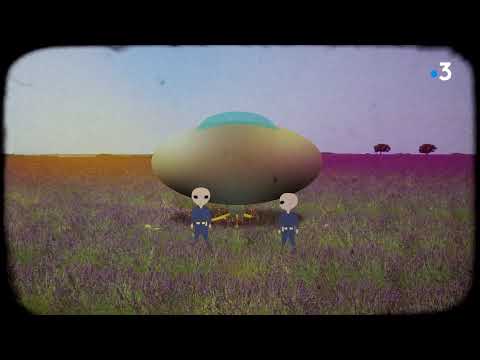
Vaqui. Des extraterrestres à Valensole
France 3 Provence-Alpes-Côte d'Azur's own regional-news segment revisiting the case and its lasting local legacy.
Un OVNI dans les champs de lavande... L'affaire historique de Valensole !
Inexploré TV's dedicated case walkthrough covering Masse's account, the gendarmerie investigation, and the physical trace.

A Farmer Faced a UFO at Close Range — The Valensole Encounter
A focused English-language narrative retelling of Masse's account and its aftermath.
1965 UFOB Case: Impressions of the Valensole Landing in Farmer's Lavender Field
A concise case-library summary covering the timeline, the ground trace, and the case's classification history.
1965: The Valensole UFO Case [SHORT]
A short-format overview of the encounter and its physical trace evidence for viewers new to the case.
Sources
- GEIPAN (CNES). "VALENSOLE (04) 01.07.1965" — official case file, PV n°445 (ref. 1965309761), Classification D. geipan.fr
- GEIPAN (CNES). "L'observation de Valensole 1965, cinquante ans après…" (50th-anniversary synthesis and gendarmerie procès-verbaux release), Toulouse, June 26, 2015. cnes-geipan.fr
- Wikipedia (English). "GEIPAN." en.wikipedia.org
- Wikipedia (French). "Rencontre de Valensole." fr.wikipedia.org
- Wikipedia (English). "Valensole" (commune). en.wikipedia.org
- Wikipedia (English). "UFO sightings in France." en.wikipedia.org
- Wikipedia (English). "Jacques Vallée." en.wikipedia.org
- Gross, Patrick. "UFOs at Close Sight: Valensole, France, 1965" — detailed sourced case archive with contemporary press citations. ufologie.patrickgross.org
- Think About It Docs. "1965: Valensole, France Landing (Maurice Masse Case)." thinkaboutitdocs.com
- NICAP. "UFO Report: Valensole, France, July 1, 1965." nicap.org
- UFO Casebook. "Valensole, France — UFO Landing (Masse), 1965." ufocasebook.com
- Project Black Echo. "Valensole Close Encounter: Timeline, Maurice Masse and Landing Evidence." projectblackecho.com
- Verdon XP. "Verdon and the Extraterrestrials — The Valensole Meeting." verdonxp.com
- Futura-Sciences. "5 histoires extraordinaires et non résolues d'ovnis : le cas toujours « inexpliqué » de Valensole." futura-sciences.com
- Bowen, Charles (ed.). The Humanoids. Flying Saucer Review special issue / Neville Spearman, 1969 (early detailed casework on Valensole and comparable European contact reports).
- Michel, Aimé. "The Valensole Affair," Flying Saucer Review 11(6), November–December 1965, pp. 7–9.
- Vallée, Jacques. Confrontations: A Scientist's Search for Alien Contact. Ballantine Books, 1990.
- Vallée, Jacques. Dimensions: A Casebook of Alien Contact. Contemporary Books, 1988.
- Hynek, J. Allen. The UFO Experience: A Scientific Inquiry. Henry Regnery, 1972 (Close Encounter classification framework).
- Clark, Jerome. The UFO Encyclopedia, 4th Edition, Relevant Information LLC (entry on the Valensole case).
- Gendarmerie nationale, Basses-Alpes. Procès-verbaux no. 445 (July 2, 1965), no. 105 (July 2–5, 1965, with site plan and photographs) and no. 145 (August 18–23, 1965); released by GEIPAN as "PV n°445 (1965309761).pdf," 18 pp. Internet Archive copy
- GEIPAN (CNES). Case page "VALENSOLE (04) 01.07.1965" (update date June 26, 2015). Internet Archive copy
- Nathan, Victor. [Did a "flying saucer" land in the Low-Alps?], Le Provençal, July 3, 1965, and follow-ups July 4 and 5, 1965; Le Dauphiné Libéré, July 4, 1965; Le Monde, July 4, 1965, p. 18; Le Méridional, July 6, 1965; Root, Waverley, "Frenchman sees 'Flying Object'," Washington Post, July 5, 1965 — all as transcribed and translated by Patrick Gross. ufologie.patrickgross.org
- Futura-Sciences. "Entre enquête et cinéma : le réalisateur de Valensole 1965 face au cas le plus célèbre d'Ovni français," 2026. futura-sciences.com
- NASA JPL Horizons. Observer ephemeris for the Sun and Moon, 43.85°N 5.97°E, July 1, 1965, 04:00–05:00 UT. ssd.jpl.nasa.gov
Corrections (October 2026)
This page was checked against the three gendarmerie procès-verbaux that GEIPAN released in 2015 and against the July 1965 press. The earlier version presented the August 18, 1965 account as Masse's consistent story from the start. In fact his July 2 statement describes one figure seen from about 60 meters and a near-immediate departure, with no approach and no paralysis; the page now sets out how the account changed. It described the beings with grey-green coveralls, slanted eyes, pointed chins and slit mouths; his statement describes dark suits, eyes like ours without eyebrows, no chin and a round mouth-hole. It quoted Jacques Vallée calling the case "the best-authenticated close encounter incident in continental Europe" and Masse saying "someone else has seen my UFO" about Socorro, with a Hynek citation. None of these could be traced, and all have been removed.
Following this review, the rating was changed from Disputed 50 to Disputed 42 (October 27, 2026), because the higher rating had rested partly on claims corrected or removed above.
Other corrections: Masse approached to about 7 m (August statement), not 5 m. The craft left toward Voix and Manosque, not Oraison. The gendarmes learned of the case through rumour at 7:30 PM on July 2 and questioned Masse in two short sessions, not for "eight hours," and the trace was photographed on July 3. The hole was 18 cm across, and the furrows 8 cm wide. He had gone to hoe, not to check a fungal problem; he went back to work after the encounter and did not run home; and he confided in a friend, with no mention of his father. Claims about the mayor and priest visiting, a gendarme's broken knife, a 1966 Phénomènes Spatiaux write-up by Michel, and a commentator named Fran Ridge were removed as unsourced. The GEIPAN case page update date is June 26, 2015, not June 23, 2021. Computed weather, lunar and nearest-airport rows were replaced with a JPL Horizons sky position: Sun about 7° up, so daylight, not dawn. The "Provence 65" helicopter manoeuvres were added. No stamp or score was changed in this pass.
See something inaccurate? Have additional information or sources?
Suggest an Edit →Last Updated: August 2026