
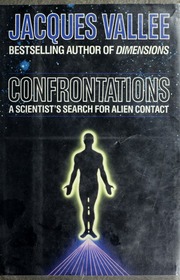
Confrontations
A Scientist's Search for Alien Contact
Core Thesis
Confrontations is Jacques Vallée's field notebook rather than his theory book: the second volume of a trilogy that opened with Dimensions (1988) and closed with Revelations (1991), it documents Vallée personally traveling to forty close-encounter sites around the world — California to Brazil, the French Alps to the Soviet Union — to interview witnesses, examine medical records, and review whatever physical evidence a case actually left behind, rather than working from secondhand summaries. Its specific, recurring subject is the phenomenon's more violent edge: cases in which witnesses reported burns, paralysis, disorientation, and in a small number of accounts, death, attributed to close encounters with unidentified aerial objects, concentrated most heavily in Vallée's own two field trips to Brazil in 1980 and 1988. Vallée does not conclude these encounters were extraterrestrial visitation in the conventional sense; instead the book carries forward the "control system" hypothesis he first proposed in The Invisible College (1975) — that the phenomenon behaves less like a technology visiting Earth and more like a mechanism that perturbs human belief and behavior across history — and asks whether that framework, tested directly against injury cases and physical-trace evidence rather than abstract argument, actually holds up in the field.
About the Author
Jacques Vallée's fuller biographical arc — his astrophysics training at the University of Lille, his computer-science doctorate under mentor J. Allen Hynek at Northwestern, his early NASA Mars-mapping work, and his parallel career at the center of ARPANET's development — is covered at length in this site's own Wonders in the Sky entry, which discusses his 2010 historiographical sourcebook with Chris Aubeck. This entry deliberately does not repeat that ground. Confrontations draws on a different side of Vallée's career: not the historian cross-checking centuries-old documents, but the field investigator willing to fly to Belém or drive into the French countryside himself, sit across a table from a frightened witness or an overworked rural physician, and ask what, specifically, they saw and felt.
That fieldwork habit predates this book by decades. Vallée had been part of the loose, informal network of scientists and investigators — a group he and Hynek only half-jokingly called the "Invisible College," borrowing the name seventeenth-century rationalists used for their own underground scientific correspondence — who traded UFO case data outside ordinary academic channels since the 1960s. It was in his 1975 book bearing that name, The Invisible College: What a Group of Scientists Has Discovered About UFO Influences on the Human Race, that Vallée first proposed the idea this book carries into the field: that the phenomenon might function as a "control system," a mechanism through which, in his own phrasing, "man's concepts are being rearranged" rather than a simple physical craft visiting from elsewhere. Confrontations, written fifteen years and dozens of personal site visits later, is where that theoretical proposal meets forty individual case files, medical charts, and skeptical cross-examinations of his own witnesses.
Vallée's method in the field, as this book documents it, is pointedly narrower than most contemporaneous UFO writing. He is on record as directly skeptical of hypnotic regression as an investigative tool for recovering abduction memories — describing the practice, in a later interview, as risking the creation of "abductees under hypnosis" through suggestive technique rather than recovering genuine repressed memory — and Confrontations favors physical trace evidence, medical documentation, and direct witness interview over hypnotic-regression testimony throughout. That stance did not go unnoticed by ufology's most prominent professional skeptic: Philip J. Klass, the aviation writer and CSICOP-affiliated debunker who spent decades attacking UFO claims, nonetheless called Vallée "one of the more distinguished members of the pro-UFO community" and "one of the brighter physical scientists who believes in UFOs" — a rare concession from Klass, and one this entry treats as a genuine data point about how Vallée's field methodology read even to researchers built to doubt it.
Historical Context & Origins
Confrontations arrived in March 1990, in the middle of a decade that had reshaped American UFO culture around a single narrative type: the hypnotically recovered abduction account, popularized by Budd Hopkins's casework and driven into the mainstream by Whitley Strieber's bestselling Communion (1987). That genre's evidentiary core rested almost entirely on hypnotic regression — a method Vallée, as the previous section discusses, considered methodologically suspect. Confrontations reads, in that specific context, as a deliberate corrective: forty cases built from waking testimony, physical trace evidence, and direct site visits rather than sessions on a hypnotherapist's couch, published by a researcher with genuine standing in both the scientific and ufological communities at the moment the field's most visible public narrative was moving in the opposite methodological direction.
The book is also, on its own terms, a middle chapter. It followed Dimensions: A Casebook of Alien Contact (1988), which laid out Vallée's comparative, multi-country casebook approach and the interdimensional framework he had co-developed with Hynek, and it preceded Revelations: Alien Contact and Human Deception (1991), which turned toward government disinformation and hoax cases specifically. Confrontations sits at the trilogy's most field-intensive point, the volume where the theoretical apparatus built up over the two neighboring books gets tested directly against physical injury cases Vallée investigated himself rather than read about — a structural fact about the trilogy worth stating plainly, since the book is often cited as a standalone casebook without noting where it actually falls in Vallée's own three-part project.
Brazil supplies the book's most sustained case cluster, and for a specific documented reason: Vallée made two personal research trips there, the first in April 1980 with his wife Janine, meeting researcher Irene Granchi in Rio de Janeiro, and the second a more extensive expedition in July–August 1988 through Fortaleza, Parnarama, Belém, and Mosqueiro Island, traveling with American researcher Bill Calvert and Brazilian investigator Professor Agobar Oliveira. Those two trips, eight years apart, gave Vallée direct access to a body of Brazilian case material — centered on the 1977 Colares wave and its aftermath — that most Western ufologists at the time knew only secondhand, if at all.
The book landed into a UFO-publishing landscape still dominated by the binary Vallée's own career had long pushed against: nuts-and-bolts extraterrestrial-hypothesis writing on one side, blanket skeptical dismissal on the other. Confrontations stakes out neither position. It treats the physical-injury reports it documents as real events requiring a real physical or physiological explanation, while explicitly declining to conclude those explanations point to conventional extraterrestrial visitation — a stance that satisfied true believers no more than it satisfied committed skeptics, and that this site's own Interdimensional Hypothesis theory file (Theory File IDH-001) situates within the broader alternative-to-ETH tradition Vallée helped found.
Core Arguments & Key Concepts
The book's organizing method is personal, on-site field investigation rather than case compilation from published sources: for each of its forty cases, Vallée traveled to the location, interviewed witnesses directly, and where medical or military documentation existed, reviewed it himself rather than relying on a local investigator's summary. That method produced its most extensive material in Brazil, where Vallée examined the 1977 Colares "chupa-chupa" wave through both witness testimony and the Brazilian Air Force's own classified Operação Prato field files, and interviewed a treating physician who had documented dozens of patients with circular burns, anemia, and localized hair loss they attributed to beams from the luminous objects residents nicknamed chupa-chupa. Vallée's own working hypothesis for the injury pattern was physiological rather than exotic: he proposed the symptoms were consistent with exposure to high-power pulsed microwave radiation capable of interfering with the central nervous system, producing effects including localized burns, disorientation, and in some witness accounts reported hallucination-like confusion — a genuinely testable physical mechanism, offered as a hypothesis rather than a confirmed finding, and one that treats the injuries as evidence of something requiring rigorous physical explanation without pre-committing to what kind of technology produced them.
That same field discipline is what makes the book's negative findings as notable as its positive ones. Investigating a reported death in Parnarama during his 1988 trip — a case involving a man local sources described only as "Ramon," said to have died following a UAP encounter — Vallée found no observable aerial phenomenon and no physical evidence of an energy beam, and concluded plainly that there was no proven instance of any death actually attributable to the objects in that specific case, even while documenting the surrounding wave of injury reports as real and worth investigating. A book built substantially around dramatic, violent case material was nonetheless willing to hand down an honest null result on a specific claim within it — a distinction this entry treats as methodologically significant rather than incidental, since it shows the field investigation was not simply confirming whatever local rumor supplied.
The book's central theoretical contribution is the "control system" hypothesis, first proposed in Vallée's 1975 The Invisible College and elaborated here against forty years' worth of accumulated fieldwork: the argument that the UFO phenomenon functions less like a physical technology of extraterrestrial origin and more like a mechanism — deliberately operated by some external intelligence, in Vallée's own formulation, rather than a spontaneous byproduct of belief itself — that manipulates human belief, expectation, and social imagination across long historical timescales. Vallée reads the phenomenon's persistent absurdity, contradiction, and apparent deception, including the deliberately confusing testimony some of his own Brazilian witnesses gave under stress, as evidence for this framework rather than as noise to be filtered out before a "real" signal can be found underneath. This site's own Jacques Vallée key-figures entry draws a specific distinction worth repeating here: the control-system model requires an external intelligence deliberately using the phenomenon as a tool, which sets it apart from this site's own Egregore & Collective Thoughtform Hypothesis file, which asks whether sufficiently intense collective belief could generate the phenomenon on its own, with no external agent required at all.
Vallée extends the same physical-evidence discipline to non-Brazilian cases the book covers, most notably his own review of the 1971 Lake Cote photograph from Costa Rica and the 1981 Trans-en-Provence trace case from France, both discussed in the following section. In each instance the book's argumentative weight rests on direct physical or documentary evidence Vallée personally examined or helped commission analysis of, rather than on witness testimony alone — the same standard applied consistently whether the case in question supports a dramatic conclusion or, as with the Parnarama death claim, does not.
Key Cases & Evidence Discussed
The Colares / Operation Prato wave (Case File #012, 1977) is the book's Brazilian center of gravity, investigated directly across both of Vallée's field trips: he reviewed the Brazilian Air Force's classified Operação Prato files, interviewed a local physician who had treated dozens of injured patients, and proposed a high-power pulsed-microwave hypothesis for the documented burn and anemia pattern rather than endorsing either the directed-energy-attack or mass-hysteria explanations this site's own case file lays out as competing, unresolved readings of the same evidence. The connection runs both directions: Vallée himself later wrote the foreword to Bob Pratt's 1996 UFO Danger Zone (Essential Reading ER-014), whose own twentieth chapter treats the same 1977 wave as the deadliest documented UFO activity anywhere in the world, making the two books direct companions on the same Brazilian case material from two field investigators working the same witness population from different angles.
The Lake Cote UFO Photograph (Case File #167, 1971) is the book's clearest example of Vallée's preference for physical, documentary evidence over testimony alone. Vallée obtained his own copy of the negative from Costa Rican researcher Ricardo Vílchez in 1985, then brought it to retired NASA Ames scientist Richard F. Haines for formal photogrammetric analysis; their joint findings, first published in the Journal of Scientific Exploration in 1989 and expanded in a 1990 follow-up addressing a Lockheed analyst's "pressure mark on film" hypothesis, are folded into this book's own account of the case — concluding, as this site's own case file documents in full, that the case should remain formally open rather than treating the photograph as confirmed proof of anything.
Outside Brazil and Costa Rica, the book gives extended, favorable treatment to two of European ufology's most rigorously documented physical-trace cases: the Trans-en-Provence Sighting (Case File #099, 1981), which Vallée cites as a model of how a government agency's own scientists ought to manage a UFO case's physical evidence chain, praising GEPAN's multi-laboratory methodology regardless of what conclusion it ultimately reached; and the Valensole UFO Incident (Case File #033, 1965), which Vallée directly assessed as "the best-authenticated close encounter incident in continental Europe" — a judgment this site's own case file on farmer Maurice Masse's encounter quotes directly, and one that reflects the same case-by-case evidentiary standard the book applies throughout, whether the underlying record supports a confident verdict or, as with several of its Brazilian cases, does not.
Critical Reception & Controversies
Trade and specialist reception at publication was strongly positive, and drew from reviewers spanning both mainstream book criticism and academic parapsychology. Kirkus Reviews called the book "a core curriculum for anyone with a serious interest in ufology," while sociologist Marcello Truzzi, a founding figure in the scientific study of anomalies who co-founded the Committee for the Scientific Investigation of Claims of the Anomalous before later distancing himself from it, wrote that "no serious student of UFOs (pro or con) should ignore this addition to the debate." Parapsychologist Kenneth Ring argued Vallée "has made the strongest case yet for his position that the reality of UFOs is far stranger, and even more ominous, than popular theories of extraterrestrial visitation," and Booklist called the collected case material "thoughtful and stimulating."
The book's most durable skeptical concession came, tellingly, from outside the community inclined to praise it: Philip J. Klass, discussed above, allowed that Vallée ranked among "the brighter physical scientists who believes in UFOs" even while remaining a committed skeptic of the underlying claims — a genuinely rare instance of CSICOP-adjacent skepticism distinguishing between a UFO researcher's methodology and the conclusions that methodology produced, rather than dismissing both together. Vallée, for his part, engaged skeptical objections directly rather than deflecting them; asked about the reliability of hypnotically recovered "missing time" testimony specifically, he argued the abduction experience itself could be real even where the specific narrative content filled in under hypnosis was fictitious confabulation — a position that satisfied neither side completely but that this entry treats as an honest attempt to hold two claims apart that popular abduction literature routinely collapsed into one.
More recent critical engagement has focused less on the book's specific 1990 case material than on the control-system framework it carries forward from The Invisible College. Writing in 2021, researcher Noah Hradek argued the hypothesis's core evidentiary claims — particularly Vallée's assertion of periodic, patterned UFO activity across time — lack the kind of transparent, checkable data needed to distinguish a genuine control system from ordinary variation in sighting frequency driven by population density and observer availability, and questioned whether Vallée's dismissal of the extraterrestrial hypothesis as inadequate was itself sufficiently justified given the astrophysical case for interstellar travel remaining live. That critique targets the theoretical superstructure specifically rather than the book's underlying fieldwork, and this entry treats it as a fair statement of the control-system hypothesis's central, still-unresolved weakness: it explains the phenomenon's apparent inconsistency by design rather than by demonstrating the pattern independently first.
A separate, long-running line of criticism holds that Vallée's Brazilian medical claims specifically — the anemia, burns, and hair-loss pattern he attributes to microwave exposure — rest on documentation that was never independently peer-reviewed or replicated outside Brazil's own medical and military channels, a limitation this site's own Colares case file addresses directly by presenting a competing physician's finding that the same lesions were consistent with self-inflicted scratching during a community-wide panic rather than directed-energy injury. Vallée's book does not resolve that tension so much as document it honestly: it presents the injury pattern as real and worth taking seriously precisely because it was witnessed and treated by working Brazilian physicians, without claiming the underlying causation question was ever definitively settled.
Influence & Legacy
The book's most concrete legacy is that it gave English-language readers their first sustained, book-length account of the Colares chupa-chupa wave from a credentialed Western scientist who had personally traveled to the case, six years before Bob Pratt's UFO Danger Zone (1996) made the same wave the center of a dedicated, eighteen-year field chronicle. Vallée's direct foreword to that later book is itself part of this book's afterlife: two field investigators working the same Brazilian witness population, publishing six years apart, each citing the other's work as part of the same small English-language documentary record of the country's most physically violent UFO case history.
Within Vallée's own body of work, Confrontations functions as the hinge where the control-system hypothesis stopped being a purely theoretical proposal from The Invisible College and became a framework tested repeatedly against forty individually investigated cases. That approach — testing a general theoretical claim against direct, personally conducted fieldwork rather than secondhand case compilation — carried forward into Vallée's subsequent work, including his continued involvement in physical-trace and isotopic-ratio analysis of anomalous materials at Stanford and his later role as a consultant to the Pentagon's Advanced Aerospace Threat Identification Program (AATIP), both of which this site's own key-figures entry documents as extensions of the same insistence on physical evidence this book applies to its Brazilian and European casework.
The control-system hypothesis itself has remained one of the more frequently cited alternative frameworks in UAP research decades after this book's publication, discussed and debated across academic-adjacent venues including the Society for Scientific Exploration and, more recently, the Sol Foundation's own public programming — a sustained afterlife this entry attributes in part to Confrontations having been the volume where the hypothesis was first shown working against real, individually documented field cases rather than presented as abstract theory alone.
The Book
As an Amazon Associate, OverClassified may earn from qualifying purchases made through this link, at no extra cost to you.
Why This Is Essential Reading
Confrontations earns its place on this list for a reason distinct from this site's own Wonders in the Sky entry, despite sharing an author: where that book is Vallée the historian, cross-checking five hundred pre-modern documents for source reliability, this book is Vallée the field investigator, flying to Belém and driving into rural France to sit across from frightened witnesses and overworked physicians himself. Its Brazilian casework — the Colares chupa-chupa wave above all — gave English-language readers their first sustained, scientifically credentialed field account of the country's most physically violent UFO case history, years before Bob Pratt's own book-length chronicle arrived to expand it. Its honest null result on the Parnarama death claim, alongside its committed pursuit of the Colares injury pattern, shows a researcher applying the same evidentiary standard whether or not it produces a dramatic conclusion. And its "control system" framework, first proposed fifteen years earlier in The Invisible College, is tested here against real casework rather than left as abstract theory — a test this entry's own critical-reception section shows did not resolve the hypothesis's core weaknesses, but did produce one of ufology's most sustained, self-critical attempts to hold a theoretical framework accountable to forty individually investigated cases rather than to argument alone.
Related Cases & Theories
Essential Viewing

Implications of UFO Phenomena with Jacques Vallée
New Thinking Allowed with Jeffrey Mishlove — A period-adjacent interview with Jacques Vallée discussing the implications of UFO phenomena around the same years Confrontations was researched and published, verified via YouTube oEmbed before inclusion.
Are UAP a Control System? Jacques Vallée | The Sol Forum
The Sol Foundation — Vallée discusses the control-system hypothesis directly, the same framework this book carries forward from The Invisible College into its Brazilian and European field investigations, verified via YouTube oEmbed before inclusion.
Sources Cited
- "Confrontations: A Scientist's Search for Alien Contact." Wikidata (bibliographic record: publisher, publication date, ISBN). wikidata.org
- "Jacques Vallée." Wikipedia (biography, career background, bibliography including Confrontations). en.wikipedia.org
- "CONFRONTATIONS: A Scientist's Search for Alien Contact." Amazon.com product listing for ISBN 1933665297 / 9781933665290 (edition already cited 11 times in this site's own resources library). amazon.com
- Confrontations: A Scientist's Search for Alien Contact, full text. Internet Archive (digitized copy, used to verify publication details and content). archive.org
- "Confrontations: A Scientist's Search for Alien Contact." Goodreads (reader reviews and reception, including Brazilian case discussion and control-system commentary). goodreads.com
- "Jacques Vallée — Heretic Among Heretics." Interview, reproduced via Spike the News (Philip Klass's assessment of Vallée, Vallée's stated concerns about hypnotic-regression abduction research, and discussion of the Lake Cote photograph case from Confrontations). spikethenews.blogspot.com
- "UFOs at Close Sight: Colares, Brazil, 1977, by Jacques Vallée." Patrick Gross UFO research archive (details of Vallée's Colares field investigation, witness and physician interviews, and microwave-injury hypothesis). ufologie.patrickgross.org
- "Investigative Adventures in Brazil." Unidentified Anomalous Phenomena — Scientific Research (blog) (timeline and detail of Vallée's April 1980 and July–August 1988 Brazilian field trips, including the Parnarama case). ufos-scientificresearch.blogspot.com
- Hradek, Noah. "The Problem With Vallee's Control System Hypothesis." Medium, 2021 (critical evaluation of the control-system framework's evidentiary basis). medium.com
- This site's own case file: Colares / Operation Prato, for the 1977 Brazilian wave this book investigates directly, including the competing medical explanations for the documented injuries.
- This site's own case file: Lake Cote UFO Photograph, for the 1971 Costa Rican case Vallée personally obtained and helped analyze, discussed in this book.
- This site's own case file: The Trans-en-Provence Sighting, which quotes this book's discussion of the case directly.
- This site's own case file: The Valensole UFO Incident, which quotes this book's "best-authenticated" assessment of the case.
- This site's own essential reading entry: UFO Danger Zone, Bob Pratt's 1996 Colares field chronicle, for which Vallée wrote the foreword.
- This site's own essential reading entry: Wonders in the Sky, for Vallée's separate historiographical body of work and fuller biographical background.
- This site's own key-figures entry: Jacques Vallée, for his broader career background, the control-system model, and its distinction from this site's Egregore & Collective Thoughtform Hypothesis file.
- This site's own resources library: Full Reading List, where this exact edition (ISBN 1933665297) is cited across 11 pages, more than any other edition of this title on the site.
Have corrections, additional research, or peer-reviewed sources? Help improve this entry.
Suggest an Edit