
UFO Danger Zone: Terror and Death in Brazil
An Eighteen-Year, Eleven-Trip Field Chronicle of the Colares "Chupa-Chupa" Wave and Brazil's Most Violent UFO Encounters
Core Thesis
UFO Danger Zone is not a theory book or a synthesis of other people's research; it is the accumulated field notebook of a single reporter who kept going back. Bob Pratt, a career newspaperman who spent six and a half years on the National Enquirer's UFO desk before continuing the work on his own dime, made eleven trips to Brazil between 1978 and the early 2000s, interviewing more than 1,700 witnesses across upward of 200 cases over roughly eighteen years of fieldwork — travel his first four trips billed to the tabloid that employed him and every trip afterward paid for out of his own pocket. The book's organizing argument, stated plainly rather than dressed up as speculation, is that Brazil's UFO phenomenon includes a documented, physically violent subset unlike almost anything reported elsewhere: witnesses burned, bloodied, and in a small number of cases killed by encounters with unidentified aerial objects, most concentrated in and around the 1977 Colares wave that Pratt's own book, in its twentieth chapter, calls deadlier than any other UFO activity documented anywhere in the world. Pratt does not resolve what these objects were — his own conclusions range from interplanetary to inter-dimensional speculation without settling on either — and the book is best read as exactly what it presents itself as: the raw, first-hand testimony of a reporter who went to the places most Western ufologists only read about, and wrote down what people told him happened to their bodies.
About the Author
Robert Vance "Bob" Pratt was born August 12, 1926, and spent 48 years as a newspaper and magazine reporter and editor before he ever wrote about UFOs, working across a run of American papers that included the Alexandria (Va.) Gazette, the Evansville (Ind.) Courier, the Buffalo Evening News, the Philadelphia Inquirer, and the Louisville Times and Courier-Journal. He studied at the University of California, Berkeley, and at American University, and by his own account came to the subject of flying saucers as a skeptic — a newspaperman's habitual distrust of the extraordinary claim, not a fan's enthusiasm.
That changed in 1973, when Pratt joined the National Enquirer's editorial staff at its Lantana, Florida headquarters, initially editing other reporters' UFO submissions rather than writing his own. The Enquirer's UFO coverage at the time sat on top of a genuinely unusual piece of publishing infrastructure: in 1972 owner Generoso Pope Jr. financed a "Blue Ribbon UFO Panel" of credentialed consultants — astronomer J. Allen Hynek, APRO-affiliated researchers R. Leo Sprinkle, James A. Harder, Frank B. Salisbury, and Robert F. Creegan, and APRO co-founder Jim Lorenzen — and backed it with a standing $50,000 prize for definitive proof of extraterrestrial origin plus an annual $5,000 award for the year's best-evidenced case, a program that ran from 1972 until the paper's 1979 pivot toward color printing and celebrity coverage. It was into that unusually well-funded, if commercially motivated, research apparatus that Pratt was assigned the newspaper's UFO beat in 1975, after a single reporting trip to Superior, Wisconsin, where he interviewed sixty to seventy witnesses in one week and came away, by his own account, genuinely convinced the phenomenon was real.
Pratt left the Enquirer in 1981 and kept investigating on his own initiative for the rest of his life, ultimately claiming more than 2,000 witness interviews across his full career. His attention had already turned specifically to Brazil during his Enquirer years — his first four trips there, in 1978 through 1980, were funded by the paper, giving him the kind of open-ended travel budget, translators, and local support most independent researchers never have — and he kept returning at his own expense afterward, for a total of eleven trips through the early 2000s. Alongside the Brazil-focused fieldwork that became this book, he co-authored Night Siege: The Hudson Valley UFO Sightings (Ballantine, 1987; revised and expanded, Llewellyn, 1998) with Hynek and Philip J. Imbrogno, and served a term as editor of the MUFON UFO Journal in 1983 and 1984.
Brazilian ufologists recognized the depth of that commitment directly: on May 3, 2003, at a conference in Curitiba, Pratt was presented with a diploma naming him an "Ufólogo Brasileiro Honorário" — Honorary Brazilian Ufologist — signed by seventy-eight Brazilian researchers, a rare honor for a foreign investigator. He died November 21, 2005, in Lake Worth, Florida, at age 79, survived by his wife of fifty years, Faith, and his son Alan; a son, Robert Scott Pratt, had died decades earlier, in 1975, at age seventeen. Despite three decades spent chasing the subject across two continents, obituary accounts are direct on one point Pratt himself never disputed: he never personally saw a UFO in his life.
Historical Context & Origins
By the time UFO Danger Zone appeared in 1996, Brazil's UFO phenomenon had already generated a body of case material distinct from anything in the North American or European literature — not just sightings but reports of physical harm, running from the 1957 Antônio Vilas-Boas abduction through the 1977 Colares wave and beyond. Most of that material existed only in Portuguese-language case files, regional newspaper coverage, and the internal records of Brazilian civilian ufology groups; Pratt's book was written specifically to close that language and access gap for an English-reading audience, built almost entirely from his own field interviews rather than secondhand translation of other researchers' work.
The book also arrived carrying the institutional memory of the National Enquirer's own unusual UFO research infrastructure, described in this site's own historical context for how tabloid funding intersected with credentialed research in the 1970s. Pratt's access to Brazil in the first place traces directly to that arrangement: his first four trips, from 1978 through 1980, were paid for by the Enquirer as reporting assignments, giving him weeks at a time in the field, local guides, translators, and transport most academic or independent UFO researchers of the era could never have afforded on their own. By 1996 that funding had long since ended — the Enquirer's UFO desk itself was gone by 1981 — and the book's later chapters, covering cases into the 1990s, represent Pratt continuing the identical investigative method entirely at his own expense, a shift from institutionally backed reporter to self-funded independent researcher that the book itself never dramatizes but that shaped every trip after the first four.
The book's publication also coincided with a broader 1990s wave of Western researchers taking Brazil's most extreme case material seriously enough to investigate in person rather than dismiss from a distance; physicist and computer scientist Jacques Vallée, who conducted his own 1980s Brazilian field investigations into cases involving death or injury attributed to UFO encounters, wrote the book's foreword, lending an outside scientific credential to a body of case material that mainstream American ufology had, until researchers like Pratt and Vallée went looking, largely treated as folklore rather than an evidentiary record worth auditing directly.
Core Arguments & Key Concepts
The book's central and most carefully qualified claim is that a subset of Brazilian UFO reports, concentrated in the country's northern and Amazonian regions, involve documented physical injury and, in a smaller number of cases, death — not as a metaphor for trauma or folklore, but as physician-treated burns, blood loss, and puncture wounds Pratt collected directly from witnesses, attending doctors, and, where available, local hospital and police records. His method throughout is consistent: travel to the location, interview witnesses in their own environment as close to the event as he could manage, and record what they said happened to their bodies, rather than working from press clippings or secondhand case summaries the way most Western UFO authors covering Brazil were forced to.
Pratt identifies a recurring pattern across the cases he investigated: an object appearing suddenly overhead, an intense burst of light or a narrow directed beam, a craft that appeared to pursue a fleeing witness, and reported attempts to seize or lift the witness using an unseen force or, in some accounts, a hooked or grappling mechanism; several witnesses described occupants dropping scalding liquid onto their hands to force them to release their grip on a fence, tree, or other fixed object during an apparent abduction attempt. Pratt catalogs this pattern across dozens of individual accounts without claiming a single unifying mechanical explanation for it, presenting it instead as a documented behavioral signature that recurs too often across independent, geographically scattered witnesses to dismiss as one-off invention.
Chapter twenty, devoted specifically to the 1977 Colares "chupa-chupa" wave, is the book's evidentiary center of gravity. Pratt states the claim without hedging: "UFOs have been deadlier in Colares than perhaps any other place in the world," reporting that approximately forty people in Colares alone were burned and two died from injuries witnesses and local physicians attributed to encounters with the luminous craft residents nicknamed chupa-chupa — "sucker-sucker" — for their apparent effect of leaving victims anemic, as though blood had been drawn from their bodies through the beam itself.
A separate, later case Pratt documents in detail, the May 1991 "Attack on Moises," involves a farmer he reports was lifted into a spinning craft and left with lasting eye injuries — evidence, in Pratt's presentation, that the pattern he traced back to 1977 had not ended with Operação Prato's formal investigation but continued to recur in rural Brazil more than a decade later, largely unnoticed outside the country because no Enquirer-funded or independently wealthy Western reporter was still making the trip to document it.
Pratt is explicit that the book does not resolve what these objects actually were, offering speculation ranging across interplanetary and inter-dimensional hypotheses without committing to either; the book's real argumentative weight rests not on an explanatory theory but on the sheer volume and consistency of first-hand testimony he assembled, treating the scale of the pattern itself — two hundred-plus cases, seventeen hundred-plus witnesses, eighteen years of fieldwork — as evidence that the Colares-style violent encounter is a real, recurring category of Brazilian UFO report rather than a handful of isolated, unrelated incidents.
Key Cases & Evidence Discussed
The Colares / Operation Prato wave (Case #012, 1977) anchors the book's twentieth chapter and its central claim of documented physical harm; this site's own case file treats the same event, including the Brazilian Air Force's classified Operação Prato investigation that ran from November 1977 to January 1978 under Capt. Uyrangê Hollanda, whose team compiled hundreds of pages of reports, photographs, and film before the file's partial 2004 declassification — the same institutional investigation Pratt's civilian fieldwork ran parallel to, working the same Colares Island witness population from the journalist's side rather than the military's.
The Antônio Vilas-Boas Abduction (Case #153, October 1957), in which a young Brazilian farmer reported being taken aboard a craft and subjected to what he described as a forced sexual encounter, is discussed as an earlier, foundational data point in Brazil's distinct case history — a report that predates Pratt's own fieldwork by two decades but that he treats as part of the same longer national pattern his book set out to document from the inside.
The Ubatuba Magnesium Fragments (Case #157, September 1957), the metallic debris an anonymous witness reportedly recovered after watching an object explode over a São Paulo beach and mailed to a Rio de Janeiro newspaper, appears in the book as an early instance of Brazil generating physical, laboratory-analyzable evidence years before Colares turned the country's case record toward reports of physical harm to witnesses themselves rather than to the craft.
The Ceará Boeing 727 Sighting (Case #122, February 1982), VASP Flight 169's radar- and multi-witness-corroborated pursuit by an unidentified light later disputed as a possible Venus mirage, is cited by this site's own case file directly to Pratt's book for the broader civilian ufology and Força Aérea Brasileira reporting context his eighteen years of fieldwork document — the institutional and cultural backdrop within which an airline captain's public UFO announcement over a cabin intercom made sense as an act a Brazilian pilot could take without professional ruin.
The Official Night of UFOs (Case #074, May 1986), in which the Brazilian Air Force scrambled interceptor jets after simultaneous radar and visual contacts across multiple states and later held a public press conference acknowledging the events, represents the book's argument from the opposite institutional direction: a case where Brazil's own military establishment, rather than a civilian witness network, generated the corroborating evidence Pratt's broader case-by-case method treats as characteristic of the country's unusually well-documented UFO record.
The Varginha UFO Incident (Case #031, January 1996), Brazil's most formally documented UAP case, involving a firefighter creature search and multiple witness sightings in the Jardim Andere and Humaitá districts, is cited on this site directly to Pratt's book as period context; published the same year as Varginha itself, UFO Danger Zone gave English-language readers the deeper Brazilian investigative and cultural background — civilian ufology groups, FAB reporting channels, national press coverage patterns — against which Varginha's own extraordinary claims first reached an international audience.
Critical Reception & Controversies
Reader reception, visible on Goodreads where the book holds a 4.03-star average from 34 ratings and 6 written reviews, is largely positive and consistently emphasizes the same quality: that Pratt actually went to Brazil and talked to the people involved, rather than compiling the work of other researchers from a distance. Reviewers praised the book's "investigative take on anomalous phenomena" and its reliance on direct oral testimony from witnesses describing what one reviewer called genuinely disturbing, unresolved events on isolated Brazilian farms, while also noting, fairly, that the individual case narratives grow repetitive across 300-plus pages built from a consistent pattern of similar encounters.
The book's clearest critical pushback, also visible in its Goodreads record, is the one every reporter-driven, testimony-first UFO book eventually faces: a reviewer dismissed it flatly as offering "no proof whatsoever" for its central claims of injury and death, a fair characterization of the book's evidentiary limits taken on its own terms. Pratt's method produces first-hand, multiply-corroborated witness testimony and, in some cases, physician accounts of treated injuries — but it does not produce the kind of independently verifiable physical evidence, chain-of-custody documentation, or peer-reviewed medical analysis that would settle what caused those injuries, and the book does not claim otherwise.
That evidentiary gap is compounded by a translation and access problem the book itself cannot fully solve: much of the underlying record Pratt worked from — hospital notes, local police reports, contemporaneous Portuguese-language press coverage — exists, where it survives at all, only in Brazil, and Pratt's own English-language case narratives are, for most Western readers, the only version of these events they will ever encounter. That makes the book both uniquely valuable, as a document that would otherwise not exist in English at all, and difficult to independently audit case by case in the way this site's own compliance standards prefer, a limitation this article notes directly rather than overstating the book's evidentiary footing.
Unlike several other titles on this list, UFO Danger Zone does not appear to have drawn contemporary coverage in general-interest American book review outlets or academic journals; its critical footprint lives almost entirely within ufology's own literature and reader communities, plus the direct endorsement of its foreword author, Jacques Vallée, whose own Brazilian field investigations into injury and death cases gave him independent standing to vouch for the seriousness of Pratt's approach even where the underlying claims remain, by any account, extraordinary and thin on independent physical corroboration.
Influence & Legacy
The book's most concrete, independently verifiable influence is documented on this very site: this exact 1996 Horus House Press edition, under ISBN 1881852148, is cited across resources.html in connection with 6 separate case-file pages — from Colares / Operation Prato and the Antônio Vilas-Boas Abduction to the Ceará Boeing 727 Sighting, the Official Night of UFOs, the Ubatuba Magnesium Fragments, and the Varginha UFO Incident — reflecting its ongoing use here as the standing English-language source for Brazil's broader civilian ufology and reporting context, not a novelty citation confined to a single case.
Within Western ufology more broadly, the book functions as one of the primary reasons Colares and the chupa-chupa cases are known outside Brazil at all; before Pratt's sustained fieldwork and this book's 1996 publication, the wave existed almost entirely in Portuguese-language sources and Operação Prato's own then-classified military files, not yet declassified even in part until 2004 — eight years after Pratt had already given English-reading researchers a first-hand witness record to work from.
The book also sits inside Pratt's own broader bibliography as the culmination of a research shift that began with his National Enquirer years: Night Siege (1987), co-authored with J. Allen Hynek and Philip Imbrogno, applied the same first-hand-interview method to the Hudson Valley boomerang sightings, and UFO Danger Zone represents Pratt taking that same discipline — go to the place, talk to the witnesses, write down exactly what they say — and applying it, alone and increasingly at his own expense, to a national case record almost no other American reporter had the persistence to keep returning to across eleven separate trips.
Brazilian ufology itself formally recognized that persistence in 2003, naming Pratt an Honorary Brazilian Ufologist at a Curitiba conference — a rare gesture of professional recognition from the research community whose national case history his book had done more than any other single English-language work to document, and one that stands, alongside the book's continued citation on sites like this one, as the clearest measure of the work's lasting standing in the field two decades after its publication and roughly two decades after Pratt's own death in 2005.
The Book
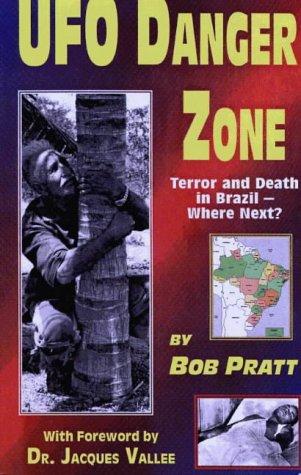
UFO Danger Zone: Terror and Death in Brazil
An Eighteen-Year, Eleven-Trip Field Chronicle of the Colares "Chupa-Chupa" Wave and Brazil's Most Violent UFO Encounters
Find on Amazon →As an Amazon Associate, OverClassified may earn from qualifying purchases made through this link, at no extra cost to you.
Why This Is Essential Reading
UFO Danger Zone earns its place on this list for a reason distinct from every other title here: it is not an argument about the UFO phenomenon in general but a field reporter's sustained, first-hand documentary record of the one national case history — Brazil's — where witnesses have most consistently reported physical harm, running from Antônio Vilas-Boas in 1957 through the Colares chupa-chupa wave in 1977 to cases Pratt was still personally investigating into the 1990s. That record carries real, honestly stated limits: it rests on witness testimony and physician accounts rather than independently verifiable physical evidence, and its underlying Portuguese-language documentation remains, for most English-reading researchers including this site's own editors, difficult to independently audit case by case. But as the accumulated product of eighteen years, eleven trips, and more than 1,700 interviews by a reporter who never claimed to have seen a UFO himself and never dressed his conclusions up as more certain than his evidence warranted, it remains the single most thorough English-language witness record of Brazil's most disturbing UFO case history — the reason Colares, Ubatuba, and Vilas-Boas are known to English-speaking researchers at all, and the working source this site's own Brazilian case files keep returning to.
Related Cases & Theories
Essential Viewing
The Most Witnessed UFO Incident in History | Operation Prato
The Why Files — A documentary account of the Colares chupa-chupa wave and the Brazilian Air Force's classified Operação Prato investigation this book's central chapter covers from the civilian witness side.

Brazil UFO Expert on 1977 Colares UFO Attacks on Humans
THE HANNIBAL TV — An interview with a Brazilian UFO researcher discussing the 1977 Colares attacks directly, covering the same pattern of witness injuries this book's twentieth chapter documents in detail.
Sources Cited
- "Robert Pratt, Newspaperman, Author of UFO Books, Articles, Dies at 79." The UFO Chronicles, November 2005 (obituary: career timeline, National Enquirer role, books, Brazil trips, MUFON Journal editorship). theufochronicles.com
- "Robert V. Pratt: 'The Realization Was Astonishing and Very Sobering. I've Been Chasing UFOs Ever Since.'" The UFO Chronicles, December 2005 (Pratt's own account of his 1975 Superior, Wisconsin assignment and conversion from skeptic to investigator). theufochronicles.com
- "Robert Pratt Obituary (2005)." The Palm Beach Post via Legacy.com (birth date, death date, survivors, Curitiba honorary ufologist diploma, family details). legacy.com
- "UFO danger zone." Open Library (Horus House Press, Madison WI, 1996, bibliographic record: pagination, LCCN, OCLC, foreword by Jacques Vallée). openlibrary.org
- "Ufo Danger Zone: Terror & Death in Brazil." AbeBooks (Horus House Press, 1996, ISBN 9781881852148, bibliographic record). abebooks.com
- "UFO Danger Zone by Bob Pratt." Goodreads (reader ratings and reviews, 4.03-star average, 34 ratings, 6 reviews). goodreads.com
- "UFOs in the National Enquirer." Podcast UFO (Bob Pratt's National Enquirer career timeline, 1973 hire, 1975 Superior WI assignment, six-and-a-half-year tenure). podcastufo.com
- "Violent UFO Encounters in Brazil." Podcast UFO (case pattern analysis of UFO Danger Zone: Colares chupa-chupa cases, the 1991 'Attack on Moises,' Pratt's eleven Brazil trips 1978–1993). podcastufo.com
- "The Blue Ribbon UFO Panel of the National Enquirer." The Saucers That Time Forgot, September 2019 (panel membership, APRO affiliations, $50,000/$5,000 prize structure, Generoso Pope Jr. funding, 1972–1979 run). thesaucersthattimeforgot.blogspot.com
- "The Bob Pratt Files." Operação Prato archive (compiled obituary and tribute materials following Pratt's November 2005 death). operacaoprato.com
- "Operação Prato." Wikipedia (Brazilian Air Force investigation into the 1977 Colares wave: Capt. Uyrangê Hollanda, investigation timeline, 2004 partial declassification). en.wikipedia.org
- "UFO Danger Zone Bob Pratt." Internet Archive (digitized full-text scan of the 1996 Horus House Press edition). archive.org
- This site's own resources library: Full Reading List, where this exact edition (ISBN 1881852148) is cited across 6 separate case-file pages.
- This site's own case file: Colares / Operation Prato, for the 1977 wave this book's twentieth chapter treats as its evidentiary center.
- This site's own case file: The Antônio Vilas-Boas Abduction, for the 1957 foundational case this book situates within Brazil's longer national pattern.
- This site's own case file: The Ubatuba Magnesium Fragments, for the 1957 physical-evidence case discussed alongside Colares.
- This site's own case file: Ceará Boeing 727 Sighting, for the 1982 case this site cites directly to this book for its civilian-ufology and FAB reporting context.
- This site's own case file: Brazil's Official Night of UFOs, for the 1986 military-corroborated case this book's fieldwork era overlapped with.
- This site's own case file: The Varginha UFO Incident, for the 1996 case this site cites directly to this book for period Brazilian investigative context.
- This site's own key-figures entry: Bob Pratt, for his full biography and case connections.
Have corrections, additional research, or peer-reviewed sources? Help improve this entry.
Suggest an Edit