
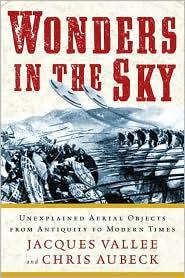
Wonders in the Sky
Unexplained Aerial Objects from Antiquity to Modern Times
Core Thesis
Wonders in the Sky makes a documentary argument rather than an interpretive one: that hundreds of pre-modern reports of unusual things seen in the sky — luminous discs, aerial ships, burning shields, moving lights — are real, locatable historical documents worth tracing to their earliest verifiable source, evaluating for translation and transmission errors, and presenting on their own terms, without forcing a verdict about what any individual report actually was. Jacques Vallée and Chris Aubeck assembled and cross-checked more than 500 such cases spanning from biblical-age antiquity through 1879 — the year they treat as the effective end of the pre-aviation era, after which airships, dirigibles, and military aircraft begin supplying mundane explanations the earlier centuries did not have available. The book's method is explicitly historiographical rather than ufological: each entry is dated, sourced to a specific chronicle, broadsheet, papyrus, or eyewitness account, and flagged honestly where the underlying document cannot be verified or where a mundane explanation (sundogs, comets, meteor swarms, religious allegory, outright literary hoax) is the better-supported reading. The authors state plainly that the book does not argue these reports are unidentified flying objects in the modern, physical-craft sense; it argues only that the historical record of "things seen in the sky" is older, richer, and more carefully document-able than either UFO believers or dismissive skeptics generally credit it to be.
About the Author
Jacques Vallée, born in Pontoise, France in 1939, holds a Master's degree in astrophysics from the University of Lille and a Ph.D. in computer science from Northwestern University, where he worked alongside his mentor J. Allen Hynek. He co-built the first computerized map of Mars for NASA in 1963, and his later computer-science career put him at the center of the ARPANET's early development: as a senior research fellow at the Institute for the Future, he succeeded Paul Baran as principal investigator on a National Science Foundation networking project that produced PLANET, one of the first ARPANET conferencing systems, years before anything resembling modern instant messaging existed. That dual background — working astronomer and working computer scientist — is what this specific book draws on directly: Wonders in the Sky is, at its core, a large historical dataset, cross-referenced and error-checked the way a systems analyst approaches a database rather than the way a folklorist retells a story. Readers wanting the fuller arc of Vallée's own theoretical UFO work — the interdimensional hypothesis, Passport to Magonia's folklore-continuity argument, or his more recent physical-trace research — will find that covered in depth elsewhere on this site; this entry stays focused on the historiographical, source-verification approach this particular book represents.
Chris Aubeck's contribution is distinct and, on the book's own evidence, substantial rather than secondary. Born in London and a longtime resident of Spain since the age of nineteen (teaching English in Cáceres and Madrid for over two decades before settling in Granada), Aubeck is the founder of Magonia Exchange, an international archival research group whose members gather clippings, chronicle entries, and press reports of pre-modern aerial phenomena from obscure regional and foreign-language sources, aiming to build the largest dedicated archive of early Fortean aerial material in the world. That archive is the raw material Wonders in the Sky draws on, and Aubeck has stated directly, in comments responding to a 2011 review of the book, that his own and Vallée's contributions to the finished text ran "about 50:50 in the end" — a rare degree of specificity about a co-authorship split, and one this entry reports because it corrects a real, recurring misreading of the book as primarily a Vallée solo project with Aubeck as a junior research assistant. Aubeck has continued the same historiographical project since 2010, co-authoring Return to Magonia (2015) with Martin Shough, OOPARTs (2015), Alien Artifacts (2022), and Saucers (2023), and in May 2015 organized "The Inhabited Sky," the first two-day conference dedicated specifically to historical UFO research, held at La Casa Encendida in Madrid.
The book's foreword, contributed by Pennsylvania State University folklorist David J. Hufford — known for his own field-defining study of sleep paralysis and the "Old Hag" phenomenon, The Terror That Comes in the Night — situates the authors' method explicitly within the philosophy of science, invoking Charles Fort, Thomas Kuhn, and Paul Feyerabend on how anomalous data gets treated by disciplines unprepared to classify it. That framing matters for how the book should be read: neither Vallée nor Aubeck claims specialist credentials in classical philology, art history, or the other individual disciplines each of the book's 500-plus entries technically falls under. Their claimed expertise is narrower and more specific — source-tracing and cross-cultural pattern recognition across an unusually large, unusually varied historical dataset — and this entry, like the book's own foreword, treats that as the honest description of what the authors are actually qualified to do.
Historical Context & Origins
Wonders in the Sky arrived in 2010 into a UFO-literature landscape still dominated by two older, competing frameworks that Vallée's own career had already helped define: the nuts-and-bolts extraterrestrial hypothesis of classic 1950s–60s ufology, and the ancient-astronaut genre that Erich von Däniken's 1968 bestseller Chariots of the Gods? had made a mass-market publishing phenomenon in its own right. Both frameworks treat historical accounts of strange things in the sky as evidence for a predetermined conclusion — alien visitation, either recent or ancient. Wonders in the Sky was written as a deliberate alternative to that pattern: source the claim first, establish what the original document actually says and how reliably it has been transmitted, and only then ask what, if anything, it might indicate.
The book followed directly on from Vallée's own 1969 Passport to Magonia, which had already argued that UFO reports track the same underlying structure as older folklore — fairies, angels, demons, aerial ships from the medieval "Magonia" — using a comparatively small, illustrative set of historical cases. Wonders in the Sky can be read as that earlier project's evidentiary expansion: rather than a handful of representative folklore parallels, the 2010 book assembles a genuinely large, chronologically organized dataset of more than 500 cases running from antiquity to 1879, with each entry sourced and dated individually rather than woven into a single narrative argument.
The book's own chosen endpoint — 1879 — is itself a historiographical decision worth stating plainly: the authors treat that year as roughly the point at which the Industrial Revolution began supplying the aviation-era explanations (airships, dirigibles, and eventually aircraft and military prototypes) that make later aerial reports categorically harder to treat as unambiguously anomalous. Everything the book catalogs predates that shift, which is also why its case list runs so heavily through the premodern and early-modern periods this site's own Ancient Connections archive covers — the Tulli Papyrus, the 1561 Nuremberg celestial phenomenon, and the Dropa Stones case among them, all discussed in the following section.
The book also landed inside the same broader publishing ecosystem Jason Colavito's own critical work on this site has documented extensively: a genre in which real regional folklore, translated primary documents, and outright 20th-century fiction circulate together with little consistent quality control, each generation of writers borrowing uncritically from the last. Wonders in the Sky positioned itself explicitly against that pattern — not by ignoring the genre's weaker material, but by subjecting individual cases from it, including some of ufology's own most durable myths, to the same sourcing standard applied to its strongest cases.
Core Arguments & Key Concepts
The book's organizing method is source verification applied case by case: for each of its 500-plus entries, Vallée and Aubeck attempt to trace the claim to its earliest identifiable document, note every significant retelling or translation between that original and the version now in circulation, and flag explicitly where the chain breaks down — where a supposed ancient chronicle turns out to trace back only to a 20th-century magazine article, a mistranslation, or a single unverifiable secondary account. This is the book's central methodological departure from both nuts-and-bolts ufology and ancient-astronaut writing: neither genre typically does this work, and both frequently recycle claims whose documentary chain a source check of this kind would immediately expose as broken.
That method produces conclusions the authors are willing to state as bluntly against the cases as for them. The book's own treatment of the Dropa Stones — the supposed 12,000-year-old inscribed discs recovered in Tibet — is a clear example: on pages 359–362, Vallée and Aubeck conclude no record exists of the stones in any museum or of any person actually involved in their supposed discovery, and classify the entire story as a hoax rather than an unresolved mystery. The book applies the identical standard to the Tulli Papyrus, the supposed Egyptian record of a 1480 BCE aerial phenomenon: the authors directly critique the case, conclude the document's authenticity cannot be verified, and describe the affair as a hoax rather than repeating it as settled ancient evidence.
Where the underlying documentation genuinely does hold up, the book treats the case very differently — presenting it as a real, unresolved historical puzzle rather than either debunking it or claiming it as proof of anything. The Nuremberg celestial phenomenon of 1561, a woodcut broadsheet depicting an aerial battle of crosses, globes, and tubes over the city, is cataloged this way: a genuine, physically surviving 16th-century document (still held today by the Zentralbibliothek Zürich) whose most likely mundane explanation — a complex sundog or parhelion display — the book presents alongside the historical record rather than in place of it, leaving readers the documentary material to evaluate rather than a foreclosed verdict.
This case-by-case discipline is also what most clearly separates Wonders in the Sky from the ancient-astronaut genre it superficially resembles on a bookstore shelf. Where von Däniken's Chariots of the Gods? reads historical and religious imagery as broadly interchangeable evidence for a single predetermined conclusion — ancient extraterrestrial contact — Vallée and Aubeck explicitly decline to unify their 500-plus cases under any single explanatory theory at all. Some entries end in a confident mundane explanation, some in an honest "hoax" verdict, and many in a stated acknowledgment that the available documentation simply cannot resolve the question either way. The book's foreword, contributed by folklorist David Hufford, frames this refusal to force a unifying theory as itself the more intellectually serious position, situating the authors' approach within Charles Fort's and Thomas Kuhn's broader arguments about how anomalous data gets treated by disciplines unprepared to classify it.
Key Cases & Evidence Discussed
Because Wonders in the Sky is a documentary catalog rather than a narrative built around one flagship incident, its overlap with this site's own case files runs unusually wide rather than deep on any single case — it is already the single most-cited book in this site's own Ancient Connections library, cited across 14 separate pages here, more than any other title in that section of the resource archive.
The Tulli Papyrus is one of the clearest examples of the book's skeptical discipline in action: the supposed record of a 1480 BCE Egyptian aerial event, most widely circulated online in a non-specialist's English rendering, is directly critiqued in Wonders in the Sky, which concludes the document's authenticity cannot be verified and calls the affair a hoax — a verdict later corroborated by Italian papyrologist Nicola Reggiani's 2017 academic philological study of the same case.
The Nuremberg Celestial Phenomenon of 1561 receives the opposite kind of treatment: a genuine, physically surviving 16th-century woodcut broadsheet that the book catalogs on its documentary merits, alongside the sundog-based mainstream reading independently advanced by historian Ulrich Magin and skeptical writer Jason Colavito, whose own 2012 rebuttal this site's key-figures archive already documents.
The Dropa Stones case is the book's most quoted skeptical verdict on this site specifically: on pages 359–362, Vallée and Aubeck report finding no record of the stones in any museum and no trace of anyone actually involved in their supposed discovery, concluding the story is a hoax — a judgment this site's own Dropa Stones file cites directly and treats as one of the earliest serious ufological (as opposed to purely archaeological) debunkings of the claim.
Beyond those three, the book's case list overlaps with several more of this site's own Ancient Connections files, including Gregory of Tours' Convergent Lights, the Sigiburg Castle Apparition, the Byland Abbey Manuscript Ghost Stories, Livy's Roman Prodigia Records, Plutarch's Battle of Lucullus, and Shen Kuo's Flying Pearl — each cataloged in the book using the same source-first method, and each already cross-referencing Wonders in the Sky directly in this site's own sources lists.
Critical Reception & Controversies
Early trade and enthusiast reception was strongly positive: one contemporary review called it "the most ambitious, broad-reaching, and intelligent analysis ever written on premodern aerial mysteries," and reader response generally praised the book's readability, describing the individual historical accounts as "fascinating, obscure, humorous, and sometimes completely baffling" even where no resolution was offered.
The book's most sustained and specific critical scrutiny came from skeptical researcher and writer Jason Colavito, whose extended blog critiques identified specific documentary errors, mistranslations, and citation problems across multiple entries, at one point characterizing the original edition as containing "demonstrably false and generally quite unreliable" material among its badly translated and, in some cases, fictitious source documents. Colavito's criticism was pointed but not dismissed by the authors: Aubeck told him directly, by email, that a number of the corrections made for a subsequent revised edition were based specifically on the errors and citations Colavito had raised on his own site — a genuine, documented instance of the book's own claimed commitment to source correction being tested, and holding up, in public.
A separate and more general line of criticism, aimed less at individual sourcing than at the book's overall interpretive stance, holds that Vallée's broader project — treating spaceship reports, fairy encounters, and religious visions as comparable data — risks flattening genuinely distinct phenomena into a single undifferentiated category, thereby dismissing rather than explaining the strangeness of any one of them. Supporters of the book's method have responded that this criticism says more about critics' own investment in a single-explanation model than about what Wonders in the Sky actually claims, since the book explicitly declines to offer any unifying theory for its 500-plus cases.
In 2016, Vallée and Aubeck launched a crowdfunding campaign seeking roughly $42,000 to produce a revised, expanded deluxe edition of the book — a campaign Colavito also covered critically on his site, questioning both the funding target and, given the errors he had already documented in the original text, whether a crowdfunded revision was the right vehicle for the corrections the book needed. That campaign is itself a small but real data point in the book's reception history: evidence that, six years after publication, there remained enough sustained interest in the project, on both the supportive and critical sides, to generate a public fundraising debate at all.
Influence & Legacy
The clearest, most directly measurable evidence of this book's influence is on this very site: Wonders in the Sky is cited across 14 separate pages in this site's own case-file and Ancient Connections archive, more than any other title in the library's Ancient Connections category, functioning as working source infrastructure rather than a passively listed recommendation. That pattern mirrors the book's broader role in the field: it is regularly cited as the standard reference sourcebook whenever a UFO researcher, journalist, or debunker needs to check whether a specific historical claim has a genuine documentary basis or is a later fabrication.
Chris Aubeck's own research program has continued directly out of the book's method rather than treating it as a one-off project: Magonia Exchange, the archival research group he founded, remains active, and Aubeck has produced multiple follow-up volumes applying the same source-tracing approach — Return to Magonia (2015, with Martin Shough), OOPARTs (2015), Alien Artifacts (2022), and Saucers (2023) — along with organizing "The Inhabited Sky," the first dedicated conference on historical UFO research, in Madrid in May 2015.
The book's willingness to publicly incorporate a skeptical critic's corrections into a later edition — specifically, the changes Aubeck told Jason Colavito were made in response to errors Colavito had documented — is itself a modest but genuine piece of the book's legacy: a rare, verifiable example of popular UFO-history literature actually correcting itself in response to outside critical scrutiny rather than simply absorbing the criticism and moving on unchanged.
More broadly, Wonders in the Sky helped establish source-verification historiography as a legitimate, distinct approach within UFO-adjacent research, standing apart from both the ancient-astronaut tradition von Däniken popularized and the folklore-continuity theorizing of Vallée's own earlier Passport to Magonia. Its influence on this site specifically is visible in the structure of the Ancient Connections archive itself, where individual case files routinely draw the same distinction the book insists on: treating a historical document's documentary reliability and its ultimate explanation as two separate questions, not one.
The Book
As an Amazon Associate, OverClassified may earn from qualifying purchases made through this link, at no extra cost to you.
Why This Is Essential Reading
Wonders in the Sky earns its place on this list less for any single argument it makes than for the discipline of its method, applied consistently across more than 500 cases: trace the claim, check the document, state plainly when the chain of evidence breaks down, and resist the temptation — common to both credulous and dismissive UFO writing alike — to force every case into a single tidy verdict. Jacques Vallée's systems-analyst rigor and Chris Aubeck's genuinely distinct archival research, drawn from the Magonia Exchange project he founded and continues to run, combine into something this site's own catalog already treats as working infrastructure rather than a passive citation: no other book in this library's Ancient Connections category is referenced as often, or by as many individual case files, as this one. That the authors were willing to revise the text based on a skeptical critic's documented corrections, and that the book itself hands down an honest "hoax" verdict on cases like the Dropa Stones and the Tulli Papyrus rather than mining them for a sensational conclusion, is exactly the kind of documentary self-discipline this site's own editorial standard tries to hold every source to.
Related Cases & Theories
Essential Viewing

Jaques Vallee Wonders in the Sky
Official The Paracast — Jacques Vallée discussing Wonders in the Sky directly on The Paracast, verified here via YouTube oEmbed before inclusion — a rare interview focused specifically on this book's historical case-sourcing method rather than his broader theoretical work.
Talking Magonia with Chris Aubeck
Rune Soup — Chris Aubeck discusses his historical UFO research project, Magonia Exchange, and the source-verification approach that underlies Wonders in the Sky and his subsequent books, verified via YouTube oEmbed before inclusion.
Sources Cited
- "Wonders in the Sky: Unexplained Aerial Objects from Antiquity to Modern Times." Penguin Random House official book page (publisher, publication date, ISBN 9781585428205). penguinrandomhouse.com
- "Wonders in the Sky: Unexplained Aerial Objects from Antiquity to Modern Times." Amazon.com product listing for ISBN 1585428205 / 9781585428205 (edition cited on this site, matching the ISBN already cited 14 times in this site's own resources library). amazon.com
- "Chris Aubeck." Coast to Coast AM guest biography (background, Magonia Exchange, career, and publication list). coasttocoastam.com
- "Biography: Jacques Vallée." HandWiki (career background: astrophysics training, NASA Mars mapping, ARPANET/PLANET research, academic history). handwiki.org
- "Jacques Vallée." Wikipedia (biography and scientific career background). en.wikipedia.org
- This Alien Earth (blog). "'Wonders in the Sky' by Vallee & Aubeck," January 2011, including author-comment thread in which Chris Aubeck describes the Vallée/Aubeck writing contribution as "about 50:50 in the end." thisalienearth.blogspot.com
- Colavito, Jason. "Jacques Vallee and Chris Aubeck Want You to Give Them $42,000 to Revise 'Wonders in the Sky.'" JasonColavito.com (critical coverage of the 2016 crowdfunding campaign, and Aubeck's acknowledgment that revisions incorporated Colavito's own documented corrections). jasoncolavito.com
- "Wonders in the Sky." Google Books listing (publisher description: 500+ reports, biblical antiquity through 1879, 75+ illustrations). books.google.com
- "Wonders in the Sky: Unexplained Aerial Objects from Antiquity to Modern Times and Their Impact on Human Culture, History, and Beliefs." Publishers Weekly listing. publishersweekly.com
- Wonders in the Sky, full text. Internet Archive (digitized copy of the book, used to verify chapter structure and case coverage). archive.org
- This site's own case file: The Tulli Papyrus, which directly cites and quotes this book's "hoax" verdict.
- This site's own case file: The Nuremberg Celestial Phenomenon, which cites this book's 2010 cataloging of the case.
- This site's own case file: The Dropa Stones, which quotes this book's pages 359–362 hoax conclusion directly.
- This site's own resources library: Full Reading List, where this exact edition (ISBN 1585428205) is cited across 14 pages, more than any other Ancient Connections title.
- This site's own key-figures entry: Jacques Vallée, for his broader career background and case connections.
- This site's own key-figures entry: Chris Aubeck, for his Magonia Exchange background and this book's co-authorship.
Have corrections, additional research, or peer-reviewed sources? Help improve this entry.
Suggest an Edit