
Gregory of Tours' Convergent Lights
In October 585 CE, Gregory of Tours — bishop, historian, and by far the most important surviving narrative source for 6th-century Merovingian Gaul — was staying at a monastery near Carignan when he personally witnessed something over three consecutive nights: bright rays of light in the north on the first two nights, paired with blood-red clouds to the east and west, and on the third night, rays converging from every direction onto a single huge cloud "as if it were a pavilion," broad at the base and narrowing to a "hood" at the top. Gregory recorded it not as an isolated dramatic set-piece but as one entry within his own systematic, career-long prodigy record — and, by his own account, followed up on it: returning to Tours, he reports learning that two islands had been destroyed by "heavenly fire" and a pond near Vannes had turned to blood at the very time he was watching the sky. This file traces the account to its source in Gregory's Historiae, situates it among the dozens of other prodigies he records, and weighs the leading natural candidate for the third night's climax: a solar or lunar halo display.
Theoretical Alignment
This file's distinguishing feature is Gregory's own working method: across the ten books of his History of the Franks, he systematically records dozens of prodigies — eclipses, comets, earthquakes, plagues, strange births, and sky-lights — as part of a consistent historiographical practice, not as isolated dramatic set-pieces. The convergent-lights account is one entry within that larger, methodical record, described with unusually precise geometric language for a phenomenon this site's other archive entries typically render in vaguer terms ("fire," "sword," "shield"). That specificity is exactly what makes a solar or lunar halo — a real atmospheric-optical phenomenon capable of producing rings, pillars, and tent-like converging light patterns — a strong candidate explanation.
Sensor & Instrumentation Detection Profile
As with every case in this site's Ancient Records series, there is no instrumentation record. Unlike many of the terse, unattributed prodigy notices scattered through his history, Gregory explicitly presents this specific account as his own first-person observation: he was lodging at a monastery near Carignan, was awoken on three separate nights by the display, and watched it "from his window." The subsequent report of two islands destroyed by "heavenly fire" and a pond turned to blood near Vannes reached him only after he returned to Tours, and is presented as secondhand news he received, not something he personally witnessed.
Environmental & Geospatial Context
The account is associated with the area around Carignan (ancient Carignacum), in the Ardennes region of what is now northeastern France, part of the Merovingian kingdom of Austrasia in Gregory's lifetime. The described geometry — a bright central cloud with rays converging symmetrically toward it, broad at the base and narrowing to a point at the top — corresponds closely to the visual structure produced by a 22-degree solar or lunar halo combined with a vertical light pillar, an atmospheric-optical phenomenon this site has proposed for several other archive entries (including the Sigiburg Castle Apparition and the Miracle of the Cross over Jerusalem) with comparable structured, geometric sky-light descriptions.
Observer Credibility & Occupational Profile
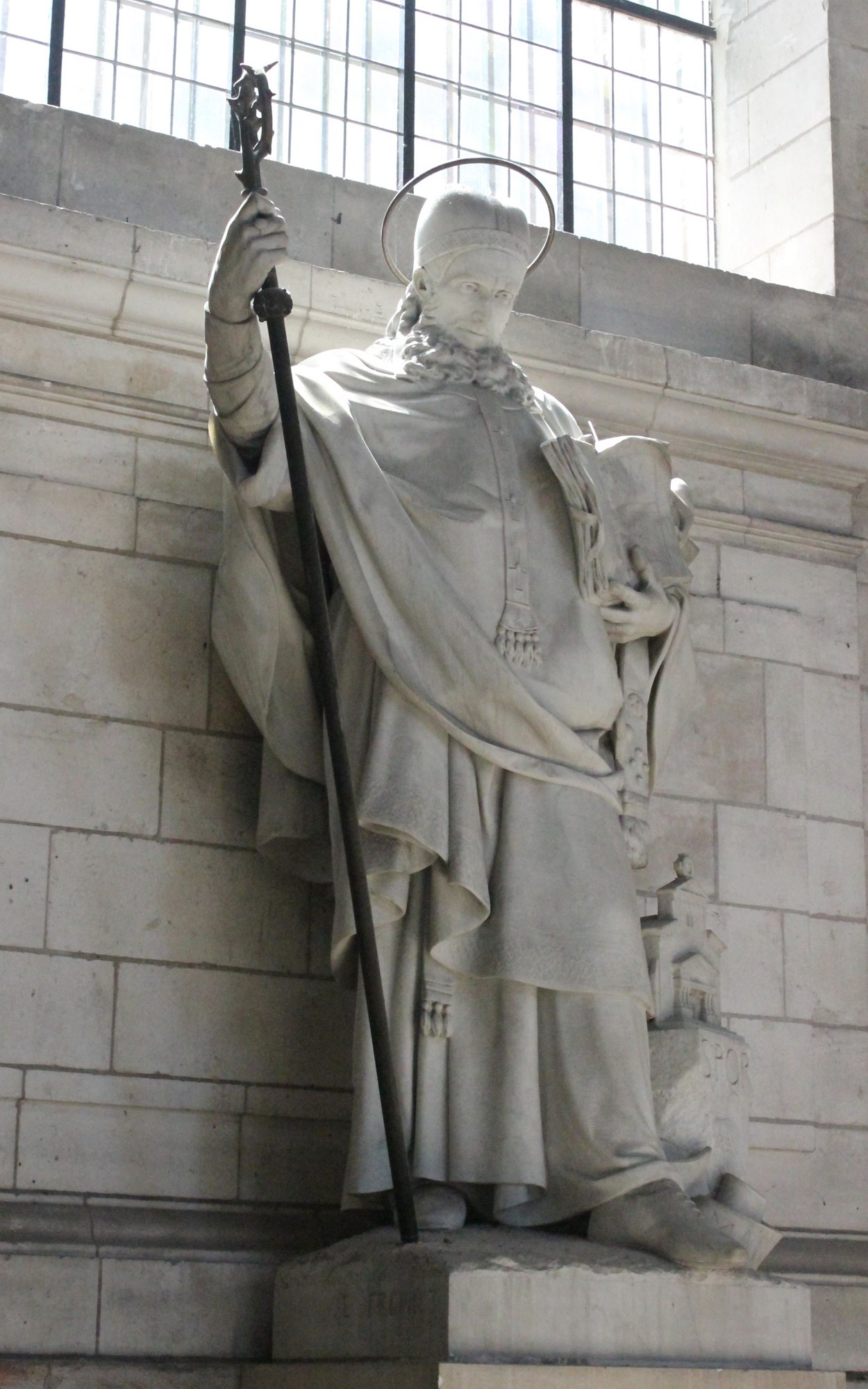
Gregory of Tours (c. 538 – 594 CE) was bishop of Tours from 573 CE until his death, and is regarded by modern historians as the single most important narrative source for Merovingian Gaul in the second half of the 6th century. His Historiae (History of the Franks) combines political history, ecclesiastical affairs, and a running record of prodigies and portents, reflecting both his genuine historiographical seriousness and the standard late-antique and early-medieval Christian conviction that unusual natural events carried providential meaning. In the specific case examined here, Gregory Halfond's peer-reviewed 2012 study "Tenebrae Refulgeant: Celestial Signa in Gregory of Tours" notes that Gregory takes unusual care to distinguish his careful, naturalistic description of celestial signs from horoscopic astrology, presenting them as genuine, if miraculous, elements of the natural created order rather than occult prognostication. Modern scholars, including Martin Heinzelmann in his standard critical study of Gregory's work, treat the prodigy material not as naive superstition layered onto otherwise reliable reporting, but as an integral, deliberately structured part of how Gregory understood and organized historical causation itself.
Historical Precedents & Archive Matches
This case sits within a dense cluster of late-antique and early-medieval "geometric sky-light" reports across this site's Ancient Records archive, several of which propose solar or lunar halo displays as the leading natural explanation: the Sigiburg Castle Apparition file documents a peer-reviewed astronomical treatment of a structurally similar 776 CE "shields" report, and the Miracle of the Cross over Jerusalem file documents a comparable cross-shaped light display roughly two centuries earlier. Gregory's "pavilion" imagery, with its explicit description of converging, narrowing light rays, is among the most precisely geometric descriptions in this entire cluster.
Historical Background
Gregory of Tours wrote during a turbulent period of Merovingian Frankish history, marked by near-constant warfare and rivalry among the grandsons of Clovis I, who had divided the Frankish kingdom among themselves. As bishop of Tours, one of Gaul's most prestigious sees due to its association with Saint Martin, Gregory occupied a position of real political and ecclesiastical significance, giving him access to reports and correspondence from across the fractured kingdom. His History of the Franks, composed in ten books across the final two decades of his life, remains modern historians' single richest narrative source for the period, valued precisely because of its combination of political detail, personal testimony, and systematic recording of unusual natural events, which Gregory and his contemporaries read as meaningful signs within a providential understanding of history.
The convergent-lights entry is one of many such records scattered throughout the work: elsewhere Gregory describes comets, solar and lunar eclipses, rays of light seen "from the northern region," and reports of serpents falling from clouds, alongside the more famous ecclesiastical portent of a lark extinguishing all the lights in the church at Clermont during a vigil. But this specific entry, from Book 8 of the Historiae, stands apart from most of the others for its detail and structure: in October 585 CE, while lodging at a monastery some miles from the fortified settlement (castrum) at Carignan, Gregory reports being woken on three successive nights by escalating sky phenomena. On the first two nights, bright rays (radii) appeared in the north while blood-red clouds hung in the east and west. On the third night, the rays returned, joined now by others streaming in from every direction, all converging on a single huge cloud in the middle of the night sky — the "pavilion" moment quoted above. Gregory, watching from his window, took the display as an omen of impending disaster. When he returned to Tours, he reports learning that two islands had been destroyed by "heavenly fire" and that a pond on another island near Vannes had turned to blood, at what he understood to be the same time he had been watching the sky at Carignan — a confirmation narrative Gregory himself constructs across Book 8, chapters 17 and 24–25, tying the sky display directly to reported disasters elsewhere in the kingdom.
Complete Timeline
| Date | Event |
|---|---|
| c. 538 CE | Gregory of Tours is born into a prominent Gallo-Roman senatorial family. |
| 573 CE | Gregory becomes bishop of Tours, one of Merovingian Gaul's most prestigious sees. |
| 573–594 CE | Gregory writes the ten books of the Historiae, including its systematic record of prodigies, comets, eclipses, and sky-lights across the period. |
| Oct. 585 CE, night 1–2 | While lodging at a monastery near Carignan, Gregory is woken by bright rays of light in the north, paired with blood-red clouds in the east and west. |
| Oct. 585 CE, night 3 | Rays converge from every direction onto a single huge cloud, described as "a pavilion," broad at the base and narrowing to a "hood at the top." |
| Oct. 585 CE (after Gregory's return to Tours) | Gregory reports learning that two islands had been destroyed by "heavenly fire" and a pond near Vannes had turned to blood, coinciding with his observation (Historiae 8.24–25). |
| 594 CE | Gregory dies at Tours. |
| 1974 CE | Lewis Thorpe publishes the standard modern English translation of the History of the Franks for Penguin Classics. |
| 2001 CE | Martin Heinzelmann publishes Gregory of Tours: History and Society in the Sixth Century, the standard modern critical study of Gregory's historiographical method, including his treatment of prodigies. |
| 2012 CE | Gregory Halfond publishes "Tenebrae Refulgeant: Celestial Signa in Gregory of Tours" in The Heroic Age, a peer-reviewed study of exactly this episode. |
The Primary Source Document
Gregory of Tours, Historiae, Book 8, Chapter 17 (October 585 CE)
On the first two nights, "bright rays of light appeared in the North, while blood-red clouds appeared in the East and in the West." On the third night, "the rays appeared again, and were joined by still others issuing forth from all directions, all directed towards a huge cloud in the middle of the night-sky... A cloud gleamed bright in the middle of the heavens, and these rays were all focused on it, as if it were a pavilion the coloured stripes of which were broad at the bottom but became narrower as they rose, meeting in a hood at the top."
Gregory of Tours, Historiae 8.17, trans. Lewis Thorpe, The History of the Franks, Penguin Classics, 1974; three-night structure per Gregory Halfond, "Tenebrae Refulgeant: Celestial Signa in Gregory of Tours," The Heroic Age, Issue 15, 2012
This is one of the more detailed and structurally developed prodigy accounts anywhere in Gregory's history, building across three successive nights to the "pavilion" climax, a passage frequently cited by Thorpe and later scholars as characteristic of Gregory's vivid, precisely visual comparisons when describing natural portents.
Gregory of Tours, Historiae, Book 8, Chapters 24–25 (Confirmation, 585 CE)
Per Halfond's study, Gregory reports that upon his return to Tours, he learned that two islands had been destroyed by "heavenly fire" and that a pond on another island near Vannes had turned to blood, events he understood to have coincided with the nights he had watched the sky at Carignan — a confirmation narrative Gregory himself constructs, linking the sky display directly to reported disasters elsewhere in the Frankish kingdom.
The Witness Record
Gregory of Tours (as First-Person Eyewitness)
Explicitly presented as Gregory's own direct observation: he reports being woken over three successive nights while lodging at a monastery near Carignan, and watching the display himself. This is a materially stronger witness credential than most of Gregory's other, unattributed prodigy notices.
Unnamed Sources for the Island and Pond Reports
The "heavenly fire" and blood-pond reports reached Gregory secondhand, after his return to Tours; no individual source is named for these confirming events.
Confirmed Textual & Archival Holdings
The full Latin text of all ten books of Gregory's history, including its prodigy entries.
PUBLICLY ACCESSIBLE ACADEMIC ARCHIVEA public-domain English translation of substantial selections from Gregory's history.
PUBLIC DOMAIN (freely accessible)A curated academic sourcebook excerpt collection from Gregory's history.
PUBLICLY ACCESSIBLE ACADEMIC ARCHIVESearch Primary & Institutional Archives Directly
Evidence Assessment
Supporting a Genuine, Precisely Observed Sky Event
- Gregory of Tours is modern historians' single most important and generally reliable narrative source for 6th-century Merovingian Gaul, and this account is explicitly presented as his own first-person eyewitness observation, precisely dated to October 585 CE
- The three-night structure and unusually precise, structured geometric language ("broad at the bottom," "narrower as they rose," "meeting in a hood") is more specific than most comparable sky-portent descriptions in this archive, suggesting real, careful, sustained observation rather than a vague inherited motif
- A solar or lunar halo display is a real, well-documented atmospheric-optical phenomenon capable of producing exactly this kind of structured, converging light pattern
Supporting a Standard Prodigy-Record Reading
- No independent external source corroborates either the sky display or the "heavenly fire" and blood-pond events Gregory says confirmed it; the entire confirmation narrative is Gregory's own construction
- The account still functions within Gregory's broader providential framework, in which he explicitly reads the display as an omen of impending disaster and then reports events that appear to validate that reading
- The specific geometric shape described on the climactic third night closely matches a well-documented natural phenomenon (halo and light-pillar display) rather than requiring any anomalous explanation
Comparative Analysis
The Sigiburg Castle Apparition
This site's Sigiburg Castle Apparition file documents a peer-reviewed astronomical treatment of a broadly contemporary (776 CE) "shields in the sky" report, also read as a solar-halo display — part of the same general cluster of geometrically structured Frankish and Carolingian-era sky-light reports this file's account belongs to.
The Miracle of the Cross over Jerusalem
This site's Miracle of the Cross over Jerusalem file documents an earlier (351 CE), independently sourced cross-shaped light display, also proposed to result from a solar halo and light-pillar combination — a useful comparison point for how consistently this specific atmospheric-optical mechanism recurs across geographically and chronologically separate ancient and medieval sky-light accounts.
Material Analysis: The Manuscript Evidence
There is no physical trace evidence of any kind associated with the reported phenomenon. What exists is the manuscript and editorial history of Gregory's text. The Historia Francorum survives through a substantial early medieval Latin manuscript tradition, with the full Latin text hosted online at the Latin Library. The standard modern complete English translation is Lewis Thorpe's 1974 Penguin Classics edition; earlier, partial English translations, including Ernest Brehaut's selections, remain in public-domain circulation. This file confirmed the wording of the convergent-lights passage against Thorpe's translation as reproduced in multiple independent secondary academic and popular sources discussing Gregory's descriptive style.
The Paleocontact / Ancient-UFO Interpretation
Gregory's convergent-lights account appears occasionally in ancient-astronaut and fringe UFO literature, usually grouped with other "structured light in the sky" reports from late antiquity and the early Middle Ages. What Gregory's own text describes, however, is a single bright cloud with rays converging into a specific, recognizable geometric shape — a description entirely consistent with a real, still-observed atmospheric-optical phenomenon, embedded without special emphasis within a long list of comparably unremarkable prodigies (plagues, eclipses, strange harvests) that Gregory records throughout his history as a matter of routine historiographical practice.
The Mainstream Historical Interpretation
The Halo Display Case
The leading scientific candidate is a solar or lunar halo combined with a vertical light pillar, produced by sunlight or moonlight refracting through ice crystals in high cirrus cloud. This mechanism, proposed for several structurally similar entries elsewhere in this site's archive, closely matches Gregory's specific description: a bright central point (the cloud, corresponding to the sun or moon's position) with rays converging symmetrically around it in a tent-like, narrowing pattern.
The Systematic Prodigy-Recording Case
Independent of the phenomenon's physical cause, modern scholarship on Gregory, including Martin Heinzelmann's standard critical study, treats his prodigy entries as an integral, deliberate part of his historiographical method rather than superstitious embellishment layered onto otherwise sober political narrative. This reading supports treating the convergent-lights account as a genuine, if unverifiable, observational record, consistent with the same care Gregory brought to his political and ecclesiastical reporting.
Five Observables Assessment
The Five Observables framework, developed decades later by former AATIP director Luis Elizondo to classify modern UAP performance characteristics that exceed known technology, is included here for structural consistency with the rest of OverClassified's case files, but does not meaningfully apply to a text-only 6th-century source with no measured flight data.
Assessment: As with this site's other pre-modern files, the Five Observables framework is the wrong instrument here. Its inclusion should not be read as suggesting genuine exotic-performance evidence exists for this case.
Conventional Explanation Candidates
Two candidates are assessed below.
1. Solar or Lunar Halo with Light Pillar
The leading explanation: a real, well-documented atmospheric-optical phenomenon in which sunlight or moonlight refracts through ice crystals in high cirrus cloud, producing a bright central point with symmetrically converging rays — a close structural match for Gregory's "pavilion" description, and the same mechanism proposed for structurally similar entries elsewhere in this site's archive.
Plausibility Rating: HIGHLY PLAUSIBLE (closely matches the specific geometric description given)
2. Genuine Anomalous / Paleocontact Phenomenon
Included for completeness, per this site's standard framework. No positive evidence, and no serious mainstream scholarship, supports a literal non-natural aerial phenomenon; the account's precise geometric detail is better explained by, rather than counting against, a known atmospheric-optical mechanism.
Plausibility Rating: SPECULATIVE / UNVERIFIABLE
Why "Disputed"
This case receives a DISPUTED classification because, while its recording author, Gregory of Tours, is an unusually credible near-contemporary historical source presenting this specific account as his own precisely dated, first-person eyewitness observation — among the strongest witness credentials in this archive — no independent external source corroborates either the sky display itself or the "heavenly fire" and blood-pond events Gregory reports as having confirmed it, and the display's most distinctive feature, the precise, structured geometry of its third-night climax, is also exactly what a known, well-documented natural phenomenon (a solar or lunar halo with light pillar) would be expected to produce. DISPUTED reflects that combination: a trustworthy, named eyewitness operating within a genuine historiographical practice, describing an event whose specific physical details point toward, rather than away from, a natural atmospheric-optical explanation, embedded within a self-constructed providential narrative Gregory offers no external means of verifying.
Related Entries
Further Reading — Recommended Literature
The History of the Franks
The standard complete modern English translation of the primary text examined in this file.
Gregory of Tours: History and Society in the Sixth Century
The standard modern critical study of Gregory's historiographical method, including his treatment of prodigies.
The Merovingian Kingdoms, 450–751
A comprehensive scholarly history of the Merovingian Frankish world in which Gregory lived and wrote.
The World of Gregory of Tours
A scholarly essay collection assessing Gregory's life, works, and historical context from multiple angles.
Wonders in the Sky
A scholarly survey of historical aerial-phenomenon reports across many cultures and eras, for comparative context.
DISCLOSURE: Some links above are affiliate links. If you purchase through them, OverClassified receives a small commission at no additional cost to you. This helps support independent research.
Essential Viewing
History of the Franks by Gregory of Tours
Colin Kerr — an overview and discussion of Gregory's history and its historical value.
Clovis and the Franks
YaleCourses — an academic lecture on the Merovingian Frankish world Gregory chronicled.
Sources
- Gregory of Tours. "Historiae" (original Latin text). The Latin Library. thelatinlibrary.com
- "History of the Franks" (trans. Ernest Brehaut, selections). Project Gutenberg. gutenberg.org
- "Gregory of Tours: History of the Franks." Medieval Sourcebook, Fordham University. sourcebooks.fordham.edu
- "Gregory of Tours." Wikipedia. en.wikipedia.org
- "Historia Francorum." Wikipedia. en.wikipedia.org
- Halfond, Gregory. "Tenebrae Refulgeant: Celestial Signa in Gregory of Tours." The Heroic Age: A Journal of Early Medieval Northwestern Europe, Issue 15, 2012. heroicage.org
- "Halo (optical phenomenon)." Wikipedia. en.wikipedia.org
- "Merovingian dynasty." Wikipedia. en.wikipedia.org
- Thorpe, Lewis (trans.). Gregory of Tours: The History of the Franks. Penguin Classics, 1974.
- Heinzelmann, Martin (trans. Christopher Carroll). Gregory of Tours: History and Society in the Sixth Century. Cambridge University Press, 2001.
- Wood, Ian. The Merovingian Kingdoms, 450–751. Longman, 1994.
- Mitchell, Kathleen & Wood, Ian (eds.). The World of Gregory of Tours. Brill, 2002.
- Vallée, Jacques & Aubeck, Chris. Wonders in the Sky: Unexplained Aerial Objects from Antiquity to Modern Times. Tarcher/Penguin, 2010.
- "File: Cathédrale d'Arras Saint Grégoire de Tours.jpg." Wikimedia Commons (CC BY-SA 3.0). commons.wikimedia.org
- "History of the Franks by Gregory of Tours." Colin Kerr, YouTube. youtube.com
- "10. Clovis and the Franks." YaleCourses, YouTube. youtube.com
See something inaccurate? Have additional information or sources?
Suggest an Edit →Last Updated: August 2026