
The Ariel School Encounter
On the morning of September 16, 1994, during the mid-morning break at the Ariel School near Ruwa, Zimbabwe, a group of pupils (62, by the usual count, aged about six to twelve) reported one or more silvery objects coming down among the trees beyond the playground. Some said a small figure, or several, in a shiny black suit with large dark eyes came toward them. The teachers were in a staff meeting and no adult saw anything. The children were interviewed within days by BBC cameraman Tim Leach and UFO researcher Cynthia Hind, and in late November by Harvard psychiatrist John Mack, whose interviews introduced reports of telepathic environmental warnings. Proponents regard it as one of the strongest close encounters of the 1990s. Skeptics point to the UFO fever after a rocket re-entry two nights earlier, group interviews, adult suggestion and a former pupil's 2023 claim that it began with his prank.
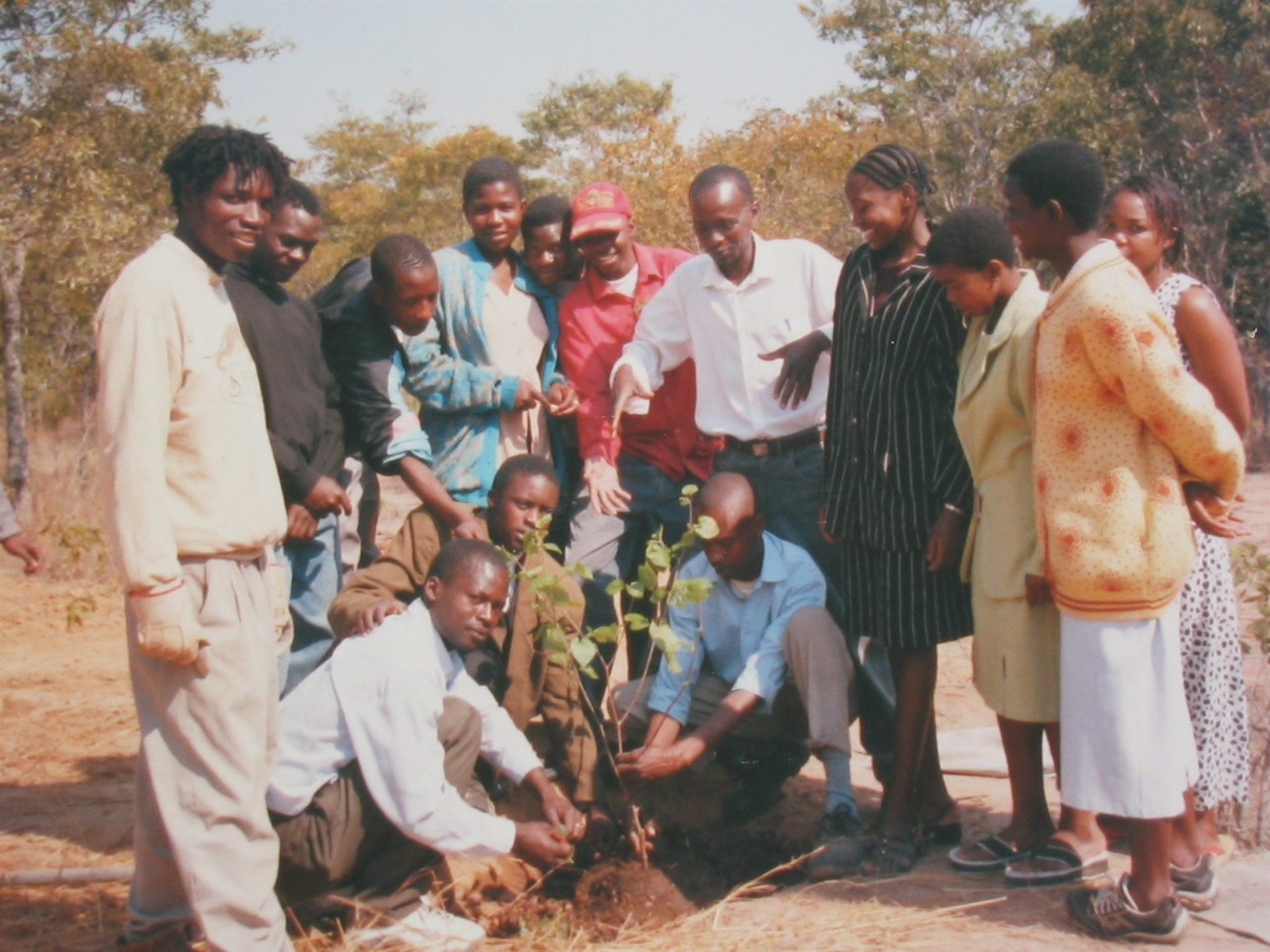
Pictured: residents and schoolchildren of Ruwa, Zimbabwe planting a tree in the town's dry highveld scrubland, photographed in 2003 — not the Ariel School playground and not any of the 62 child witnesses from the September 1994 encounter itself. No photograph of the schoolyard or its witnesses from the time of the sighting is known to exist; this image instead shows the same Ruwa community roughly a decade later.
Theoretical Alignment
The alignment figures reflect the story's content. A craft landing and beings with a message fit the Extraterrestrial Hypothesis. The reported telepathic warnings, which first appear in John Mack's interviews, echo Jacques Vallée's “control system” and ultraterrestrial ideas. The psycho-social reading is not marginal here. The sighting came two days after a widely seen rocket re-entry had set off UFO talk across Zimbabwe, and most of what is known comes from children interviewed in groups and by adults who believed in visitors. The percentages describe how each hypothesis would read the reports, not how well the reports have been confirmed.
Background & Regional Context
Ruwa and the Ariel School
Ruwa lies about 22 km southeast of Harare. In 1994 it was “little more than a crossroads in an agricultural region” (Wikipedia, citing the press). The Ariel School was an expensive private primary school. Most pupils came from well-off white families in Harare, along with pupils of Shona and Ndebele and of Indian descent. Beyond the playground lay an area of rough bush and small trees, crossed by power lines, which the children were not supposed to enter. Accounts of the size of the school differ. Headmaster Colin Mackie later spoke of “something like 250” children in the playground, of whom “only sort of 60 claim to have seen it” (as quoted by Reid, 2024). The Mail & Guardian was told there were “more than 110 children and staff.”
The mix of backgrounds matters to both sides of the argument. Hind noted that the children interpreted what they saw differently. Some white pupils spoke of aliens, while some black pupils thought the figures were tokoloshe or zvikwambo, creatures of Shona and Ndebele folklore, and cried that they would be eaten. Proponents see agreement on the basic features across cultural lines as evidence of a real stimulus. Skeptics note that the children were together on one playground, and that the descriptions were collected after days of talking with each other and with adults.
The Fireball of September 14, 1994
Two nights before the sighting, on the evening of Wednesday, September 14, 1994, a spectacular fireball crossed southern Africa between about 20:50 and 21:05, seen over Zambia, Botswana, Zimbabwe, South Africa and Mozambique (Hind, via Christie 2014). ZBC Radio asked listeners to call in, and the night produced a wave of UFO excitement. According to Reid, BBC cameraman Tim Leach doubted the official meteor explanation, local radio reported his suggestion of an alien “mothership” as the BBC's position, and Leach's phone number was broadcast with an appeal for sightings.
The fireball was the re-entry of the second stage of a Russian Zenit-2 rocket (an “SL-16” rocket body) that had launched the Cosmos 2290 reconnaissance satellite from Baikonur on August 26, 1994. The U.S. satellite catalog records the rocket body's decay on September 14, 1994. Geoffrey Perry of the Kettering Group, which tracked Soviet and Russian spacecraft, matched the ground track to the sightings on September 15, and the identification was carried by BBC World Service Television and Ceefax that day and by The Daily Telegraph on September 16. It did not reach Zimbabwe's media until October 8; there, the lights were described as a meteor shower (Reid 2024). The re-entry does not explain a daytime sighting at ground level. What it explains is why, on the morning of September 16, a playground of children had UFOs on their minds.
Complete Timeline
| Date | Event |
|---|---|
| September 14, 1994 (~20:50) | The Zenit-2 (SL-16) rocket body from the Cosmos 2290 launch re-enters over southern Africa; the fireball is widely seen and ZBC Radio appeals for reports. |
| September 15, 1994 | Geoffrey Perry of the Kettering Group identifies the fireball as the rocket re-entry; BBC World Service and Ceefax report it (Reid 2024). |
| September 16, 1994 (~10:00) | During morning break at the Ariel School, with the teachers in a staff meeting, children report silvery objects coming down among the trees beyond the playground and a small figure or figures in black. The tuckshop operator, the only adult nearby, is surrounded by frightened and excited children. The school day ends at 1 PM. |
| September 17, 1994 | Parents raise the matter with the school. Cynthia Hind, alerted by Tim Leach, speaks to some children by phone (Reid 2024). |
| September 19, 1994 | Tim Leach films interviews with pupils and staff for the BBC. |
| September 20, 1994 | Hind visits the school and interviews “10 or 12 of the older children” in groups, on camera and with others listening; children make drawings. |
| Late 1994 | Hind writes up the case in her newsletter UFO Afrinews; ZBC and SABC crews also interview the children. |
| November 30, 1994 | John Mack, who had arrived in Johannesburg on November 18, begins interviewing pupils at the school individually and in pairs, with Dominique Callimanopulos (Reid 2024). |
| August 1995 | Harvard Medical School's committee on Mack's abduction research (convened in spring 1994, before the Ariel sighting) concludes; Dean Daniel Tosteson reaffirms Mack's academic freedom. |
| September 27, 2004 | Mack is killed in London when struck by a car driven by a drunk driver. |
| 2022 | Randall Nickerson's documentary Ariel Phenomenon, featuring former pupils as adults and restored interview footage, is released. |
| 2023 | Netflix's Encounters features the case; former pupil Dallyn Vico says it began when he told classmates a “shiny rock” was a UFO. |
| 2024–2025 | Gideon Reid publishes the “puppet hypothesis” (Scepticisme scientifique, 2024) and a critique of Encounters (Skeptical Inquirer, 2025). |
The Morning Break (September 16, 1994)
What the Children Reported
The sighting took place during the mid-morning break, at about 10 AM on Friday, September 16, 1994, with the school's teachers inside at a meeting. The woman who ran the school tuckshop was the only adult near the children, and she was soon swamped by children who were frightened or excited. She did not herself report seeing anything unusual. No adult saw the objects or the figures (Christie 2014; Wikipedia; Reid 2024). The school day ended at 1 PM, and many children told their parents that afternoon.
The core accounts, as gathered by Hind and others over the following days, are as follows. Children saw a glinting, silvery light, or “three or four objects” that some called “little ships,” come in along the line of the power cables and come down among the trees in the bush beyond the playground. Most were drawn as discs, some with lights. One former pupil, interviewed in 2014 under a pseudonym, recalled “sixty-two kids” aged about six to twelve (Christie 2014). Reid, citing Michael Hesemann, gives about 38 of the 62 as reporting humanoid figures. Many of the children, including much of the playground, saw nothing at all (Reid 2024).
The Figures
Descriptions of the figure or figures vary. A boy identified as Guy G described a figure about a meter tall in a “black, shiny suit,” with large, elongated eyes, a slit for a mouth and barely visible ears (Christie 2014). One white pupil described a figure with “long, straight black hair,” and another said the “little men” looked “a bit like Michael Jackson.” Hind herself suggested in group interviews that one figure's clothing was like a “diving suit” (Reid 2025). Accounts differ on whether there was one figure or several, up to four, and on how close they came. Many children ran; some, mostly older pupils, stayed and watched. The often-repeated details of a figure with no nose or mouth that “phased” in and out of view, and of an object hovering exactly one meter above the ground before vanishing straight up, come from later retellings, not from the early interviews.
There is also no contemporary report of a “telepathic download” on the day. As Brian Dunning points out, the messages are absent from Hind's and Leach's early accounts and first appear in John Mack's interviews ten weeks later, although Hind reported them afterwards (Dunning; Wikipedia). In those interviews, a fifth-grader said he was warned “about something that's going to happen” and that “pollution mustn't be.” An eleven-year-old girl, Emma, said: “I think they want people to know that we're actually making harm on this world and we mustn't get too technologed.”
Physical Evidence
No physical evidence from the Ariel School sighting is known. No photograph or film of the objects or figures exists, no instrument recorded anything, and no landing traces, soil samples or damaged vegetation have been documented in Hind's published account, the press coverage, Mack's material or the skeptical analyses. An earlier version of this page described tripod impressions, swirled grass, broken and scorched branches, and Geiger, magnetometer and metal-detector surveys by a local photographer. None of these could be traced to any source, so they have been removed (see Corrections below).
Specific Theories, Analyses & Crossovers
Shona Folklore: Tokoloshe and Zvikwambo
One of the most interesting aspects of the case is the range of interpretations among the children. Hind recorded that some children, especially black pupils, thought the small figures were tokoloshe (also tikoloshe), the small, malevolent creatures of Shona, Ndebele and wider southern African folklore, or zvikwambo, spirit familiars. Some cried that they would be eaten (Christie 2014). Others, especially white pupils, spoke of aliens, and some of goblins or “little men.”
Hind and later proponents saw this as evidence of a real shared stimulus. Children with different cultural scripts described similar features but labelled them differently, which is harder to explain as a story copied from one source. Skeptics read it the other way. The labels show the children fitting an ambiguous sight into whatever frame they already had, which is how misperception and rumor usually work. That a tokoloshe is said in folklore to be visible mainly to children is a parallel noted on both sides.
The Ecological Messages
The best-known part of the case, the environmental warnings, has the weakest early record. The messages are not in Hind's or Leach's first reports. They appear in Mack's interviews from November 30 onward, recorded more than two months after the event and after the children had been interviewed repeatedly by journalists. Mack had published Abduction: Human Encounters with Aliens in April 1994, in which ecological messages from “aliens” are a recurring theme. He had also earlier studied children's fears of nuclear war (Reid 2025). Dunning argues that Mack “prompted and suggested” the telepathic angle. Proponents, including Nickerson's documentary, reply that the children's own words, such as “technologed,” and their visible emotion are not the language of coached witnesses. Several of the former pupils, interviewed as adults, maintain that the experience was real and that the message was part of it.
Jacques Vallée and others have noted that warnings about technology delivered by apparently high-technology visitors recur in contact reports. They treat that as either a symbolic feature of the phenomenon or a reflection of the witnesses' own culture.
Mass Psychogenic Illness?
Skeptics have suggested mass hysteria (mass psychogenic illness), and episodes of mass hysteria in African schools are well documented (Kokota, Malawi Medical Journal, 2011). The fit here is imperfect. Classic school outbreaks feature spreading physical symptoms such as fainting or breathing difficulty, and none was reported at Ariel. The more common skeptical reading is social contagion of a perception, not an illness: a glint or an object in the bush, perhaps prompted by a prank, interpreted in a week of UFO talk, then reinforced by group interviews and repeated media retellings. No psychiatric evaluation of the children for mass hysteria was published. Mack interviewed a small number of children, never wrote a report on the case, and mentioned it only briefly in his books (Reid 2024). A “five-criteria clinical framework” attributed to him in an earlier version of this page could not be found and has been removed.
The Harvard Inquiry
Harvard Medical School's inquiry into John Mack was not triggered by Ariel. The ad hoc committee was convened in spring 1994, after the publication of Abduction and months before the Ruwa sighting, to review his methods with adult abduction experiencers. It was chaired by Dr. Arnold Relman, former editor of the New England Journal of Medicine. Mack was represented by lawyers including Roderick MacLeish and Daniel Sheehan. In August 1995, Dean Daniel Tosteson issued a statement reaffirming Mack's academic freedom and his standing as a member of the faculty; Mack was not disciplined. His trip to southern Africa in November 1994 took place while the inquiry was under way, and Reid notes that Mack had planned it to look for abduction cases.
Official Explanations & Investigations
The government of Zimbabwe did not investigate the sighting, and no official record of it is known. The case was documented by journalists and private researchers: the BBC's Tim Leach, the SABC and ZBC, Cynthia Hind, and John Mack and his assistant. Later documentation came from the filmmakers of Ariel Phenomenon and Encounters. Leach, a BBC cameraman in Zimbabwe and later head of the Foreign Correspondents' Association there, filmed the first interviews on September 19 and has said, “I could handle war zones, but I could not handle this” (Wikipedia, citing the press). His role was not neutral. By Reid's account, he was the source of the suggestion on local radio that the September 14 lights were an alien “mothership,” and he alerted Hind.
Hind's and Mack's methods have been criticized. Hind interviewed the children in groups of two to six, sometimes more, with others listening and cameras running, and she made suggestions of her own. Dunning calls this a high risk of “cross-contamination.” Mack interviewed individuals and pairs but only after ten weeks of retellings. His archive, donated to Rice University, is not yet open to researchers, and only part of the interview footage is public (Reid 2025). The early BBC footage remains the closest record to the event.
How the Accounts Were Gathered
The way the children's accounts were collected is central to how the case should be weighed. After the September 14 fireball, ZBC Radio asked listeners for UFO reports. According to Brian Dunning and Gideon Reid, BBC man Tim Leach's number was given out on air, and Ariel School was among the reports phoned in. Leach contacted Cynthia Hind, who spoke to some children by telephone on Saturday, September 17. The only record of those calls is her own later paraphrase (Reid 2024). The school day had ended at 1 PM on the Friday, so the children had a weekend to talk among themselves and with their parents before any adult outsider questioned them in person.
On Monday, September 19, Leach filmed interviews at the school. On Tuesday, September 20, Hind questioned “10 or 12 of the older children,” in Reid's quotation from her report, in groups of two to six. Other children, teachers and the BBC camera were present, and Hind sometimes offered her own words, describing one figure's clothes as a “diving suit.” She asked the children to draw what they had seen and photocopied 22 drawings she considered the “clearest” (Dunning). When a skeptic on the TV program Sightings suggested the children knew saucers from television and film, Hind replied that “a lot of these children don't go to the movies” (Dunning). In the following weeks, crews from ZBC and the South African Broadcasting Corporation interviewed the children again. The SABC's Agenda producer, Nicky Carter, was the first media respondent (Christie 2014). Reid argues that the children were asked to retrieve the memory again and again, in front of cameras, with no control for the distorting effect of repeated retelling.
John Mack arrived in Johannesburg on November 18, 1994, gave several public talks on abduction and appeared on radio and television. He then drove the 35 km from Harare to Ruwa, spoke with parents and teachers, and from November 30 interviewed pupils individually and in pairs, many on videotape (Christie 2014; Reid 2024). Reid counts twelve children interviewed, with seven clips publicly available, three of which mention messages from the beings. Mack publicly described the event as genuine, and his verdict was widely repeated (Dunning). He never wrote it up as a case study, his papers at Rice University are not yet open, and much of the footage has never been released.
What the Drawings and Descriptions Show
Supporters of the case often say the children drew “the same thing.” The record is more mixed. Dunning, who reviewed the drawings Hind circulated, calls them “wildly divergent,” although the most widely reproduced show a conventional saucer. In the accounts summarized by Dunning, silver balls, objects or spacecraft appeared, darted about or floated low toward the field beside the school. One to four men were seen, described either as normal-looking Black men or as small, grey, alien-looking figures in black clothing. The craft faded away, flew off or simply disappeared. In Mack's interviews, one girl said “the eyes looked evil”; another said of the figure's gaze, “He was interested.” Some children described long black hair, others a smooth head; some described a slit mouth and small ears, others no features at all.
That variation cuts both ways. To proponents, it shows that the children were not repeating a rehearsed story, and that something real but hard to see was interpreted through each child's own frame. To skeptics, it shows that there was no single, clearly seen object. A core story (something shiny came down beyond the fence, and someone or something in black was seen) was elaborated differently by each child, and more consistently in groups.
The Witnesses as Adults
The former pupils are now in their late thirties and forties and live in many countries. Randall Nickerson was asked by the John E. Mack Institute in 2007 to make a short film about Mack's interviews. He went on to spend about fifteen months in Africa and travelled elsewhere to interview more than 40 former students, most of whom would not appear on camera (Pfarrer 2022). In Ariel Phenomenon, former pupil Emily Trim, the daughter of Canadian missionaries who withdrew her and her siblings from the school, is the central figure. Another woman says she never told her husband what she saw. A former student serving in the British military says he kept silent because “most people would probably think I'm nuts.” The film also includes interviews with Tim Leach, who has since died.
Other adult accounts have appeared over the years. In 2014 the Mail & Guardian interviewed a former pupil, given the pseudonym “Sarah,” who said she fears the beings will return and that she can “sense when they are back in the atmosphere.” In 2016 Emily Trim exhibited paintings she described as a manifestation of the messages she received. In 2021 a former pupil known as Zah described on a Barstool Sports podcast a bright light coming down and beings getting out, and the BBC's Witness History called the event “one of the most significant events in UFO history.” Former pupils also appeared in the 2020 documentary The Phenomenon and in Netflix's Encounters (2023).
Not every former pupil tells the same story. In Encounters, Dallyn Vico said the sighting began as his prank with a “shiny rock,” and Reid quotes another former pupil who now calls the spaceship “a shiny rock” and the alien “made-up.” Most of the former pupils who have spoken publicly, though, maintain that they saw something real. Adult recollection three decades on cannot show what happened in 1994. It does show that the experience was real and lasting for many of the people involved.
Children as Witnesses
Psychological research on children's testimony is directly relevant to weighing a case built on children's accounts. Studies since the 1980s, notably Stephen Ceci and Maggie Bruck's work for the courts, have shown that young children can give accurate, detailed reports when questioned neutrally. Their reports can also be shaped by suggestive questioning, repeated interviews, stereotypes passed on by adults and discussion with peers, sometimes to the point of describing events that never happened. In the well-known “Sam Stone” study (Leichtman and Ceci, 1995), preschoolers who had been given a stereotype about a visitor and asked leading questions later reported misdeeds he had not committed. Repeated retelling also tends to make an account more fluent and confident, which observers can mistake for accuracy.
Several of the conditions that research associates with distortion were present at Ariel. Questioning was delayed. The interviews were held in groups, by adults with strong expectations, with suggestions such as the “diving suit” offered. The same children were interviewed repeatedly on camera. And Mack's interviews, ten weeks later, came from a researcher whose published work centered on messages from visitors. None of this shows that the children saw nothing. Some features of the case point the other way: their visible distress on the first day, their reports to parents before outsiders became involved, and the persistence of their accounts into adulthood. But it does mean that the details most often quoted, especially the telepathic environmental messages, are also the details most exposed to contamination.
The case is therefore best read as two layers. The first is an event on September 16, 1994 that frightened a large number of children, attested by the school, the parents and the first journalists. The second is a narrative of a landed craft, beings and an ecological warning, built from those children's accounts over the following weeks by interviewers with their own views. The first layer is well documented. The second is where the dispute lies.
Key Researchers
- Dr. John E. Mack (1929–2004) — Harvard psychiatrist and Pulitzer Prize-winning biographer who interviewed pupils from November 30, 1994; his interviews are the source of the telepathic-message reports.
- Cynthia Hind (d. 2000) — Zimbabwe-based UFO researcher, MUFON's African representative and publisher of UFO Afrinews, who interviewed the children on September 20, 1994 and collected drawings.
- Randall Nickerson — Filmmaker and director of the documentary Ariel Phenomenon (2022), who began working with the footage in 2007 and interviewed former pupils as adults.
- Gideon Reid — Skeptical researcher who proposed the puppet hypothesis (2024) and documented the case's chronology from archival sources.
Key Witness Profiles
Primary Civilian Witnesses (Schoolchildren)
Emily Trim
Emily Trim was one of the pupils interviewed by John Mack, and one of the former pupils who appear as adults in Ariel Phenomenon. She is the central figure of Ariel Phenomenon. Her parents, missionaries from Canada, withdrew her and her two older siblings from the school after the event (Pfarrer 2022). In 2016 she exhibited paintings that she described as a “manifestation of the messages she received” from the beings that day (Wikipedia, citing the press). Other details sometimes given about her, including a 2024 death, could not be verified and are not repeated here.
Salma Siddick
Salma Siddick is a former pupil who has spoken about the event as an adult, including in a 2017 recorded conversation with filmmaker Randall Nickerson and in Ariel Phenomenon. She has said that “nobody had any experience on that half of the playground,” one indication that much of the school saw nothing (as cited by Reid 2024). Reid compares one of her drawings with a large puppet head. Quotations attributed to her on an earlier version of this page could not be traced and have been removed.
Lisil Field
Lisil Field is listed among the former pupils interviewed in Ariel Phenomenon. No contemporary account of her own observation has been found, and the details of her account given in an earlier version of this page could not be verified.
Guy G.
Guy G. is one of the children whose description is most often quoted. He described a figure about a meter tall in a “black, shiny suit,” with large, elongated eyes, a slit for a mouth and barely discernible ears (Christie 2014).
Investigators & Researchers
Dr. John E. Mack
John Mack (1929–2004), a Harvard psychiatrist and the author of the 1977 Pulitzer Prize-winning biography of T. E. Lawrence, published Abduction in April 1994 and was under review by a Harvard committee when he travelled to southern Africa that November. He interviewed a small number of Ariel pupils individually and in pairs from November 30, with his research assistant. Those interviews contain the children's descriptions of environmental messages. He never published a report on the case and discussed it only briefly in his books. He was killed by a drunk driver in London on September 27, 2004.
Cynthia Hind
Cynthia Hind (d. 2000) was a Zimbabwe-based UFO researcher, MUFON's representative in Africa and publisher of UFO Afrinews. Alerted by Tim Leach, she spoke with some children by phone on September 17. On September 20 she interviewed “10 or 12 of the older children” at the school, in groups and in front of the BBC camera, and had children draw what they had seen. She wrote up the case in UFO Afrinews and in UFOs Over Africa (1997). Critics note that her group interviews and her own suggestions to the children risked contamination.
Dominique Callimanopulos
Dominique Callimanopulos accompanied John Mack to southern Africa in November–December 1994 and took part in the interviews with pupils at the school.
Gideon Reid
Gideon Reid published “The mysterious events at Ariel school: the puppet hypothesis” (Scepticisme scientifique, 2024), which proposes that the children saw large puppets of the kind used in touring educational theatre in southern Africa. He also wrote “A Closer Look at Encounters and the Ariel School Sighting” (Skeptical Inquirer, November/December 2025). His work reconstructs the chronology from archival sources, including the Kettering Group's records of the September 14 re-entry.
Randall Nickerson
Randall Nickerson is a filmmaker from Whately, Massachusetts. He began working with the 1994 footage in 2007, interviewed former pupils as adults, and released Ariel Phenomenon in 2022.
Skeptics & School Staff
Colin Mackie
Colin Mackie was the headmaster. He was not a witness: the teachers were in a staff meeting during the break. He later described the scale of the event this way: “There were no adults who saw it, it was only children at the school, and all the children in the playground, something like 250 of them, and out of that only sort of 60 claim to have seen it” (as quoted by Reid 2024). Reid also reports that a headmistress at the school later claimed that aliens had appeared to her three times.
Tim Leach
Tim Leach, a BBC cameraman and producer in Zimbabwe who later headed the Foreign Correspondents' Association there, was the first journalist at the school. He has since died. After the September 14 fireball he publicly doubted the meteor explanation, and his phone number was broadcast on ZBC radio with an appeal for sightings (Reid 2024). He alerted Cynthia Hind to the Ariel reports and filmed interviews with pupils and staff on September 19 and 20. That footage is the earliest record of the children's accounts.
The Five Observables Assessment
The Five Observables framework, developed by former AATIP director Luis Elizondo, is used to classify UAP encounters based on performance characteristics that exceed known technology:
Assessment: The Ariel School reports describe objects coming down among the trees and leaving, which could be read as lift and rapid departure. But these come from children's accounts gathered after the fact, with no measurement of any kind, so both are entered as speculative. No radar or other sensor covered the event, so low observability is not documented. Descriptions of beings “phasing” in and out come from later retellings. Hypersonic and trans-medium travel were not reported.
Why "Credible"
The Ariel School encounter is rated CREDIBLE on OverClassified. The rating reflects that the event itself, a large group of children reporting an extraordinary sighting at their school on September 16, 1994, is unusually well documented. The record includes BBC footage filmed three days later, Cynthia Hind's interviews and drawings within four days, and John Mack's recorded interviews ten weeks later. Many of the former pupils have stood by their accounts as adults. It stops short of Verified, and does not mean that a craft or beings have been confirmed. There is no physical, photographic or instrumental evidence. Most testimony was gathered in groups and after days of media attention following the September 14 rocket re-entry. The telepathic messages appear only in later interviews. And one former pupil has said the sighting began as his prank. The children's sincerity is well attested; what they saw is not established.
Sensor & Instrumentation Detection Profile
No radar, instrument or electromagnetic data exist for the Ariel School sighting. Claims in an earlier version of this page that wristwatches stopped and car engines sputtered near the school could not be traced to any source and have been removed.
Environmental & Geospatial Context
Ruwa sits on the Zimbabwean highveld about 22 km southeast of Harare, at roughly 1,500 m. September is the hot, dry season before the rains, and Hind described a hot day. No weather observation for the time and place has been cited. Beyond the playground was rough ground with grass and small trees, crossed by power lines, along which several children said the objects came in.
Observer Credibility & Occupational Profile
The witnesses were primary-school children, usually given as 62 of them, aged about six to twelve, of mixed racial and cultural backgrounds. They were described by the adults who interviewed them, including a skeptical-minded headmaster and a BBC cameraman, as visibly upset and sincere. No adult witnessed the objects or figures. Children's testimony is especially vulnerable to suggestion and to repeated questioning, and these children were questioned repeatedly, in groups and on camera, by adults with strong views on UFOs.
Physical & Material Assays
No physical debris, landing traces, soil or vegetation samples, or instrument readings were recorded. No "landing depression," "compressed grass" or "vegetation dehydration" is documented in any source located for this article.
Historical Precedents & Archive Matches
The sighting came two days after the September 14, 1994 re-entry of a Zenit-2 rocket body over southern Africa, which produced many UFO reports in the region; Hind recorded other claimed sightings that week, including a daylight sighting by a boy and his mother and a trucker's report of beings on a road. The closest parallel is the Westall, Australia school sighting of April 6, 1966, in which pupils at a Melbourne school reported a craft landing nearby.
The reports of September 14–16, 1994 were varied. According to Dunning, they ranged from "one shooting star" to a fleet of sixteen spaceships, and the wave was fed by ZBC Radio's appeals for sightings. For Ariel, two points follow. First, the children went out to play on September 16 in a country where UFOs had been on the radio and in conversation for two days, and where the authoritative identification of the fireball had not yet been broadcast. Second, the adults who arrived to investigate had already been chasing the week's UFO story: Leach was "continuing to follow" it, in his own on-camera words, and Hind was already collecting reports from it. Neither point explains what the children saw. Both bear on how quickly a sighting became a "landing."
Ariel is also often compared with school-based mass sightings and outbreaks elsewhere, and with the wider abduction literature of the early 1990s. That literature peaked in public attention in 1994 with Mack's Abduction and his appearances on American television, including The Oprah Winfrey Show on April 18, 1994 (Reid 2024). The large-eyed figure in a dark suit that some of the children described, and the environmental message reported in Mack's interviews, both closely match themes prominent in that literature. Proponents take the match as corroboration. Skeptics take it as a sign of where the details came from.
Material Analysis
What Physical Record Exists
The Ariel School case has no material evidence. Its record is documentary: the BBC footage of September 19–20, 1994; Cynthia Hind's notes, published articles and the children's drawings; ZBC and SABC television interviews; John Mack's interview recordings, of which only part has been released, his archive at Rice University being not yet open; and later documentary interviews with former pupils.
Claims Removed From This Page
Earlier versions of this page described a field survey the day after the sighting by a local photographer. It reported three wedge-shaped tripod impressions about 5 cm deep in hard clay, two 2.5 m ovals of grass flattened clockwise, and Msasa branches snapped at about 2 m with leaves that blackened within 48 hours and were "collected by Cynthia Hind." It also gave Geiger-counter readings (0.08–0.12 µSv/h), magnetometer sweeps and metal-detector sweeps. No source for any of this, or for the photographer's involvement in the case, could be found in Hind's account, the press coverage, Mack's material or the skeptical literature. All of it has been removed.
The Debate
Supporting Anomalous Origin
- A large number of children reported something unusual at the same time and place, and many drew similar objects and figures within days.
- Children of different cultural backgrounds reported similar features while interpreting them differently (aliens, tokoloshe, goblins).
- The adults who met them in the first days, including a BBC cameraman and the headmaster, described them as genuinely frightened.
- Many former pupils still maintain their accounts as adults, decades later.
Supporting Terrestrial Origin
- No physical, photographic or instrumental evidence exists, and no adult saw anything.
- The sighting followed a widely publicized rocket re-entry and days of UFO talk on local radio, partly stirred by Tim Leach himself.
- Early interviews were held in groups, on camera, with suggestions from the interviewer; the telepathic messages first appear in Mack's interviews ten weeks later.
- A former pupil, Dallyn Vico, said in 2023 that the sighting began when he told classmates a "shiny rock" was a UFO, though his 2008 on-camera account conflicts with that claim.
Conventional Explanation Candidates (CEC)
Several conventional explanations have been proposed for the Ariel School sighting. Some concern the stimulus: a prank, a dust devil, puppets. Others concern how a stimulus became a mass “landing”: social contagion after the September 14 re-entry, group interviews and suggestion. They are not mutually exclusive.
The Cosmos 2290 Re-Entry and the Week's UFO Fever
The Zenit-2 rocket body from the Cosmos 2290 launch re-entered over southern Africa on the evening of September 14, 1994, producing a fireball seen across the region. No one argues that the re-entry was what the children saw two mornings later in daylight. The argument is that it, and the radio coverage that followed, primed the region, and the children, to see a UFO. In Zimbabwe the fireball was described as a meteor shower, or as possibly alien, and the correct identification did not reach local media until October 8 (Reid 2024). As an explanation of the landing itself, the re-entry is irrelevant. As context for why a glint in the bush became a spaceship in many children's minds, it is important.
The Puppet Hypothesis
Gideon Reid (Scepticisme scientifique, 2024) proposes that the children saw large puppets of the kind used by touring development-theatre groups in southern Africa. These included the African Research and Educational Puppetry Programme (AREPP), whose Puppets Against AIDS production toured Zimbabwe in 1993. Such groups used two-meter “mobilisation puppets” worn by performers, oversized puppet heads, Bunraku-style puppets operated by black-clad puppeteers, and vehicles such as white VW vans. Reid compares a pupil's drawing with an AREPP puppet head, and argues that the figures' stiff, gliding movement and uncanny faces fit puppets seen at a distance among tall grass and trees.
The hypothesis has a major gap that Reid's own sources acknowledge. No record has been found placing a puppet troupe near Ruwa on September 16, 1994. A Metabunk contributor who had contacted AREPP reported no confirmation. It also does not explain why the children described objects coming down from the sky. No school records or statements by the headmaster about puppet troupes have been found either way; a claim on an earlier version of this page that “school records” ruled one out was unsourced.
A Prank, a Shiny Rock or a Dust Devil
In Netflix's Encounters (2023), former pupil Dallyn Vico said he had pointed out a “shiny rock” in the distance and told other children it was a UFO, and was surprised at what followed. His account conflicts with his own 2008 on-camera description of a light that would “flash a different color,” and with the other witnesses in the film. Oliver D. Smith has proposed that a dust devil, a whirl of dust and debris common in the dry season, could have been the stimulus (SUNlite, 2023). Neither explanation accounts for the descriptions of figures, unless those grew from rumor and retelling.
Social Contagion / Mass Hysteria
InconclusiveNo physical symptoms of the kind seen in classic school outbreaks were reported, so mass psychogenic illness in the clinical sense fits poorly. But the conditions for social contagion of a perception were present: a week of UFO talk, a crowded playground with no adults, children telling each other what they had seen, and group interviews on camera within days. No study has tested this against the full interview record, much of which remains unreleased.
Puppet Hypothesis
InconclusivePuppets of the kind Reid describes were used in Zimbabwe in the early 1990s, and some features of the descriptions fit them. But no troupe has been placed at Ruwa that day, and the hypothesis does not account for objects seen coming down from the sky.
Cosmos 2290 Re-Entry Priming
Plausible ImplausiblePLAUSIBLE as context: the September 14 re-entry and the radio coverage that followed created a climate of UFO expectation. IMPLAUSIBLE as the stimulus itself: the re-entry was a night-time event two days earlier and could not be what the children saw in daylight on September 16.
None of the conventional candidates has been shown to fit the whole event. Equally, nothing in the record establishes a physical craft or beings. Taken together, the prank claim, the contagion conditions and the interview methods make a conventional origin a serious possibility, but they have not been proven.
Related Cases
Contextual Documents & Reference Materials
The public satellite catalog (Space-Track data, displayed by Satcat) lists the rocket body from the August 26, 1994 Cosmos 2290 launch as decayed on September 14, 1994. That is the re-entry seen across southern Africa two nights before the Ariel sighting. The payload itself (NORAD 23218) stayed in orbit until April 1995.
UNCLASSIFIEDGeneral search of the CIA's FOIA reading room. No CIA document about the Ariel School sighting or the September 1994 southern African reports has been identified; the link is provided for searching only.
UNCLASSIFIED (released via FOIA)Search Government Archives Directly
Further Reading — Recommended Literature
Abduction: Human Encounters with Aliens
Mack's 1994 study of thirteen adult abduction experiencers. It prompted Harvard's inquiry and preceded his visit to Zimbabwe; its themes, including ecological messages, are the background to his Ariel interviews.
Passport to the Cosmos
Mack's 1999 book on abduction experiences across cultures, including his travels in southern Africa; Ariel receives only passing mention.
UFOs Over Africa
Cynthia Hind's account of African UFO cases, including the Ruwa sighting she investigated in September 1994.
DISCLOSURE: Some links above are affiliate links. If you purchase through them, OverClassified receives a small commission at no additional cost to you. This helps support independent research.
Essential Viewing
The Why Files: The Ariel School UFO Incident
Investigative re-edit covering the September 1994 Ariel School landing in Ruwa, Zimbabwe, focusing on the children's accounts of the telepathic warnings they said the beings communicated during the encounter.
Ariel Phenomenon (2022) — Official Trailer
Official trailer, published on the film's own channel, for Randall Nickerson's documentary on the Ariel School case, featuring now-adult former students returning to the school grounds to revisit their 1994 testimony.
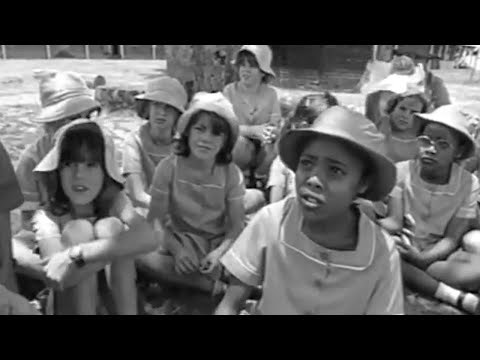
Ariel School Children Describe the 1994 UFO Landing
Archival footage from Eyes On Cinema of Ruwa, Zimbabwe schoolchildren recounting, in their own words, the silver craft and beings they encountered on the Ariel School grounds during recess.
Sources
- Mack, John E. Abduction: Human Encounters with Aliens, Charles Scribner's Sons, New York, 1994.
- Mack, John E. Passport to the Cosmos: Human Transformation and Alien Encounters, Crown Publishers, New York, 1999.
- Hind, Cynthia. UFOs Over Africa, Horus House Press, Madison, WI, 1997.
- Hind, Cynthia. Report on the Ruwa sighting in UFO Afrinews, 1994 (as cited by Reid 2024 and Wikipedia).
- Mack, John E. A Prince of Our Disorder: The Life of T. E. Lawrence, Little, Brown and Company, Boston, 1976.
- Nickerson, Randall. Ariel Phenomenon (documentary), 2022. arielphenomenon.com
- Reid, Gideon. “The mysterious events at Ariel school: the puppet hypothesis,” Scepticisme scientifique 2 (2024), pp. 25–39. comitepara.be
- Dunning, Brian. “The 1994 Ruwa Zimbabwe Alien Encounter,” Skeptoid #760. skeptoid.com
- Smith, Oliver D. “The Ariel School UFO: A Dust Devil?” SUNlite 15(3), 2023, pp. 7–10.
- Kokota, Demobly. “Episodes of mass hysteria in African schools: A study of literature,” Malawi Medical Journal 23(3), 2011, pp. 74–77.
- Space-Track / Satcat catalog entries for Cosmos 2290 (NORAD 23218) and SL-16 R/B (NORAD 23219, decayed September 14, 1994). satcat.com
- Netflix, Encounters, episode 2 (“Believers”), 2023 (Dallyn Vico's account).
- Wikipedia, “Ariel School UFO incident” (used as a pointer to the BBC, Sunday Mail, Dunning and other coverage; consulted October 2026).
- Christie, Sean. "Remembering Zimbabwe's Great Alien Invasion," Mail & Guardian, September 4, 2014. mg.co.za
- Reid, Gideon. "A Closer Look at Encounters and the Ariel School Sighting," Skeptical Inquirer, Vol. 49, No. 6, November/December 2025. skepticalinquirer.org
- Tung, Liz. "Documentary Explores the UFO Sighting That Changed the Course of 62 Children's Lives," WHYY / The Pulse, October 23, 2023. whyy.org
- Pfarrer, Steve. "What Did the Children See? Whately Filmmaker's Documentary Examines a Famous UFO Incident Outside an African School," Daily Hampshire Gazette, October 7, 2022. gazettenet.com
- Ceci, Stephen J., and Bruck, Maggie. Jeopardy in the Courtroom: A Scientific Analysis of Children's Testimony, American Psychological Association, 1995; and Leichtman, M. D., and Ceci, S. J., “The effects of stereotypes and suggestions on preschoolers' reports,” Developmental Psychology 31 (1995): 568–578.
Corrections (October 2026)
A fact-check of this page found extensive invented detail, now removed or corrected. Removed: a photographer's next-day "field survey" with three tripod impressions, clockwise-flattened grass, branches snapped at 2 m with necrotic leaves "collected by Cynthia Hind," and Geiger, magnetometer and metal-detector readings (no source for any of it, or for the photographer's role); stopped watches and stalling cars; a named playground monitor who "left to fetch tea" (the only adult nearby was the unnamed tuckshop operator); a "five-criteria clinical framework" by which John Mack supposedly ruled out mass hysteria (Mack published no report on the case); "35 child witnesses" interviewed on "November 28" (Reid counts twelve, from November 30); the claim that the Harvard inquiry was triggered by Mack's Ariel work (it began in spring 1994, before the sighting) and was convened in "May 1995"; an object hovering "exactly one meter" up, beings with no nose or mouth that "phased," and "zigzag" discs as established facts; children's quotations that could not be traced; a puppet-hypothesis rebuttal citing "school records"; and sources that could not be found ("John E. Mack Papers, Box 42," held at Harvard — Mack's papers are at Rice; school "pupil registries and recess logs"; a Zimbabwe Science Review article; a Sol Foundation analysis; a court case reference). Corrected: the publisher and date of Abduction (Scribner's, 1994), the satellite-catalog link (the re-entering object was the rocket body, NORAD 23219, not the payload), and several book descriptions. Following this review, the rating was changed from Verified 74 to Credible 52 (October 26, 2026): the Verified rating had rested partly on the physical evidence and the Mack findings removed above.
See something inaccurate? Have additional information or sources?
Suggest an Edit →Last Updated: October 2026