
A Prince of Our Disorder
The Life of T. E. Lawrence
Core Thesis
A Prince of Our Disorder is John E. Mack's 1976 psychobiography of T. E. Lawrence ("Lawrence of Arabia"), which won the 1977 Pulitzer Prize for Biography and, unlike every other title on this site's Essential Reading list, has nothing whatsoever to do with UFOs, UAP, or anomalous phenomena. Its relevance here is entirely biographical: this book, written nearly two decades before Mack's landmark 1994 investigation of the Ariel School mass sighting in Zimbabwe, is the credential-defining achievement that made Mack a serious, nationally recognized scholar before he ever turned his psychiatric training toward UAP-abduction research — and, in a genuinely striking historical footnote, it was the subject of the London conference Mack was attending when he was killed by a drunk driver in 2004.
About the Author
John E. Mack (1929–2004) was a professor of psychiatry at Harvard Medical School whose early career was built on conventional, highly respected psychoanalytic scholarship, long before his later, far more controversial turn toward clinical study of UAP-abduction experiencers. A Prince of Our Disorder, published in 1976, was the achievement that established his national scholarly reputation: drawing on extensive interviews, far-flung correspondence, access to British War Office dispatches, and previously unpublished letters, Mack applied his psychoanalytic training to reconstruct the psychiatric dimensions of T. E. Lawrence's famously complex personality.
The book's 1977 Pulitzer Prize for Biography placed Mack among the most respected nonfiction authors of his generation, a credential this site's own related case file notes directly when assessing why his later, far more extraordinary Ariel School conclusions could not simply be dismissed as the work of a fringe or unserious researcher — whatever a reader ultimately concludes about his abduction-research findings, his underlying scholarly rigor and institutional standing were independently, publicly established well before he ever wrote about UFOs.
Mack's later career turn toward UAP-abduction research, beginning in the late 1980s and culminating in his 1994 Ariel School investigation and his 1994 and 1999 books on the subject, triggered a 14-month Harvard Medical School peer-review inquiry into his clinical methods — an inquiry that ultimately concluded with the full protection of his tenure and academic freedom, a resolution this site's own key-figures entry on Mack documents in detail.
Beyond this book and his later UAP-research writing, Mack also wrote extensively on the psychology of the nuclear arms race and co-founded the Center for Psychology and Social Change (later renamed the John E. Mack Institute), reflecting a career-long interest in applying clinical psychiatric insight to large-scale, difficult-to-categorize human experiences — a throughline connecting his earliest scholarly work on Lawrence's individual psychology to his much later, more controversial interest in the collective phenomenon of UAP-abduction testimony.
Historical Context & Origins
Mack began research for the book in the 1960s, drawing on his psychoanalytic training at a moment when psychobiography — applying clinical psychological frameworks to historical figures — was an increasingly serious, if still occasionally contested, subfield within both psychiatry and historical biography, distinct from more speculative or reductive earlier attempts at the same genre.
T. E. Lawrence (1888–1935) had, by the time Mack began his research, already become a heavily mythologized figure, his World War I role in the Arab Revolt filtered through his own famous, stylistically ornate memoir Seven Pillars of Wisdom and further amplified by David Lean's 1962 film Lawrence of Arabia. Mack's book arrived as a deliberate corrective to this mythologizing, aiming to recover the specific, documented psychological complexity of the historical Lawrence beneath decades of romanticized popular image.
The book's 1976 publication, a full eighteen years before Mack's Ariel School investigation, means its own critical reception was entirely uninfluenced by anything related to his later UFO research — a useful, independently verifiable data point for readers assessing Mack's general scholarly standing apart from the specific, much more contested question of his later abduction-research conclusions.
The book also arrived amid a broader wave of serious historical and psychological reassessment of T. E. Lawrence specifically, following decades in which his own carefully self-curated public image, cultivated through Seven Pillars of Wisdom and his subsequent retreat into anonymous enlisted military service under assumed names, had made him an unusually difficult subject for conventional biography. Mack's clinical training gave him a specific methodological tool other biographers lacked for approaching a subject who had, by design, left an unusually fragmented and self-contradictory public record.
Core Arguments & Key Concepts
The book's central argument is that T. E. Lawrence's documented psychological complexity — including his ambivalent relationship with his own illegitimate birth and Anglo-Irish family background, his intense, often self-punishing relationship to physical suffering, and his profound post-war disillusionment — is essential to understanding his historically significant actions during the Arab Revolt, not a separate, merely personal matter incidental to his public achievements.
Mack explicitly argues that Lawrence was neither a cynical instrument of British imperial policy nor a naive, wholly sincere Arab nationalist, but someone genuinely attempting, and ultimately failing, to reconcile British strategic interests with promises of Arab self-determination he had personally made and increasingly believed in — a nuanced middle position Mack develops through careful attention to Lawrence's own private correspondence rather than his more polished public writing.
As a work of psychobiography specifically, the book deliberately subordinates military and political history to psychological portraiture: reviewers and later assessments have noted that Lawrence's Arab Revolt campaigns and postwar political career receive comparatively brief treatment relative to the book's extensive analysis of his inner life, a structural choice consistent with Mack's own psychiatric training and stated interpretive priorities rather than an oversight.
Mack's own psychoanalytic method throughout the book is notably restrained rather than reductive: reviewers have specifically praised him for applying clinical psychological insight without claiming that any single theoretical framework could fully "explain" so complex a historical figure, a methodological humility this article notes as directly comparable to the evidentiary caution this site's own case files aim to apply to contested claims generally.
This article notes, as an interpretive observation rather than a claim drawn from any specific source, that the same underlying professional discipline — careful, non-leading clinical interviewing aimed at reconstructing a subject's genuine inner experience rather than fitting it to a predetermined theory — is visible in both this 1976 book and Mack's much later Ariel School work, even though the ultimate subject matter and the critical reception of his conclusions differed enormously between the two projects.
Key Cases & Evidence Discussed
This site's own Ariel School (1994, Ruwa, Zimbabwe) is the case file this book's inclusion on this list exists to support, though the book itself predates and has no connection to that investigation. The case file's own Further Reading section cites this book specifically as "Dr. Mack's Pulitzer Prize-winning biography, the subject of the London conference he was attending at his death" — framing it as essential biographical context for evaluating Mack's own credibility and institutional standing as the Ariel School case's central psychiatric investigator.
The case file's companion biographical title, The Complete Book of Aliens and Abductions by Jenny Randles, is described in the same Further Reading section as offering "a detailed biography of Dr. John Mack, detailing his Harvard tenure battle, academic inquiry, and his journey to Ariel School" — a more UAP-specific biographical account that this book usefully complements by covering the earlier, pre-ufology half of Mack's career the Randles book does not focus on.
Critical Reception & Controversies
The book received outstanding reviews and won the 1977 Pulitzer Prize for Biography, with some later assessments, including a detailed retrospective review on the T.E. Lawrence Society-affiliated blog T.E. Lawrence: A Biographical Review, calling it "by a pretty wide margin, the best Lawrence biography" among the many competing accounts of Lawrence's life.
The University of Texas history blog Not Even Past's own retrospective review specifically credited the book with "rescuing" Lawrence from the mythologizing that had dominated his popular image, praising Mack's sensitive handling of Lawrence's family secrets, literary predilections, and intensely emotional inner life.
The same review noted a genuine structural limitation: as a work primarily concerned with psychology rather than military-political history, the book gives comparatively short shrift to the historical ramifications of Lawrence's actions during the Arab Revolt, with Mack explicitly declining to render extensive judgment on Lawrence's military or political achievements — a fair characterization of the book's own stated scope rather than a claim that Mack's psychological analysis itself was unreliable.
No critical source located in researching this article disputes the book's core psychobiographical claims about Lawrence's documented inner life or Mack's own scholarly rigor in reconstructing them; the book's reputation as a landmark, still widely read Lawrence biography has remained stable across the nearly five decades since its publication.
This stability is itself worth noting given how differently Mack's later UAP-abduction work has been received: while A Prince of Our Disorder has faced only the ordinary, genre-appropriate scholarly debate any serious psychobiography draws, his post-1990s abduction research has remained genuinely, sharply contested among both his psychiatric peers and the broader scientific community. This article treats that contrast as informative rather than as evidence favoring either body of work on its own: it demonstrates Mack's undisputed capability as a rigorous scholar in a conventional context, without settling the separate, much harder question of how that same capability translated into his later, far more extraordinary research program.
Influence & Legacy
This exact edition is cited in this site's own Ariel School case file's Further Reading section specifically as Mack's "Pulitzer Prize-winning biography, the subject of the London conference he was attending at his death."
The book remains, nearly five decades after publication, among the most respected single-volume biographies of T. E. Lawrence, still cited by subsequent Lawrence scholarship and regularly recommended alongside Lawrence's own Seven Pillars of Wisdom as essential reading for understanding the historical figure behind the popular "Lawrence of Arabia" mythology.
In a detail with genuine historical resonance for this site's own catalog, Mack's death in September 2004 occurred in London while he was attending a conference sponsored by the T. E. Lawrence Society specifically devoted to this book and its subject — meaning the achievement that first made Mack's scholarly reputation was also, decades later, directly connected to the circumstances of his death, a detail his obituaries in outlets including UPI and The Washington Post specifically noted.
Mack's Harvard memorial minute, published in the Harvard Gazette in December 2005, treated this book's Pulitzer Prize and his later UAP-abduction research as two genuinely separate chapters of a single, intellectually restless career, rather than presenting one as a credential legitimizing the other — a framing this article treats as the fairest available summary of how Mack's own institution ultimately chose to remember him.
The Book
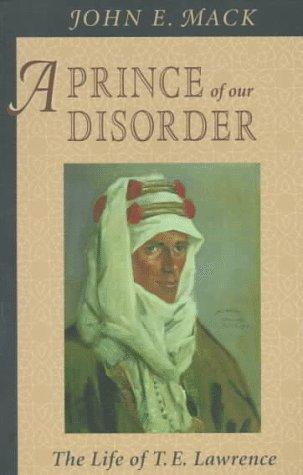
As an Amazon Associate, OverClassified may earn from qualifying purchases made through this link, at no extra cost to you.
Why This Is Essential Reading
A Prince of Our Disorder earns its place on this list for a reason unique among this site's Essential Reading entries: it contains no UFO content whatsoever, but it is essential to understanding the full measure of the man behind this site's own Ariel School case file's central investigation. A Pulitzer Prize won nearly two decades before Mack ever wrote about UAP abductions is independently verifiable evidence of serious scholarly capability — context that neither proves nor disproves his later, far more contested Ariel School conclusions, but that any fair reader assessing his credibility should have in view.
Related Cases & Theories
Sources Cited
- Mack, John E. A Prince of Our Disorder: The Life of T. E. Lawrence. Little, Brown and Company, 1976 (Harvard University Press edition, ISBN-13 9780674704947). amazon.com
- "A Prince of Our Disorder." Harvard University Press (official publisher page, reviews). hup.harvard.edu
- "John E. Mack." Wikipedia (full biography: Harvard career, Pulitzer Prize, UAP research, death). en.wikipedia.org
- "John Mack, Pulitzer winner, dies." UPI, September 29, 2004. upi.com
- "John E. Mack, 74." The Washington Post, September 30, 2004. washingtonpost.com
- "John E. Mack." Harvard Gazette, December 2005 (memorial minute). news.harvard.edu
- "A Prince of Our Disorder: The Life of T.E. Lawrence, by John E. Mack (1976)." Not Even Past, University of Texas at Austin Department of History. notevenpast.org
- "A Prince of Our Disorder: The Life of T.E. Lawrence." T.E. Lawrence: A Biographical Review (blog). telawrence.blogspot.com
- "A Prince of Our Disorder: The Life of T.E. Lawrence." Goodreads (reader ratings and reviews). goodreads.com
- "A prince of our disorder: the life of T.E. Lawrence." Internet Archive (full digitized text). archive.org
- "A Prince of Our Disorder." Open Library (bibliographic record and cover art source). openlibrary.org
- This site's own case file: Ariel School, for Mack's full investigative role and this book's citation context.
- This site's own key-figures entry: John E. Mack, for his full biography, Harvard tenure inquiry, and further case connections.
- This site's own essential reading entries: Abduction and Passport to the Cosmos, Mack's own UAP-abduction research books.
Have corrections, additional research, or peer-reviewed sources? Help improve this entry.
Suggest an Edit