
Passport to the Cosmos
Human Transformation and Alien Encounters
Core Thesis
Passport to the Cosmos: Human Transformation and Alien Encounters is John E. Mack's second and, following his 2004 death, final book-length statement on the abduction phenomenon — and a deliberate departure from the format of his 1994 Abduction. Where that first book organized itself around thirteen detailed clinical case narratives and a diagnostic argument about what abductees were not (mentally ill, delusional, coached), this book is organized topically around what the experience might actually be, drawing explicitly on shamanic and indigenous cosmologies, near-death and mystical literature, and Mack's own unhypnotized 1994 field interviews with the child witnesses of the Ariel School encounter in Ruwa, Zimbabwe. Mack's central move is to set aside, more explicitly and more insistently than in 1994, the question of whether abductions are literally happening as physical events in ordinary space and time, and to argue instead that the experience is real and consequential in whatever sense matters — psychologically, spiritually, ecologically — regardless of how that underlying ontological question is ultimately resolved. It is less a sequel than a reframing: the same phenomenon, the same author, but pushed five years further from clinical psychiatry and toward a consciousness-studies argument that asks what these encounters reveal about the boundaries Western materialism draws around what counts as real.
About the Author
This site's own essential-reading entry on Mack's first book, Abduction (1994), covers his full biography — the 1977 Pulitzer Prize, the Harvard Medical School career, the founding of PEER — in detail; this entry keeps that ground uncovered and focuses instead on what changed between April 1994, when Abduction appeared, and November 1999, when this book followed it.
The single most consequential event in that five-year gap happened seven months after the first book's publication and five years before this one: in November 1994, Mack traveled to Ruwa, Zimbabwe, with researcher Dominique Callimanopulos to interview close to fifty of the children who reported the Ariel School mass sighting two months earlier — without hypnosis, a methodological departure from nearly all of the adult casework in Abduction. That fieldwork, and the unprompted, spontaneous accounts he says it produced, appears to have pushed his thinking in a direction this book makes explicit: toward treating the phenomenon as continuous with mystical and shamanic experience rather than as a clinical entity to be diagnosed case by case.
The other defining fact of that interval was institutional: in August 1995, roughly midway between the two books, Harvard Medical School's fourteen-month peer-review inquiry into Mack's research methods concluded with his academic freedom and faculty standing formally intact and no disciplinary action taken — a resolution this site's own Abduction entry documents in full. This book was written and published in the wake of that outcome, by an author who had been formally cleared but who committee chairman Arnold Relman would later say was "not taken seriously by his colleagues anymore." That this book pushes further into explicitly non-materialist territory rather than retreating toward more defensible clinical ground is, on its own terms, notable.
Mack did not live to write a third. He died on September 27, 2004, struck by a drunk driver near the junction of Totteridge Lane and Longland Drive in London while walking home from dinner during a conference on T.E. Lawrence — the subject of the Pulitzer-winning biography that had first established his academic reputation. This book stands, by the fact of his death rather than by design, as Mack's final full statement on the subject he spent the last fourteen years of his career investigating.
Historical Context & Origins
By 1999, Mack was writing into a field that had moved on in specific ways from the one Abduction had entered five years earlier. Budd Hopkins and David Jacobs continued to publish and investigate within the older, more literalist framework of physical abduction and reproductive experimentation; Harvard psychologist Susan A. Clancy's cognitive-science false-memory research, which would become the decade's most influential scientific rebuttal to hypnosis-based abduction casework, was still several years from publication. Mack's own 1994 book had already absorbed the sharpest methodological criticism of hypnotic regression — from Donna Bassett's undercover exposé to Elizabeth Loftus's memory research — and this book, rather than mounting a fresh defense of hypnosis, largely sidesteps the debate by leaning more heavily on the unhypnotized Zimbabwe interviews and on cross-cultural, non-clinical material instead.
The book's cross-cultural argument draws specifically on three living tradition-bearers Mack interviewed and profiles at length: Sequoyah Trueblood, a Native American; Bernardo Peixoto, a Brazilian shaman who described childhood encounters with beings from Brazilian starpeople folklore; and Credo Mutwa, a Zulu sangoma from South Africa. Mack's use of these figures — presenting their traditional accounts of contact with non-human beings as evidence that the abduction phenomenon predates and exceeds the modern American "grey alien" narrative — is the book's clearest structural departure from Abduction's exclusively Western clinical population, and the clearest expression of its argument that the phenomenon is a human constant refracted through different cultural vocabularies rather than a recent American cultural artifact.
The book arrived from Crown Publishers on November 10, 1999, five years after Abduction's Scribner publication and four years after PEER, Mack's Cambridge Hospital research program, had absorbed the reputational cost of the Harvard inquiry while continuing to operate (it would run until 2002). Mack was explicit in interviews around the book's release that he considered it his mature statement: not a retraction or a defense of the 1994 book, but an extension of an argument that had, in his words, continued to "broaden and deepen" across nearly a decade of work with experiencers.
Core Arguments & Key Concepts
Mack's first argument is definitional: he asks readers to set aside what he frames as a largely unproductive debate over whether abductions are "real" in a strictly physical, literal sense, and instead to treat the phenomenon as what he calls "ontologically shocking" — his term, carried over and sharpened from Abduction, for an experience that ruptures a subject's assumptions about the boundaries of reality itself. This book pushes that framing further than the first: rather than presenting it as one possible interpretation among several, it becomes the book's organizing premise, the lens through which every subsequent chapter is written.
His second argument is the shamanic-parallel claim: Mack contends that the sensory and narrative content of Western abduction accounts — travel to other realms, encounters with non-human intelligences, bodily transformation, information or teaching received from the beings — closely mirrors the phenomenology shamans and mystics across cultures and centuries have reported entering non-ordinary states of consciousness to reach. He treats this convergence as evidence that abduction experiences access a genuine, if poorly understood, dimension of human consciousness, rather than as evidence that abductees are simply reproducing a shared modern cultural script, which is precisely the explanation his critics prefer.
His third argument is ecological and, in Mack's own framing, urgent: he reports that a strikingly consistent theme across his interview population, reinforced by what he heard from the Ariel School children, is an experience of being shown apocalyptic or degraded visions of Earth's environmental future, often accompanied by an imperative sense that the witnessing itself carries some obligation. Mack presents this as one of the phenomenon's most consistent and least explained features, and links it to his broader argument that the encounters function as a kind of forced expansion of ecological and cosmic identity beyond the boundaries of the individual ego.
His fourth argument concerns identity and transformation rather than evidence at all: Mack argues, building on PEER's therapeutic model, that abductees who are supported non-pathologizingly through the experience often describe lasting shifts in their sense of who they are and what they are connected to — a transformation he treats as the phenomenon's real subject matter, more significant clinically and spiritually than any final resolution of whether the beings are physically extraterrestrial. This is the argument that most fully replaces Abduction's diagnostic, is-this-mental-illness framework with a developmental, is-this-meaningful one.
Key Cases & Evidence Discussed
This book's most direct case connection is also this site's own most direct connection to Mack personally: the Ariel School Encounter (Case File #010, 1994), which Mack investigated in the field the same year Abduction was published and which this book, unlike its predecessor, discusses at length — connecting the children's reported environmental warnings to the same theme Mack traces across his adult interview population.
This book's most important relationship to this site's own library is to Abduction (Essential Reading ER-027) itself, the direct predecessor this entry treats as required companion reading: that 1994 book supplies the clinical case histories, the Harvard investigation, and the hypnosis-methodology dispute this book largely does not re-litigate, while this book supplies the interpretive framework — shamanic parallels, ecological messaging, consciousness transformation — that Abduction gestured toward but did not fully develop.
The book's cross-cultural chapters on Sequoyah Trueblood, Bernardo Peixoto, and Credo Mutwa function less as case studies in the conventional sense than as a deliberate widening of the evidentiary base beyond named incidents; readers looking for named historical UFO cases in the manner of a Hopkins or Jacobs book will not find that structure here, since the book's organizing unit is testimony about consciousness rather than testimony about specific dated encounters.
This site's DMT & Psychedelic Contact Hypothesis (Theory File DPC-001) draws directly on this book's argument that abduction phenomenology and psychedelic or shamanic states of consciousness may be functionally continuous — a connection this site's own John E. Mack key-figures card already states explicitly, crediting this book specifically rather than Abduction as that theory file's evidentiary source.
Critical Reception & Controversies
Kirkus Reviews, in its September 1, 1999 notice, delivered the sharpest trade-press skepticism the book received, writing that Mack had adopted "the prophetic tone of Whitley Strieber in his latest works," a comparison the review did not intend as flattering, and concluding flatly that "only the most dedicated abduction devotees will be able to read this all the way through without intense skepticism." The review credited Mack's psychological-testing evidence that his subjects seemed "completely normal" while remaining openly unconvinced by his central claim that the aliens represented access to "an other reality — a kind of parallel universe."
A more measured, specifically scientific critique came from Albert A. Harrison, a psychology professor at the University of California, Davis, reviewing the book for the SETI League. Harrison praised the book's "topical organization" and "impressive use of cross-cultural material" as a genuine advance over Abduction's narrower clinical population, and called the finished work "a credible work on an incredible topic and worth reading." But he identified what he considered a specific and telling gap for a book by a trained psychiatrist: Mack's failure to directly address conventional psychological explanations — memory distortion, suggestion effects, the influence of hypnosis — which Harrison wrote was "a weakness in a book by a psychiatrist," concluding that whatever the book's cross-cultural achievements, "it offers no final answers" and would not persuade a genuinely skeptical reader.
Trade reception ran more favorably in places aimed at a general readership: Publishers Weekly called it "a fascinating foray into an exotic world" and, framing Mack's project as "a serious investigation into a mystifying experience," concluded it "poses questions begging for answers." Budd Hopkins, the abduction researcher whose own investigative approach this book explicitly moves away from toward a more spiritual framework, nonetheless praised it in a jacket endorsement as "an eloquent, insightful statement" — a notable show of support from within the field's more literalist wing for a book that was quietly arguing literalism was the wrong question to be asking.
Writing decades later, religious-studies scholar David Halperin — a specialist in the biblical Ezekiel visions and a serious, independent commentator on Mack's career — read this book as the moment Mack's real underlying preoccupation surfaced: not extraterrestrial visitation as such, but "the issue that his quest had perhaps secretly been about all along," namely whether human consciousness survives bodily death. That reading, offered from outside both the believer and skeptic camps that reviewed the book on release, treats this book less as a sequel to Abduction than as the point where Mack's UFO research became explicitly indistinguishable from a broader, older set of questions about mortality and meaning — questions this book raises but, consistent with its own stated method, does not claim to resolve.
None of the reviewers who engaged this book directly revisited the specific hypnosis-methodology critique — Loftus, Bassett, Baker — that had already been leveled against Abduction five years earlier; this book's own reduced reliance on hypnotic regression in favor of unhypnotized testimony and cross-cultural material appears to have shifted the terms of the argument rather than settling it, with reviewers instead splitting over whether the book's more explicit turn toward non-materialist interpretation represented genuine intellectual courage or, as the more skeptical notices implied, a retreat from evidentiary standards a Harvard-credentialed psychiatrist should have been expected to hold to.
Influence & Legacy
This book's most direct legacy on this site is already on the record: this site's own DMT & Psychedelic Contact Hypothesis theory file cites this book, by name and specifically rather than Abduction, as part of its evidentiary base for treating abduction phenomenology as continuous with psychedelic and shamanic states of consciousness — a direct line from this book's central argument to a live theory file this site maintains today.
Because it was Mack's last book, this title's legacy is inseparable from the manner and timing of his death. He died on September 27, 2004, not long after Passport to the Cosmos had established itself as his mature, closing statement; the driver who struck him, Raymond Czechowski, pleaded guilty to careless driving while under the influence of alcohol and was sentenced the following year, and Mack's family asked the court for leniency once they understood the collision was accidental rather than malicious.
PEER, the Cambridge Hospital research program this book's ecological and transformation arguments grew directly out of, continued operating until 2002, two years before Mack's death; the John E. Mack Institute has since continued to archive and promote both this book's and Abduction's research, without a third full-length successor ever appearing under Mack's own name.
Ralph Blumenthal's 2021 biography The Believer: Alien Encounters, Hard Science, and the Passion of John Mack — the same posthumous biography this site's Abduction entry cites for its account of the Harvard inquiry — devotes its own chapter specifically to this book, titled simply "Passport to the Cosmos"; Blumenthal has said in interviews that his own discovery of a used copy of this exact title while reporting in Texas in 2004 was what first drew him to Mack's story, making this book, rather than the more famous Abduction, the direct origin point of the biography that renewed serious public interest in Mack's career during the 2017–2021 UAP-disclosure wave.
Within the abduction-research field more broadly, this book is generally read as marking the point where a Harvard-credentialed clinical voice moved furthest from the field's evidentiary, literalist wing — represented by researchers like Hopkins and Jacobs — and closest to the explicitly spiritual, consciousness-studies framing that later writers on anomalous experience, working outside psychiatry altogether, would develop further; this site's own library treats it as the clearest single expression of that more spiritually-oriented current within serious abduction research, distinct from both the clinical caution of Abduction and the openly evidentiary approach of Hopkins-style field investigation.
The Book
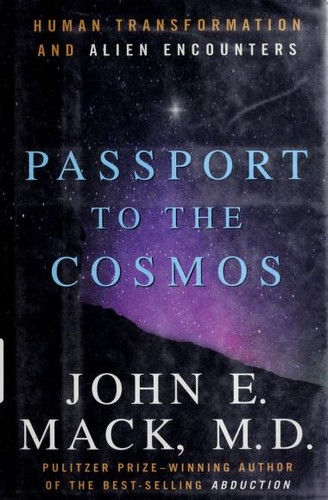
As an Amazon Associate, OverClassified may earn from qualifying purchases made through this link, at no extra cost to you.
Why This Is Essential Reading
Passport to the Cosmos earns its place on this list as the book where John E. Mack finally said, without qualification, what Abduction had only gestured toward five years earlier: that the question of whether alien encounters are literally happening in physical space may be less important, clinically and humanly, than the question of what they mean to the people who report them and what they reveal about the limits Western materialist science draws around the real. Coming after a Harvard peer-review inquiry that formally cleared him but never fully restored his standing among colleagues, and drawing on his own unhypnotized fieldwork with the Ariel School children rather than more hypnosis-dependent adult casework, this book represents Mack's most developed and most exposed argument — exposed because, as both the Kirkus review and Albert Harrison's more measured SETI League notice make clear, its cross-cultural and shamanic framing never engages the specific memory-science critique that had already been leveled at his methods, it simply changes the subject to a register that critique cannot easily reach. Read Mack's second book not as a stronger evidentiary case than his first, but as the more honest one: a credentialed psychiatrist's final, undisguised admission that he had stopped trying to prove a literal case and started trying to describe a human transformation he believed was happening regardless.
Related Cases & Theories
Essential Viewing
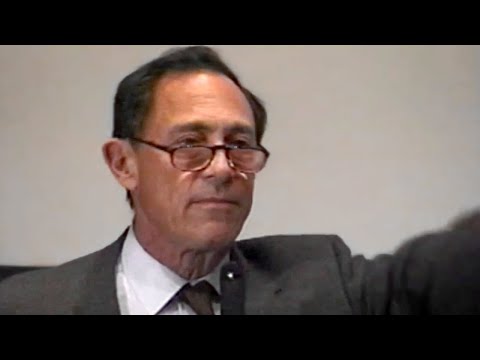
1999.11.16 Dr John Mack "Entering the Heart of the Alien Mystery"
John E. Mack — A recorded lecture from November 16, 1999 — six days after this book's publication — in which Mack lays out the more consciousness-oriented argument this book makes, in his own words, at the moment of its release. Verified via YouTube oEmbed before inclusion.
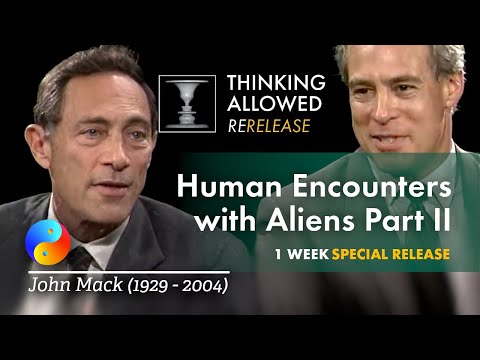
Human Encounters with Aliens Part II with John Mack (1929 - 2004)
New Thinking Allowed with Jeffrey Mishlove — The second half of a New Thinking Allowed interview with Mack, exploring the deeper consciousness and transformation themes this book develops beyond the clinical case-study format of his 1994 book. Verified via YouTube oEmbed before inclusion.
Sources Cited
- Mack, John E. Passport to the Cosmos: Human Transformation and Alien Encounters. Crown Publishers, 1999 (ISBN 0517705680, cited here). openlibrary.org
- "PASSPORT TO THE COSMOS." Kirkus Reviews, September 1, 1999 (contemporary trade review, "prophetic tone of Whitley Strieber" comparison). kirkusreviews.com
- Harrison, Albert A. "Book Review: Passport to the Cosmos." The SETI League, 1999 (review by a UC Davis psychology professor). setileague.org
- "John E. Mack." Wikipedia (biography: Harvard career, Pulitzer Prize, death circumstances). en.wikipedia.org
- "Driver In Dr John Mack Accident Sentenced." John Mack Institute, 2005 (Raymond Czechowski's guilty plea and sentencing). johnemackinstitute.org
- "Biography of John E. Mack, M.D." John Mack Institute (career timeline, PEER, post-1994 fieldwork). johnemackinstitute.org
- Halperin, David. "Ralph Blumenthal's 'The Believer' — The UFO Odyssey of John Mack (Part 1)." davidhalperin.net (independent scholarly commentary on this book's place in Mack's career). davidhalperin.net
- Blumenthal, Ralph. The Believer: Alien Encounters, Hard Science, and the Passion of John Mack. High Road Books / University of New Mexico Press, 2021 (posthumous biography, includes a dedicated chapter on this book and Blumenthal's own account of discovering it in 2004). books.google.com
- "John E. Mack and the Unbelievable UFO Truth." Los Angeles Review of Books, 2021 (career reassessment on the occasion of Blumenthal's biography). lareviewofbooks.org
- "Passport to the cosmos." Open Library / Internet Archive (bibliographic record, Crown Publishers, 1999, 306pp., ISBN 9780517705681). openlibrary.org
- This site's own case file: The Ariel School Encounter (Case File #010), Mack's own most consequential field investigation, discussed directly in this book.
- This site's own essential-reading entry: Abduction by John E. Mack, this book's direct predecessor and required companion reading.
- This site's own key-figures entry: John E. Mack, for his broader site-wide career and case connections beyond this book.
- This site's own theory file: DMT & Psychedelic Contact Hypothesis (Theory File DPC-001), which cites this book directly.
- This site's own resources library: Full Reading List, where this exact edition (ISBN 0517705680) is cited in connection with the Ariel School case file.
Have corrections, additional research, or peer-reviewed sources? Help improve this entry.
Suggest an Edit