
USS Nimitz / Tic Tac Encounter
On November 14, 2004, two F/A-18F crews from the USS Nimitz Carrier Strike Group, redirected from a training sortie off Baja California, reported encountering a white, wingless, Tic Tac–shaped object that Cmdr. David Fravor says accelerated away faster than any aircraft he knew. Crew members say the cruiser USS Princeton had been tracking unusual radar contacts in the area for days, and a later flight recorded the object on infrared video. The Navy acknowledged in 2019 that the video shows “unidentified aerial phenomena,” and on April 27, 2020, the Pentagon officially released it as an unclassified video. It is among the most widely discussed military UAP encounters on record.
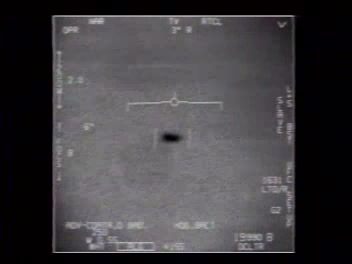
Pictured: an actual FLIR (forward-looking infrared) still frame from the November 14, 2004 Nimitz encounter video, officially released as unclassified by the Department of Defense in April 2020, showing the dark, oblong "Tic Tac" object as tracked by the F/A-18F's ATFLIR targeting pod, with the sensor's own range, mode, and heading readouts visible around the frame. This is an official Department of Defense-released image from the actual incident, not a stand-in or artist's rendering.
Theoretical Alignment
These alignment figures are OverClassified’s editorial weighting, not a finding by any official body. They reflect the extraterrestrial and black-project interpretations favored by many researchers, based on the eyewitness accounts, the released FLIR video, and crew reports of radar tracks; the underlying radar data has never been released.
Background
The COMPTUEX Exercise and Strike Group Assets
In November 2004, the USS Nimitz Carrier Strike Group (CSG-11) was conducting pre-deployment workups, often described as a Composite Training Unit Exercise (COMPTUEX), in the Pacific off the Baja California coast, roughly 100 miles from San Diego. An unofficial executive summary of the encounter, of unknown authorship and first published in 2018, places the November 14 events near 31°20′ N, 117°10′ W, about 30 nautical miles off Baja and some 70 nautical miles south of the U.S.–Mexico border; press accounts commonly describe the location as about 100 miles from San Diego. Exercises of this kind prepare a strike group for deployment with simulated combat scenarios and air defense drills. Witnesses describe the weather on November 14 as clear, with a calm sea that made surface disturbances easy to see.
The strike group was composed of several advanced military assets. The flagship was the USS Nimitz (CVN-68), a nuclear-powered supercarrier carrying Carrier Air Wing Eleven (CVW-11), which included the "Black Aces" of Strike Fighter Squadron 41 (VFA-41) flying F/A-18F Super Hornets. According to his 2023 written statement to Congress, Cmdr. David Fravor commanded VFA-41 at the time. Accompanying the carrier was the USS Princeton (CG-59), a Ticonderoga-class guided missile cruiser equipped with the Aegis Combat System and its AN/SPY-1B phased-array radar, designed to track large numbers of air targets for fleet air defense. E-2C Hawkeye airborne early warning aircraft from the air wing provided airborne command and control. Together these platforms formed a layered sensor picture intended to detect conventional air threats.
Crew members from the Princeton, speaking publicly years later, say operators first considered whether the unusual contacts were system artifacts before concluding they were real targets. That conclusion rests on their testimony: none of the Princeton’s radar data from November 2004 has been publicly released, and the unofficial executive summary states that the ship’s radar “never obtained an accurate track” of the objects. Whether the contacts were physical objects, clutter, or processing errors therefore cannot be settled from the public record, which is why the visual accounts and the released FLIR video carry most of the evidential weight in this case.
State-of-the-Art Sensor Systems: Aegis, APG-73, and ATFLIR
The AN/SPY-1B on the Princeton is an S-band phased-array radar whose four fixed antenna faces, built into the ship’s superstructure, steer beams electronically rather than relying on a rotating antenna, allowing frequent revisits of many targets. Like any modern radar, it relies on processing software to reject clutter and to build track files; track files are processed outputs rather than raw returns, and can in principle be affected by clutter, anomalous propagation, or processing errors. That distinction matters here, because the public descriptions of the radar contacts come from three indirect sources: Fravor’s account of what the Princeton’s controller told him, the unofficial executive summary, and interviews given by Princeton crew members more than a decade later. No track data has been released for independent analysis.
Onboard the F/A-18F Super Hornets, the primary air-to-air sensor was the Raytheon AN/APG-73, an X-band pulse-Doppler multimode radar. Accounts of what the APG-73 showed are in conflict. Fravor has alleged, in his 2023 written statement and testimony, that the fighters’ radars were jammed. The unofficial executive summary’s account of the afternoon FLIR flight, however, reports “no jamming cues,” saying instead that the radar could not hold a lock on the object. Lt. Chad Underwood, who flew that sortie, did not describe jamming in his 2019 interview with New York Magazine. No APG-73 recording from either flight has been released, so the jamming allegation cannot be independently assessed.
The infrared video was recorded with the Raytheon AN/ASQ-228 Advanced Targeting Forward Looking Infrared (ATFLIR) pod, which combines a mid-wave infrared sensor, a visible-light television camera, and a laser designator/rangefinder on a stabilized gimbal, and can track a target automatically or manually. In the released FLIR1 video, which runs 76.3 seconds in the official Department of Defense file, the object appears as a small oblong shape while the pod switches between infrared and television modes and between zoom levels. Proponents note that no obvious exhaust plume is visible. Skeptics note that at long range a small target spans only a few pixels, which limits what can be inferred about its heat signature, shape, or size, and that the video does not by itself establish the object’s range or speed.
Complete Timeline
| Date | Event |
|---|---|
| Early–mid November 2004 | According to Fravor’s 2023 written statement, the USS Princeton (CG-59)’s controller told him the ship had been tracking objects for “the previous 2 weeks” that descended from above 80,000 feet to 20,000 feet, stayed for hours, and went “straight back up.” The unofficial executive summary places the contacts at roughly November 10–16. |
| November 2004 (later accounts) | Princeton crew members, including Senior Chief Kevin Day and technician Gary Voorhis, later describe watching the contacts for days and checking the radar for faults. Day’s figures for the objects’ speeds and altitudes come from interviews given from 2019 onward and are not documented in any released record. |
| November 14, 2004 | Two VFA-41 F/A-18Fs launch from the USS Nimitz for a “2 v 2” training exercise controlled by the Princeton; per Fravor, the training is suspended right after launch for “real world tasking.” Commander David Fravor leads, with Lt. Alex Dietrich flying the wingman jet. |
| November 14, 2004 | Fravor’s flight sees whitewater on the ocean and a white, wingless “Tic Tac” object. As Fravor spirals down, the object climbs; at about half a mile, he says, it “rapidly accelerated and disappeared.” Per Fravor, the Princeton then reports it at the flight’s CAP point, “roughly 60 miles” away, in “less than a minute.” |
| November 14, 2004 (afternoon) | Lt. Chad Underwood of VFA-41 records an object on his ATFLIR targeting pod, creating the “FLIR1” video. He did not see the object visually. |
| November 2004 (alleged) | According to Princeton technician Gary Voorhis and E-2C technician PJ Hughes, in 2019 interviews with Popular Mechanics, data recordings from the Princeton and the E-2C Hawkeye were collected after unknown men arrived. No record of any collection has been made public; the unofficial executive summary says of the E-2C, “There was no recording of this event,” and Fravor testified under oath in 2023 that for his squadron “The tapes were never taken.” |
| 2007 | The FLIR video is posted online by a crew member, according to Navy spokesman Joseph Gradisher in 2019. The Department of Defense later referred to “unauthorized releases in 2007 and 2017.” |
| c. 2009 | According to Fravor’s 2023 statement, Jay Stratton contacts him about the encounter on behalf of a Pentagon program. |
| December 16, 2017 | The New York Times publishes the FLIR1 video and reveals the existence of the Pentagon’s Advanced Aerospace Threat Identification Program (AATIP). |
| May 2018 | An undated, unofficial “Executive Summary” on the Nimitz encounters, of unknown authorship, is published by KLAS-TV and George Knapp. |
| 2019 | Navy spokesman Joseph Gradisher states: “The Navy designates the objects contained in these videos as unidentified aerial phenomena.” |
| April 27, 2020 | The Department of Defense “authorized the release of three unclassified Navy videos” (FLIR1, GIMBAL, and GOFAST), stating that the phenomena in them “remain characterized as ‘unidentified.’” |
| June 25, 2021 | The ODNI’s preliminary assessment covers 144 reports from November 2004 to March 2021 and identifies only one; it does not name the Nimitz case. |
| July 26, 2023 | Commander David Fravor testifies under oath before a House Oversight subcommittee, alongside Ryan Graves and David Grusch. |
Prelude: The Radar Contacts
The Aegis AN/SPY-1B Detections
According to Fravor’s 2023 written statement, the Princeton’s controller told him that for “the previous 2 weeks” the ship had been observing objects “descending from above 80,000ft and coming rapidly down to 20,000ft” that “would stay for hours and then go straight back up.” The unofficial executive summary gives a somewhat different picture: it places the contacts at roughly November 10–16, relays an unnamed Fire Control senior chief’s description of objects dropping from about 60,000 feet to about 50 feet in seconds, and states that the radar “never obtained an accurate track.” Senior Chief Kevin Day, an operations specialist in the Princeton’s Combat Information Center, has described in later interviews (including with Popular Mechanics in 2019 and in Dave Beaty’s documentary The Nimitz Encounters) watching groups of contacts at about 28,000 feet moving at about 120 knots, and says he initially suspected a system fault.
Day’s most dramatic claim, given in those later interviews, is that one contact dropped from about 28,000 feet to about 50 feet in 0.78 seconds. That figure is single-source: it does not appear in Fravor’s statement, it differs from the executive summary’s account, and no radar data has been released that would allow it to be checked. Day and technician Gary Voorhis have both said the system was checked for faults before the intercept; the details of those checks, and who ordered them, are known only from their own later accounts. If the descent figures were accurate, the implied accelerations would be far beyond any known aircraft, which is precisely why skeptics treat them as the weakest link in the case: extraordinary performance inferred from processed radar tracks that the public cannot examine.
On November 14, according to Fravor, his flight launched for a planned “2 v 2” training exercise controlled by the Princeton, and the training was suspended right after launch for “real world tasking.” Day has said in interviews that he pressed to send fighters to investigate the contacts; that account of the decision is his own and is not documented in any released record. Fravor says the controller directed his flight toward a contact west of a combat air patrol (CAP) point roughly 40 miles south of the ship.
The Intercept: David Fravor & Alex Dietrich
Vectored to the Contact
Two F/A-18F Super Hornets from VFA-41 made up the flight. The unofficial executive summary gives their call signs as FASTEAGLE 01 and FASTEAGLE 02. The lead aircraft was flown by Commander David Fravor, the squadron’s commanding officer, with a weapon systems officer (WSO) in the back seat who has not been publicly named. The wingman aircraft was flown by Lt. Alex Dietrich (later Lt. Commander); based on the rank listings in the executive summary, her WSO appears to have been Lt. Cmdr. Jim Slaight. The jets carried inert training missiles rather than live weapons, according to The New York Times and the executive summary.
As the jets arrived over the area, Fravor says, they saw an area of whitewater on an otherwise calm ocean, which he has compared to breaking waves. Descriptions of the disturbance differ. The executive summary, citing the commanding officer of Marine squadron VMFA-232, describes it as 50 to 100 meters across and “close to round”; in the 2021 60 Minutes segment it was likened to roughly the size of a Boeing 737. Fravor has said the crews did not see an object under the water, so what caused the whitewater is unknown.
The Sighting and Mirroring Maneuver
Near the whitewater, just above the surface, was a white, oblong object that Fravor compared to a Tic Tac mint. In his 2023 written statement he described it as having “no Rotors, No Rotor wash, or any visible flight control surfaces like wings,” and under questioning he called it “perfectly white, smooth, no windows.” Fravor confirmed under oath a length estimate of about 40 feet; the executive summary and Navy range-fouler reports released under FOIA in 2023 give about 46 feet. Fravor has described the object moving erratically over the water, changing direction abruptly, before it reacted to the jets.
Fravor began a descending spiral toward the object while Dietrich’s jet stayed about 8,000 feet above as high cover. According to his statement, the object then aligned itself with his jet and began climbing in a clockwise turn, so that the fighter and the object were circling on opposite sides of the same circle. Fravor has described this as the object responding to his aircraft, and it is the core of his argument that the object was under intelligent control. The account comes from Fravor; Dietrich’s public descriptions of the event are broadly consistent with it.
Fravor says that when he cut across the circle toward the object, he was at about 15,000 feet and the object at about 12,000 feet. At roughly half a mile, according to his statement, it “rapidly accelerated and disappeared right in front of our aircraft.” No sound or sonic boom was reported by the crews. Neither aircraft’s radar or sensors produced a released recording of this part of the encounter, so the description of the object’s departure rests on the two crews’ visual accounts.
Shortly afterward, Fravor says, the Princeton’s controller reported that the object had reappeared on the ship’s SPY-1 radar at the flight’s CAP point, “roughly 60 miles” away, in “less than a minute.” The New York Times’ 2017 account put the distance at at least 40 miles. No radar data documenting the reappearance has been released, so the implied speed cannot be calculated from any public record. The jets returned to the USS Nimitz.
Lt. Commander Alex Dietrich's Sighting and Visual Corroboration
Alex Dietrich, then a lieutenant flying the wingman jet, has described the encounter publicly, most prominently on CBS’s 60 Minutes in May 2021. From roughly 8,000 feet above Fravor, by his account, her crew had a separate vantage on the whitewater and the object, and her public description is broadly consistent with his: a white, wingless object that moved erratically over the water and then departed abruptly. Her account matters because it is a second aircrew’s description of the same event. It is not, however, an independent sensor record, and it was given publicly some 17 years after the fact.
Dietrich has spoken about the reluctance of aviators to report such sightings for fear of stigma, and has argued for formal reporting channels so that crews can report unexplained objects without damage to their careers. She did not testify at the July 2023 House Oversight hearing, and she has generally avoided speculating about what the object was.
The E-2C Hawkeye Airborne Early Warning Data
Accounts of what the E-2C Hawkeye airborne early warning aircraft saw differ. Fravor has said the E-2 also tracked the object. The unofficial executive summary says the E-2C obtained only a faint radar return when cued to the object’s location, and states: “There was no recording of this event.” P.J. Hughes, an aviation electronics technician with the E-2C squadron, has said in later interviews that the aircraft’s data storage devices were taken after the flights (see below). No E-2C radar data has been released.
If the E-2C did hold even a faint return, it would be an airborne sensor independent of the surface ships, which is why the question matters. On the current public record, however, the E-2C’s contribution amounts to conflicting secondhand descriptions: a firm track in Fravor’s telling, a faint cued return with no recording in the executive summary, and an unverified claim of removed hard drives from Hughes.
Chad Underwood's FLIR Sighting
The Launch of the Second Flight
After Fravor’s flight returned, a later sortie launched in the afternoon that included Lt. Chad Underwood of VFA-41. Underwood’s F/A-18F carried a Raytheon AN/ASQ-228 ATFLIR (Advanced Targeting Forward Looking Infrared) pod, a targeting sensor combining mid-wave infrared and visible-light cameras with a laser designator, which can record video of what it tracks. In his December 2019 interview with New York Magazine, Underwood confirmed that he recorded the FLIR1 video and said he never saw the object with his own eyes.
Underwood told New York Magazine that the object was “inside of 20 miles” when he picked it up, and he did not describe radar jamming. The unofficial executive summary’s account of the FLIR crew gives initial radar tracks at 30 to 40 nautical miles, reports “no jamming cues,” and says the radar could not hold a lock, so the crew used the ATFLIR to find the object. Fravor, by contrast, has alleged that the jets’ APG-73 radars were jammed. No radar tape from the sortie has been released, so these accounts cannot be reconciled from the public record.
The ATFLIR Lock and Video Capture
The ATFLIR pod tracked the object and displayed it as a small, oblong shape. The resulting video, known as “FLIR1” or the “Tic Tac” video, is the only sensor record from the encounter that has been publicly released; the official Department of Defense file runs 76.3 seconds. The object’s altitude and range during the recording have not been established from released data. Features of the video discussed by analysts include:
- No obvious exhaust plume: Proponents note that no bright exhaust plume is visible behind the object, as might be expected from a jet engine at close range. Skeptics respond that at long range and in some sensor modes a distant aircraft’s exhaust need not appear as a distinct plume.
- Uniform appearance: The object appears as a small, fairly uniform shape with no clearly resolved hot spots. Because it spans only a few pixels for much of the clip, how much detail the video can show is itself a point of dispute.
- Mode and zoom changes: The pod switches between infrared and television modes and between zoom levels during the clip. Analysts such as Mick West argue that these changes, and the pod’s loss of track, account for much of the object’s apparent motion.
According to the executive summary’s account of the FLIR crew, the object appeared stationary and then left the frame without the pod being slewed. Underwood himself told New York Magazine that he could not confirm the object accelerated, since he never saw it visually. The video was posted online by a crew member in 2007, according to Navy spokesman Joseph Gradisher, was published by The New York Times in December 2017, and was officially released as an unclassified video by the Pentagon on April 27, 2020.
Physical Evidence & Data Tape Confiscation
The Gary Voorhis and P.J. Hughes Testimonies
The aftermath of the Nimitz encounters has produced allegations that recordings were collected and removed. Aegis technician Gary Voorhis, stationed on the USS Princeton, told Popular Mechanics in 2019 that after a helicopter arrived carrying two people, he was told to hand over the ship’s data recordings and to erase the remaining tapes. This account is unverified: no official record of such a collection has been made public, and Voorhis’s account has not been corroborated by documentation.
A similar claim comes from Aviation Electronics Technician P.J. Hughes, who was with the E-2C Hawkeye squadron. Hughes has said that shortly after the flights, his commanding officer and two unknown men took the E-2C’s data storage devices. This, too, is unverified, and it is contradicted by the unofficial executive summary, which states of the E-2C that “There was no recording of this event.” No non-disclosure agreements connected to the incident have been documented in the public record.
These allegations have been a source of debate among the encounter’s participants. Commander David Fravor’s sworn account differs for his own squadron: testifying before a House Oversight subcommittee on July 26, 2023, he said the incident “was never investigated,” that “None of my crew were ever questioned,” and that “The tapes were never taken,” though he did not speak to the Princeton’s or the E-2C’s recordings. Navy range-fouler records released under FOIA in 2023 point to bureaucratic neglect rather than confiscation: “Reporting terminated at 3rd Fleet, there was no process to share the reporting.” Whatever happened to the ship and aircraft recordings, none has been made public, and the FLIR1 video remains the only released sensor record.
Congressional Testimony: David Fravor's July 2023 Statements
On July 26, 2023, Commander David Fravor testified under oath before the House Oversight Subcommittee on National Security, the Border, and Foreign Affairs. He was joined by former Navy pilot Ryan Graves and former intelligence officer David Grusch. Alex Dietrich did not testify. In his written statement and answers to lawmakers, Fravor restated his account of the 2004 encounter and argued that the object’s performance did not match any technology he knew of.
Fravor’s statement and testimony covered several aspects of the encounter and its handling:
- The Flight Envelope: Fravor said the technology was “far superior to anything that we had at the time, have today, or are looking to develop in the next 10+ years.” He described the object as having no wings, no rotors, and no rotor wash.
- Safety and Security: He argued that unidentified objects operating in military training areas are a potential flight-safety and national security concern that warrants better reporting and investigation.
- Lack of Investigation: Fravor said the encounter “was never investigated” by the Navy. Under oath he said “None of my crew were ever questioned” and “The tapes were never taken.” He criticized the absence of a reporting process at the time.
- The Prior Radar Contacts: Fravor relayed that the Princeton’s controller had told him the ship had been tracking objects for “the previous 2 weeks” that descended from above 80,000 feet to 20,000 feet, stayed for hours, and then went back up.
Fravor’s sworn testimony placed his account on the congressional record and drew wide public attention. It is eyewitness testimony, however, not independent verification of what the object was: Congress did not receive or release any radar data from the encounter at the hearing, and the All-Domain Anomaly Resolution Office (AARO) has not published a formal resolution of the case.
Specific Theories, Analyses & Crossovers
The AATIP 2009 Executive Summary on "Anomalous Aerial Vehicles" (AAVs)
In May 2018, KLAS-TV in Las Vegas and investigative journalist George Knapp published an undated “Executive Summary” on the Nimitz encounters. Its author is unknown and its provenance unofficial; it has been widely reported to be associated with the Pentagon’s Advanced Aerospace Threat Identification Program (AATIP) and its contractor, Bigelow Aerospace Advanced Space Studies (BAASS), but the Department of Defense has not confirmed it as an official product. Internal evidence suggests it was written between about 2009 and 2012: it refers to an officer named Curtis as “now a Vice Admiral.” The document refers to the objects as Anomalous Aerial Vehicles (AAVs).
The summary’s account differs in several details from later popular retellings. It relays an unnamed Fire Control senior chief’s description of objects descending from about 60,000 feet to about 50 feet in seconds, while stating that the Princeton’s radar “never obtained an accurate track.” It says the E-2C obtained only a faint return when cued and that “There was no recording of this event.” Its account of the afternoon FLIR flight reports “no jamming cues” and says the object appeared stationary before leaving the frame. It also gives the flight’s call signs (FASTEAGLE 01 and 02) and estimates the object at about 46 feet long.
Some UAP researchers read the summary’s choice of “vehicles” rather than “phenomena” as a sign that its authors regarded the object as a physical craft. Because its author is unknown, however, how far it reflects any official assessment is unclear. AATIP itself had already been made public by The New York Times in December 2017, months before the summary appeared. The document remains a useful but secondary source, valuable mainly for its early, contemporaneous-style details and its call-sign and timeline information.
The Physics of the Five Observables
The Nimitz encounter is often cited as a case study for the Five Observables framework promoted by Luis Elizondo, who has described himself as AATIP’s director (a role the Pentagon has disputed). The framework classifies reported UAP performance characteristics that would exceed known technology. How well the Nimitz case fits each one depends heavily on which accounts are accepted:
- Anti-Gravity Lift: Fravor describes the object hovering over the water and climbing with no wings, rotors, or rotor wash. This rests on the aircrews’ visual accounts.
- Instantaneous Acceleration: Fravor says the object “rapidly accelerated and disappeared right in front of our aircraft” at about half a mile. Underwood has said he cannot confirm acceleration in the FLIR1 video.
- Hypersonic Velocity: Fravor relays that the Princeton reported the object at a CAP point “roughly 60 miles” away in “less than a minute” (the New York Times said at least 40 miles). No sonic boom was reported, but no radar data has been released to establish the actual speed.
- Low Observability: Fravor alleges radar jamming; the executive summary’s FLIR-crew account reports “no jamming cues” but says the radar could not hold a lock. The object was visible both to the eye and to the ATFLIR pod.
- Trans-Medium Travel: The whitewater beneath the object has been read as a sign of something entering or leaving the water. Fravor has said the crews did not see an object under the water, so this observable is inferred rather than observed.
Proponents argue that the combination of these characteristics in a single encounter rules out conventional aircraft, drones, or balloons, and some have speculated about exotic propulsion. Critics respond that each observable rests either on witness estimates or on radar data that has never been released, and that the one released sensor record, FLIR1, does not by itself demonstrate extraordinary performance.
Official Explanations & Investigations
The Pentagon Acknowledgment and the April 2020 Release
For years the Navy and the Department of Defense said little publicly about the Nimitz encounter, though the FLIR video had circulated online since 2007. On December 16, 2017, The New York Times published a front-page article co-written by journalist Leslie Kean that revealed the existence of AATIP and published the FLIR1 video. The videos were reportedly provided by former Defense Department official Christopher Mellon; the role of Luis Elizondo in their release is disputed, and the Department of Defense has disputed that the videos were cleared for public release at the time.
In 2019, Navy spokesman Joseph Gradisher stated: “The Navy designates the objects contained in these videos as unidentified aerial phenomena.” On April 27, 2020, the Department of Defense “authorized the release of three unclassified Navy videos,” FLIR1, GIMBAL, and GOFAST, citing “unauthorized releases in 2007 and 2017” and stating that “The aerial phenomena observed in the videos remain characterized as ‘unidentified.’” The videos were unclassified, not declassified, and the statement made no claim about what the objects were. In June 2021, the ODNI’s preliminary assessment reviewed 144 reports from November 2004 to March 2021, identified only one (as a balloon), noted that some reports may be attributable to “sensor errors, spoofing, or observer misperception,” and did not name the Nimitz case. The All-Domain Anomaly Resolution Office (AARO) has issued no formal resolution of the case.
Key Researchers
- Leslie Kean — Investigative journalist who co-authored the December 2017 New York Times article revealing AATIP and publishing the FLIR1 video.
- Luis Elizondo — Former Defense Department official who says he led AATIP (a role the Pentagon has disputed); his part in the 2017 release of the FLIR1 video is also disputed. He has discussed the Nimitz case extensively in interviews and in his 2024 book Imminent.
- Ross Coulthart — Investigative journalist who covers the Nimitz encounter in his 2021 book In Plain Sight.
Key Witness Profiles
Primary Military Witnesses (Pilots & Radar Operators)
Commander David Fravor
Commander David Fravor, commanding officer of VFA-41, led the FASTEAGLE flight (call sign per the unofficial executive summary) during the intercept. He made close visual contact with the object, describing it climbing in a clockwise turn opposite his descending spiral before it “rapidly accelerated and disappeared” at about half a mile, with Fravor near 15,000 feet and the object near 12,000 feet. Fravor first described the encounter publicly in 2017 and testified before a House Oversight subcommittee in July 2023, stating that the technology was “far superior to anything that we had at the time, have today, or are looking to develop in the next 10+ years.” He has remained a prominent public voice on military UAP reporting.
Lt. Commander Alex Dietrich
Alex Dietrich, then a lieutenant, flew the wingman jet in the FASTEAGLE flight, holding high cover about 8,000 feet above Fravor during his descent. She saw the whitewater and the object and has described its abrupt departure. Dietrich spoke publicly in 2021, including on 60 Minutes, and has discussed the stigma aviators faced in reporting such sightings. She did not testify at the July 2023 hearing. Dietrich has advocated for formal, data-driven military reporting of unexplained aerial objects and has generally avoided speculating about what the object was.
Lt. Chad Underwood
Lt. Chad Underwood was the VFA-41 pilot whose ATFLIR pod recorded the “FLIR1” video during an afternoon sortie on November 14. He was identified publicly in a December 2019 interview with New York Magazine, in which he confirmed the recording was his, said he never saw the object visually, placed it “inside of 20 miles” when he picked it up, did not describe radar jamming, and said he could not confirm that the object accelerated. His measured account is one of the more cautious firsthand descriptions in the case.
Senior Chief Kevin Day
Senior Chief Kevin Day was an operations specialist in the Princeton’s Combat Information Center. In interviews given from 2019 onward, including with Popular Mechanics and in Dave Beaty’s documentary The Nimitz Encounters, he has described watching groups of contacts for days at about 28,000 feet and 120 knots, and one drop from about 28,000 feet to about 50 feet in 0.78 seconds; these figures are single-source and no radar data supporting them has been released. Day has also said he pushed for fighters to be sent to investigate; that account of the decision is his own. He has since spoken extensively about the encounter in interviews.
Gary Voorhis
Gary Voorhis was an Aegis systems technician aboard the Princeton. He says the SPY-1 radar was functioning correctly and, in a 2019 interview with Popular Mechanics, said that after two people arrived by helicopter he was told to hand over the data recordings and erase the remaining tapes; the collection is an unverified allegation. Voorhis has co-founded the organization UAPx to conduct independent scientific sky-tracking, continuing his efforts to collect raw data on aerial anomalies.
P.J. Hughes
P.J. Hughes was an aviation electronics technician with the E-2C squadron. He has said in interviews, including with Popular Mechanics in 2019, that his commanding officer and two unknown men took the E-2C’s data storage devices shortly after the intercept flights. The allegation is unverified, and the unofficial executive summary states of the E-2C that “There was no recording of this event.”
Petty Officer Jason Turner
Jason Turner has said that he watched the object’s maneuvers on a monitor aboard ship during the encounters. His account is single-source: no other witness or record has confirmed what he says he saw, or what feed was displayed.
The Five Observables Assessment
The Five Observables framework, promoted by Luis Elizondo (who describes himself as AATIP’s former director, a role the Pentagon has disputed), is used to classify UAP encounters based on performance characteristics that exceed known technology:
Assessment: The “Present” markers above reflect the observables as described in witness accounts, not as established by released sensor data. Anti-gravity lift rests on Fravor’s description of a wingless object hovering and climbing with no rotor wash. Instant acceleration rests on the aircrews’ visual accounts; Underwood has said he cannot confirm acceleration in the FLIR1 video. Hypersonic velocity rests on Fravor’s account that the Princeton reported the object “roughly 60 miles” away in “less than a minute” (the New York Times said at least 40 miles), with no radar data released. Low observability rests on Fravor’s disputed jamming allegation and the radar’s reported failure to hold a lock. Trans-medium travel is inferred from the whitewater; the crews did not see an object under the water.
Evidence Assessment
Supporting Anomalous Origin
- Reported detection by several sensors: Princeton SPY-1 radar contacts (per crew accounts), a faint E-2C return when cued (per the executive summary), and the released ATFLIR video.
- Visual observation by two aircrews (four aviators) in clear daylight, with sworn testimony from the flight lead.
- No obvious exhaust plume in the released ATFLIR video (its significance is disputed).
- Fravor’s account of an abrupt departure and of the object reappearing at the CAP point “roughly 60 miles” away in “less than a minute.”
- Fravor’s allegation of radar jamming, disputed by the executive summary’s report of “no jamming cues” and absent from Chad Underwood’s account.
- A surface disturbance (“whitewater”) described as 50 to 100 meters across in the executive summary, on an otherwise calm sea.
Supporting Terrestrial Origin
- No physical debris, metallic fragments, or chemical residues were recovered to verify non-terrestrial materials.
- Voorhis and Hughes allege that Navy radar records and data cassette tapes were removed, preventing public scientific audit (unverified; Fravor testified his squadron's tapes were never taken).
- The presence of active submarine and training exercises in the COMPTUEX range suggests a potential secret domestic test.
- The low-resolution public video release leaves room for technical debate; analysts such as Mick West argue FLIR1 is consistent with a distant aircraft, with zoom and mode changes and lost lock explaining its apparent motion.
- No radar data from the Princeton, the E-2C, or the fighters has been released, so the reported speeds and altitudes cannot be independently checked.
Why "Verified"
The USS Nimitz / Tic Tac encounter receives a VERIFIED status on OverClassified because the event itself is documented beyond reasonable dispute: the flight lead has described it under oath, the Navy acknowledged in 2019 that the video shows “unidentified aerial phenomena,” the Department of Defense officially released the FLIR1 video as unclassified in April 2020, and Navy range-fouler reports released under FOIA in 2023 record the incident. The status verifies that the encounter occurred and was reported by military personnel; it is not a finding about what the object was. Key elements of the popular account, including the radar-derived speeds and altitudes, the jamming allegation, and the alleged removal of data recordings, rest on testimony or unreleased data and are marked as such throughout this file.
Sensor & Instrumentation Detection Profile
AN/SPY-1B phased-array radar (USS Princeton; contacts reported by crew, data not released), AN/APG-73 fighter radar (lock problems reported; jamming disputed), AN/ASQ-228 ATFLIR electro-optical/infrared pod (FLIR1 video, officially released 2020), and the E-2C’s radar (faint cued return per the unofficial executive summary, which says there was no recording).
Environmental & Geospatial Context
Clear daylight and a calm sea, per witness accounts. Open Pacific off the Baja California coast, roughly 100 miles from San Diego (about 31°20′ N, 117°10′ W per the unofficial executive summary).
Observer Credibility & Occupational Profile
Commander David Fravor, Lt. Commander Alex Dietrich, Chad Underwood, and radar operator Kevin Day.
Physical & Material Assays
Video data recording (FLIR1, officially released 2020); radar data reported by crew but never publicly released; no physical material was recovered by the fleet.
Historical Precedents & Archive Matches
Connects to later Navy aircrew encounters off the U.S. East Coast in 2014–2015, whose GIMBAL and GOFAST videos were officially released by the Pentagon alongside FLIR1 in April 2020.
Material Analysis
The Whitewater Hydrographic Disturbance
The primary physical trace reported in the Nimitz encounter was the localized patch of “whitewater” on the ocean surface described by Commander David Fravor and the crew of Lt. Alex Dietrich’s jet. The sea was calm, which made the disturbance stand out. Size estimates differ: the unofficial executive summary, citing the commanding officer of VMFA-232, describes it as 50 to 100 meters across and “close to round,” while the 2021 60 Minutes segment likened it to roughly the size of a Boeing 737. Fravor has said the crews did not see an object under the water.
Proposed explanations for this feature, none of which can be tested on the available evidence, include:
- Submerged Object: Some researchers propose that something large below the surface caused the disturbance, possibly linked to the object above it. The crews did not see anything under the water, so this remains speculation.
- Propulsion Downwash: The disturbance might have been caused by the object itself. Fravor, however, described the object as having “No Rotor wash,” which argues against a conventional downwash explanation.
- Natural or Conventional Cause: Skeptics suggest a natural feature such as a feeding event or a breaking swell over a submerged feature, or activity related to the exercise, such as a submarine; no evidence has been published either way.
ATFLIR Thermal Exhaust Plume Absence
The ATFLIR video is the only released sensor record of the encounter. Proponents emphasize that no obvious exhaust plume is visible, which would be unexpected for a jet engine seen at close range. Skeptics, including Mick West, respond that the object’s range is not established from the video, that a distant aircraft can appear without a distinct plume in this kind of imagery, and that the object spans only a few pixels for much of the clip, limiting what the video can show about its temperature.
No crew member reported hearing a sonic boom when the object departed. Because no radar data has been released, the object’s actual departure speed is unknown; Fravor’s account of the object reappearing “roughly 60 miles” away in “less than a minute” is the main basis for claims of extreme speed, and the New York Times gave the distance as at least 40 miles.
The Debate
Supporting Anomalous Origin
- The whitewater disturbance, described as 50 to 100 meters across on a calm sea, has no confirmed explanation.
- No obvious exhaust plume is visible in the released ATFLIR video.
- Fravor alleges radar jamming and describes an abrupt acceleration, though the jamming claim is disputed by the executive summary’s report of “no jamming cues.”
- The alleged simultaneous removal of E-2C hard drives and Princeton Aegis tapes, if accurate, would point to a coordinated national security containment.
Supporting Conventional Origin
- The whitewater could be explained by a natural shoal, a surfacing whale, or a submarine participating in the COMPTUEX exercise.
- The lack of a thermal plume could be an artifact of the targeting pod's calibration or distance, though this is highly contested.
- No physical debris, metallic fragments, or chemical residues were recovered from the site to verify non-terrestrial materials.
- Navy records released in 2023 state that “Reporting terminated at 3rd Fleet, there was no process to share the reporting,” consistent with bureaucratic neglect rather than a cover-up.
Connection to Material Studies: Like the layered bismuth-magnesium metamaterials or the physical trace impressions at Ruwa, the Nimitz case is cited as a physical interaction with the environment (the ocean surface). Without recovered material or released radar data, however, the case rests on testimony and a single released video. The investigation is ongoing.
The Conventional Explanation Candidate: Advanced Drone, Sensor Artifact, or Classified Program
The Drone Hypothesis
One conventional explanation proposed for the Tic Tac is that the pilots saw an advanced, classified unmanned aerial vehicle. According to this theory, the object was a secret U.S. or contractor project being tested against the carrier strike group to evaluate its detection and evasion capabilities. Proponents suggest the drone used buoyancy or stealth designs that let it hover without rotors. The main difficulty is the performance Fravor describes: a conventionally powered drone would be expected to show rotor wash or exhaust when hovering, and could not match his account of an abrupt departure and a reappearance “roughly 60 miles” away in “less than a minute.” Testing an unannounced drone against active Navy fighters without coordination would also be a serious flight-safety breach. The hypothesis depends on Fravor’s performance account being substantially wrong.
The Sensor Artifact / Radar Malfunction Hypothesis
Another skeptical approach treats the encounter as a combination of sensor artifacts and misperception. Skeptics suggest that the Princeton’s radar tracks could have included false or poorly formed tracks (the executive summary itself says the radar “never obtained an accurate track”), and analysts such as Mick West of Metabunk argue that the FLIR1 video is consistent with a distant aircraft, with zoom and mode changes and the pod’s lost lock explaining its apparent motion. This hypothesis has real strengths for the radar and video evidence, neither of which independently demonstrates extraordinary performance. Its weakness is the visual account: two aircrews describe a close-range, wingless white object in clear daylight, which sensor artifacts alone do not explain. The case therefore remains open rather than resolved in either direction.
The Classified U.S. Program Hypothesis
A final conventional candidate is that the object was a secret U.S. platform developed under a Special Access Program, tested against the carrier group without its knowledge. The alleged removal of recordings is sometimes cited in support, although those allegations are unverified and Fravor testified that his squadron’s tapes were never taken. While the military has tested secret platforms (like the U-2 or F-117) against its own assets, the performance Fravor describes would represent a leap that has not visibly emerged in the two decades since. Navy records showing the reports simply “terminated at 3rd Fleet” also sit awkwardly with a deliberate test program, which would be expected to manage such reports actively.
Drone Hypothesis
ImplausibleA conventionally powered drone would be expected to show rotor wash or exhaust when hovering and could not match Fravor’s account of an abrupt departure and reappearance “roughly 60 miles” away in “less than a minute”; testing one against active Navy fighters without coordination would also be a serious safety breach.
Sensor Artifact / Radar Malfunction Hypothesis
InconclusivePlausible for the unreleased radar tracks and the FLIR1 video (Mick West argues it is consistent with a distant aircraft), but it does not explain two aircrews’ close-range daylight description of a wingless white object.
Classified U.S. Program Hypothesis
ImplausibleThe performance Fravor describes — no visible propulsion or control surfaces and an abrupt, extreme acceleration — would represent a leap that has not visibly emerged in two decades, and Navy records showing the reports simply “terminated at 3rd Fleet” fit poorly with a managed test program.
Confirmed Documents & Official Records
An undated “Executive Summary” of unknown authorship describing the radar contacts, the E-2C, the pilot intercepts, and the FLIR flight involving what it calls Anomalous Aerial Vehicles (AAVs) during the November 2004 exercises. It refers to an officer named Curtis as “now a Vice Admiral,” suggesting it was written around 2009–2012. It was never officially released by AATIP or the Pentagon and its provenance is unofficial — it was published by KLAS-TV and journalist George Knapp in May 2018 and is hosted here on DocumentCloud, a journalistic primary-source archive.
UNOFFICIAL (published via leak)Official Department of Defense statement that it “authorized the release of three unclassified Navy videos,” including “FLIR1” (the Tic Tac video, recorded by Lt. Chad Underwood per his 2019 interview), stating that the phenomena “remain characterized as ‘unidentified.’”
UNCLASSIFIEDSearch Government Archives Directly
Further Reading — Recommended Literature
Imminent: Inside the Pentagon's Hunt for UFOs
Elizondo's first-person account of his Pentagon UFO work (his AATIP leadership role is disputed by the Pentagon). Directly covers the Nimitz encounter and its aftermath from inside the DoD.
UFOs: Generals, Pilots, and Government Officials Go on the Record
The investigative work that laid the groundwork for the 2017 NYT bombshell. Kean's meticulous sourcing from military officials worldwide set a new standard for UFO journalism.
In Plain Sight
Award-winning investigative journalist connects the Nimitz encounter to the broader pattern of government secrecy. Excellent fresh reporting with new interviews.
DISCLOSURE: Some links above are affiliate links. If you purchase through them, OverClassified receives a small commission at no additional cost to you. This helps support independent research.
Essential Viewing

David Fravor: Lex Fridman Interview
Comprehensive 2-hour interview with Commander Fravor, going into deep technical detail on the flight dynamics and piloting perspective of the Tic Tac dogfight.
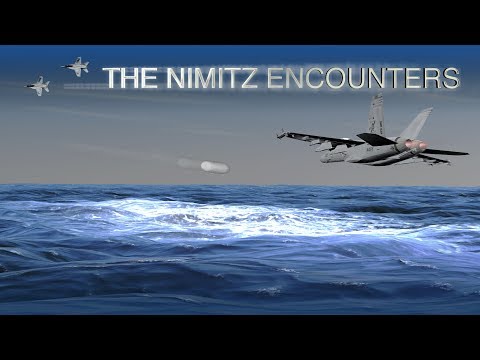
The Nimitz Encounters (Documentary)
Detailed CGI reconstruction and documentary compilation produced by Dave Beaty, interviewing multiple Princeton crew members on the radar tracks.
Sources
- Cooper, Helene; Blumenthal, Ralph; & Kean, Leslie. "Glowing Auras and 'Black Money': The Pentagon's Mysterious U.F.O. Program." The New York Times, December 16, 2017. nytimes.com
- Kean, Leslie. UFOs: Generals, Pilots, and Government Officials Go on the Record, Harmony Books, 2010
- Fravor, David. Interview with Lex Fridman, Lex Fridman Podcast #122, October 2020. youtube.com
- Fravor, David. Interview with Joe Rogan, The Joe Rogan Experience #1361, October 2019. youtube.com
- Dietrich, Alex. Interview with 60 Minutes, CBS News, May 16, 2021. cbsnews.com
- U.S. Navy. Range-fouler reports on the November 2004 Nimitz encounters, released under the Freedom of Information Act, January 2023
- U.S. Department of Defense. "Statement by the Department of Defense on the Release of Historical Navy Videos," April 27, 2020. defense.gov
- Day, Kevin. Interviews in Popular Mechanics, 2019, and in Beaty, Dave. The Nimitz Encounters (documentary), 2019
- Underwood, Chad. Interview with New York Magazine / Intelligencer, December 2019
- Voorhis, Gary. Interview with The War Zone (twz.com), October 2019. twz.com
- Turner, Jason. Interview documented alongside Voorhis in The War Zone investigation, 2019
- Hughes, PJ. Testimony documented in multiple outlets including The War Zone, 2019–2021
- Live Science. “Navy Officers Say ‘Unknown Individuals’ Made Them Erase Evidence of 2004 UFO Encounter,” reporting the Voorhis and Hughes interviews with Popular Mechanics, November 2019 livescience.com
- U.S. House Committee on Oversight and Accountability. Hearing transcript, “Unidentified Anomalous Phenomena: Implications on National Security, Public Safety, and Government Transparency,” July 26, 2023, Serial No. 118-53 (Fravor statement) govinfo.gov
- Scientific Coalition for UAP Studies (SCU). "A Forensic Analysis of Navy Carrier Strike Group Eleven's Encounter with an Anomalous Aerial Vehicle," 2019
- Elizondo, Luis. Imminent: Inside the Pentagon's Hunt for UFOs, William Morrow, 2024
- Elizondo, Luis. Multiple interviews discussing "Five Observables" framework, 2017–2023
- House Oversight Committee. "Hearing on Unidentified Anomalous Phenomena: Implications on National Security, Public Safety, and Government Transparency," July 26, 2023. oversight.house.gov
- FLIR1 Video (unclassified; officially released by the Department of Defense, April 27, 2020), originally captured November 14, 2004
- “Pentagon UFO videos,” Wikipedia (summary of published sources). en.wikipedia.org
- Rogoway, Tyler. "The Complete Story of the Nimitz Encounters," The War Zone, 2019. twz.com
- Office of the Director of National Intelligence. “Preliminary Assessment: Unidentified Aerial Phenomena,” June 25, 2021
- Unofficial “Executive Summary” on the Nimitz encounters (undated, author unknown), published by KLAS-TV / George Knapp, May 2018 documentcloud.org
- West, Mick. Analysis of the FLIR1 “Tic Tac” video, Metabunk. metabunk.org
See something inaccurate? Have additional information or sources?
Suggest an Edit →Last Updated: June 2026