
UFOs & Nukes
Extraordinary Encounters at Nuclear Weapons Sites
Core Thesis
UFOs & Nukes: Extraordinary Encounters at Nuclear Weapons Sites is the consolidated record of a single-author research project that ran, by the time of the book's 2008 self-publication, for roughly three decades: independent researcher Robert L. Hastings interviewed more than 150 former and retired U.S. Air Force missile launch officers, security police, and other personnel who described unidentified aerial objects appearing over American ICBM launch facilities and nuclear weapons-storage areas — frequently, in the witnesses' own accounts, in the same window of time that missiles under their command dropped inexplicably offline. Hastings's argument is cumulative rather than built on any single case: no one interview, he acknowledges, would carry much evidentiary weight alone, but the book's central claim is that the sheer number of independently sourced, broadly consistent accounts spanning from the late 1940s into the 21st century, corroborated in places by declassified Air Force and NORAD documents, describes a real and recurring pattern of non-human interest in the U.S. nuclear arsenal specifically — a pattern he argues the Air Force's own contemporaneous and later record-keeping cannot fully explain away.
About the Author
Robert Lambert Hastings was born May 6, 1950, in Albuquerque, New Mexico, the son of a career U.S. Air Force senior master sergeant who retired in 1967. The family's own postings gave Hastings a direct, personal stake in the subject before he ever became a researcher: stationed at Malmstrom Air Force Base, Montana, in 1966–67, the teenage Hastings was present in the base's air traffic control tower in March 1967 when controllers reported tracking radar returns from unidentified objects maneuvering near Minuteman ICBM sites southeast of the base — the same general period, this site's own Malmstrom AFB Missile Shutdowns case file documents, that produced the Echo and Oscar Flight shutdowns. That firsthand brush with the subject, by his own later account, is what set his subsequent research agenda rather than any prior involvement in ufology.
Hastings's professional background is civilian and non-technical in the specific sense that matters for evaluating his book honestly: he holds a BFA in photography from Ohio University (1972), worked as a photographic technician at Northern Illinois University from 1973 to 1981, retrained in electron microscopy at San Joaquin Delta College in Stockton, California between 1986 and 1988, and was employed as a laboratory analyst at Philips Semiconductors in Albuquerque from 1988 to 2002. He holds no military, intelligence, or aerospace-engineering credential of his own; his standing in the field rests entirely on the decades of interview work itself, not on any institutional authority to evaluate the missile-system or radar data his witnesses describe.
Beginning in 1981, Hastings started presenting his accumulating research on the college lecture circuit, and by his own count has since spoken at more than 500 U.S. colleges and universities, as well as at Oxford University in England. Over more than four decades of that same period he sought out and interviewed the more than 150 former and retired Air Force personnel — from airmen to full colonels — whose testimony forms the spine of UFOs & Nukes, publishing the consolidated result himself through CreateSpace's self-publishing platform in 2008 and issuing a substantially revised and expanded second edition in 2017. He went on to direct a 2016 documentary film, UFOs and Nukes: The Secret Link Revealed, built from many of the same interviews, and continues to update and republish his research through his own website.
That Hastings has spent his career as an independent researcher working almost entirely outside any university, government, or scientific institution is worth stating plainly rather than glossing over: he is, by profession, a self-taught oral historian of a single narrow and controversial subject, and the credibility of his book rests on the same foundation as any oral-history project — the number, consistency, and corroborating detail of the testimony he collected, not on any credential entitling him to adjudicate what caused the incidents his witnesses describe.
Historical Context & Origins
Hastings began collecting nuclear-site UAP testimony in the years immediately following the U.S. Air Force's December 1969 closure of Project Blue Book, at a moment when the subject had lost its last official federal investigative body and when the specific claim that UFOs might be interfering with nuclear weapons systems had almost no public documentary record at all. The most consequential single incident in that record — the March 1967 Echo and Oscar Flight shutdowns at Malmstrom Air Force Base — would not become widely known outside the Air Force itself until Robert Salas, one of the officers on duty that night, began speaking publicly about it decades later; Hastings's own research, beginning from his personal connection to the same base and period, ran on a parallel track for years before the two men's efforts converged.
The book's specific evidentiary approach — corroborating witness testimony with declassified government paperwork wherever it could be found — situates it within the broader wave of FOIA-driven UFO research this site's own reading list documents from other angles, including Kevin D. Randle's Project Blue Book Exposed's case-by-case Blue Book file audits and Richard Dolan's UFOs and the National Security State's chronological national-security history. Hastings's project differs from both in scope: rather than working from a single institutional archive, he built his own archive from scratch, one interview at a time, across a research career that predates the modern Roswell revival, the Betty and Barney Hill abduction narrative's mainstream popularization, and the FOIA-era document releases that would later corroborate parts of what his witnesses had already told him.
By the time Hastings assembled the interviews into book form, no mainstream or academic press had shown sustained interest in a manuscript built entirely around anonymous and named military testimony regarding an institutionally denied subject; self-publishing through CreateSpace in 2008, and again for the revised 2017 second edition, was accordingly less an editorial choice than the only realistic publication route available for a 600-page compilation of this kind — a genuine structural limitation on the book's reach and vetting that this article addresses directly in its Critical Reception section below, rather than treating self-publication as incidental.
The book's 2008 first edition also arrived roughly two years before the event that would do more than the book itself to bring Hastings's research to a mainstream audience: the September 27, 2010 press conference at Washington's National Press Club, discussed in full in this article's Influence & Legacy section, at which several of the book's own interview subjects went on the record in person for the first time.
Core Arguments & Key Concepts
The book's central, explicitly stated thesis is narrower than the sweeping "UFOs and nukes" framing of its title might suggest: Hastings does not primarily argue that unidentified craft are hostile to nuclear weapons, but that the documented pattern of sightings concentrated specifically around nuclear-capable installations — missile silos, weapons-storage igloos, and the air bases housing nuclear-armed aircraft — is itself the finding requiring explanation, regardless of what ultimate interpretation a reader draws from it. He organizes the book's several hundred pages largely chronologically and by installation, moving from the earliest reported incidents in the late 1940s at atomic-weapons assembly and storage sites through the Minuteman-era missile-field incidents of the 1960s and 1970s and into sightings reported as recently as the early 2000s.
A recurring structural argument concerns corroboration: Hastings repeatedly pairs individual witness accounts with whatever declassified paperwork he was able to obtain through FOIA requests — unit histories, NORAD radar logs, Air Force message traffic — arguing that where such documents exist, they tend to confirm the timing, location, or radar-detection elements of a witness's account even when they cannot confirm the witness's interpretation of what was seen. The book's treatment of the August 1965 F.E. Warren AFB sighting wave exemplifies this method directly: Hastings cites the surviving Air Force memorandum — the same document J. Allen Hynek had separately published in his own 1972 book — as contemporaneous documentary confirmation of a night nine-object sighting his own later-conducted interviews with missile officers Jay Earnshaw and Richard Tashner filled in with firsthand detail decades afterward.
The book's most specific and most contested claim concerns missile-guidance interference: multiple witnesses, most prominently Robert Salas at Malmstrom's Oscar Flight, describe nuclear missiles dropping into a "No-Go," launch-inhibited status within minutes of an object being sighted overhead — a correlation Hastings treats throughout the book as too frequent and too specific across independent bases to attribute to coincidence, while acknowledging that no declassified engineering report has ever definitively attributed any individual shutdown to an external UAP-generated cause rather than to conventional electrical or hardware faults.
Geographically, the book's case coverage is deliberately broad rather than concentrated on any single celebrated incident: alongside Malmstrom and F.E. Warren, Hastings devotes sustained attention to the 1975 Northern Tier intrusion wave at Loring Air Force Base's nuclear weapons-storage area, the 1968 Minot AFB radar-visual case, and the 1964 Vandenberg Air Force Base missile-tracking film incident described by Robert Jacobs — presenting the geographic spread itself, across missile fields and weapons-storage sites separated by hundreds or thousands of miles and spanning several decades, as the strongest single piece of circumstantial evidence for a genuine pattern rather than a series of unrelated local misperceptions.
Key Cases & Evidence Discussed
This site's own Malmstrom AFB Missile Shutdowns (Case File #092, March 1967) receives the book's single most detailed case treatment, and is also the incident that first drew the teenage Hastings into the subject firsthand from the base's own control tower; the case file's own timeline directly credits Hastings's 2008 book with "consolidating decades of interviews including Malmstrom personnel," including Fred Meiwald's 2011 taped interview confirming a Security Alert Team's report of "a bright, flying object at low-level."
This site's own F.E. Warren AFB Nuclear Silo Intrusion (Case File #119, August 1965) is discussed in the book both for its contemporaneously documented nine-object sighting, published independently by J. Allen Hynek, and for the string of later 1970s incidents at the same base — recounted to Hastings directly by launch officer Walter Billings — that this site's own case file treats as historical pattern evidence rather than as corroboration of the 1965 events themselves.
This site's own Loring AFB Nuclear Storage Area case file (Case File #064, 1975) documents the same Northern Tier intrusion wave the book situates within its much longer thesis about nuclear-capable sites appearing disproportionately often in credible UAP reports — a broader claim the case file itself describes as "a matter of ongoing dispute Hastings himself acknowledges cannot be settled by any single incident."
This site's own Vandenberg AFB Missile Disabling Incident (Case File #229, 1964) covers the disputed Atlas reentry-vehicle tracking-film case involving Robert Jacobs, with whom Hastings later co-authored the 2019 book Confession: Our Hidden Alien Encounters Revealed and whose account Hastings has separately defended in a published rebuttal to engineer Kingston George's competing decoy-and-chaff explanation.
Critical Reception & Controversies
As a self-published, roughly 600-page compilation, UFOs & Nukes has drawn essentially no attention from mainstream book-review outlets or academic journals — a genuine limitation in its documented critical footprint this article states directly rather than papering over. Its reception instead lives almost entirely in reader reviews and in the ufology and skeptic communities' running commentary on Hastings's broader research project, most concentrated around the 2010 press conference the book fed into.
Reader reception on Goodreads is strongly positive but modest in critical rigor: the book holds a 4.35-star average across 329 ratings and 40 written reviews. Representative reviews call it "THE bible on the subject" and "an encyclopedia of UFO encounters at nuclear sites, a collection of accounts, and in that role it serves well" — a description that captures both the book's core appeal as an exhaustive reference and its genre limitation as a curated collection rather than an independently adjudicated investigation. A separate review from the UFO-research site darkstar1.co.uk, while broadly favorable, singles out the book's sheer length and density as double-edged: thorough and "downright terrifying" in its cumulative effect, but demanding of a reader willing to work through hundreds of pages of case-by-case detail without a tighter argumentative throughline.
The most substantive outside skeptical critique came in direct response to the 2010 press conference rather than to the book itself, from Benjamin Radford, a Research Fellow with the Committee for Skeptical Inquiry writing for Live Science. Radford argued that despite the conference's framing of veterans "breaking their silence," the specific incidents described had in most cases already circulated for thirty or forty years in UFO magazines, books, and websites, and that the event therefore offered, in his words, "merely a rehashing of old, discredited reports that didn't yield any significant evidence when they were originally reported decades ago" rather than new corroborating material. That critique applies a general and well-founded skeptical principle to Hastings's whole project: testimony collected decades after the fact, however sincere and consistent across witnesses, is subject to the same memory-decay and narrative-convergence concerns that affect any retrospective oral-history project, and cannot substitute for contemporaneous physical or documentary evidence of the specific causal claim — that an unidentified craft actually caused a missile malfunction — at the center of the book's most striking chapters.
A further limitation specific to the Malmstrom material Hastings's book draws on is internal to the witness record itself, and this site's own James Carlson key-figures entry documents it directly: Carlson, son of Echo Flight crew commander Eric Carlson, has argued at length in his own self-published book that no UFO was involved in the March 16, 1967 Echo Flight shutdown at all, and that the narrative built around it by Hastings and Robert Salas misrepresents his father's and Walt Figel's actual recollections — a dispute that remains genuinely unresolved among researchers and that this article notes honestly rather than treating Hastings's Echo Flight account as uncontested.
Set against those limitations, it is also true that Hastings's method is more disciplined than the "rehashing" characterization alone suggests: the book repeatedly distinguishes between contemporaneously documented elements of a case (radar logs, unit histories, Air Force message traffic) and testimony reaching the record only decades later through his own interviews, a distinction this site's own case files on Malmstrom and F.E. Warren have found useful enough to adopt in their own evidentiary weighing of Hastings-sourced material.
Influence & Legacy
The book's most concrete, verifiable influence is its citation on this site's own resources library, where this exact CreateSpace edition (ISBN 1544822197) is cited across 12 separate case-file and theory pages — including the 1975 SAC Base Intrusion Wave, the CFS Falconbridge Radar/Visual Incident, and the Hanford Site Radar-Visual Intercept — reflecting its continued use here as the primary secondary source for the documentary and testimonial record of UAP activity at American nuclear installations specifically.
The book's single most consequential real-world outcome was the September 27, 2010 press conference Hastings organized at the National Press Club in Washington, D.C., which CNN carried live. Seven former U.S. Air Force officers and personnel — including Robert Salas, retired missile targeting officer Robert Jamison, Col. Charles Halt of the separate Bentwaters/Woodbridge Weapons Storage Area incident, and Bruce Fenstermacher, whose own F.E. Warren AFB account is documented in this site's own case file — discussed UFO incursions at nuclear sites including Malmstrom, F.E. Warren, Walker Air Force Base, and RAF Bentwaters, alongside declassified supporting documents and signed witness affidavits distributed at the event. The conference remains the single most widely reported public event in the nuclear-UAP research area, and drew the Radford critique addressed above — itself a measure of how much mainstream and skeptical attention the event, more than the book, ultimately generated.
The book's reach also extended internationally: a German-language edition, UFOs und Atomwaffen, was published in 2015 by Kopp Verlag in Rottenburg, Germany, and was subsequently catalogued in the International Atomic Energy Agency's own International Nuclear Information System (INIS) database under the agency's nuclear-disarmament and physical-protection subject classification — a genuinely notable, independently verifiable instance of a self-published UFO book being formally indexed by an international nuclear-oversight body, whatever the IAEA's own institutional view of its central claims.
Within Hastings's own body of work, the book functioned as the foundation for a 2016 documentary film, UFOs and Nukes: The Secret Link Revealed, built from many of the same interviews, and for his continued research collaborations, including the 2019 book Confession: Our Hidden Alien Encounters Revealed, co-authored with Robert Jacobs about the Vandenberg AFB case. Most directly for this site, Hastings's decades of interviews feed two of its own most detailed case files — Malmstrom AFB and Loring AFB Nuclear Storage Area — both of which cite this book by name as a primary source for witness accounts that would otherwise exist only in Hastings's own private interview archive.
The Book
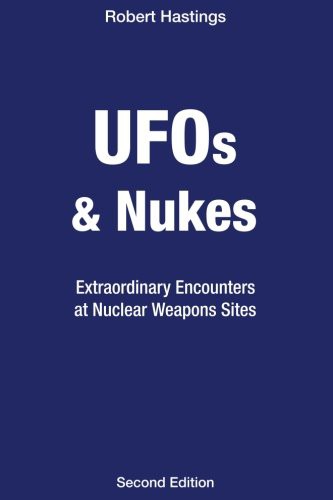
As an Amazon Associate, OverClassified may earn from qualifying purchases made through this link, at no extra cost to you.
Why This Is Essential Reading
UFOs & Nukes earns its place on this list as this site's clearest example of a single independent researcher's decades-long oral-history project standing in for the institutional investigation the U.S. government never conducted: more than 150 named and interviewed former Air Force personnel, corroborated where possible against declassified radar logs and unit histories, organized around the specific and genuinely under-examined claim that American nuclear weapons sites have drawn a disproportionate share of credible UAP reports since the late 1940s. It is also, honestly, a self-published book that has drawn almost no scrutiny from outside ufology's own community, whose central missile-interference claims rest on testimony gathered decades after the fact, and whose own witness record — as this site's James Carlson dispute over the Echo Flight incident shows — is not uniformly agreed upon even among the people who were there. Read it as what it demonstrably is: the most comprehensive single compilation of nuclear-site UAP testimony in print, built by the one researcher who spent four decades collecting it, and the direct documentary backbone behind this site's own Malmstrom and Loring case files.
Related Cases & Theories
Essential Viewing
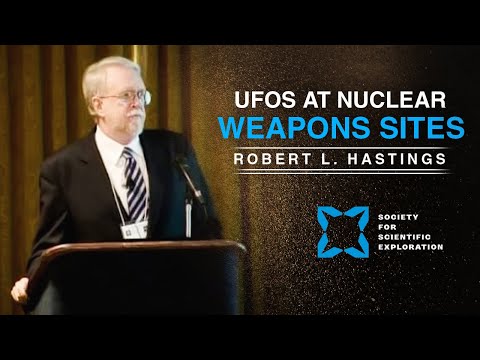
UFOs at Nuclear Weapons Sites | Robert L. Hastings
Society for Scientific Exploration — A recorded talk in which Hastings presents his decades of nuclear-site interview research directly, covering much of the same case material as the book. Verified via YouTube oEmbed before inclusion.
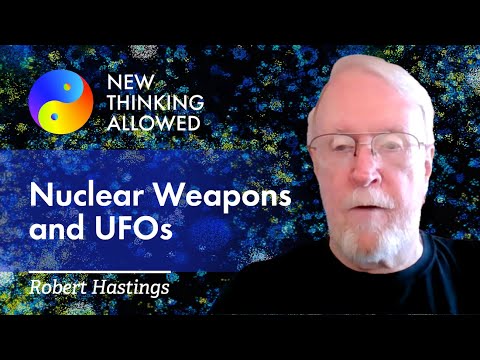
Nuclear Weapons and UFOs with Robert Hastings
New Thinking Allowed with Jeffrey Mishlove — An extended interview with Hastings discussing the UFO-nuclear weapons connection his book documents, including the 2010 National Press Club press conference. Verified via YouTube oEmbed before inclusion.
Sources Cited
- Hastings, Robert L. UFOs & Nukes: Extraordinary Encounters at Nuclear Weapons Sites. 2nd ed., CreateSpace Independent Publishing Platform, 2017 (ISBN 1544822197 / 9781544822198, cited here, matching this site's own resources library citations). amazon.com
- "UFOs & Nukes: Extraordinary Encounters at Nuclear Weapons Sites." AbeBooks (CreateSpace, 2017 2nd ed., ISBN 9781544822198, 598 pages, bibliographic record). abebooks.com
- "Robert Hastings (ufologist)." Wikipedia (biography: birth date, education, career, Malmstrom origin story, book editions, 2016 documentary, Benjamin Radford criticism). en.wikipedia.org
- "About." ufohastings.com, official Robert Hastings website (research career summary, 150+ interviews, four decades, 500+ colleges and universities, National Press Club press conference). ufohastings.com
- "The UFOs-Nukes Connection Press Conference." ufohastings.com (author's own account of the September 27, 2010 National Press Club event, participants, and distributed documentation). ufohastings.com
- "Researcher Urges U.S. Military Veterans to Divulge Their UFO Sightings at Nuclear Weapons Sites." PR Newswire, 2010 (press conference announcement and framing). prnewswire.com
- Mount, Mike. "Ex-Air Force personnel: UFOs deactivated nukes." CBS News, September 27, 2010 (press conference coverage: Robert Salas, Robert Jamison, Charles Halt testimony; Pentagon response). cbsnews.com
- Radford, Benjamin. "Did UFOs Disarm Nuclear Weapons? And If So, Why?" Live Science, 2010 (skeptical critique of the National Press Club press conference claims). livescience.com
- "UFOs & Nukes: Extraordinary Encounters at Nuclear Weapons Sites by Robert L. Hastings." Goodreads (reader ratings and reviews: 4.35-star average, 329 ratings, 40 reviews). goodreads.com
- "UFOs and Nukes by Robert Hastings book review." darkstar1.co.uk (independent reader review of the book's length, density, and cumulative case-by-case effect). darkstar1.co.uk
- "UFOs and nukes. Extraordinary encounters at nuclear weapons sites" / "UFOs und Atomwaffen." International Nuclear Information System (INIS), International Atomic Energy Agency (record of the 2015 Kopp Verlag German-language edition, subject classification, record no. 46130842). inis.iaea.org
- This site's own resources library: Full Reading List, where this exact edition (ISBN 1544822197) is cited across 12 case-file and theory pages.
- This site's own case file: The Malmstrom AFB Missile Shutdowns, which credits this book directly with consolidating decades of Malmstrom personnel interviews.
- This site's own case file: Loring AFB Nuclear Storage Area, which situates its 1975 incidents within this book's broader Northern Tier thesis.
- This site's own case file: F.E. Warren AFB Nuclear Silo Intrusion, for the book's treatment of the 1965 sighting wave and later 1970s incidents.
- This site's own key-figures entry: Robert Hastings, for his full biography and further case connections.
- This site's own key-figures entry: James Carlson, for the documented internal dispute over the book's Echo Flight witness testimony.
Have corrections, additional research, or peer-reviewed sources? Help improve this entry.
Suggest an Edit