
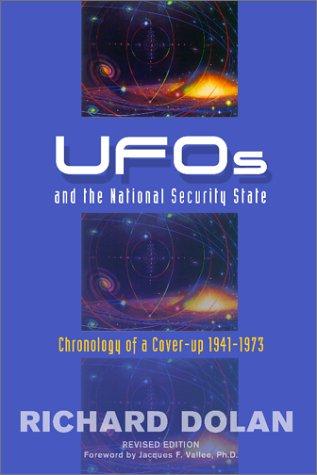
UFOs and the National Security State
Chronology of a Cover-up, 1941–1973
Core Thesis
The U.S. government's seven-decade relationship with the UFO subject is best understood not as scattered incompetence but as a genuine, sustained pattern of institutional secrecy — the ordinary, well-documented behavior of a Cold War national-security apparatus (compartmentalized classification, inter-agency turf control, public-relations management of embarrassing data) applied to a phenomenon the military and intelligence establishment took seriously enough, internally, to hide the extent of its own interest from the public it nominally served.
About the Author
Richard M. Dolan was born on July 1, 1962, in Brooklyn, New York. He earned a B.A. in English and history from Alfred University in 1984, then an M.A. in history from the University of Rochester in 1995, with additional study in political ideologies at Exeter College, Oxford. His graduate work focused on German and Soviet Cold War studies — he researched Otto von Bismarck's spy chief before shifting his dissertation to Harry Truman and the newly formed National Security Council — training in archival, primary-source historical method that he later applied directly to the UFO file.
Dolan has described leaving academia shortly after finishing his graduate work rather than pursuing a doctorate, and supported himself in Rochester, New York while researching and writing this book largely on his own initiative. He self-published the result in April 2000 through his own imprint, Keyhole Publishing, under the title UFOs and the National Security State: An Unclassified History, Volume One: 1941–1973 — a 544-page, heavily footnoted chronology built from declassified documents, FOIA releases, and contemporaneous press coverage. Hampton Roads Publishing picked up the book for a wider release in July 2002, reissuing it in a revised, 478-page paperback under the title used on this site, Chronology of a Cover-up, 1941–1973, with a new foreword contributed by longtime UFO researcher Jacques F. Vallée.
Dolan followed this volume with UFOs and the National Security State: The Cover-Up Exposed, 1973–1991 in 2009, extending the same declassified-document chronology to the end of the Cold War and completing the two-volume project his first book began. He also co-authored the speculative A.D. After Disclosure: The People's Guide to Life After Contact (2010, with television writer-producer Bryce Zabel) and wrote UFOs for the 21st Century Mind (2014). He founded Richard Dolan Press to continue publishing in the field and, since 2012, has hosted The Richard Dolan Show, a weekly two-hour program on KGRA Radio; he is also a frequent guest on Coast to Coast AM and has spoken at events including the 2017 International UFO Congress and the 2018 Ozark Mountain UFO Conference.
Dolan has consistently framed his own approach as that of a trained historian working from documentary evidence rather than a ufologist arguing a personal theory of what UFOs are — a positioning this book's extensive footnoting and declassified-source method was built to support, and one later writers doing similar archival work on the subject, including this site's other Essential Reading author Garrett M. Graff, have implicitly followed.
Historical Context & Origins
When Dolan began writing in the 1990s, no single-volume history of the American UFO subject had yet been built primarily from declassified government records assembled chronologically and cross-referenced against contemporaneous press coverage. The genre's existing landmark books — Edward Ruppelt's insider account, Donald Keyhoe's advocacy series, and later Timothy Good's internationally sourced Above Top Secret (1987) — were each built substantially on personal testimony, correspondence with military and intelligence sources, and (in Good's case) the still-unresolved Majestic 12 documents controversy that had split the field since 1987. Dolan's project was narrower and more archival by design: build the record almost entirely from paper — FOIA releases, declassified memos, congressional testimony, and the newspaper coverage each incident actually generated at the time.
That method traced directly back to his own graduate training. Dolan's University of Rochester coursework in Cold War strategy, Soviet studies, and his dissertation research on Truman's National Security Council gave him a working knowledge of exactly the bureaucratic machinery — classification systems, inter-agency rivalry, compartmentalized "need to know" access — that his book would go on to argue best explained the government's UFO secrecy, without requiring that secrecy to prove any specific claim about what the objects themselves were.
Dolan self-published the book's first edition through his own Keyhole Publishing in April 2000 as An Unclassified History, Volume One: 1941–1973, working largely outside the existing ufological publishing establishment. Its 2002 pickup by Hampton Roads Publishing — retitled Chronology of a Cover-up and given a foreword by Jacques Vallée, whose own decades of UFO writing had by then made him one of the field's most respected figures — gave the book wider retail distribution and the two-word subtitle change (from clinical "unclassified history" to the more pointed "cover-up") that has defined its public identity ever since.
The book arrived into a UFO-research landscape still recovering from the MJ-12 fight of the late 1980s and largely dismissed by mainstream science since the Condon Report's 1969 conclusion. Dolan's explicit ambition — a documentary chronology rather than a witness-testimony narrative — was itself a response to that landscape: an attempt to give the cover-up thesis a foundation skeptics could at least argue with on paper-trail terms, rather than dismiss as anecdote.
Core Arguments & Key Concepts
The book runs chronologically from 1941 through 1973, tracing the U.S. military and intelligence community's engagement with unidentified aerial phenomena from the wartime "foo fighter" reports through the early Cold War UFO waves, the creation and repeated renaming of the Air Force's investigative apparatus (Project Sign, Project Grudge, and finally Project Blue Book), and on to the Condon Report and Blue Book's December 1969 closure. Along the way Dolan documents UFO-related activity connected to more than fifty military installations and repeated incidents of unidentified craft violating sensitive American airspace, built case by case from declassified Air Force, FBI, and CIA records.
Dolan's central historical claim is that this record shows sustained, serious internal military and intelligence interest in the UFO subject running directly alongside a public-facing posture of official dismissal — and that the gap between those two postures, not any single dramatic disclosure, is the actual "cover-up" the book's title names. He is explicit in the book's introduction that he uses the phrase "national security state" as a structural term for the military-intelligence apparatus and the contractors and "underground, nebulous entities" that depend on it, arguing its defining traits are "secrecy, wealth, independence, power, and duplicity" — a framing that positions UFO secrecy as one instance of a much broader pattern of Cold War institutional concealment rather than a unique, isolated deception.
The book gives particular weight to the CIA-convened Robertson Panel of January 1953 and the University of Colorado's Condon Report of 1966–1968 as the two moments Dolan argues did the most lasting institutional damage — the former for recommending a public-education and "debunking" program to reduce UFO reports rather than investigate them further, the latter for supplying the Air Force the scientific cover it needed to close Project Blue Book in 1969 and remove the subject from mainstream institutional science for decades. Dolan also traces the parallel rise of civilian anti-secrecy organizations such as NICAP through the 1950s and 1960s, arguing their momentum was deliberately curtailed by changing government press-relations policy under the Nixon administration.
On the specific claims that made earlier cover-up literature controversial, Dolan is notably more cautious than reviewers sometimes assume: on Roswell he concludes the case "has offered hope to those seeking to prove a UFO cover-up, but has yet to deliver the goods," and on the Majestic 12 documents — still disputed when he was writing — he acknowledges plainly that "most UFO researchers now believe the MJ-12 documents are fake," while devoting several pages to who he believes may have fabricated them and why.
A recurring, more idiosyncratic argument runs through the book's treatment of individual researchers: Dolan argues at length that Donald Keyhoe, the retired Marine Corps major whose 1950s bestsellers first popularized the extraterrestrial hypothesis, was "the most important UFO researcher, ever," and expresses puzzlement that later UFO researchers "almost never footnote his books" — a strong claim about Keyhoe's underappreciated centrality to the field that several reviewers have treated as one of the book's more debatable interpretive judgments rather than a straightforward documentary finding.
Key Cases & Evidence Discussed
The Foo Fighters (Case #160, 1944–1945) open the book's chronology, situated as the earliest military-observed aerial anomalies predating the postwar "flying saucer" era and establishing, in Dolan's account, that the phenomenon and organized military interest in it are older than 1947.
The Kenneth Arnold sighting (Case #007, June 1947) and the Roswell Incident (Case #001, July 1947) anchor the book's opening postwar chapters, with Dolan treating the debris recovered near Roswell Army Air Field relatively cautiously among cover-up-thesis authors of his era — presenting it as suggestive but, in his own words, a case that "has yet to deliver the goods" as proof of extraterrestrial wreckage.
The Washington, D.C. UFO Flap (Case #015, July 1952) receives extended treatment as the book's central Cold War set-piece: twin radar-and-visual incidents over the nation's capital, an Air Force press conference forced by the scale of public and press attention, and the immediate institutional aftermath Dolan traces directly into the Robertson Panel's formation the following January.
The Robertson Panel (Case #226, January 1953) is one of the book's two pivotal institutional case studies — Dolan reads the CIA-convened scientific panel's recommendation to reduce public UFO interest through education and "debunking" as the moment official policy shifted from investigation toward active public-relations management of the subject.
The Condon Report (Case #227, 1966–1968) closes out the book's core institutional narrative as its second pivotal case study — the University of Colorado study whose conclusions gave the Air Force the scientific justification to close Project Blue Book in December 1969, ending official U.S. government UFO investigation for decades.
Critical Reception & Controversies
The book's reception split sharply along the same believer/skeptic lines that have shaped ufology's reception of nearly every cover-up-thesis book on this list. On the enthusiastic end, Silicon Valley entrepreneur Joe Firmage promoted it in a widely circulated December 2001 internet message predicting it was "likely to be ranked one day among the great works of investigative journalism" and calling it "a book that every student of science, government, philosophy and history must read." Physicist Bernard Haisch, a former longtime editor of the Society for Scientific Exploration's journal, listed it among his recommended UFO books on his own "ufoskeptic.org" site — notably, a list that otherwise included no book by an actual skeptical UFO investigator, illustrating how thoroughly the book was embraced within believer and "open-minded scientist" circles rather than by working skeptics.
The most substantive skeptical critique came from Philip J. Klass, the longtime aviation journalist and UFO skeptic, in his Skeptics UFO Newsletter (SUN #71, Spring 2002). Klass focused on specific documentary omissions rather than dismissing the project wholesale: he noted that Dolan's account of the 1950 McMinnville, Oregon UFO photographs (p. 452) quotes Condon-era investigator William K. Hartmann's early, qualified assessment of the images without informing readers that Hartmann later revised that judgment after studying a follow-up investigation by skeptic Robert Sheaffer, concluding Sheaffer's work "removes the McMinnville case from consideration as evidence for the existence of disk-like artificial aircraft." Klass also quoted Dolan's one-line dismissal of Sheaffer's identification of the planet Venus as the likely explanation for Jimmy Carter's 1969 sighting — "the only analysis of the incident was offered by debunker Robert Sheaffer, who established the presence of Venus in that part of the sky. To which one answers: so?" — as an example of the book engaging skeptical findings rhetorically rather than substantively.
Klass additionally flagged passages he considered under-sourced relative to the book's otherwise heavy footnoting, including an anecdote about President Eisenhower being "horrified" by what he learned about the Strategic Air Command's nuclear retaliatory plan in his final year in office, for which Klass found no supporting citation in the text. Klass also took issue with the overtly political framing of Dolan's introduction, which describes America as "a country with a bad conscience... in reality an empire and oligarchy" governed by institutions that are "conspiratorial by nature" — language Klass argued revealed the ideological lens shaping Dolan's reading of the UFO evidence, going so far as to compare the rhetoric unfavorably to that of contemporary anti-American extremists, a sign of how personally at least one leading skeptic took the book's framing.
Reception among ufology-focused reviewers and general readers has been considerably warmer and has held up over two decades. A 2016 review on the blog The Breakaway praised Dolan for having "brought credibility to UFOlogy" through meticulous footnoting of sources, concluding "everyone should read this book" regardless of prior belief. A 2023 review of the audiobook edition rated it 4.5 stars, calling its chronological organization "fantastic" while noting a tendency to "drift off-topic" as its main weakness. On Goodreads the book holds a 4.27-out-of-5 average across more than 500 ratings, with readers consistently citing its declassified-document sourcing as the reason it reads as more credible than typical genre entries, alongside occasional complaints that its exhaustive case-by-case structure "gets boring quickly" for readers already familiar with the history.
Influence & Legacy
The book's most direct legacy is structural: it launched a two-volume project Dolan completed nine years later with The Cover-Up Exposed, 1973–1991 (2009), and the pair together are now routinely described in ufology bibliographies as the field's standard chronological reference for the Cold War period — the book other researchers cite for a documented timeline rather than argue with as a theory.
The book also functioned as the foundation of Dolan's subsequent career as a full-time UFO researcher and media figure: he has hosted the weekly Richard Dolan Show on KGRA Radio since 2012, appears regularly on Coast to Coast AM, and became one of the more visible independent commentators covering the 2023–2024 congressional UAP hearings in real time for his own audience — a role built directly on the documentary credibility this first book established nearly a quarter-century ago.
On this site specifically, this exact edition already functions as a working secondary source: it is cited across resources.html in connection with the Robertson Panel, UFO sightings over Morocco and French West Africa, and the Vranov nad Dyjí helicopter incident, reflecting its usefulness as a general-purpose Cold War-era reference alongside this site's other Essential Reading titles — Above Top Secret for the same period's international angle and UFO: The Inside Story for the decades since.
Unlike Garrett Graff's 2023 book, this one never crossed over into mainstream press review coverage — there is no Kirkus, Publishers Weekly, or Washington Post notice of it on record, and its reception has remained almost entirely internal to ufology's own believer and skeptic communities. That narrower reach has not diminished its staying power within the field: it remains in print in audiobook and paperback editions more than two decades after its original 2000 publication, still selling and still generating new reader reviews, functioning today as a canonical reference text rather than a book whose relevance has faded with time.
The Book
As an Amazon Associate, OverClassified may earn from qualifying purchases made through this link, at no extra cost to you.
Why This Is Essential Reading
UFOs and the National Security State earns its place on this list as the first attempt to build a UFO cover-up chronology almost entirely from declassified documents and contemporaneous press records rather than witness testimony — a genuinely more disciplined method than most of the genre it entered, produced by an author whose Cold War historical training shows throughout the book's footnotes. Its reception exposes exactly the fault line that runs through this entire reading list: enthusiastic, sometimes uncritical embrace from within ufology (Joe Firmage's prediction it would rank among "the great works of investigative journalism" is one of this list's more overreaching blurbs) against pointed, specific skeptical pushback from critics like Philip Klass, who found real, documented instances of the book engaging inconvenient skeptical findings rhetorically rather than substantively. Read it for what its method actually accomplished — a citable, chronological paper trail for the Cold War-era pattern of military and intelligence interest in the subject — and weigh its more sweeping claims, particularly around Donald Keyhoe's centrality and the book's own ideologically charged framing of American power, with the same documentary skepticism Dolan brings to the government record itself.
Related Cases & Theories
Essential Viewing
UFOs and the National Security State - Richard Dolan LIVE
UFO CENTRAL — A recorded live presentation by Dolan walking through the book's central argument and its declassified-document method.
Richard Dolan Explains Blue Book. Ep. 1: The Gorman Dogfight
Richard Dolan Intelligent Disclosure — Dolan's own video series unpacking Project Blue Book case files, directly extending the institutional history this book first chronicled.
Sources Cited
- "Richard M. Dolan." HandWiki (Wikipedia mirror, biographical summary). handwiki.org
- "Richard M. Dolan." Wikidata. wikidata.org
- "UFOs and the National Security State: Chronology of a Coverup, 1941-1973." Amazon.com (Hampton Roads Publishing, 2002 ed., ISBN 9781571743176). amazon.com
- "UFOs and the National Security State." Open Library (Hampton Roads Publishing Company, July 2002 edition record). openlibrary.org
- "UFOs and the National Security State: An Unclassified History, Volume 1: 1941-1973." Amazon.com (Keyhole Publishing, 2000 first ed., ISBN 9780967799506). amazon.com
- Klass, Philip J. "Firmage Praises UFO-Coverup Views in Dolan's Recent Book." Skeptics UFO Newsletter (SUN), Issue 71, Spring 2002 (archived copy). web.archive.org
- "Book Review: UFOs & The National Security State – Chronology Of A Cover Up [Volume 1] – By Richard Dolan." The Breakaway (independent blog review), June 13, 2016. thebreakaway.wordpress.com
- "Book Review: UFOs and the National Security State by Richard M. Dolan." oceanwriterreads (independent blog review, audiobook edition), August 25, 2023. oceanwriterreads.com
- "UFOs and the National Security State: Chronology of a Coverup, 1941-1973." Goodreads (reader ratings and review aggregation). goodreads.com
- "The Richard Dolan Show." KGRA Digital Broadcasting (official show page, hosting since 2012). kgradb.com
- "Richard Dolan." Coast to Coast AM (official guest page). coasttocoastam.com
- "UFOs and the National Security State: The Cover-Up Exposed, 1973-1991." Amazon.com (Volume Two, 2009, listed for the sequel's bibliographic continuity). amazon.com
- This site's own case file: The Roswell Incident, for the case this book treats with notable caution relative to its genre.
- This site's own case file: The Robertson Panel, for the 1953 panel this book identifies as a key turning point toward official debunking policy.
- This site's own case file: The Condon Report, for the 1966–1968 study this book identifies as the cause of Project Blue Book's 1969 closure.
- This site's own key-figures entry: Richard Dolan, for his full biography and case connections.
Have corrections, additional research, or peer-reviewed sources? Help improve this entry.
Suggest an Edit