
Kenneth Arnold Sighting
The historic June 24, 1947, encounter that coined the phrase "flying saucer" and triggered the modern era of UAP sightings.
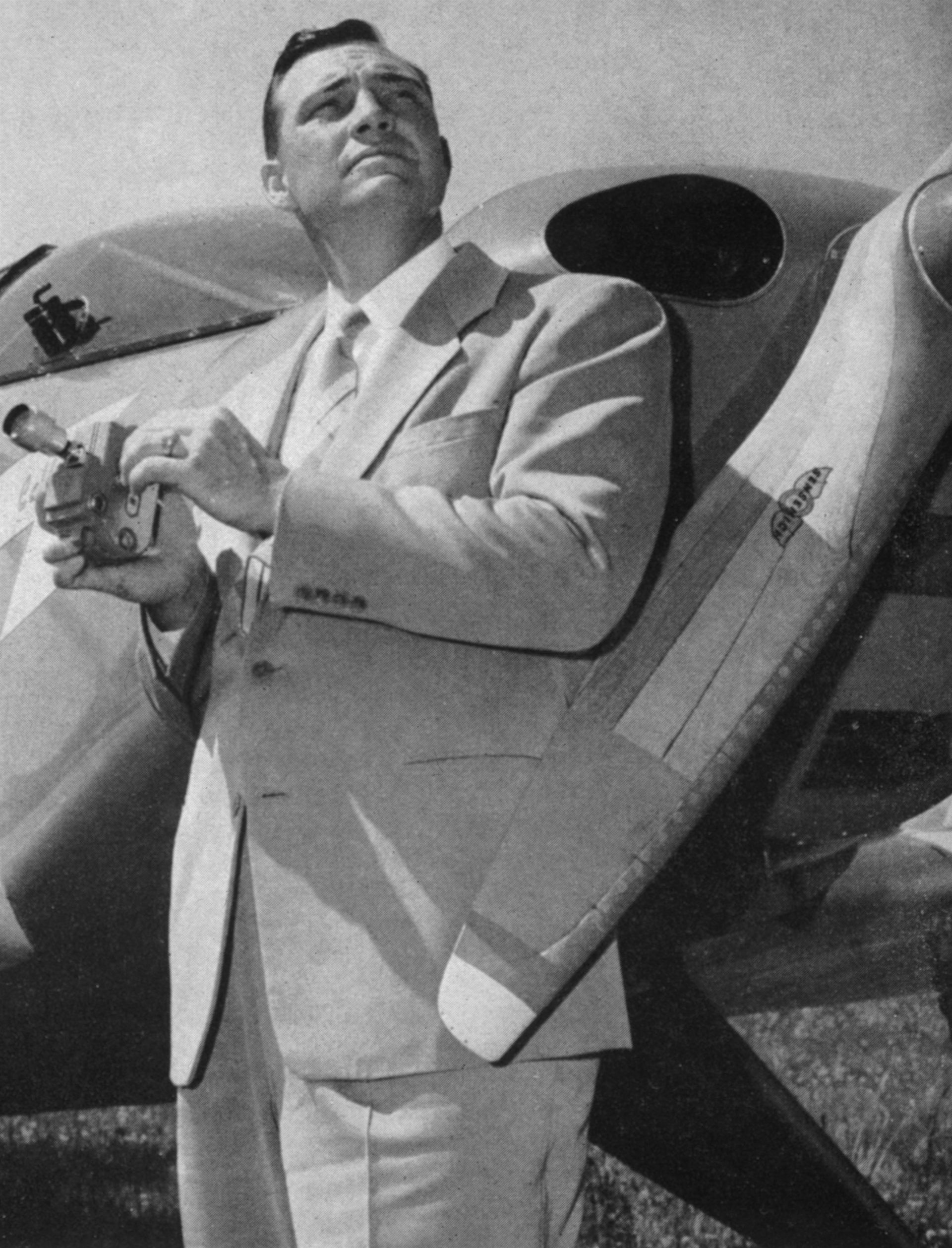
Pictured: Kenneth Arnold with the CallAir A-2 he was flying near Mount Rainier on June 24, 1947, holding a movie camera. He had no camera during the sighting; in early July 1947 he told the AP he had bought one and would carry it on every flight. AP wire photo, July 8, 1947.
Theoretical Alignment
The Kenneth Arnold sighting of June 24, 1947, is one of the most significant cases in UFO history and one of the hardest to classify. It began the modern UFO era without proving anything about what UFOs are. Arnold was an experienced private pilot, and his first assumption was that he was watching some new kind of jet. He timed the formation between Mount Rainier and Mount Adams and got a speed of about 1,700 mph, which he cut to a "conservative" 1,200 mph. Either figure was about twice the world air-speed record of the day (623.7 mph, set by a P-80R five days earlier). The objects had no visible tails, flew in a long echelon and flipped and flashed in the sun. On his figures, nothing in any air force could have done that, and that is the basis of the case's extraterrestrial alignment. But the figures depend on his estimate of distance, which has been disputed since 1948, and the Air Force filed the case as a mirage.
Complete Timeline
| Date | Event | June 21, 1947 |
|---|---|
| June 21, 1947 | Date of the sighting later claimed by Harold Dahl: six doughnut-shaped craft over Maury Island, one dropping slag-like debris. The claim was not made public until after Arnold's sighting. |
| June 24, 1947 | Arnold leaves Chehalis about 2 PM, detours to search for a Marine C-46 lost near Mount Rainier, and at 2:59 PM by his panel clock sees nine objects pass Mount Rainier heading south. He times them to Mount Adams at 1 min 42 s. He lands at Yakima and tells Al Baxter, then flies on to Pendleton, Oregon. |
| June 25, 1947 | Reporters Bill Bequette and Nolan Skiff of the East Oregonian run a 191-word story ("nine saucer-like aircraft... about 1,200 miles an hour"), which goes out on the AP wire. |
| June 26, 1947 | Headline writers coin "flying saucer"; the Chicago Sun runs "Supersonic Flying Saucers Sighted by Idaho Pilot." Arnold gives a radio interview on KWRC, Pendleton. |
| July 4, 1947 | United Air Lines Flight 105 crew (Capt. E. J. Smith, First Officer Ralph Stevens) report two groups of flat objects shortly after leaving Boise. |
| July 12, 1947 | Arnold is interviewed in Boise by Lt. Frank M. Brown (CIC, Fourth Air Force) and Capt. William Davidson, and gives them a written report with a drawing. Brown's memo of July 16 concludes that "Mr. Arnold actually saw what he stated that he saw." |
| July 28–31, 1947 | Amazing Stories editor Raymond Palmer wires Arnold $200 to investigate Maury Island. Arnold interviews Dahl in Tacoma and calls in Brown and Davidson, who collect fragments. |
| August 1, 1947 | In the early hours, the B-25 carrying Brown and Davidson back to California crashes near Kelso, WA, killing both officers. The FBI later concludes that the Maury Island story was a hoax. |
| September 23, 1947 | Lt. Gen. Nathan Twining's memo states that "the phenomenon reported is something real and not visionary or fictitious" and recommends a formal study. |
| Spring 1948 | The first issue of Palmer's Fate carries Arnold's "I Did See the Flying Disks!" |
| 1949 | J. Allen Hynek's evaluation, appended to the Project Grudge final report, argues the objects must have been much closer than Arnold thought and therefore subsonic. The Air Force file (Project Blue Book Incident #17) concludes "mirage." |
| 1952 | Arnold and Palmer publish The Coming of the Saucers. |
| January 16, 1984 | Arnold dies in Bellevue, Washington, aged 68. |
The Narrative
On June 24, 1947, Kenneth Arnold, a Boise businessman who sold fire-suppression equipment, was flying his CallAir A-2 from Chehalis to Yakima, Washington, on his way to an air show in Pendleton, Oregon. He was an experienced private pilot and a member of an Idaho search-and-rescue unit. He detoured to look for a Marine Corps C-46 transport that had crashed with 32 Marines aboard near Mount Rainier on December 10, 1946; there was a $5,000 reward for finding it. Having given up the search near Mineral at about 9,200 feet, he wrote, "a bright flash reflected on my airplane." Then, "to the left and the north of Mt. Rainier... I observed a chain of nine peculiar looking aircraft flying from north to south at approximately 9,500 foot elevation and going, seemingly, in a definite direction of about 170 degrees" (Arnold, report to the AAF, July 1947).
He assumed at first that they were jets, but "I couldn't find their tails." They flew "in a rather diagonal chain-like line as if they were linked together," swerving "in and out of the high mountain peaks," and two or three at a time would "dip or change their course slightly, just enough for the sun to strike them at an angle that reflected brightly on my plane." He judged them 20 to 25 miles away. He used his panel clock to time them from the southern edge of Mount Rainier, which the first object passed at "one minute to 3 P.M.," to the southernmost crest of Mount Adams, which the last passed one minute 42 seconds later. Rainier to Adams is about 47 miles, which gives roughly 1,700 mph. Arnold, unsure exactly where they had faded from view, rounded this down to a "conservative" 1,200 mph. He watched for a total of about two and a half to three minutes. To rule out reflections, he said, he turned sideways, opened his window and watched them "with a completely unobstructed view."
He landed at Yakima and told his friend Al Baxter, who "in a joking way didn't believe me," then flew on to Pendleton. There, on June 25, he talked to reporters Bill Bequette and Nolan Skiff of the East Oregonian. Their short story, which went out on the AP wire, described "nine saucer-like aircraft flying in formation" at "about 1,200 miles an hour." The East Oregonian itself never used the phrase "flying saucer"; headline writers elsewhere coined it within a day (Wright, East Oregonian, 2017; Lee, NASM, 2022). Hundreds of similar reports followed over the next few weeks, a wave that included the Roswell announcement of July 8.
The Maury Island Connection
Harold Dahl, who described himself as a harbor patrolman, later claimed that on June 21, 1947, three days before Arnold's sighting, he had seen six doughnut-shaped craft over Maury Island, Washington, one of which dropped slag-like debris onto his boat. Raymond Palmer, then editor of Amazing Stories, wired Arnold $200 on July 28 to fly to Tacoma and investigate. Fate did not exist until 1948.
Arnold brought in United Air Lines Captain E. J. Smith, and then called Lt. Frank Brown and Capt. William Davidson of Fourth Air Force intelligence at Hamilton Field, California (Brown and Davidson). The two officers interviewed Dahl and his associate Fred Crisman, took fragments and flew out of McChord Field. In the early hours of August 1, 1947, after one of its engines caught fire, their B-25 crashed near Kelso, Washington, killing both men; the crew chief and a passenger parachuted to safety (contemporary reports, as summarized by later sources). The FBI then investigated and concluded that the story was a hoax; it recorded Dahl saying that if questioned by the authorities he would call it a hoax to avoid further trouble. Ruppelt later called it "the dirtiest hoax in the UFO history." The deaths nonetheless fed some of the earliest cover-up theories (Ruppelt 1956; Wikipedia, "Maury Island incident," as pointer to the FBI file).
Evidence & Debate
Supporting Points & Corroboration
- Pilot Credibility: Arnold was an experienced private pilot (about 4,000 hours, per the Smithsonian) who flew his own plane on business across the Northwest. The Army CIC agent who interviewed him in July 1947 believed he "actually saw what he stated that he saw."
- Other Witnesses: Prospector Fred Johnson, on Mount Adams, wrote to the Army Air Forces that at about 3 PM he saw "five or six" round objects tapering to a point, one of which he watched through a telescope. Blue Book carried his report (Incident #37) as unexplained. A fire lookout south of Yakima also reported flashes over Rainier at 3 PM.
- Flight Speed Calculation: Arnold timed the formation between Mount Rainier and Mount Adams on his instrument-panel clock (1 min 42 s), implying about 1,700 mph; he gave 1,200 mph as a conservative figure.
Contradicting Points & Skeptics
- Optical Illusion: Donald Menzel offered several explanations over the years: snow blown off the ridges (1953), orographic or wave clouds (1963) and water spots on the windows (1971). The Air Force file concluded "mirage."
- Calculated Distance Errors: J. Allen Hynek argued in 1949 that the objects must have been much closer, perhaps six miles away, and so subsonic (about 400 mph), and could have been aircraft. Others have proposed American white pelicans (James Easton, 2000) or meteor fireballs (Philip Klass, 1997).
- Maury Island Slag: The FBI concluded the Maury Island story was a hoax, and Arnold's involvement in it was later used to question his judgment, though it postdated his own sighting.
Arnold’s Subsequent Investigations and Maury Island
Kenneth Arnold’s brush with the Maury Island affair shows how quickly he was drawn from witness into investigator. Palmer, the Amazing Stories editor whom Arnold said he had never heard of, approached him in July 1947 about two Tacoma men, Harold Dahl and Fred Crisman. They claimed to have seen flying discs over Maury Island in Puget Sound and to hold fragments that had fallen from one. Arnold flew to Tacoma on July 29, interviewed Dahl, and brought in Capt. E. J. Smith of United Air Lines. Smith and Arnold thought the "white metal" Crisman showed them looked mundane and did not match Dahl's description (Wikipedia, "Maury Island incident," as pointer).
Arnold then called Lt. Frank Brown and Capt. William Davidson, the officers who had interviewed him in Boise. They flew to Tacoma, talked to the men, took a box of fragments and left that night from McChord Field. The B-25 crashed near Kelso early on August 1, 1947, killing both officers. In The Report on Unidentified Flying Objects (1956), Edward Ruppelt wrote that the government had seriously considered prosecuting Dahl and Crisman. It decided not to, he said, because the hoax was "a harmless joke that had mushroomed" and the deaths could not be blamed directly on them.
The Maury Island affair has been investigated for decades, and the consensus, including the FBI's at the time, is that the account was fabricated. The deaths of Davidson and Brown, two intelligence officers who had just collected the "evidence," have nonetheless fed persistent conspiracy theories. Arnold devoted much of The Coming of the Saucers (1952) to the episode. Its relevance to his own sighting is indirect: his report was made, published and investigated before he ever heard of Dahl.
The Air Force’s Investigation and Project Sign
The Air Force's first formal UFO project, Project Sign, was ordered at the end of December 1947 and began work in January 1948 at the Air Materiel Command, Wright Field (now Wright-Patterson AFB). It followed Twining's September 1947 recommendation and the whole summer wave, not Arnold's report alone. Before Sign existed, the Army Air Forces had already looked at Arnold. Lt. Frank M. Brown of the Fourth Air Force CIC interviewed him in Boise on July 12, 1947, and Arnold gave him a written report and a drawing. Brown's memo of July 16 is the first official assessment: "It is the personal opinion of the interviewer that Mr. Arnold actually saw what he stated that he saw." Brown added that "if Mr. Arnold can write a report of the character that he did while not having seen the objects that he claimed he saw... he should be writing Buck Rogers fiction." He also noted that after checking an aeronautical chart, the distances, speed, course and size Arnold gave "could very possibly be facts" (CIC memo, Incident 4AF 1208 I, 16 July 1947).
Project Sign and its successor reached different conclusions. Ruppelt, who headed Blue Book from 1951, described Sign's staff as split into two factions. One said Arnold had seen "plain, everyday jet airplanes flying in formation"; the other noted that Arnold "knew where the objects were when he timed them." Sign's astronomy consultant, J. Allen Hynek, argued that Arnold's own estimate of their size was inconsistent with his estimate of distance. The objects, Hynek concluded, must have been much closer, about six miles away, and therefore moving at a subsonic 400 mph or so, which would make conventional aircraft possible. His evaluation was printed as an appendix to the Project Grudge final report in 1949. Martin Shough's 2010 analysis argues that Hynek relied on a garbled Air Force summary of Arnold's size estimate ("45 to 50 ft") and on a mistaken measure of visual acuity, and that nothing in Arnold's report is internally inconsistent (Shough 2010).
The Air Force did not leave the case open. The Project Blue Book file (Incident #17) states: "It is the Air Force conclusion that the objects of this sighting were due to a mirage" (as quoted by Shough 2010). Bruce Maccabee points out an oddity. Fred Johnson's sighting from Mount Adams, logged a minute or so after Arnold's, is the first of the 701 cases Blue Book still carried as unexplained when it closed in 1969, while Arnold's own case was carried as explained (Maccabee, via NICAP). Grudge succeeded Sign in February 1949, and Blue Book ran from 1952 to 1969.
Cultural Impact and the Flying Saucer Mythology
Kenneth Arnold’s sighting created a cultural phenomenon that outlasted him. The phrase “flying saucer” came from newspaper headline writers, not from the East Oregonian reporters who first wrote up his story. Herbert Strentz's 1970 study of the coverage, cited by Jerome Clark, concluded that the term probably came from an editor or headline writer. Arnold later insisted he had compared the objects' motion, not their shape, to a saucer skipped across water. The earliest stories, though, quote him calling them “saucer-like,” “flat like a pie-pan and somewhat bat-shaped,” and, on Pendleton radio on June 26, “something like a pie plate that was cut in half with a sort of a convex triangle in the rear” (Wikipedia, “Kenneth Arnold UFO sighting,” as pointer to Bequette and the KWRC recording; Lee, NASM, 2022). By June 26 and 27 “flying saucer” and “flying disc” were in papers across the country.
The image that grew from Arnold's report shaped how later witnesses described what they saw, and how films showed it. The flying saucers of 1950s science fiction, from The Day the Earth Stood Still (1951) to Earth vs. the Flying Saucers (1956), drew on the saucer imagery of the 1947 wave. That imagery was round, even though Arnold's own drawing for the Army Air Forces showed something closer to the heel of a shoe: a rounded leading edge and a shallow point at the back. The National Air and Space Museum notes the drawing's resemblance to the Navy's experimental Vought V-173 “Flying Pancake” (Lee, NASM, 2022). The popular template both sustained public interest and complicated the analysis of later reports.
The Intelligence Community’s Initial Assessment
The Army Air Forces took the summer's reports more seriously in private than in public. On September 23, 1947, Lt. Gen. Nathan Twining, commanding the Air Materiel Command, replied to a request from Brig. Gen. George Schulgen with a memo on “Flying Discs.” It concluded that “the phenomenon reported is something real and not visionary or fictitious.” It also said that the reported climb rates, maneuverability and evasive behavior suggested some of the objects were controlled. It was not a finding that the objects were beyond human technology. The same memo allowed that some reports might be natural phenomena such as meteors and said due consideration must be given to the possibility that the objects were of domestic origin. It added that it was possible “within the present U.S. knowledge,” given extensive development, to build a piloted aircraft of the general description reported. It recommended a formal study, and that led to Project Sign. The memo was first published in the Condon Report in 1969.
The FBI also became involved that July. A memo of July 10, 1947, from Clyde Tolson to D. M. Ladd, records an Army request for Bureau help with disc reports. J. Edgar Hoover's comment on it reads, in the usual transcription: “I would do it but before agreeing to it we must insist upon full access to discs recovered. For instance in the La. case the Army grabbed it and would not let us have it for cursory examination.” The case is not redacted. It is written “La.” (some transcriptions read “IA”) and is generally taken to mean a disc found in Louisiana in early July 1947 that turned out to be a hoax. It is not evidence of a recovered craft from Roswell or anywhere else. On July 12 FBI agents interviewed Arnold and Captain Smith (Wikipedia, “Flight 105 UFO sighting,” as pointer; FBI file reproductions).
Project Sign’s Estimate of the Situation
Project Sign’s “Estimate of the Situation,” produced in 1948, reportedly concluded that the discs were interplanetary. It is one of the most discussed and least documented items in UFO history. No copy is known to exist publicly. What is known comes mainly from Captain Edward Ruppelt, who joined the Air Force's UFO project in 1951 and later headed Project Blue Book. In The Report on Unidentified Flying Objects (1956), he wrote that the Estimate went up to Chief of Staff Gen. Hoyt Vandenberg, who rejected it for lack of proof, and that it was later declassified and burned, although he said he had seen one surviving copy.
If Ruppelt's account is accurate, Vandenberg's rejection set the Air Force's posture for the next two decades: reports were to be explained, not treated as evidence of visitors. Proponents read the episode as suppression. Skeptics read it as a senior officer declining to accept a conclusion unsupported by physical evidence. Either way, the Estimate is not evidence about Arnold's sighting in particular. It is not known whether it relied on his case, and the Air Force's own file on his case ended with “mirage.”
The Cascade Wave and Corroboration
Kenneth Arnold’s sighting was not the only one in the area that day; it was simply the first to reach the wire services. Ted Bloecher's survey of the 1947 wave found about 20 reports dated June 24, mostly from Washington, Oregon and Idaho and scattered from morning to night (Ridge, NICAP). Some were reported only after Arnold's story was in the papers, and some described events before his. Most important for Arnold is Fred Johnson, a prospector on Mount Adams. He wrote to the Army Air Forces, was interviewed by the FBI, and described “five or six” objects at about 3 PM, “round... tapering sharply to a point,” one of which he followed with a telescope (Shough 2010). L. G. Bernier of Richland and a fire lookout at Diamond Gap, south of Yakima, also reported objects or flashes near the time of Arnold's sighting.
The best-known report that followed was from United Air Lines Flight 105 on July 4, 1947, ten days after Arnold's sighting. Eight minutes after leaving Boise for Pendleton in a DC-3, First Officer Ralph Stevens and Captain E. J. Smith saw four or five objects they described as “flat and circular,” followed by four more. Flight attendant Marty Morrow saw them too. Smith told United Press that “we can't say for sure if they were saucer-like, oval or anything else about their size.” Arnold said he felt vindicated, and he and Smith were photographed together. The Air Materiel Command concluded that because the sighting occurred at sunset, “the objects could have been ordinary aircraft, balloons, birds, or pure illusion” (Wikipedia, “Flight 105 UFO sighting,” as pointer).
The Army Air Forces began reviewing the best of the summer's reports in July 1947, with FBI help, and the Twining memo of September 23 summarized its view. There was “something real” behind the reports, but domestic origin and natural phenomena could not be excluded. Arnold's observation was the catalyst for that review. Whether the wave that followed shows a phenomenon already present, or a public primed to look up by his story, is still argued.
The 1947 Context: Wartime Technology and the Possibility Space
Understanding the Kenneth Arnold sighting requires knowing what was possible in June 1947. The war had produced jet aircraft: the Bell P-59 flew in 1942, and the Lockheed P-80 Shooting Star was entering service in 1945. It had also produced ballistic rockets (the German V-2) and widespread radar. German flying-wing designs, such as the Hortens', fueled postwar speculation, and the U.S. Navy had flown the disc-like Vought V-173.
The performance Arnold calculated, 1,200 to 1,700 mph, was beyond any aircraft then flying. On June 19, 1947, five days before the sighting, Col. Albert Boyd set the world air-speed record of 623.7 mph in a modified P-80R. The Gloster Meteor's 1946 record of about 616 mph had already been beaten. No one had flown faster than sound until Chuck Yeager reached about Mach 1.06 in the Bell X-1 on October 14, 1947, nearly four months after Arnold's sighting. If Arnold's distance and timing are right, the objects were flying at two to three times the record. That conditional is the whole case. If the objects were much closer than he thought, they were also much slower and smaller.
The Air Materiel Command did not conclude that Arnold's objects were beyond American technology. The Twining memo said the opposite about the disc reports generally: such an aircraft could be built “within the present U.S. knowledge” with enough development. And the Air Force's file on Arnold concluded “mirage.” The only formal analysis of his figures in the file, Hynek's, argued that the objects were probably closer, slower and possibly ordinary aircraft. Those conclusions have been challenged, most thoroughly by Shough, but they are the official record.
The Speed Calculation and Scientific Validity
Arnold’s calculation is simple. The first object passed the southern edge of Mount Rainier at 2:59 PM by his panel clock, and the last passed the southernmost crest of Mount Adams 1 minute 42 seconds (102 seconds) later. He did not measure the distance between the peaks until he reached Pendleton. Rainier to Adams is about 47 miles; 47 miles in 102 seconds is about 1,660 mph. Arnold himself gave “over 1,700 mph.” Not knowing exactly where the objects had faded from view, he settled on a figure he called conservative, 1,200 mph, and two days later told a radio audience that 1,200 was the most generous allowance for error he could make (Shough 2010). Timing errors matter less than the geometry: an error of 30 seconds either way would still give roughly 1,300 to 2,350 mph. The real uncertainty is how far away the objects were, and therefore what stretch of sky they actually crossed. Hynek, working from the Air Force summary, put them about six miles away and rescaled the speed to about 400 mph. Shough, working from Arnold's own reports, argues they could not have been much nearer than about 16 miles.
Timing an object across known landmarks is a standard navigation habit, and the CIC agent who checked Arnold's figures against an aeronautical chart in July 1947 found that the distances Arnold gave were “within a short distance of the actual distances.” The disagreement since then has not been about Arnold's arithmetic or clock. It has been about whether the objects were where he thought they were.
The Legacy in American Aerospace History
Arnold's sighting came in the same summer as some of the most intensive aeronautical testing in American history. At Muroc Army Airfield (now Edwards AFB), the X-1 program was preparing for the first supersonic flight, and the National Advisory Committee for Aeronautics (NACA) was studying high-speed aerodynamics. The engineers of 1947 knew that a tailless flying wing was buildable. Northrop's XB-35 had flown in 1946, and the Twining memo said a disc-like aircraft could be built with enough development. What they could not account for was the speed Arnold reported, at the distance he reported.
That remains the shape of the problem. Within a few years supersonic aircraft were routine, and by the 1960s aircraft such as the SR-71 flew well above 2,000 mph, so the speed alone is no longer beyond human technology. The objects' silence was not anomalous, since Arnold was in a noisy cockpit 20 or more miles away. What is still unexplained, on Arnold's figures, is what nine tailless, mirror-bright objects were doing at that speed over the Cascades in 1947. On the skeptics' reading, the figures themselves are the error.
The 75th anniversary of Arnold’s sighting in 2022 was marked by events in the Pacific Northwest, including a commemoration organized by the Washington State Historical Society that acknowledged the sighting’s significance to the region’s history. The Washington State aviation community has long maintained a complex relationship with Arnold’s legacy: pride in the fact that one of their own was the catalyst for a global phenomenon, combined with institutional discomfort about what that phenomenon implies. The Mount Rainier National Park, which lies at the center of the geographic area where Arnold made his observation, does not formally commemorate the sighting, reflecting the ambivalence about official acknowledgment that characterizes most governmental engagement with the UAP historical record.
Arnold’s Personal Legacy
Kenneth Arnold died on January 16, 1984, in Bellevue, Washington, at the age of 68. In the 37 years after his sighting he investigated other cases, corresponded with researchers, co-wrote The Coming of the Saucers (1952), published a 16-page booklet, The Flying Saucer As I Saw It (1950), and spoke at the 1977 Fate congress marking the thirtieth anniversary. In 1962 he won the Republican nomination for lieutenant governor of Idaho and lost the election. He reported several further sightings of his own, and by the mid-1950s he was suggesting that UFOs might be living organisms, “sort of like sky jellyfish.” He never recanted his 1947 account. He complained for the rest of his life about being misquoted, especially over the word “saucer,” although the earliest reports show that he did use “saucer-like” and “pie-pan” for the objects' shape as well as their motion. His daughter Kim later described him as “a real nuts-and-bolts realist” who wanted to know what he had seen (Wright 2017).
The First Witness of the Modern Era
Kenneth Arnold was not the first person to report strange objects in the sky. Before him came the airship waves of the 1890s, the “foo fighters” of the Second World War and the “ghost rockets” over Scandinavia in 1946. But his account has a clarity and a documentary record that make it a useful starting point. There is his own written report to the Army Air Forces with a drawing, the CIC interview memo, the first newspaper stories, a surviving radio interview from June 26, and the Air Force file. Much of what followed, from the Air Force projects and the civilian research groups to the later congressional interest, has some line back to the wire story that began in Pendleton on June 25, 1947. The question he raised, what were those nine objects, has never been settled to everyone's satisfaction.
The Enduring Aeronautical Mystery
The mystery of June 24, 1947, is not a speed that no aircraft can match. Aircraft passed 1,700 mph within a decade and a half. It is a set of observations that fit no single conventional explanation well. Aircraft would need the objects much closer than Arnold placed them. Pelicans would need them much closer still, and in a place and season where the birds are rare. A mirage would need the “objects” to be distorted images of fixed peaks, which conflicts with Arnold's description of them crossing in front of the snowfields. Each conventional answer requires that some part of his report be wrong, and each skeptic picks a different part.
The Unfinished Question
Kenneth Arnold’s June 24, 1947, sighting launched the modern UAP era and posed a question that is still argued: what were the nine objects he timed between Mount Rainier and Mount Adams? The Air Force's answer was a mirage. Hynek's was aircraft at closer range. Easton's was pelicans, and Klass's was meteors. Arnold's own answer, in his July 1947 report, was some new kind of aircraft, and later something stranger. Shough's detailed reconstruction concludes that none of the conventional proposals fits the report without discarding parts of it, which does not prove that the report is accurate. The case has stayed open for that reason, not because any official body found it inexplicable.
The Wave That Followed and the Birth of Ufology
Within a day of the Associated Press picking up Kenneth Arnold’s story, “flying saucer” was in headlines across the country, and the first wave of the modern UFO era was under way. Reports reached newspapers, the FBI, the Army Air Forces and the Civil Aeronautics Administration from across the United States. In the weeks that followed, at least several hundred similar reports came in, most describing disc- or saucer-shaped objects. The Army Air Forces began a review of the best reports in July, and on September 23, 1947, Gen. Nathan Twining's memo concluded that “the phenomenon reported is something real and not visionary or fictitious.”
The wave that followed Arnold’s sighting included the Roswell announcement of July 8, 1947, two weeks after his encounter. That day the Roswell Army Air Field public information officer issued a press release saying the 509th Bomb Group had recovered a “flying disc.” Within hours it was replaced by the explanation that the debris was a weather balloon, and the speed and clumsiness of the retraction convinced many observers that the military knew more than it said.
Arnold himself became one of the first public figures in the emerging UFO community. He continued to fly, bought a movie camera to carry on every flight, and in 1952 published The Coming of the Saucers with Ray Palmer. The book gives his account of the June 24 sighting and devotes much of its length to the Maury Island affair. Later researchers, from Major Donald Keyhoe, whose Flying Saucers Are Real (1950) was a best-seller, to the people who file FOIA requests today, start their histories with his afternoon flight over the Cascades and the story he told in Pendleton the next day.
Kenneth Arnold’s legacy is inseparable from the question his June 24, 1947 encounter posed. The nine objects he described were never identified to everyone's satisfaction. The Air Force filed them as a mirage, and its astronomer suggested aircraft. Later skeptics proposed pelicans and meteors, and later defenders have argued that none of these fits. The case is the foundational report of the modern UAP era: a businessman's account, written up for the Army Air Forces in July 1947, of what he had seen on a routine flight from Chehalis to Yakima.
Key Witnesses & Figures
Kenneth Arnold
A Boise fire-suppression-equipment businessman and experienced private pilot (about 4,000 hours, per the Smithsonian) who flew his own CallAir A-2 on business and belonged to an Idaho search-and-rescue unit. His report, and the wire story from Pendleton, helped prompt the Army Air Forces' first inquiries into “flying discs” in July 1947.
Raymond Palmer
An influential science fiction publisher who co-founded Fate magazine. Palmer published Arnold's first-person account in the spring 1948 issue and co-authored the 1952 book The Coming of the Saucers, shaping early saucer culture.
Frank Brown & William Davidson
Lt. Frank M. Brown (a CIC special agent) and Capt. William L. Davidson, of Fourth Air Force intelligence at Hamilton Field, California. They interviewed Arnold in Boise on July 12, 1947, and Brown's memo concluded that Arnold “actually saw what he stated that he saw.” Called to Tacoma by Arnold over the Maury Island claims, they collected fragments and were killed when their B-25 crashed near Kelso in the early hours of August 1, 1947. The crash fed early cover-up theories; the FBI concluded that the Maury Island story was a hoax.
The Five Observables Assessment
Assessment: Arnold calculated the objects' speed as approximately 1,700 mph (about Mach 2.3), and gave 1,200 mph as a conservative figure. That is supersonic, not hypersonic, and it depends entirely on his distance estimate, so the speed observable is entered as speculative. The objects had no visible tails or propulsion, which makes anti-gravity lift speculative as well. Low observability was absent, since the objects reflected sunlight strongly, and no trans-medium travel was seen.
Why "Credible"
The Kenneth Arnold sighting is classified as CREDIBLE. The flight and the report demonstrably occurred and are unusually well documented for 1947. The record includes Arnold's own written report to the Army Air Forces with his drawing, the CIC agent's memo judging him truthful, the June 25–26 newspaper stories and radio interview, and the Air Force's case file. A prospector on Mount Adams, Fred Johnson, independently reported similar objects at about the same time, and the Air Force left his report unexplained. The case was the catalyst for the 1947 wave that led to the Twining memo and Project Sign. It is rated Credible rather than Verified because no instrument recorded the objects and nothing beyond Arnold's own observation fixes their size, distance or speed. The Air Force's own conclusion about what Arnold saw was “mirage,” and the identity of the objects remains disputed.
Sensor & Instrumentation Detection Profile
Kenneth Arnold's sighting produced no radar or instrumental confirmation. In June 1947 private aircraft carried no radar, and Arnold's CallAir A-2 had none. Nothing in the record shows any radar watching the Mount Rainier area that afternoon. Arnold did not report the sighting to an air traffic facility at Yakima. He told his friend Al Baxter at the airport there, and told reporters in Pendleton the next day.
Arnold's estimate of the objects' speed, the figure that made the case internationally significant, came from timing the formation between two landmarks he could identify, Mount Rainier and Mount Adams. He used the sweep second hand of the eight-day clock on his instrument panel, not a wristwatch. The peaks are about 47 miles apart, and the transit took 1 minute 42 seconds, giving about 1,700 mph. The CIC agent who checked Arnold's distances against an aeronautical chart in July 1947 found them close to the charted figures. Later analysis did not endorse his speed: Hynek, for the Air Force, argued the objects must have been closer and slower.
The Army Air Forces CIC agent who interviewed Arnold described him as a man of “character and apparent integrity” who “actually saw what he stated that he saw” (Brown, CIC memo, 16 July 1947). Another officer, Lt. Hal L. Eustace, called him “reasonably well balanced, although excitable” (as cited in the Wikipedia article on the sighting). The Air Force's eventual formal conclusion was not “unexplained” but “mirage” (Project Blue Book Incident #17). Arnold's case was among the summer-1947 reports in the Air Force's files from the start, but it was not the first incident in them.
Environmental & Geospatial Context
The June 24, 1947, sighting occurred in the airspace near Mount Rainier, Washington, at approximately 3:00 PM local time. Arnold was flying at an altitude of approximately 9,200 feet in his CallAir A-2, on a course from Chehalis, Washington, to Yakima, Washington. He had diverted from his direct route to search for a missing Marine C-46 transport plane that had been lost in the Cascade Mountains — providing a specific, verifiable reason for his presence in that area of airspace that day.
The weather on June 24, 1947, was good for aerial observation. Arnold wrote that “the sky and air was clear as crystal” and the air was so smooth that he trimmed the plane and simply watched the sky. Meteorologists who later reviewed the case, James McDonald and Richard Reed, thought there may have been scattered cumulus with bases around 3,000 feet east of the Cascades and clear skies to the west (Shough 2010). Mirage theories, from Steuart Campbell and others, rely on temperature inversions over the valleys bending the light from distant peaks. Arnold rejected a mirage because he saw the objects through his open window, and because they moved across the face of the mountains.
The Cascade Range was a busy place for aircraft. Arnold himself saw a DC-4 airliner about 15 miles to his left, and he had first assumed the flash came from a military P-51. After his story broke, officials at McChord Army Air Field suggested that the only planes resembling his description were P-80 jets, which were based no nearer than March Field, California (Wikipedia, as pointer to the June 26, 1947 Minneapolis Star). Several other June 24 reports from the Pacific Northwest came to light after his, but most were not at the same time or place.
Observer Credibility & Occupational Profile
Kenneth Arnold was, by the standards of the era, a credible witness. He was 32, married with two young daughters, and ran his own business, Great Western Fire Control Supply in Boise, selling and installing fire-suppression systems around the Pacific Northwest. He had logged about 4,000 hours of flying (Lee, NASM, 2022), and told reporters he flew 60 to 100 hours a month across five western states. In his youth he was a football player and swimmer, and an Eagle Scout. The CIC agent who interviewed him noted that he was “well thought of in the community.”
He was not a fringe figure or a publicity seeker in 1947. He told the CIC agent his business had suffered because crowds met him at every stop, and that because of the ridicule, “if I saw a ten story building flying through the air I would never say a word about it.” His daughter later said his reason for speaking out at all was a fear that the Soviets had something faster than anything the U.S. had (Wright 2017).
Arnold's first explanation was a conventional one. He was “convinced in my own mind that they were some type of airplane,” perhaps new jets or guided missiles, and pilots at Pendleton told him much the same. By July he was telling reporters that if the Army had no explanation, they must be “and I know this sounds crazy” from another planet. He never found an explanation that satisfied him. His later involvement in the Maury Island affair, which the FBI concluded was a hoax, was used by critics to question his judgment. But it came after his own sighting had been reported, published and investigated, and it does not bear on that report.
Physical & Material Assays
The Kenneth Arnold sighting produced no physical evidence. Arnold was in an aircraft during the encounter and had no ability to land and examine the area where the objects had been. No debris, landing traces, or physical artifacts were ever associated with the sighting. This absence of physical evidence is not unusual for aerial observation reports and does not diminish the case's significance, which rests on the quality of the witness testimony and on the unresolved dispute over the conventional explanations that have been offered.
Arnold's descriptions of the objects' shape varied. In his July 1947 report he drew them as heel- or shovel-shaped, with a rounded front and a shallow point at the rear, and noted that “their thickness was about 1/20th their width,” that they were “mirror bright,” and that they “did not appear to me to whirl or spin.” He also wrote that when the sun reflected from them “they appeared to be completely round,” and that when flying straight and level “they were just a black thin line.” In the first days he called them “saucer-like,” “flat like a pie-pan and somewhat bat-shaped,” and “like a pie plate that was cut in half.” Years later he said one of the nine looked different from the others, crescent-shaped. The heel shape resembles the Navy's experimental Vought V-173 “Flying Pancake” more than any operational aircraft of 1947 (Lee, NASM, 2022).
Arnold first noticed the objects because of a bright flash on his own airplane, which he traced to sunlight glinting off them as they dipped and banked. A specular reflection like that suggests a smooth, shiny surface. It does not by itself rule out other reflective objects, such as pale birds or aircraft, at closer range than he estimated.
Historical Precedents & Archive Matches
The Kenneth Arnold sighting is the foundational case of the modern UFO era. Much of what followed in the 75-plus years since June 24, 1947 traces back to the wire story that began in Pendleton: the Air Force investigations, the civilian research groups, the FOIA releases and the later congressional interest. Project Sign, the Air Force's first UFO project, was set up at the end of 1947 in response to the summer's wave of reports. It became Project Grudge and then Project Blue Book, which ran until 1969.
The wave of June and July 1947 produced hundreds of reports from across the United States, at least 800 by some counts, mostly describing discs or saucers. Many came after the newspapers had told readers what to look for. Proponents argue that the volume and the number of independent pilot reports point to something real. Skeptics, and the Air Force at the time, point to the power of suggestion. Both readings are present in the 1947 files themselves.
The FBI's files on the 1947 wave, released under FOIA in the 1970s, show that the Bureau helped the Army Air Forces investigate disc reports that July. FBI agents interviewed Arnold and Captain Smith on July 12, 1947, and investigated the Maury Island story after the B-25 crash. The Army Air Forces' own view at the time is set out in the Twining memo. It treated the reports as real enough to study but considered both natural phenomena and domestic aircraft possible, and it recommended a formal investigation.
Material Analysis
Kenneth Arnold's June 24, 1947 sighting was purely visual with no physical evidence recovered. The case's significance lies not in material artifacts but in its foundational role in UAP history.
Absence of Physical Evidence
Arnold observed nine objects from his CallAir A-2 aircraft near Mount Rainier. No radar data, photographs, or physical traces were captured. Arnold's speed calculations (approximately 1,700 mph) were based on visual timing between two known peaks.
Speed Calculation Analysis
Arnold timed the objects' transit between Mount Rainier and Mount Adams (approximately 47 miles) at 102 seconds, yielding roughly 1,700 mph. This exceeded the speed of sound, which no aircraft had yet reached in June 1947. Skeptics have argued Arnold may have misjudged the distance or the objects were closer and slower than estimated.
Supporting Anomalous Evidence
- Calculated speed exceeded any known 1947 aircraft capability
- Arnold was an experienced pilot with thousands of flight hours
Supporting Conventional Explanation
- No physical evidence, radar data, or photographs exist
- Distance and speed calculations rely on visual estimates only
The Conventional Explanation Candidate: Pelicans, Mirages, and Calculation Error
Kenneth Arnold's June 24, 1947 sighting launched the modern UFO era, and its conventional explanations have been debated for nearly 80 years. The main proposals are aircraft at closer range, American white pelicans, a mirage and meteors. Each captures something real about the limits of his account, and each requires that some part of the report be wrong. Martin Shough's 2010 reconstruction, the most detailed analysis available, argues that none of them fits the report as Arnold gave it.
The Pelican Hypothesis
The pelican hypothesis was put forward in 2000 by James Easton, building on Martin Kottmeyer's earlier suggestion that Arnold saw swans. When Easton asked ornithologists in the Pacific Northwest what birds Arnold might have seen, the answer was American white pelicans (Pelecanus erythrorhynchos). They are large birds with wingspans that can exceed 9 feet, pale undersides that can flash in sunlight, and a habit of flying in long lines with a flap-and-glide rhythm that could look like Arnold's “flipping” (Shough 2010).
The objections are geometric and seasonal. To look the way Arnold described, birds would have had to be very close, within a mile or so, and Arnold's plane would have been overtaking them rather than being outdistanced by objects dwindling toward Mount Adams. Shough's reconstruction concludes that the only geometry that reproduces Arnold's angular observations is inconsistent with his reported heading. He also concludes that the flap-and-glide timing and the spacing of pelican formations are not a good fit to what Arnold described. American white pelicans are also improbable in the western Cascades in late June, although, as Shough notes, unusual sightings do occur. The hypothesis is generally considered unlikely, though not impossible.
The Calculation Error Hypothesis
The most technically credible conventional argument is that Arnold misjudged the distance, not the time. He timed the formation from Rainier to Adams in 102 seconds, which on his range estimate of 20 to 25 miles implies about 1,700 mph. He offered 1,200 mph as a conservative figure. If the objects were much closer, they crossed much less sky, and both their speed and their size shrink. J. Allen Hynek made this argument for the Air Force in 1949. He put them at about six miles and some 400 mph, within the range of jet fighters. Shough counters that Hynek relied on a garbled Air Force summary and a mistaken model of visual acuity, and that Arnold's description of the objects passing in front of and behind identifiable peaks fixes them at no less than about 16 miles. That would make conventional aircraft very hard to reconcile with what he saw. Distance estimation in clear mountain air is genuinely difficult, so this remains the central technical question in the case.
The Assessment
The Air Force's official explanation was a mirage. Steuart Campbell later developed the idea into a theory that Arnold saw distorted, mirage-displaced images of snow-capped peaks, which would appear to move with his own plane. Philip Klass suggested in 1997 that Arnold saw a train of daylight meteor fireballs. Neither explanation sits easily with Arnold's account of objects flipping, flashing and crossing in front of identified mountains over nearly three minutes. No conventional explanation cleanly accounts for everything he reported. The case's status as the founding report of the modern UAP era rests on that unresolved combination, not on any official finding that it was inexplicable. The military did investigate, and its file ended with “mirage.”
Pelican Hypothesis
UnlikelyProposed by James Easton (2000). Pelicans are large, pale and fly in lines, but they would have to have been within about a mile of Arnold's plane to look as he described. Shough's reconstruction finds that geometry inconsistent with Arnold's heading and with his being outdistanced by the objects, and finds the birds' flight rhythm and spacing a poor fit. White pelicans are also rare in the western Cascades in late June.
Calculation Error
Possible (for speed element only)Hynek (1949) argued the objects were about six miles away and moving at about 400 mph, which would put them within conventional aircraft range. Estimating distance in clear mountain air is difficult. Shough (2010) replies that Arnold saw them pass identified peaks, which keeps them at least about 16 miles out; at that range their angular size and speed are hard to reconcile with aircraft. This is the case's central technical dispute.
Known Aircraft
InconclusiveAt Arnold's range, the speed exceeded any aircraft of 1947. At Hynek's shorter range, the objects could have been a formation of jets. Officials at McChord Field suggested P-80s, though none was known to be nearby, and a DC-4 airliner was in Arnold's view. No air traffic logs for the area have been cited either way. Whether aircraft can be ruled out depends entirely on the distance question.
Related Cases
Confirmed Documents & Official Records
The National Archives' research guide to its UFO records. The link is to the guide, not to the Arnold file itself. The Arnold file (Mt. Rainier, 24 June 1947, Incident #17) is on the Blue Book microfilm and includes his July 1947 written report and drawing, and the Air Force's conclusion: "mirage."
UNCLASSIFIED (declassified)Project Blue Book records at the National Archives (Record Group 341), covering 12,618 reports from 1947 to 1969.
UNCLASSIFIED (declassified 1976)The CIA's general collection of declassified UFO documents. The CIA was not created until September 1947, and no CIA assessment specific to the Arnold sighting has been identified; the collection is listed as background only.
UNCLASSIFIED (declassified)Search Government Archives Directly
Further Reading — Recommended Literature
The Coming of the Saucers
Arnold's own detailed, firsthand narrative of the sighting, his subsequent investigation of Maury Island, and his interactions with early military investigators.
The Report on Unidentified Flying Objects
The former head of Project Blue Book provides a detailed military perspective on how Project Sign investigated the 1947 Arnold sighting.
Watch the Skies!: A Chronicle of the Flying Saucer Myth
A comprehensive historical and sociological review of the cold war UAP phenomenon, tracking the emergence of early saucer culture from the Arnold report.
DISCLOSURE: Some links above are affiliate links. If you purchase through them, OverClassified receives a small commission at no additional cost to you. This helps support independent research.
Essential Viewing
Primary Case Video
Primary documentary or interview coverage detailing the historical context, key figures, and evidence of the case.

The Kenneth Arnold UFO Sighting - June 24, 1947
Documentary recap of Arnold's original sighting report near Mount Rainier and the media storm that followed.
Kenneth Arnold and The Flying Saucers | June 24, 1947
Channel: SAUCER. Case-specific coverage of pilot Kenneth Arnold's June 24, 1947 sighting of nine crescent-shaped objects near Mount Rainier, Washington, the encounter that coined the term "flying saucer" and launched the modern UFO era.
Sources
- Arnold, Kenneth, & Palmer, Raymond. The Coming of the Saucers, privately published, 1952.
- Ruppelt, Edward J. The Report on Unidentified Flying Objects, Doubleday, 1956.
- Peebles, Curtis. Watch the Skies!: A Chronicle of the Flying Saucer Myth, Smithsonian Institution Press, 1994.
- Clark, Jerome. The UFO Book: Encyclopedia of the Extraterrestrial, Visible Ink Press, 1998.
- Swords, Michael, et al. UFOs and Government: A Historical Inquiry, Anomalist Books, 2012.
- Project Sign. Technical Report No. F-TR-2274-IA (Declassified Project Sign Report), Air Materiel Command, Wright-Patterson AFB, February 1949.
- Bequette, Bill, and Skiff, Nolan. "Impossible! Maybe, But Seein' Is Believin', Says Flyer," East Oregonian (Pendleton, OR), June 25, 1947 (AP wire), and Bequette's feature, June 26, 1947.
- NICAP Case Files. The Mount Rainier Sighting of June 24, 1947 (Field reports and correspondence), National Investigations Committee on Aerial Phenomena, Washington, D.C. nicap.org
- Menzel, Donald H. Flying Saucers, Harvard University Press, Cambridge, MA, 1953.
- Arnold, Kenneth. Report to the Commanding General, Wright Field (written for the Army Air Forces, July 1947; CONFIDENTIAL, later declassified). Transcribed at patrickgross.org
- Arnold, Kenneth. The Flying Saucer As I Saw It, privately published 16-page booklet, Boise, ID, 1950.
- U.S. Air Force, Project Blue Book case file, Incident #17, Mt. Rainier, Washington, 24 June 1947 (conclusion: "mirage"); and Brown, Frank M., CIC Fourth Air Force memorandum, Incident 4AF 1208 I, 16 July 1947. nicap.org (memo)
- "Supersonic Flying Saucers Sighted by Idaho Pilot," Chicago Sun, June 26, 1947 (as reproduced by NASM and Wikipedia).
- Hynek, J. Allen. Evaluation of the Arnold sighting, appended to the Project Grudge final report (Technical Report No. 102-AC 49/15-100), August 1949.
- Shough, Martin. "The Singular Adventure of Mr Kenneth Arnold," NARCAP, June 2010 (rev. July 2010). nicap.org
- Maccabee, Bruce, and Ridge, Francis. NICAP case directory, "Kenneth Arnold Sighting, June 24, 1947" (Fred Johnson as first Blue Book unknown; Bloecher's count). nicap.org
- Klass, Philip J. "Were Kenneth Arnold's UFOs Actually Meteor-Fireballs?" Skeptics UFO Newsletter #46, July 1997.
- Wikipedia, "Kenneth Arnold UFO sighting," "Flight 105 UFO sighting" and "Maury Island incident" (used as pointers to the 1947 press, the FBI file and Ruppelt; consulted October 2026).
- Lee, Russell. "1947: Year of the Flying Saucer," National Air and Space Museum, Smithsonian Institution, June 2022. airandspace.si.edu
- HistoryLink.org Staff. "Flying saucers, first in world, reported near Mount Rainier on June 24, 1947," Essay 5336, HistoryLink.org — The Free Online Encyclopedia of Washington State History. historylink.org
- Wright, Phil. "Flying Saucers Still Evasive 70 Years After Pilot's Report," East Oregonian, June 25, 2017. spokesman.com
Corrections (October 2026)
A fact-check of this page found invented or wrong statements, and they have been removed or corrected. The most serious were claims that Arnold's case "remained an unresolved 'Unknown'" throughout Project Blue Book (the Blue Book file, Incident #17, concludes "mirage"), and that Wright Field engineers "found no error" in his method and that Project Sign "interviewed Arnold multiple times" and examined his flight records (no such record; the documented interview is the CIC interview of July 12, 1947, and Hynek's 1949 evaluation disputed his distances). Also corrected: the Twining memo was misquoted as calling the discs "not within the known range of American science and technology"; it says such an aircraft could be built "within the present U.S. knowledge" and that domestic origin must be considered. The memo was dated September 23, not the end of June. Hoover's "La." case was not redacted and is not evidence of a recovered craft. The phrase "flying saucer" was not "coined by AP reporter Bill Bequette"; the East Oregonian never used it. The pelican hypothesis is James Easton's (2000), not "ornithologist Phil Scoville and Martin Gardner." Arnold had about 4,000 flight hours, not 9,000; no source was found for his being a "licensed deputy federal marshal"; he timed the objects with his panel clock, not a watch; he reported to no "CAA at Yakima." Palmer edited Amazing Stories, not Fate, in 1947. The B-25 crashed on August 1, not July 31, and the claims that the crash investigation was "immediately classified" and that the engine fire was "consistent with the aircraft's maintenance records" were removed. So were the following: a Washington State Historical Society 75th-anniversary commemoration; a "45–50 ft" size that comes from an Air Force summary, not Arnold; "air traffic logs show no other aircraft" (Arnold himself saw a DC-4); the world air-speed record (P-80R, 623.7 mph, June 19, 1947, not the Meteor); the speed-error arithmetic; a hero caption saying Arnold held "the camera he used to document his flight" (he had none); and invented sources (a Tacoma Times story of June 22, 1947, an Oregonian headline, a 1977 CUFOS Hynek analysis, a 1947 date for Arnold's 1950 booklet and a "Project Sign" report of July 1947). Following this review, the stamp was changed from Verified to Credible (score 62, October 26, 2026): the Air Force’s own conclusion was “mirage,” and no instrument recorded the objects.
See something inaccurate? Have additional information or sources?
Suggest an Edit →Last Updated: October 2026