
The Coming of the Saucers
The Witness Who Named the Flying Saucer and the Publisher Who Sold It
Core Thesis
Five years after his own name became permanently attached to the phrase "flying saucer," Kenneth Arnold sat down with the pulp-magazine editor who had done more than anyone alive to publicize his story and produced The Coming of the Saucers: a privately printed, self-financed 192-page book combining Arnold's own first-person account of his June 24, 1947 sighting near Mount Rainier with Raymond A. Palmer's editorializing, historical padding, and considerably more sensational framing of the case that had made both men famous. The book is not, on any honest reading, a reliable or dispassionate history — its own most careful chroniclers, including this site's own Kenneth Arnold and Maury Island case files, treat Palmer's chapters as commercially motivated showmanship layered over Arnold's more sober, already-public testimony. Its importance lies elsewhere: it is the single earliest book-length primary-source document produced by the actual witness at the center of the sighting that launched the modern UFO era, written by the two men most directly responsible for turning a Pacific Northwest businessman's afternoon flight into a permanent fixture of twentieth-century culture, and it contains, in its dramatized "Tacoma Affair" chapter, the first print appearance of the "man in black" concept that would go on to outlive the discredited hoax that produced it.
About the Author
Kenneth Albert Arnold was born March 29, 1915, in Sebeka, Minnesota, and grew up in Scobey, Montana, where he was an Eagle Scout and an all-state football player. He attended the University of Minnesota briefly in 1934 and 1935 before entering business, working for the fire-suppression manufacturer Red Comet and rising to district manager by 1938. In 1940 he founded Great Western Fire Control Supply in Boise, Idaho, installing fire-control systems across the Pacific Northwest, and became a licensed private pilot who used his own plane for both business travel and volunteer search-and-rescue work — the exact activity he was engaged in on June 24, 1947, searching for a downed Marine Corps C-46 transport near Mount Rainier, when he sighted nine bright objects weaving between the peaks at a speed he calculated at roughly 1,200 to 1,700 miles per hour. Arnold described their motion to reporters as moving "like a saucer would if you skipped it across the water" — language about flight path, not shape, that United Press reporter Bill Bequette's wire account nonetheless compressed into "flying saucer," a phrase that reached national print within days and has outlived every more accurate description Arnold himself preferred.
Within weeks of his sighting, Arnold was drawn into a second, considerably murkier case: Raymond Palmer, editor of the pulp science-fiction magazine Amazing Stories, paid Arnold $200 to travel to Tacoma and investigate a harbor patrolman's claim of hovering, slag-dropping discs near Maury Island. Arnold's own on-the-ground skepticism, formed within days of arriving, remains the strongest contemporaneous credibility check on that case, which the FBI and Army Air Forces investigators concluded was a fabrication; the story nonetheless produced two deaths when a B-25 carrying the collected debris crashed near Kelso, Washington on July 31, 1947. Arnold continued flying and continued reporting sightings for decades afterward, by 1955 advancing his own "space animal" hypothesis that UFOs might be biological rather than mechanical, and in 1962 ran unsuccessfully as the Republican nominee for Idaho lieutenant governor, later campaigning publicly for Barry Goldwater. He married twice, raised four daughters with his second wife Doris, and died January 16, 1984, in Bellevue, Washington, of colorectal cancer, at age 68.
Raymond Alfred Palmer was born August 1, 1910, in Milwaukee, Wisconsin, and at age seven was struck by a truck, an injury complicated by childhood spinal tuberculosis that left him, by his own account, unable to walk for a period and permanently under four and a half feet tall with a curved spine. He found refuge in science fiction fandom as a teenager, co-founded one of the country's earliest fan organizations, and in 1938, at 27, was hired to edit the failing Amazing Stories, which he rebuilt from roughly 40,000 to well over 200,000 monthly readers through aggressive, reader-courting editorial choices — most notoriously the "Shaver Mystery," a series beginning in 1945 that presented a schizophrenic contributor's paranoid fiction about underground alien races as at least partly true. Palmer's own involvement in the Maury Island investigation, and the deaths of the two Army Air Forces officers carrying its evidence, factored directly into Ziff-Davis ordering him to end the Shaver Mystery in late 1947. He left the company in 1949, having already co-founded Fate magazine with Curtis Fuller the year before — its debut spring 1948 issue led with Arnold's own firsthand account of the Mount Rainier sighting — and relocated his growing publishing operation to a farm near Amherst, Wisconsin, the base from which The Coming of the Saucers was privately printed in 1952. Palmer suffered a third serious spinal injury in 1950 and lived the rest of his life in chronic pain; he continued publishing paranormal and science-fiction titles through Amherst Press and its successors until his death on August 15, 1977, in Portage, Wisconsin, at age 67.
The book itself is the product of an already well-established, and already somewhat unequal, working relationship. Palmer had published Arnold's story, paid for his Maury Island investigation, and spent five years keeping Arnold's name attached to the still-unfolding "flying saucer" phenomenon through Fate; by 1952 he had both the commercial motive and the material to build a book around his star witness. The finished text bears the marks of that division of labor throughout — Arnold's chapters read as plain, first-person recollection, often hedged and uncertain, while Palmer's connecting material reaches for the suspenseful, cover-up-inflected tone that had already made the Shaver Mystery profitable for him. This site's own Maury Island case file, after independently reviewing the record, describes the resulting book as "a genuinely awkward document" precisely because of that internal tension between its two authors' evidently different relationships to the truth of what they were publishing.
Historical Context & Origins
By the time The Coming of the Saucers appeared in 1952, the phenomenon it described had already generated a small library of competing accounts, none of them written by the original witness. Major Donald Keyhoe's The Flying Saucers Are Real (1950) and Flying Saucers from Outer Space (1951) had sold widely on an explicit cover-up thesis; Frank Scully's Behind the Flying Saucers (1950) had promoted a crashed-saucer story later exposed as a swindle; and the Air Force's own Project Sign and Project Grudge had already come and mostly gone, their internal debates over an "Estimate of the Situation" still unknown to the public. Arnold's own sighting was, by this point, five years old and already the subject of considerable secondhand distortion — a state of affairs Palmer's introductory framing explicitly invokes as the book's justification, positioning it as the corrective, firsthand record no one else could supply.
The book was also, on the bibliographic record, a genuinely marginal publishing event rather than a mainstream one. Catalogers and booksellers describe the 1952 first edition as privately printed by the authors themselves, issued jointly from Arnold's home base in Boise, Idaho and Palmer's newly established operation in Amherst, Wisconsin — the Amherst, Wisconsin address later associated with Palmer's own "Amherst Press" imprint, through which he issued a run of contactee and flying-saucer titles across the 1950s. No major New York trade publisher's name appears on the book, and this site's own research found no evidence any such publisher was ever seriously courted; the book exists because its two authors financed and distributed it themselves, a fact this article treats as relevant context for its documentary reliability rather than a minor bibliographic footnote.
The book landed squarely inside Palmer's own commercial engine rather than beside it: its first several chapters directly expand articles Arnold and Palmer had already run in Fate, the digest-size paranormal magazine Palmer had co-founded in 1948 specifically to capture the audience Arnold's own sighting had helped create. Read in that light, The Coming of the Saucers functions less as an independent historical reckoning than as the hardcover capstone of a five-year publishing relationship between a witness who had become a minor celebrity and an editor who had built much of his subsequent career narrating that witness's story back to the public.
Core Arguments & Key Concepts
Structurally, the book runs thirteen chapters, opening with Arnold's own "How the Big Story Happened" — his direct account of the June 24, 1947 sighting and its immediate aftermath — before pivoting into "The Tacoma Affair," Palmer's dramatized retelling of the Maury Island investigation and Arnold's meeting with harbor patrolman Harold Dahl and his associate Fred Crisman. It is this chapter, not Arnold's own more measured Mount Rainier account, that carries the book's most consequential and durable contribution to UFO folklore: a large man in a black suit, driving a black Buick, warning Dahl into silence — the first print appearance of what would become the "men in black" trope, later expanded into a standalone mythology by Gray Barker's 1956 book They Knew Too Much About Flying Saucers and eventually detached entirely from its origin in a case Arnold himself came to regard as a fabrication.
Chapters three through five — "The Mysterious Informant," "Death Takes a Hand," and "Get Out — For Your Own Good!" — build a suggestive, if never fully substantiated, atmosphere of surveillance and official pressure around Arnold's investigation, invoking the fatal August 1, 1947 B-25 crash that killed the two Army Air Forces officers carrying the Maury Island debris as evidence of a pattern rather than a tragic accident. The book does not claim to prove a cover-up so much as accumulate circumstantial unease around one, a rhetorical approach that runs through Palmer's own broader career and stands in some tension with Arnold's more literal, unadorned recollection elsewhere in the same book.
The middle chapters shift register entirely, reprinting and commenting on astronomer J. Allen Hynek's 1949 "Project Saucer" report and walking through what the book treats as the period's other unresolved classics — the fatal January 1948 Thomas Mantell Incident, the July 1948 Chiles-Whitted sighting, and the October 1948 Gorman Dogfight — before broadening further into a chapter claiming "One Thousand Years of Flying Saucers," a survey of historical anomalous-sighting reports, and a chapter on the wartime "foo fighters" phenomenon reported by Allied aircrews. A closing chapter, "Camera Story of the Saucers," reproduces contemporary disc photographs, including the disputed 1947 Rhodes photographs, without the kind of independent image analysis later UFO photo-evidence cases would demand.
Taken as a whole, the book's central argument is less a single thesis than a layered claim: that Arnold genuinely saw something his own considerable flying experience could not explain, that the ensuing public phenomenon and official response deserved more candor than either the press or the military had provided, and — in Palmer's own additions far more than Arnold's — that the authorities' handling of cases like Maury Island suggested something being managed rather than honestly investigated. Read against this site's own independent case-file research into both events, the book's strongest material is exactly where Arnold's own voice is least mediated by Palmer's showmanship.
Key Cases & Evidence Discussed
The book's foundational subject is this site's own Kenneth Arnold Sighting (Case File #007), which that case file's own "Narrative" and timeline sections document in far greater detail than this article attempts to duplicate, including the exact speed calculations Arnold made between Mount Rainier and Mount Adams and the corroborating account of prospector Fred Johnson.
The book devotes its second chapter to this site's own Maury Island Incident (Case File #068), presenting a dramatized version of events that case file's own research treats as a documented hoax, while crediting the chapter as the first print source for the "man in black" motif that outlived the story that produced it.
The book's middle chapters summarize three 1948 cases this site documents independently: the Thomas Mantell Incident (Case File #038), in which a Kentucky Air National Guard pilot died pursuing an unidentified object; the Chiles-Whitted Sighting (Case File #066), an airline crew's reported near-collision; and the Gorman Dogfight (Case File #039), a North Dakota Air Guard pilot's radar- and tower-corroborated pursuit of a maneuvering light — all three presented through J. Allen Hynek's reprinted 1949 "Project Saucer" findings rather than original Arnold/Palmer reporting.
The book's final chapter reproduces the 1947 Rhodes UFO photographs and other contemporary disc images without independent analysis, a treatment this site's own photographic case files approach with considerably more source-level scrutiny than the book itself applies.
Critical Reception & Controversies
The book's most-quoted contemporary critical assessment comes from within Air Force ufology itself: Captain Edward J. Ruppelt, who ran Project Blue Book and reviewed the book years after its publication, wrote bluntly that "as Arnold's story of what he saw that day has been handed down by the bards of saucerism, the true facts have been warped, twisted, and changed," specifically flagging discrepancies between the book's retelling and what Arnold had told Air Force investigators directly in 1947 — a documented, named-source judgment this site's own Maury Island case file treats as the most substantive period critique the book received.
Science writer Martin Gardner, assessing the broader flying-saucer literature in Fads and Fallacies in the Name of Science (revised 1957), was openly skeptical of Palmer's reliability as a narrator, describing him elsewhere in the same book as "a shy, good-natured, gentle, energetic little man with the personality of a professional con artist" whose primary motive, in Gardner's reading, was simply to create commercial uproars — while conceding in the same breath that "no one can deny that [Palmer] played an enormous role... in tirelessly promoting the craze." Gardner's assessment, directed at Palmer's career generally rather than at this book specifically, nonetheless captures precisely the tension later researchers have identified within the book itself.
This site's own research was unable to locate a contemporary 1952 trade or newspaper review of the book, a genuine documentation gap consistent with its status as a privately printed, self-distributed title rather than a mainstream release; the search results consulted for this article turned up bookseller listings and later retrospective commentary, but no period review from a wire service, newspaper book page, or genre trade publication. Where the book has drawn sustained attention is from later biographers of Palmer specifically: Fred Nadis's 2013 biography The Man from Mars: Ray Palmer's Amazing Pulp Journey and a contemporaneous review of it on the Fortean research blog Magonia both discuss the book as one node in Palmer's much longer career straddling "science fiction, the occult underground and flying saucers," with the Magonia review noting persistent (if unconfirmed) suggestions that Arnold's own chapters may have been substantially reworked in Palmer's house style during editing.
Modern reader reception is thin but tells a consistent story: the book holds roughly a 3.5-star average on Goodreads across just over fifty ratings, and reviewers there repeatedly single out the same structural split this article's own research identified — Arnold's first-person sighting-and-Maury-Island material as the book's genuinely compelling core, followed by a second half of reprinted reports and historical padding that one reviewer flatly described as "an obvious effort to cash in on the UFO craze of the early 1950s."
Influence & Legacy
The book's most concretely documented influence, on this site specifically, is its citation by exact ISBN on two of this site's own case files — Kenneth Arnold Sighting (Case File #007) and Maury Island Incident (Case File #068) — where it is treated as the primary first-person artifact of both cases even as each file explicitly declines to treat its more suspenseful passages as evidence of anything beyond Palmer's own commercial instincts.
Its clearest and most durable cultural legacy is the "men in black" concept, which this book's "Tacoma Affair" chapter put into print for the first time in connection with the Maury Island case. That single narrative detail outgrew the hoax that produced it almost completely, feeding directly into Gray Barker's 1956 book and, across subsequent decades, into a self-sustaining strand of UFO folklore and popular culture that today exists almost entirely detached from Kenneth Arnold, Fred Crisman, or the debunked slag samples that started it.
More broadly, the book stands as the first book-length primary-source document produced by an actual UFO witness rather than a journalist, contactee, or government investigator — a distinction 2024 academic historian Greg Eghigian's After the Flying Saucers Came: A Global History of the UFO Phenomenon (Oxford University Press) implicitly recognizes by opening its own account of the modern UFO era with Arnold's 1947 sighting as the phenomenon's true starting point. Conspiracy writer Milton William Cooper's bestselling 1991 book Behold a Pale Horse also drew directly on this book's material, illustrating its afterlife as raw material for far more elaborate later conspiracy narratives than either of its own authors originally constructed.
Raymond Palmer's own role in producing the book has itself become a subject of historical argument: UFO writer and researcher John Keel, writing in Fortean Times in 1983, dubbed Palmer "the man who invented flying saucers," crediting him with having primed the public imagination for saucer-shaped craft through Amazing Stories' own cover art in the years just before Arnold's sighting. Later researchers, including Fred Nadis in his 2013 biography, have called that specific framing "fatuous" as a literal causal claim, while still crediting Palmer — and, by extension, this book — with doing more than any other single figure to turn one pilot's afternoon sighting into the founding document of an entire field of research.
The Book
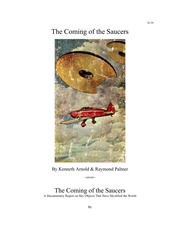
The Coming of the Saucers
The Witness Who Named the Flying Saucer and the Publisher Who Sold It
Find on Amazon →As an Amazon Associate, OverClassified may earn from qualifying purchases made through this link, at no extra cost to you.
Why This Is Essential Reading
The Coming of the Saucers earns its place on this list not as a trustworthy history — on the evidence of its own text, and of Edward Ruppelt's blunt verdict that its facts had been "warped, twisted, and changed," it plainly is not one — but because it is the single earliest book produced by the actual witness at the center of the sighting that gave the modern UFO era its name, its founding vocabulary, and much of its enduring iconography. Read against this site's own Kenneth Arnold Sighting and Maury Island Incident case files, which independently work through the same material with considerably more source discipline than the book itself applies, The Coming of the Saucers is best understood as a primary artifact of how the case was marketed rather than a finished account of what happened — a self-published, commercially motivated collaboration between a genuinely puzzled witness and an editor whose talent for turning uncertainty into uproar produced, in its "Tacoma Affair" chapter alone, a piece of UFO folklore that has long since outlived the hoax that spawned it. No other book on this site's reading list was written this close to the source, by the source, five years after the flight that started everything.
Related Cases & Theories
Essential Viewing
Kenneth Arnold's 1947 UFO Sighting termed "Flying Saucer" as told by Author Dr. Bruce Maccabee
Club Paranormal (Truth Be Told) — Physicist and UFO researcher Dr. Bruce Maccabee, author of a book-length study of the Arnold case, discusses the sighting and how the press description became "flying saucer." Verified via YouTube oEmbed before inclusion.

Kenneth Arnold UFO Sighting: The First UFOs
Jimmy Akin's Mysterious World — A researcher-hosted deep dive into the Mount Rainier sighting and its role establishing the vocabulary and iconography of the modern UFO era. Verified via YouTube oEmbed before inclusion.
Sources Cited
- Arnold, Kenneth, and Raymond Palmer. The Coming of the Saucers: A Documentary Report on Sky Objects That Have Mystified the World. Privately printed, Boise, ID & Amherst, WI, 1952 (ISBN 9780964499713 / 0964499711, 1996 Legend Press reprint, matching this site's own case-file citations under this exact edition). amazon.com
- "The Coming of the Saucers." Wikipedia (publication details, chapter contents, contemporary and later critical reception). en.wikipedia.org
- "Kenneth Arnold." Wikipedia (biography: birth/death, business career, the 1947 sighting, Maury Island, later life and death). en.wikipedia.org
- "Kenneth Arnold UFO sighting." Wikipedia (sighting details, press coverage, and the "flying saucer" misquote). en.wikipedia.org
- "Raymond A. Palmer." Wikipedia (biography: childhood injury, Amazing Stories, Shaver Mystery, Fate magazine, Amherst Press, death). en.wikipedia.org
- "The Coming Of The Saucers." Internet Archive (identifier the-coming-of-the-saucers_202407; scanned/OCR text and cover image of the 1952 first edition). archive.org
- "The Coming of the Saucers." Bibliographic listing, Biblio.com ("Privately Published, Amherst, Wisconsin," first-edition collation details). biblio.com
- "The Coming of the Saucers — Arnold, Kenneth & Ray Palmer: 9780964499713." AbeBooks (1996 Legend Press reprint edition details, cassette-tape insert). abebooks.com
- "The Unidentified Adventures of Raymond A. Palmer." Kirkus Reviews (Palmer's biography and his relationship with Arnold, drawn from Fred Nadis's 2013 biography). kirkusreviews.com
- "MAGONIA REVIEW: INVENTING UFOLOGY." Pelicanist (review of Fred Nadis's The Man from Mars, discussing Palmer's role publishing Arnold and this book). pelicanist.blogspot.com
- Keel, John A. "Ray Palmer, the man who invented flying saucers." Fortean Times, 1983, reproduced via Norio Hayakawa's blog. noriohayakawa.wordpress.com
- Gardner, Martin. Fads and Fallacies in the Name of Science. Revised ed., Dover Publications, 1957 (assessment of Raymond Palmer's role in the flying-saucer craze).
- Eghigian, Greg. After the Flying Saucers Came: A Global History of the UFO Phenomenon. Oxford University Press, 2024 (academic history opening with the Arnold sighting as the phenomenon's origin point). global.oup.com
- "The Coming of the Saucers by Kenneth Arnold." Goodreads (reader ratings and reviews). goodreads.com
- This site's own case file: Kenneth Arnold Sighting (Case File #007), which lists this exact book and documents the full sighting narrative this article summarizes.
- This site's own case file: Maury Island Incident (Case File #068), which cites this book directly and provides this article's Ruppelt quotation and its assessment of the book's internal authorial tension.
- This site's own essential-reading article: The Report on Unidentified Flying Objects (ER-011), for Edward Ruppelt's own firsthand, considerably more skeptical treatment of the Arnold case.
- This site's own key-figures entry: Kenneth Arnold, for his full biography and case connections.
- This site's own key-figures entry: Raymond Palmer, for his full biography and role in early UFO publishing.
- This site's own resources library: Full Reading List, where this title is cited on the Kenneth Arnold and Maury Island case files.
Have corrections, additional research, or peer-reviewed sources? Help improve this entry.
Suggest an Edit