
UFO: The Inside Story of the US Government’s Search for Alien Life Here—and Out There
A Watergate Historian Turns His Archival Method on the UFO File
Core Thesis
The seventy-five-year U.S. government relationship with the UFO subject is not a single, coordinated cover-up but a genuinely inconsistent, often self-defeating institutional pattern — investigate, dismiss, investigate again, obscure — that Graff argues is best explained not by government certainty that visitors exist, but by the government's much more mundane and much harder to admit discomfort with telling the public it does not actually know what some of these objects are.
About the Author
Garrett M. Graff was born in 1981 and educated at Harvard College, where he edited The Harvard Crimson. He entered political journalism early — serving as deputy national press secretary on Howard Dean's 2004 presidential campaign and, in 2005, becoming the first blogger credentialed to cover the White House press briefing room — before moving into magazine editing, eventually serving as editor of Politico Magazine and editor-in-chief of Washingtonian. He now teaches at Georgetown University's journalism graduate program and writes a national-security column for The Washington Post.
Graff's reputation, and the reason this particular book was taken seriously by reviewers who would normally avoid the UFO shelf entirely, rests on the run of deeply archival, oral-history-driven books he had already published before turning to the subject: The Threat Matrix (2011), on the FBI's post-9/11 transformation; Raven Rock (2017), a history of the government's Cold War continuity-of-government bunkers; The Only Plane in the Sky (2019), a #1 bestselling oral history of September 11; and Watergate: A New History (2022), a finalist for the Pulitzer Prize in History that the New York Times Book Review called "dazzling" and Kirkus Reviews called "standard-setting."
That bibliography matters directly to how UFO was reviewed: Graff is a working national-security historian with a documented track record of building narrative history from declassified documents, FOIA releases, and on-the-record interviews with senior intelligence and military officials — not a ufologist arguing a personal theory of extraterrestrial contact. He has said plainly in interviews that he came to the subject with no prior position on whether UAP were extraterrestrial, and applied the identical archival method he had used on Watergate and the Mueller FBI investigation to the government's UFO file instead.
Graff continued the same oral-history-and-archival approach immediately after this book, publishing When the Sea Came Alive: An Oral History of D-Day in 2024 and The Devil Reached Toward the Sky: An Oral History of the Making and Unleashing of the Atomic Bomb in 2025 — placing UFO as one entry in a broader career spent making inaccessible, often classified American institutional history legible to a mainstream audience, rather than as a departure from it.
Historical Context & Origins
Graff began writing UFO at an unusually active moment for the subject's institutional history. The Pentagon had publicly confirmed the authenticity of the "FLIR1," "Gimbal," and "GoFast" Navy pilot videos in April 2020; the Office of the Director of National Intelligence released its unclassified Preliminary Assessment on Unidentified Aerial Phenomena in June 2021, acknowledging 144 unexplained military encounters; and Congress had begun holding its first open UAP hearings in decades. By the time the book reached shelves in November 2023, former intelligence officer David Grusch had already testified under oath before the House Oversight Committee that July, alleging illegal government crash-retrieval programs, and the Pentagon had stood up the All-domain Anomaly Resolution Office (AARO) the previous year to centralize UAP reporting and investigation.
That timing gave Graff a genuinely rare vantage point: he was writing the first comprehensive, single-volume archival history of the government's UFO file at almost exactly the moment the file itself was reopening in public for the first time since Project Blue Book closed in 1969. Earlier single-author histories of the subject — Timothy Good's Above Top Secret (1987), Richard Dolan's UFOs and the National Security State (2002) — were written from outside that reopening, arguing the government was still concealing what it knew; Graff wrote from inside a period when the government itself was, however haltingly, beginning to say the opposite: that its own historical secrecy had mostly reflected bureaucratic embarrassment, turf protection, and a reluctance to admit ignorance rather than a settled, hidden answer.
Graff has described his own approach to the subject as a direct extension of the method he used on Watergate and The Only Plane in the Sky: build the narrative from primary documents, contemporaneous news coverage, and interviews with the people who were actually in the room, rather than starting from either a believer's or a debunker's conclusion. That discipline is what separated UFO from most of the genre it was published into — a genre historically dominated either by ufologist advocacy or by reflexive Air Force-style dismissal — and is the specific quality nearly every mainstream review of the book, favorable or not, singled out for comment.
Core Arguments & Key Concepts
Graff structures the book around three interwoven narrative threads that run roughly chronologically from 1947 to the present: the specific incidents that shaped public UFO belief (Kenneth Arnold's 1947 sighting, Roswell, the 1948 Mantell incident, the Michigan "swamp gas" wave, the Hill and Pascagoula abduction claims, the Phoenix Lights, and the modern Navy encounters); the government's own shifting apparatus for investigating those incidents, from Project Sign through Project Grudge, Project Blue Book, the Condon Report, AATIP, and AARO; and, more distinctively, the separate scientific search for extraterrestrial life itself — SETI, the Drake Equation, and the astronomers who tried to legitimize the search for life beyond Earth as a respectable field distinct from flying-saucer sightings.
The book's central historical argument is that the government's UFO posture was never a single coordinated policy but a decades-long sequence of ad hoc, frequently contradictory bureaucratic reactions — take it seriously, then downplay it for public-relations reasons, then take it seriously again under a new name and a new office — driven as much by inter-agency turf battles, Cold War classification reflexes, and individual officials' personal convictions as by any settled institutional position on what UAP actually are.
Graff's most quoted formulation of that argument, repeated in multiple interviews promoting the book, reframes the entire secrecy question: "It's not that the government knows something it doesn't want to tell us; it's that the government is uncomfortable telling us it doesn't know anything at all." That sentence is doing real interpretive work — it argues against both the hard cover-up thesis common in the ufology genre and the reflexive skeptical dismissal common in mainstream science journalism, positioning Graff's own conclusion as a third option neither camp is fully comfortable with.
A significant structural feature, and one several reviewers treated as a genuine limitation rather than a strength, is that Graff runs the government-secrecy narrative and the SETI/astrobiology narrative largely in parallel rather than fully integrating them; the book argues both are part of the same underlying human question — are we alone? — without ever fully demonstrating that the Air Force's Cold War radar-visual case files and the Drake Equation belong in the same continuous argument.
On the specific, still-live question of the 2023 Grusch allegations, Graff treats the whistleblower claims of illegal crash-retrieval and reverse-engineering programs with the same evidentiary caution he applies throughout: presenting them as a serious, credentialed allegation that reopened the disclosure debate in Congress, while noting plainly that, as of the book's own November 2023 publication, no documentary or physical evidence had surfaced to corroborate the specific claims Grusch made under oath.
Key Cases & Evidence Discussed
The Roswell Incident (Case #001, 1947) receives one of the book's clearest debunking treatments: Graff traces the case's origin to a premature "flying disc" press release from a public information officer at Roswell Army Air Field, walking through the Army's same-day retraction and the weather-balloon explanation the Air Force settled on, while still explaining why the case became the foundational myth of modern American ufology regardless of the underlying mundane debris.
The Condon Report (Case #227, 1966–1968) appears as the book's central case study in how an ostensibly scientific government review actually concluded the field's most serious pre-AATIP institutional inquiry — Graff situates the University of Colorado study's finding that further investigation "probably cannot be justified" as the direct cause of the Air Force's December 1969 closure of Project Blue Book, and as the reason the subject spent the next several decades outside serious institutional science.
The USS Nimitz "Tic Tac" Encounter (Case #003, 2004) and its related "Gimbal" and "GoFast" videos anchor the book's modern section, tracing the chain from the 2004 Point Mugu-area encounter through the Pentagon's eventual April 2020 confirmation of the footage's authenticity — the specific sequence of events that, in Graff's account, reopened the entire subject for Congress and the mainstream press after five decades of institutional dismissal.
The book closes its narrative arc with David Grusch's 2023 whistleblower testimony (Case #019) and the Pentagon's creation of AARO — the most current material in the book at the time of its November 2023 publication, and the section several reviewers noted felt the most rushed relative to the fuller, slower-paced treatment Graff gives the 1940s–1970s material.
Critical Reception & Controversies
The book landed with an unusually broad spread of mainstream review coverage for a UFO title. Publishers Weekly called it a "probing report" and "a fascinating dive down the rabbit hole," writing that Graff's "agnosticism has the potential to appeal to skeptics and believers alike." Kirkus Reviews called it "an entertaining tour through the world of flying saucers, aliens, and weird science," noting Graff "admires the open-mindedness and imagination" of UFO researchers while concluding their work "has yet to produce substantial returns." The Associated Press's Andrew DeMillo called it "the perfect guide for readers interested in learning how that discussion has evolved."
The most substantive mixed review came from science journalist Sarah Scoles — herself the author of They Are Already Here (2020), also cited on this site — writing for The Washington Post in November 2023. Scoles credited the book with "ample detail of the players and programs and primary source material," but identified the same structural seam several other reviewers flagged: the government-secrecy narrative and the separate search-for-alien-life narrative, she wrote, "simply sit side by side, separate hemispheres that Graff can't quite weld into one orb."
Seven Days critic Chelsea Edgar made a related but distinct criticism, arguing the book's chronological, all-incidents-included structure leaves little room for character development: "The reader of UFO is like a person on a speed-walking tour of a strange and enormous house." Edgar nonetheless highlighted Graff's central formulation — that the government's discomfort is less about hiding a known answer than about admitting it has none — as the book's most useful contribution to the debate.
A more critical independent review by writer Jordan Poss flagged specific limitations beyond tone: the book's later chapters, covering the 1980s through the present, feel comparatively rushed next to its detailed 1940s–1970s sections; Bob Lazar's Area 51 claims, a major node in 1990s UFO culture, go essentially unmentioned; and Poss counted an unusually high number of typographical and factual slips for a major-press release, alongside footnotes he felt occasionally editorialized against figures rather than simply sourcing the text. Taken together, the range of reception — genuine praise for the archival rigor and evenhandedness, alongside real, specific critiques of structure, pacing, and proofreading — is itself evidence the book was reviewed as serious nonfiction rather than shelved reflexively with UFO advocacy literature.
Influence & Legacy
UFO became a New York Times bestseller and generated an unusually large media tour for a history book, with Graff appearing on NPR's Fresh Air, PBS NewsHour, MSNBC's Morning Joe, WBUR's On Point, and in a Time magazine interview, along with in-person events including a Politics and Prose appearance moderated by Washington Post columnist David Ignatius and a C-SPAN Book TV taping at the Gerald R. Ford Presidential Museum.
Because the book was published in the same window as Grusch's testimony and AARO's early public reporting, it was widely used by journalists and producers covering the 2023–2024 congressional UAP hearings as accessible background reading — a role several of the interviews Graff gave explicitly leaned into, positioning him as a credentialed explainer for a story that had suddenly become mainstream news again after decades of media stigma.
Within the broader UFO-literature landscape, the book's most notable legacy so far is less a specific new claim than a demonstrated proof of concept: that a mainstream, non-ufologist national-security historian applying ordinary archival-journalism method to the subject could produce a book major outlets like The Washington Post, Kirkus, and the Associated Press would review on its historical merits rather than dismiss on genre grounds alone — a credibility bridge earlier single-author UFO histories, including this site's other Essential Reading entries, had not consistently achieved with the mainstream press.
On this site specifically, the book already functions as a working secondary source rather than a novelty: it is cited across resources.html in connection with several separate case files, including the 2023 Yellowknife-period balloon coverage, the Gimbal/GoFast encounters, and the Campeche FLIR incident, reflecting its usefulness as a general-purpose reference for the government-institutional side of modern UAP history.
The Book
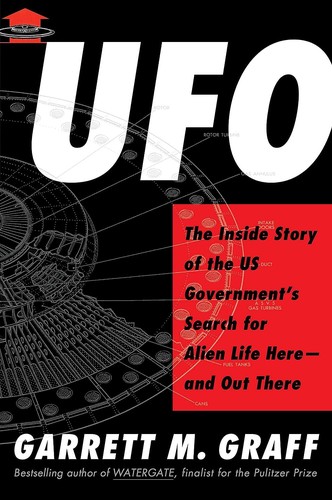
UFO: The Inside Story of the US Government’s Search for Alien Life Here—and Out There
A Watergate Historian Turns His Archival Method on the UFO File
Find on Amazon →As an Amazon Associate, OverClassified may earn from qualifying purchases made through this link, at no extra cost to you.
Why This Is Essential Reading
UFO: The Inside Story earns its place on this list as the first single-volume history of the American government's UFO file written by a mainstream national-security historian using the same archival method he had already proven on Watergate and 9/11 — and as a book mainstream outlets like The Washington Post, the Associated Press, and Kirkus Reviews were willing to take seriously on exactly those terms. Its central insight, that the government's decades of mixed signals reflect institutional discomfort admitting ignorance more than a settled hidden answer, is a genuinely useful reframing of the secrecy question this site's other Essential Reading titles mostly argue from the opposite direction. Its real weaknesses — an SETI narrative that never fully welds to the UFO narrative, a rushed final stretch covering the 2020s, and the kind of proofreading slips a faster publication schedule can produce — are worth knowing going in, but they do not undercut the book's core achievement: making the government's own UFO history legible, sourced, and reviewable by people who would never have opened a book from the ufology shelf.
Related Cases & Theories
Essential Viewing
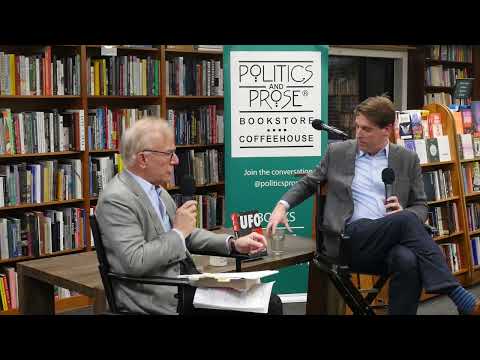
Garrett M. Graff — UFO - with David Ignatius
Politics and Prose — Graff's full book talk and reading at Politics and Prose in Washington, D.C., in conversation with Washington Post columnist David Ignatius.
'The math is on the side of the aliens': New book looks at inside story of UFOs
MS NOW — A television interview with Graff discussing the book's central findings shortly after its November 2023 publication.
Sources Cited
- "Garrett M. Graff." Wikipedia. en.wikipedia.org
- "UFO." GarrettGraff.com (official author site, book page). garrettgraff.com
- "UFO by Garrett M. Graff." Simon & Schuster (official publisher page). simonandschuster.com
- "UFO: The Inside Story of the U.S. Government's Search for Alien Life Here—and Out There." Publishers Weekly, September 11, 2023 (review). publishersweekly.com
- "UFO: The Inside Story of the US Government's Search for Alien Life Here—and Out There." Kirkus Reviews. kirkusreviews.com
- Scoles, Sarah. "Book review: UFO, by Garrett M. Graff." The Washington Post, November 11, 2023. washingtonpost.com
- Edgar, Chelsea. "Book Review: UFO: The Inside Story of the US Government's Search for Alien Life Here — and Out There, Garrett Graff." Seven Days. sevendaysvt.com
- Poss, Jordan M. "UFO." JordanMPoss.com (independent book review). jordanmposs.com
- "All Book Marks reviews for UFO: The Inside Story of the US Government's Search for Alien Life Here—And Out There by Garrett M. Graff." Book Marks / Literary Hub. bookmarks.reviews
- "Garrett M. Graff." The Pulitzer Prizes (Watergate: A New History, 2023 finalist listing). pulitzer.org
- "UFO: The Inside Story of the US Government's Search for Alien Life Here—and Out There." Goodreads (bibliographic listing, hardcover 1st ed.). goodreads.com
- "Is the truth out there? Garrett M. Graff on his new UFO book." Space.com (author interview). space.com
- "Fresh Air for Nov. 27, 2023: UFOs and conspiracy theories." NPR. npr.org
- This site's own case file: The Roswell Incident, for the debunked debris/press-release chapter this book covers.
- This site's own case file: The Condon Report, for the 1966–1968 study this book identifies as the cause of Project Blue Book's 1969 closure.
- This site's own case file: USS Nimitz / Tic Tac Encounter, for the 2004 case this book traces through to the Pentagon's 2020 video confirmation.
- This site's own case file: David Grusch Whistleblower Testimony, for the 2023 allegations this book closes its narrative arc with.
- This site's own key-figures entry: Garrett M. Graff, for his full biography and case connections.
Have corrections, additional research, or peer-reviewed sources? Help improve this entry.
Suggest an Edit