
Hanford Site Radar-Visual Intercept
At about 1:30 p.m. on May 21, 1949, a civilian at the Hanford plant's 200 West meteorology tower reported through a telescope that a disc was standing still over the 200 East Area of the Hanford Atomic Works, then took off to the southeast faster than a jet fighter. Crew members and the controller of the 637th Aircraft Control and Warning Squadron then searched the sky and saw a round, white or silver object heading northeast at 10,000–15,000 feet. An F-82 from Moses Lake Air Force Base was airborne at 2:20 p.m. and was told to intercept an unidentified radar target "in hopes that it might be a Disk," but the target faded. Later that afternoon leaflets for a Richland air rodeo, dropped by a PT-19, fell near the Rattlesnake Mountains. The squadron judged that "two separate and distinct alert conditions" had occurred, yet Project Blue Book recorded both the radar and the visual reports as "Aircraft."
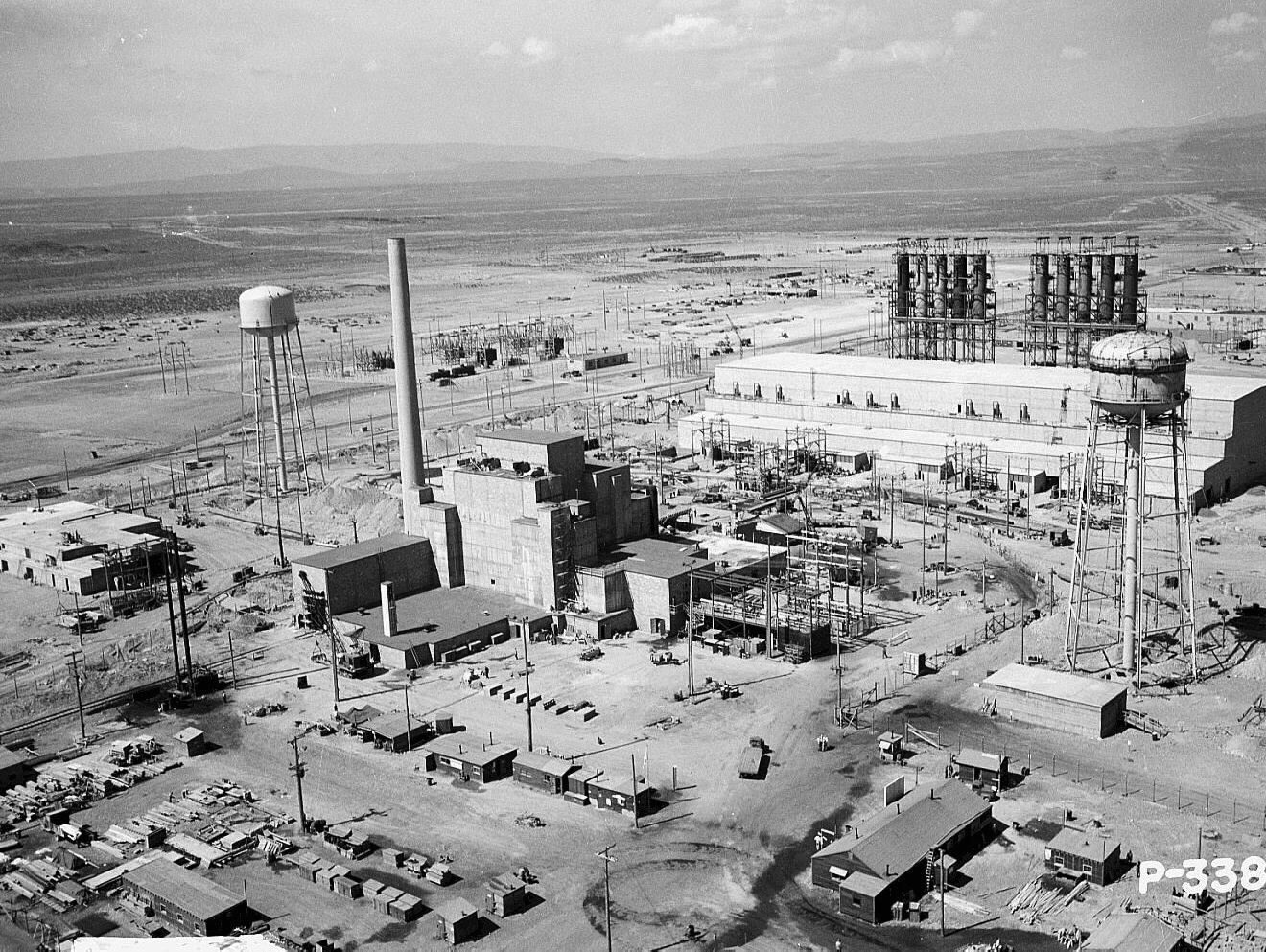
Pictured: the B-Reactor area of the Hanford Site, Washington, photographed circa 1944 by the U.S. Army Corps of Engineers — the same restricted plutonium-production complex, five years before this incident, whose airspace the 637th Aircraft Control and Warning Squadron and the Moses Lake fighters were tasked with protecting. This is not a photograph of the object or the intercept itself; no photograph of the disc, the radar scope, or the responding F-82 is known to exist in any archive consulted for this case file — only the declassified Air Force reports and the Blue Book record card.
Theoretical Alignment
Hanford's case draws its Extraterrestrial Hypothesis weight from a telescope sighting of a stationary "disk" that then left faster than a jet, a second visual sighting by an air-defense crew, and an unidentified radar target that an F-82 was sent after. It carries essentially no Interdimensional Hypothesis signature. The Mundane reading carries real weight because the two visual reports do not describe the same motion (one object left to the southeast, the other was moving northeast), the radar target was in a third sector (east-southeast) and was never tied to either sighting, an air rodeo was putting civilian aircraft over the area that afternoon, and the recorded winds aloft would have carried a free balloon toward the north-northeast. Project Blue Book's "Aircraft" verdict nonetheless sits awkwardly beside the reporting squadron's own judgment that the saucer sighting and the leaflet drop were "two separate and distinct alert conditions."
Background
The Hanford Site was established in 1943 by the Manhattan Engineer District on roughly 670 square miles of sparsely populated shrub-steppe along the Columbia River in Benton County, Washington, chosen for its remote location, abundant river water for reactor cooling, and access to hydroelectric power from Grand Coulee Dam. Its purpose was to produce weapons-grade plutonium at industrial scale, first at the B Reactor — the world's first full-scale nuclear reactor, which went critical in September 1944 — and eventually across a chain of production reactors and chemical separations plants. Plutonium produced at Hanford fueled the Trinity test device detonated near Alamogordo, New Mexico on July 16, 1945, and the "Fat Man" bomb dropped on Nagasaki three weeks later, making the site, alongside the Los Alamos and Oak Ridge laboratories, one of the three pillars of the American atomic bomb program. With the 1946 creation of the civilian Atomic Energy Commission (AEC), Hanford's mission continued and expanded into the Cold War, its restricted airspace and grounds guarded by a combination of AEC security personnel, contractor security forces, and, from 1948 onward, a dedicated Air Force fighter-interceptor presence.
That dedicated presence existed because of a documented, specific concern rather than generic Cold War caution. Beginning in December 1948, a wave of unexplained aerial "green fireballs" began appearing with unusual frequency in the skies over Albuquerque, New Mexico, in the immediate vicinity of Kirtland Air Force Base, Sandia Base, and, most pointedly, the Atomic Energy Commission's Los Alamos Scientific Laboratory. Astronomer Lincoln La Paz, a University of New Mexico meteor specialist brought in to assess the phenomena, along with Kirtland intelligence officers, Air Defense Command personnel, and several of Los Alamos's own physicists, reported observing the fireballs firsthand and found their behavior inconsistent with ordinary meteors. A January 31, 1949 FBI memorandum from the Bureau's San Antonio field office to Director J. Edgar Hoover, titled "Protection of Vital Installations" and classified Confidential, documented repeated December 1948 intrusions into restricted airspace over Los Alamos and noted that the "Flying Saucer"/"Flying Disc" matter was considered Top Secret by Army and Air Force intelligence specifically because of the pattern's concentration around atomic installations. In February 1949 a conference at Los Alamos brought together Project Sign personnel, military officers and scientists including Joseph Kaplan, Edward Teller and La Paz to assess the fireballs; it could not identify them. Later in 1949 the Air Force set up Project Twinkle, a network of camera and observation posts that was never fully implemented. (Los Alamos director Norris Bradbury's laboratory hosted the inquiry.)
This is the institutional climate Hanford's May 1949 incident sits inside: by the spring of 1949, the AEC and the Air Force were already treating unexplained aerial activity near atomic installations as a matter for formal investigation. The report on this case went to Air Force headquarters under the subject line "Project SIGN," and Headquarters USAF forwarded it to Air Materiel Command at Wright-Patterson on 8 June 1949. Former Project Blue Book chief Edward J. Ruppelt later wrote that UFOs "were habitually reported from areas around 'technically interesting' places like our atomic energy installations, harbors, and critical manufacturing areas." His 1956 book mentions Hanford twice: the December 10, 1952 F-94 encounter near the plant, and a July 5 airliner report over the installation that he says "was a skyhook balloon."
Hanford's own dedicated air-defense component arrived in this same window. Moses Lake Air Force Base, roughly 45–50 miles north-northeast of the Hanford Site's central plateau, reopened as a permanent Air Defense Command installation on August 26, 1948, and on November 26, 1948 received the 325th Fighter-Interceptor Group, whose 317th Fighter (All-Weather) Squadron began transitioning from war-surplus Northrop P-61 Black Widow night fighters to the newer North American F-82 Twin Mustang. Aviation histories of the base are explicit and consistent about its purpose: "the primary mission of Larson-based ADC aircraft was to protect the secret Hanford Atomic Works and the Grand Coulee Dam." A second squadron, the 319th Fighter Interceptor Squadron, arrived from McChord Air Force Base on September 2, 1949 — several months after this case's own May 21 intercept, meaning the F-82 that responded that afternoon almost certainly belonged to the 317th, the only F-82 squadron then present at the base. The base was renamed Larson Air Force Base in 1950, in honor of Major Donald A. Larson, and closed in 1966; its runways today form Grant County International Airport.
Parallel to this fighter-interceptor buildup, the Air Force's radar surveillance over the Hanford region was also standing up. The 637th Aircraft Control and Warning Squadron, part of the 505th Aircraft Control and Warning Group, had been activated on May 21, 1947 at Long Beach Municipal Airport, California, moved to McChord Air Force Base in April 1948 and was listed at Moses Lake AFB from 1 May 1949, three weeks before this incident; it moved to a permanent site at Saddle Mountain, Washington (later Othello Air Force Station) on January 1, 1951. Its report on this case, dated 23 May 1949, uses the call sign "Torch" for its ground controller. In May 1949, then, both halves of the military response were being run by units still settling into the region.
Complete Timeline
| Date | Event |
|---|---|
| 1943 | The Manhattan Engineer District establishes the Hanford Engineer Works on the Columbia River in south-central Washington State to produce weapons-grade plutonium. |
| Sept. 1944 | Hanford's B Reactor, the world's first full-scale nuclear reactor, goes critical. |
| Dec. 1944–Jan. 1945 | U.S. Navy F6F Hellcat fighters based at Naval Air Station Pasco, near Hanford, make unsuccessful night attempts to intercept an unidentified light reported over the plant; Fourth Air Force diary entries of 23 and 25 January 1945 refer to an unidentified aircraft over the plant on at least three nights and a radar "bogie" on several nights in the past three weeks. Former pilot Clarence "Bud" Clem described the episode to Robert Hastings in 2013. |
| Aug. 6 & 9, 1945 | Hanford-produced plutonium fuels the "Fat Man" weapon dropped on Nagasaki, following the Trinity test three weeks earlier. |
| 1946 | The civilian Atomic Energy Commission (AEC) assumes control of Hanford from the Army. |
| Dec. 1948 | A wave of unexplained "green fireballs" begins over New Mexico (the earliest specific reports date to 5 December 1948), concentrated around Kirtland AFB, Sandia Base, and the AEC's Los Alamos Scientific Laboratory, drawing AEC and Air Force intelligence concern. |
| Jan. 31, 1949 | An FBI memorandum, "Protection of Vital Installations," documents repeated December 1948 airspace intrusions over Los Alamos and characterizes the matter as Top Secret to Army and Air Force intelligence. |
| Feb. 16, 1949 | A conference at Los Alamos, attended by Project Sign personnel and scientists including Joseph Kaplan, Edward Teller and Lincoln La Paz, fails to identify the fireballs; the Project Twinkle observation network follows later in 1949. |
| Aug. 26, 1948 | Moses Lake Air Force Base reopens under Air Defense Command, tasked with protecting the Hanford Site and Grand Coulee Dam. |
| Nov. 26, 1948 | The 325th Fighter-Interceptor Group arrives at Moses Lake AFB; its 317th Fighter (All-Weather) Squadron begins transitioning to the F-82 Twin Mustang. |
| May 21, 1949, 1:30 p.m. | At 1330 a civilian at the 200 West meteorology tower calls in that a "Flying Saucer" is standing still over the 200 East Area, about four miles east of the Hanford plant, and then takes off to the southeast faster than a jet fighter; he estimates its altitude at 17,000–20,000 ft. The 637th's crew personnel and controller search the sky and see a round, white or silver object moving northeast at 10,000–15,000 ft. The radar scopes search the southern sector without result. |
| May 21, 1949, 2:20 p.m. | At 1420 F-82 "Gertrude 20," pilot Gardner, is airborne. The controller is told to intercept radar target 81, then being tracked in the east-southeast sector, "in hopes that it might be a Disk"; the target fades about five minutes after the fighter takes off, after two vectors. Radar contact with the fighter itself is spotty. |
| May 21, 1949, 2:25–3:25 p.m. | At about 1425 Hanford reports bits of paper falling near the Rattlesnake Mountains, about six inches square, red on one side and green on the other; the F-82 is sent to look. At about 1525 the papers are identified as advertisements for an air rodeo at Richland, dropped by a PT-19 flown by a commercially licensed pilot from the Atomic Speedway in Pasco. |
| May 23 – June 1, 1949 | The 637th AC&W Squadron's report of 23 May 1949, signed by its adjutant for the commanding officer, concludes that "two separate and distinct alert conditions existed on the afternoon of 21 May 1949" and that "there is no connection between the two events." Moses Lake AFB's acting intelligence director forwards it in an Air Intelligence Information Report dated 1 June 1949. |
| 1949 (Blue Book processing) | The Blue Book record card (incident 331) gives the conclusion "Radar: Aircraft, Visual: Aircraft," with the note that a call was received the same day from the tower "that a/c were in area dropping pamphlets for an Air Rodeo." |
| Sept. 2, 1949 | The 319th Fighter Interceptor Squadron arrives at Moses Lake AFB from McChord AFB, becoming the base's second F-82 unit — after this case's own incident. |
| Jan. 1, 1951 | The 637th Aircraft Control and Warning Squadron relocates to a permanent radar site at Saddle Mountain, Washington, later renamed Othello Air Force Station. |
| July 30–Aug. 4, 1950 | A follow-up wave of "round" objects is reported over the Hanford AEC Plant above 15,000 feet; a confidential memo by Major U.G. Carlan documents a coordinated alert of anti-aircraft units, radar stations, Air Force fighter squadrons, and the FBI. |
| Dec. 10, 1952 | Near Hanford, the crew of a patrolling F-94 jet obtains an ARC-33 airborne radar lock-on against a large, round, white light with reddish "window" markings closing on their aircraft — a separate, later Hanford-area radar/visual case. |
| 1956 | Former Project Blue Book chief Edward J. Ruppelt's The Report on Unidentified Flying Objects describes reports clustering around "technically interesting" AEC installations and recounts the December 1952 F-94 encounter near Hanford. |
| 2008 / 2017 | Robert Hastings situates Hanford's documented aerial-intrusion history within his broader UFOs & Nukes research project on UAP activity at U.S. nuclear weapons sites. |
| 2026 | This case file is published; in October 2026 it was corrected against scans of the original 1949 Air Force documents. |
The Afternoon of May 21, 1949: What the Record Actually Says
Hanford's core incident survives as a short file of contemporary Air Force paper: the 637th Aircraft Control and Warning Squadron's report of 23 May 1949 and the Air Intelligence Information Report built on it (Project Blue Book incident 331; scans via NICAP). NICAP's case page leads with a summary by Fran Ridge and a longer passage by J. Allen Hynek, who wrote that "before the F-82 was airborne the disc suddenly took off in a southerly direction at a speed greater than that of a jet fighter" and that "the object had sped out of the range of ground radar." The documents themselves are more specific, and in several places different. The first report came at 1330 by telephone from the "Hanford Area (Concrete)," saying a "Flying Saucer was over the East 200 area approximately four miles east of the Hanford Atomic Plant"; the Hanford operator said "the Disk was standing still and then took off in a southeasterly direction at a speed greater than that of a jet fighter." The observer, a civilian whose place of work was the 200 West meteorology tower, was using a telescope, estimated the altitude at 17,000 to 20,000 feet, and gave the object's colour as white or silver and its shape as round.
The 637th's own people then joined in. After the scopes were told to search the southern sector "with no results," the report says, "Crew personnel and the controller searched the sky, visually, and noted a round, white or silver object traveling in a northeasterly direction at a speed greater than that of a jet fighter at approximately 10,000 to 15,000 feet." The base weather section said it did not use weather balloons. So the case has two visual sightings rather than a visual sighting confirmed on radar: one of an object that stood still and left to the southeast, and one of an object already moving northeast, at a different estimated altitude. The record does not say whether they were the same object. No radar return is tied to either sighting.
What the record does not preserve is also informative. The file gives no size, no sound and no description beyond round or disc-shaped and white or silver. It does not say how long the telescope observer watched, beyond the record card's "5 minutes," or how far away the object was. The teletype weather quoted in the report shows scattered cloud at 5,000 feet, 20 miles visibility and winds aloft from the south-southwest to southwest at 10 to 20 knots up to 20,000 feet, which would carry any free balloon toward the north-northeast. Earlier versions of this page said that no witness name, clock time or weather survived; the scanned documents preserve all three.
The "Two Separate and Distinct Alert Conditions"
The most consequential sentence in the record was written by the reporting squadron, not by a witness. Paragraph 2 of the 637th AC&W Squadron's report reads: "It is believed that two separate and distinct alert conditions existed on the afternoon of 21 May 1949. The first was caused by the sightings of Flying Saucers (noted) by Hanford using a telescope and the operations crew of the 637th ADCC. The second was caused by the dropping of leaflets by an aircraft into the Hanford area. It is believed that there is no connection between the two events."
This sentence does two things. It shows that the squadron treated the saucer sightings as a real report worth forwarding under Project SIGN, not as an obvious misidentification of the leaflet plane. And it separates those sightings from the leaflet drop. Its wording also confirms that the squadron's "operations crew" contributed a sighting, not a radar track. The second alert condition was the falling paper, not a second radar contact: the file does not say the PT-19 was ever seen on radar.
The F-82 That Never Made Contact
The intercept was slow to start and inconclusive. The 1330 call came about fifty minutes before F-82 "Gertrude 20," flown by a pilot named Gardner, reported airborne to the Torch controller at 1420; the Hanford operator first had to clear the aircraft into the prohibited area, with authorization from the Assistant Chief of the Security Section at Hanford. By then the ADCC was tracking target 81 in the east-southeast sector and told the controller "to intercept it in hopes that it might be a Disk." The controller gave two vectors before target 81 faded, about five minutes after the fighter took off, and radar contact with the fighter itself was "so poor that a coherent track on the fighter was impossible." The fighter was then sent to look for the leaflets near the Rattlesnake Mountains and to search the Hanford area "for other evidences of the Flying Saucers," with no results. The pilot reported no sighting.
Two points remain open. The file does not say what target 81 was: it was tracked in a different sector from both visual sightings, and with an air rodeo under way at Richland it may simply have been an aircraft. Nor does it say which F-82 variant flew the sortie or whether its own radar was used. The F-82F and F-82G night-fighter models carried an AN/APG-28 or SCR-720C set in a centerline pod, but no source names the variant flown on this day.
Blue Book's "Aircraft" Disposition and Why It Fails to Fit
The Blue Book record card for incident 331 lists the source as "Civilian," one object, five minutes, "Ground-Radar / Air-Visual," course "Northeasterly," and the conclusion "Radar: AIRCRAFT. Visual: AIRCRAFT," with the note that a phone call "was received the same day from tower that a/c were in area dropping pamphlets for an Air Rodeo." Hynek, quoted by NICAP, read this as Blue Book assuming "that the commercial aircraft and the UFO were one and the same object," despite the squadron's statement that the two events were unconnected. That criticism has force: nothing in the file links the PT-19 to the stationary disk seen through the telescope, and the leaflet plane was identified from its paper, not from a radar track. But the card's verdict is not necessarily a mistake about the PT-19 alone. Several aircraft were taking part in the air rodeo that afternoon, the 637th crew's object was moving rather than hovering, and target 81 was never identified, so "aircraft" may have been Blue Book's general judgment on an afternoon with civilian planes in the area. The file does not record its reasoning. What can be said is that the telescope report of a stationary object that left faster than a jet was never specifically explained.
Key Witnesses
The scanned documents name more participants than earlier summaries suggested. This section lists them as the documents give them.
Max Segoinns (spelling as typed in the report)
The first observer was a civilian whose place of work was the 200 West meteorology tower; the report types his name as Max Segoinns and gives a Richland address. He was using a telescope, saw the object standing still and then leaving to the southeast faster than a jet fighter, and estimated its altitude at 17,000–20,000 feet. The record card lists the source as "Civilian." Earlier summaries, including NICAP's, describe him as "crew and personnel from the Hanford radar station"; the documents do not support that description. No later account by him has been located.
637th Aircraft Control and Warning Squadron Crew (Names Not Given)
Crew personnel and the controller of the 637th Aircraft Control and Warning Squadron (called the "637th ADCC" in the report) searched the sky visually after the first call and saw a round, white or silver object moving northeast at an estimated 10,000–15,000 feet, faster than a jet fighter. Their scopes found nothing in the southern sector. No individual names are given. The squadron had been listed at Moses Lake since 1 May 1949.
F-82 Pilot Gardner ("Gertrude 20")
The pilot of F-82 "Gertrude 20," named in the report only as Gardner, was airborne at 1420, received two vectors toward radar target 81 before it faded, then searched the Rattlesnake Mountains and the Hanford area for the leaflets and "other evidences of the Flying Saucers," with no results. His squadron is not named; the 317th was the only F-82 unit at Moses Lake until September 1949.
Reporting and Intelligence Officers
The squadron report of 23 May 1949 was signed for the commanding officer by the 637th's adjutant, a first lieutenant (the signature is partly legible in the scan). The Air Intelligence Information Report of 1 June 1949 was prepared by Capt. Francis W. Sherrill (as the scan reads), acting director of intelligence at Moses Lake AFB. The squadron's "two separate and distinct alert conditions" judgment is the key to the debate over Blue Book's later verdict.
The Five Observables Assessment
Assessment: Anti-Gravity Lift is rated Speculative: the telescope observer said the object was "standing still," at an estimated altitude, for an unstated time; that is also consistent with a balloon or with an object moving along the line of sight. Instant Acceleration is rated Present on the strength of that same observer's statement that it "took off" to the southeast faster than a jet fighter, which remains a single observer's judgment of a distant object. Hypersonic is rated Speculative because no number survives, only the comparison "a speed greater than that of a jet fighter," applied in the report to both visual sightings. Low Observability is rated Speculative: the object was visible to the eye and telescope, and the only radar target in the file (target 81) was never tied to it. Trans-Medium is rated Absent.
Evidence Assessment
Supporting Anomalous Origin
- Two separate visual sightings within the same alert: a civilian meteorology-tower observer using a telescope, and crew personnel and the controller of an Aircraft Control and Warning squadron, both describing a round, white or silver object faster than a jet fighter
- The sighting occurred over one of the most security-conscious sites in the United States, during a period of documented AEC and Air Force concern about aerial activity near atomic installations (the Los Alamos green fireball wave)
- A real military response followed: an F-82 was cleared into the prohibited area and told to intercept a radar target "in hopes that it might be a Disk"
- The reporting squadron explicitly separated the saucer sightings from the leaflet drop, undermining any simple claim that the whole incident was "just the leaflet plane"
- Nothing in the file ties the telescope observer's stationary object, which left faster than a jet, to any identified aircraft
Supporting Conventional Explanation
- The two visual sightings describe different behaviour (stationary then leaving southeast at an estimated 17,000–20,000 ft; moving northeast at 10,000–15,000 ft), so they may not be the same object, and no later account by any witness is known
- An air rodeo at Richland put civilian aircraft over the area that afternoon, and the only radar target in the file (target 81, east-southeast) was never identified or tied to either sighting
- No quantified speed, size or sound survives; every performance claim rests on the phrase "a speed greater than that of a jet fighter"
- The F-82 pilot reported no sighting, and radar coverage of the fighter itself was too poor for a coherent track
- The recorded winds aloft (from about 190–240° at 10–20 knots up to 20,000 ft) would carry a free balloon toward the north-northeast, close to the northeasterly course on the Blue Book card; the Moses Lake weather section said it released no balloons, but other launches were not checked in the file
Why "Disputed"
This case earns a DISPUTED classification with a credibility score of 36/100, placing it below this catalogue's Thomas Mantell case (Disputed, 38) and well below Oscoda AFB Sighting (Disputed, 60), while sitting above cases this site rates as thinner still, such as Fort Benning (Personal, 14). Its strength is a contemporary Air Force file: a named civilian meteorology-tower worker watching through a telescope reported an object standing still over the 200 East Area that then left faster than a jet, the air-defense squadron's own crew saw a round white or silver object minutes later, and the squadron judged the episode to be unconnected to the leaflet plane that Blue Book's "Aircraft" verdict appears to lean on. That telescope sighting was never specifically explained.
What keeps this case short of Mantell's 38 is that the record, now read in the original scans, is weaker on corroboration than earlier summaries claimed. There was no radar confirmation of the disk: the scopes found nothing in the southern sector, and the one radar target the fighter was sent after was in a different sector and faded unidentified. The two visual sightings differ in direction, altitude and behaviour. The intercept produced no data, and an air rodeo put civilian aircraft over the area that afternoon. Against that, the telescope sighting of a stationary object that then left faster than a jet was never specifically explained, and the reporting squadron itself said it had nothing to do with the leaflet plane.
Sensor & Instrumentation Detection Profile
Hanford's case rests on two visual channels and one unresolved radar target. The first visual channel is the civilian observer at the 200 West meteorology tower, who used a telescope; the file gives no magnification or range. The second is the 637th's crew personnel and controller, who searched the sky by eye. The squadron's radar scopes were told to search the southern sector and found nothing; separately, the ADCC was tracking target 81 in the east-southeast sector when the F-82 took off, and the target faded after two vectors. The file does not name the radar model in use. Radar contact with the F-82 itself was spotty. The F-82's own onboard set, if fitted, produced no reported data. No infrared, electromagnetic or radiological data exist.
Environmental & Geospatial Context
The Hanford Site occupies a broad, arid expanse of shrub-steppe desert along a bend of the Columbia River in Benton County, in Washington's Columbia Basin — flat-to-rolling terrain with long, largely unobstructed sightlines, punctuated by basalt ridges such as Rattlesnake Mountain along the site's southwestern boundary, where the rodeo leaflets fell. The observer worked at the meteorology tower in the 200 West Area, and the object was reported over the 200 East Area, a few miles east. The weather quoted in the report was good for observation: scattered cloud at 5,000 feet, visibility 20 miles, 69°F, and light south-southwesterly winds at the surface and aloft. Larson Air Force Base (Moses Lake AFB) sits roughly 45–50 miles north-northeast of the 200 Areas; the F-82 was not airborne until about fifty minutes after the first call, partly because it had to be cleared into the prohibited area.
Observer Credibility & Occupational Profile
The first observer worked at a meteorology tower, a job that involves watching the sky, and used a telescope; that is a better-than-average civilian witness profile, though the file gives nothing about his experience. The second sighting came from air-defense crew personnel and a ground controller, whose job was to watch this airspace. The F-82 pilot was a trained Air Defense Command interceptor pilot, but he saw nothing.
Set against this, none of the witnesses gave any later account that has been found, so their statements cannot be tested beyond the 1949 file. Unlike Oscoda AFB Sighting's named Air Force personnel, or Robert Salas's decades of on-record public testimony for the Malmstrom case, Hanford's witnesses exist only in a few paragraphs of a 1949 report, and the 637th crew members are not named at all.
Physical & Material Assays
No physical trace evidence of any kind exists for this case. The object was never reported to land, and its entire documented interaction with the physical world consists of a telescope-assisted visual sighting and a corroborating ground radar return. No debris, landing-site impression, or material sample was ever recovered or is claimed to exist in any source consulted for this case file. See Material Analysis below for a full discussion of what does and does not survive of the case's documentary record itself.
Historical Precedents & Archive Matches
Hanford's May 1949 incident is not an isolated data point even within its own site's history. The earliest documented precedent dates to December 1944 and January 1945, four years before this case and while the plant was still under wartime Army control: U.S. Navy F6F Hellcat fighters based at Naval Air Station Pasco, near Hanford, made repeated unsuccessful attempts to intercept a bright, fast-moving object reported hovering over the plant on at least three separate nights, according to a declassified Fourth Air Force Daily Diary entry dated January 23, 1945 (obtained via Project 1947 researcher Jan Aldrich) stating the sightings resulted "from an unidentified aircraft flying over the Hanford Engineering Company Plant at Pasco, Wash. on at least three nights in the past month," with a companion entry two days later noting the object had been "detected by radar on several nights in the past three weeks." Former Navy Lieutenant Junior Grade Clarence R. "Bud" Clem, who served as a communications relay during these events and was later interviewed at length by researcher Robert Hastings before his death in 2014, described the object chased by fellow pilot Lieutenant Commander Richard Brown (with Ensign C.T. Neal flying as standby) as an intensely bright, fast-moving light that showed "no form, no substance to it whatsoever, just a bright light," moving northwest in a straight line without maneuvering.
A second, closely related precedent follows just over a year after this case's own incident: a confidential memorandum dated August 4, 1950 and authored by Major U.G. Carlan, based on information from Lieutenant Colonel Mildren, documents that "since 30 July 1950 objects, round in form, have been sighted over the Hanford AEC Plant," observed above 15,000 feet, with "Air Force jets" attempting interception "with negative results." The memo describes a coordinated, multi-agency alert — "all units including the anti-aircraft battalion, radar units, Air Force fighter squadrons, and the Federal Bureau of Investigation" — placed on watch for further activity, with the AEC itself confirming an ongoing investigation. The close structural similarity to this case's own May 1949 incident (round/disc objects, high altitude, a failed jet intercept, Hanford's restricted airspace specifically) makes the 1950 wave this case file's single closest chronological and geographic precedent, and this case file's own research treats the two incidents as plausibly connected data points in a longer pattern rather than coincidental repeats.
A third, later Hanford-area case extends the pattern into the jet-radar era: on the night of December 10, 1952, the crew of a patrolling F-94 jet interceptor near Hanford spotted a light while flying at 26,000 feet, closed on a large, round, white "thing" with a dim reddish light from two "windows," lost it visually but got a radar lock-on (Patrick Gross's page identifies the set as an ARC-33), and several times altered course because collision seemed imminent (Ruppelt) — a case this site's research found separately documented and distinct from, though geographically and thematically continuous with, this file's own May 1949 incident.
Beyond Hanford's own site-specific history, this case sits inside the same broader national pattern this site's UFOs and Nukes theory page addresses at length: researcher Robert Hastings' documented pattern of reported UAP activity concentrated at American nuclear weapons facilities from the late 1940s onward. Former Blue Book chief Edward Ruppelt wrote that UFOs "were habitually reported from areas around 'technically interesting' places like our atomic energy installations," and his book separately describes a June 21, 1952 Ground Observer Corps, radar and F-47 episode at Oak Ridge (covered in this site's Oak Ridge UFO Intrusions file) and the December 10, 1952 F-94 case near Hanford. This file restricts its own scope to Hanford's May 1949 afternoon.
Material Analysis
There is no physical object, debris, or trace sample connected to this case. "Material" here means the surviving paper record: the squadron's report, the Air Intelligence Information Report that forwarded it, the Headquarters USAF endorsement, and the Blue Book record card.
The Surviving Documentary Record
The file, as scanned from the Blue Book microfilm (Maxwell PBB6 frames 475, 478–479 and 483–488) and posted by NICAP, contains: the Blue Book record card for incident 331; an Air Intelligence Information Report (AF Form 112) dated 1 June 1949, prepared by Capt. Francis W. Sherrill, acting director of intelligence at Moses Lake AFB, with "date of information" 23 May 1949; a sighting questionnaire giving the time (1330), place (four miles east of Hanford), shape (round, "disc intimated"), colour (white or silver), altitude (17,000–20,000 ft) and weather; Headquarters USAF's first endorsement of 8 June 1949 forwarding the report to Air Materiel Command at Wright-Patterson; and the 637th AC&W Squadron's original report of 23 May 1949 under the subject "Project SIGN." NICAP's narrative page reproduces J. Allen Hynek's summary rather than this text, and Hynek's version (the object leaving "before the F-82 was airborne" and speeding "out of the range of ground radar") does not match the documents in its details.
What Does Not Survive
No photograph, film, or physical trace of the object is known to exist. The scans are poor in places: the adjutant's surname and some figures (including the time the F-82 was cleared to land) are hard to read, and the observer's surname may be mistyped in the original. No later interview with any participant has been located.
Supporting Non-Terrestrial or Unexplained Origin
- A same-month official Air Force report, rather than a recollection years later, anchors the core facts and the squadron's own distinction between the two events
- Two separate visual reports, one of them through a telescope by a meteorology-tower worker, obtained through normal security channels rather than through the press
- The squadron's conclusion that the saucer sightings and the leaflet drop were unconnected undercuts any simple reading of Blue Book's "Aircraft" verdict as resolving the telescope sighting
Supporting Terrestrial or Mundane Origin
- No radar return was ever tied to the disk, and the one radar target the fighter chased was in a different sector and faded unidentified
- No photograph or physical trace exists to allow any independent modern re-analysis of the object itself
- Civilian aircraft from a Richland air rodeo were over the area that afternoon, and the recorded winds aloft would carry a balloon toward the northeast, the direction the 637th crew's object was moving
The Conventional Explanation Candidate (CEC): The Leaflet-Dropping Aircraft (and Why It Doesn't Actually Fit)
Project Blue Book's conclusion for this case is "Radar: Aircraft. Visual: Aircraft," and any honest treatment has to start there. The supporting facts are real: an air rodeo at Richland put civilian aircraft over the area that afternoon, one of them (a PT-19) dropped leaflets into the Hanford area, and the radar target the F-82 was sent after was never identified. The explanation is weakest for the first report. The reporting squadron itself said the saucer sightings and the leaflet drop were "two separate and distinct alert conditions" with "no connection," and nothing in the file shows that any aircraft was over the 200 East Area at 1330 or that any aircraft could have appeared to stand still and then leave faster than a jet. As an explanation for the radar target and possibly for the 637th crew's moving object, "aircraft" is reasonable; as an explanation for the telescope sighting, the file does not show it.
Misidentified High-Altitude Balloon
A balloon is a serious candidate. The telescope observer described an object standing still at high altitude, round and white or silver, which is how a distant balloon often appears. The winds aloft quoted in the report (from about 190–240° at 10–20 knots between 10,000 and 20,000 ft) would carry a balloon toward the north-northeast, close to the northeasterly course of the object the 637th crew saw and the course on the Blue Book card. The Moses Lake base weather section said it did not use weather balloons, but the file does not record whether Hanford's own meteorology staff, the Weather Bureau or anyone else had a balloon up; the observer himself worked at a meteorology tower. The candidate fits poorly with the reported departures "at a speed greater than that of a jet fighter," which a drifting balloon does not do, although speed estimates for a distant object of unknown size are unreliable. Ruppelt records a later Hanford report, by the crew of a non-scheduled airliner on a July 5 during his tenure at Blue Book, that "was a skyhook balloon."
Unidentified Conventional or Experimental Aircraft
A conventional aircraft remains a candidate, especially for the 637th crew's moving object and for radar target 81: the Richland air rodeo was under way, and the file names one participating aircraft. It fits the telescope report less well, because an aircraft does not appear to stand still unless it is flying toward or away from the observer, and the file shows no aircraft over the 200 East Area at 1330.
Radar Anomalous Propagation Corroborated by Coincidental Visual Misidentification
Anomalous propagation could explain an unidentified, fading radar target such as target 81, but it is largely beside the point here, because the file contains no radar detection of the disk. The visual sightings stand or fall on their own.
Genuine Unconventional Aerial Object
This reading remains open, because the telescope sighting of a stationary object that left faster than a jet was never specifically explained and the reporting squadron separated it from the leaflet plane. It is limited by a single telescope observer, the absence of any radar confirmation, a second visual sighting that does not clearly describe the same object, and no quantified performance data.
The Leaflet-Dropping Aircraft (Blue Book's Filed Disposition)
ImplausibleIMPLAUSIBLE for the telescope sighting specifically: the reporting squadron said the leaflet drop was unconnected, and nothing places the PT-19 over the 200 East Area at 1330. Reasonable for the unidentified radar target and possibly the 637th crew's moving object.
Misidentified High-Altitude Balloon
InconclusiveINCONCLUSIVE. Fits a stationary, round, white object at high altitude and the recorded winds toward the northeast; fits poorly with the reported departures faster than a jet. The file does not say whether any balloon other than the Moses Lake weather section's was aloft.
Unidentified Conventional or Experimental Aircraft
InconclusiveINCONCLUSIVE. Plausible for the 637th crew's moving object and radar target 81, given the air rodeo; less natural for the telescope observer's stationary object.
Radar Anomalous Propagation
ImplausibleLARGELY IRRELEVANT. Could explain the fading radar target, but the file contains no radar detection of the disk, so it does not bear on the visual sightings.
Genuine Unconventional Aerial Object
InconclusiveINCONCLUSIVE. Supported by the official record's own failure to resolve the original sighting with a matching conventional explanation, but limited by the total absence of quantified performance data, named witnesses, and primary-source document access.
Related Cases
Confirmed Documents & Official Records
NARA's own finding aid describing the Project Blue Book textual case files (arranged chronologically by date and location on 94 rolls of microfilm), the official federal repository within which this case's own Blue Book file is indexed.
DECLASSIFIEDA declassified FBI San Antonio field office memo to Director Hoover documenting December 1948 airspace intrusions over the AEC's Los Alamos installation — direct documentary evidence of the specific institutional concern about atomic-site aerial activity active just months before this case's own May 1949 Hanford incident.
DECLASSIFIED (CONFIDENTIAL)Scans of the original 1949 documents (the 637th AC&W Squadron report, the Air Intelligence Information Report, the Headquarters USAF endorsement and the Blue Book record card) are posted by NICAP as a PDF of Blue Book microfilm frames; the quotations on this page are taken from those scans.
Search Government & Military Archives Directly
Further Reading — Recommended Literature
UFOs & Nukes: Extraordinary Encounters at Nuclear Weapons Sites
The foundational research project situating Hanford's documented aerial-intrusion history within decades of reported UAP activity at U.S. nuclear weapons sites, drawn from interviews with more than 150 retired military veterans.
The Report on Unidentified Flying Objects: The Original 1956 Edition
The first Project Blue Book chief's own insider account of the era this case belongs to, including his discussion of recurring reports around "technically interesting" AEC installations such as Hanford and Oak Ridge.
Watch the Skies!: A Chronicle of the Flying Saucer Myth
An aerospace historian's detailed chronicle of the late-1940s flying saucer period, including the green fireballs wave, Project Grudge, and the broader official investigative climate this case's May 1949 intercept occurred within.
The UFO Encyclopedia (3rd Edition)
A comprehensive, two-volume reference work covering early Cold War UFO cases and the declassified documentation behind them, useful for cross-referencing this case against the broader 1947–1969 Blue Book record.
The UFO Controversy in America
An academic historian's account of how the U.S. government's own UFO investigations, including Project Blue Book's case-disposition practices, evolved from 1947 onward — directly relevant to understanding how a case like Hanford's could be filed under a disposition that does not fully match its own record.
DISCLOSURE: Some links above are affiliate links. If you purchase through them, OverClassified receives a small commission at no additional cost to you. This helps support independent research.
Essential Viewing
No Videos Available
A reasonable search effort for this case file found no video that is primarily and specifically about the May 21, 1949 Hanford radar-visual intercept itself, as distinct from broader recent-news coverage of the 1948–49 "green fireballs" period generally. Per this site's Video Verification & Thumbnail Protocol, a thinly-covered case with no genuinely dedicated video coverage is presented honestly rather than padded with off-topic or tangential content.
Sources
- NICAP. "Hanford AEC/F-82 Case. May 21, 1949." nicap.org
- NICAP. "UFO Report" (Hanford, May 21, 1949, RADCAT case directory, quoting Fran Ridge and J. Allen Hynek). nicap.org
- NICAP. "1949 Chronology." nicap.org
- 637th Aircraft Control and Warning Squadron, "Project SIGN," report of 23 May 1949; Air Intelligence Information Report, Moses Lake AFB, 1 June 1949; Hq USAF 1st Indorsement, 8 June 1949; Project Blue Book record card, incident 331 (Blue Book microfilm, Maxwell PBB6 frames 475, 478–479, 483–488), scans posted by NICAP. nicap.org (PDF)
- NICAP. FOIA document collection, August 4, 1950 Carlan memorandum on the follow-up Hanford AEC Plant sightings wave. nicap.org
- IdyllopusPress. "The Shape of Things to Come (declassified)." idyllopuspress.com
- The UFO Chronicles. "Reports Confirm UFO Activity at the Hanford Nuclear Weapons Plant During World War II." theufochronicles.com
- The UFO Chronicles. "UFO Activity at Nuclear Weapons Sites." theufochronicles.com
- Patrick Gross. "ACUFO Catalog — Case of the Hanford Nuclear Plant, Washington, USA, in January 1945." ufology.patrickgross.org
- Patrick Gross. "UFOs at Close Sight: Hanford AEC Plant Sighting, USA, December 10, 1952." ufologie.patrickgross.org
- Openminds.tv. "UFOs Over Atomic Plants — Part 2." openminds.tv
- The Black Vault Document Archive. "1949 FBI UFO Memo Describes Technology at Least 50 Years Ahead of Humans" (FBI memorandum, "Protection of Vital Installations," Jan. 31, 1949). theblackvault.com
- National Archives and Records Administration. "Project BLUE BOOK: Unidentified Flying Objects." archives.gov
- "637th Radar Squadron." Wikipedia. en.wikipedia.org
- "Larson Air Force Base." Wikipedia. en.wikipedia.org
- "North American F-82 Twin Mustang." Wikipedia. en.wikipedia.org
- "The Report on Unidentified Flying Objects." Wikipedia. en.wikipedia.org
- Ruppelt, Edward J. The Report on Unidentified Flying Objects (1956), full text. gutenberg.org
- Hastings, Robert L. UFOs & Nukes: Extraordinary Encounters at Nuclear Weapons Sites (2008; 2nd ed. 2017), via ufohastings.com
- Wikimedia Commons. "File: Hanford B-Reactor Area 1944.jpg" (U.S. Army Corps of Engineers, public domain via National Archives), source of this case file's hero image. commons.wikimedia.org
- "Hanford Site." Wikipedia (general background on the facility's Manhattan Project origins and AEC-era history). en.wikipedia.org
- "Green Fireballs." Wikipedia (background on the concurrent 1948–49 Los Alamos/Kirtland/Sandia aerial-phenomena wave and Project Twinkle). en.wikipedia.org
Corrections (October 2026)
A fact-check against scans of the original 1949 Air Force documents (the 637th AC&W Squadron report of 23 May 1949, the Moses Lake AFB Air Intelligence Information Report of 1 June 1949, the Headquarters USAF endorsement and the Blue Book record card for incident 331, posted by NICAP) found that the earlier version of this page rested on J. Allen Hynek's summary rather than on the documents, and misdescribed the case. There was no radar confirmation of the disk: the squadron's scopes searched the southern sector "with no results," and the 637th's "operations crew" contribution was a visual sighting of a round, white or silver object moving northeast at 10,000–15,000 feet. The first observer was not "Hanford radar station" personnel but a civilian at the 200 West meteorology tower, named in the report, who used a telescope. The second "alert condition" was falling leaflets from an air-rodeo PT-19, not a second radar contact. The object was not reported to leave once the intercept was under way; it was reported leaving at the time of the first call, and the F-82 was not airborne until 1420. The page also said that no witness name, clock time or weather survived and that no primary document could be examined; all three survive in the scans, and the page now quotes them.
Following this review, the rating was changed from Disputed 36 to Disputed 30 (October 28, 2026), because the higher rating had rested partly on claims corrected or removed above.
Other corrections: Moses Lake AFB is about 45–50 miles from the Hanford 200 Areas, not 65; the 637th was listed at Moses Lake from 1 May 1949; the February 1949 Los Alamos conference is described from its documented attendees, and Project Twinkle followed later in 1949; Ruppelt's book does discuss Hanford (the December 1952 F-94 case and a skyhook-balloon report), contrary to the earlier statement that no Hanford passage could be found; the 1945 Pasco episode is dated December 1944–January 1945 from the Fourth Air Force diary; the computed Moon (37%) and "overcast" reanalysis values were replaced by JPL Horizons (about 31%, below the horizon) and the 1949 teletype weather; and the Oscoda comparison score was updated to 60. The explanation analysis was rewritten: Blue Book's "Aircraft" verdict is reasonable for the unidentified radar target and possibly for the 637th crew's moving object, given the air rodeo, but does not specifically explain the telescope sighting.
See something inaccurate? Have additional information or sources?
Suggest an Edit →Last Updated: August 2026