
Oscoda AFB Sighting
Beginning around 10:10 p.m. on October 30, 1975, security personnel at Wurtsmith Air Force Base, a Strategic Air Command B-52 base about three miles northwest of Oscoda, Michigan, reported the running lights of a low-flying craft they took to be a helicopter. Gate and motor-pool airmen saw it near the perimeter. At 10:14, 10:20 and 10:25 p.m., police at the back gate reported an unlit “helicopter” hovering at low altitude over the weapons storage area. Radar Approach Control then tracked low-flying returns about 35 miles to the southeast, and the wing commander ordered a KC-135 tanker returning from a refuelling mission to try to identify the craft. A NORAD Command Director’s Log entry made at 0445Z on October 31 records the incident at 0355Z (10:55 p.m. local) and states that the tanker, at 2,700 feet, “made both visual sighting and radar skin paint” and tracked the object 25 nautical miles southeast over Lake Huron, where contact was lost. More than three years later, the tanker’s instructor navigator, Capt. Myron Taylor, described in a 1979 memo two objects flashing at each other, a chase to Saginaw Bay, and an object that “sped away from us doing approximately 1,000 knots.” On November 11, 1975, a NORAD message named Wurtsmith among the bases where “reliable military personnel” had seen “suspicious objects.” Despite the page title, the base had been named Wurtsmith, not Oscoda, since 1953.
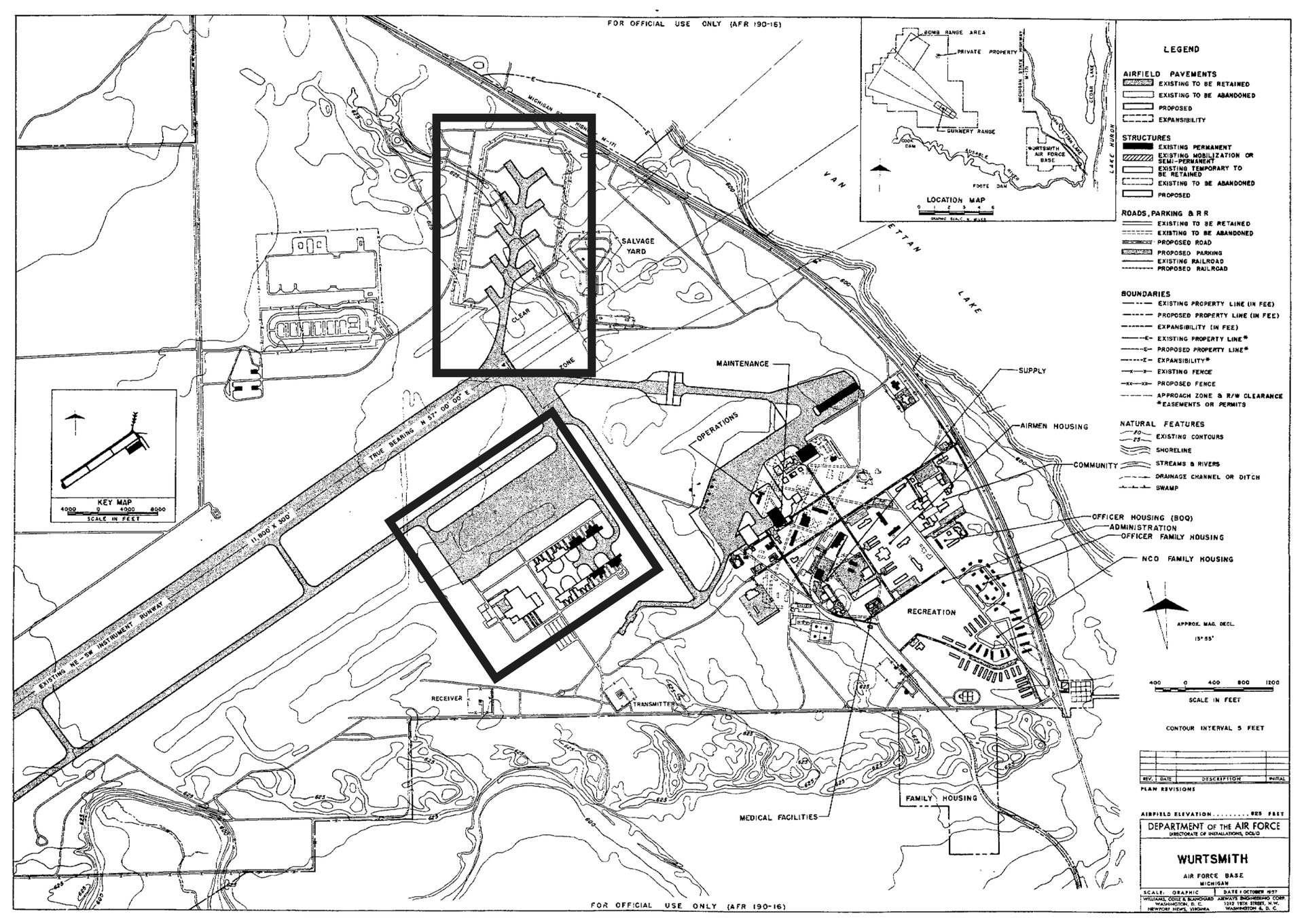
Pictured: the Strategic Air Command "Christmas tree" alert apron and tanker pen at Wurtsmith Air Force Base, from a U.S. Army Corps of Engineers historical study of Cold War SAC bomber infrastructure — the type of ready-alert parking and refueling infrastructure the base's KC-135 fleet, including the aircraft that pursued the object on October 30, 1975, operated from. This is not a photograph of the object or the incident itself; no photograph of the intruder is known to exist in any archive consulted for this case file, only radar logs, an Air Force Operations Center report, and written or later-interviewed witness testimony.
Theoretical Alignment
Wurtsmith is one of the better-documented military intrusion reports of the 1975 wave because a contemporaneous NORAD log entry survives alongside the witness accounts. That log, however, calls the intruder a helicopter, and the base’s own security reports used the same word. Most of what lends the case an Extraterrestrial reading, such as two objects “signalling” to each other, an object following the tanker, and a 1,000-knot departure, comes from one crew member’s memo written more than three years later. That keeps the ETH score moderate. The Interdimensional Hypothesis has nothing in the record to work with. The Psycho-Social/Mundane reading carries real weight: the craft was described in helicopter terms (running lights, hovering, a helicopter-like sound), and a pursuit over Lake Huron and Saginaw Bay at night, among boat lights, is a setting in which lights are easily confused.
Background
Wurtsmith Air Force Base began in 1923 as a landing area used by Army aircraft from Selfridge Field near Detroit, and was later known as Camp Skeel and, from 1942, as Oscoda Army Air Field. It was renamed Wurtsmith Air Force Base on February 15, 1953 for Major General Paul B. Wurtsmith, commander of the Eighth Air Force, who was killed when his B-25 crashed near Asheville, North Carolina, on September 13, 1946. The base passed to Strategic Air Command on April 1, 1960. It hosted the 40th Air Division from July 1959 and the 379th Bombardment Wing from January 1961, which controlled the 524th Bombardment Squadron (B-52s) and the 920th Air Refueling Squadron (KC-135s). It was one of the northern-tier bases that stored nuclear weapons.
By October 1975 the base’s weapons storage area (WSA) made Wurtsmith one of the class of installations, Strategic Air Command nuclear bases on the northern tier, that researcher Robert Hastings later argued saw a disproportionate share of reported unidentified aerial activity. Whether that thesis holds is disputed, and this file does not try to settle it. Wurtsmith’s October 30 report does fall inside the two-and-a-half-week wave of 1975 base intrusions that the NORAD message of November 11 summarised.
The base would go on to be selected for closure under the 1991 round of Base Realignment and Closure, shutting down in June 1993; its runways today form the civilian Oscoda-Wurtsmith Airport, and a portion of the old flightline houses the Wurtsmith Air Museum. The site was separately listed as an EPA Superfund location in January 1994 for groundwater contamination, with additional PFAS contamination identified in 2010 — an entirely unrelated environmental legacy of the base's decades of jet-fuel and firefighting-foam use, noted here only because it is sometimes conflated in casual online discussion with the base's UFO history, with which it has no connection.
Complete Timeline
| Date | Event |
|---|---|
| 1923 | A landing area for Army aircraft from Selfridge Field is established near Oscoda; later Camp Skeel, it becomes Oscoda Army Air Field in 1942 and Wurtsmith Air Force Base on February 15, 1953. |
| Apr. 1960 | Wurtsmith passes to Strategic Air Command; the 40th Air Division (from July 1959) and the 379th Bombardment Wing (from January 1961) are based there, with B-52 bombers and KC-135 tankers. |
| Oct. 27–28, 1975 | A separate, low-flying intruder is reported at Loring Air Force Base, Maine, approaching within roughly 300 yards of that base's nuclear weapons storage area — the wave's documented opening incident, three nights before Wurtsmith's own. |
| Oct. 30, 1975, ~10:10 p.m. | People in the family housing area report the running lights of a low-flying craft thought to be a helicopter, hovering and moving up and down. Airman Martin E. Tackabury at the Capehart housing gate sees it for about five seconds, due south, with one white light pointing down and two red lights near the rear, heading west-southwest; a B-52 overhead drowns any sound. |
| Same period | At the motor pool, Airman Michael J. Myers sees several lights near the western edge of the base turn north and lose altitude, with no sound. Sgt. Robert J. Anderson sees a KC-135 and, below and ahead of it, a slower craft with a steady red light, and thinks he hears a helicopter-like sound. Airman Roger Skipper at the main gate hears sounds that diminish quickly. |
| 10:14, 10:20, 10:25 p.m. | Security police at the back gate report to the command post that an unidentified “helicopter” with no lights has come over the back gate and is hovering at low altitude over the weapons storage area; it moves north and turns its lights on at the northern perimeter. Sgt. James A. Miller in the WSA hears what may be a helicopter off base to the north. The tower makes no visual contact, and no one tries to call the craft by radio. |
| ~10:30 p.m. | WSA security notifies Col. John J. Doran, vice commander of the 379th Bomb Wing; the command post notifies him and the wing commander, Col. Boardman, and both go to the flight line. Radar Approach Control (RAPCON) reports low-flying objects and tracks them about 35 miles on a southeastern bearing. Boardman orders a KC-135, returning from a refuelling mission and flying practice approaches, to try to identify the craft. |
| ~10:30–11:00 p.m. | The KC-135, with Maj. Frederick Pappas, Capt. K. E. May, Capt. Rick Meier, Capt. Myron Taylor (instructor navigator), Capt. Randy Higginbotham (instructor pilot) and Sgt. Steve Smith aboard, is vectored toward the object. By Taylor’s later account the crew follows flashing lights north over Lake Huron and then south toward Saginaw Bay at about 2,000 feet and 200 knots, loses them among fishing-boat lights, picks them up again on the way back, and sees one speed off toward the bay. |
| ~10:55 p.m. (0355Z) | The time NORAD later logs for the incident. The log says the tanker, at 2,700 feet, “made both visual sighting and radar skin paint” and tracked the object 25 nautical miles southeast over Lake Huron, where contact was lost. Low on fuel, the tanker returns; on final approach the crew sees the lights again near the WSA (Taylor). |
| Oct. 31, 1975, 0445Z | The NORAD Command Director’s Log records the report from Wurtsmith, relayed through the Air Force Operations Center. Local police and the FBI office in Saginaw are notified; air traffic in the area is checked; the Michigan Department of Natural Resources says it had no helicopters up. |
| Late Oct.–Nov. 1975 | Several northern-tier SAC bases, Wurtsmith among them, are placed on Security Option 3 alert because of repeated low-level intrusions over weapons storage areas. |
| Nov. 7–9, 1975 | Related, separately documented intrusions are reported at Malmstrom Air Force Base, Montana (radar contact 9,500–15,600 ft, lights extinguished as F-106 interceptors approach) and Minot Air Force Base, North Dakota (a silent, car-sized bright object at 1,000–2,000 ft). |
| Nov. 11, 1975 | A CINCNORAD (Commander-in-Chief, NORAD) message states: "Since 28 Oct 75 numerous reports of suspicious objects have been received at the NORAD COC. Reliable military personnel at Loring AFB, Maine, Wurtsmith AFB, Michigan, Malmstrom AFB, [Montana], Minot AFB, [North Dakota], and Canadian Forces Station, Falconbridge, Ontario, Canada, have visually sighted suspicious objects" — the same day as the separate CFS Falconbridge radar-visual incident. |
| Late 1970s | Phoenix-based Ground Saucer Watch, led by William H. Spaulding, obtains Air Force and NORAD records on the wave via Freedom of Information Act requests. |
| Jan. 1979 | Prompted by a congressional inquiry from Rep. Samuel Stratton, SAC’s history office asks the 379th Bomb Wing historian, SSgt. Paul J. Cahill, for records; he finds no mention of the incident in the October–December 1975 wing history, interviews Col. Doran, and on January 18 obtains a Memo for the Record from former Capt. Myron Taylor. On January 19, The Washington Post publishes “What Were Those Mysterious Craft?” by Ward Sinclair and Art Harris. |
| 1984 | Researchers Lawrence Fawcett and Barry Greenwood publish Clear Intent, compiling FOIA-obtained documentation on the wider wave, including Wurtsmith. |
| 1987 | Timothy Good's Above Top Secret: The Worldwide UFO Cover-Up summarizes the Wurtsmith incident for an international readership. |
| 2008 / 2017 | Robert Hastings publishes UFOs & Nukes (first edition 2008; expanded second edition 2017), situating Wurtsmith within his decades-long research project on UAP activity at U.S. nuclear weapons sites. |
| Sept. 27, 2010 | Hastings hosts a National Press Club briefing in Washington, D.C., at which former Air Force officers, including Robert Salas, testify about UAP activity at nuclear sites, drawing renewed national press attention to the broader body of cases Wurtsmith belongs to. |
| 2022 | Michigan MUFON director Bill Konkolesky presents on the Wurtsmith case at an East Tawas City Hall speakers' series, part of a resurgence of local interest in Michigan's Cold War UFO history. |
The Night of October 30, 1975: A Minute-by-Minute Reconstruction
The fullest account of the ground sightings is in Lawrence Fawcett and Barry Greenwood’s Clear Intent (1984, pp. 41–56), which NICAP reproduces. At about 10:10 p.m., people in the family housing area in the southeast of the base reported the running lights of a low-flying craft thought to be a helicopter, which “hovered and moved up and down in an erratic manner.” Airman Martin E. Tackabury at the Capehart housing gate saw it for about five seconds, due south of him, with “one white light pointing directly downward and two red lights near the rear,” heading west-southwest. He heard nothing because a B-52 was in the air nearby. At the motor pool, Airman Michael J. Myers saw several lights near the western edge of the base turn north and appear to lose altitude, again with no sound. Sergeant Robert J. Anderson saw an airborne KC-135 and “another craft with a steady red light” that “appeared to be flying slower, ahead and below the KC-135”; he believed he heard a helicopter-like sound, and the craft passed out of view after 30 to 35 seconds. Airman Roger Skipper at the main gate heard sounds that “diminished quickly.”
The more serious reports came from the weapons storage area. At 10:14, 10:20 and 10:25 p.m., security police at the back gate reported to the command post that “an unidentified helicopter with no lights came up over the back gate and hovered over the weapons storage area at a low altitude.” Security police in the WSA “could not make out the type of craft.” It moved toward the northern perimeter, where its lights came on again. Sergeant James A. Miller in the WSA heard what he took for a possible helicopter off base to the north. He thought he had heard one fifteen minutes earlier but had not reported it, and the noise was drowned out by a passing jet. The local police found nothing to suggest a landing. The control tower made no visual contact, and no one tried to call the craft by radio. An unlit craft over a nuclear weapons store is exactly what SAC security existed to react to, whatever it was.
WSA security notified Col. John J. Doran, vice commander of the 379th Bomb Wing; the command post notified him and the wing commander, Col. Boardman, and both went to the flight line. RAPCON then reported low-flying objects and tracked them about 35 miles on a southeastern bearing. A KC-135 returning from a refuelling mission had entered the traffic pattern to fly practice approaches. Boardman ordered it to try to identify the object, and Wurtsmith air traffic control vectored it toward the target. The response went further than at Loring three nights earlier: a crewed aircraft was sent after the intruder while the event was still under way.
The Paper Trail: NORAD’s Log and the 1979 Inquiry
The one record from the night itself is an entry in the NORAD Command Director’s Log, timed 0445Z on October 31, 1975: “Report from Wurtsmith AFB through Air Force Ops Center – incident at 0355Z. Helicopter hovered over SAC weapons storage area then departed area. Tanker flying at 2700 feet made both visual sighting and radar skin paint. Tracked object 25NM SE over Lake Huron where contact was lost.” The entry calls the intruder a helicopter, gives the tanker’s altitude as 2,700 feet, and confirms an airborne radar contact. The rest of the paper trail dates from January 1979. Rep. Samuel Stratton had made a congressional inquiry, and SAC’s history office asked the 379th Bomb Wing historian, SSgt. Paul J. Cahill, for documents. Cahill found “no references to the incident” in the October–December 1975 wing history. He met Col. Doran, by then the wing commander, who “recalled the incident and described what he remembered.” He then traced three former KC-135 crew members and obtained a Memo for the Record from Myron Taylor dated January 18, 1979. Doran reviewed and changed the draft, and the memo was marked For Official Use Only and sent to the Air Force history office. Clear Intent reproduces Cahill’s research log. Sgt. Steve Smith is listed there as the sixth man aboard the KC-135.
The KC-135 Intercept and the “1,000 Knots” Problem
The KC-135 crew is named in Clear Intent: Major Frederick Pappas, aircraft commander; Captain K. E. May, co-pilot; Captain Rick Meier, navigator; Captain Myron Taylor, instructor navigator; Captain Randy Higginbotham, instructor pilot; and Sergeant Steve Smith. Cahill’s log, however, refers to “the aircraft commander, Capt. Higginbotham,” so the sources disagree on who commanded the aircraft. Only Taylor’s account of the flight has been published; no statement from the other crew members has surfaced.
Taylor’s memo, written more than three years after the event and placing it “around the 1st of November,” is the source of every dramatic detail. “I remember seeing lights similar to strobe lights which were flashing irregularly. We followed the lights north out over Lake Huron and then the UFO swung south still over the lake toward the Saginaw Bay area.” He wrote that “after observing the lights we determined that there were in fact two objects and the irregular flashing appeared to be some sort of signal being passed from one to the other in an effort to maintain the same position.” The crew kept visual contact “most of the time,” about a mile away, at about 2,000 feet and 200 knots, but “I was only able to paint an object on the radar scope for about 10 seconds,” and “each time we attempted to close on the object it would speed away from us.” They lost it over Saginaw Bay “because of all the fishing boat lights”; at first they thought it had landed on one of the large oil tankers, “but later decided that we had been wrong.”
The detail responsible for the case’s reputation came next. “On the way back, we picked the UFO up again at our eight o’clock position. We turned away, and it proceeded to follow us. Finally, we turned back in the direction of the UFO and it really took off back in the direction of the Bay area. I know this might sound crazy, but I would estimate that the UFO sped away from us doing approximately 1,000 knots.” RAPCON then reported “a UFO four to five miles over the coast traveling in a westerly direction,” but the tanker was low on fuel and had to land. On final approach the crew “saw the lights again near the Weapons Storage Area.” About a week later, Taylor said, Higginbotham was questioned by the Air Force Office of Special Investigations and “cautioned not to discuss the incident.”
The 1,000-knot figure is therefore one navigator’s visual estimate, recalled after three years and introduced with “I know this might sound crazy.” It is not a radar measurement. Judging the speed of a light at night, with no known size or distance, is unreliable at the best of times, and the NORAD log written the same night mentions no high speed at all. It records a “helicopter” and a radar contact lost 25 nautical miles out over the lake. The two accounts are not necessarily in conflict, but only the log is contemporaneous.
The CINCNORAD Message and the Wider Northern Tier Wave
Wurtsmith’s report was part of a wider pattern. On October 27–28, 1975, a low-flying intruder had approached the nuclear weapons storage area at Loring Air Force Base, Maine; that case has its own file on this site. Over about three weeks in October and November, several northern-tier SAC bases were put on Security Option 3 alert because of repeated low-level intrusions over weapons storage areas. Cahill’s 1979 memo also refers to activity at Plattsburgh AFB, New York, in the same period.
Further incidents followed in early November at Malmstrom AFB, Montana (a radar contact between 9,500 and 15,600 feet, accompanied by a sound personnel described as jet-like, with the object's lights reported extinguished as NORAD-scrambled F-106 interceptors approached) and at Minot AFB, North Dakota (a bright, silent, car-sized object reported at 1,000 to 2,000 feet) — both events distinct from, and roughly a decade later than, this site's own separately published Malmstrom AFB Missile Shutdown (March 1967) and Minot AFB UFO Incident (October 1968) case files, which readers should not conflate with this 1975 wave despite the shared base names.
The wave's formal military acknowledgment came in a Defense Department message, classified CONFIDENTIAL and dated November 11, 1975, transmitted through NORAD's Combat Operations Center: "Since 28 Oct 75 numerous reports of suspicious objects have been received at the NORAD COC. Reliable military personnel at Loring AFB, Maine, Wurtsmith AFB, Michigan, Malmstrom AFB, [Montana], Minot AFB, [North Dakota], and Canadian Forces Station, Falconbridge, Ontario, Canada, have visually sighted suspicious objects." That same date, November 11, also happens to be the date of the separate, sustained radar-and-visual incident at CFS Falconbridge, Ontario, this site's own dedicated file for the wave's Canadian entry. The full wave across all these installations is synthesized in this site's separate 1975 SAC Base Intrusion Wave overview; this file does not attempt that broader synthesis, restricting its own scope to Wurtsmith's own specific night, witnesses, and evidence.
Dating the Wurtsmith Incident
Every detailed account of a Wurtsmith intrusion places it on the night of October 30, 1975: Clear Intent, NICAP’s reproductions, the NORAD log extract and UFO Casebook’s summary. NORAD logged the incident time as 0355Z on October 31. The “Oscoda AFB” title is itself a misnomer: Oscoda Army Air Field became Wurtsmith Air Force Base in 1953, and the older name survives here only as a familiar shorthand for the base beside the town of Oscoda. The page also does not describe the best-known Michigan radar case of the early 1950s. On July 29, 1952, according to Edward Ruppelt, an Air Defense Command radar station in central Michigan tracked a target crossing Saginaw Bay at 625 mph, and an F-94 crew briefly got a radar lock-on before it pulled away. That is a separate event from a different era.
October 27–28, 1975 is a real date in this story — just not Wurtsmith's. It is the documented start date of the wave's very first incident, at Loring Air Force Base, Maine, already covered in this site's own dedicated Loring AFB Nuclear Storage Area case file. The two incidents are easy to conflate, because a summary such as "object hovers over weapons storage area, prompting base alert" fits what happened at both bases: both bases are genuinely part of the same, tightly clustered two-and-a-half-week wave, both intrusions genuinely targeted a nuclear weapons storage area and triggered a base security alert, and the two dates sit only three days apart within the same documented sequence of events named together in the same CINCNORAD message. Wurtsmith's own incident is the real, well-documented, and independently sourced one of October 30, 1975; the October 27 date belongs to Loring.
Ground Saucer Watch, FOIA, and the Paper Trail
Records on the wave, including the NORAD log entries, were obtained through Freedom of Information Act requests in the late 1970s, notably by Ground Saucer Watch, a Phoenix-based group led by William H. Spaulding, and were later compiled in Clear Intent. On January 19, 1979, The Washington Post published “What Were Those Mysterious Craft?” by Ward Sinclair and Art Harris, which drew on Defense Department and NORAD documents. It reported that low-flying, elusive objects had visited a string of nuclear missile sites and bomber bases in Montana, Michigan and Maine, and that official records described them in inconsistent terms, from helicopters to unknown objects.
The same article reported that on November 11, 1975, the office of the Secretary of the Air Force instructed public-information staff to “avoid linking the scattered sightings unless specifically asked.” On its own, that is consistent with ordinary caution about feeding a “UFO wave” story to the press. It also shows that the Air Force knew the reports were connected and chose not to say so. Clear Intent (1984) and Timothy Good’s Above Top Secret (1987) compile the same FOIA material; they are not independent evidence.
The "Helicopter" Question: What the Base Itself Believed
Wurtsmith’s own people did not treat the intruder as self-evidently anomalous. The base security reports and the NORAD log both call it a helicopter, and the local police and the FBI office in Saginaw were notified, as one would for a suspected intrusion. NICAP’s summary of the published record says all possible air traffic in the area was checked and none explained the sightings. It also says the Michigan Department of Natural Resources, which sometimes flew helicopters to catch hunters spotlighting deer in the nearby Huron National Forest, was contacted and had no aircraft in the air.
Ruling out the DNR and the logged traffic is a real check, but a limited one. An unlogged civilian helicopter, an aircraft from another agency, or military traffic without a filed plan cannot be excluded from the published record, and the wave as a whole was never explained. The helicopter-like sounds, running lights and hovering reported on the ground fit a helicopter. The parts that do not fit, the two “signalling” objects, the pursuit of the tanker and the 1,000-knot dash, rest on Taylor’s later account.
Robert Hastings and the Nuclear-Sites Research Project
Robert Hastings, a researcher who has spent decades interviewing more than 150 retired U.S. Air Force veterans about reported UAP activity at American nuclear weapons facilities, situates Wurtsmith's October 1975 intrusion within a much longer historical pattern he has documented from the late 1940s into the 21st century, published in his book UFOs & Nukes: Extraordinary Encounters at Nuclear Weapons Sites (2008; expanded second edition 2017). Hastings' own most prominent public moment came on September 27, 2010, when he organized a National Press Club briefing in Washington, D.C. at which several former Air Force officers, including retired Captain Robert Salas (describing a separate 1967 incident at Malmstrom Air Force Base involving the near-simultaneous shutdown of ten Minuteman missiles) and retired Colonel Charles Halt (describing the 1980 Rendlesham Forest incidents at RAF Bentwaters, England), testified on the record about their own experiences.
In Hastings’ work, Wurtsmith appears mainly as one entry in the 1975 northern-tier wave rather than as a case built around a long personal interview like his Malmstrom material. Its evidential weight rests on the NORAD log and the witness accounts compiled in Clear Intent, plus Taylor’s 1979 memo. Only the log was written on the night.
Key Witnesses
Wurtsmith’s record names an unusually large number of people for a case this old, though not all of them saw anything. Five ground witnesses are named (Tackabury, Myers, Anderson, Skipper and Miller), and the back-gate guards who reported the craft over the WSA are not. Two senior officers (Boardman and Doran) are named because they were notified and directed the response. The six men aboard the KC-135 are named, but only Taylor’s account has been published.
Airman Martin E. Tackabury
Posted at the Capehart housing gate. At about 10:10 p.m. he saw the object for about five seconds, due south of him near the base perimeter, with one white light pointing straight down and two red lights near the rear, heading west-southwest. A B-52 nearby drowned out any sound (Clear Intent).
Airman Michael J. Myers
Assigned to Police Unit Seven and on duty at the motor pool. Looking west, he saw several lights near the western edge of the base that turned north and appeared to lose altitude; he heard no sound (Clear Intent).
Sergeant Robert J. Anderson
Also at the motor pool. He saw an airborne KC-135 and “another craft with a steady red light” flying slower, ahead of and below the tanker, believed he heard a helicopter-like sound, and lost sight of it after 30 to 35 seconds (Clear Intent).
Airman Roger Skipper
On duty at the main gate. Responding to the activity at the motor pool, he heard sounds that “diminished quickly” (Clear Intent).
Sergeant James A. Miller
Security policeman on duty in the weapons storage area. He heard the sound of a possible helicopter off base to the north, thought he had heard one fifteen minutes earlier without reporting it, and lost the sound when a military jet passed. The report of an unlit craft hovering over the WSA came from the back-gate guards, who are not named (Clear Intent).
Colonel Boardman
Wing commander. Notified by the command post, he went to the flight line and ordered a KC-135 returning from a refuelling mission to try to identify the object. He is not recorded as having seen it.
Colonel John J. Doran
Vice commander of the 379th Bomb Wing in 1975, notified by the weapons-storage-area security police that the back-gate guard had reported what he thought was a helicopter overhead. By January 1979, as wing commander, he described the incident to the wing historian and reviewed and amended Taylor’s Memo for the Record.
Major Frederick Pappas
Named in Clear Intent as the KC-135’s aircraft commander (the historian’s 1979 log calls Higginbotham the aircraft commander). No statement from him has been published.
Captain K. E. May
Named in Clear Intent as the KC-135’s co-pilot. No statement from him has been published.
Captain Rick Meier
Named in Clear Intent as the KC-135’s navigator. No statement from him has been published.
Captain Myron Taylor
Instructor navigator aboard the KC-135 and the only crew member whose account has been published: a Memo for the Record dated January 18, 1979, given to the 379th Bomb Wing historian after Taylor had left the Air Force. It is the source for the two objects “signalling” to each other, the chase to Saginaw Bay, the object following the tanker, the ~1,000-knot estimate, and the OSI questioning of Higginbotham.
Captain Randy Higginbotham
Instructor pilot aboard the KC-135 (the historian’s 1979 log calls him the aircraft commander). According to Taylor, he was questioned by the Air Force Office of Special Investigations about a week after the flight and “cautioned not to discuss the incident.”
Sergeant Steve Smith
Listed in Clear Intent as the sixth man aboard the KC-135 (his crew position, probably the boom operator’s seat, is not stated). No statement from him has been published.
The Five Observables Assessment
Assessment: Anti-Gravity Lift is rated Speculative: the craft was reported hovering, which a helicopter does routinely, and helicopter-like sounds were heard. Instant Acceleration is rated Present only on Taylor’s 1979 account of the object following the tanker and then speeding away; the same-night NORAD log mentions nothing of the kind. Hypersonic is rated Present (disputed figure). The ~1,000 knots is Taylor’s visual estimate (“I know this might sound crazy, but I would estimate”), not a radar measurement, and 1,000 knots is supersonic but well short of hypersonic. Low Observability is Speculative: the craft was unlit over the WSA, and Taylor could paint it on the tanker’s radar for only about ten seconds. Trans-Medium is Absent.
Evidence Assessment
Supporting Anomalous Origin
- Several ground witnesses in different places (housing gate, motor pool, main gate, back gate, weapons storage area) reported lights or a craft within the same half hour
- RAPCON tracked low-flying returns, and the NORAD log says the tanker made a visual sighting and a radar skin paint and tracked the object 25 nautical miles out over Lake Huron
- The incident was logged by NORAD the same night and named eleven days later in a CINCNORAD message alongside four other installations
- The Michigan DNR helicopter candidate was checked and excluded, and the logged air traffic did not explain the sightings
- Taylor’s account of an object that followed the tanker and then sped away, if accurate, does not fit a helicopter
Supporting Conventional Explanation
- The base security reports and the same-night NORAD log both call the intruder a helicopter, and ground witnesses reported helicopter-like sounds and running lights
- The dramatic details (two signalling objects, the pursuit of the tanker, ~1,000 knots) come from one crew member’s memo written more than three years later; no other crew statement has been published
- The ~1,000-knot figure is a visual estimate, which Taylor himself prefaced with “I know this might sound crazy”
- The pursuit was lost among fishing-boat lights over Saginaw Bay, and the radar contact was lost over Lake Huron; nothing was identified either way
- The October–December 1975 wing history contains no reference to the incident, and no photograph or physical trace exists
Why "Disputed"
The intrusion is real and documented: several ground witnesses, a radar track, a tanker sent to look, a same-night NORAD log entry and a mention in a NORAD summary message eleven days later. What is disputed is what the intruder was. The contemporaneous records call it a helicopter, and the ground reports (running lights, hovering, helicopter-like sounds) fit one. The features that point away from a helicopter come from a single source written more than three years later: two signalling objects, an object that followed the tanker, and a 1,000-knot dash. That source is not supported by any other crew statement and is not reflected in the NORAD log. The case is genuinely unexplained, because no helicopter was ever identified and the DNR was excluded. But it is not strong evidence of anything beyond an unidentified low-flying aircraft over a nuclear weapons area. A Disputed rating near 60 fits that balance.
Several things would raise the rating: a published statement from Pappas, May, Meier, Higginbotham or Smith; the RAPCON or tanker radar data; the base security police reports in full; or the OSI file on Higginbotham’s questioning. Without them, the case rests on a log that says “helicopter” and a memo that says “UFO.”
Sensor & Instrumentation Detection Profile
Two radar sources are recorded. RAPCON reported low-flying objects and tracked them about 35 miles on a southeastern bearing (Clear Intent), and later reported a target four to five miles off the coast heading west (Taylor). Aboard the tanker, the NORAD log says the crew made “radar skin paint” and tracked the object 25 nautical miles southeast over Lake Huron. Taylor wrote that he could paint it on his scope for only about ten seconds. No radar data, scope photographs or track plots have been published. No infrared, electromagnetic or radiological data exists.
Environmental & Geospatial Context
Wurtsmith Air Force Base sits on Michigan's Lower Peninsula "sunrise side," along Lake Huron's western shore near Oscoda, in Iosco County — a low-density, heavily forested region whose adjoining Huron National Forest is itself relevant to this case's leading mundane-candidate discussion (see "The Helicopter Question" above). No specific meteorological record for the night of October 30, 1975 was located in any source consulted for this case file; the sequence of events as documented — sustained visual contact with running lights from multiple ground positions, followed by an extended airborne visual pursuit over open water — implies conditions clear enough for uninterrupted line-of-sight observation, but this case file's research could not confirm cloud cover, visibility, or wind data for the specific evening. The pursuit's geography, carrying the object out over Lake Huron before radar contact was lost, places its final tracked position over one of the Great Lakes rather than over land, a detail this case file's Historical Precedents section below connects to at least one other well-known regional case.
Observer Credibility & Occupational Profile
The ground witnesses were security police and airmen on duty, used to reporting intrusions. Their accounts as summarised in Clear Intent are modest: brief sightings of lights, sounds that might have been a helicopter, and no claim of anything beyond an unidentified low-flying craft. The tanker crew were trained aviators, two of them instructors. Only one of them, Taylor, has an account on record, given as a civilian more than three years later.
None of the witnesses is known to have given a public interview in later decades, the way Robert Salas has for Malmstrom or Charles Halt for Rendlesham. Their accounts survive only through the records summarised in Clear Intent and through Taylor’s memo. That limits how far their testimony can be tested.
Physical & Material Assays
No physical trace evidence of any kind exists for this case. The object was never reported to land, and its entire documented interaction with the physical world consists of a radar return, a base's ground and airborne visual observations, and the sound described by weapons-storage-area guards as resembling a helicopter. No debris, landing-site impression, or material sample was ever recovered or is claimed to exist in any source consulted for this case file. See Material Analysis below for a full discussion of what does and does not survive of the case's documentary record itself.
Historical Precedents & Archive Matches
Wurtsmith's closest and most directly connected precedent is the wave's own opening incident at Loring Air Force Base, Maine, three nights earlier — a genuinely parallel case (a low-flying, quiet-to-silent intruder approaching a Strategic Air Command nuclear weapons storage area, triggering a base alert and an unsuccessful aircraft-based search) named alongside Wurtsmith in the same November 11, 1975 CINCNORAD message. The same message names Malmstrom Air Force Base, Montana and Minot Air Force Base, North Dakota's separate 1975 incidents (distinct from this site's own earlier, separately published case files on those same two bases from 1967 and 1968 respectively) and the same-day CFS Falconbridge radar-visual case in Ontario. This site's separate 1975 SAC Base Intrusion Wave overview synthesizes the full multi-base wave these five incidents belong to; this case file deliberately does not attempt that broader synthesis, restricting its scope to Wurtsmith's own night, witnesses, and evidence.
Geographically, Wurtsmith's pursuit path out over Lake Huron before radar contact was lost places it within the same general Great Lakes airspace as this site's Kinross Incident (November 1953, Lake Superior), a case involving a USAF F-89 interceptor that itself vanished after apparently merging with a radar target over a different Great Lake — a much more severe outcome than Wurtsmith's, but a useful regional precedent for radar-tracked intrusions over Great Lakes airspace specifically. More broadly, Wurtsmith fits within researcher Robert Hastings' documented pattern of reported UAP activity concentrated at U.S. nuclear weapons sites from the late 1940s onward, a pattern this site's UFOs and Nukes theory page addresses directly.
Material Analysis
There is no physical object, debris, or trace sample connected to this case; "material" here refers instead to the case's actual surviving evidentiary substrate — the NORAD Command Director’s Log entry, the witness accounts compiled in Clear Intent, Taylor’s 1979 memo, and the other written accounts that preserve the event — since that documentary record is the only tangible thing this case file's research was able to assess, and even then only via secondary compilations rather than a primary Air Force document image examined directly.
The Surviving Documentary Record
The core of the paper trail is the NORAD Command Director’s Log entry of 0445Z, October 31, 1975, reporting the incident at 0355Z as relayed from Wurtsmith through the Air Force Operations Center. Two other documents survive. Taylor’s Memo for the Record of January 18, 1979 was prepared for the Air Force history office in response to Rep. Stratton’s inquiry and marked For Official Use Only. The CINCNORAD message of November 11, 1975 names Wurtsmith among the bases with sightings. These were obtained through FOIA requests and compiled in Clear Intent (1984), which NICAP and UFO Casebook reproduce, and summarised in Timothy Good’s Above Top Secret (1987). The ground witnesses’ accounts as Clear Intent gives them appear to come from base security records, which have not been published in full.
What Does Not Survive
No photograph, film or physical trace exists. This file relies on the transcriptions in Clear Intent and NICAP, not on scans of the original log, memo or message. The wing history for October–December 1975, which the wing historian checked in 1979, contains no reference to the incident.
Supporting Non-Terrestrial or Unexplained Origin
- A same-night NORAD log entry records the incident, the tanker’s visual sighting and its radar skin paint
- Ground witnesses at several posts and RAPCON reported activity in the same half hour, through normal military channels
- The case's authenticity is reinforced by consistent wording of the CINCNORAD message across multiple independently published secondary sources
Supporting Terrestrial or Mundane Origin
- This file could not examine scans of the original NORAD log, memo or message, only consistent transcriptions
- No photograph or physical trace exists to allow any independent modern re-analysis of the object itself
- The base's own contemporaneous working language characterized the intruder as a "helicopter," the mundane default explanation, even though the specific locally plausible candidate that was checked (Michigan DNR) came back negative
The Conventional Explanation Candidate (CEC): Misidentified Helicopter
The Air Force’s own contemporaneous description, that the intruder was a helicopter, deserves first place because it was the base’s real-time judgment and the NORAD log’s wording, not a skeptic’s later guess. Ground witnesses reported running lights, hovering and helicopter-like sounds. Nick Redfern’s writing on the 1975 “phantom helicopter” wave notes that officials at several bases defaulted to “helicopter” for the same reasons. At Wurtsmith the most obvious local operator, the Michigan Department of Natural Resources, which sometimes flew night patrols over the Huron National Forest to catch deer poachers, was contacted and had nothing airborne. Logged air traffic was also checked.
Unidentified Civilian, Military, or Law-Enforcement Helicopter (Uninvestigated Operator)
Ruling out the single most locally obvious candidate operator does not rule out every possible helicopter. A civilian charter, a different law-enforcement agency's aircraft, or a military rotary-wing aircraft transiting the area without a flight plan on file with the tower RAPCON was drawing from remain candidates this case file's own research could not affirmatively exclude, because no source consulted documents an exhaustive canvass of every possible operator rather than the one specific agency (Michigan DNR) that was actually checked. This candidate cannot, however, comfortably account for the reported ~1,000-knot departure speed, which is roughly five to ten times faster than any helicopter flying in 1975 could sustain in level flight, let alone during a low-altitude departure maneuver.
Misidentified Fixed-Wing Aircraft (Military or Civilian)
A fixed-wing aircraft operating without lights, or with an unusual lighting configuration, at low altitude over a rural area at night could in principle account for some of the visual reports, and might better explain the eventual high-speed departure than a helicopter candidate does. It sits uncomfortably, however, against the specific, repeated description of the object hovering and moving slower than an accompanying KC-135 — behavior fixed-wing aircraft, particularly in 1975, do not readily perform at the low altitudes and slow speeds multiple witnesses independently described during the sighting's opening phase.
Radar Anomalous Propagation / Ground Clutter
Anomalous radar propagation, in which atmospheric conditions produce spurious returns that can appear as fast-moving or erratically behaving targets, is a well-documented phenomenon capable of accounting for radar-only anomalies in isolation. It does not, however, comfortably explain the independent, simultaneous ground-based visual and auditory reports, nor the KC-135 crew’s visual contact with lights that Taylor later described as two objects — a radar propagation artifact does not itself produce a correlated visual sighting from multiple independent ground positions plus an airborne crew.
Genuine Unconventional Aerial Object
This reading remains open. A low-flying craft entered the airspace over a nuclear weapons storage area without lights, was tracked on radar and pursued, and was never identified. It is tempered by the fact that the most unconventional details rest on one later account, and that the contemporaneous record describes nothing a helicopter could not do.
Unidentified Civilian/Military Helicopter
InconclusiveINCONCLUSIVE, leaning plausible for the ground sightings. It matches the contemporaneous log and the ground reports, and the one operator checked (Michigan DNR) came back negative, but not every operator could be excluded. It does not fit Taylor’s later account of the object following the tanker and departing at ~1,000 knots.
Misidentified Fixed-Wing Aircraft
ImplausibleIMPLAUSIBLE as a complete explanation. Sits uncomfortably against the specific, repeated description of slow, hovering flight at low altitude that multiple independent witnesses described during the sighting's opening phase.
Radar Anomalous Propagation
ImplausibleIMPLAUSIBLE as a complete explanation. A real, documented radar phenomenon that could account for an isolated radar anomaly, but it does not explain the independent, simultaneous ground and airborne visual contact.
Genuine Unconventional Aerial Object
InconclusiveINCONCLUSIVE. The craft was never identified and the obvious local helicopter was excluded, but the evidence for unusual performance comes from a single later account, and the contemporaneous record describes a helicopter.
Related Cases
Confirmed Documents & Official Records
The CIA's own declassified-document collection on UFOs, within which a 1979 document discussing the Air Force/NORAD data behind the 1975 SAC base wave (including Wurtsmith) is held.
DECLASSIFIED (various)A declassified CIA-held copy discussing the 1979 Washington Post report on Air Force and NORAD records concerning the October–November 1975 wave at Loring, Wurtsmith, and Malmstrom Air Force Bases.
DECLASSIFIEDThis case file's research could not obtain a directly legible image of the NORAD Command Director’s Log entry of October 31, 1975, Capt. Taylor’s 1979 memo, or the November 11, 1975 CINCNORAD teletype; the quoted text above is drawn from consistent transcriptions across NICAP, UFO Casebook, and published book-length treatments, not from this case file's own examination of the original document images.
Search Government & Military Archives Directly
Further Reading — Recommended Literature
UFOs & Nukes: Extraordinary Encounters at Nuclear Weapons Sites
The foundational research project situating Wurtsmith within decades of reported UAP activity at U.S. nuclear weapons sites, drawing on interviews with more than 150 retired Air Force veterans.
Clear Intent: The Government Coverup of the UFO Experience
A foundational compilation of FOIA-obtained Air Force, FBI, and CIA documentation, including the underlying paper trail behind the 1975 SAC base wave this case file draws on.
Above Top Secret: The Worldwide UFO Cover-Up
A wide-ranging survey of international government UFO files, including an early published summary of the Wurtsmith incident for a general readership.
DISCLOSURE: Some links above are affiliate links. If you purchase through them, OverClassified receives a small commission at no additional cost to you. This helps support independent research.
Essential Viewing
UFO's Buzz Wurtsmith Air Force Base: October 1975
A local Michigan history segment covering the October 1975 Wurtsmith AFB intrusion, drawing on the same declassified Air Force and NORAD records discussed in this case file.
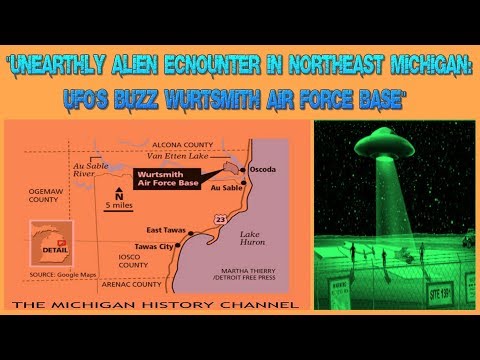
Unearthly Alien Encounter: UFO's Buzz Wurtsmith AFB, Oscoda, Michigan
A companion local-history segment revisiting the same October 1975 Wurtsmith incident and its place in Michigan's Cold War UFO record.
Sources
- NICAP. "Wurtsmith AFB Incursion." nicap.org
- NICAP. "UFO Report" (Wurtsmith AFB, October 30, 1975 witness statement compilation). nicap.org
- NICAP. "Wurtsmith and Others," on the broader Oct–Nov 1975 Northern Tier SAC base wave. nicap.org
- UFO Casebook. "UFOs Intrude into SAC Base Weapons Areas: October–November, 1975." ufocasebook.com
- The War Zone (TWZ). "The Mysterious Cold War Case Of Unidentified Aircraft Descending On Loring Air Force Base." twz.com
- Sinclair, Ward, and Art Harris. "What Were Those Mysterious Craft?" The Washington Post, Jan. 19, 1979. washingtonpost.com
- Central Intelligence Agency. FOIA Reading Room, "UFOs: Fact or Fiction?" collection. cia.gov
- Central Intelligence Agency. FOIA Reading Room, "What Were Those Mysterious Craft?" (declassified document). cia.gov
- CBS News. "Ex-Air Force Personnel: UFOs Deactivated Nukes." cbsnews.com
- Gander Newsroom. "Spies in the Sky Over Michigan? The 2023 UFOs Weren't the First Unidentified National Security Threats." gandernewsroom.com
- Iosco County News. "UFO Expert Talks About Sightings in Michigan." iosconews.com
- Redfern, Nick. "The Mysterious UFO-Helicopter Wave of 1975," via JimHarold.com. jimharold.com
- Military History of the Upper Great Lakes (Michigan Technological University). "Wurtsmith Air Force Base, a Brief History and Life on Post." ss.sites.mtu.edu
- Fawcett, Lawrence, and Barry J. Greenwood. Clear Intent: The Government Coverup of the UFO Experience (1984).
- Good, Timothy. Above Top Secret: The Worldwide UFO Cover-Up (1987).
- Hastings, Robert L. UFOs & Nukes: Extraordinary Encounters at Nuclear Weapons Sites (2008; 2nd ed. 2017), via ufohastings.com
- "Robert Hastings (ufologist)." Wikipedia. en.wikipedia.org
- "Wurtsmith Air Force Base." Wikipedia. en.wikipedia.org
- YouTube oEmbed API verification for video ID CnwsiOIJE5U (title, author, and thumbnail confirmed live). youtube.com
- YouTube oEmbed API verification for video ID dVoZJAOp15E (title, author, and thumbnail confirmed live). youtube.com
- Wikimedia Commons. "SAC Christmas Tree Alert Apron... Wurtsmith Air Force Base" (U.S. Army Corps of Engineers, public domain), source of this case file's hero image. commons.wikimedia.org
Corrections (October 2026)
This page was checked in October 2026 against Clear Intent (Fawcett and Greenwood, 1984, pp. 41–56, as reproduced by NICAP). That account includes the 379th Bomb Wing historian’s January 1979 research log and Capt. Myron Taylor’s Memo for the Record of January 18, 1979. Other sources were NICAP’s case summary, which quotes the NORAD Command Director’s Log; UFO Casebook’s text of the November 11, 1975 CINCNORAD message; the January 19, 1979 article by Ward Sinclair and Art Harris; Edward Ruppelt’s account of the 1952 Michigan radar case; and a JPL Horizons ephemeris. Confirmed: the date (October 30, 1975); the named ground witnesses and their posts; the back-gate reports at 10:14, 10:20 and 10:25 p.m.; Colonels Boardman and Doran; the RAPCON track of about 35 miles to the southeast; the KC-135 crew names; Taylor’s “two objects” and “approximately 1,000 knots” quotations; the DNR check; and the CINCNORAD wording.
Following this review, the rating was changed from Disputed 70 to Disputed 60 (October 27, 2026), because the higher rating had rested partly on claims corrected or removed above.
Corrected: there was no “same-night OPREP timestamped 0355Z.” The contemporaneous record is a NORAD Command Director’s Log entry made at 0445Z on October 31, giving the incident time as 0355Z (10:55 p.m. EST). It calls the craft a helicopter and says the tanker, at 2,700 feet, made a visual sighting and radar skin paint, and lost contact 25 nautical miles southeast over Lake Huron. The 25-mile point is the tanker’s contact, not RAPCON’s. Taylor’s account, the source of the “two objects,” the pursuit and “1,000 knots,” is a memo written in January 1979, not a same-night statement. The 1,000-knot figure is his visual estimate. The chase went north over Lake Huron, then south to Saginaw Bay, where the lights were lost among fishing boats. The helicopter-like sound was reported by Anderson and Miller, not by “guards over the WSA.” Boardman and Doran were notified but are not recorded as witnesses, so “thirteen named witnesses” overstated the roster. Sgt. Steve Smith was the sixth man aboard the KC-135, and the sources disagree on whether Pappas or Higginbotham was aircraft commander. The 379th Bomb Wing’s history for late 1975 contains no reference to the incident. The Moon was about 16% lit and below the horizon, not 22%. The base’s early history was also corrected.
Removed as unsupported: the SAC “Defense Against Helicopter Assault” directive and its ten-base distribution list; the B-52H “State of Michigan” nickname and “at least three fully armed B-52s” on alert; the description of the base’s origin as a Michigan National Guard training ground; and Robert Hastings as “photography-trained.” Added: a note that the page does not describe Ruppelt’s July 29, 1952 Saginaw Bay radar and F-94 case, and that “Oscoda AFB” had not been the base’s name since 1953.
See something inaccurate? Have additional information or sources?
Suggest an Edit →Last Updated: October 2026