
The Kinross Incident
On the night of November 23, 1953, First Lieutenant Felix Moncla Jr. and Second Lieutenant Robert L. Wilson took off from Kinross Air Force Base in an F-89C Scorpion interceptor to identify an unknown radar target over Lake Superior. Guided by the ground-controlled intercept (GCI) radar at Calumet Air Force Station on the Keweenaw Peninsula, the fighter descended toward the target; at about 6:55 PM its blip merged with the target's on the controller's scope, and the fighter was never seen or reliably heard from again. A U.S. and Canadian air and surface search found no wreckage, no oil slick and no trace of either airman. The Air Force said the target was a Royal Canadian Air Force C-47 transport that was off course, and that the F-89 crashed after the intercept, perhaps because the pilot became disoriented. The C-47 was real and was over the lake that night, but its pilot later insisted he was never off course, and RCAF spokesmen answering NICAP in 1961 and 1963 denied that one of their aircraft had been involved. More than seventy years later, the aircraft and its crew have never been found.
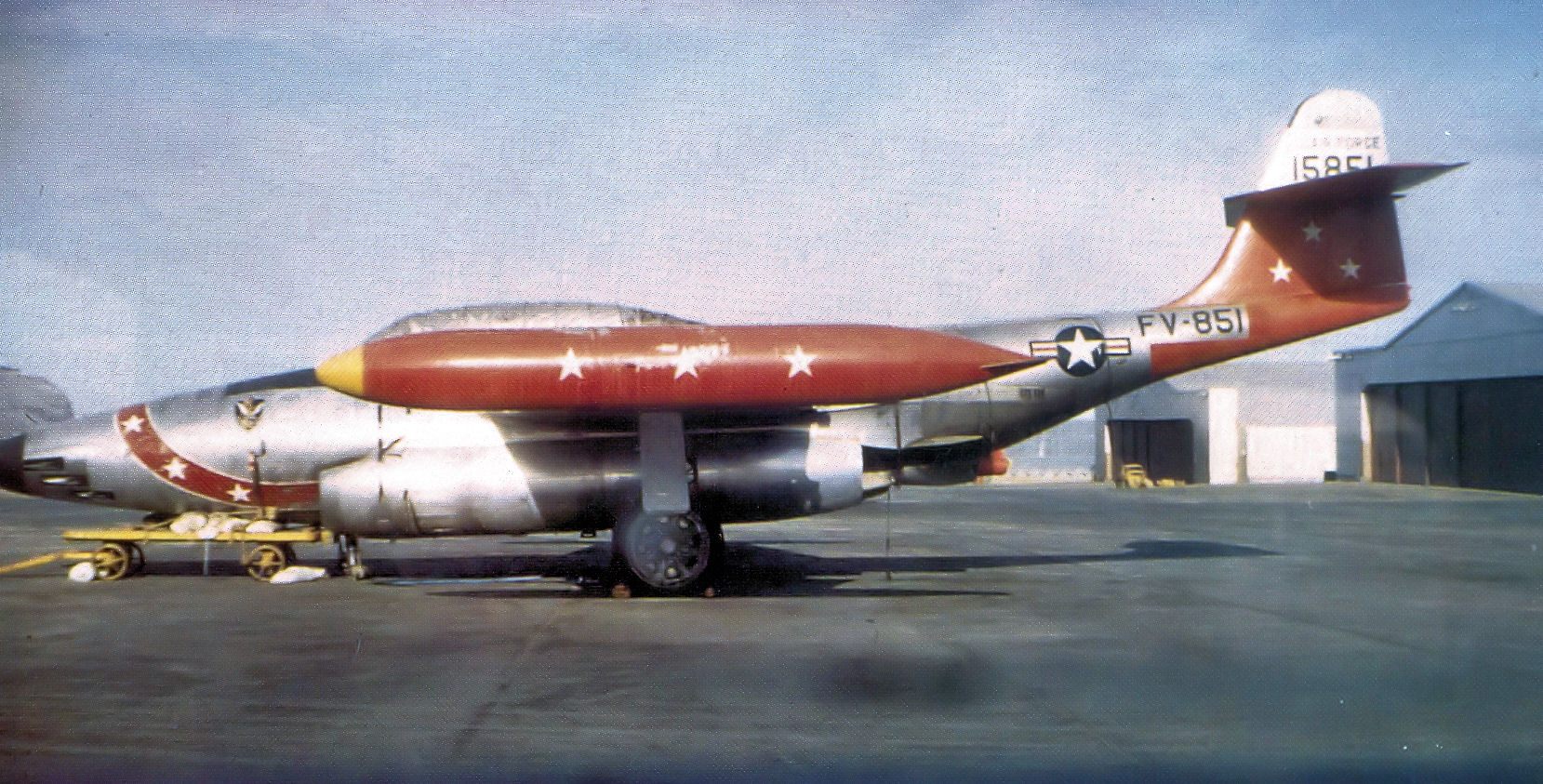
Pictured: a Northrop F-89C-40-NO Scorpion of the same 74th Fighter-Interceptor Squadron and production block, photographed at Presque Isle AFB, Maine in 1954 — not the actual aircraft (s/n 51-5853A) flown by Felix Moncla and Robert Wilson, which vanished over Lake Superior on November 23, 1953 and was never recovered. No photograph of that specific airframe is known to exist.
Theoretical Alignment
Kinross earns a modest ETH score not because any witness described a structured craft — no one did, since the target was tracked only on radar — but because the central event, a fighter whose return vanished at the moment it merged with its target, has never been explained by the conventional account on offer. The Psycho-Social component reflects the secondary mythology that has attached itself to the case over seven decades: a 1953 rumor that the jet was "hit by a flying saucer," a target speed misread from Keyhoe's narrative, an anonymous radar-station posting, and a hoaxed 2006 sonar "discovery." The bulk of the case's real uncertainty, however, sits outside all three frameworks: the most likely target, an RCAF C-47, is well identified, but why the fighter was lost, and why it left no trace, is not.
Background
Felix Eugene Moncla Jr. was born October 21, 1926, in Mansura, Louisiana, to Felix Moncla Sr., a high school science teacher and principal and a World War I veteran, and Yvonne Beridon Moncla, a seamstress; the family later moved to nearby Moreauville. He attended Southwestern Louisiana Institute (now the University of Louisiana at Lafayette) on an athletic scholarship, playing football and earning a B.S., and served with the Army in occupied Japan after World War II. He enlisted in the U.S. Air Force as an officer pilot trainee after the outbreak of the Korean War in 1950, training at Connally Air Force Base in Waco, Texas — where he met and married Bobbie Jean Coleman — then at Reese Air Force Base in Lubbock, and finally on the F-89 Scorpion at Tyndall Air Force Base in Panama City, Florida, where the couple's first son was born. In July 1952 the family moved to Madison, Wisconsin, where Moncla was assigned to the 433rd Fighter-Interceptor Squadron at Truax Field; a daughter was born about five months before his disappearance.
Robert L. Wilson, a second lieutenant from Ponca City, Oklahoma, served as Moncla's radar observer — the "backseater" responsible for operating the F-89C's onboard radar and guiding the pilot onto a target once ground control had made the initial vector. Comparatively little of Wilson's personal biography survives in the public record next to Moncla's; the one colleague later located by researchers, fellow F-89 pilot William Mingenbach, spoke highly of him. Earlier versions of this page gave his age as 22 and styled him "Jr."; neither detail was found in a source.
Both men were, in November 1953, on temporary duty with Detachment 1 of the 433rd Fighter-Interceptor Squadron at Kinross Air Force Base in Michigan's eastern Upper Peninsula. Kinross had been built in 1943 as an auxiliary airfield to refuel aircraft bound for Alaska and help defend the Soo Locks; it passed to the Air Force on July 1, 1952 under Air Defense Command's 30th Air Division, to defend Sault Ste. Marie and the upper Great Lakes. The base's own fighter unit, the 438th Fighter-Interceptor Squadron, had been activated there in April 1953 with F-94B Starfires. According to researcher Gord Heath, the Truax crews were at Kinross because the base's own fighter and ground crews were away on gunnery training at Yuma, Arizona. The same day, the 433rd lost a second F-89C: at about 1 PM, Lt. John W. Schmidt and Capt. Glen E. Collins were killed when their aircraft crashed into the marsh at Lake Wingra in Madison after an afterburner test flight.
Complete Timeline
| Date | Event |
|---|---|
| October 21, 1926 | Felix Eugene Moncla Jr. is born in Mansura, Louisiana. |
| 1950 | Moncla returns to U.S. Air Force service with the outbreak of the Korean War and begins pilot training. |
| July 1952 | Moncla and his family relocate to Madison, Wisconsin, as he joins the 433rd Fighter-Interceptor Squadron at Truax Field, flying the F-89C Scorpion. |
| November 23, 1953, ~1:00 PM CST | A second 433rd FIS F-89C, flown by Lt. John W. Schmidt with Capt. Glen E. Collins, crashes at Lake Wingra in Madison after an engine test flight; both men are killed. |
| ~6:17 PM EST | The GCI radar at Calumet Air Force Station ("PILLOW," 665th Aircraft Control & Warning Squadron) detects an unidentified target; Kinross is ordered to scramble. Control is initially with "NAPLES," the 753rd AC&W Squadron at Sault Ste. Marie. |
| 6:22 PM | An F-89C Scorpion (s/n 51-5853A, call sign "Avenger Red"), piloted by 1st Lt. Felix Moncla with 2nd Lt. Robert Wilson as radar observer, takes off from Kinross AFB. |
| 6:41–6:49 PM | After poor radio reception, control passes from NAPLES to PILLOW. Vectored west-northwest, then west, Moncla climbs to about 30,000 feet; at 6:49 he is passing 25,000 feet as PILLOW orders him down to 7,000 feet, turning east-northeast onto the target. |
| 6:52 PM | PILLOW controller 2nd Lt. Douglas A. Stuart tells Moncla the target is at his 11 o'clock, 10 miles out; Moncla acknowledges. The next range and heading call gets no response. |
| ~6:55 PM | On the PILLOW scope the fighter's blip merges with the target's at about 8,000 feet, roughly 70 miles off Keweenaw Point; the F-89's IFF signal is lost and no blip is seen to break away. No further confirmed transmission is received. |
| 7:15–7:35 PM | A second F-89 ("Avenger Black," Lt. William Mingenbach) is airborne at 7:15 and sent to the area. About 7:35, Mingenbach and his radar observer hear a brief, broken transmission, a few seconds long, that both believe was Moncla's voice. |
| 8:07 PM | Capt. Bridges reports the F-89C overdue; the RCAF's Eastern Area Rescue Coordination Centre is contacted at about 10:00 PM and directs the search. |
| November 24–28, 1953 | Search aircraft of the USAF 49th Air Rescue Squadron, the U.S. Coast Guard (including the cutter Woodrush), the Civil Air Patrol and RCAF C-47s search the lake and shoreline. |
| November 24, 1953 | Madison papers report both of the day's 433rd losses; the Wisconsin State Journal's "2 Truax Men Killed in Jet's Crash Here" concerns the Lake Wingra crash. An early-edition Associated Press story carried by the Chicago Tribune quotes Truax: "The plane was followed by radar until it merged with an object 70 miles off Keweenaw Point." |
| November 28–30, 1953 | The search, having covered an estimated 80 percent of the designated area without result, is suspended on November 28, then briefly reopened on November 30 after Algoma Central Railway workers report hearing a crash about 100 miles north of Sault Ste. Marie. |
| Late 1953 | The Air Force's explanation, recorded in the accident investigation: the target was RCAF C-47 VC-912, Winnipeg to Sudbury, classified as "unknown" because it was about 30 miles off course; the F-89 crashed for unknown reasons after the intercept. |
| May 1954 | A second search is mounted by the 49th Air Rescue Squadron after further information from Robert Wilson's father; it also finds nothing. |
| 1955 | Donald Keyhoe publishes an account of the case in The Flying Saucer Conspiracy, reporting that an Air Force public information officer, Lt. Robert C. White, told him "the unknown in that case was a Canadian DC-3." |
| 1961 & 1963 | Answering NICAP's inquiries, RCAF spokesmen deny that one of their aircraft was involved; Squadron Leader W. B. Totman notes that the C-47 was said to be on a flight plan over Canadian territory and that "this alone would seem to make such an intercept unlikely." |
| October 1968 | Two prospectors find aircraft parts in the bush near Alona Bay on Lake Superior's eastern shore, about 70 miles north of Sault Ste. Marie; the Sault Star asks whether they belong to the missing F-89, but their identity is never published. |
| March 2004 | Researcher Gord Heath of UFO*BC locates the C-47's pilot, former RCAF flight lieutenant Gerald Fosberg, who writes that a ground station asked whether his crew had seen another aircraft's lights and that they had seen nothing; he later insists to Heath that his aircraft was never off course. |
| September 2006 | An email from an "Adam Jimenez," claiming to represent a "Great Lakes Dive Company," reaches NICAP's Francis Ridge with crude "sonar scans" said to show an intact F-89 on the lakebed and, later, a nearby "metallic disc"; the claim spreads across UFO forums and websites. |
| October–November 2006 | MUFON's James Carrion and shipwreck historian Brendon Baillod find no such company registered in Michigan and no trace of "Jimenez" among Great Lakes wreck hunters; Canada denies having restricted access to any site; an accompanying "Associated Press" story proves fake. In mid-October the company's website goes blank and "Jimenez" stops responding. |
| 2020s | The case remains a recurring subject of Great Lakes regional history writing and UFO literature; no wreckage, debris, or remains connected to the F-89C or its crew has ever been publicly verified. |
The Scramble Over the Soo Locks
The sequence began in the early evening of November 23, 1953. According to the timeline compiled by the Open Skies Project from the accident investigation and unit records, the GCI radar at Calumet Air Force Station on the Keweenaw Peninsula — call sign "PILLOW" — detected an unidentified target at about 6:17 PM. An F-89C Scorpion on alert at Kinross Air Force Base, flown by 1st Lt. Felix Moncla with 2nd Lt. Robert Wilson in the radar observer's seat, took off at 6:22 PM under the control of "NAPLES," the 753rd Aircraft Control & Warning Squadron station near Sault Ste. Marie; the 30th Air Division's control center at Willow Run ("HORSEFLY") had overall command. Moncla was vectored west-northwest, then west, climbing to about 30,000 feet; at 6:41 PM, after poor radio reception, control passed to PILLOW. Popular accounts say the target was first seen over the Soo Locks; the official record places the intercept far out over the lake.
The Descent onto the Target
At 6:49 PM, with the fighter passing 25,000 feet, PILLOW cleared Moncla down to 7,000 feet, turning him east-northeast so that he came steeply down onto the target from above. The controller told him the target would be moving from left to right, west to east. At 6:52 PM, controller 2nd Lt. Douglas A. Stuart reported the target at Moncla's eleven o'clock position, ten miles out, and Moncla acknowledged — the last transmission from the aircraft on the official record. Donald Keyhoe later wrote that the target changed course as the fighter approached and that Wilson should have been able to see it on the F-89's own radar; neither detail appears in the official record, and earlier versions of this page presented a struggle by Wilson to hold a radar lock, which no source supports.
The Merge
What happened next is the single most consistently documented — and most debated — fact in the case. On the Calumet scope, the fighter's return and the target's return converged into one. The 433rd Fighter-Interceptor Squadron's unit history recorded it in procedural language: "GCI had control of the fighter and was directing it from 25,000 feet down to 7,000 feet. The fighter and the bogey blips merged on the GCI radar scope. There was no further transmission from the fighter, the bogey was not aware of any aircraft in the area, and GCI saw no blips break off from the target." The last radar position put the fighter at about 8,000 feet, roughly 70 miles off Keweenaw Point and about 150 miles northwest of Kinross, well into the Canadian side of the lake. The accident report itself noted that a merge is expected in an intercept; what was not expected was that the fighter's return, and its IFF signal, never reappeared. The unit history's note that the "bogey was not aware of any aircraft in the area" implies that controllers were in radio contact with the target aircraft, which fits the later identification of a Canadian transport. Earlier versions of this page said that controllers at three stations watched the merge; the records describe it on the Calumet scope.
The Search That Found Nothing
Attempts to raise Moncla and Wilson by radio went unanswered. A second F-89 under Lt. William Mingenbach was airborne at 7:15 PM and sent toward the last position; at about 7:35 PM he and his radar observer heard a brief, broken transmission of a few seconds that both believed was Moncla's voice, and Mingenbach later told researcher Gord Heath it seemed to contain the words "we had better..." At 8:07 PM Capt. Bridges reported the aircraft overdue. Because the loss was in Canadian waters, the RCAF's Eastern Area Rescue Coordination Centre directed the search, with USAF 49th Air Rescue Squadron aircraft, U.S. Coast Guard units including the cutter Woodrush, the Civil Air Patrol and RCAF C-47s. The search was suspended on November 28, 1953, after covering an estimated 80 percent of the designated area; it was briefly reopened on November 30 after Algoma Central Railway workers reported hearing a crash about 100 miles north of Sault Ste. Marie, and a second search followed in May 1954. Nothing was found: no oil slick, no floating wreckage, no life raft, no remains. That outcome is unusual for a jet crash into open water, though Lake Superior's depth and cold are well known for keeping what it takes; the freighter Edmund Fitzgerald, lost in 1975, was located on the bottom within days, but only because searchers knew within a few miles where she went down and used aircraft magnetometers and sonar.
The Official Explanation: A Royal Canadian Air Force C-47
The explanation recorded in the Air Force's accident investigation was that the target Moncla had been vectored onto was a Royal Canadian Air Force C-47 Dakota transport, VC-912, flying from Winnipeg to Sudbury, Ontario, and classified as "unknown" because it was about 30 miles off course. Under this account Moncla completed the intercept and then crashed for reasons unknown. Spatial disorientation ("vertigo") was suggested, but according to the accident report the vertigo evidence was hearsay and vertigo was not listed among the board's findings. At the press briefing the day after the loss, the Truax commander, Lt. Col. Harry Shoup, offered his own theory that the pilot banked steeply during the intercept and lost control. Donald Keyhoe, in his 1955 book The Flying Saucer Conspiracy, reported that after hearing of a rumor at Selfridge Field that an F-89 from Kinross had been "hit by a flying saucer," he called the Air Force press office, where Lt. Robert C. White told him "the unknown in that case was a Canadian DC-3. It was over the locks by mistake." Keyhoe later wrote, from letters sent to him by a relative of Moncla's, that one Air Force visitor told Moncla's widow her husband had flown too low while identifying a Canadian aircraft, while a second said the jet had exploded at high altitude.
The Canadian Rebuttal
Where this explanation runs into trouble is with the Canadian side. Keyhoe reported that Canadian airlines quickly denied having any flights in the area, and when NICAP asked the RCAF in 1961 and again in 1963, spokesmen denied that one of their aircraft had been involved; Squadron Leader W. B. Totman noted that the C-47 was said to be on a flight plan over Canadian territory and that "this alone would seem to make such an intercept unlikely." The RCAF did not deny that the C-47 existed or that it was over the lake that night. In 2004, researcher Gord Heath of UFO*BC located its pilot, Gerald Fosberg, then a flight lieutenant with 412 Squadron at Rockcliffe. In a letter dated March 1, 2004, Fosberg wrote that his log books confirmed the flight; that they were "probably at 7,000 or 9,000 feet over a solid cloud deck below and absolutely clear sky above"; that a ground station near Sault Ste. Marie asked whether they had seen another aircraft's lights and said an interceptor had been scrambled and lost; and that they had seen nothing. Heath reports that Fosberg insisted his aircraft was never off course. Fosberg repeated his account in David Cherniack's 2006 documentary The Moncla Memories. Readers should know that Heath's investigation began with what he describes as childhood "memories" that seemed to him to relate to Moncla; he presents those separately and does not claim they are real.
The Target's Speed and Course
A frequently repeated objection is that the target was flying "in excess of 500 mph" and changing course, behavior impossible for a C-47 that cruised at well under 200 mph. That objection does not survive a check of the sources. The 500 mph figure comes from Donald Keyhoe's narrative, where it describes the F-89 following the target out over the lake, not the target itself; Keyhoe described the target only as "flying as fast as a jet airliner." No official document seen for this file gives the target's speed, and the controller's instruction that the target would be moving from left to right (west to east) is consistent with an eastbound Winnipeg–Sudbury flight. The course change appears only in Keyhoe's account. What remains genuinely unexplained is not the target's performance but why the fighter's return vanished at the moment of the merge.
The Air Force's Own Contradiction
Perhaps the strangest wrinkle in the official record is the Air Force's own later inconsistency about whether the case was ever formally investigated as a UFO sighting at all. Statements attributed to the Air Technical Intelligence Center (ATIC), the Wright-Patterson-based body that oversaw Project Blue Book, and quoted in later accounts, assert that "there is no record in the Air Force files of sighting at Kinross AFB on 23 November 1953... there is no case in the files which even closely parallels these circumstances." Popular accounts add that NICAP researchers found references to the mission "expunged from official records"; no NICAP document saying so was found for this file, and the accident report, statements and unit histories have in fact been released under FOIA (to CUFON and, more fully, to investigator John Tenney). The likelier explanation for ATIC's answer is mundane: the loss was investigated by an aircraft accident board, as Richard Hall noted, not filed as a UFO report.
Sensationalized Claims and the Case's Secondary Mythology
As with Mantell five years earlier, Kinross accumulated a layer of embellishment beyond the 1953 record, and some genuine early details have been misfiled as later mythology. Donald Keyhoe reported a rumor, passed on by phone, that the F-89 had been "hit by a flying saucer"; he presented it as a rumor from Selfridge Field. The late radio transmission, by contrast, is not a later legend: Lt. William Mingenbach described it in his statement to the accident board, and the board's findings mention it. Earlier versions of this page attributed it to investigator John Tenney as an uncorroborated claim of a voice heard "hours" later; Tenney's actual contribution was obtaining, by FOIA, the board statements that record it. Likewise the Algoma Central Railway report of a heard crash was reported in newspapers within days, not recalled "decades later." Genuinely uncorroborated is a web posting by a man who said he was on duty at the Battle Creek, Michigan radar station that night, describing two F-89s heading out, one aborting for mechanical trouble, and transmissions dissolving into static; its details do not match the official timeline. A third-hand report via investigator Ray Stanford that a GCI operator later described the target as "very large" is hearsay. A claim that Moncla deliberately left his wallet behind before the flight, repeated in earlier versions of this page, was not found in any source and has been removed.
The 2006 "Great Lakes Dive Company" Sonar Claim
In September 2006, an email reached NICAP's Francis Ridge from a contact calling himself "Adam Jimenez," representing an outfit called the "Great Lakes Dive Company." It claimed the company had used towed side-scan sonar in the summer of 2005 to find what appeared to be a mostly intact F-89 on the bottom of Lake Superior near the 1953 loss position, missing one wing and a horizontal stabilizer. "We expected, at best, to locate an engine, wing or other small debris," Jimenez told the Marquette Mining Journal. The claim escalated: Jimenez said the team had found a "metallic disc" a little more than 215 feet from the wreck, bearing a mark that could match the missing wing, that it could not be sonar-imaged because it was emitting some kind of "radiation," and that the Canadian government was denying them access. The story spread across UFO forums, including UFO Updates and UFO Digest, and was covered on Linda Moulton Howe's Earthfiles website.
The claim did not survive scrutiny. James Carrion, MUFON's international director, found no company of that name registered in Michigan and no one among Great Lakes wreck-salvage operators who had heard of it or of "Adam Jimenez"; the Canadian government said it had no record of any contact with the company and had denied it nothing; and the "Associated Press" story attached to the original email had never been released. Shipwreck historian Brendon Baillod of the Great Lakes Shipwreck Research Center published his own rebuttal concluding that the claims were an elaborate hoax; the website was registered to a post office box in Emeryville, California. Gord Heath noted that the published "scans" looked like crude drawings or a photographed model run through a noise filter, and the company claimed to have imaged the "disc" by lowering a jury-rigged fish finder to a depth of about a thousand feet. In mid-October 2006 the website went blank and "Jimenez" stopped answering calls and email. Frank Warren, who reposted coverage of the affair on The UFO Chronicles, summed it up: "The Great Lakes Dive Company debacle was a hoax created out of whole cloth." This file treats the 2006 claim as a hoax, not as evidence of any kind.
Circumstantial Evidence
- The intercept was run by a trained GCI controller on an operational air-defense scramble, and the merge and loss were recorded in the 433rd Fighter-Interceptor Squadron's unit history and the accident investigation, not reconstructed later.
- The 433rd Fighter-Interceptor Squadron's own contemporaneous internal unit history recorded the merge and total loss of contact in plain administrative language, with no incentive to embellish an already embarrassing operational loss.
- RCAF spokesmen, answering NICAP in 1961 and 1963, denied that one of their aircraft had been involved, and Squadron Leader Totman called the intercept "unlikely" because the C-47 was on a flight plan over Canadian territory.
- The C-47's pilot, Gerald Fosberg, wrote in 2004 that his crew saw no other aircraft, and insisted to researcher Gord Heath that he was never off course.
- Despite a five-day, binational air-and-surface search covering an estimated 80 percent of the target zone, absolutely no wreckage, debris, oil slick, or remains connected to the F-89C were ever recovered.
- Air Technical Intelligence Center statements quoted in later accounts say it held no record of a sighting at Kinross on that date — consistent with the loss having been handled as an accident rather than a UFO report, but leaving no UFO file to consult.
- The one claimed physical discovery in the case's history — the 2006 "Great Lakes Dive Company" sonar wreckage — was investigated in detail and conclusively established to be a hoax, removing rather than adding to the case's physical evidence base.
Key Researchers
- Donald Keyhoe (1897–1988) — Retired Marine Corps major and NICAP founder who published one of the earliest detailed accounts of the case in his 1955 book The Flying Saucer Conspiracy, including a reported private Air Force confirmation of the Canadian-aircraft identification.
- Gord Heath — UFO*BC researcher whose online investigation of the case gathered the accident-board statements, contemporary newspaper reports and the 1968 parts story, and who located RCAF pilot Gerald Fosberg in 2004. His interest began with what he describes as personal "memories" relating to Moncla.
- James Carrion — International Director of the Mutual UFO Network (MUFON) in 2006, who led the investigation that conclusively established the "Great Lakes Dive Company" sonar-wreckage claim was a hoax.
- Brendon Baillod — Great Lakes maritime historian whose independent research corroborated that no legitimate dive operation of that name or description existed, reinforcing Carrion's 2006 hoax findings.
- Donald Menzel (1901–1976) — Harvard astronomer and prominent UFO skeptic who proposed that ground radar operators likely observed a "phantom echo" of the F-89 itself, generated by atmospheric conditions, which briefly merged with and then vanished alongside the jet's own genuine return.
- Francis Ridge — Longtime NICAP web archivist and producer of NICAP's Kinross pages, who received the September 2006 "Adam Jimenez" email claiming discovery of the F-89's wreckage.
Cultural Impact
Kinross has never achieved the household-name recognition of Roswell or even Mantell, a gap partly explained by minimal contemporary newspaper coverage outside Wisconsin and Michigan and partly by the case's unphotogenic nature — a radar blip merging with another radar blip does not make a memorable image. In Great Lakes history circles, however, it endures as one of the region's most durable unsolved mysteries, discussed in Michigan and Ontario local journalism and by the Open Skies Project, the group of friends and family who bought the former Calumet Air Force Station and are restoring it. Moncla's memorial at Sacred Heart Cemetery in Moreauville, Louisiana bears the inscription "Disappeared Nov. 23, 1953 intercepting an UFO over Canadian Border as Pilot of a Northrup F89 Jet Plane" and is frequently reproduced in coverage of the case, a rare instance of a family's own memorial adopting the UFO framing that official Air Force records never used.
Key Witnesses
1st Lt. Felix E. Moncla Jr.
A Korea-era Air Force pilot from Louisiana who trained on the F-89 Scorpion at Tyndall AFB and was assigned to the 433rd FIS at Truax Field, Wisconsin. On temporary duty at Kinross AFB the night of November 23, 1953, Moncla was scrambled to intercept an unidentified radar target over Lake Superior; his aircraft's radar return merged with the target's on the Calumet GCI scope and never reappeared. Neither he nor his aircraft was ever found.
2nd Lt. Robert L. Wilson Jr.
A radar officer from Ponca City, Oklahoma, Wilson occupied the F-89C's rear seat, responsible for operating the aircraft's onboard radar and guiding Moncla onto the target once ground control handed off the intercept. He disappeared alongside Moncla and was never found.
2nd Lt. Douglas A. Stuart
The GCI controller at Calumet who handled the final vectoring of Moncla's intercept, reporting the target at the F-89's eleven o'clock position, ten miles out, at 6:52 PM — the last acknowledged instruction on record. Minutes later the fighter's and the target's returns merged on his scope and the fighter's never reappeared. His written statement, which includes the account of the C-47 being about 30 miles off course, is the core of the Air Force accident report.
Gerald Fosberg
A flight lieutenant with 412 Squadron at Rockcliffe, Ontario, and pilot of C-47 VC-912, the aircraft the Air Force accident investigation identified as the "unknown" target. Located by researcher Gord Heath in 2004, Fosberg wrote that a ground station had asked whether his crew had seen another aircraft's lights and that they had seen nothing, and he insisted to Heath that he was never off course; he repeated his account in a 2006 documentary.
Donald Keyhoe
The retired Marine Corps major and prominent flying-saucer author gave the case its first detailed treatment in his 1955 book The Flying Saucer Conspiracy, reporting that an Air Force press officer told him the unknown was a Canadian DC-3, and returned to it in Aliens From Space (1973), which quotes the Chicago Tribune early-edition headline "JET, TWO ABOARD, VANISHES OVER LAKE SUPERIOR."
The Five Observables Assessment
The Five Observables framework, developed by former AATIP director Luis Elizondo, is used to classify UAP encounters by performance characteristics exceeding known technology of their era. Kinross poses an unusual challenge for the framework: because the object was tracked exclusively by ground and airborne radar and was never visually observed by any witness, before or after the merge, there is no eyewitness morphology or flight-path description to evaluate against any of the five criteria — only the radar behavior itself.
Assessment: Anti-Gravity Lift is rated absent: with no visual observation of the object at any point in the encounter, there is no basis to describe any propulsion or lift mechanism, exotic or otherwise. Instant Acceleration is rated speculative only because Donald Keyhoe wrote that the target changed course as the fighter approached, a detail some researchers read as evasive maneuvering; the surviving record does not describe the rate or magnitude of any such course change precisely enough to call it anomalous rather than simply a normal turn by a conventional aircraft. Hypersonic Velocity is rated absent: no source gives the target's speed; the often-quoted 500 mph figure describes the F-89 in Keyhoe's narrative. Low Observability is rated absent: the target was tracked by the Calumet GCI radar throughout the intercept, showing no evidence of radar-evading behavior. Trans-Medium travel is rated absent; no transition between air, water, or space was ever reported for the object itself (as distinct from the F-89's own presumed descent into the lake). Taken together, the Five Observables data is essentially silent on the question of exotic origin, not because it argues against one, but because the case simply never generated the kind of visual or behavioral data the framework is built to evaluate.
Evidence Assessment
Supporting Anomalous Origin
- RCAF spokesmen answering NICAP in 1961 and 1963 denied that one of their aircraft had been involved, and the RCAF spokesman called the intercept "unlikely."
- The C-47's pilot says his crew saw no other aircraft and that he was never off course, which undercuts the reason given for classifying his aircraft as "unknown."
- No wreckage, debris field, oil slick, or remains were ever recovered despite an extensive five-day binational search — an outcome inconsistent with most jet-fuel-laden crashes into open water.
- The accident investigation did not establish why the fighter crashed; the vertigo explanation rested on hearsay and is not among the board's findings.
Supporting Conventional Explanation
- RCAF C-47 VC-912 was genuinely over Lake Superior that night, its pilot confirms a ground station asked about another aircraft, and the unit history records that the "bogey" was not aware of any aircraft in the area — all consistent with a real, conventional target.
- Spatial disorientation ("vertigo") during a low-altitude night descent over featureless open water, with no visual horizon reference, is a well-understood and still-occurring hazard in modern aviation, entirely sufficient on its own to explain a fatal crash independent of what the radar target actually was.
- Lake Superior is deep and cold, and a crash in open water at night, without a known position, could leave little that a 1953 search would find; the total absence of debris is unusual but not inexplicable.
- The most sensational secondary claims associated with the case — the "hit by a flying saucer" rumor, the Battle Creek posting, the "very large" target hearsay — are secondhand or anonymous, and the claimed 500 mph target speed turns out to describe the F-89, not the target.
- The one claimed piece of physical evidence for anything unusual at the crash site — the 2006 sonar "discovery" — was investigated in detail and conclusively exposed as a hoax with a fabricated wire story and a nonexistent company.
Why "Disputed"
This file rates the Kinross Incident DISPUTED rather than "Credible" or "Debunked" because its central question — what happened to the F-89 at the moment of the merge — has never been answered, while the identity of the target is better established than popular accounts suggest. What is well documented: a trained GCI controller watched the fighter close on a target and its return vanish at the merge; the unit history and accident investigation record it; the late, broken transmission is in the board's findings; and a binational search found nothing. The target was very probably RCAF C-47 VC-912, which was over the lake and in radio contact with ground stations. What remains open is narrower: the reason the C-47 was treated as "unknown" (its pilot denies being off course, and the RCAF denied involvement when NICAP asked), why the fighter crashed, and why no trace of it has ever been found. The case's most sensational elements — the "flying saucer" rumor, the 500 mph target, the 2006 sonar discovery — are either rumor, misreadings, or a hoax.
Sensor & Instrumentation Detection Profile
Kinross is fundamentally a radar-only case. Three Air Defense Command facilities were involved in controlling the intercept: NAPLES, the 753rd Aircraft Control & Warning Squadron radar at Sault Ste. Marie, which had initial control of the scramble; PILLOW, the 665th AC&W Squadron station at Calumet Air Force Station on the Keweenaw Peninsula, which detected the target and ran the final intercept (its radar was probably an AN/CPS-5); and HORSEFLY, the 30th Air Division's control center at Willow Run. The merge itself is recorded on the Calumet scope: two returns, one the F-89C and one the target, closing until they occupied a single position, after which the fighter's return and its IFF signal were not seen again. No gun camera, photographic, or recorded radar data exists, and neither crewman described what, if anything, they could see. The case's evidentiary profile is therefore the inverse of a typical visual sighting: instrument-based observation of behavior by a trained controller, with no visual, physical, or personal-account description of appearance.
Environmental & Geospatial Context
The intercept took place after dark on a late-November night over the open, frigid waters of Lake Superior, the last radar position about 70 miles off Keweenaw Point and about 150 miles northwest of Kinross, on the Canadian side of the international boundary. Weather records summarized by Richard Hall describe several layers of scattered cloud, one with bases between 5,000 and 8,000 feet, and snow flurries in the area, with stable air and little or no turbulence; the Open Skies Project adds that visibility was generally 8 to 10 miles but as low as 1 to 2 miles in snow showers. Hall noted that the flight was on instruments, which bears on the vertigo theory. According to NASA JPL Horizons, the Moon (about 88% illuminated, waning gibbous) was below the horizon throughout the intercept and rose at about 7:40 PM EST. Lake Superior is the largest, coldest, and deepest of the Great Lakes, which bears on the failure of the search discussed below.
Observer Credibility & Occupational Profile
The primary witnesses to the Kinross Incident were on-duty U.S. Air Force radar controllers performing an assigned air-defense function, not chance civilian observers. 2nd Lt. Douglas A. Stuart, the controller who vectored Moncla onto his final heading, was a trained GCI operator working a live scramble, and his written statement is the core of the accident report — although researcher Gord Heath believes parts of it, particularly the claim that the C-47 was 30 miles off course, are contradicted by other evidence. The 433rd Fighter-Interceptor Squadron's unit history recorded in flat procedural language that "the fighter and the bogey blips merged on the GCI radar scope." Felix Moncla was a qualified pilot on an active alert crew, and Robert Wilson a trained radar observer. Weighed against this testimony is the case's greatest evidentiary weakness: no one — not Moncla, not Wilson, not any ground station — is recorded as having seen the object, so no testimony exists about what it looked like.
Physical & Material Assays
No physical evidence connected to the unidentified object, the F-89C, or either crewman has ever been recovered, examined, or tested. The search directed by the RCAF's Eastern Area Rescue Coordination Centre, with USAF 49th Air Rescue Squadron aircraft, U.S. Coast Guard units, the Civil Air Patrol and RCAF aircraft, covered an estimated 80 percent of the designated area before it was suspended on November 28, 1953; it was briefly reopened on November 30, and a second search was mounted in May 1954. No oil slick, floating debris, wing section, life raft, or remains were found. The RCAF search report recorded two tips considered reliable — a mail courier's sighting of possible wreckage near the Cut River Bridge in Michigan, which state police dismissed as rocks, and a reported sighting of wreckage on a mountainside on the lake's eastern shore, searched without result. Aircraft parts found near Alona Bay in October 1968 were never publicly identified. The only claimed modern discovery — the 2006 "sonar" images — was a hoax, discussed above.
Historical Precedents & Archive Matches
Kinross sits inside the same first great wave of Cold War-era radar and intercept cases that also produced the Gorman Dogfight (1948) and the Washington, D.C. UFO flap (1952), and it shares a grim distinction with the Thomas Mantell case of 1948: both involve a military pilot who died during an official interception of an unidentified aerial object, and both were blamed on pilot physiology (hypoxia for Mantell, a suggested but unproven vertigo for Moncla) layered on a conventional identification of the object itself. Period UFO literature also linked Kinross to the disappearance two weeks earlier, on November 10–11, 1953, of a small plane carrying the self-described contactees Karl Hunrath and Wilbur Wilkinson near Los Angeles; there is no established connection between the two. Within the Air Force's own archive Kinross occupies an odd position: unlike Mantell, which became one of Project Sign's first major cases, it was investigated by an accident board rather than as a UFO report, and statements attributed to the Air Technical Intelligence Center say "there is no record in the Air Force files of sighting at Kinross AFB on 23 November 1953" — so there is no Blue Book file to consult, only the accident report and unit histories.
Material Analysis
Kinross presents this catalogue's starkest material-evidence profile: nothing physical, from either the target or the missing F-89C, has ever been recovered, examined, or tested. This differs sharply from Mantell, where the pursuing aircraft's wreckage was found within hours. Here, a binational air-and-surface search covering an estimated 80 percent of the designated area, briefly reopened on November 30 and repeated in May 1954, produced no oil slick, no floating debris, no life raft, and no remains. The only claimed physical material connected to the case — the 2006 "Great Lakes Dive Company" images purporting to show an intact airframe and a nearby "metallic disc" — was a hoax: no such company existed, the accompanying wire story was fake, and the images resembled crude drawings rather than sonar returns. No legitimate side-scan sonar or remotely operated vehicle survey of the loss area by a maritime archaeology or salvage organization is known to this file.
Supporting a Genuinely Unresolved Loss
- The total absence of any wreckage after an extensive, well-resourced binational search is a genuinely unusual outcome for a fuel-laden jet crash into open water, and remains formally unexplained regardless of what caused it.
- No legitimate scientific survey of the reported loss site has ever definitively located, examined, or ruled out the presence of wreckage.
Supporting a Mundane (if Undocumented) Loss
- Lake Superior's depth and cold, and the absence of any precise crash position, make a complete failure to find a small jet in 1953 unusual but not inexplicable.
- The single claimed piece of physical evidence for anything at the site — the 2006 sonar "discovery" — was conclusively established as a hoax, meaning zero credible physical evidence exists pointing toward an exotic explanation either.
The Conventional Explanation Candidate: The RCAF C-47 Intercept and Vertigo Crash
The explanation recorded in the Air Force accident investigation holds that Moncla's radar target was RCAF C-47 VC-912, flying from Winnipeg to Sudbury and classified as "unknown" because it was about 30 miles off course, and that Moncla intercepted it and then lost control of his own aircraft for reasons the board could not establish; spatial disorientation during a night descent over open water was suggested. It deserves serious consideration: the C-47 was genuinely over the lake that night, its pilot recalls a ground station asking about another aircraft, the squadron history records that the "bogey" was not aware of any aircraft in the area, and night disorientation remains a well-understood aviation hazard.
A caveat on treating the U.S. Air Force's resolution as settled: the identification and the crash are separate questions. The first is reasonably well supported; the second is not. The board did not find a cause, the vertigo evidence was hearsay, the C-47's pilot denies the off-course premise, and RCAF spokesmen later denied involvement. A Cold War-era Air Force facing a lost interceptor had an obvious incentive to close the file quickly; this file notes that without concluding the C-47 explanation is false.
Where the RCAF Explanation Falls Short
Its central weakness is that the reason given for the intercept is disputed by the aircraft's own pilot: Gerald Fosberg insisted he was never off course, and his crew saw no other aircraft. RCAF spokesmen answering NICAP in 1961 and 1963 denied that one of their aircraft had been involved, and Squadron Leader Totman thought an intercept of a flight planned over Canadian territory "unlikely." And the absence of any wreckage means the crash half of the explanation, whatever its cause, has never been physically confirmed. Earlier versions of this page also cited a target speed "in excess of 500 mph"; that figure describes the F-89 in Keyhoe's narrative, not the target.
Radar Malfunction or Atmospheric "Phantom Echo"
A second candidate, proposed by the Harvard astronomer Donald Menzel, who accepted the vertigo explanation, holds that ground radar operators saw a "phantom echo" of the F-89 itself, produced by atmospheric conditions, which merged with the jet's genuine return and vanished with it when the plane struck the water. This candidate requires no second aircraft. It struggles against the record: the target was detected before the fighter took off and was being tracked as the intercept developed, and the squadron history's note that the "bogey was not aware of any aircraft in the area" implies a real aircraft in radio contact. Richard Hall, writing for NICAP, also asked why, if Menzel was right, the Air Force needed to invoke a Canadian C-47 at all.
Simple Mechanical or Structural Failure
A third candidate holds that Moncla's F-89C suffered an ordinary mechanical or structural failure during the steep descent, unrelated to the target — a real risk given the type's troubled early history, which included a fleet-wide grounding in late 1952, and given that the 433rd lost another F-89C to an unexplained crash in Madison the same afternoon. The Open Skies Project, which compiled the most detailed timeline from the official records, calls mechanical failure "one plausible theory." Under this view the merge on the scope reflects the fighter reaching the target's position as it went down. The documentation is not detailed enough to confirm or rule out this possibility.
RCAF C-47 Intercept & Vertigo Crash
Plausible DisputedThe C-47 was real and over the lake, but its pilot disputes the off-course premise, the RCAF later denied involvement, and the board never established why the F-89 crashed.
Related Cases
Confirmed Documents & Official Records
National Archives finding aid for the Project Sign, Project Grudge, and Project Blue Book records transferred from Wright-Patterson AFB (Record Group 341), the broader collection within which any surviving Kinross-related Air Force paperwork would fall.
UNCLASSIFIED (declassified)Finding aid for Project Blue Book's textual and microfilm holdings; useful for researchers attempting to locate the 433rd Fighter-Interceptor Squadron's own contemporaneous accident and unit-history paperwork on the Moncla/Wilson loss.
UNCLASSIFIEDSummary of the institutional lineage from Project Sign through Project Grudge, Blue Book, and the modern AARO, including AARO's 2024 historical record review covering Cold War-era investigations such as Kinross.
UNCLASSIFIEDSearch Government Archives Directly
Further Reading — Recommended Literature
The Flying Saucer Conspiracy
Keyhoe's own contemporaneous account of the Kinross disappearance, published just two years after the event, including his claim of a private Air Force confirmation of the Canadian-aircraft identification well before it was made public.
The Report on Unidentified Flying Objects
Written by the first head of Project Blue Book, this remains the essential primary account of how the Air Force's investigative apparatus actually functioned during the exact period of the Kinross loss, including its Ground Control Intercept and radar-verification procedures.
Project Blue Book Exposed
A detailed case-by-case review of Blue Book's most significant files by a veteran Air Force intelligence officer and researcher, useful for placing Kinross's unusual "no record found" status within the wider pattern of Blue Book record-keeping failures.
Watch the Skies!: A Chronicle of the Flying Saucer Myth
A rigorously documented, skeptically minded history of American UFO cases that situates Kinross within the broader early-1950s wave of radar-intercept "unknowns" generated by Air Defense Command's rapidly expanding Cold War radar network.
DISCLOSURE: Some links above are affiliate links. If you purchase through them, OverClassified receives a small commission at no additional cost to you. This helps support independent research.
Essential Viewing
The Creepy Missing F-89 Pilot — The Kinross UFO Incident
A detailed narrative walkthrough of the November 23, 1953 scramble, the radar merge, and the disputed RCAF C-47 explanation, from documentary channel Dark Docs.
Kinross Incident: Airmen & Jet Go Missing in 1953 After UFO Encounter
Den of Geek's "Talking Strange" series covers the disappearance, the GCI radar merge, and the case's enduring status as an unsolved Air Force loss.
1953's Strangest Air Force Mystery: The Kinross Incident
A focused deep-dive covering Moncla and Wilson's background, the intercept itself, and the case's lasting place in Cold War-era UFO history.
Sources
- "Felix Moncla," Wikipedia (comprehensive biography and incident summary with citations). en.wikipedia.org
- National Investigations Committee on Aerial Phenomena (NICAP). "Kinross Tragedy," including 433rd FIS unit history excerpts. nicap.org
- UFOBC.ca. "The Kinross Incident" (complete multi-page research archive: opening questions, witness accounts, newspaper articles, and official documents). ufobc.ca
- UFOBC.ca. "Great Lakes Dive Company Hoax." ufobc.ca
- Fear of Landing. "Another Unsolved Mystery: The Kinross Incident." fearoflanding.com
- Open Skies Project. "The Kinross Incident" (timeline compiled from the USAF accident investigation, unit histories and contemporary newspapers by the group restoring the former Calumet Air Force Station; radar call signs, times, altitudes and search details). openskiesproject.org
- Think About It Docs. "1953: The Kinross Air Force Base Incident." thinkaboutitdocs.com
- UFO Insight. "The Kinross Incident — The Disappearance of Felix Moncla and Robert Wilson." ufoinsight.com
- Lost In Michigan. "The Kinross Incident" (Moncla gravestone inscription and Michigan regional context). lostinmichigan.net
- Visit Keweenaw. "Missing in the Keweenaw | The Kinross Incident." visitkeweenaw.com
- The UFO Chronicles. "The Mystery of 'The Kinross Incident' Deepens" (2006 hoax investigation, Frank Warren). theufochronicles.com
- "Kincheloe Air Force Base," Wikipedia (base history, 438th FIS activation, F-94B/F-89D transition). en.wikipedia.org
- "Northrop F-89 Scorpion," Wikipedia (aircraft specifications and service history). en.wikipedia.org
- Michigan Technological University, Military History of the Upper Great Lakes. "438th Fighter-Interceptor Squadron." ss.sites.mtu.edu
- Aviation Safety Network. "Accident Northrop F-89C Scorpion 51-5853, Monday 23 November 1953." aviation-safety.net
- Find a Grave. "1LT Felix Eugene 'Gene' Moncla Jr. (1926–1953)," Memorial #27943536, Sacred Heart Cemetery, Moreauville, Louisiana. findagrave.com
- Channel3000 / WISC-TV. Moe, Doug. "Disappearance of Two Madison Airmen in 1953 Remains a Mystery." channel3000.com
- WOODTV.com. "The Kinross Incident: Alien Encounter or a Fatal Flight Error?" woodtv.com
- "Kincheloe Air Force Base," Military Wiki (438th FIS operational timeline and Cold War context). military-history.fandom.com
- Wikimedia Commons. "74th Fighter-Interceptor Squadron Northrop F-89C-40-NO Scorpion 51-5851.jpg" (U.S. Air Force photograph, public domain). commons.wikimedia.org
- Keyhoe, Donald E. The Flying Saucer Conspiracy, Henry Holt and Co., 1955.
- Keyhoe, Donald E. Aliens From Space: The Real Story of Unidentified Flying Objects, Doubleday, 1973.
- Clark, Jerome. The UFO Encyclopedia, 4th Edition, Relevant Information LLC (Kinross Incident entry).
- Randle, Kevin D. Project Blue Book Exposed, Barnes & Noble Books, 1996.
- Ruppelt, Edward J. The Report on Unidentified Flying Objects, Doubleday, 1956 (context on 1950s Air Defense Command intercept procedures and Ground Control Intercept methodology).
- Peebles, Curtis. Watch the Skies!: A Chronicle of the Flying Saucer Myth, Smithsonian Institution Press, 1994 (1950s radar-intercept case context).
- Richard Hall, "Kinross AFB / F-89 Disappearance," NICAP (from USAF accident-report records: vectors, 30,000/7,000/8,000 ft, 70 miles off Keweenaw Point, ~150 miles NW of Kinross, weather, NICAP's 1961/1963 RCAF queries and the Totman quotation, Menzel's phantom-echo explanation). nicap.org
- Gord Heath, UFO*BC, "Persons Involved" (Moncla and Wilson biographies, Mingenbach's account of the late transmission, Fosberg's letter of March 1, 2004), "Railway Crew Heard Crash," "Aircraft Parts Found in 1968," "The Battle Creek Witness," "F-89 Crash in Madison" (Wisconsin State Journal, November 24, 1953), "My Story." ufobc.ca
- John Pepin, "The Mystery of the Kinross Incident Deepens," The Mining Journal (Marquette), November 26, 2006, as reposted by The UFO Chronicles (Jimenez quotations, 215-foot "disc," Warren's comment).
- NASA JPL Horizons, observer ephemeris for the Moon at 47.9°N, 87.5°W, November 23–24, 1953, 23:00–01:00 UT (QUANTITIES 4 and 10), queried October 2026. ssd.jpl.nasa.gov
Corrections (October 2026)
This page was checked in October 2026 against the 433rd FIS unit history and Calumet unit record (as transcribed by NICAP), Richard Hall's summary of the accident-report records, the Open Skies Project timeline compiled from the accident investigation, Gord Heath's UFO*BC investigation (including Gerald Fosberg's 2004 letter), Wikipedia's summary of the accident report (pointer), contemporary newspaper reports, and coverage of the 2006 hoax. The basic story holds, but much of the detail was wrong. The merge was seen on the Calumet (PILLOW) scope, not at "three stations"; Calumet, not Sault Ste. Marie, first detected the target, at 6:17 PM. The RCAF did not deny "from the outset" that any of its aircraft was in the area: the C-47 was over the lake, its pilot confirms a ground station asked about another aircraft, and the RCAF denials quoted were answers to NICAP in 1961 and 1963 that one of its aircraft was "involved." Fosberg wrote to Gord Heath in 2004 (there is no 2003 UFOBC Quarterly article in any source seen). The "in excess of 500 mph" target speed came from Keyhoe's description of the F-89, and Wilson's difficulty holding a radar lock is in no source. The late radio transmission was reported by Lt. William Mingenbach to the accident board about 40 minutes after the loss, not "hours" later via John Tenney, and the Algoma Central Railway crash report was in the newspapers within days. The "2 Truax Men" headline concerned a second F-89 crash in Madison the same day. The 2006 hoax "sonar scans" looked crude, not "too clean"; the Coast to Coast AM date was not confirmed. Removed as unsourced: Moncla's "more than 1,000 flight hours," Wilson's age, the wallet story, a November 1952 Bonanza disappearance, the statement that the Edmund Fitzgerald was not located for weeks, the Open Skies Project's "Michigan Tech" affiliation, and the claim that the 438th FIS was not yet operational (Heath gives the Kinross crews' Yuma gunnery training as the reason for the detachment). The computed lunar figure was replaced with the JPL Horizons value.
Following this review, the rating was changed from Disputed 54 to Disputed 50 (October 27, 2026), because the higher rating had rested partly on claims corrected or removed above.
See something inaccurate? Have additional information or sources?
Suggest an Edit →Last Updated: October 2026