
UFOs Are Real
Extraterrestrial Encounters Documented by the U.S. Government — Sgt. Clifford Stone's FOIA Casebook
Core Thesis
UFOs Are Real is two books bound together, and a reader has to separate them because the author does not. The first is a Freedom of Information Act compilation: Clifford E. Stone, a retired US Army sergeant, spent years filing narrowly targeted requests against Air Force and Navy intelligence, the CIA and the State Department, and surfaced genuine declassified material — including documentation of Projects Moon Dust and Blue Fly, real Air Force programmes for the recovery of foreign or unidentified aerospace objects. That work is legitimate and useful. The second book is Stone's own account: that he served covertly on classified crash-retrieval teams from the late 1960s until his 1990 retirement, that he had physical contact with recovered craft, and that he acted as an interpreter for living non-human beings. Nothing supports that account except Stone, and the researcher best placed to check his service record — Kevin D. Randle, himself a retired Air Force officer — found it did not match.
About the Author
Clifford E. Stone served twenty-two years in the United States Army, including service in Vietnam, and retired in 1990. His official assignment was to a nuclear, biological and chemical retrieval and abatement team — a real and unglamorous specialty concerned with contaminated materiel. That much is not in dispute.
His claim is that this assignment was cover. Stone says that from the late 1960s through his retirement he led a double life, covertly attached to crash-retrieval operations run under Projects Moon Dust and Blue Fly, present at recovery sites, in physical contact with downed craft, and functioning as an empathic interpreter with living extraterrestrial biological entities. He has also stated that the government maintains a classified catalogue of fifty-seven non-human species.
The FOIA work is what distinguishes him from other claimants and it deserves credit. Stone filed requests that were specific enough to be answerable and persistent enough to be answered, and the material he obtained — including documentation establishing that Moon Dust and Blue Fly existed and what their nominal missions were — entered the public record because he asked for it. Very few people in this field have done comparable documentary labour.
In May 2001 Stone was among the roughly twenty witnesses who appeared at the National Press Club for Steven Greer's Disclosure Project conference, and his testimony is in that volume. He has since been a fixture of the talk-radio and conference circuit, and his claims have grown rather than contracted over the following quarter-century.
The critical assessment has to be stated squarely because the book will not state it. Kevin D. Randle — a retired Air Force officer, a serious Roswell researcher and no reflexive debunker — has examined Stone's service record and reported discrepancies with the account, describing his actual duties as substantially clerical and noting that neither the combat claims nor the retrieval claims are substantiated. No independent witness, document or artefact corroborates any of the personal narrative.
The introduction is by Stanton T. Friedman, the nuclear physicist who was the most prominent advocate of the Roswell crash thesis, and the 1997 edition is explicitly packaged around that anniversary. Friedman's endorsement placed Stone inside the Roswell research community's mainstream at the moment of its greatest visibility.
Historical Context & Origins
1997 was the fiftieth anniversary of the Roswell incident and the commercial peak of the crashed-saucer literature. The Air Force had published The Roswell Report: Case Closed the same year, attributing the debris to Project Mogul and the reported bodies to anthropomorphic test dummies; the book's own cover quotes Stone calling that report and other denials lies. The volume was published into an argument that was at that moment about as loud as it has ever been.
The FOIA context is the more important one. The Freedom of Information Act had by the 1990s become the principal instrument through which anything was learned about official UFO handling, and the field had developed a small number of skilled practitioners who understood that a request has to name a specific programme, office or document series to succeed. Stone was one of them.
Projects Moon Dust and Blue Fly are the substantive discovery. Both are real United States Air Force programmes, documented in released material, concerned with the recovery and exploitation of foreign or unidentified aerospace objects — principally, on the official account, Soviet space hardware and debris. Their existence was denied or obscured in some official correspondence and then confirmed by documents, which is precisely the pattern that gives cover-up claims their traction.
That pattern deserves careful statement because it is the book's strongest card. When an agency tells an enquirer that a programme does not exist and a later document shows it did, the enquirer is entitled to be suspicious about everything else the agency has said. What the enquirer is not entitled to do is treat that suspicion as evidence for a specific alternative account, and this is exactly the step Stone takes.
The witness-testimony environment of the 1990s also shapes the book. The decade produced a series of claimants asserting first-hand knowledge of recovered craft — Philip Corso's The Day After Roswell appeared the same year — and a market that rewarded such claims. Stone's account belongs to that cohort and shares its evidentiary profile: a credentialled veteran, a decades-late disclosure, and no corroboration.
Four years later the Disclosure Project would take this model to its logical conclusion, assembling dozens of such witnesses at once. Stone's participation links this book directly to that effort, and the two should be read as parts of the same phenomenon.
The international case material in the book — incidents in the Caribbean, the Horn of Africa and the Himalayas — reflects the genuine geographic scope of the released documents. Moon Dust and Blue Fly were global programmes because Soviet hardware came down globally, and the resulting cable traffic constitutes a real and under-used documentary record of official interest in unidentified objects outside the United States.
Core Arguments & Key Concepts
The documents exist and the government has not been straight about them. The book's strongest and best-supported claim. Stone's FOIA returns establish that programmes existed whose existence had been denied or elided, that unidentified aerospace objects were a standing recovery priority, and that the reporting channels for them ran through intelligence rather than through Project Blue Book. All of that is checkable and all of it is true.
Testimony from armed forces personnel survives inside the released material. Stone's point that redaction is inconsistent — that excisions in one copy are absent in another, and that witness statements often survive where analysis does not — is a real and practically useful observation about how FOIA material should be worked. It is the sort of thing only someone who has filed a great many requests would know.
Moon Dust and Blue Fly are the load-bearing discovery, and the inference drawn from them is not supported. The programmes are real; their documented purpose is the recovery of foreign space debris and unidentified aerospace objects, overwhelmingly of terrestrial origin. Stone treats the existence of a recovery capability as evidence that it was used on non-terrestrial material. That does not follow, and the documents he obtained do not close the gap.
Official denial is treated as confirmation. The book's characteristic reasoning move and its central logical weakness. Where documents contradict official statements, Stone reads the contradiction as evidence for his own account rather than as evidence that the agency was being unhelpful about a routine classified programme. Bureaucratic obstruction is enormously common and almost never conceals what enquirers hope it conceals.
The personal narrative is asserted, not evidenced, and the book does not distinguish it from the documents. This is the criticism that matters most. The FOIA material and Stone's claim to have served on retrieval teams are presented in the same volume, in the same voice, with the same apparent authority. A reader who accepts the documents — which are real — is invited to accept the narrative, which has nothing behind it.
Service credentials are offered where corroboration is required. The same substitution that runs through the whole 1990s whistleblower literature. Twenty-two years in the Army establishes that Stone served; it does not establish where he was on any given night, and the record Randle examined does not support the account he gives.
The empathic-interpreter claim is the point at which the book leaves testable ground entirely. A statement that one communicated with living non-human beings by non-verbal means, at classified sites, with no other witness, cannot be examined by any procedure. It is not weak evidence; it is not evidence. Its presence in the same book as verifiable declassified documents is the volume's defining problem.
Key Cases & Evidence Discussed
Project Moon Dust. The Air Force programme for the recovery and exploitation of foreign or unidentified aerospace objects, documented in material Stone obtained through FOIA. Real, denied at various points, and the single most valuable item in the book.
Project Blue Fly. The companion airlift arrangement for the rapid movement of recovered material, likewise established by released documents and likewise absent from the public account of official UFO handling.
The Roswell incident. The 1997 edition is packaged around the fiftieth anniversary and the cover carries Stone's rejection of the Air Force's Case Closed report. This site's own Roswell case file treats the incident at Roswell Army Air Field and the competing explanations.
The Caribbean, Horn of Africa and Himalayan reports. The international incidents surfaced in the released State Department and defence cable traffic — the strongest demonstration that official interest in unidentified objects was global and routed through intelligence channels rather than through the public Air Force projects.
Stone's claimed retrieval service. The account of covert attachment to recovery teams from the late 1960s to 1990 under Moon Dust and Blue Fly cover, with physical contact with downed craft. Uncorroborated by any independent source and contradicted, in Randle's assessment, by Stone's own service record.
The claimed catalogue of fifty-seven species. Stone's assertion that the government maintains a classified taxonomy of non-human beings. No document he obtained shows anything of the kind, and none has surfaced since.
The empathic interpreter role. The claim that Stone communicated with living recovered entities at crash sites. Unfalsifiable in principle and unsupported in fact, and the section of the book that has done most damage to the credibility of the rest.
The National Press Club testimony, May 2001. Stone's appearance as one of the Disclosure Project's witnesses, which carried these claims into the movement's founding document and into international press coverage.
Critical Reception & Controversies
The book was a commercial paperback published for the Roswell anniversary market and received no reviews of record. Its reception was entirely within the field, where Stanton Friedman's introduction and the endorsement carried on the cover gave it immediate standing among Roswell researchers.
That standing has not survived. The decisive assessment came from Kevin Randle, who is not a sceptic about Roswell and who has spent decades checking the service records of people who claim military UFO experience. His conclusion — that Stone's documented duties do not match the account, that the combat claims are unsupported, and that the retrieval narrative rests on nothing but Stone's word — is the most damaging possible criticism because of who is making it.
The broader sceptical objection is simpler and has never been answered: in nearly thirty years of public claims, Stone has produced no document, no photograph, no artefact and no corroborating witness for any part of his personal narrative. The FOIA material he obtained concerns programmes; none of it places him anywhere or describes anything non-terrestrial.
It is worth being precise about what this does and does not establish. Randle's finding and the absence of corroboration mean the retrieval narrative should not be believed. They do not mean the documents are forged, that Moon Dust is not real, or that Stone's FOIA work was worthless — and readers who discard the whole book along with the narrative lose material that has independent value.
The most instructive criticism is structural rather than personal. Binding real declassified documents to an unverifiable first-person claim is a format, and it is the format that has done the most damage to this subject's credibility over fifty years. The documents lend the narrative an authority they do not confer; the narrative, when it fails, discredits the documents it was attached to. Both halves of the book would be better apart.
Friedman's role deserves a note. His introduction did not vet Stone's service record — introductions do not — and Friedman's own reputation rested on documentary work of a much higher standard. That a researcher of his stature lent his name here is a fact about how the Roswell community operated in 1997 rather than a validation of the contents.
The book's afterlife is mostly as a source for Stone's claims rather than for its documents. It is cited in the exopolitics literature, on talk radio and in conference presentations, almost always for the fifty-seven species and the interpreter narrative and almost never for the FOIA returns — which is precisely the wrong way round.
Influence & Legacy
The book's real and lasting contribution is Moon Dust and Blue Fly. Those programmes are now a fixed part of the documentary record of official interest in unidentified aerospace objects, they appear in every serious account of how such material was actually handled, and they are in the public domain substantially because Stone kept filing.
Its second legacy is methodological and unintentionally instructive. Stone demonstrated that narrowly targeted FOIA requests, naming a specific programme or office, get results where broad ones do not. That lesson has been absorbed by the field's better document researchers and is one of the few techniques in this subject that reliably produces new material.
Its damaging legacy is the template. A credentialled veteran, a decades-late disclosure, real documents about adjacent programmes, and an uncheckable personal narrative resting on them is now a recognisable genre, and it has recurred continuously from 1997 to the present. Learning to identify the join — the exact point where the documented material ends and the testimony begins — is the most useful skill this book can teach, and it teaches it by example.
The cautionary point is worth stating in its own right, because it applies well beyond Stone. Government secrecy about a programme is evidence about the government's handling of that programme and nothing else. Every claimant in this literature invites the reader to convert institutional evasiveness into support for a specific extraordinary account, and the conversion is never valid.
The Book
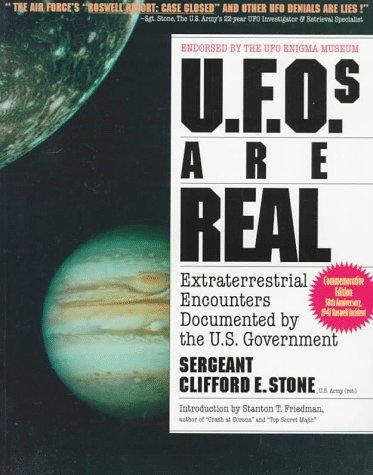
UFOs Are Real
Extraterrestrial Encounters Documented by the U.S. Government — Sgt. Clifford Stone's FOIA Casebook
Find on Amazon →As an Amazon Associate, OverClassified may earn from qualifying purchases made through this link, at no extra cost to you.
Why This Is Essential Reading
Use it, do not trust it, and read it in two halves. The Freedom of Information Act material in UFOs Are Real is genuine and valuable: Clifford Stone's persistent, precisely targeted requests put Projects Moon Dust and Blue Fly into the public record, established that recovery of unidentified aerospace objects was a standing priority routed through intelligence rather than through Project Blue Book, and surfaced international cable traffic that is still under-used. Everything Stone says about himself — covert attachment to retrieval teams, physical contact with craft, a catalogue of fifty-seven species, communication with living beings — rests on his word alone, and Kevin Randle, a retired Air Force officer and committed Roswell researcher, found that Stone's own service record does not support it. Take the documents, check them yourself, and read the personal narrative as a specimen of the genre it helped establish. Then read it against the Disclosure Project volume, where Stone appears as one witness among sixty-nine, and the pattern becomes considerably easier to see.
Related Cases & Theories
Sources Cited
- Stone, Clifford E. UFOs Are Real: Extraterrestrial Encounters Documented by the U.S. Government. SPI Books, New York, 1997. 276 pp. Introduction by Stanton T. Friedman. ISBN-10 1561719722 / ISBN-13 9781561719723. amazon.com
- Internet Archive holding, UFOs are real: extraterrestrial encounters documented by the U.S. government — the full scanned text of the SPI Books edition. archive.org
- Open Library edition record, ISBN 1561719722 — bibliographic verification and cover-art source. openlibrary.org
- Google Books record, UFOs are Real — SPI Books, 1997, 276-page extent, and the publisher description of the FOIA material obtained from Air Force and Navy intelligence, the CIA and the Department of State, and the Caribbean, Horn of Africa and Himalayan cases. books.google.com
- Goodreads edition record — edition data and description. goodreads.com
- ThriftBooks author record for Clifford E. Stone — independent bibliographic listing of his published titles. thriftbooks.com
- Wikipedia, "Project Moon Dust" — the United States Air Force programme for the recovery and exploitation of foreign or unidentified aerospace objects, its documented mission, and its relationship to the companion Blue Fly airlift arrangement. en.wikipedia.org
- Wikipedia, "Freedom of Information Act (United States)" — the statute through which Stone obtained the documentary material that is the book's genuine contribution. en.wikipedia.org
- Wikipedia, "Project Blue Book" — the public Air Force UFO investigation, distinct from the intelligence channels through which Moon Dust material moved. en.wikipedia.org
- Wikipedia, "Roswell incident" — the 1947 event around whose fiftieth anniversary this edition was packaged, and the Air Force's 1997 Case Closed report that the cover quotes Stone rejecting. en.wikipedia.org
- Wikipedia, "Kevin D. Randle" — the retired Air Force officer and Roswell researcher whose examination of Stone's service record found discrepancies with the account given in this book. en.wikipedia.org
- Kevin Randle, A Different Perspective — the standing venue for Randle's document-level assessments of military UFO claimants, including his examination of Stone. kevinrandle.blogspot.com
- Wikipedia, "Disclosure Project" — the May 9, 2001 National Press Club conference at which Stone was one of approximately twenty witnesses. en.wikipedia.org
- Coast to Coast AM guest profile for Clifford Stone — his twenty-two years of Army service, Vietnam service, 1990 retirement, and the claims he has made publicly since. coasttocoastam.com
Have corrections, additional research, or peer-reviewed sources? Help improve this entry.
Suggest an Edit