
The Day After Roswell
Col. Philip J. Corso's Claim That He Personally Seeded Recovered Roswell Technology into American Industry
Core Thesis
The Day After Roswell: A Former Pentagon Official Reveals the U.S. Government's Shocking UFO Cover-Up, published by Pocket Books on July 1, 1997 and written with journalist William J. Birnes, is retired Lt. Col. Philip J. Corso's account of his own claimed role at the center of the single most extraordinary allegation in all of Roswell literature: that as chief of the U.S. Army's Foreign Technology desk in the early 1960s, he personally oversaw the quiet distribution of material recovered from the 1947 Roswell crash to American defense contractors and research laboratories, and that this covert seeding program is the real, unacknowledged origin of the transistor, fiber optics, the laser, night-vision technology, and Kevlar. It is, by design, a book of a fundamentally different kind than either this site's own Witness to Roswell or Roswell: Inconvenient Facts entries cover: not a compilation of other witnesses' testimony, but one man's first-person claim to have been the mechanism of the cover-up itself. It belongs on this list for exactly that reason — as the fullest, most consequential, and most thoroughly disputed version of the "government reverse-engineered alien technology" narrative ufology has ever produced, not as a reliable account of how the transistor, fiber optics, or Kevlar actually came to exist.
About the Author
Philip James Corso was born May 22, 1915, and served in the U.S. Army from February 23, 1942, until his retirement on March 1, 1963, rising to the rank of lieutenant colonel. His verified wartime and postwar record is genuinely substantial: intelligence and counterintelligence work in Europe from 1943 to 1946, including a stint as chief of the U.S. Counter Intelligence Corps detachment in Rome, where he is credited with helping arrange safe passage for roughly 10,000 Jewish refugees out of Italy to the British Mandate of Palestine in 1945; a Mediterranean-theater posting in 1946–47; service during the Korean War period in the Far East from 1950 to 1953; and a further European tour from 1957 to 1960. Twice in his career — from March 1963 to December 1964, and again from February 1973 to July 1974 — he worked as a staff aide to Senator Strom Thurmond of South Carolina, a relationship that would become directly relevant to this book's own publication thirty-plus years later. Corso died on July 16, 1998, roughly a year after the book's release.
The book's own account of Corso's final Army posting is where verified record and disputed claim begin to separate. Corso was assigned as a staff officer to the Army's Foreign Technology Division within Research and Development on June 20, 1961, and left that division on July 18, 1962. Researcher Jan Aldrich, working from Corso's own Department of the Army Form 66 (Officer Qualification Record), obtained via a Freedom of Information Act request by researcher Larry Bryant, found that Corso held the division's formal chief or acting-chief position for approximately 90 days — from mid-April to mid-July 1962, during which he was recorded absent for 15 of those days — not the roughly two years of senior authority the book's own framing implies. A separate and, for the book's larger claims, more consequential dispute concerns Corso's account of four years on the staff of President Eisenhower's National Security Council from 1953 to 1957: Kevin Randle, citing Eisenhower Presidential Library archivist Herbert L. Pankratz, has reported that no documentary evidence places Corso on the NSC or its Operations Coordinating Board in any capacity, a gap Randle calls simply "nothing to link Corso to the NSC." Randle has separately noted that Corso's own retrospective claims to the press of having commanded White Sands Missile Range or held the rank of full colonel are contradicted by a facility ordinarily commanded by general officers and by his own documented final rank, concluding that Corso was "clearly inflating his record" independent of anything in this book's central UFO claims.
Corso's reliability had already been publicly questioned once before this book: in an earlier period of his career, syndicated columnists Drew Pearson and Jack Anderson reported allegations that Corso was guilty of "misconduct in both military and civilian life, incompetency, unreliability, untruthfulness," a controversy that reportedly cost him a subsequent Senate committee staff appointment. Co-author William J. Birnes, who spent roughly two years working with Corso to produce the manuscript, held a Ph.D. in English and went on to a long career as a UFO-media figure in his own right, editing UFO Magazine and co-authoring numerous later books; questions about how much of the book's specific narrative voice and structure originated with Corso versus his ghostwriter have been a recurring, if secondary, thread in the book's critical reception.
Historical Context & Origins
The book arrived at the crest of a Roswell publishing wave nearly two decades in the making. Stanton Friedman's 1978 interview with retired intelligence officer Jesse Marcel had revived the case after thirty years of public silence; Charles Berlitz and William Moore's The Roswell Incident (1980) brought it to a mass readership; and Kevin Randle and Donald Schmitt's UFO Crash at Roswell (1991) and The Truth About the UFO Crash at Roswell (1994), together with Friedman and Don Berliner's Crash at Corona (1992), built the elaborate multiple-witness, multiple-crash-site narrative that dominated popular treatments of the case by the mid-1990s. The U.S. Air Force answered twice, with The Roswell Report: Fact vs. Fiction in the New Mexico Desert (1994) attributing the Foster Ranch debris to Project Mogul, and The Roswell Report: Case Closed (1997) — published the same year as this book — attributing alien-body accounts to anthropomorphic parachute test dummies. Corso's book entered this crowded, already contested field not as another witness compilation but as something genuinely new to the genre: a first-person claim by a retired officer to have been not merely a witness to the cover-up but its active operational instrument.
The book's marketing leaned heavily on an endorsement that quickly became a scandal in its own right. Corso had twice served as a staff aide to Senator Strom Thurmond, and used that relationship to secure a foreword from the senator for the book's cover. According to Thurmond's own office and reporting at the time, the material Corso's camp submitted for the senator's review described the project only as Corso's personal memoirs and did not disclose that its central subject was a claimed UFO cover-up. When advance copies began circulating in the weeks before publication, Thurmond's staff and the senator himself learned the book's actual content essentially at the same time as the public, prompting a public statement of regret that became national news in its own right before the book's contents were even widely reviewed.
Despite — or, as several reviewers later argued, partly because of — the Thurmond controversy's pre-publication publicity, The Day After Roswell became a genuine commercial success, spending three weeks on the New York Times bestseller list and peaking at number 12. That commercial performance, arriving in the same year the Air Force's own "Case Closed" report was meant to settle the Roswell question definitively, ensured the book's specific and highly disputed reverse-engineering claim reached a far larger general audience than any prior Roswell title, setting up the extensive critical scrutiny documented below.
Core Arguments & Key Concepts
Corso's central and organizing claim, presented throughout as his own first-person, on-the-ground account, is that in 1961 Lt. Gen. Arthur Trudeau, then chief of Army Research and Development, personally handed him an "above top-secret" filing cabinet of material connected to the 1947 Roswell recovery and tasked him with finding ways to move it, quietly and without attribution, into private industry. Corso states that he spent his subsequent tenure at the Foreign Technology desk routing pieces of this material to defense contractors and research laboratories — among them Bell Labs, IBM, Hughes Aircraft, Dow Corning, and Monsanto — without those organizations' knowledge of the material's true origin, and that this seeding program is the real, unacknowledged source of the integrated circuit and transistor, fiber optics, the laser, night-vision image intensification, particle-beam weapons research, and Kevlar-type high-tensile fibers.
A separate and equally load-bearing claim, set fourteen years earlier in the narrative, is that Corso personally viewed the body of a dead non-human occupant of the crashed craft. He states that while serving as staff duty officer at Fort Riley, Kansas, in July 1947, he was ordered to inspect the contents of a shipping crate passing through and found inside a small, large-headed, black-eyed being preserved in a fluid-filled container — an episode Corso presents as his own first direct exposure to the material he would claim to manage fourteen years later.
The book frames its narrative around the recurring image of "the box" — the Roswell debris and, later, the alien body itself, treated as a literal and symbolic object Corso says was placed in his hands and that he alone was positioned to redistribute into the wider world. Corso presents this framing device, and the reconstructed first-person dialogue and internal reasoning that accompanies it throughout the book, as his own direct recollection of decisions made and conversations held more than three decades before the book's writing, without contemporaneous notes, documents, or corroborating witnesses cited to support the specific claims of what was sent where and to whom.
Corso's broader thesis situates this personal account inside a wider argument — one he shares in spirit with fellow Roswell researcher Stanton Friedman's "Cosmic Watergate" framing, covered on this site's own Top Secret/Majic entry — that the U.S. government has knowingly concealed proof of a 1947 extraterrestrial recovery for decades. Where Friedman's book argues primarily from disputed documents, however, Corso's argues almost entirely from his own uncorroborated personal testimony, a distinction this article's Critical Reception section treats as central to evaluating the claim.
Key Cases & Evidence Discussed
The Roswell Incident (Case File #001, July 1947) is this book's entire foundation: the debris and, in Corso's account, an alien body recovered near Roswell, New Mexico, that Corso claims passed through his hands at Fort Riley in 1947 and again, as archived material, at the Pentagon's Foreign Technology desk in 1961. This site's own Roswell case file cites this book directly, describing it as a "controversial memoir by a former Pentagon official" whose "military credentials are verified" even as its "extraordinary claims" remain unconfirmed — the same distinction this article draws throughout.
This site's own Roswell: Inconvenient Facts and the Will to Believe entry (ER-033) is directly relevant here on both sides of its argument: author Karl Pflock's own book devotes specific attention (p. 206 in the Prometheus edition) to documenting one of this book's chronological impossibilities — Corso's account of the CORONA reconnaissance satellite program, dated in a way that conflicts with the program's actual development timeline — making Pflock's skeptical Roswell book itself one of the primary sources this article draws on for this book's critical reception.
This site's own Witness to Roswell entry (ER-065), covering Thomas Carey and Donald Schmitt's later, witness-testimony-driven case for the crash-retrieval narrative, offers a useful contrast in method: where Carey and Schmitt built their case from more than 600 named-witness interviews, Corso's book rests on a single, uncorroborated first-person account of Corso's own alleged actions, a narrower and, as this article's Critical Reception section documents, considerably more contested evidentiary foundation.
This site's own Top Secret/Majic entry (ER-063), covering Stanton Friedman's defense of the disputed MJ-12 documents, is this book's closest point of comparison anywhere in this library for a different reason: Friedman, one of the most persistent defenders of a Roswell crash-retrieval and government-cover-up narrative in all of ufology, reviewed this book critically and rejected its central reverse-engineering claim as unsubstantiated — a rare instance of one of ufology's most committed believer-side researchers publicly disputing another's extraordinary claim on the same general side of the debate.
Critical Reception & Controversies
The most sustained forensic critique came from CSICOP investigator Philip J. Klass, who examined the book at length in his own Skeptics UFO Newsletter and, according to multiple secondary accounts of that critique, characterized it as one of the most factually flawed books on the Roswell subject ever published. Klass documented specific, checkable errors: the book misplaces the wartime headquarters of the Eighth Air Force at Fort Bliss rather than Fort Worth Army Air Field, and describes the MIM-23 Hawk surface-to-air missile — a radar-guided weapon — as heat-seeking. Individually minor, these errors matter because they involve exactly the kind of verifiable military-technical detail a career intelligence and ordnance officer's own account should get right, and Klass presented them as representative of a much longer pattern running through the book.
Ufologist Brad Sparks, in "Philip Corso's Roswellmania" (Skeptical Inquirer, March/April 1998), went further, documenting what he described as a pattern of placing Corso as a central, heroic figure in an improbably large number of the twentieth century's seminal moments, with no independent historical corroboration for the specific roles claimed. Among the chronological problems Sparks and other researchers identified: the book places Corso entering the CIA's Langley, Virginia, headquarters in 1961, a facility that did not open until after that date, with a named CIA figure the book puts at that meeting who was, according to the documentary record, posted to London at the time.
Kevin Randle, a fellow Roswell crash-retrieval researcher rather than a general UFO skeptic, has returned to this book's specific claims repeatedly over more than two decades, most extensively in a 2014 blog post reassessing Corso's record. Beyond the disputed NSC staff role and inflated rank and command claims documented above, Randle has noted that this book includes a UFO photograph Corso presents as genuine that had, by the time of the book's writing, already been publicly exposed as faked — a detail Randle argues undercuts Corso's own claimed insider access, since "if Corso was on the inside as he claimed, he would have been aware that this particular UFO photograph was faked."
The book's own marketing became a critical episode in its own right. Senator Strom Thurmond's foreword, printed prominently on the cover, praised Corso's "expertise not only as a military officer but also in the fields of intelligence and national security" without any mention of UFOs — because, according to reporting in the New York Times and Government Executive at the time, the material Thurmond's staff had been given to review described the book only as Corso's personal memoirs. When the book's actual subject became clear, Thurmond issued a public statement: "I regret the foreword that I wrote in comment on Col. Corso's professional life has now appeared as part of a book that professes to 'reveal the U.S. government's shocking UFO cover-up.' I know of no such 'cover-up' and do not believe one existed." Karl Pflock, who investigated the episode independently, told Randle that "the senator was and is mad as hell about the cheap trick that Corso pulled," and Simon & Schuster removed the foreword from subsequent printings. Randle has argued that the deception itself, independent of anything about UFOs, speaks directly to Corso's broader credibility: having misled a sitting U.S. senator to obtain a cover endorsement, Randle writes, there is little reason to extend Corso's own account of events the benefit of the doubt elsewhere in the book.
Even researchers otherwise sympathetic to a Roswell crash-retrieval scenario found the book unpersuasive. Stanton T. Friedman — whose own defense of the disputed MJ-12 documents is covered on this site's Top Secret/Majic entry, and who confirmed Corso "is a real person with a solid military background" — nonetheless reviewed this book unfavorably, calling it "most unsatisfactory" and noting it offers "no index, no table of contents, no references, not even the promised newly released classified government documents." Friedman specifically challenged the plausibility of the technology-seeding claim on its own terms, writing that Corso "seems to be taking credit for the single handed introduction of a whole host of new technologies" and asking why, if Corso could "change the world's technology... in less than 3 years," the same industries and research establishment had supposedly done nothing comparable between 1947 and 1960 while the material sat unused — "not very likely," in Friedman's own assessment. Friedman also raised specific logistical objections to the Fort Riley alien-body account, questioning why such a body would reportedly have been moved cross-country by truck without round-the-clock guard rather than by military aircraft.
Karl Pflock's own assessment of Corso, formed after meeting him in January 1993, was blunter still: Pflock dismissed him privately as "a blowhard loony tune" despite Corso's outwardly solid military credentials, a characterization Randle's own reporting on the Thurmond episode later cited approvingly. General press reception mirrored this split between commercial success and critical dismissal: Publishers Weekly called the book "outlandish" even while allowing that Corso "comes off as calm, sober, and rational" as a narrator; the Financial Post ran its review under the headline "Book Reads Like Unidentified Lying Object"; and in November 2001 The Guardian included the book on a published list of "Top 10 literary hoaxes."
Independent of any dispute about Corso's own credibility, the technology-history record itself does not support this book's central claim. The transistor's invention is documented in exhaustive, contemporaneous detail: John Bardeen and Walter Brattain first demonstrated a working point-contact transistor at Bell Labs on December 16, 1947, under a project directed by William Shockley, with the device publicly unveiled on June 30, 1948, and all three sharing the 1956 Nobel Prize in Physics — a fully documented laboratory achievement that predates Corso's own claimed 1961 Foreign Technology assignment by well over a decade. The laser's origin is equally well established and, notably, falls entirely outside Corso's claimed seeding window in the other direction: Theodore Maiman built and demonstrated the first working laser at Hughes Research Laboratories on May 16, 1960, a full year before Corso says he received Trudeau's filing cabinet. Fiber optics and Kevlar likewise have thoroughly documented, Roswell-independent invention histories that postdate Corso's 1961–1963 Foreign Technology tenure: physicist Charles Kao's foundational 1966 theoretical work at STL in England and Corning's Robert Maurer, Donald Keck, and Peter Schultz developing the first practical low-loss optical fiber in 1970; and DuPont chemist Stephanie Kwolek's 1965 discovery of the liquid-crystalline polymer solution that became Kevlar. None of these independently verified histories leaves room for an intervening 1961-era Army seeding program, and several of the specific technologies Corso claims to have seeded were, on the documented record, either already invented before his relevant Army posting began or not invented until after it had already ended.
Influence & Legacy
Commercially, The Day After Roswell was a genuine success by the standards of Roswell literature: three weeks on the New York Times bestseller list, peaking at number 12, arriving the same year as the Air Force's own "Case Closed" report and helping keep the Roswell story in mainstream press coverage through the late 1990s. The book was later reissued in a 2017 paperback and audio edition by Threshold Editions (ISBN 9781501172007), and its claims were the subject of a dedicated 2005 episode of the History Channel's UFO Files series, extending its reach well beyond its original hardcover readership.
Within ufology and popular UFO culture more broadly, this book did more than any prior title to popularize the specific narrative that ordinary, unremarkable modern technology — the chips in a computer, the fiber-optic cable carrying a phone call, the body armor worn by police and soldiers — is secretly downstream of a 1947 alien crash. That framing has become one of the most recognizable tropes in UFO conspiracy culture generally, echoed in later popular and documentary treatments of alleged government technology-transfer programs. Commentators covering the 2020s resurgence of UAP-related whistleblower claims, including former intelligence officer David Grusch's July 2023 congressional testimony alleging decades-long "legacy" crash-retrieval and reverse-engineering programs, have noted the narrative's clear resemblance to Corso's decades-earlier account — while it bears stating plainly that Grusch's testimony did not cite Corso, Roswell specifics, or this book by name, and the two claims should not be treated as corroborating one another.
The Thurmond foreword episode became, and has remained, a minor case study in its own right about the risks political and public figures take when lending their names to books they have not fully vetted; it is regularly cited in retrospectives of the book independent of any assessment of its UFO claims. Within the narrower community of Roswell researchers, this book's specific reverse-engineering claim never gained the sustained defenders that, for example, the MJ-12 documents found in Friedman; instead, it settled into the position Kevin Randle's continuing engagement with it — including his own 2014 reassessment, seventeen years after publication — suggests: a claim serious Roswell researchers continue to feel obligated to address and rebut, precisely because of how widely read and influential it became, rather than because its central evidence has held up.
Read against this site's own Top Secret/Majic and Witness to Roswell entries, this book occupies a distinct place in the library's coverage of Roswell's documented aftermath: not a case for a document's authenticity, and not a compilation of other people's testimony, but the single most personally consequential and most comprehensively disputed claim any one individual has made about their own role in a government UFO cover-up.
The Book
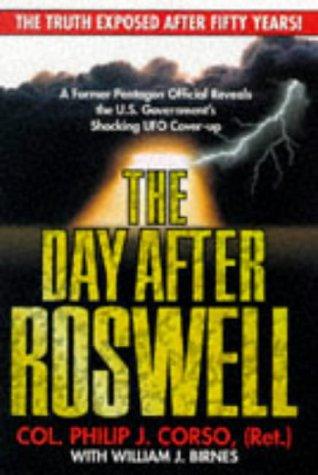
The Day After Roswell
Col. Philip J. Corso's Claim That He Personally Seeded Recovered Roswell Technology into American Industry
Find on Amazon →As an Amazon Associate, OverClassified may earn from qualifying purchases made through this link, at no extra cost to you.
Why This Is Essential Reading
The Day After Roswell earns its place on this list not as evidence that Roswell wreckage became the transistor, fiber optics, the laser, or Kevlar — the fully documented, independent invention histories of every one of those technologies leave no room for Philip Corso's claimed 1961 seeding program, and several of the specific breakthroughs he claims credit for either predate his relevant Army posting or postdate it entirely. It belongs here instead as the fullest, most consequential single-author version of ufology's "alien technology transfer" narrative ever published, and as a genuinely instructive case study in how a real, partly verifiable military career can be used to lend outward credibility to claims that same career's own documentary record does not support. Kevin Randle's and Jan Aldrich's own dismantling of Corso's National Security Council and Foreign Technology Division claims, Philip Klass's and Brad Sparks's forensic catalogs of factual and chronological errors, the public embarrassment of the Strom Thurmond foreword, and — perhaps most tellingly — the rejection of the book's central claim by Stanton Friedman, one of ufology's most committed believers in a real Roswell crash-retrieval, together make this one of the most thoroughly disputed books in this site's entire Essential Reading library. It remains essential reading precisely for that reason: not as reliable history of how modern technology was invented, but as the clearest documented example of how far a single uncorroborated personal claim, backed by real but overstated credentials, can travel through American popular culture before the historical record catches up with it.
Related Cases & Theories
Essential Viewing

"The Day After Roswell" Candid uncut interview with Colonel Philip J. Corso (Ret.)
Eyes On Cinema — Archival, uncut footage of Corso discussing the claims made in this book in his own words. Verified via YouTube oEmbed before inclusion.

1997 Phillip Corso Complete Interview
Mystery Wire — A separate, complete 1997 interview with Corso from the year of the book's publication, useful alongside the critical reception documented in this article. Verified via YouTube oEmbed before inclusion.
Sources Cited
- Corso, Philip J., with William J. Birnes. The Day After Roswell: A Former Pentagon Official Reveals the U.S. Government's Shocking UFO Cover-Up. Pocket Books, 1997 (ISBN 9780671004613 / 0671004611, matching this site's own resources library and key-figures citation under this exact first hardcover edition). amazon.com
- "The Day After Roswell." Wikipedia (publication details, Thurmond foreword controversy, critical reception summary, bestseller performance). en.wikipedia.org
- "Philip J. Corso." Wikipedia (military service record, Foreign Technology Division and disputed NSC claims, death date). en.wikipedia.org
- Broad, William J. "Senator Regrets Role in Book on Aliens." The New York Times, June 5, 1997 (Thurmond's public statement of regret over the foreword). nytimes.com
- "The Senator and the UFOs." Government Executive, June 1997 (detailed contemporaneous account of how Thurmond's staff was misled about the book's content and Thurmond's response). govexec.com
- "Top 10 literary hoaxes." The Guardian, November 15, 2001 (inclusion of this book on a published list of literary hoaxes). theguardian.com
- Klass, Philip J. Skeptics UFO Newsletter (SUN), Center for Inquiry archive (forensic critique of this book's specific factual errors, including the Eighth Air Force headquarters and MIM-23 Hawk missile misidentifications). centerforinquiry.org
- Sparks, Brad. "Philip Corso's Roswellmania." Skeptical Inquirer, March/April 1998 (documented pattern of chronologically impossible claims, including the CIA Langley headquarters and CORONA program timeline errors).
- Wojciechowski, Eric. "Becoming Fantastic: Why Some People Embellish Their Already Accomplished Lives with Incredible Tales." Skeptical Inquirer, November/December 2017 (broader analysis of embellished-credential claims citing this book's pattern).
- Randle, Kevin. "A Different Perspective: Philip Corso and The Day After Roswell, Again." kevinrandle.blogspot.com, January 2014 (disputes Corso's NSC, White Sands, and rank claims; documents the Thurmond foreword deception and the faked UFO photograph in the book). kevinrandle.blogspot.com
- Pflock, Karl T. Roswell: Inconvenient Facts and the Will to Believe. Prometheus Books, 2001, p. 206 (documents this book's CORONA satellite program chronological error; this site's own ER-033 entry).
- Friedman, Stanton T. "Book Review: Col. Philip J. Corso's THE DAY AFTER ROSWELL." Medium / Stanton Friedman's Articles archive (critical review by a fellow Roswell crash-retrieval researcher, disputing the technology-seeding claim's plausibility and the book's lack of documentation). medium.com
- "Philip J. Corso's US Army Officer Qualification Record (DA Form 66)." cufon.org, reproducing Jan Aldrich's analysis of Corso's FOIA-obtained military record and his actual Foreign Technology Division tenure. cufon.org
- "1947: Invention of the Point-Contact Transistor." Computer History Museum, The Silicon Engine (documented, Roswell-independent transistor invention history at Bell Labs). computerhistory.org
- "How Charles Kao Beat Bell Labs to the Fiber-Optic Revolution." IEEE Spectrum (documented, Roswell-independent fiber-optics invention history). spectrum.ieee.org
- This site's own case file: The Roswell Incident (Case File #001), which cites this exact book and edition directly.
- This site's own essential-reading entry: Roswell: Inconvenient Facts and the Will to Believe, for Karl Pflock's own documentation of this book's CORONA chronology error.
- This site's own essential-reading entry: Witness to Roswell, for the contrasting, testimony-driven case for the crash-retrieval narrative.
- This site's own essential-reading entry: Top Secret/Majic, for Stanton Friedman's full biography and his own critical review of this book.
- This site's own key-figures entry: Philip J. Corso, for his full biography and further case connections.
- This site's own resources library: Full Reading List, where this exact 1997 edition (ISBN 0671004611) is cited in connection with the Roswell Incident case file.
Have corrections, additional research, or peer-reviewed sources? Help improve this entry.
Suggest an Edit