
Disclosure
Military and Government Witnesses Reveal the Greatest Secrets in Modern History — The Disclosure Project's 573-Page Transcript Volume
Core Thesis
Disclosure is the founding document of the modern disclosure movement and it should be read as exactly one thing: a transcript volume. Published by Steven M. Greer's Crossing Point Inc. to coincide with the Disclosure Project's press conference at the National Press Club in Washington on May 9, 2001, its 573 pages collect interview testimony — and some corroborating documents — from 69 military personnel, enlisted men and officers, scientists, astronauts, and government and corporate witnesses, all attesting to knowledge of extraterrestrial visitation and of technologies withheld from the public. The conference drew twenty of them in person and produced what was then the largest webcast audience in the Press Club's history. Its stated objective was to force open congressional hearings. Twenty-five years later, those hearings have happened for other reasons, and not one of this book's central claims has been independently corroborated.
About the Author
Steven M. Greer is a former emergency-room physician who left medicine to work full time on the UFO question. He founded the Center for the Study of Extraterrestrial Intelligence in 1990 and the Disclosure Project in 1993, describing the latter as an effort to grant amnesty to government whistleblowers willing to violate their security oaths — a formulation that captures both the project's ambition and its central evidential problem.
His method has been consistent for thirty-five years: locate people with military, intelligence or aerospace backgrounds who say they have relevant knowledge, record their testimony at length, and publish it as a corpus. The theory is that volume and credentials together constitute evidence — that sixty-nine witnesses with security clearances cannot all be mistaken or lying.
That theory is worth stating clearly because it is the book's entire architecture, and because it is not obviously wrong. Corroborating testimony from independent, credentialled sources is genuinely how a great deal of historical and legal fact is established. The question is whether these witnesses are independent, whether their claims are the kind that testimony can establish, and whether any of them said anything checkable.
Greer's own reputation has deteriorated substantially since 2001, and an honest article has to record it. The pattern critics identify is a repeated cycle of announced revelations — new witnesses, recovered materials, imminent proof — that do not survive examination, alongside paid CE-5 contact events and a steady escalation of claims well beyond anything the 2001 witnesses said. Researchers who take the UAP question seriously now frequently regard him as a liability to it.
None of that retroactively falsifies the 2001 testimony, and the article does not treat it as doing so. But it does bear on how much weight to give the compiler's framing, his selection of witnesses, and his characterisation of what they said — because the book is not a neutral archive, it is a curated brief.
Historical Context & Origins
May 2001 was, for a few days, the high-water mark of the American UFO subject's public standing between the 1960s and 2017. Twenty retired military and Federal Aviation Administration officials appeared at the National Press Club to urge congressional hearings; the BBC, ABC News, Fox News and the Washington Times covered it; and roughly a quarter of a million people queued for the webcast, a record for the venue.
The book existed to be handed out that day. The physical object announces the fact — the 2001 printing is labelled a 'Pre-Publication Rush Edition' — and that origin explains a great deal about it: the length, the transcript format, the minimal editing, the absence of a critical apparatus. It is a press kit at book length.
The strategic theory behind the event was specific and reasonable. Individual whistleblowers had been dismissed for fifty years; a large simultaneous group with verifiable service records would be harder to dismiss; Congress would be obliged to hold hearings; and the classification structure would come apart. Greer said as much, and the plan's failure is instructive rather than embarrassing.
The wider context is that this was pre-9/11. Four months later the political appetite in Washington for hearings on any subject unrelated to terrorism vanished for the better part of a decade, and it is genuinely arguable that the Disclosure Project's timing was catastrophically unlucky rather than its argument unpersuasive.
What did eventually produce congressional hearings, sixteen years later, was something entirely different: leaked US Navy sensor video, on-record statements from serving officers through established channels, reporting in the New York Times, and legislation. This site tracks the current phase through its UAP Disclosure Act case file. The route that worked was institutional and evidentiary; the route this book represents was testimonial and adversarial.
The witness pool reflects the period's preoccupations. Missile-facility incidents — the Malmstrom shutdown claims associated with Robert Salas above all — radar controllers, base security personnel, and aerospace-contractor employees dominate, and the astronaut Gordon Cooper's statements are among the best-known included.
The book also arrives at the end of a decade in which the crashed-saucer narrative had become the field's centre of gravity, driven by Roswell's fiftieth anniversary and by books such as The Day After Roswell. Greer's witnesses are drawn from and speak to that framework, and the book cannot be understood apart from it.
Core Arguments & Key Concepts
Sixty-nine credentialled witnesses constitute evidence by their number and their independence. The book's foundational claim. It is a real argument — convergent independent testimony does establish facts — and it has two weaknesses here. The witnesses are not independent: they were located by one organisation, interviewed by one interviewer, and in many cases were already active in the same UFO research community. And their statements largely concern what they were told, inferred or heard rather than what they directly observed.
Verifiable service records substitute for verifiable claims. This is the book's implicit and most misleading move. The credentials in it are generally real: these people did serve, did hold clearances, did work where they say. What credentials establish is that a witness was in a position to know something, not that what they say they know is correct. Almost none of the specific factual claims in the book can be checked against any independent record, and the credentials are consistently offered where corroboration should be.
The suppressed-technology claim is separable and is the book's most consequential. Greer's argument extends beyond visitation to withheld energy and propulsion systems, and this is what gives the project its political charge and its funding appeal. It is also entirely uncorroborated: no document, no device, no patent trail, no defector with hardware. Twenty-five years on, this claim has produced nothing.
Amnesty is the correct policy instrument for classified testimony. The most defensible idea in the whole project and the one that has actually been adopted. If people are bound by oaths that prevent them speaking, the remedy is a legal mechanism that releases them, and something recognisably like that reasoning underlies the whistleblower-protection provisions in recent UAP legislation. Greer was early and right about the mechanism.
The transcript format is a virtue. Publishing the testimony at length and largely unedited, rather than summarising it, lets a reader see what witnesses actually said and how they said it — including the hedges, the second-hand attributions and the moments where an interviewer's question supplies the answer. Readers who work through the transcripts often find them less impressive than the summaries built on them, which is a point in the book's favour.
The weakest structural feature is the absence of adversarial testing. No witness in the book is cross-examined, no claim is checked against a service record or a document, no contradictory account is presented, and no witness who failed vetting is mentioned. A brief with no opposing case is not a body of evidence, and the volume's own format conceals how much filtering must have occurred before publication.
A large open testimony pool is an invitation to contamination. The criticism raised most seriously by other researchers, including some sympathetic to the subject: a project publicly soliciting hundreds of witnesses with a stated ideological objective is close to an ideal target for disinformation, and there is no mechanism in the book by which a planted or fabricating witness would be detected.
Key Cases & Evidence Discussed
The May 9, 2001 National Press Club conference. Twenty retired military and FAA officials appearing together in Washington to demand congressional hearings, with international press coverage and a record webcast audience. The book's occasion and, in retrospect, the disclosure movement's founding public act.
The Minuteman missile shutdown claims. Testimony from former missile-launch and security officers, most prominently Robert Salas, describing weapons taken off alert status during UFO events at Malmstrom Air Force Base in Montana. This site's Malmstrom case file examines the March 1967 incident that anchors these accounts, including the documentary record and the competing explanations.
Gordon Cooper's statements. The Mercury and Gemini astronaut's accounts of UFO observations and of film he said was taken and withheld — the highest-profile individual name associated with the project and the one most often cited from it.
Air traffic control and radar testimony. Former FAA personnel describing unidentified radar returns and the handling of the associated reports, including material relating to the 1986 Japan Air Lines Flight 1628 case tracked from Anchorage over Fort Yukon, Alaska.
Aerospace and corporate witnesses. Contractor employees describing programmes they were not cleared for and materials they said existed, forming the basis of the suppressed-technology claim. The most consequential and the least documented category in the book.
Base security and ground-encounter accounts. Enlisted personnel reporting objects over nuclear installations, weapons-storage areas and airfields — the most numerous class of testimony and, taken individually, the most plausible.
The crashed-material claims. Second- and third-hand accounts of recovered craft and bodies, generally attributed to sources the witness will not name. The category on which the project's public reputation has principally rested and the one that has produced no verifiable artefact in twenty-five years.
The withheld energy technologies. Greer's linked argument that propulsion and energy systems derived from recovered material are being suppressed, which has driven the project's fundraising and much of its subsequent activity, and which remains entirely unevidenced.
Critical Reception & Controversies
The book was never reviewed in a mainstream literary or scientific venue and was not meant to be; it was distributed to press and to supporters. Its reception was the reception of the event, which was substantial for about a week and then evaporated.
Philip Klass's Skeptics UFO Newsletter covered the Disclosure Project in the summer of 2001 and the standard sceptical position was set out then and has not changed: the witnesses are credentialled but their claims are overwhelmingly second-hand; the credentials are used rhetorically where corroboration is required; and no document, artefact or independently verifiable fact accompanies any of it.
The more damaging criticism has come from inside the field. Researchers who take the subject seriously have argued that a project publicly recruiting hundreds of witnesses toward a declared conclusion is structurally vulnerable to disinformation, and that some proportion of the testimony pool is likely to have been seeded. That argument does not require anyone to be lying deliberately, and it is difficult to answer.
Greer's own trajectory has done the book more harm than any critic. The pattern of announced revelations that fail to materialise, the paid contact expeditions, and claims that have escalated far past anything his 2001 witnesses said have made him a figure that serious UAP researchers now actively distance themselves from — and the 2001 book is generally discounted along with him.
That discount is partly unfair and readers should notice why. The 573 pages contain testimony from real people with real service records, some of whom — Salas above all — have given consistent accounts for decades in other venues, submitted to questioning, and never asked for money. The compiler's later conduct is not evidence about those witnesses.
The decisive assessment is the one time has made rather than any reviewer. The book's explicit purpose was to force congressional hearings. Hearings eventually came, and they came through Navy sensor data, on-record serving officers, the New York Times, and statutory reporting requirements — not through this. Whatever else that establishes, it establishes that the method did not work.
The fair placement in a library is as a primary source about the disclosure movement rather than about UFOs. If the question is what a large group of credentialled people said in 2001 and how the movement organised itself around them, this book is the document. If the question is what is in the sky, it contributes nothing that can be checked.
Influence & Legacy
The Disclosure Project created the vocabulary and the template that the entire subsequent movement uses. 'Disclosure' as a noun denoting an anticipated government revelation, the whistleblower-with-clearance as the central evidentiary figure, the press conference as the primary instrument, and amnesty as the policy demand — all of it is traceable to 2001 and to this book.
Its most concrete legacy is legislative. The idea that people bound by classification need a legal mechanism to speak, rather than merely encouragement, has been substantially adopted: whistleblower provisions and records-review structures in recent UAP legislation embody exactly the reasoning Greer articulated, whatever anyone thinks of him. This site follows that thread in its UAP Disclosure Act case file.
Its negative legacy is at least as large. Twenty-five years of promised revelations that did not arrive have made 'disclosure' a term of suspicion for a substantial part of the serious research community, and the recurring pattern — a credentialled witness, an announced imminent proof, nothing — has trained journalists and legislators to discount exactly the kind of testimony the movement produces. Some of the difficulty current researchers face in being taken seriously is inherited from this.
The cautionary legacy is the clearest lesson in the book and it is methodological. Credentials establish access, not accuracy. Sixty-nine people who were in a position to know something is not sixty-nine people who know it, and a volume that presents service records where it should present documents has substituted one kind of authority for another. Recognising that substitution is the single most useful skill a reader of this literature can take away, and this is the best available specimen for practising it.
The Book
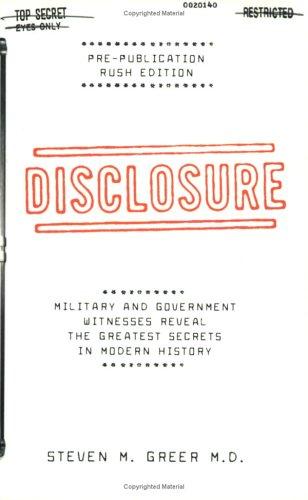
Disclosure
Military and Government Witnesses Reveal the Greatest Secrets in Modern History — The Disclosure Project's 573-Page Transcript Volume
Find on Amazon →As an Amazon Associate, OverClassified may earn from qualifying purchases made through this link, at no extra cost to you.
Why This Is Essential Reading
Read it as a historical document, not as evidence. Disclosure is the founding text of the modern disclosure movement: 573 pages of transcript from 69 credentialled witnesses, published to accompany the May 2001 National Press Club conference that was supposed to force congressional hearings and did not. Its virtue is the format — the testimony is printed at length rather than summarised, so a reader can see the hedges, the second-hand attributions and the leading questions for themselves, and most readers find the transcripts weaker than the claims built on them. Its defect is structural: no cross-examination, no documents, no independent corroboration, and a compiler whose subsequent conduct has cost the whole project its standing. Read it to understand where the current disclosure discourse came from, read the individual missile-facility testimony against this site's Malmstrom case file, and keep firmly in view that hearings finally happened by an entirely different route.
Related Cases & Theories
Sources Cited
- Greer, Steven M. Disclosure: Military and Government Witnesses Reveal the Greatest Secrets in Modern History. Crossing Point Inc., May 9, 2001. 573 pp. ISBN-10 0967323819 / ISBN-13 9780967323817. amazon.com
- Open Library edition record, ISBN 0967323819 — bibliographic verification and cover-art source for the 2001 'Pre-Publication Rush Edition'. openlibrary.org
- Goodreads edition record, Disclosure — publisher, May 9 2001 publication date, 573-page extent, and the description of the contents as interview testimony and corroborating documents from 69 military, scientific, astronaut, government and corporate witnesses. goodreads.com
- Wikipedia, "Disclosure Project" — Greer's 1993 founding of the project, his description of it as an effort to grant amnesty to government whistleblowers willing to violate their security oaths, the May 9 2001 National Press Club conference with twenty retired military and Federal Aviation Administration officials, and the coverage by BBC News, ABC News, Fox News and the Washington Times. en.wikipedia.org
- Wikipedia, "Steven M. Greer" — biography, his medical career, the founding of CSETI in 1990, and the reception of his subsequent claims. en.wikipedia.org
- Wikipedia, "Center for the Study of Extraterrestrial Intelligence" — the organisation Greer founded in 1990 and through which the Disclosure Project operated. en.wikipedia.org
- National Press Club events listing, "25th Anniversary of the 2001 Disclosure Project Press Conference" — the venue's own record of the original event and its anniversary. press.org
- ABC News, "Group Calls for Disclosure of UFO Info" — contemporaneous mainstream reporting on the May 2001 press conference and its participants. abcnews.com
- Philip J. Klass, Skeptics UFO Newsletter #68, Summer 2001 — the contemporaneous sceptical assessment of the Disclosure Project and the National Press Club conference. centerforinquiry.org
- Philip J. Klass, Skeptics UFO Newsletter #71, Spring 2002 — the follow-up assessment after the conference failed to produce congressional hearings. centerforinquiry.org
- Crozet Gazette, "UFOs: The Exposed Secret," June 15 2009 — local Virginia reporting on Greer, his medical background and the Disclosure Project's operations. crozetgazette.com
- Wikipedia, "Robert Salas" — the former Minuteman launch officer whose missile-facility testimony is among the most-cited in the volume and who has given consistent public accounts for decades. en.wikipedia.org
- Wikipedia, "Gordon Cooper" — the Mercury and Gemini astronaut whose statements are the highest-profile individual testimony associated with the project. en.wikipedia.org
Have corrections, additional research, or peer-reviewed sources? Help improve this entry.
Suggest an Edit