
Loring AFB Nuclear Storage Area
At 7:45 PM on 27 October 1975, Staff Sergeant Danny K. Lewis, on duty at the nuclear weapons storage area of Loring Air Force Base near Limestone, Maine, saw a low-flying aircraft with a red navigation light and a white strobe cross the base's northern perimeter. It circled, at one point coming within 300 yards of the storage area at about 150 feet, and ignored radio calls on every military and civilian band. The wing commander, Colonel Richard E. Chapman, put the base on a Security Option 3 alert, and the control-tower radar followed an unknown target circling about ten miles east-northeast before it was lost near Grand Falls, New Brunswick. The intruder, which the Air Force's own messages called "an unidentified helicopter," returned on the evening of 28 October and in the early hours of 29 October. A Maine Army National Guard UH-1 crewed by Chief Warrant Officers Bernard Poulin and Eugene Herrin searched without ever seeing it, and reports reached the National Military Command Center. The aircraft was never identified. The Loring reports open the wider wave of autumn 1975 sightings at northern-tier bases that also included Wurtsmith, Malmstrom, Minot and, in November, Canadian Forces Station Falconbridge.
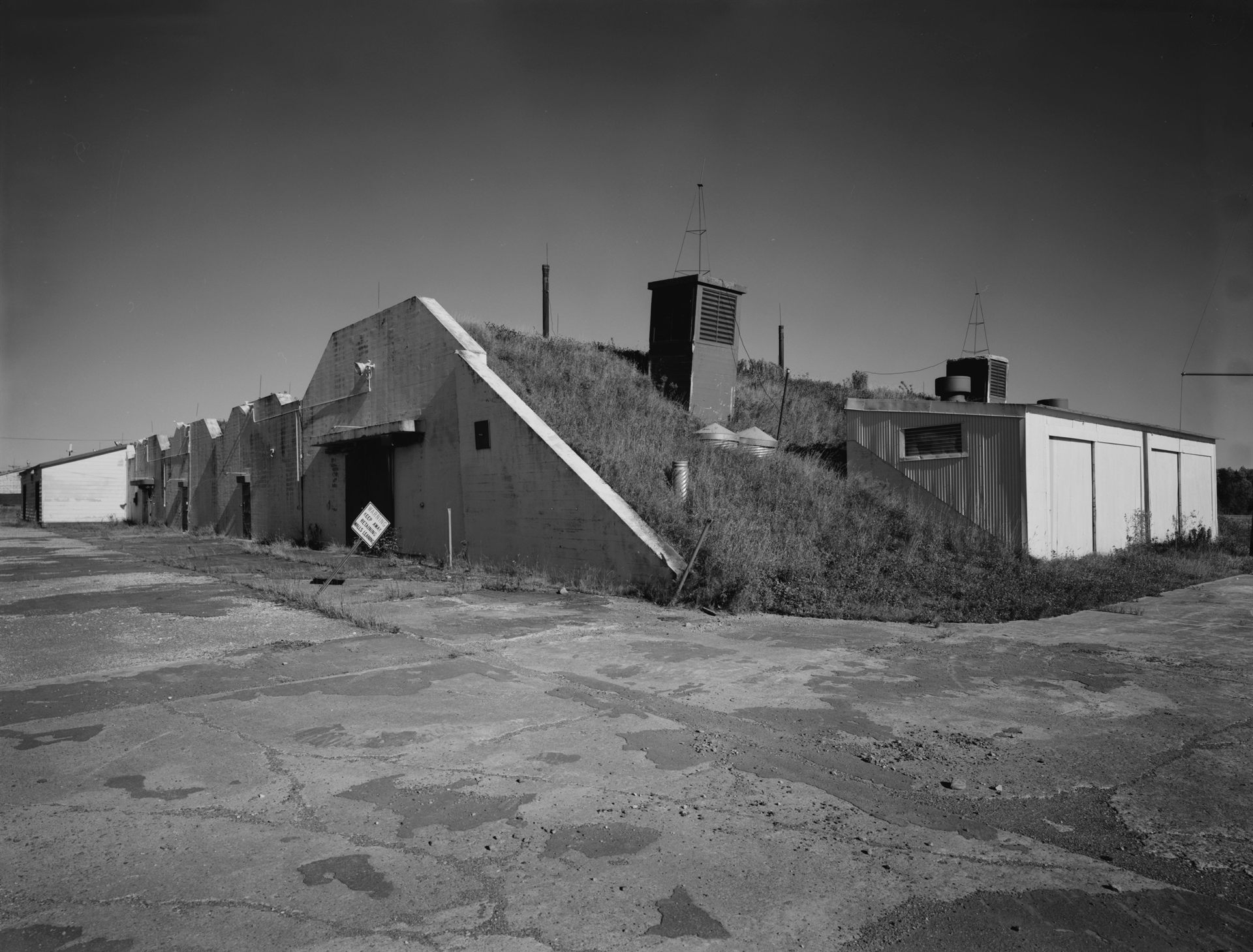
Pictured: the earthen-mound-covered retaining wall of Building 216, an ammunition maintenance shop inside Loring AFB's Weapons Storage Area (WSA) — part of the same restricted nuclear weapons complex the intruding object circled in October 1975 — photographed in 1998 by the National Park Service's Historic American Engineering Record (HAER ME-64-D-20) shortly before the base's structures were surveyed for historic preservation. This is not a photograph of the incident itself: no photograph or radar-scope image of the 1975 object has ever surfaced publicly, and this file's research located no evidence any was ever taken.
Theoretical Alignment
Loring's ETH weight is modest. What supports it is the later testimony: one B-52 crew's account of a silent, reddish-orange object hovering a few feet off the ground, and veterans' recollections of extraordinary manoeuvres. The contemporaneous record points the other way. The base's own messages describe "an unidentified helicopter," possibly two, with navigation and strobe lights and a helicopter's speed and movement, and the military response was built around a hostile or unauthorised aircraft: a Security Option 3 alert, a National Guard helicopter search, and arrangements with Canadian authorities for cross-border pursuit. Psycho-Social weight is relatively high because much of the case's most vivid detail comes from accounts written or recorded decades later, after the case had become well known. No source reviewed supports an interdimensional framing.
Background
Loring Air Force Base was built from 1947 as Limestone Air Force Base and renamed in 1954 for Major Charles J. Loring Jr., a Korean War pilot awarded the Medal of Honor posthumously after diving his damaged F-80 into enemy gun positions in 1952. Sited in the far northeast of Aroostook County, Maine, it was SAC's easternmost base in the continental United States. From 1953 it hosted the 42nd Bombardment Wing, which flew Convair B-36s before converting to the Boeing B-52 in 1956, and by 1975 Loring housed a B-52 squadron with the nuclear alert mission and two KC-135 tanker squadrons. Its nuclear weapons were kept in a separate storage complex on the northern side of the base, originally the North River Depot and later Caribou Air Force Station, which was merged into Loring in 1962. Fawcett and Greenwood describe the storage area as more than half a mile long, with weapons kept in earth-covered igloos behind a twelve-foot chain-link fence topped with barbed wire, patrolled day and night by the 42nd Security Police Squadron with K-9 teams and vehicles.
That setting shaped the response. Loring lay close to the Canadian border, and Grand Falls, New Brunswick, where the radar lost the intruder, is about twelve miles away, so an unidentified low-flying aircraft coming from the northeast was treated first as a possible unauthorised or hostile incursion. The surviving documents show exactly that posture: a Security Option 3 alert, priority messages to the National Military Command Center, a request for fighter support, liaison with the Maine State Police and the Royal Canadian Mounted Police, and Canadian permission for an American helicopter to pursue across the border. The National Military Command Center's memoranda also record that the State Department's Canadian desk officer was kept informed.
Chronology of Events
| Date / Time (EST) | Event |
|---|---|
| 7:45 PM, Oct 27 | First sighting. S/Sgt. Danny K. Lewis (42nd Security Police Squadron), at the weapons storage area, sees an aircraft with a red navigation light and a white strobe cross the northern perimeter at about 300 feet. In the control tower, S/Sgt. James P. Sampley (2192nd Communications Squadron) sees an unknown target 10–13 miles east-northeast; radio calls on all military and civilian bands get no reply. The aircraft circles and at one point comes within 300 yards of the storage area at about 150 feet. |
| ~7:52 PM, Oct 27 | Col. Richard E. Chapman, commander of the 42nd Bomb Wing, reaches the storage area seven minutes after the first report, implements Security Option 3, and requests fighter cover from the 21st and 22nd NORAD Regions, which both decline. The Maine State Police and flight services are asked to help identify the aircraft, without result. |
| 8:45 PM, Oct 27 | At the command post's request, Sgt. Grover K. Eggleston in the tower watches an unknown target circling about ten miles east-northeast for some forty minutes before it disappears from the screen, either landing or dropping below radar coverage. The intruder then heads toward Grand Falls, New Brunswick; radar contact is lost there, bearing 065 degrees, twelve miles out. |
| Night of Oct 27–28 | Security sweeps inside and outside the storage area find nothing. Priority messages go to the National Military Command Center, the Air Force Chief of Staff, the USAF Forward Operations Division at Fort Ritchie, SAC headquarters, 8th Air Force and the 45th Air Division. |
| 7:45–8:20 PM, Oct 28 | Second night. Sgt. Clifton W. Blakeslee, S/Sgt. William J. Long and Lewis see running lights approaching from the north at about 3,000 feet; Lewis reports a white flashing light and an amber or orange light. Col. Chapman comes out and sees the same lights. For 35 minutes the craft is watched from the storage area and followed by tower radar about three miles north of the perimeter; at one point it appears over the end of the runway at 150 feet, then turns off its lights and reappears over the storage area. It is again tracked heading for Grand Falls. |
| Oct 28 (later account) | B-52 crew chief Sgt. Steven Eichner, Sgt. R. Jones and their crew later told Fawcett and Greenwood that they saw a reddish-orange object "like a stretched-out football" hovering about five feet up, some 300 feet ahead of their truck, with no visible doors, windows, propellers or engines and no sound. They did not report it at the time because they had driven into a restricted area. |
| Oct 28–29 | An Operation Report states: "It is our opinion that the unknown helicopter has demonstrated a clear intent in the weapons storage area, is smart and a most capable aviator." A SAC security police message headed "Defense Against Helicopter Assault" orders northern-tier bases to Security Option 3 during darkness. |
| ~1:00 and 3:00 AM, Oct 29 | Third night. Per the National Military Command Center memoranda, an unidentified helicopter, "possibly two," is seen at about 150 feet, 200–500 meters from the storage area at about 1:00 AM, and over the storage area at about 3:00 AM. An Army National Guard helicopter responds both times without making contact. "Sightings of the unidentified helicopter(s) were limited to security guards." Canadian authorities give permission for pursuit into Canadian airspace. |
| Oct 29 | Brig. Gen. C. D. Roberts Jr. (USMC), the NMCC's Deputy Director for Operations, handles the case in Washington. Maj. Gen. Sniffin, Department of the Army Director of Operations, approves rules for the Guard helicopter: "full time training duty," tracking and identification only, Canadian airspace with Canadian consent, and only U.S. military personnel (plus FBI, FAA or Border Patrol if needed) aboard. Col. Bailey, military aide to the Special Assistant to the Secretary and Deputy Secretary of Defense, is advised. The helicopter, crewed by CWOs Bernard Poulin and Eugene E. Herrin of the 112th Medical Company (Air Ambulance), Bangor, searches in sorties of about forty minutes without seeing anything. |
| Evening of Oct 29 | The intruder does not return. The Air Force plans to replace the Guard helicopter with one from Plattsburgh AFB, which takes over on Oct 30. |
| Oct 30 | At Wurtsmith Air Force Base, Michigan, personnel report an unidentified low-flying aircraft near the weapons storage area, the next entry in the wave. |
| Oct 31–Nov 1 | Several more reports at Loring of unknown objects suspected to be helicopters, some confirmed on RAPCON radar at 300 to 5,000 feet. An OSI message of 2 Nov reports three "verified sightings" of an unidentified aircraft flying low over and near the base on those nights. |
| Nov 11, 1975 | A CINCNORAD message reports that "since 28 Oct 75" reliable military personnel at Loring, Wurtsmith, Malmstrom, Minot and CFS Falconbridge have sighted suspicious objects. On the same date, according to the Washington Post, a directive from the office of the Secretary of the Air Force tells information officers to avoid linking the sightings unless asked. |
| 1979 | The Washington Post (19 Jan) and the New York Times (14 Oct, "U.F.O. Files: The Untold Story") report the wave; the Times says Air Force investigation of the Loring sightings "did not reveal a cause." |
| 1984 | Fawcett and Greenwood publish "Intrusions at Loring AFB" in Clear Intent (pp. 16–26), drawing on the released documents and on Fawcett's 27 August 1982 interview with Bernard Poulin. |
| 2009, 2015 & 2020 | The Bangor Daily News revisits the case in columns by Kent Ward (2009) and a 2015 follow-up drawing veterans' accounts; The War Zone publishes a long feature (2020) quoting veterans' posts on LoringRemembers.com. |
The First Night: October 27, 1975
The Loring intrusions began at 7:45 PM on Monday, 27 October 1975, when Staff Sergeant Danny K. Lewis of the 42nd Security Police Squadron, on duty at the weapons storage area, saw what he took for an aircraft flying low along the base's northern perimeter. It crossed the perimeter at about 300 feet, showing a red navigation light and a white strobe. At about the same moment Staff Sergeant James P. Sampley of the 2192nd Communications Squadron, in the control tower, saw an unknown target on the tower radar 10 to 13 miles east-northeast of the base. The tower tried every military and civilian band to identify the aircraft and warn it off the restricted area, and got no reply. The aircraft began to circle, and at one point came within 300 yards of the storage area at an altitude of about 150 feet. A teletype to the National Military Command Center put it plainly: "The A/C definitely penetrated the LAFB northern perimeter and on one occasion was within 300 yards of the munitions storage area perimeter."
Lewis reported to the 42nd Bomb Wing command post, and the wing commander, Colonel Richard E. Chapman, implemented a Security Option 3 alert, bringing the base to major alert status; according to Fawcett and Greenwood he reached the storage area seven minutes after the first report, as security vehicles converged from across the base. A Bangor Daily News reader later passed on his father's account that the tower had at first dismissed the guard's call until Chapman himself intervened, a story that is secondhand and unverified. Through the command post Chapman asked for fighter cover from the 21st NORAD Region at Hancock Field, New York, and the 22nd at North Bay, Ontario; both declined. He then asked the Maine State Police for help, and a call to flight services failed to identify any legitimate traffic.
The Radar Track and the Vanishing Point
The radar record from the first night is less tidy than later retellings suggest. At 8:45 PM, at the command post's request, Sergeant Grover K. Eggleston began watching the unknown on the tower radar. Six minutes later the target appeared to be circling about ten miles east-northeast of the base, and it did so for about forty minutes before it suddenly disappeared from the screen; Fawcett and Greenwood write that "either the object had landed, or it had dropped below the radar coverage." So the forty-minute track was of a target circling some ten miles out, not over the storage area. The craft then broke off and headed toward Grand Falls, New Brunswick, and radar contact was lost in the vicinity of Grand Falls, bearing 065 degrees, twelve miles from Loring. A War Zone summary of the documents describes this as a second unknown aircraft separate from the one the guards saw, which suggests that even the original reports did not settle how many targets there were.
A recurring problem was the poor fit between the radar and the people on the ground. On the second night the tower radar did follow the craft about three miles north of the perimeter while guards watched it. But Bernard Poulin, the National Guard helicopter pilot, later said that while ground personnel vectored him to places where they could see or hear the intruder, "radar was not painting the object that was being reported"; on the second night of his mission the one return radar did pick up "turned out to be a KC-135 tanker returning from overseas." The tower set was an air traffic control radar, and low-flying targets near terrain are a known weak spot for such equipment. That could hide a real low-flying helicopter. It could equally mean that some ground reports were of lights that were not aircraft at all. The sources do not settle which.
Chain of Command: From Limestone to the National Military Command Center
The incident travelled quickly up the chain of command. Priority messages went that night to the National Military Command Center, the Air Force Chief of Staff, the USAF Forward Operations Division at Fort Ritchie, Maryland, SAC headquarters, 8th Air Force and the 45th Air Division. The NMCC's own memoranda, released later under FOIA, show how the case was handled there. A memorandum for record signed by Brigadier General C. D. Roberts Jr., USMC, the NMCC's Deputy Director for Operations, at 6:05 AM on 29 October records that at 2:00 AM the Air Force Operations Center had reported "an unidentified helicopter, possibly two," flying low over Loring near a weapons storage area; that an Army National Guard helicopter had been called in; that NORAD, informed by SAC, had obtained Canadian authority to proceed into Canadian airspace if necessary; that by 4:04 AM the Guard helicopter "had not sighted the unidentified helo(s)"; and that "a similar incident was reported at Loring the evening of 28 October." Later updates name Major General Sniffin, the Army's Director of Operations, who approved the rules for using the Guard helicopter, and Colonel Bailey, military aide to the Special Assistant to the Secretary and Deputy Secretary of Defense, who was advised in case Defense Department approval was needed.
The Second Night: "A Stretched-Out Football"
The intruder returned the following evening. At 7:45 PM on 28 October, Sergeant Clifton W. Blakeslee and Staff Sergeant William J. Long, with Lewis, saw the running lights of an aircraft approaching from the north at about 3,000 feet. It came no closer than about three miles at first and was seen intermittently for the next hour. Lewis reported a white flashing light and an amber or orange light; Colonel Chapman came out to the storage area and saw the same lights, and "the speed and movement in the air suggested that the craft was a helicopter." From 7:45 to 8:20 PM it was under constant observation from the storage area and on the tower radar, three miles north of the perimeter. It appeared and disappeared from view, at one point showed up over the end of the runway at 150 feet, then turned off its lights and reappeared over the weapons storage area at 150 feet. After a sweep of the storage area found nothing, radar again briefly tracked the object heading for Grand Falls.
The case's most striking description comes from a crew who did not report what they saw at the time. According to Clear Intent, B-52 crew chief Sergeant Steven Eichner, Sergeant R. Jones and other crew members, working from a launch truck, saw a red and orange object over the flight line that looked like "a stretched-out football." When it reappeared over the north end of the runway they drove toward it, and as they turned onto the road to the storage area they saw it about 300 feet ahead, hovering about five feet off the ground without movement or noise, reddish-orange and about four car lengths long. "The object looked like all the colors were blending together, as if you were looking at a desert scene. You see waves of heat rising off the desert floor," Eichner said. "The object was solid and we could not hear any noise coming from it." They saw no doors, windows, propellers or engines. As security police vehicles raced toward the storage area, the crew left, and they "decided not to report what they had seen, because they had entered a restricted area." This account therefore rests on Eichner's later interview and is not part of the 1975 record, which describes a light-carrying aircraft presumed to be a helicopter. The base's Operation Report put its view of the intruder this way: "It is our opinion that the unknown helicopter has demonstrated a clear intent in the weapons storage area, is smart and a most capable aviator."
The Helicopter Intercept Attempts
After the second night, Chapman requested a National Guard helicopter so that the base would be ready if the intruder returned. The request went through military channels and came back with constraints: tracking and identification only, no apprehension, no crossing of the international border, and only U.S. personnel on board. Chapman, according to Fawcett and Greenwood, said there was no point in using the helicopter if it could not cross the border. General Roberts set up a conference call with Major General Burkhart at SAC and with Chapman, and raised the border issue with General Sniffin; permission to cross was requested from Canadian officials and granted. The helicopter and crew were placed on "full time training duty," which in effect federalized them.
The intruder came back in the early hours of 29 October. According to the NMCC updates, an unidentified helicopter was seen at an altitude of 150 feet some 200 to 500 meters from the weapons storage area at about 1:00 AM, and over the storage area at about 3:00 AM; each time an Army National Guard helicopter responded and was "unable to contact or identify the intruder," and the NMCC noted that "sightings of the unidentified helicopter(s) were limited to security guards." The Guard aircraft was a UH-1 of the 112th Medical Company (Air Ambulance) in Bangor, crewed by Chief Warrant Officers Bernard Poulin and Eugene E. Herrin. Interviewed by Lawrence Fawcett on 27 August 1982, Poulin recalled flying sorties of about forty minutes with a Royal Canadian Mounted Police officer, a Maine State Police officer and Air Force security police aboard, the police because of suspicions about drug-smuggling flights, "but this never panned out." Asked about documents saying ground personnel reported his helicopter within 100 feet of the intruder, he said: "we could go real low to where they said it was and would turn on our search light and sweep the area with the light, but we never saw the craft." The intruder did not return on the evening of 29 October. On 30 October the Guard helicopter was replaced by a USAF helicopter and crew from Plattsburgh AFB, and on the following night there were several more reports of objects "suspected to be helicopters," some confirmed on RAPCON radar at 300 to 5,000 feet. An OSI message of 2 November recorded three "verified sightings" of an unidentified aircraft flying low over and near the base on 31 October and 1 November, the first by Staff Sergeant Michael D. Scott at 11:14 PM. By then Wurtsmith Air Force Base in Michigan had begun reporting its own intrusions.
Later Testimony: Beers, Wallace, and Morkavich
Some of the case's most quoted detail comes from veterans' recollections posted or recorded decades later. Arthur Beers, a security police shift commander at Loring from 1970 to 1976, wrote on the veterans' site LoringRemembers.com that during the intrusion the National Emergency Command Post ordered him to shoot the helicopter down if it buzzed the area again, and that a general officer then told him "the President had been briefed" and changed the order to shoot only if it tried to land. He described "an unlighted Huey type helicopter" that came back twice more that shift and "three other nights and then just disappeared," and added that NORAD launched the F-106 "that was on alert at Loring," which never saw it. That last point sits uneasily with the documented refusal of NORAD fighter support on the first night, and with the fact that Loring's own F-106 squadron, the 83rd Fighter-Interceptor Squadron, had been inactivated in 1972. Beers's account is nonetheless notable for what it does not say: he describes a helicopter, not a UFO.
KC-135 pilot Michael Wallace, in a video account, said he and a few hundred others were briefed on a silent, luminous object capable of "rapid, straight-line movements, with straight vertical movements, can turn without any apparent radius in the turn," that personnel openly called it a UFO, and that the press was to be told a Canadian helicopter had crossed the border. He recalled hearing "stressed voices" on the radio during an intercept attempt before the tower said, "We've lost it." Hospital corpsman John E. Morkavich wrote that he overheard two pilots in the officers' club say "there is NOTHING on THIS PLANET that can do the things this aircraft or damn UFO did," though he himself dated the alert he linked it to to the fall of 1973 and invited correction. None of these recollections is matched in the 1975 documents, which consistently describe a low-flying helicopter, and this file treats them as later testimony rather than primary evidence.
Connecting to the Broader 1975 Northern Tier Wave
Loring's place in the wider wave is documented, not merely inferred. A CINCNORAD message of 11 November 1975 began: "Since 28 Oct 75 numerous reports of suspicious objects have been received at the NORAD COC; reliable military personnel at Loring AFB, Maine, Wurtsmith AFB, Michigan, Malmstrom AFB, Mont, Minot AFB, ND, and Canadian Forces Station Falconbridge, Ontario, Canada, have visually sighted suspicious objects." A NORAD document quoted by The War Zone adds: "Information indicates that the A/C is a helicopter. However, the A/C remains unidentified." Author Robert Hastings, who by his own account has interviewed more than 150 former military personnel about UFO activity at nuclear weapons sites, places the 1975 northern-tier reports within a longer pattern he traces from the late 1940s, arguing that nuclear sites feature disproportionately in credible reports. That thesis remains disputed, and the Loring documents themselves describe a helicopter-like intruder rather than anything exotic.
SAC treated the problem as a threat to the whole northern tier. A SAC security police message headed "Defense Against Helicopter Assault" told Pease, Plattsburgh, Wurtsmith, Kincheloe, K. I. Sawyer, Grand Forks, Minot, Malmstrom, Fairchild and Barksdale that "the past two evenings at one of our northern tier bases, an unidentified helicopter has been observed hovering over and in the near vicinity of the weapons storage area," and ordered Security Option 3 during the hours of darkness. Those bases were addressees of the warning, not, at that point, sites of sightings. NORAD's later summary of the wave noted that "efforts by Air Guard helicopters, SAC helicopters and NORAD F-106s have failed to provide positive identification."
The Press and the Official Record
The first newspaper coverage came from the Bangor Daily News, whose Presque Isle bureau chief Dean Rhodes reported the story. The paper revisited it in an October 2009 column by Kent Ward, "The Loring UFO Episode Revisited," which asked: "Was it an unannounced test of base security by SAC headquarters? A probe by an unfriendly force? Or … was it a bona fide Unidentified Flying Object?" A November 2015 follow-up drew more accounts from veterans. Nationally, the story surfaced in 1979 after the documents were released. The Washington Post (Ward Sinclair and Art Harris, 19 January 1979) reported that "a Nov. 11, 1975, directive from the office of the secretary of the Air Force instructed public information staffers to avoid linking the scattered sightings unless specifically asked." The New York Times ("U.F.O. Files: The Untold Story," 14 October 1979) reported that despite multiple briefings to the Joint Chiefs of Staff, "subsequent investigations by the Air Force into the sightings at Loring Air Force Base, Maine, where the remarkable series of events began, did not reveal a cause for the sightings."
Key Witnesses
Staff Sgt. Danny K. Lewis
The case's first witness. On duty at the weapons storage area at 7:45 PM on 27 October 1975, he saw an aircraft with a red navigation light and a white strobe cross the northern perimeter at about 300 feet, and reported to the command post when it came within 300 yards of the storage area. He saw the lights again on 28 October with Blakeslee and Long.
Sgt. Grover K. Eggleston & Staff Sgt. James P. Sampley
Sampley saw the unknown on the tower radar 10–13 miles east-northeast as Lewis made his sighting, and the tower tried to raise it on every band. From 8:45 PM Eggleston followed a target circling about ten miles east-northeast for some forty minutes before it vanished from the screen; radar later lost contact near Grand Falls.
Sgt. Clifton W. Blakeslee & Staff Sgt. William J. Long
On the second night, 28 October, they and Lewis saw running lights approaching from the north at about 3,000 feet; the craft was then watched for 35 minutes from the storage area while tower radar followed it about three miles north of the perimeter.
Sgt. Steven Eichner
According to Clear Intent, on 28 October he, Sgt. R. Jones and their crew saw a reddish-orange object "like a stretched-out football" hovering about five feet off the ground some 300 feet ahead, silent and with no visible doors, windows, propellers or engines. The crew did not report it at the time because they had entered a restricted area, so the account is later testimony.
Col. Richard E. Chapman
Reached the storage area seven minutes after the first report on 27 October, implemented Security Option 3, and asked NORAD for fighter cover, which was declined. On 28 October he saw the intruder's white flashing and amber lights himself. He then requested the National Guard helicopter and argued that it was pointless unless it could cross into Canada.
CWO Bernard Poulin & CWO Eugene E. Herrin
Flew the Guard helicopter that responded to the 29 October sightings and searched in sorties of about forty minutes, vectored by ground personnel, with police and Air Force security officers aboard. They never saw the intruder. Poulin told Lawrence Fawcett in 1982 that "radar was not painting the object that was being reported."
Arthur Beers
In a post on LoringRemembers.com he described shoot-down orders, later restricted to shooting only if the craft tried to land, and "an unlighted Huey type helicopter" that returned on "three other nights." He also said NORAD launched an F-106 from Loring, which conflicts with the documented refusal of fighter support on the first night.
Michael Wallace
In a video account, he described a briefing on a silent, luminous object with "rapid, straight-line movements," personnel calling it a UFO, and radio traffic during an intercept attempt ending with "We've lost it." He does not give a date, and nothing in the 1975 documents matches his account.
John E. Morkavich
Recalled overhearing pilots say that "there is NOTHING on THIS PLANET that can do the things this aircraft or damn UFO did," weeks after a base alert he himself placed in the fall of 1973. It is not clear that his story concerns the 1975 events at all.
NMCC Duty Officers: Brig. Gen. C.D. Roberts Jr., Maj. Gen. Sniffin & Col. Bailey
Roberts, the NMCC's Deputy Director for Operations, signed the 29 October memorandum for record and set up the conference call with SAC and Loring; Sniffin, the Army's Director of Operations, approved the rules under which the Guard helicopter could operate; Bailey was advised in case Defense Department approval was required.
The Five Observables Assessment
The Five Observables framework, developed by former AATIP director Luis Elizondo, is used to classify UAP encounters by performance characteristics exceeding known technology of their era. Applied to Loring, the framework highlights a case whose strongest evidence is close-range, sustained witness description rather than any single instrumented performance metric:
Assessment: Anti-Gravity Lift is rated speculative: the only account of a motionless, silent hover a few feet off the ground is Eichner's later one, while the 1975 documents describe a craft whose "speed and movement in the air suggested that the craft was a helicopter." Instant Acceleration is speculative, resting on Michael Wallace's undated recollection of movements with "no apparent radius in the turn." Hypersonic Velocity is absent: nothing in the record describes high-speed flight. Low Observability is speculative: the tower radar tracked unknown targets on the first two nights, but the Guard helicopter crew never saw the intruder and, by Poulin's account, radar often did not show what guards were reporting, which could reflect either a hard-to-see target or reports of things that were not there. Trans-Medium travel is absent. Overall the profile describes an elusive low-flying aircraft more than a performance anomaly.
Evidence Assessment
Supporting Anomalous Origin
- The control-tower radar followed unknown targets on 27 and 28 October while guards reported the intruder, including a target that circled about ten miles out for some forty minutes and contact lost near Grand Falls.
- Security police, the wing commander and tower staff reported the intruder on several nights, and the reports were serious enough to reach the National Military Command Center and trigger a SAC-wide warning.
- One B-52 crew later described a silent, reddish-orange object hovering five feet off the ground with no visible rotor, propellers or engines.
- No aircraft was ever identified despite radio challenges on all bands, checks with the FAA and flight services, police liaison, and a federalized helicopter search.
- The Guard helicopter, vectored to places where guards reported the intruder, never saw it, and on the 29 October sightings the NMCC noted they "were limited to security guards."
Supporting Conventional Explanation
- The 1975 documents consistently describe "an unidentified helicopter," possibly two, with navigation and strobe lights, whose "speed and movement in the air suggested that the craft was a helicopter."
- No second radar confirmed the targets, and on the second night of the helicopter search the only return radar picked up was a KC-135 tanker.
- By Poulin's account radar often did not show what ground personnel were reporting, which fits a low-altitude radar limitation, or reports of lights that were not aircraft, as well as it fits an elusive craft.
- No photograph, film or physical trace exists, and the most exotic description (Eichner's) was not reported at the time.
- Beers's, Wallace's and Morkavich's accounts were written or recorded decades later; Morkavich dated his story to 1973, and Beers described a helicopter.
Why "Disputed"
This file rates the Loring AFB intrusions DISPUTED. The core event is well documented: an aircraft that would not answer radio calls repeatedly flew low near a nuclear weapons storage area on at least three nights, it was seen by security police and the wing commander, unknown targets were followed on the tower radar, and neither the radar, the police, the FAA nor a federalized helicopter search ever identified it. The Air Force's own investigation, as reported in 1979, "did not reveal a cause." What is disputed is what the intruder was. Every 1975 document describes a helicopter, and nothing in that record requires anything more than an unidentified aircraft flown by someone who did not want to be caught; drug smuggling and deliberate probing were both considered at the time. The case's exotic reputation rests on testimony given later, Eichner's account of a silent "stretched-out football," which his crew did not report at the time, and veterans' recollections, one of which its author dated to 1973. A well-documented security incident whose anomalous interpretation depends on unreported or late testimony is what this site's "Disputed" rating exists to describe.
Sensor & Instrumentation Detection Profile
Detection rested on the Loring control-tower radar, an air traffic control set operated by the 2192nd Communications Squadron. On 27 October Staff Sergeant James P. Sampley saw an unknown 10 to 13 miles east-northeast as the guards reported their sighting, and from 8:45 PM Sergeant Grover K. Eggleston watched a target circling about ten miles east-northeast for some forty minutes until it disappeared from the screen; radar contact was later lost near Grand Falls, bearing 065 degrees, twelve miles out. On 28 October the tower radar followed the craft about three miles north of the perimeter from 7:45 to 8:20 PM and again briefly as it headed for Grand Falls. On 31 October some reports were confirmed on RAPCON radar at 300 to 5,000 feet. No independent radar confirmed any of these targets; NORAD declined to send fighters on the first night; and during the Guard helicopter's search, Poulin recalled, radar repeatedly failed to show the object ground personnel were reporting, and the one return it did show was a returning KC-135. No photographic, infrared or radiation instrument was used, and no image of the intruder exists.
Environmental & Geospatial Context
No weather log for these nights appears in the sources consulted, and visibility is not recorded. Geography mattered more. Loring sat in the far northeast of Aroostook County, close to the Canadian border, and both the 27 and 28 October tracks were lost near Grand Falls, New Brunswick, about twelve miles away. That is why the RCMP and the State Department's Canadian desk were brought in, and why the Guard helicopter's usefulness depended on Canadian permission to cross the border. The country around the base is forest and farmland, where a helicopter flying low without lights at night would be hard to see and hard for an air traffic radar to hold.
Observer Credibility & Occupational Profile
The 1975 witnesses were on-duty military personnel reporting in real time through the chain of command. Staff Sergeant Danny K. Lewis, Sergeant Clifton W. Blakeslee and Staff Sergeant William J. Long of the 42nd Security Police Squadron were guards whose job was to notice exactly this kind of intrusion. Tower radar operators James P. Sampley and Grover K. Eggleston provided instrument observations. Colonel Richard E. Chapman saw the lights himself on the second night and escalated the base's security posture. Chief Warrant Officers Bernard Poulin and Eugene E. Herrin were professional Guard aviators who searched and saw nothing. The weaker layer is later testimony: the account of Sergeant Steven Eichner and his crew, who chose not to report at the time, and the recollections of Arthur Beers, Michael Wallace and John E. Morkavich, written or recorded decades afterwards.
Physical & Material Assays
No physical trace, debris or recovered material was ever reported. The NMCC update relayed a report that one helicopter landed briefly near a weapons storage area on 29 October, but no ground examination is documented, and no radiation survey of the storage area is recorded. The case's evidence is radar observations, message traffic through the military chain of command, and witness testimony, the same kind of record as CFS Falconbridge in the same wave.
Historical Precedents & Archive Matches
Loring opens the documented wave. The CINCNORAD message of 11 November 1975 dates the reports from "28 Oct 75" and names Loring first, followed by Wurtsmith, Malmstrom, Minot and Falconbridge, and NORAD's summary noted that "efforts by Air Guard helicopters, SAC helicopters and NORAD F-106s have failed to provide positive identification." Lawrence Fawcett and Barry Greenwood, who obtained the documents under FOIA, gave Loring its own chapter in Clear Intent (1984). SAC's "Defense Against Helicopter Assault" message warned Pease, Plattsburgh, Wurtsmith, Kincheloe, K. I. Sawyer, Grand Forks, Minot, Malmstrom, Fairchild and Barksdale. Similar reports followed elsewhere in the next months, including Wurtsmith on 30 October, Malmstrom in November, Cannon AFB, New Mexico, in January 1976 and Fort Ritchie, Maryland, in July 1976, where an NMCC memo suggested temperature inversions. According to the Washington Post, a directive of 11 November 1975 from the office of the Secretary of the Air Force told information officers "to avoid linking the scattered sightings unless specifically asked."
Material Analysis
No physical trace, debris or recovered material connected to the intruder was ever reported, examined or tested. The only close-range account of a hover a few feet off the ground is Eichner's later one, and no ground disturbance is documented anywhere. This file located no evidence that any photograph, film or physical sample was ever taken. The case's evidentiary weight rests on radar observations, documented message traffic and memoranda through the military chain of command, and testimony, much of the most colourful of it recorded decades later.
Supporting a Genuinely Unusual Stimulus
- The tower radar recorded unknown targets on two nights, including a forty-minute circling track, and no aircraft was ever identified.
- Security police, the wing commander and radar operators reported activity on several nights, and a helicopter search failed to find what they were reporting.
Supporting a Mundane Origin
- No physical sample, debris, or independently authenticated photograph exists to test against any hypothesis, mundane or otherwise — the case cannot be resolved by physical evidence because none survives, or was apparently ever produced, in reviewable form.
- Radar often failed to show what ground personnel reported, no second radar ever confirmed a target, and the 1975 documents describe a helicopter.
The Conventional Explanation Candidate
Four terrestrial explanations deserve serious weight against the Loring record, each accounting for part of the case's evidence while leaving other parts genuinely unaddressed.
Unauthorized or Unidentified Conventional Helicopter
This was Loring's own working assumption and the description used in every 1975 document: "an unidentified helicopter," with navigation and strobe lights, whose "speed and movement in the air suggested that the craft was a helicopter," and which the Operation Report called "a most capable aviator." Poulin recalled that the police were aboard his helicopter because drug-smuggling flights were suspected, and the Bangor Daily News later asked whether it had been an unannounced test of base security. It is the most economical explanation: a real helicopter flown low, without lights at times, by someone skilled and unwilling to be identified. Its difficulties are that no such aircraft or pilot was ever found, that the Guard crew never saw it even when vectored to it, and that Eichner's later account describes a silent object with no rotor. That account, however, was not reported at the time, and the guards and Poulin speak of hearing the intruder.
Soviet or Foreign Reconnaissance Incursion
Given Loring's role and its position about twelve miles from the Canadian border, a covert foreign or hostile probe was a real concern, and the documented response was built around it: a Security Option 3 alert, priority messages to the NMCC, a request for fighters, shoot orders according to Beers, and Canadian permission for cross-border pursuit. As an explanation it has no positive support. No aircraft, wreckage or nationality was ever identified, no diplomatic protest is known, and a foreign aircraft would have had to operate over a heavily guarded U.S. base on several nights without being identified by radar, police or the helicopter search.
Civilian Aircraft Misidentification
Aroostook County had civilian and medevac aviation, and the base checked with flight services and, according to Patrick Gross's summary, the FAA office in Houlton, without finding a legitimate flight. Later reports were partly explained: Fawcett and Greenwood note that sporadic helicopter reports continued into December and "many of these were subsequently identified as normal helicopter traffic," though a Border Patrol official judged an 18 November report "too slow and too small to be the craft they had problems with at Loring." Civilian traffic may explain some later reports. It does not explain the October intruder, which ignored every radio call and was never matched to any flight.
Astronomical or Atmospheric Misidentification
No source reviewed proposes a specific astronomical or atmospheric explanation for the Loring sightings, and no meteorological data for the nights in question were found. After the wave the military did begin checking for temperature inversions when such reports came in, and an NMCC memo on the July 1976 Fort Ritchie sightings cited them, which shows that anomalous propagation was on investigators' minds. Inversions could account for some spurious radar returns. They cannot account for an aircraft with navigation lights seen crossing the perimeter at a few hundred feet by guards and the wing commander, and this category is included for completeness.
Unauthorized/Unidentified Conventional Helicopter
InconclusiveThe description used in every 1975 document and the most economical explanation; weakened by the failure to find any aircraft or pilot and by one later account of a silent, rotorless object.
Soviet / Foreign Reconnaissance Incursion
ImplausibleA real concern that shaped the documented response, but with no positive evidence: no aircraft, nationality or protest was ever identified.
Civilian Aircraft Misidentification
ImplausibleChecked at the time without a match; may explain some later reports, which were identified as normal helicopter traffic, but not the October intruder that ignored all radio calls.
Astronomical / Atmospheric Misidentification
ImplausibleNo specific candidate is proposed in any source; inversions may explain stray radar returns but not lighted aircraft seen at low level by guards and the wing commander.
Related Cases
Confirmed Documents & Official Records
Lawrence Fawcett and Barry Greenwood's dedicated chapter on the Loring case, drawing directly on Freedom of Information Act-released Air Force message traffic and later interviews with participants including CWO Bernard Poulin.
Formerly official-use message traffic (declassified/released via FOIA)Transcriptions of the National Military Command Center memorandum for record of 29 October 1975 (signed by Brig. Gen. C. D. Roberts Jr., USMC) and the DDO updates of 29–30 October, which record the 29 October sightings, the Guard helicopter's failure to make contact, and the roles of Maj. Gen. Sniffin and Col. Bailey.
Formerly official-use message traffic (declassified/released via FOIA)The federal government's own architectural and engineering documentation of Loring's facilities, including the nuclear weapons storage area (Building 216 and related structures) central to this case, produced ahead of the base's post-closure historic assessment.
UNCLASSIFIED (public domain, U.S. federal government work)Search Government Archives Directly
Further Reading — Recommended Literature
Clear Intent: The Government Coverup of the UFO Experience
Devotes a dedicated FOIA-sourced chapter, "Intrusions at Loring AFB – 1975," to this exact case — the single most detailed published documentary account of the incident's message traffic and later witness interviews.
UFOs & Nukes: Extraordinary Encounters at Nuclear Weapons Sites
Hastings's book on reported UFO activity at nuclear weapons sites, based on interviews he says number more than 150 former military personnel; useful context for the 1975 northern-tier wave.
UFOs and the National Security State: The Cover-Up Exposed, 1973–1991
Covers the 1975 Strategic Air Command bases wave in the context of Cold War military secrecy and institutional handling of unresolved aerial contacts during exactly this period.
High Strangeness: UFOs from 1960 Through 1979
A reference-grade survey of the UFO phenomenon's most active two decades by a former Fate magazine editor and Center for UFO Studies board member, placing the Loring intrusions within the full national context of mid-1970s reporting.
Above Top Secret: The Worldwide U.F.O. Cover-Up
A widely cited survey of government UFO investigation across multiple countries, including U.S. military handling of nuclear-site intrusions during the Cold War, with appended reproduced government documents.
DISCLOSURE: Some links above are affiliate links. If you purchase through them, OverClassified receives a small commission at no additional cost to you. This helps support independent research.
Essential Viewing
No Videos Available
A reasonable search across multiple query angles turned up no video meeting this site's relevance and source-quality standard — directly and primarily about the October 1975 Loring AFB intrusions, from a reputable, non-sensationalized source, with a verifiable YouTube ID. Results found were either general 1975-wave compilation videos not primarily focused on Loring, videos from sources this site does not treat as reputable for UAP analysis, or could not be independently verified via the YouTube oEmbed API. Rather than include an unverified or off-topic video, this section is left honestly marked as having none meeting the bar at this time.
Sources
- NICAP. "Intrusions at Loring AFB – 1975," excerpted from Fawcett, Lawrence & Greenwood, Barry J., Clear Intent. nicap.org
- NICAP. "UFO Report," reproduced Operation Report and National Military Command Center message traffic, October 27, 1975. nicap.org
- NICAP. "Wurtsmith and Others," on the broader Oct–Nov 1975 Northern Tier SAC base wave. nicap.org
- The War Zone (twz.com). "The Mysterious Cold War Case Of Unidentified Aircraft Descending On Loring Air Force Base." twz.com
- Bangor Daily News. Ward, Kent. "The Loring UFO Episode Revisited," October 2, 2009. bangordailynews.com
- Bangor Daily News. "Loring Story Draws More Tales of Nuclear Weapons, UFOs," November 19, 2015. bangordailynews.com
- Gross, Patrick. "UFOs at Close Sight: UFO Intrude Strategic Air Command Base, 1975." ufologie.patrickgross.org
- Strange New England. "UFOs Over Northern Maine – The 1975 Loring UFO Incident," June 26, 2015. strangenewengland.com
- Loring Air Museum. "Loring History." loringairmuseum.com
- "Loring Air Force Base," Wikipedia. en.wikipedia.org
- Wikimedia Commons. "Category: Loring Air Force Base" (HAER photographic survey, incl. LORING AFB WSA 20.jpg). commons.wikimedia.org
- Wikimedia Commons. "File:LORING AFB WSA 20.jpg," Historic American Engineering Record HAER ME-64-D-20 (public domain, U.S. federal government work). commons.wikimedia.org
- f-106deltadart.com. "83 FIS," unit history of the 83rd Fighter-Interceptor Squadron, Loring AFB (the squadron and its F-106s were inactivated in June 1972). f-106deltadart.com
- Fawcett, Lawrence & Greenwood, Barry J. Clear Intent: The Government Coverup of the UFO Experience, Prentice-Hall, 1984.
- Hastings, Robert. UFOs & Nukes: Extraordinary Encounters at Nuclear Weapons Sites, Second Edition, 2020.
- Dolan, Richard M. UFOs and the National Security State: The Cover-Up Exposed, 1973–1991, Keyhole Publishing, 2009.
- Clark, Jerome. High Strangeness: UFOs from 1960 Through 1979, Omnigraphics, 1996.
- Good, Timothy. Above Top Secret: The Worldwide U.F.O. Cover-Up, William Morrow, 1988.
- Above the Norm News. "Nuclear Night Watch: The Mysterious 1975 Loring Air Force Base UFO," November 1, 2024. abovethenormnews.com
- NICAP. "CFS Falconbridge, Ontario, Canada" (companion 1975 wave entry naming Loring in the same CINCNORAD message). nicap.org
- National Military Command Center. Memorandum for record, "AFB Penetration," 29 October 1975, 0605 EST (signed C. D. Roberts Jr., Brig. Gen., USMC), and DDO updates of 29–30 October 1975, transcribed at NICAP. nicap.org
- The Washington Post. Sinclair, Ward, and Art Harris. "What Were Those Mysterious Craft?" 19 January 1979. washingtonpost.com
- The New York Times. "U.F.O. Files: The Untold Story," 14 October 1979. nytimes.com
- LoringRemembers.com. Arthur Beers (1970–1976) and John E. Morkavich (1972–1975) veteran pages. loringremembers.com
Corrections (October 2026)
This file was rechecked in October 2026 against the National Military Command Center memoranda of 29–30 October 1975, Fawcett and Greenwood's chapter in Clear Intent, and the veterans' own posts. The earlier text blended later testimony into the 1975 record and misplaced several details. Sergeant Eichner's "stretched-out football" account was presented as corroborated at the time, but according to Clear Intent his crew did not report it; the object was about 300 feet away and five feet off the ground, not five feet away. Sergeants Blakeslee and Long were witnesses on 28 October, not corroborators of the 27 October sighting. The forty-minute radar track was of a target circling about ten miles east-northeast of the base, not over the storage area.
Following this review, the rating was changed from Disputed 66 to Disputed 58 (October 27, 2026), because the higher rating had rested partly on claims corrected or removed above.
- Added the third night (about 1:00 and 3:00 AM on 29 October) recorded in the NMCC memoranda, the "possibly two" helicopters, the note that sightings "were limited to security guards," Brig. Gen. Roberts's service (USMC), Maj. Gen. Burkhart, the 112th Medical Company, the Plattsburgh helicopter, and the OSI report of 31 October–1 November.
- The "Defense Against Helicopter Assault" bases (Pease, Plattsburgh, K. I. Sawyer, Grand Forks, Fairchild, Barksdale and others) were addressees of a SAC warning; the earlier text wrongly described them as sites of similar intrusions.
- Beers's account comes from his post on LoringRemembers.com, not an interview by Fawcett and Greenwood or The War Zone, and he describes "an unlighted Huey type helicopter." Morkavich dated his story to the fall of 1973. The "wave-wide" F-106 quotation is from NORAD's November summary, not a separate Defense Department memorandum.
- Removed as unsupported: "Maine's Roswell"; the claim that Eichner saw the object "at a range of roughly five feet"; "completely silent on both nights per every witness account"; the 42nd Bomb Wing as "the first to convert directly from a propeller-driven bomber"; and the comment on 1975 as the last decade of bomber primacy.
See something inaccurate? Have additional information or sources?
Suggest an Edit →Last Updated: October 2026