
UFOs and the National Security State, Vol. 2
The Cover-Up Exposed, 1973–1991
Core Thesis
UFOs and the National Security State, Vol. 2: The Cover-Up Exposed, 1973–1991 is Richard M. Dolan's 656-page continuation of the declassified-document chronology he began in 2000, picking up exactly where Volume One left off and carrying the same case-by-case, citation-heavy method through the final two decades of the Cold War. Where Volume One argued that sustained military and intelligence interest in UFOs ran quietly beneath a public posture of dismissal from the 1940s through Watergate, Volume Two extends that same argument through a period Dolan treats as pivotal for a different reason: it is the era in which, in his account, secrecy itself matured into an institution — a self-perpetuating "black budget" apparatus he would go on to name, in this very book, a "breakaway civilization." The book surveys military encounters worldwide (the 1976 interception attempt over Tehran, the landing reported near RAF Bentwaters/Woodbridge in Rendlesham Forest, the triangular-craft wave over Belgium), and pairs that survey with an extended argument about UFO politics: the MJ-12 documents controversy, the alleged infiltration of civilian UFO research by intelligence personnel, animal mutilations, crop circles, and the Gulf Breeze photographs. As with this site's treatment of Volume One, this article separates what is independently documentable — Dolan's academic training, the book's sourcing, and the real, verifiable history of the cases it covers — from Dolan's own interpretive framework, which extends well beyond what any single declassified document can support and has drawn real, substantive skepticism even from researchers sympathetic to the broader UAP disclosure project.
About the Author
Richard M. Dolan (born July 1, 1962, in Brooklyn, New York, and raised in Brentwood on Long Island) earned a B.A. in English and history from Alfred University in 1984 and an M.A. in history from the University of Rochester in 1995, with graduate research focused on U.S. Cold War strategy and diplomacy, plus a certificate in political ideologies from Exeter College, Oxford. That academic background — a historian's training in archival research and institutional analysis, not a scientist's or engineer's — shapes both books' method: extensive citation of declassified documents, FOIA releases, and contemporaneous press accounts, organized as a chronological narrative rather than a case-by-case investigative report in the mode of an Ed Ruppelt or a Jacques Vallée.
Dolan self-published UFOs and the National Security State: An Unclassified History, Volume One: 1941–1973 through his own Keyhole Publishing in April 2000 while living in Rochester, New York, having left conventional academic employment to pursue the research independently. Hampton Roads Publishing picked up Volume One for wider retail distribution in 2002 as Chronology of a Cover-up, with a foreword by Jacques Vallée. Volume Two, covering 1973–1991, followed in August 2009, again through Keyhole, this time with a foreword by Linda Moulton Howe — a choice of collaborator that signals the book's greater openness to the animal-mutilation and high-strangeness material Howe has spent her own career investigating, material Volume One had largely left aside.
In the years since, Dolan has built one of ufology's most visible independent media operations: he founded Richard Dolan Press, hosts The Richard Dolan Show on KGRA Radio (since 2012), and appears regularly on Coast to Coast AM and at conferences including the International UFO Congress. He has authored or co-authored more than a dozen further titles, including A.D. After Disclosure (2010, with television writer-producer Bryce Zabel), UFOs for the 21st Century Mind (2014), and The Secret Space Program and Breakaway Civilization (2016) — a standalone expansion of the concept this exact book, Volume Two, first formalized in 2009.
Dolan holds no formal scientific or engineering credentials, a point this site's own research into the Breakaway Civilization Hypothesis notes explicitly as a limitation critics raise whenever his analysis extends into propulsion physics or reverse-engineering claims rather than staying within his actual training in intelligence and institutional history. That same page also observes that Dolan's work is published through his own press and general-audience imprints rather than academic or defense-policy journals, and has gained more traction in congressional testimony and popular media than in peer-reviewed scholarship — a pattern this article's Critical Reception section below treats as directly relevant to evaluating Volume Two's own historical claims.
Historical Context & Origins
Volume Two begins in 1973, the year Dolan's first book ended, and closes in 1991 with the collapse of the Soviet Union — a deliberate bookend, since much of Volume Two's "UFO politics" argument rests on Cold War institutional secrecy as a load-bearing structure that a bipolar superpower standoff, not UFOs themselves, made possible. The period it covers includes the post-Watergate, post-Church Committee reform era in U.S. intelligence oversight (the same 1975–76 congressional hearings that produced new FOIA obligations and, indirectly, many of the declassified documents Dolan cites throughout both volumes), followed by a renewed buildup in defense and intelligence spending under the Reagan administration in the 1980s — the specific decade Dolan argues saw "black budget" programs expand fastest and become hardest for outside oversight to audit.
The book's chronology directly overlaps several of this site's own published case files from the same window: the September 1976 Tehran UFO Incident, in which an Imperial Iranian Air Force F-4 Phantom lost its weapons and instruments while attempting to intercept an object over Mehrabad airspace; the December 1980 Rendlesham Forest Incident near the joint RAF/USAF bases at Bentwaters and Woodbridge; the November 1989 Belgian UFO Wave, in which thousands of witnesses and, later, two scrambled F-16s reported triangular craft over Petit-Rechain and other Belgian towns; and the 1987–88 Gulf Breeze UFO Sightings in Gulf Breeze, Florida, whose Ed Walters Polaroids Dolan treats more credulously than this site's own case file, which carries a Debunked stamp, does.
The book also arrived alongside, and helped fuel, the broader 1980s–90s wave of "government cover-up" ufology — the same publishing moment that produced Fawcett and Greenwood's Clear Intent and Timothy Good's Above Top Secret, both of which Dolan cites and both of which this site has already reviewed. What distinguishes Dolan's project from those contemporaries is scope and structure: where Good and Fawcett/Greenwood organize around specific documents and incidents, Dolan's two volumes together attempt a continuous, year-by-year institutional narrative spanning five decades, a format later ufology historians (including Jerome Clark, whose own UFO Encyclopedia this site has reviewed) cite as a genuinely useful chronological reference, whatever they make of Dolan's interpretive conclusions.
Most consequentially for how later UAP research would frame itself, Volume Two is the book in which Dolan first formalized the term "breakaway civilization" — the idea that classified aerospace and intelligence programs had, by the late Cold War, grown so far beyond public science's own visible frontier that they constituted a separate, self-sustaining technological culture. This site's own Breakaway Civilization Hypothesis theory page documents the term's subsequent trajectory in detail: Dolan expanded it into a standalone 2016 title, The Secret Space Program and Breakaway Civilization, and it has since been invoked by figures as different as Bob Lazar (whose 1989 S-4 claims Dolan cites in this book as a firsthand account of a compartmented workforce) and, decades later, whistleblower David Grusch's 2023 congressional testimony about a parallel, unacknowledged reverse-engineering program — making this specific book the documented origin point of a framing concept still actively in use in 2023–2026 UAP disclosure discourse, independent of whether its underlying claims hold up.
Core Arguments & Key Concepts
Dolan's central argument, carried over unchanged from Volume One, is that the gap between quiet, sustained institutional interest in UFOs and a public posture of official dismissal is itself the "cover-up" his title names — not necessarily a single dramatic hidden truth, but a decades-long pattern of institutional behavior. Volume Two's specific contribution is arguing that this gap widened rather than narrowed after 1973, precisely because the same post-Watergate reforms that opened up other government secrets (Vietnam, COINTELPRO, MKUltra) left UFO-related material almost entirely undisturbed, which Dolan reads as evidence the compartmentalization protecting it was unusually deep even by Cold War intelligence standards.
The book's second major thread is Dolan's "breakaway civilization" concept: that black-budget aerospace and intelligence programs, funded and organized largely outside normal congressional appropriations oversight, had by the 1970s and 1980s developed technology and institutional knowledge meaningfully beyond what mainstream public science acknowledged — and that this gap, not extraterrestrial visitation itself, is the primary reason UFO secrecy has persisted. This is a genuinely distinct claim from a simple "the government is hiding alien contact" thesis, and this site's own dedicated theory page treats it as its own hypothesis precisely because it can be true independent of whether any UFO sighting has a non-human origin at all.
Dolan's third argument concerns the MJ-12 documents — a set of purported 1947–54 top-secret memoranda describing a committee overseeing recovered alien technology, which surfaced anonymously in the 1980s. Rather than defending the specific documents' authenticity (which the FBI's own 1988 review, based on U.S. Air Force Office of Special Investigations analysis, declared "completely bogus," and which skeptic Philip J. Klass and other document analysts identified as containing signature and date-format anomalies), Dolan reframes the question: he argues the more interesting issue is not whether these particular papers are genuine but whether a body performing MJ-12's alleged function exists within the government under any name. This site treats that reframing honestly in its Critical Reception section below — it is a real intellectual move, not merely evasion, but it also means the book extensively discusses a document set with a documented forgery finding against it without that finding driving Dolan's own conclusion.
A fourth strand covers the alleged infiltration of civilian UFO research organizations (NICAP, APRO, and others) by intelligence-community personnel seeking to monitor or steer public research — a claim with genuine documentary support in some specific, well-sourced instances (declassified CIA and Air Force interest in NICAP's activities is a matter of public FOIA record) that Dolan generalizes into a broader pattern of systematic infiltration across the whole civilian research community, a claim harder to verify at that scope.
The book's final major argument concerns "high strangeness" material — animal mutilations, crop circles, and the Gulf Breeze photographs — which Dolan treats as likely genuine anomalies worth serious investigation rather than as hoaxes or misidentifications. This is the single point on which the book's own Goodreads critical reviews (cited below) push back hardest, and where this site's independent case-file research (Gulf Breeze carries a Debunked stamp; no cattle-mutilation case on this site has cleared independent forensic veterinary review as unambiguously anomalous) diverges most clearly from Dolan's own editorial judgment.
Key Cases & Evidence Discussed
This site's own Tehran UFO Incident (Case File #18, September 19, 1976, Verified) is one of Volume Two's most detailed military-encounter chapters: an Imperial Iranian Air Force F-4 Phantom pursuing an unidentified object over Tehran's Mehrabad airspace reported losing weapons systems and communications during its closest approach, a sequence independently documented in a released U.S. Defense Intelligence Agency report — making it one of the strongest instrumented military cases either Dolan volume discusses, and one this site rates well above the book's more anecdotal high-strangeness material.
This site's own Rendlesham Forest Incident (Case File #4, December 26, 1980, Credible) — the landing reported near the joint RAF/USAF bases at Bentwaters and Woodbridge, corroborated by multiple U.S. Air Force personnel and a contemporaneous memo from deputy base commander Lt. Col. Charles Halt — is discussed in Volume Two as the British case Dolan treats as most comparable in evidentiary weight to Tehran, given its multiple named military witnesses.
This site's own Belgian UFO Wave (Case File #8, beginning November 29, 1989, Verified) — thousands of ground-witness reports of large triangular craft over Petit-Rechain and other Belgian towns, eventually including a radar-corroborated F-16 intercept attempt by the Belgian Air Force — closes out the chronological range Volume Two covers and is one of the cases Dolan cites as evidence that the 1970s pattern of unresolved sensor-corroborated encounters had not weakened by the end of the Cold War.
This site's own Gulf Breeze UFO Sightings (Case File #98, beginning November 11, 1987, Debunked) — Ed Walters's Polaroid photographs from Gulf Breeze, Florida — receives more sympathetic treatment in Dolan's book than this site's own research supports; this article flags that divergence explicitly rather than silently endorsing Dolan's more credulous framing of a case this site's own independent investigation rates as Debunked.
This site's own Breakaway Civilization Hypothesis theory page is, in a direct and documented sense, this book's own offspring: the theory page's timeline dates the concept's formalization to this exact 2009 publication, and separately discusses Bob Lazar's 1989 S-4 claims (cited in this book as firsthand testimony of a compartmented workforce) and David Grusch's 2023 congressional testimony as later, independent threads feeding the same interpretive framework this book first named.
Critical Reception & Controversies
Reader response on Goodreads is strongly positive on average (4.37 out of 5 across 295 ratings at time of research) but includes substantive critical reviews alongside the praise. One reviewer credited Dolan's "impeccable research credentials as an academic, combined with straightforward, no-nonsense prose," calling the two-volume project "the closest thing there is to a definitive account" of UFO secrecy's documentary record. A more critical reader review pushed back specifically on the book's treatment of crop circles and cattle mutilations as presumptively genuine anomalies, and separately questioned the evidentiary weight the book gives to hypnosis-derived abduction narratives — hypnotic regression's reliability for recovering accurate memory is itself a matter of real, documented scientific controversy this site's own essential-reading coverage of David Jacobs's The Threat and Budd Hopkins's Missing Time both address from the abduction-research side.
The book's treatment of the MJ-12 documents draws the sharpest documented skeptical counterpoint available: the FBI's own 1988 review, acting on an opinion from the U.S. Air Force Office of Special Investigations, concluded the papers were forgeries, and longtime skeptic investigator Philip J. Klass separately identified signature and date-format anomalies (including a photocopied signature lifted from another document and formatting that matched conventions used by the documents' own first publicizer rather than period government standards) that most independent document analysts, skeptic and UFO-researcher alike, now treat as effectively dispositive against MJ-12's authenticity. Dolan does not defend the specific documents against this finding; instead he reframes the underlying question toward whether an MJ-12-type body exists under any name — a genuinely more defensible position than asserting the papers themselves are real, but one this article notes explicitly rather than letting the book's own framing pass unchallenged, since a reader skimming the MJ-12 chapters alone could come away underestimating how thoroughly the specific documents have been debunked.
This site's own independent research into Dolan's broader body of work, conducted for its Breakaway Civilization Hypothesis page, identifies a structural limitation worth restating here: Dolan holds no formal scientific or engineering credentials, and his "breakaway civilization" and reverse-engineering claims — central to this book's second half — extend into propulsion physics and materials science territory outside his actual training in Cold War diplomatic and institutional history. That same research found the theory has gained substantially more traction in congressional testimony and popular media (podcasts, conference talks, the 2023 UAP hearings) than in any peer-reviewed defense-policy or physics literature, a pattern consistent with a historian's compelling narrative synthesis outrunning what its own underlying technical claims can currently support.
Set against Dolan's own contemporaries, this book occupies a middle position on evidentiary rigor: it is markedly more document-driven and citation-heavy than contactee-era or purely anecdotal UFO literature, but noticeably more credulous toward high-strangeness claims (animal mutilations, crop circles, the Gulf Breeze photographs) than Curtis Peebles's skeptical Watch the Skies! or this site's own independent case-file investigations, several of which (Gulf Breeze chief among them) reach more skeptical conclusions than Dolan's book does about the same specific incidents.
Influence & Legacy
This book's most concrete, traceable legacy is terminological: it is the documented origin of "breakaway civilization" as a named interpretive framework in UAP research, a term specific enough and useful enough that Dolan built an entire 2016 standalone sequel, The Secret Space Program and Breakaway Civilization, around expanding it, and specific enough that this site maintains a dedicated Breakaway Civilization Hypothesis theory page tracing its use from this book's 2009 publication through Bob Lazar's testimony and into David Grusch's 2023 congressional disclosures — a fifteen-year through-line from a single chapter of this specific book to a live congressional whistleblower controversy.
Together with Volume One, this book completed what ufology bibliographies now routinely describe as the field's standard chronological reference for U.S. government UFO engagement across the full Cold War period (1941–1991) — the two volumes function as a matched pair cited by researchers across the ideological spectrum of the field for their documentary timeline, independent of whether those researchers accept Dolan's own interpretive conclusions about breakaway technology or high-strangeness phenomena.
On this site specifically, this exact edition (ISBN-13 9780967799513, ASIN 0967799511) is cited across resources.html in connection with seven case files and theory pages spanning the exact chronological range it covers: the 1975 SAC Base Intrusion Wave, the CFS Falconbridge Radar/Visual Incident, the David Grusch Whistleblower Testimony, the Loring AFB Nuclear Storage Area intrusion, the Matanzas Skies UFO Formation, the Phoenix Lights, and this site's own Breakaway Civilization Hypothesis page — the clearest evidence of the book's continuing usefulness here as a chronological reference for exactly the institutional-secrecy questions those pages raise.
The book's foreword author, Linda Moulton Howe, represents a specific, documented bridge between Dolan's institutional-history approach and the animal-mutilation and high-strangeness research tradition she has pursued independently since the 1980s; her involvement signals, and arguably helped normalize within the wider field, the more credulous treatment of that material this article's Critical Reception section identifies as the book's weakest evidentiary ground.
The Book
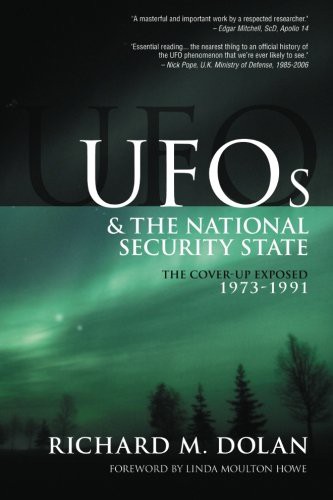
As an Amazon Associate, OverClassified may earn from qualifying purchases made through this link, at no extra cost to you.
Why This Is Essential Reading
UFOs and the National Security State, Vol. 2 earns its place on this list as the direct continuation of a two-volume project this site already treats as essential in its own right — and, on its own separate merits, as the documented origin of "breakaway civilization," a framing concept that has outlived this specific book by more than a decade and now sits directly upstream of live 2023–2026 congressional UAP disclosure discourse. Read it for Dolan's genuinely useful, citation-heavy chronology of Tehran, Rendlesham, the Belgian Wave, and the MJ-12 controversy's documented forgery finding — and read this site's own Breakaway Civilization Hypothesis page alongside it for the credentials-and-evidence gap between Dolan's historian's narrative and the propulsion-physics claims that narrative increasingly leans on. A reader who takes the book's institutional chronology as reliable history and its high-strangeness chapters (animal mutilations, crop circles, a more sympathetic Gulf Breeze) as unresolved anecdote, rather than collapsing the two into a single verdict, has read this book the way its own strongest and weakest material actually earns.
Related Cases & Theories
Essential Viewing

Secret Space Programs with Richard Dolan
New Thinking Allowed with Jeffrey Mishlove — A long-form interview with Dolan discussing the black-budget and breakaway-civilization arguments central to this book. Verified via YouTube oEmbed before inclusion.
Richard Dolan - The Case for a Breakaway Civilization (Pt. 2 of 2)
Forum Borealis — A long-form interview with Dolan making the case for the breakaway-civilization framework this book introduced. Verified via YouTube oEmbed before inclusion.
Sources Cited
- Dolan, Richard M. UFOs and the National Security State: The Cover-Up Exposed, 1973–1991. Foreword by Linda Moulton Howe. Keyhole Publishing Company, 2009 (2013 pbk. printing, ISBN-13 9780967799513). amazon.com
- "UFOs and the National Security State: The Cover-Up Exposed, 1973-1991." Open Library (bibliographic record: publisher, publish date, cover art, page count). openlibrary.org
- "UFOs and the National Security State: The Cover-up Exposed 1973-1991." Goodreads (295 ratings, 17 reviews, including the reader reviews quoted in this article). goodreads.com
- "UFOs and the National Security State Series." Goodreads (both volumes' series listing). goodreads.com
- "Majestic 12." Wikipedia (FBI 1988 forgery finding, Philip J. Klass document analysis). en.wikipedia.org
- Klass, Philip J. "New Evidence of MJ-12 Hoax." Skeptical Inquirer / Committee for Skeptical Inquiry archive. cdn.centerforinquiry.org
- "Richard M. Dolan." Rochester Wiki (biography: education, Rochester residence, career). rocwiki.org
- "About Richard Dolan." Richard Dolan Press / Richard Dolan Members (author's own biography and bibliography). richarddolanmembers.com
- This site's own resources library: Full Reading List, where this exact edition (ASIN 0967799511) is cited across seven separate case-file and theory pages.
- This site's own essential reading entry: UFOs and the National Security State (Volume One), for the first half of Dolan's two-volume chronology.
- This site's own theory page: Breakaway Civilization Hypothesis, for this book's own documented origin of the "breakaway civilization" concept and its later use by Bob Lazar- and David Grusch-adjacent researchers.
- This site's own case file: Tehran UFO Incident, for the 1976 F-4 Phantom intercept this book discusses in detail.
- This site's own case file: Rendlesham Forest Incident, for the 1980 RAF Bentwaters/Woodbridge landing.
- This site's own case file: Belgian UFO Wave, for the 1989–91 triangular-craft sightings closing this book's chronology.
- This site's own case file: Gulf Breeze UFO Sightings, for the Debunked-rated case this book treats more credulously than this site's own independent investigation supports.
- This site's own key-figures entry: Richard M. Dolan, for his full biography and further case connections.
- This site's own key-figures entry: Linda Moulton Howe, for this book's foreword author and her own independent animal-mutilation research.
Have corrections, additional research, or peer-reviewed sources? Help improve this entry.
Suggest an Edit