
The Matanzas Skies UFO Formation
On the evening of December 21, 1993, Radio Progreso correspondent Cándido Domínguez stepped onto his porch in Matanzas, Cuba, after his eight-year-old daughter shouted that she had spotted fireworks in the sky. What he saw instead was a bright white ball trailing a comet-like tail, followed by six or seven identical lights strung in a line, each with its own tail, crossing the sky north to south in roughly 30 seconds. He was not the only one watching. The same night, and independently of him and of each other, two staff meteorologists from the Cuban Academy of Sciences — Jesús Gómez in Jovellanos, 42 km southeast, and Orestes Gribao in Matanzas's own Versailles neighborhood — watched the same formation from their own vantage points. Two days later, Havana Radio Progreso Network broadcast Domínguez's account, the U.S. Foreign Broadcast Information Service (FBIS) translated and filed it the same day, and the resulting document sat unremarked in the CIA's classified archive for nearly fifteen years before its May 2008 declassification. It remains the only documentary record of the sighting known to exist.
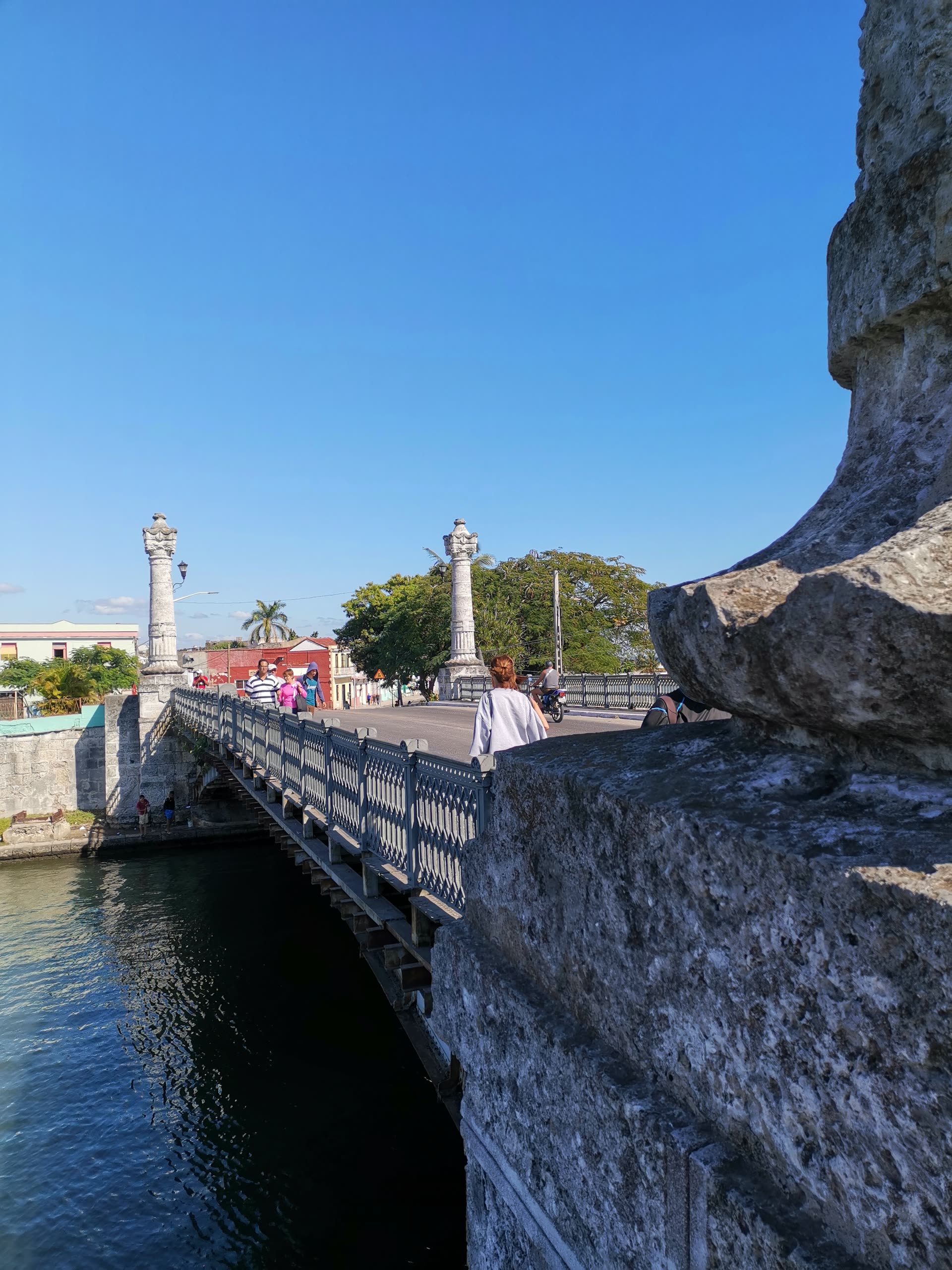
Pictured: the Puente de la Concordia (built 1878), the bridge over the Río Yumurí connecting central Matanzas to the city's Versailles neighborhood, where meteorologist Orestes Gribao watched the December 21, 1993 sighting. This is not a photograph of the event itself — no photograph, video, or other visual recording of the sighting is known to exist anywhere; the entire surviving evidentiary record is the single CIA-declassified FBIS translation of a Cuban radio broadcast filed two days later. Photo by Wikimedia Commons contributor Nord794ub (2019), licensed CC BY-SA 4.0.
Theoretical Alignment
None of the three major exotic hypotheses fits this case especially well, which is itself an analytically useful result. The Extraterrestrial Hypothesis draws only modest alignment: nothing about a line of six or seven lights, each trailing a tail, moving in a single straight pass across the sky and disappearing after roughly 30 seconds implies a controlled craft rather than an object falling or burning up under gravity and atmospheric drag. The Interdimensional Hypothesis has essentially nothing to work with — no reported discontinuity, no sudden appearance or vanishing in place, nothing beyond a conventional meteor-like trajectory. The Psycho-Social Hypothesis fares only slightly better: three trained, professionally credentialed observers at three separate locations independently describing a consistent formation argues against a purely subjective misperception isolated to one person, though it does not rule out several people independently and correctly perceiving an ordinary astronomical or space-debris event and each interpreting its cause as unknown. The case's low alignment across all three frameworks is consistent with this file's own assessment, discussed at length below, that the most parsimonious explanation belongs to a fourth category entirely: a naturally occurring meteoric event or a piece of man-made orbital debris burning up on reentry, neither of which any of the three standard hypotheses was built to describe.
Background
Matanzas is a port city of roughly 160,000 people on Cuba's northern coast, built around the deep, sheltered Bay of Matanzas where the Río Yumurí, the Río San Juan, and the Río Cánimar all meet the sea. Nineteenth-century Cubans nicknamed it “La Atenas de Cuba” — the Athens of Cuba — for its outsized literary and intellectual culture, and separately the “City of Bridges” for the seventeen spans that cross its three rivers. One of those bridges, the 1878 Puente de la Concordia, connects the historic center to the Versailles neighborhood on the Yumurí's north bank — a barrio settled after 1791 by French coffee and sugar planters fleeing the Haitian Revolution, named for the Parisian royal suburb its founders had left behind, and now regarded as the birthplace of rumba yambú, the oldest surviving form of Cuban rumba. Forty-two kilometers to the southeast sits Jovellanos, a municipal town founded in 1842 as Corral de la Bemba and renamed in 1870 for the Spanish Enlightenment writer Gaspar Melchor de Jovellanos; locals still call it “Bemba” today.
By December 1993 Cuba was three years into what its government called the “Périodo especial en tiempos de paz” — the Special Period — the severe economic contraction that followed the collapse of Soviet subsidies and trade after 1991. Fuel, transportation, and consumer goods were in short supply nationwide, radio remained one of the most accessible mass media for ordinary Cubans, and Havana Radio Progreso Network was one of the island's principal state-run stations, broadcasting national and provincial news, including listener and correspondent reports from cities like Matanzas.
The two meteorologists who corroborated Domínguez's report worked for what the FBIS translation calls the “territorial meteorology section of the Cuban Academy of Sciences.” Cuba's national meteorological service traces its modern form to October 12, 1965, when the Instituto de Meteorología (INSMET) was formally constituted from the merger of the country's National Observatory with a Department of Meteorology the Academy of Sciences had created fifteen months earlier; by the 1990s the institute maintained a central headquarters at Casablanca, near Havana, along with provincial and territorial sections across the island, staffed by professionally trained observers whose ordinary job was watching the sky and correctly identifying and logging what moved through it. Jesús Gómez and Orestes Gribao were, in other words, exactly the sort of witnesses whose professional training makes casual misidentification of an ordinary object — an aircraft, a planet, a satellite pass — comparatively unlikely, while doing nothing to guarantee the extraordinary conclusion that whatever they saw was artificial or intelligently controlled.
The document that preserves their testimony is a product of the U.S. Foreign Broadcast Information Service, the CIA-run open-source unit that spent decades monitoring, transcribing, and translating foreign radio and television broadcasts for the American intelligence community. FBIS routinely picked up Cuban state radio, among hundreds of other foreign outlets worldwide, as a matter of standing Cold War practice rather than because any particular broadcast was expected to contain intelligence of unusual significance — which is exactly the category into which this report fell. It survives today only because FBIS's daily haul of foreign-media translations was itself later swept into the CIA's broader historical archive.
Complete Timeline
| Date | Event |
|---|---|
| Dec 21, 1993, ~18:55 local | The sighting begins. Cándido Domínguez's eight-year-old daughter, on the porch of the family home in Matanzas, shouts that she sees fireworks. Domínguez walks outside and sees a very bright white ball trailing a lighted tail, “something like a comet.” |
| Dec 21, 1993, moments later | The lights multiply. Domínguez counts six or seven of them, lined up, each with its own tail, following a north-to-south trajectory. The formation remains visible for approximately 30 seconds before disappearing. |
| Dec 21, 1993, same evening | Independent corroboration, 42 km away. Cuban Academy of Sciences meteorologist Jesús Gómez watches the same phenomenon from Jovellanos, southeast of Matanzas. Nothing in the surviving record indicates Domínguez, Gómez, and the next witness had any contact with one another before or during the sighting. |
| Dec 21, 1993, same evening | Meteorologist Orestes Gribao, described in the FBIS translation as having “for years” studied UFO reports independently, watches the phenomenon from Matanzas's own Versailles neighborhood. |
| Dec 22, 1993 | Domínguez learns that the two meteorologists also observed the sighting. Gribao shows “several people” a book containing a photograph taken in 1913 from the Toronto Observatory in Canada, and the group agrees the 60-year-old (at the time) image is “almost identical” to what they saw on December 21. |
| Dec 23, 1993, 1200 GMT (~07:00 local) | Havana Radio Progreso Network broadcasts Domínguez's on-air report from Matanzas in Spanish. |
| Dec 23, 1993, 1815Z | The U.S. Foreign Broadcast Information Service transcribes and translates the broadcast into English, filing it as DOCN 000429524, serial FL2312181593, under the heading “UNIDENTIFIED FLYING OBJECTS SIGHTED IN MATANZAS SKIES,” marked UNCLAS 6A and routed for onward attention to “BBC SD” — consistent with FBIS's long-standing, routine information-sharing arrangement with the BBC's own foreign-broadcast monitoring service. |
| 1993–2008 | The report sits in the CIA's classified administrative archive (CREST — the CIA Records Search Tool) with no indication in the available record that it received any follow-up investigation, comment, or further distribution beyond its initial FBIS filing. |
| May 2008 | Declassification. The scanned document, control number C00386416, is stamped “Approved for Release” and formally declassified as part of the CIA's ordinary CREST review process. |
| Jan 17, 2017 | The CIA publishes its entire CREST archive — roughly 13 million pages, including this document — online for the first time, following a Freedom of Information Act lawsuit by the news outlet MuckRock and independent researcher Michael Best. Before this date the record was technically public but accessible only via an in-person terminal at the National Archives facility in College Park, Maryland. |
| Present | The document is catalogued in the CIA's FOIA Electronic Reading Room as record 0005517759 and mirrored by independent FOIA archives including The Black Vault and UFOScans.com. It remains the only documentary trace of the December 21, 1993 sighting known to survive; no Cuban government file, meteorological log, or independent press account of the event has been located. |
The Sighting, in the Witnesses' Own Words
The FBIS translation preserves Domínguez's report largely in his own first-person voice, credited “report by Cándido Domínguez from Matanzas.” Rendered from the original all-capitals wire transcript, it reads:
“The day before yesterday, a group of Matanzas residents, yours truly included, had the opportunity to observe unidentified flying objects, UFOs, over Matanzas City. Shortly before 1900, I heard my eight-year-old daughter, who was on the porch, shout: Daddy, look, fireworks. I walked out onto the porch and observed the strange phenomenon. The first thing I saw was a very bright white ball followed by a lighted tail, something like a comet. Later the lights multiplied and I saw six or seven of them lined up, each with a tail that followed a north-to-south trajectory. These lights remained visible for approximately 30 seconds.”
Domínguez continues, describing how he learned the following day that he had not been alone:
“Yesterday I learned that a group of specialists from the territorial meteorology section of the Cuban Academy of Sciences also viewed the strange sight from various areas of the city. One of them, Jesús Gómez, saw it in Jovellanos, 42 km southeast of Matanzas. [Orestes Gribao], who is a meteorologist and for years has been studying UFOs, watched the phenomenon in the Versailles neighborhood. [Gribao] showed several people a book that has a photograph taken in 1913 from the Toronto Observatory, Canada. We all agreed that what we saw on 21 December in Matanzas is almost identical to what the 80-year-old picture shows. Undoubtedly, this will be a subject of much interest to those who study the extraterrestrial universe.”
(The FBIS translator's own bracketed annotation flags “[Gribao]” and “[Orestes Gribao]” as a best-effort rendering of a name the transcriber evidently found difficult to parse cleanly from the broadcast audio — a routine hedge in FBIS product, and one worth noting rather than silently smoothing over, since it means Gribao's exact surname spelling rests on a single translator's phonetic judgment rather than on any written source. The original teletype transcript further shows garbled fragments and transmission artifacts typical of 1990s wire service equipment, none of which affect the substance of the account reproduced here.)
Two structural features of this account matter for evaluating it. First, all three descriptive elements — the initial bright, tailed “comet-like” object, the subsequent multiplication into six or seven similarly tailed lights, and the roughly straight north-to-south line they formed — are consistent across every witness the report cites, with no contradictory detail recorded anywhere in the text. Second, the entire account rests on a single secondhand relay: Domínguez did not personally interview Gómez or Gribao on the air, and no independent statement from either meteorologist survives outside what Domínguez says he learned from them the next day. The corroboration is real in the sense that a working reporter is unlikely to fabricate two named, checkable colleagues from a small provincial scientific institute for a throwaway radio item; it is limited in the sense that this site has no first-person meteorologist testimony to weigh independently against Domínguez's paraphrase of it.
Gribao's 1913 Comparison
The detail Gribao volunteered — that what the group saw over Matanzas was “almost identical” to a photograph taken in 1913 at the Toronto Observatory — is checkable, and it points somewhere specific. On the evening of February 9, 1913, observers across a huge swath of Ontario, the northeastern United States, and points beyond watched a slow-moving, tightly organized procession of dozens of fireballs cross the sky in formation, each trailing a luminous tail, moving in near-perfect single file along a shared great-circle path before some of the fragments continued on to be reported as far away as Bermuda and, per later reconstructions, over the South Atlantic. University of Toronto astronomer Clarence Augustus Chant collected hundreds of eyewitness accounts of what came to be called the Great Meteor Procession, and although no photograph of the event itself is known to have survived, Toronto artist and amateur astronomer Gustav Hahn's watercolor reconstruction, made from his own observation near High Park, became the event's canonical visual record and was reproduced (hand-tinted, copy by copy) in the Journal of the Royal Astronomical Society of Canada. A 2013 reconstruction by astronomers Donald Olson, Steve Hutcheon, and Margaret Vaverek, published around the event's centennial, used Chant's original eyewitness geometry to trace the fragment swarm's likely path and origin with modern orbital-mechanics tools.
Whatever specific 1913 image Gribao actually owned or showed his neighbors — Hahn's painting rather than a true photograph is the far more likely candidate, given that no genuine 1913 photograph of the procession is known to exist in any archive this site could locate — the comparison itself is analytically double-edged for anyone hoping it strengthens the case for something exotic over Matanzas in 1993. Mainstream astronomers today do not classify the Great Meteor Procession as anomalous or unexplained; they classify it as a genuine but very unusual natural phenomenon — a tight cluster of meteoroid fragments, likely torn from a single small parent body, entering the atmosphere on an almost perfectly horizontal, Earth-grazing trajectory rather than the steep dive of an ordinary meteor, which is what let dozens of separate fragments stay visible together for a slow, sustained pass across the sky instead of the usual one-second streak. If Gribao's own chosen comparison is the correct one, the internal logic of his argument — “this looked exactly like that” — cuts toward a mundane meteoric explanation for the 1993 sighting rather than away from one, even though Domínguez's broadcast frames the comparison as support for extraterrestrial interest.
The 1913 event's own explanatory history is worth spelling out, because it shows how far a genuinely strange-looking mass sighting can travel from “unexplained” to “understood, if unusual” given enough analysis. Chant's own contemporaneous study of the eyewitness reports he collected found that every account plotted along a single great-circle arc across the Earth's surface, and combined ship and shore reports eventually extended that arc from Saskatchewan across Ontario and the northeastern United States, out over Bermuda, and as far as Brazil — a ground track later estimated at more than 11,000 km. That geometry led Chant to conclude the source body had briefly become a genuine, if extremely short-lived, natural satellite of Earth: a small object or cluster of objects gravitationally captured into a temporary, near-circular orbit that decayed and burned up within a single pass rather than the steep, one-way dive of an ordinary meteor. The idea was contested for decades — astronomer Charles C. Wylie argued the procession instead had a discoverable radiant like any conventional shower, a position later astronomers including Lincoln LaPaz and John A. O'Keefe pushed back against in favor of Chant's original temporary-satellite reading — and modern researchers (Mikael Granvik, Jeremie Vaubaillon, and Robert Jedicke, writing on the general dynamics of near-Earth objects captured into short-lived Earth orbits, so-called temporarily captured orbiters or “minimoons”) have since situated the 1913 procession within that same well-studied population of objects. None of this reconstruction was available to Gribao in 1993, but it is available now, and it reinforces the same point: the single comparison case the Matanzas witnesses themselves chose to invoke has, in the decades since, been folded ever more firmly into mainstream orbital-dynamics science rather than into ufology.
From Havana Radio to Langley: How an FBIS Report Becomes a CIA Record
It is worth being precise about what kind of document this case rests on, because the answer shapes how much evidentiary weight it can fairly carry. The Foreign Broadcast Information Service was not a spy agency collecting secrets; it was the CIA's open-source monitoring arm, listening to publicly broadcast foreign radio and television around the world, transcribing what it heard, translating it into English, and distributing the product to analysts and other government consumers who needed a fast, centralized digest of what foreign media was saying. A Cuban provincial radio station's human-interest item about a UFO sighting was, from FBIS's perspective, simply one more piece of that day's foreign-media traffic — routine, not urgent, and evidently never flagged for any follow-up investigation, since no analytic comment, cross-reference, or later addendum accompanies it anywhere in the available file.
That mundane bureaucratic pedigree is precisely what makes the document trustworthy as a record of what Cuban state radio broadcast on December 23, 1993, while simultaneously limiting what it can prove about the underlying phenomenon. The CIA's declassification stamp certifies that this is a faithful capture of a real foreign broadcast; it does not, and was never intended to, certify that the broadcast's content was true, that Domínguez's account was accurate, or that Gómez and Gribao's corroboration (itself relayed at one remove, through Domínguez) held up under any independent scrutiny. The document's own internal markings — classification UNCLAS 6A, filed as DOCN 000429524 under serial FL2312181593, routed for onward attention to “BBC SD” — are standard FBIS administrative metadata, not intelligence assessment.
The document's own journey to public visibility is itself a small case study in U.S. declassification practice. It was formally approved for release in May 2008, one of many thousands of records processed under the CIA's ordinary CREST (CIA Records Search Tool) review pipeline, but “declassified” in 2008 did not mean “publicly accessible online” in any practical sense: CREST records were searchable only from four dedicated terminals at the National Archives facility in College Park, Maryland, an arrangement journalists and FOIA researchers had long criticized as public in name only. That changed on January 17, 2017, when the CIA published the entire CREST archive — roughly 13 million pages — on its own website, a move it took under legal pressure after the news outlet MuckRock sued the agency in 2014 and researcher Michael Best ran a crowdfunded campaign to manually print and rescan the archive page by page rather than wait out the CIA's initial estimate that full digitization would take up to 28 years. This specific document has since been further mirrored by independent FOIA archives, including John Greenewald Jr.'s The Black Vault and UFOScans.com, both of which host copies of the original scanned page bearing the same C00386416 control number and May 2008 release stamp.
Cuban Ufology: Context and Constraints
Cuba's relationship with organized UFO research is unusually constrained even by the genre's normal standards. The 1967 Cuban MiG-21 Jet Incident, this site's other published Cuban case file, describes an alleged Cold War-era radar intercept and interception attempt against an unidentified aerial target — a story built almost entirely on secondhand U.S. signals-intelligence claims rather than any Cuban government acknowledgment, and one that at least one Cuban military historian has since dismissed outright as an urban legend absent from Cuban archives. The Matanzas sighting sits at the opposite end of the credibility spectrum from that story in one important respect: it is not a secondhand intelligence claim about classified Cuban military activity but a plainly broadcast, publicly aired civilian news item, picked up by a foreign monitoring service exactly as it aired.
Institutionally, however, Cuban ufology has remained an amateur and largely unofficial pursuit. The Asociación Cubana de Ufología (ACU), formed by independent researchers, has sought since 2006 to register formally as a nonprofit research association with the Cuban government and has not succeeded in doing so; academic conferences touching on the subject are tolerated, but a dedicated, officially sanctioned UFO research body is not. Cuba's own popular UFO folklore predates any of this by well over a century — the colonial-era legend of the “Luz de Yara,” a great light said to rise from the sea or the mountains near Yara and split into independently moving spheres, tied in local tradition to the death of the Taíno cacique Hatuey, is still cited by Cuban writers today as the island's oldest UFO story, though as oral legend rather than a documented sighting with named witnesses or a fixed date, it belongs to a different evidentiary category than the Matanzas case and is noted here only as cultural background, not as a comparable data point. Against that backdrop, a report as specific as Domínguez's — three named, geographically separated, professionally credentialed observers, a fixed date, a described trajectory and duration — is unusually well-anchored for Cuban ufology, even though its survival as a documented case owes more to Cold War American signals collection than to any Cuban institution's own record-keeping.
Key Witnesses
Cándido Domínguez
The original and only named primary witness to make an on-the-record account of the sighting's opening moments. A working radio correspondent rather than a UFO researcher, Domínguez reported the event in the plain, unembellished register of routine local news, framing his own reaction as curiosity rather than alarm. His account is the anchor for everything else in the case: it supplies the exact time window, the described trajectory and duration, and the only surviving (secondhand) report of Gómez and Gribao's corroborating observations. No information about Domínguez's later career, further public statements, or any follow-up reporting on the case has surfaced in the available record.
Jesús Gómez
The most geographically significant witness in the case. Watching from Jovellanos, 42 km southeast of Matanzas, Gómez's report — as relayed by Domínguez — independently matches the trajectory, formation, and general character Domínguez himself described from the city. A separation of 42 km between two observers reporting a consistent sighting the same night is difficult to square with a purely local, low-altitude, small-scale stimulus (a firework, a local light source, a small aircraft at low altitude) and points instead toward either a genuine coincidence of two people independently misdescribing unrelated local events in similar terms, or a single real stimulus large enough, bright enough, or high enough in the atmosphere to be visible across that distance — a discriminator that favors an astronomical or space-debris origin over a small, nearby, terrestrial one. As a professional meteorologist, Gómez's ordinary job required routine, trained observation of the sky, which somewhat raises the baseline credibility of his description relative to an untrained bystander, though it does not make him immune to misidentifying an unfamiliar phenomenon.
Orestes Gribao
Described in the FBIS translation as a meteorologist who had “for years” independently studied UFO reports, Gribao is the only witness in this case with any stated prior interest in the subject — a fact that cuts in two directions at once. On one hand, a pre-existing interest in UFOs could make a witness more inclined to interpret an ambiguous stimulus in exotic terms. On the other, someone who has spent years actually looking into UFO reports has also, in the ordinary course of that interest, likely absorbed a working knowledge of the astronomical and man-made phenomena (meteors, bolides, satellite reentries, aircraft contrails at sunset) most often mistaken for something stranger — and it was Gribao, not a skeptic, who supplied the case's own most useful comparison point by reaching for a documented 1913 meteor procession rather than a claim of alien visitation. His exact surname spelling rests on a single FBIS translator's phonetic rendering of a Spanish-language broadcast, flagged with brackets in the original transcript, and no independent written source for it has been located.
The Five Observables Assessment
The Five Observables framework, developed by former AATIP director Luis Elizondo, classifies UAP encounters by performance characteristics that exceed known technology. None is described here.
Assessment: Every witness description is consistent with a single continuous pass in one direction, ending in the objects burning out or passing from view rather than stopping, hovering, reversing course, or maneuvering. There is no reported hovering or lift (anti-gravity lift: absent), no reported sudden change of speed or direction (instant acceleration: absent), no reported disappearance from view followed by radar or instrumented contact that would establish genuine low observability (absent, since the case has no instrumented data of any kind to establish observability either way), and nothing touching water, ground, or any other medium transition (trans-medium: absent). Hypersonic velocity is marked N/A rather than present or absent for a specific reason: natural meteors and reentering space debris both travel at genuinely hypersonic speeds as a routine, unremarkable consequence of atmospheric entry physics, so an object's raw velocity here would be uninformative even if it could be measured, which it cannot be from unaided-eye testimony alone. The Five Observables framework was built to flag performance that exceeds known aerospace technology; nothing in this account does that.
Evidence Assessment
Supporting a Genuine, Well-Corroborated Sighting
- Three separate observers, at three separate locations up to 42 km apart, independently described a consistent formation, trajectory, and duration the same night
- Two of the three witnesses were professional meteorologists whose ordinary training involves careful, trained sky observation
- The primary record is a contemporaneous broadcast filed within two days of the event, not a decades-later reconstructed memory
- The document's chain of custody is unusually clean: a foreign intelligence monitoring service's routine translation product, declassified through ordinary review rather than released under public pressure tied to this specific case, with no incentive to embellish or suppress
- No named witness in the case has any known financial or promotional interest in the story
Supporting a Mundane, Misidentified Stimulus
- The described phenomenology — a bright leading object with a tail, followed by several more tailed lights strung in a line, moving in one direction for about 30 seconds — is a close, almost textbook match for either a fragmenting bolide (fireball meteor) or a piece of reentering rocket or satellite debris breaking apart, both extremely common and well-documented occurrences
- No maneuvering, hovering, acceleration, or other performance characteristic inconsistent with a falling or burning object was reported by any witness
- Gómez's and Gribao's corroboration reaches this file only secondhand, through Domínguez's own paraphrase, not as independent statements this site can weigh directly
- Gribao's own chosen comparison — the 1913 Great Meteor Procession — is today classified by astronomers as a natural, if highly unusual, meteoric event, undercutting the exotic framing his broadcast comparison was originally used to support
- No photograph, video, radar return, or physical trace of any kind was collected, despite three educated observers with, presumably, access to cameras or at minimum detailed note-taking capacity
- No Cuban government agency, meteorological log, or independent press outlet is known to have investigated or corroborated the sighting beyond Domínguez's own broadcast
Why "Disputed"
This case earns a DISPUTED classification rather than either a credible or debunked stamp because the evidence supports a real, multiply-witnessed event whose most likely cause is mundane, but that cause has never been specifically identified, confirmed, or ruled out by any competent authority. What is not in dispute: three people, at geographically separated locations, independently reported watching the same formation of luminous, tailed objects cross the sky over Matanzas province on the night of December 21, 1993, and their account survives today only because it happened to be captured by a Cold War-era foreign radio monitoring apparatus that had no stake whatsoever in the UFO question one way or the other.
What remains genuinely open is everything downstream of that basic fact. The described phenomenology overwhelmingly resembles two extremely common, entirely mundane categories of event — a fragmenting meteor or a reentering piece of space debris — and this file has found no evidence that either was specifically confirmed for this date by any tracking authority, meteor network, or Cuban government body; equally, this file has found no evidence that any such mundane explanation was ever formally investigated and ruled out. In the absence of instrumented data, physical evidence, or any government follow-up on either side, the case cannot honestly be marked either credible (there is no performance characteristic here that exceeds known technology, and the phenomenology fits mundane categories too well) or debunked (no specific mundane object or event has actually been identified and matched to the date and description). It sits, honestly, in between.
Sensor & Instrumentation Detection Profile
No instrumented detection of any kind is documented in this case. The entire record consists of unaided-eye visual testimony from three witnesses. No radar station, military or civilian, is reported to have logged a corresponding track; no photograph or video camera captured the event; no seismic, acoustic, or electromagnetic sensor data is referenced anywhere in the surviving documentation. This is unremarkable rather than suspicious: a brief, roughly 30-second nighttime sky event in December 1993 falls well within the range of things that would routinely go undetected by Cuba's contemporary civil aviation and meteorological radar network even if it were a genuine, mundane meteor or reentry, since neither type of ground-based radar of that era and region was optimized to track high-altitude, high-speed natural or debris objects passing briefly overhead.
Environmental & Geospatial Context
Matanzas sits on Cuba's Atlantic-facing north coast at roughly 23.04°N, 81.58°W; Jovellanos lies inland at approximately 22.80°N, 81.19°W. Late December falls within Cuba's dry season (roughly November through April), when the island typically sees its clearest, least humid skies of the year — conditions that would favor unobstructed visibility of a distant aerial phenomenon across the 42 km separating Domínguez and Gómez, though no specific meteorological station log for the evening of December 21, 1993 has been located to confirm cloud cover, visibility, or wind conditions at either location. The date also falls squarely within the annual active window (roughly December 17–26) of the Ursid meteor shower, whose radiant lies near the star Kochab in Ursa Minor and which reaches its own annual peak around December 22 — one day after this sighting. The Ursids are a minor shower, typically producing only about ten visible meteors per hour even at their peak, and its individual meteors are independent, momentary streaks rather than a synchronized, multi-object formation persisting together for 30 seconds, which argues against ordinary shower activity as a complete explanation even though the general date sits inside the shower's active period; a coordinated multi-fragment breakup of a single larger body (a sporadic bolide unrelated to the Ursid radiant, or a reentering piece of orbital debris) fits the described formation far better than does routine shower meteor activity. No historical record of a specific tracked rocket-body or satellite reentry over the Cuba/Caribbean region on this date has been located in the sources available to this file.
Observer Credibility & Occupational Profile
All three named witnesses held ordinary, checkable civilian occupations with no apparent connection to UFO research, promotion, or profit, and no history of prior extraordinary claims beyond Gribao's stated (but otherwise undocumented) personal interest in the subject. Cándido Domínguez was a working radio correspondent, whose occupational habit of accurate, checkable, on-the-record reporting cuts toward reliability, tempered by the fact that his account is the only source for everything else in the case, including the two meteorologists' own corroboration. Jesús Gómez and Orestes Gribao both held professional meteorological posts with the Cuban Academy of Sciences, occupations that require routine, disciplined sky observation as a matter of daily work — a genuine credibility asset relative to an untrained bystander, though meteorological training is not the same as astronomical training, and correctly logging cloud cover, wind, and precipitation does not automatically confer expertise in identifying meteors, bolides, or satellite reentries specifically. No rank, security clearance, radar operator certification, or other higher-tier credential (of the kind that elevates witness credibility in cases like military radar-intercept incidents) applies to any witness here; all three are, at most, trained lay observers of the sky rather than specialists in the specific phenomenon categories most relevant to explaining what they saw.
Physical & Material Assays
None were conducted, and none are claimed. No debris, meteorite fragment, or other physical trace connected to the sighting was recovered, reported found, or referenced anywhere in the surviving documentation, and no government agency is known to have searched for any. This absence is unremarkable for a brief nighttime sky phenomenon witnessed at a distance rather than a close-range or landing-type encounter; the great majority of meteor and bolide sightings, including many far brighter and more widely witnessed than this one, never yield a recovered meteorite, since most bolides either burn up completely in the upper atmosphere or scatter any surviving fragments across a wide, unsearched, and often oceanic dispersal ellipse. Nothing about the absence of physical evidence here is diagnostic one way or the other.
Historical Precedents & Archive Matches
The single most direct historical precedent in this case is the one the witnesses themselves supplied: the February 9, 1913 Great Meteor Procession, discussed in detail above, in which dozens of bright, tailed fireballs crossed the sky over Ontario and the northeastern United States in a slow, sustained, single-file formation, subsequently reconstructed by astronomers as a swarm of meteoroid fragments on a rare, nearly horizontal Earth-grazing trajectory. That the witnesses reached for a documented, since-explained natural phenomenon as their own point of comparison — rather than for a craft, an abduction account, or any other more overtly exotic reference — is itself a notable, if double-edged, feature of the case.
Within Cuba specifically, the island's only other published case file on this site, the 1967 Cuban MiG-21 Jet Incident, describes an entirely different category of claim — a secondhand, U.S. signals-intelligence account of an alleged Cold War military radar intercept and interception attempt, unconfirmed by any Cuban source and dismissed as apocryphal by at least one Cuban military historian who consulted his own country's archives and veteran pilots. The Matanzas sighting shares only its national setting with that story; evidentially, the two cases have almost nothing in common. Cuba's broader UFO folklore, including the colonial-era “Luz de Yara” legend tied to the death of the Taíno cacique Hatuey, predates any of this by centuries but belongs to oral tradition rather than to documented, dated, named-witness reporting, and is noted here strictly as cultural background rather than as a comparable evidentiary precedent.
Material Analysis
There is no physical material to analyze in this case, and this section exists to record that fact plainly rather than to describe findings that do not exist. No fragment, residue, or other trace evidence connected to the December 21, 1993 sighting was ever recovered, submitted for laboratory analysis, or referenced in any government or press record this site has located.
What a Genuine Fragmenting Bolide or Reentry Would Be Expected to Leave Behind
For context, it is worth noting what physical evidence a genuine meteorite fall or debris reentry over this specific stretch of Cuba would, and would not, be likely to produce. A bright bolide breaking into several pieces at high altitude very often burns up completely before any fragment reaches the ground; when fragments do survive to impact, they typically scatter across a dispersal ellipse that can run from a few hundred meters to several kilometers long, and unless that ellipse happens to fall over inhabited, actively searched terrain, recovery is the exception rather than the rule worldwide. A stretch of Cuban countryside between Matanzas and Jovellanos, or open water in the Straits of Florida or the Caribbean depending on the object's actual heading, would be an entirely ordinary place for any surviving fragments to go permanently unrecovered. The same logic applies with even more force to reentering artificial debris, most of which is designed or expected to burn up completely, with any surviving fragments falling across similarly wide and often unpopulated or oceanic footprints. The absence of a recovered object here is fully consistent with either mundane explanation and provides no evidence against them.
Supporting Non-Terrestrial or Otherwise Anomalous Origin
- Independent corroboration across a 42 km baseline is a genuine evidentiary strength not present in most single-witness UFO reports
- Two of the three witnesses were professionally trained sky observers
- No conventional object or event has been specifically confirmed as the cause for this exact date
Supporting Mundane Terrestrial/Natural Origin
- The described formation — a lead object with a tail followed by several more tailed lights in a line, moving in a single direction for ~30 seconds — matches known bolide-fragmentation and debris-reentry phenomenology closely
- No performance characteristic (hovering, acceleration, course change) inconsistent with a falling or burning object was reported
- The date falls within the active window of an annual meteor shower, and December generally is a period of elevated bright-fireball reporting worldwide
- Absence of any recovered physical fragment is fully expected under a mundane explanation and carries no evidentiary weight against it
The Conventional Explanation Candidate
No single conventional explanation for the Matanzas sighting has ever been formally proposed, investigated, or confirmed by any government or scientific body — the case simply was never picked up for that kind of follow-up. What follows is this file's own assessment of the leading candidates, evaluated directly against the described phenomenology rather than against any external investigative finding, since none exists.
Rocket Body or Satellite Reentry Fragmentation
Uncontrolled reentries of spent rocket upper stages and defunct satellites were, by 1993, an already well-established and frequent occurrence, a legacy of nearly four decades of Cold War-era Soviet and American orbital launches accumulating in low Earth orbit faster than natural atmospheric drag could clear them. A tumbling rocket body breaking apart under aerodynamic and thermal stress during reentry characteristically produces exactly the phenomenology described here: an initial bright leading fragment, followed by a trailing string of smaller pieces, each burning and trailing its own luminous plume, moving together along a single roughly straight ground track for anywhere from several seconds to over a minute before burning out. Such events remain visible across baselines of dozens to hundreds of kilometers, comfortably covering the 42 km separating Matanzas and Jovellanos. This file has not located any specific catalogued reentry event matched to December 21, 1993 over the Cuba/Caribbean corridor; the absence of a confirmed match reflects the limits of publicly available 1993-era tracking data and this file's own research, not evidence against the hypothesis.
Sporadic Bolide (Fireball Meteor) Fragmentation
A bright sporadic meteor (unrelated to any annual shower) breaking apart during atmospheric entry is the natural-phenomenon counterpart to the reentry hypothesis above, and produces a visually similar signature: a bright leading fragment with a tail, followed by secondary fragments each trailing their own luminous debris, moving together along the parent body's original trajectory. Such events are reported worldwide multiple times per year and are frequently, if inaccurately, described by lay witnesses as "UFOs" or "formations" precisely because a fragmenting bolide's multi-object appearance does not immediately register to an untrained eye as a single object breaking apart. This candidate does not require any specific tracked catalog entry to be plausible, since the great majority of sporadic bolides, unlike orbital debris, are never catalogued by any tracking authority at all.
Ursid Meteor Shower Activity
The sighting's date, one day before the Ursid shower's typical December 22 peak, invites the shower itself as a candidate, but the match is weak on close examination. Ursid meteors are independent events, each a fraction of a second to at most a couple of seconds long, radiating outward from a fixed point near Kochab in Ursa Minor rather than moving together as a synchronized group along a shared straight-line path for a sustained 30 seconds. The Ursids are also a minor shower with a typically low hourly rate, making a spontaneous, tightly synchronized cluster of six or seven shower meteors appearing together, in formation, at the same moment from three separated vantage points, a poor statistical fit compared with a single fragmenting body (whether natural bolide or artificial debris) that would produce exactly this kind of coordinated, multi-piece display as a matter of ordinary physics rather than statistical coincidence.
The Assessment
Rocket/Satellite Reentry
PlausibleThe described phenomenology is a close match to well-documented reentry fragmentation events, and 1993-era orbital debris density made such an event unremarkable. No specific reentry has been confirmed for this date, but that absence reflects incomplete public tracking data for a Cold War-era Cuban sighting rather than evidence against the hypothesis.
Sporadic Bolide Fragmentation
PlausibleEqually close a match to the described phenomenology as the reentry candidate, and inherently harder to rule in or out since most sporadic bolides are never catalogued anywhere. The single strongest candidate simply on frequency of occurrence worldwide.
Ursid Meteor Shower
ImplausibleThe date falls within the shower's active window, but ordinary shower meteors do not travel together in a synchronized, multi-object formation for a sustained 30 seconds. A minor shower with a low hourly rate is a poor statistical fit for what three witnesses independently described.
Related Cases
Confirmed Documents & Official Records
The primary source for this entire case file: the CIA's Foreign Broadcast Information Service translation of Cándido Domínguez's December 23, 1993 Havana Radio Progreso broadcast, filed as DOCN 000429524 / serial FL2312181593, control number C00386416, declassified and approved for release in May 2008.
UNCLAS 6A (declassified via FOIA)Search Government Archives Directly
Further Reading — Recommended Literature
UFOs In Central and South American AirSpace
A survey of UFO reports across Latin America and the Caribbean, situating cases like Matanzas within the region's broader, comparatively under-documented reporting history.
Clear Intent: The Government Coverup of the UFO Experience
A foundational study of declassified U.S. government UFO documents obtained through FOIA, useful background for understanding how records like this case's own FBIS translation come to exist and be released.
The UFO Encyclopedia, 4th Edition
The standard general reference for UFO case history worldwide, useful for placing an obscure single-broadcast case like this one within the wider landscape of documented sightings.
UFOs and the National Security State: The Cover-Up Exposed, 1973–1991
A chronological history of U.S. government engagement with UFO reports through the end of the Cold War, the same institutional era and declassification pipeline that produced this case's own FBIS document.
Above Top Secret: The Worldwide U.F.O. Cover-Up
An early, wide-ranging survey of international UFO cases and government secrecy, representative of the genre's approach to cases from outside the United States and Western Europe.
DISCLOSURE: Some links above are affiliate links. If you purchase through them, OverClassified receives a small commission at no additional cost to you. This helps support independent research.
Essential Viewing
No Videos Available
A genuine, reasonable search turned up no video specifically and verifiably about the December 21, 1993 Matanzas sighting — an unsurprising gap for a case whose entire public record is a single declassified text document, never covered by any television documentary or dedicated video essay this site could locate. Per editorial policy, no off-topic or recycled video has been substituted here.
Sources
- Central Intelligence Agency, Foreign Broadcast Information Service. “Unidentified Flying Objects Sighted in Matanzas Skies” (Havana Radio Progreso Network, Spanish, 1200 GMT Dec. 23, 1993), DOCN 000429524, control no. C00386416, approved for release May 2008. cia.gov/readingroom
- The Black Vault (John Greenewald Jr.). Mirror of CIA document C05517759, “Unidentified Flying Objects Sighted in Matanzas Skies.” theblackvault.com
- UFOScans.com. Mirror and transcription of CIA document C05517759. ufoscans.com
- Central Intelligence Agency. “Freedom of Information Act Electronic Reading Room — UFOs: Fact or Fiction?” collection. cia.gov/readingroom
- MuckRock News. “The CIA's declassified database is now online. Thanks MuckRock and others!” Jan. 17, 2017. muckrock.com
- MuckRock News. “Our three-year saga to release 13 million pages of CIA secrets.” Jan. 19, 2017. muckrock.com
- Smithsonian Magazine. “You Can Now Explore the CIA's 'Entire' Collection of UFO Documents Online.” smithsonianmag.com
- Central Intelligence Agency. “CIA's Role in the Study of UFOs, 1947–90,” Federation of American Scientists archive. sgp.fas.org
- “Matanzas,” Wikipedia — geography, population, and “Athens of Cuba”/“City of Bridges” history. en.wikipedia.org
- “Jovellanos,” Wikipedia — founding as Corral de la Bemba and 1870 renaming. en.wikipedia.org
- Cuban Travel Agency. “Barrio de Versalles, Matanzas” — history of the Versailles neighborhood and Puente de la Concordia. cubantravelagency.org
- “Instituto de Meteorología: plaza del conocimiento y el bien público,” Granma, Oct. 12, 2020 — founding history of Cuba's national meteorological service (original Tribuna de La Habana article retired). granma.cu
- “Instituto de Meteorología (Cuba),” Wikipedia (Spanish). es.wikipedia.org
- “1913 Great Meteor Procession,” Wikipedia. en.wikipedia.org
- Astronomical Society of Canada (RASC). “Meteor Procession 1913.” rasc.ca
- Phys.org. “Celestial sleuths track historic meteor procession to South Atlantic,” Jan. 2013 (Olson, Hutcheon & Vaverek centennial reconstruction). phys.org
- Astronomy Picture of the Day (NASA/APOD). “The Great Meteor Procession of 1913,” Feb. 9, 2013. apod.nasa.gov
- EarthSky. “Ursid meteor shower: All you need to know” — radiant, peak date, and active window. earthsky.org
- Cubanet. “Cuba y los OVNIs: una historia de militares, campesinos, expedientes y misterios sin resolver.” cubanet.org
- Cubalite. “Extraterrestres y ovnis en Cuba: Lo que (quizás) sabes y lo que no.” cubalite.com
- Marcianitos Verdes. “Ovnilogía cubana” — history of the Asociación Cubana de Ufología (ACU) and Cuban UFO research. marcianitosverdes.haaan.com
- Periódico Cubano. “OVNIS en Cuba: la historia del caza MiG-21 que perseguía una esfera metálica” — background on the 1967 Cuban MiG-21 case. periodicocubano.com
- The UFO Chronicles. “Military UFO Sightings During the Cuban Missile Crisis” — background on U.S. signals monitoring of Cuban airspace during the Cold War. theufochronicles.com
- Wikimedia Commons. “File:Puente de la Concordia, Matanzas 2019.jpg,” photograph by Nord794ub, CC BY-SA 4.0, Dec. 8, 2019. Source of this case file's hero image. commons.wikimedia.org
- Wikipedia. “Yumurí River.” en.wikipedia.org
- Wikipedia. “Matanzas Province.” en.wikipedia.org
See something inaccurate? Have additional information or sources?
Suggest an Edit →Last Updated: August 2026