
The Threat
Revealing the Secret Alien Agenda
Core Thesis
The Threat is David M. Jacobs's third book and the fullest, most uncompromising statement of a research program he had been building since the mid-1980s: drawing on more than 700 of his own hypnotic-regression sessions, conducted through his privately run International Center for Abduction Research, Jacobs argues that reported alien abductions are not isolated, random encounters but evidence of a coordinated, multi-generational breeding program in which alien beings — unable to reproduce on their own — use abducted humans to create a graduated series of hybrid offspring, from early forms that look almost entirely alien to late-stage hybrids capable of passing as ordinary humans. Where most abduction researchers had treated the hybridization idea as a disturbing hypothesis still under investigation, Jacobs's central and most consequential move in this book is to present it as an essentially settled conclusion: the hybrids, he argues, are already being trained to "pass" and are being gradually introduced into human society ahead of an event abductees reportedly call "the Change," a covert transition toward alien–hybrid control of Earth. Published 23 years after Jacobs's sober, institutionally cautious 1975 academic debut The UFO Controversy in America — a University of Wisconsin history dissertation that treated the UFO phenomenon's underlying reality as secondary to the sociopolitical fact of the controversy itself — The Threat is a different kind of book by the same author entirely: not institutional history built from archives and interviews about government policy, but a first-person assertion of what its author had come to believe, built almost entirely from hypnotically recovered testimony, and pitched at a level of interpretive certainty that went further than any other credentialed academic in ufology had been willing to go, drawing serious and lasting criticism even from researchers who shared Jacobs's basic premise that abductions were real and involved reproductive activity.
About the Author
This site's own essential-reading entry on David M. Jacobs's 1975 book covers his early biography in full — his graduate work at the University of Wisconsin–Madison near Madison, his 1973 Ph.D. dissertation, and the academic-press book Indiana University Press published from it with a foreword by J. Allen Hynek — and that account is not repeated here. What matters for The Threat is what happened afterward. Jacobs joined Temple University's history faculty, earned tenure in 1981, and by his own account taught "UFOs in American Society" — reportedly the only university-accredited course of its kind in the country — for more than 25 years, work he later told The Philadelphia Inquirer in 2014 came at a direct professional cost: passed over for promotion to full professor twice, he said, "I was not rewarded for my views," and recalled a university donor once threatening to withdraw support unless he stopped teaching the course. He retired from Temple in 2011 after 36 years on the faculty.
The turning point between the historian who wrote The UFO Controversy in America and the researcher who wrote The Threat came in 1986, roughly a decade after the first book's publication, when Jacobs began conducting hypnotic-regression interviews with self-described abductees, working in the same period alongside Budd Hopkins — whose own 1987 book Intruders, also covered on this site, had just advanced an early version of the hybrid-breeding hypothesis at length. Jacobs's first abduction book, Secret Life: Firsthand, Documented Accounts of UFO Abductions (1992), established the same hypnosis-centered method this book would apply at far greater scale, and in 1991–92 Jacobs joined Hopkins and Harvard psychiatrist John E. Mack in commissioning a Roper Organization poll of nearly 6,000 American adults, which the three researchers argued suggested millions of undiagnosed abduction experiences nationwide — a statistical anchor The Threat leans on directly to argue for the scale of the program it describes.
By the time The Threat appeared in 1998, Jacobs had logged the bulk of the more than 700 of his own hypnotic-regression sessions the book draws on, conducted through the privately run International Center for Abduction Research he directed. Over the course of his full career he would eventually log more than 1,200 sessions with upwards of 150 subjects across three decades, but The Threat represents the specific midpoint at which Jacobs moved from documenting what abductees reported to asserting, in his own authorial voice, what he had concluded those reports meant: a systematic, hostile, exploitative program rather than the ambiguous or even benevolent phenomenon other researchers working from similar testimony were describing.
The book's reception, discussed in full below, marked a real turn in how Jacobs was received even within a field already inclined to take abduction claims seriously. Skeptic magazine founder Michael Shermer interviewed Jacobs on his weekly NPR radio program shortly after the book's publication and later wrote in Why People Believe Weird Things that he found Jacobs "bright, articulate, and completely committed to his belief," someone who "spoke like an academic" even while defending an argument Shermer judged circular and unfalsifiable. That same tension — a credentialed, publicly persuasive historian defending a claim his critics considered impossible to test — would resurface with much higher stakes six years after Jacobs retired from Temple, when a research subject using the pseudonym "Emma Woods" released audio recordings of hypnosis sessions Jacobs had conducted with her from December 2004 through February 2007, alleging he had led her toward increasingly extreme, apparently confabulated memories using the same fundamental method The Threat had been built on. This site's own key-figures entry on David Jacobs documents that controversy directly; it belongs to the years after this particular book's publication but grew out of the identical methodology, and later critics have consistently read it as the clearest available evidence for exactly the confabulation risk Jacobs's own critics had been warning about since 1998. Jacobs published a further book, Walking Among Us: The Alien Plan to Control Humanity, in 2015, extending The Threat's thesis to argue that hybrid integration into human society was already substantially underway.
Historical Context & Origins
The Threat arrived into an abduction-research field that had already spent a decade building the hybridization idea Jacobs's book would push to its most extreme conclusion. Budd Hopkins's Intruders (1987) had turned a reproductive-focus claim from his own 1981 debut into a sustained, single-family case study culminating in a hypnotically recovered hybrid-child claim, and Whitley Strieber's Communion, published the same year from a first-person rather than investigative angle, had brought a related set of themes to a mass readership. By the mid-1990s, Harvard psychiatrist John E. Mack's Abduction (1994) had extended comparable case-depth methods with institutional psychiatric credibility Hopkins's artist background and Jacobs's own historian's credentials could not independently claim, but Mack's framing treated the phenomenon as potentially spiritually transformative rather than hostile — a genuinely different interpretive stance from the one Jacobs was about to publish.
That interpretive gap is what makes The Threat's specific place in the field's history: rather than adding another case study alongside Hopkins's and Mack's, Jacobs published a book arguing, in effect, that both of them — along with everyone else treating the phenomenon as ambiguous, spiritually meaningful, or still genuinely open to interpretation — had misread what their own witnesses were describing. Where later assessments of the field have summarized the divide as one between researchers who saw alien "infiltration" of human society and those who saw a more benign "integration," Jacobs's book is the fullest statement of the infiltration reading, built specifically to challenge researchers, Mack chief among them, who had described the phenomenon in more benevolent terms.
The book also landed inside an American psychology and psychiatry establishment already engaged in the bitter "memory wars" over recovered-memory therapy, five to eleven years after the March 1992 founding of the False Memory Syndrome Foundation. Elizabeth Loftus's experimental work on memory's malleability under suggestion had been reshaping serious clinical opinion on hypnosis and recovered memory for over a decade by 1998, even as The Threat was built almost entirely on the premise that hypnotic regression, conducted carefully, could reliably recover suppressed memory rather than help construct it — the same underlying methodological assumption this site's own Intruders entry traces through Hopkins's parallel work and criticism.
Structurally, the book's publisher mattered as much as its content. Where Jacobs's 1975 debut had been an academic-press monograph with a scientist's foreword lending it institutional legitimacy, The Threat was published by Simon & Schuster, a major commercial trade house, pitched and marketed as a mass-market argument for general readers rather than a peer-reviewed contribution to a scholarly literature — a shift in venue that mirrored the shift in the book's own claims, from institutional history assessed by an academic press's review process to a personal thesis judged by trade reviewers, radio hosts, and the wider public instead.
Core Arguments & Key Concepts
The book's central claim is that alien abductions represent a single, coordinated, multi-generational program rather than a series of unconnected individual encounters: because the alien beings described by Jacobs's hypnotic-regression subjects cannot reproduce among themselves, he argues, they have spent decades running what amounts to a systematic breeding operation on abducted humans, using techniques his subjects described under hypnosis as artificial insemination, egg and sperm extraction, and gestation of hybrid fetuses in what Jacobs's subjects called "extrauterine gestational units" outside the human body.
Jacobs's second and more original claim is a developmental one: that the hybrids produced by this program exist along a graduated spectrum, from early-stage hybrids that remain visibly alien in appearance to late-stage hybrids capable of passing convincingly as ordinary humans, and that the later stages are being deliberately trained — using abductees themselves as instructors during ongoing abduction events — in human mannerisms, emotional expression, and social behavior specifically so they can be introduced into human society undetected.
The book's most consequential and most-quoted claim is the endpoint Jacobs argues this entire process is building toward: a covert transition abductees reportedly described to him as "the Change," in which sufficiently "passable" hybrids are integrated into human institutions and eventually assume positions of control, with the abduction phenomenon's decades-long consistency treated by Jacobs as evidence of an approaching, not merely hypothetical, event. Literary critic Frederick Crews, reviewing the book in 1998, singled out one representative sentence — "the new order will be insectlike aliens in control, followed by other aliens, hybrids, abductees, and, finally, nonabductees" — as exhibit one for what he considered the book's characteristic move from witness testimony to speculative certainty.
Running underneath all three claims is a methodological argument Jacobs defended repeatedly against his critics: that cross-validation across hundreds of independently regressed, unconnected subjects who converged on similar specific details — procedures, hybrid appearances, and reported alien statements about long-term goals — constituted stronger evidence than any single case could provide on its own, and that roughly thirty pages of the book itself were devoted to examining the dangers of hypnosis, including "media contamination, confabulation, leading questions by the investigator, mutually confirmatory fantasies, false memory syndrome," and related risks, a defense he and Hopkins made jointly and explicitly in an October 1998 exchange with Crews in The New York Review of Books.
Key Cases & Evidence Discussed
The Threat is organized around aggregated testimony from more than 700 of Jacobs's own hypnotic-regression sessions rather than a small number of named case studies, so its clearest overlaps with this site's own case-file library run through the precursor cases and evidentiary sources it draws on and extends, more than through individual incidents documented at length in the book itself. A Google Books index listing for the volume shows pseudonymous research subjects including "Allison Reed," "Claudia Negrón," and "Courtney Walsh" among the hundreds of interviewees whose testimony Jacobs synthesizes, consistent with the same case-anonymization convention this site's own Intruders entry describes Hopkins using for Debbie Jordan-Kauble a decade earlier.
This site's own Herbert Schirmer Encounter (Case File #154, December 1967, Ashland, Nebraska) is the clearest documented precursor to this book's central thesis: Schirmer's hypnotically recovered account of aliens discussing a "breeding analysis" monitoring program, recovered under Leo Sprinkle's hypnosis roughly two decades before Jacobs began his own systematic hybridization research, is flagged by researchers including Kevin Randle as one of the earliest explicit appearances of the genetic/hybridization theme this book would later push to its fullest and most certain statement — a connection this site's own Genetic Hybridization Program Hypothesis file traces directly, and one already reflected in the reciprocal link on Jacobs's own key-figures card.
The book's other major evidentiary anchor is not a single case but a statistical one: the 1991–92 Roper Organization poll of nearly 6,000 American adults that Jacobs co-designed with Budd Hopkins and John E. Mack, which the three researchers argued implied a far larger undiagnosed abductee population than the number of people who had ever come forward — a figure Jacobs uses in The Threat to argue the hybridization program he describes operates at a scale large enough to explain the poll's results.
Read alongside this site's own Intruders entry, The Threat sits at the far end of a chronological line that begins with Hopkins's 1981 Missing Time and continues through his 1987 Intruders: each book pushed the hybridization hypothesis further and treated it with greater certainty than the one before, and Jacobs's 1998 book represents the point at which a credentialed academic historian pushed that same escalating certainty furthest of all, asserting a covert societal-infiltration program as the phenomenon's real and largely settled meaning rather than as one interpretation among several still under active investigation.
Critical Reception & Controversies
Kirkus Reviews treated the book with unusual neutrality for its subject matter, acknowledging Jacobs as "a bona fide historian at Temple University" and distinguishing his hard, hostile-program interpretation from Whitley Strieber's more spiritually oriented approach in Communion, while noting the striking internal consistency among Jacobs's many interviewees, who the review says reported similar experiences "uninformed by prior knowledge of other abductions" — a consistency the review presents as either genuinely significant or explicable by a shared cultural abduction script, without resolving which.
Music and cultural critic Greg Sandow's contemporary review called Jacobs's systematic approach "brave, and even necessary" given the scale of what abduction claims would mean if true, while flagging specific gaps: Jacobs's account never explains the practical logistics of the "breeding preserves" his subjects describe non-abductees eventually being relegated to, and Sandow found insufficient direct evidence offered for the physical disappearances "the Change" and related claims would require.
Skeptic magazine founder Michael Shermer engaged with the book most directly of Jacobs's critics, interviewing him on Shermer's weekly NPR program shortly after publication and later writing in Why People Believe Weird Things that Jacobs's explanation for why skeptics doubted his conclusions — "The aliens have fooled us. They lulled us into an attitude of disbelief, and hence complacency, at the very beginning of our awareness of their presence" — amounted to "the perfect circular (and impenetrable) argument," since on Jacobs's own logic, both belief and skepticism could equally be read as evidence the aliens had succeeded.
The most sustained methodological critique came from literary and cultural critic Frederick Crews, whose June 1998 New York Review of Books essay "The Mindsnatchers" — already cited on this site's own Intruders entry for its parallel critique of Hopkins — argued that Jacobs's published treatment of hypnosis risk amounted to only "token gestures" against confabulation, and that Jacobs's practice of withholding judgment on a hypnotically recovered detail only until it was "confirmed" by another abductee unaware of the earlier testimony reflected, in Crews's reading, a built-in bias toward the most dramatic possible explanation rather than a genuine methodological safeguard, since the same convergence was equally explicable by a shared abduction narrative already circulating in the culture by 1998.
Jacobs did not let that critique stand unanswered. In an October 1998 New York Review of Books exchange titled "'When Words Collide': An Exchange," Jacobs and Hopkins jointly defended their methodology, with Jacobs specifically countering that The Threat contained roughly thirty pages of direct analysis of hypnosis's dangers, including "media contamination, confabulation, leading questions by the investigator, mutually confirmatory fantasies, false memory syndrome, sexual abuse," among other risks. Crews's published rebuttal dismissed this defense as amounting to the same "token gestures toward the danger of confabulation" he had originally identified, citing Jacobs's own sentence describing "the new order" of "insectlike aliens in control, followed by other aliens, hybrids, abductees, and, finally, nonabductees" as evidence that the book's actual practice remained, in his view, recklessly speculative regardless of its stated cautions.
The book's reception among Jacobs's fellow abduction researchers was itself telling. Later assessments of the field have described a real divide between researchers who read the same reported testimony as evidence of hostile alien "infiltration" of human society, the position Jacobs argued most forcefully and completely in this book, and researchers including John E. Mack who read comparable accounts as evidence of a more ambiguous or even potentially transformative "integration" — a genuine interpretive split, not a dispute over whether abductions were occurring, that set The Threat in direct tension with the more benevolent framing Mack's own Abduction had offered four years earlier, and that made this book, more than any other single title in Jacobs's bibliography, the one most responsible for the distance some sympathetic researchers kept from his specific conclusions even while continuing to take the broader abduction phenomenon seriously.
Influence & Legacy
The Threat's most durable legacy is definitional: it is the fullest, most systematized published statement of the hybridization-program hypothesis in the entire abduction-research literature, and this site's own Genetic Hybridization Program Hypothesis file treats the book as its central primary source for the theory's most developed form, citing its "over 700 of his own hypnotic-regression sessions" directly as the evidentiary base later assessments of the hypothesis have had to engage with, whether sympathetically or critically.
Commercially and professionally, the book cemented Jacobs's position as one of the two or three most publicly recognized abduction researchers of the late 1990s, alongside Budd Hopkins, and generated enough attention to draw Michael Shermer's direct on-air engagement and Frederick Crews's sustained two-round critique in The New York Review of Books — a level of mainstream intellectual scrutiny few other ufology titles of the period received.
The book's most serious downstream consequence, though, runs through its own methodology rather than its arguments: the identical hypnotic-regression technique The Threat was built on and defended against Crews's criticism became, six years after Jacobs's 2011 retirement from Temple, the center of the Emma Woods controversy this site's own key-figures entry on David Jacobs documents directly — a research subject's public release of dozens of hours of session recordings alleging Jacobs had led her toward increasingly extreme claims, which later critics and this site alike treat as concrete evidence for exactly the confabulation risk Crews had warned about in 1998, arriving in a form far more direct and specific than a published book review could ever have supplied.
Jacobs's own later work extended rather than revised this book's conclusions: his 2015 book Walking Among Us: The Alien Plan to Control Humanity argued that the covert integration The Threat had described as an approaching event was, by then, substantially already underway — a continuity of thesis across 17 years that this site's own theory file and key-figures entry both note, and that makes The Threat not an isolated extreme statement but the founding document of the specific, still-unretracted position Jacobs held for the remainder of his public career.
For the wider field, the book's legacy is inseparable from the critical reception that met it: The Threat is regularly cited, including on this site's own Genetic Hybridization Program Hypothesis file, as both the hypothesis's fullest statement and a central exhibit in the broader case against hypnotic regression's reliability as a memory-recovery tool — a book whose scientific and journalistic critics and whose own author's supporters have, unusually, ended up agreeing on its historical significance even while disagreeing completely about whether that significance reflects genuine discovery or methodological failure.
The Book
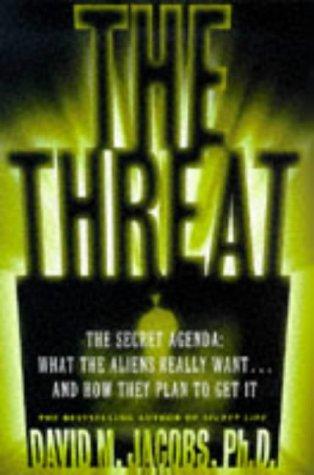
As an Amazon Associate, OverClassified may earn from qualifying purchases made through this link, at no extra cost to you.
Why This Is Essential Reading
The Threat earns its place on this list not because its central claim is well supported — this site's own treatment of the critical reception above makes clear it is not — but because it is the single fullest, most explicit statement any credentialed academic researcher in ufology has made of the hybridization hypothesis, and because the controversy it generated, both on publication and in the Emma Woods case that followed years later, makes it an essential case study in what happens when hypnotically recovered testimony is presented not as suggestive data but as settled conclusion. Read against The UFO Controversy in America, David M. Jacobs's own sober 1975 academic debut, the distance this 1998 book traveled in 23 years — from institutional historian cataloguing how American institutions managed a contested claim to hypnotherapist asserting a secret alien breeding program as demonstrated fact — is itself the most instructive thing about it. Read alongside Budd Hopkins's Intruders, the 1987 book whose reproductive-focus claim this book extended to its logical and most extreme conclusion, The Threat marks the point at which the hybridization hypothesis stopped being one interpretation among several within abduction research and became, for its author and for the researchers and readers who followed him, something asserted with a certainty the book's own critics — Kirkus, Greg Sandow, Michael Shermer, and Frederick Crews chief among them — consistently argued the underlying hypnotic-regression evidence could never actually support.
Related Cases & Theories
Essential Viewing

David M Jacobs | The Secret Alien Agenda | Interview
David Jacobs Interviews — An interview in which Jacobs discusses the hybridization and infiltration thesis at the center of this book directly, in his own words. Verified via YouTube oEmbed before inclusion.

Coast to Coast AM with Art Bell - May 29, 2001 - Dr. David Jacobs - The Threat
Old Man River — Archival Coast to Coast AM radio appearance in which Jacobs discusses The Threat's claims directly with host Art Bell, three years after the book's publication. Verified via YouTube oEmbed before inclusion.
The Threat: Revealing the Secret Alien Agenda by David M. Jacobs, PhD · Audiobook preview
Google Play Books — An official publisher-distributed audiobook preview of this book, useful for hearing its argument presented in its own published language. Verified via YouTube oEmbed before inclusion.
Sources Cited
- Jacobs, David M. The Threat: The Secret Agenda: What the Aliens Really Want... And How They Plan to Get It. Simon & Schuster, 1998 (hardcover 1st ed., ISBN 0684814846 / 9780684814841, cited here); reissued in paperback as The Threat: Revealing the Secret Alien Agenda, Fireside, 1999 (ISBN 0684848139 / 9780684848136). amazon.com
- "The threat." Internet Archive (full scan and metadata of the Simon & Schuster 1998 first edition, Boston Public Library copy; publisher, ISBN, and LCCN 97027040). archive.org
- "The THREAT." Open Library edition record (title, subtitle, publisher, ISBN, and cover-art metadata across the 1998 hardcover and 1999 paperback editions). openlibrary.org
- "THE THREAT." Kirkus Reviews (contemporary trade review). kirkusreviews.com
- Sandow, Greg. "A Review of David Jacobs's Book 'The Threat.'" gregsandow.com (contemporary independent review). gregsandow.com
- Shermer, Michael. Why People Believe Weird Things (excerpt discussing Jacobs, The Threat, and Shermer's NPR interview with him). michaelshermer.com
- Crews, Frederick. "The Mindsnatchers." The New York Review of Books, June 25, 1998 (critique of Jacobs's and Hopkins's hypnosis methodology, including direct citation of The Threat). nybooks.com
- Hopkins, Budd, David M. Jacobs, and David F. Maier. "'When Words Collide': An Exchange." The New York Review of Books, October 8, 1998 (Jacobs's and Hopkins's own published response to Crews, including Jacobs's defense of The Threat's hypnosis-risk discussion). nybooks.com
- "David M. Jacobs." Wikipedia (biography: birth date, education, Temple University career, bibliography). en.wikipedia.org
- DiFilippo, Dana. "Space aliens walk among us? Indeed, claims retired Temple prof." The Philadelphia Inquirer, July 15, 2014 (Temple career, tenure, promotion denial, retirement, abduction research). inquirer.com
- "Bio." DavidMichaelJacobs.com, official author biography (career details, International Center for Abduction Research, session and subject counts). davidmichaeljacobs.com
- "The Aliens In Her Mind." Grey Faction (documentation of the Emma Woods hypnotic-regression controversy: session dates, Temple University consent-form framing, and complaint history). greyfaction.org
- "The UFO Trail: Central Issues of the Emma Woods Case." ufotrail.blogspot.com (independent researcher's documentation of the 2004–2007 hypnosis-session recordings and allegations). ufotrail.blogspot.com
- "David M. Jacobs: A Comprehensive Profile." UFO Timeline Project (assessment of Jacobs's bibliography and The Threat's reception). ufotimelineproject.com
- This site's own resources library: Full Reading List.
- This site's own essential-reading entry: The UFO Controversy in America by David M. Jacobs, this book's earlier, far more academic predecessor by the same author.
- This site's own essential-reading entry: Intruders by Budd Hopkins, the 1987 book whose reproductive-focus claim this book extended to its most systematized and certain form.
- This site's own theory file: Genetic Hybridization Program Hypothesis, which treats this book as its central primary source for the theory's fullest published statement.
- This site's own case file: Herbert Schirmer Encounter, documenting an early 1967 precursor to this book's central hybridization thesis.
- This site's own key-figures entry: David M. Jacobs, for his full biography, the Emma Woods controversy, and case connections beyond this book.
Have corrections, additional research, or peer-reviewed sources? Help improve this entry.
Suggest an Edit