
Communion
A True Story
Core Thesis
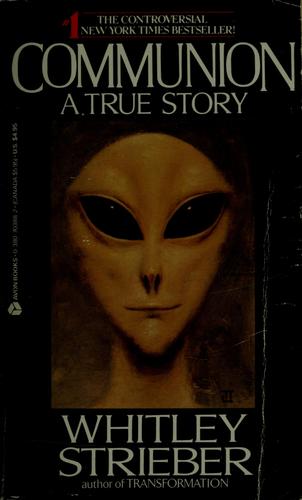
Communion: A True Story is Whitley Strieber's own account of a series of unexplained, deeply disturbing experiences that began at his family's cabin in the Hudson Valley on the night of December 26, 1985, and its central claim is announced right in the subtitle: that what follows, however strange, is presented as literally true rather than fiction. That framing carried unusual weight because of who was making it. Strieber was not an unknown claimant plucked from obscurity; he was already a commercially successful horror novelist, the author of The Wolfen and The Hunger, both adapted into Hollywood films, whose name lent the book a mainstream credibility — and, to his skeptics, a professional storytelling craft — no first-time abductee's account could match. Working with Budd Hopkins, who connected him with Columbia University psychiatrist Dr. Donald F. Klein for formal hypnotic regression, Strieber recovered detailed memories of small, grey-skinned beings with large black eyes performing an intrusive physical examination, and folded that material into a narrative built less like the case-file investigations of Hopkins's Missing Time or Fowler's The Andreasson Affair and more like the horror fiction Strieber had spent the previous decade writing. The book's lasting historical significance rests less on whatever specifically happened to Strieber that December than on two facts this entry treats in detail below: it became one of the bestselling nonfiction books of the 1980s, reaching #1 on The New York Times list within three months of publication, and its cover — painted by artist Ted Seth Jacobs directly from Strieber's own description — became the single most reproduced image of the "Grey" alien in modern popular culture, effectively fixing what a whole generation pictures when it pictures an extraterrestrial.
About the Author
Louis Whitley Strieber was born June 13, 1945, in San Antonio, Texas, to attorney Karl Strieber and Mary Kathleen (Drought) Strieber. He attended Central Catholic High School in San Antonio before earning a degree from the University of Texas at Austin and a further credential from the London School of Film Technique in 1968. Rather than moving directly into fiction, Strieber spent much of the 1970s working in New York advertising, rising to a vice-president-level position before leaving the industry in 1977 to write full time — a career pivot that put him, by his own later account, under real financial pressure in the years just before UFOs entered his life at all.
His fiction career, and the reputation that gave Communion its unusual credibility problem, was built on horror rather than the paranormal. The Wolfen (1978), a novel about a hidden species of intelligent wolf-like predators stalking New York City, was adapted into a 1981 film; The Hunger (1981), his vampire novel, became the 1983 Tony Scott film starring David Bowie and Susan Sarandon. He followed those with Black Magic (1982) and The Night Church (1983), and moved briefly into speculative near-future fiction with Warday (1984) and Nature's End (1986), both co-written with James Kunetka. By late 1985, Strieber was not a struggling unknown hoping a strange story might make his career; he was an established, commercially successful novelist with four Hollywood-adjacent horror properties already behind him — a biographical fact this entry's own Critical Reception section returns to directly, since it cuts both toward and against his credibility depending on which critic is arguing.
Strieber's account begins with two specific dates. On October 4, 1985, and again on the night of December 26, 1985, at the family's cabin in the Hudson Valley near Kingston, New York, Strieber said he experienced a period of intense fear and a partial memory gap surrounding the appearance of small, non-human figures inside his own house. Troubled enough by the fragments he could consciously recall to seek help, Strieber turned to Budd Hopkins, whose 1981 book Missing Time had already established missing-time hypnotic regression as ufology's working method — a detail that would later draw its own scrutiny, since Strieber had reportedly read a book discussing Hopkins's casework, a gift from his brother, shortly before the December encounter. Hopkins in turn connected Strieber with Dr. Donald F. Klein, a Columbia University professor of psychiatry and medical director of the New York State Psychiatric Institute, who conducted the book's formal hypnosis sessions and contributed a short clinical appendix to the finished manuscript. Under Klein's hypnosis, Strieber recovered a considerably more detailed narrative: being carried from his bedroom, undergoing what he described as an intrusive physical examination in a small enclosed space, and encountering entities he came to call, deliberately withholding any firmer identification, simply "the visitors."
Communion's commercial success reshaped the rest of Strieber's life in ways he would describe, a decade later, as close to ruinous. In a 1997 interview, he said the family was "driven out of our home in upstate New York by people who invaded the cabin and attempted to burn it down," that his son faced sustained harassment from teachers and classmates, and that his wife "effectively lost all her friends" — while his own career as a novelist and screenwriter grew, in his words, "extremely precarious" despite the book's sales. He kept writing about the same material for the rest of his career regardless: Transformation (1988), Breakthrough: The Next Step (1995), The Secret School (1996), The Communion Letters (1997, co-written with his wife Anne Strieber), Confirmation (1998), and, on the book's twenty-fifth anniversary, Solving the Communion Enigma (2011). Strieber and Hopkins's working relationship, close in the years immediately after Communion's publication, eventually broke down; the two men had always represented different poles of abduction interpretation — Hopkins's increasingly systematized, alarmed reading of a coordinated alien breeding program versus Strieber's more ambiguous, at times overtly spiritual framing of the visitors as neither clearly hostile nor clearly benevolent — and after Hopkins's 2011 death, Strieber said publicly that Hopkins had been "undermining him for 25 years," while Anne Strieber went further, publicly alleging problems with how Hopkins had conducted hypnosis with other, female research subjects, an allegation this entry notes as a serious, disputed claim rather than an established fact. Anne Strieber, Whitley's wife and longtime collaborator, died in 2015; Strieber continues to write and host Dreamland, a weekly interview program on paranormal and science topics that grew out of a radio show he began with Art Bell in the early 1990s, through his own website, Unknown Country.
Historical Context & Origins
When Communion appeared in February 1987, the abduction genre already had a clear, if narrow, investigative template behind it. John G. Fuller's 1966 The Interrupted Journey had established hypnotic regression as a way to recover a witness's missing time; Raymond Fowler's 1979 The Andreasson Affair had shown how far a multi-investigator team could push that method into stranger, more elaborate territory; and Budd Hopkins's 1981 Missing Time had turned the whole approach into a repeatable methodology built around outside investigators assembling other people's case histories. Every one of those books was written by an investigator working from the outside in. Strieber's book broke that pattern in a way none of its predecessors had: it was the subject's own first-person account, written by someone whose entire prior career had been built on making invented horror feel visceral and real on the page — a craft advantage the book's own harshest critics would treat as its central problem rather than its central strength.
The book also arrived into a specific cultural moment. Retrospective critics have situated Communion within mid-1980s American anxieties about home invasion, nuclear dread, and a broader unease about bodily violation that its central examination scene taps into directly — themes recognizably continuous with the horror fiction Strieber had spent the previous decade writing, whatever the truth of his underlying claims. Its 1987 publication also placed it, largely by geographic coincidence, inside the tail end of the well-documented Hudson Valley UFO Wave: Strieber's cabin sat roughly forty miles north of that wave's Putnam County epicenter around Kent Cliffs, in the same general Hudson Valley corridor that had already produced thousands of separately reported sightings between 1982 and 1995 — though Strieber's own account describes a close-range entity encounter rather than the wave's more typical distant light formations, and this site's own case file on that wave does not treat the two as connected.
Whatever else it was, Communion was also, structurally, a departure the book trade noticed immediately: it was published as nonfiction by William Morrow and Company under the company's Beech Tree Books imprint, priced and marketed for a mass audience rather than a specialty ufology readership, and its cover — discussed in full below — gave bookstores a single, immediately recognizable image to build a front-table display around in a way no earlier abduction book's plainer, text-forward jacket had offered.
Core Arguments & Key Concepts
Communion's central claim is narrower than most other books already covered in this site's Essential Reading library, and Strieber says so directly and repeatedly: the book asserts that something real, external, and physically present happened to him on at least two nights in 1985, but it does not commit to an extraterrestrial explanation. Strieber explicitly entertains interdimensional beings, some kind of terrestrial but non-human intelligence, or a category of experience with no existing framework, and treats the question of the visitors' ultimate nature as open rather than settled — a hedge his critics have read alternately as intellectual honesty and as a way of making an unfalsifiable claim impossible to pin down.
The book's second argument is structural rather than evidentiary: Strieber builds Communion less like an investigative case file and more like a novel, using his horror-fiction craft to render the examination scenes, the fear, and the physical sensations in vivid, scene-by-scene detail rather than the flatter, transcript-heavy prose Fuller, Fowler, and Hopkins had all used for the same basic material. Literary scholar Terry Matheson's later study, Alien Abductions: Creating a Modern Phenomenon, discusses Communion directly as an example of how the genre's narrative techniques do real persuasive work independent of whatever underlying event they describe — precisely the credibility-building-through-craft dynamic Strieber's professional background makes unusually explicit.
A third argument concerns the visitors' disposition, and it is where Communion diverges most sharply from the book that indirectly enabled it. Where Hopkins's own casework increasingly organized itself around a coordinated, purposive breeding or hybridization program — the theory this site's own Genetic Hybridization Program Hypothesis file covers in full — Strieber consistently refused to characterize the visitors as either straightforwardly hostile or straightforwardly benevolent, describing an experience that was terrifying in the moment but that he increasingly came to frame, across his sequel books, in spiritually significant rather than purely biological terms. That interpretive gap between Strieber and Hopkins, present in seed form in this 1987 original, is the same gap that would eventually end their working relationship entirely, as this entry's About the Author section documents.
Strieber's fourth and most self-consciously defensive argument runs through the book like a counter-narrative to its own claims: he repeatedly raises, and does not fully dismiss, the possibility that he might simply be losing his mind. He describes seeking psychiatric evaluation and, at his own request, testing for temporal lobe epilepsy — a condition associated with vivid hallucinatory experiences — reporting normal results in the 1988 sequel Transformation. Whether that self-skepticism reads as genuine intellectual honesty or as a rhetorical inoculation against the obvious skeptical rebuttal is a question this entry's Critical Reception section takes up directly, since reviewers on both sides have reached opposite conclusions about the same passages.
Key Cases & Evidence Discussed
Communion is unusual among the books in this site's Essential Reading library in that it is not primarily about other people's cases; it is a first-person account of Strieber's own experiences, and this site does not currently maintain a dedicated case file for the Strieber encounters specifically, a gap worth stating plainly rather than working around. The book's own central evidence is Strieber's October 4 and December 26, 1985 accounts, recovered partly through conscious memory and partly through Dr. Donald F. Klein's hypnotic regression sessions, along with a polygraph examination whose results Strieber included in the book and which the contemporary Skeptical Inquirer review of the book discussed directly.
The most substantial independent investigation into Strieber's own claims came after the book's publication, in journalist Ed Conroy's Report on Communion: An Independent Investigation of and Commentary on Whitley Strieber's Communion (Morrow, 1989). Conroy, working with Strieber's cooperation, spent roughly a year interviewing figures from Strieber's San Antonio childhood, his advertising career, and the writing of both Communion and Transformation, and found some corroboration among Strieber's boyhood acquaintances for a pattern of unexplained "visitor"-type experiences reaching back decades before 1985 — corroboration this entry treats as suggestive rather than conclusive, since it rests on decades-old personal recollection rather than any contemporaneous documentation.
Read alongside this site's other abduction-literature entries, Communion sits in a specific chronological and interpretive position: five years after Budd Hopkins's Missing Time had formalized hypnotic-regression investigation, eight years after The Andreasson Affair had shown how elaborate a hypnotically recovered narrative could become, and seven years before John E. Mack's Harvard-credentialed Abduction would lend the genre an institutional legitimacy Strieber's own account, by design, never claimed for itself.
Critical Reception & Controversies
The most direct methodological critique of Communion traces back to the same source this site's own Missing Time entry already cites: Robert A. Baker's "The Aliens Among Us: Hypnotic Regression Revisited" (Skeptical Inquirer, Winter 1987/88), which examined Hopkins's hypnosis-driven casework broadly and treated Strieber's own regression sessions, conducted by Dr. Donald F. Klein at Hopkins's referral, as falling under the identical confabulation concern: that a subject working with an authority figure inside a relaxed, suggestible hypnotic state will construct a convincing false narrative shaped by whatever the hypnotist and the surrounding cultural material already suggest is likely, rather than recovering a genuinely buried memory intact.
A more detailed skeptical case, laid out in a 2012 retrospective marking the book's twenty-fifth anniversary, complicates the "ordinary guy" framing Communion's marketing leaned on. Strieber's pre-1985 biography included years of involvement with the Gurdjieff Foundation, tarot, and other New Age and esoteric practices, a background the retrospective argues made him considerably more predisposed toward an anomalous interpretation of an ambiguous experience than the book's framing let on. The same analysis raises a specific priming concern: Strieber's brother had given him a book discussing Hopkins's abduction casework shortly before the December 1985 incident, and Strieber initially sought help specifically from Hopkins — an artist with no clinical credentials — rather than from a psychiatrist directly, a sequence of choices the analysis reads as shaping the resulting narrative well before Dr. Klein's formal hypnosis sessions began.
Strieber's relationship with the field's most prominent professional skeptic was openly adversarial rather than merely analytical. He said he had received long letters from Philip J. Klass of CSICOP that he considered "crazy" and left standing instructions that he would not appear on any broadcast alongside Klass — a level of personal antagonism unusual even by the genre's generally contentious standards, and one that meant Communion's most prominent professional critic and its author essentially never debated the book's claims in the same room.
A more recent and more clinically grounded skeptical reading comes from Bob Novella, co-founder of the New England Skeptical Society and co-host of The Skeptics' Guide to the Universe, who cites Communion's own opening description — waking in the night, feeling paralyzed, and perceiving alien-like figures in the room — as "a textbook example" of hypnagogia, a well-documented neurological phenomenon occurring in the transition between sleep and waking that produces vivid, often frightening hallucinations alongside genuine muscular paralysis. That specific explanation, unavailable in anything like its modern form when Strieber wrote Communion in the mid-1980s, has become one of the more commonly offered mundane accounts for close-encounter narratives structured the way its opening chapters are.
Set against that body of skepticism, the book's own internal record complicates a purely dismissive reading. Strieber sought temporal lobe epilepsy testing at his own initiative rather than under any outside pressure, reported the resulting normal results rather than omitting them, and repeatedly entertained the possibility of his own mental illness within the book's text rather than only in later interviews — a degree of stated self-doubt genuinely uncommon among the genre's other first-person accounts. Robert Sheaffer's 2013 Skeptical Inquirer review of the 2011 follow-up Solving the Communion Enigma, titled "Pretentious Whit," argued the later book still offered no genuine resolution to the questions the original raised, and pointed to what he read as a financial irony: Strieber's own repeated claims of poverty in the 1990s sitting alongside a continuing, decades-long stream of Communion-branded books, a pattern Sheaffer suggested kept a commercially useful mystery open rather than working toward the closure the newer book's title promised.
Influence & Legacy
Communion's most durable legacy is visual rather than textual. Artist Ted Seth Jacobs painted the cover in his own small apartment on East 83rd Street in Manhattan, working directly from Strieber's description in a process Jacobs later compared to a police composite sketch — repeated small corrections until, in Jacobs's own words, "the image was exact." The resulting large-eyed, hairless grey face became one of the most widely reproduced images in modern popular culture, effectively standardizing what a mass audience pictures when it imagines an alien visitor, referenced and parodied across film, television, and merchandise for decades after the book's original 1987 print run had ended — a level of independent visual influence no other book on this site's Essential Reading list, including Missing Time and The Andreasson Affair, achieved through its cover art alone.
Commercially, Communion demonstrated that a first-person abduction memoir, marketed as mainstream nonfiction rather than niche ufology, could reach #1 on The New York Times nonfiction list — which it did on May 10, 1987, and again on May 24 — and hold bestseller status for roughly six months, selling more than two million copies in its earliest printings. That commercial proof of concept helped clear a path for the genre's subsequent bestsellers, including Hopkins's own 1987 follow-up Intruders and, seven years later, John E. Mack's Harvard-credentialed Abduction, even though Mack's clinical framing and Strieber's spiritually ambiguous one shared little beyond a publisher's expectation that the subject could sell.
Within the abduction-research community specifically, the book's legacy is more contested than celebratory. Strieber's eventual, publicly stated break with Budd Hopkins — the investigator whose referral had made the book's hypnosis sessions possible in the first place — crystallized a real interpretive fork that has persisted in the field ever since: Hopkins's and David Jacobs's increasingly systematized, alarmed reading of a coordinated alien breeding program on one side, and Strieber's more ambiguous, at times explicitly spiritual framing of the visitors on the other. Neither side ever fully absorbed the other, and Strieber's own continuing platform — the Dreamland program he has hosted for decades through his website Unknown Country — has kept his version of the visitor narrative in public circulation largely independent of the Hopkins-Jacobs research tradition.
Terry Matheson's 1998 Alien Abductions: Creating a Modern Phenomenon treats Communion directly as one of the genre's defining texts, discussing it alongside Fuller, Fowler, Hopkins, Jacobs, and Mack as part of the literary record his book analyzes — this site's own entry on Matheson's book already notes that Strieber's account is among the bestselling narratives that rhetorical study examines, a citation this new article now gives its own dedicated home rather than leaving Communion as a reference point inside someone else's entry.
The Book
As an Amazon Associate, OverClassified may earn from qualifying purchases made through this link, at no extra cost to you.
Why This Is Essential Reading
Communion earns its place on this list for a reason distinct from every other first-person or investigator-led abduction account already covered here: it is the genre's single most commercially successful and visually iconic work, written not by a clinician, engineer, or fine artist turned investigator but by an already-successful horror novelist whose professional craft is exactly what makes the book read as compellingly as it does — and exactly what its harshest critics point to when questioning it. Whitley Strieber built a book that reached #1 on The New York Times nonfiction list, sold more than two million copies in its earliest printings, and produced, in Ted Seth Jacobs's cover painting, the single most reproduced image of an alien being in modern popular culture — while never quite committing to the extraterrestrial explanation that image now universally symbolizes. That combination of open-ended ambiguity and visual certainty is a mix no other book on this list quite carries: read against Robert A. Baker's confabulation critique, the hypnagogia explanation Bob Novella and others have since offered, and the eventual, publicly documented break between Strieber and Budd Hopkins over what the visitors actually represented, Communion is essential not because its central claims have held up under scrutiny, but because no single book did more to put a specific, unforgettable face on the modern alien encounter — for readers who believed every word and for readers who never believed any of it.
Related Cases & Theories
Essential Viewing

Alien Abductions on Larry King CNN - Whitley Strieber - Part 1
Krtek108 — Archival footage of Strieber discussing Communion on CNN's Larry King Live during the height of the book's 1987 bestseller run, verified via YouTube oEmbed before inclusion.
Communion interview with alien abductee Whitley Strieber and behind the scenes of the 1989 movie
Eyes On Cinema — An archival interview with Strieber discussing his own account alongside behind-the-scenes material from the 1989 film adaptation starring Christopher Walken, verified via YouTube oEmbed before inclusion.

Whitley Strieber's Communion (Aliens, UFOs, Visitors, Abduction)
Jimmy Akin's Mysterious World — A close examination of Communion's claims, hypnosis sessions, and reception, tracing how the book's account was constructed, presented, and received. Verified via YouTube oEmbed before inclusion.
Sources Cited
- Strieber, Whitley. Communion: A True Story. William Morrow and Company (Beech Tree Books), 1987 (hardcover, ISBN 0688070868 / 9780688070861); Avon Books mass-market pbk., 1988 (ISBN 0380703882 / 9780380703883, cited here, 306pp). openlibrary.org
- "Communion (Strieber book)." Wikipedia (publication details, cover art description, sales figures, film adaptation, sequel list). en.wikipedia.org
- "Whitley Strieber." Wikipedia (biography: birth, education, advertising career, novels, the December 1985 encounter, later books, Dreamland podcast). en.wikipedia.org
- "List of The New York Times number-one books of 1987." Wikipedia (confirms Communion reached #1 on the nonfiction list on May 10 and May 24, 1987). en.wikipedia.org
- "Communion: A True Story by Whitley Strieber, Strieber." Biblio.com (bibliographic listing confirming William Morrow & Company, 1987 hardcover, ISBN 9780688070861). biblio.com
- Baker, Robert A. "The Aliens Among Us: Hypnotic Regression Revisited." Skeptical Inquirer, Winter 1987/88 (confabulation critique of hypnotic-regression abduction research, discussing both Hopkins's and Strieber's casework; already cited on this site's own Missing Time entry). centerforinquiry.org
- "Donald F. Klein." Wikipedia (biography of the Columbia University psychiatrist and New York State Psychiatric Institute medical director who conducted Strieber's hypnotic regression sessions and wrote Communion's clinical appendix). en.wikipedia.org
- Sheaffer, Robert. "Pretentious Whit." Skeptical Inquirer, January 2013 (review of the 2011 follow-up Solving the Communion Enigma, with biographical and financial context on Strieber's continuing Communion franchise). skepticalinquirer.org
- Novella, Bob. "Hypnagogia: An Explanation of Strange Nighttime Visitations." The NESS (New England Skeptical Society). Cites Communion's opening account as "a textbook example" of hypnagogic hallucination and sleep paralysis. theness.com
- "MUERTOS BLOG: 'Communion' at 25: Whitley Strieber's Alien Claims Re-examined (Part I)." Skeptic Project, 2012 (detailed skeptical retrospective on Strieber's pre-1985 esoteric background, the Hopkins referral, and priming concerns). paranormal.skepticproject.com
- "Whitley Strieber's 'Communion: A True Story', 1987." We Are the Mutants, August 24, 2017 (retrospective critical essay on the book's publication, reception, and Cold War-era cultural context). wearethemutants.com
- "UFOs have made author — and broken him." Las Vegas Sun, January 24, 1997 (interview documenting the personal, family, and financial toll of Communion's fame, including the harassment and attempted arson at Strieber's Hudson Valley cabin). lasvegassun.com
- "Ted Seth Jacobs: An Interview with the Artist." Beyond Communion (beyondcommunion.com) (the cover painter's own account of working from Strieber's description in his East 83rd Street apartment). beyondcommunion.com
- Conroy, Ed. Report on Communion: An Independent Investigation of and Commentary on Whitley Strieber's Communion. William Morrow, 1989; Avon pbk., 1990 (independent biographical investigation conducted with Strieber's cooperation). archive.org
- This site's own essential-reading entry: Missing Time by Budd Hopkins, the 1981 book whose hypnotic-regression method and Skeptical Inquirer criticism this article traces directly into Strieber's own case.
- This site's own essential-reading entry: Alien Abductions: Creating a Modern Phenomenon by Terry Matheson, which already discusses Communion directly as one of the genre's defining bestselling texts.
- This site's own essential-reading entry: The Andreasson Affair by Raymond E. Fowler, the 1979 investigation that established how elaborate a hypnotically recovered abduction narrative could become before Communion arrived.
- This site's own case file: Hudson Valley UFO Wave, the contemporaneous regional sighting wave centered roughly forty miles south of Strieber's own Hudson Valley cabin.
- This site's own resources library: Full Reading List, where Communion is already referenced across more than a dozen of this site's other essential-reading and case-file entries.
Have corrections, additional research, or peer-reviewed sources? Help improve this entry.
Suggest an Edit