
The Andreasson Affair
The Documented Investigation of a Woman's Abduction Aboard a UFO
Core Thesis
The Andreasson Affair: The Documented Investigation of a Woman's Abduction Aboard a UFO is the book that took the investigative machinery The Interrupted Journey had built for the Hill case — hypnotic regression, corroborating testimony, a skeptical outside investigator willing to publish inconvenient detail — and pointed it at a story the Hills' calm, secular account had never prepared ufology to handle. Raymond E. Fowler, a Sylvania/GTE aerospace engineer and MUFON field investigator with no clinical training, spent twelve months in 1977 directing a multi-investigator team — a professional hypnotist, a polygraph examiner, and several MUFON colleagues — through fourteen separate hypnosis sessions with Betty Andreasson, a devout Massachusetts housewife and mother of seven who said that on the evening of January 25, 1967, small entities identifying their leader as "Quazgaa" had walked through her closed kitchen door, placed her family in suspended animation, and taken her aboard a craft for a medical examination that included the removal of a small object from her nasal cavity. What emerged under hypnosis was not the Hills' relatively contained missing-time narrative but something considerably stranger: passage through solid walls, an underground alien environment, and a climactic mystical vision of a phoenix-like bird consumed by fire and reborn from its own ashes, received by Betty as a religious revelation from a divine "Lord" figure rather than a secular alien encounter. Fowler's core argument was that this stranger, more overtly religious content did not disqualify the case from serious investigation — it simply meant the investigation had to work harder, which his book, published with a foreword by J. Allen Hynek, set out methodically to prove.
About the Author
Raymond Eveleth Fowler was born November 11, 1933, in Salem, Massachusetts, and earned a B.A. magna cum laude from Gordon College in nearby Wenham. He joined the U.S. Air Force in 1952 during the Korean War era, serving with the Air Force Security Service, and afterward spent 25 years as a task manager and senior planner with Sylvania/GTE Government Systems working on the Minuteman intercontinental ballistic missile program — a defense-engineering career, not a psychology or investigative-journalism one, that this site's own key-figures entry on him treats as the same kind of credential gap worth stating plainly that it notes for other UFO investigators without formal behavioral-science training.
Fowler's UFO investigation career began through the National Investigations Committee on Aerial Phenomena (NICAP), where he chaired the Massachusetts subcommittee and, on September 11, 1965, conducted an independent field investigation of the Exeter UFO Incident, his detailed report later entered into the Congressional Record in connection with the House Armed Services Committee's April 5, 1966 UFO hearing. By the time he took on the Andreasson case in 1977, Fowler had become MUFON's Massachusetts State Director and Director of Scientific Investigations, and a Scientific Associate at J. Allen Hynek's Center for UFO Studies (CUFOS), headquartered at Hynek's Northwestern University base of operations. Hynek himself had called Fowler, in 1974, "an outstanding UFO investigator and fact-finder," a working relationship that put Fowler in position to lead CUFOS's most ambitious single-case investigation to date when Betty Andreasson's letter, initially set aside for its unusual content after she answered a 1975 newspaper appeal Hynek had run soliciting accounts of anomalous experiences, was finally taken up by MUFON field investigator Jules Vaillancourt in January 1977.
The Andreasson Affair was Fowler's first book built around a single abduction case, but not his last: he returned to the same family's continuing claims across three further volumes, The Andreasson Affair, Phase Two (1982), The Watchers (1990), The Watchers II (1995), and The Andreasson Legacy (1997), a five-book span over nearly two decades in which the case's content grew steadily more elaborate — recovered memories reaching back into Betty's childhood, her second husband Bob Luca's own parallel abduction claims, and increasingly explicit "genetic and consciousness" framing that this entry's own Core Arguments section treats as present only in seed form in the 1979 original. Fowler later disclosed his own claimed lifelong abduction experiences in UFO Testament: Anatomy of an Abductee (2002), a decision this site's own key-figures entry does not gloss over: an investigator who spent twelve months building a corroborated, polygraph-supported case file for someone else's abduction account eventually concluded he had been living through a version of the same phenomenon himself.
Alongside his UFO work, Fowler was a serious amateur astronomer who built and operated the Woodside Planetarium & Observatory in Wenham, Massachusetts from 1970 to 2001, and he later taught adult-education classes on the paranormal near his home in Kennebunk, Maine. He went on to lead the multi-year investigation into the 1976 Allagash Waterway Abduction, directing separate hypnotic regression sessions with all four witnesses beginning in 1988 and publishing his findings as The Allagash Abductions (1993) — a project this site's own case file on that incident describes as following directly from the investigative template Fowler first built for the Andreasson case eleven years earlier.
Historical Context & Origins
Betty Andreasson's account began the way most pre-1975 abduction reports did: privately. On the evening of January 25, 1967, in South Ashburnham, Massachusetts, Betty said the house lights blinked out while her seven children and her visiting parents sat in the kitchen and living room, followed by a pulsating reddish-orange light at the window and the appearance of small entities who passed through the closed door. She told almost no one for years. It was only after she answered a newspaper appeal J. Allen Hynek had placed soliciting accounts of unusual personal experiences that her letter entered CUFOS's files — and even then, its unusually elaborate content saw it set aside rather than acted on immediately, until MUFON field investigator Jules Vaillancourt picked it up in January 1977, roughly a decade after the reported event and eleven years after The Interrupted Journey had already established hypnotic regression as ufology's standard tool for recovering exactly this kind of delayed, fragmentary memory.
The investigation that followed was, by the standards of its moment, unusually resourced: a twelve-month CUFOS/MUFON project assembling Raymond Fowler as principal investigator alongside Joseph Santangelo, Fred Youngren, professional hypnotist Harold Edelstein of the New England Institute of Hypnosis, and polygraph examiner Ernest Reid, who together conducted fourteen separate hypnotic regression sessions, two lie-detector examinations, a psychiatric interview, and an extensive character-reference check on Betty and her family before Fowler compiled the results into a 528-page confidential report for CUFOS, a fraction of which became the published book. That scale of investigation — multiple named specialists, formal polygraph testing, and a full year of work — went beyond what Dr. Benjamin Simon's more clinically framed hypnosis sessions with the Hills had involved a decade earlier, reflecting how much more elaborate the Andreasson material was: where Betty and Barney Hill's hypnosis sessions recovered roughly two hours of missing time, Betty Andreasson's sessions kept surfacing new material session after session, eventually including a walk through what she described as a black tunnel-like void, an underground alien environment, and a mystical vision she experienced as directly religious.
That religious content arrived into a UFO research culture still organized almost entirely around Hynek's own close-encounter taxonomy — nocturnal lights, daylight discs, radar-visual cases, and close encounters of the first through third kind — a classification system built for physical, external phenomena rather than for a witness's own devout Christian framing of a starkly theological experience: Betty consistently described the beings and their leader Quazgaa in the vocabulary of angels and biblical prophecy rather than the more neutral, secular language the Hills had used. Later marketing of the book, including a 2018 reissue subtitled The True Story of a Close Encounter of the Fourth Kind, retroactively applied a "fourth kind" designation abduction researchers would only formalize as a standard category in the years after 1979; no such term appears in Fowler's original edition.
The book also arrived the same year as this site's own The UFO Handbook by Allan Hendry, a coincidence that captures how far apart CUFOS's own 1979 output could be: Hendry's book was a statistical field manual arguing that the overwhelming majority of UFO reports resolved to mundane explanations, while Fowler's book, published under the same organization's institutional umbrella and the same Hynek foreword-writer, argued for the opposite conclusion about one specific, unusually elaborate case. Both books shared a commitment to documenting their own investigative process in detail rather than asking readers to simply trust a conclusion — the through-line this entry's own Core Arguments section treats as Fowler's central methodological claim.
Core Arguments & Key Concepts
Fowler's structural choice mirrors John G. Fuller's in The Interrupted Journey: rather than summarizing his conclusions, he reproduces long stretches of the hypnosis transcripts directly, session by session, and pairs them with the investigation's supporting apparatus — the two polygraph examinations Ernest Reid administered, the character-reference check into Betty's reputation among neighbors and clergy, and detailed comparison with other contemporaneous abduction accounts CUFOS had on file. The argument embedded in that structure is the same one Fuller made for the Hills thirteen years earlier: a reader given the raw material rather than only the author's verdict can judge the case's internal consistency for themselves, and Fowler's team went further than Fuller's had by adding formal deception-detection testing to the record.
The case's narrative core, as recovered under hypnosis, describes Betty's family being placed in what she called suspended animation while four to five entities led by one identifying himself as "Quazgaa" escorted her through her own kitchen wall to a waiting craft in the backyard, where an examination included the insertion of a needle-like instrument into her nasal cavity to remove or place a small object. Wikipedia's own entry on alien implants credits this specific detail as the concept's first significant appearance in published abduction literature, crediting Fowler's book by name for introducing what would become a recurring motif across the genre in the following decades — the physical, verifiable-seeming artifact that other researchers, from Budd Hopkins onward, would spend years trying to document in other abductees.
Beyond the physical examination, the hypnosis sessions surfaced a second, more unusual layer: a walk through a darkened tunnel into what Betty described as an artificial underground environment, and a culminating vision of a massive phoenix-like bird that burned to ash and was reborn from a curled, worm-like form within its own remains — an image Betty received not as alien technology but as a direct religious communication, described in the book in the language of prophecy and cosmic purpose rather than extraterrestrial biology. Fowler's decision to include this material in full, rather than edit it toward a more conventional nuts-and-bolts abduction account, is one this entry treats as the book's most consequential and most divisive editorial choice.
Running underneath both the physical and the visionary material is what later Fowler sequels would develop into an explicit "genetic and consciousness" thesis — the suggestion that the entities' interest in Betty extended beyond a single physical examination into something like a longer-term monitoring or preparation program spanning her family and, implicitly, humanity more broadly. In the 1979 original this framing remains largely implicit, surfacing mainly in Quazgaa's own hypnotically recovered statements about watching over humanity and delivering a message "when the time is right"; it is Fowler's three sequel volumes, not this book, that expand the idea into the more fully developed hybrid-program material this entry's Influence & Legacy section addresses separately.
Fowler is also candid, within the book itself, about the case's interpretive limits: he presents Quazgaa's message and the phoenix vision as material his investigative team could document happening — recorded consistently across separate sessions, accompanied by genuine emotional distress, and passing the polygraph examinations Ernest Reid administered — without claiming the same evidentiary certainty for what the content actually was, a distinction between documenting an experience and endorsing its content that this entry's Critical Reception section treats as only partially persuasive to the book's harshest reviewers.
Key Cases & Evidence Discussed
The Andreasson case now has its own dedicated case file on this site: The Betty Andreasson Luca Abduction (Case File #366), covering the full 1967 event, the twelve-month CUFOS/MUFON investigation, and the case's Disputed classification in more depth than this book-focused entry attempts. It is also already live infrastructure in two others. The Berkshire UFO Wave / Thom Reed case file (Case File #072, 1969) cites this exact 1979/1994 edition directly in its own further-reading section and states outright that Raymond Fowler "investigated both the Allagash case and the 1967 Andreasson case, a similarly Massachusetts-rooted, hypnosis-driven abduction narrative," treating this book as the direct methodological precedent for how that later case's own MUFON investigation was structured and evaluated.
The Allagash Waterway Abduction case file (Case File #045, 1976) makes the same connection from the opposite direction: it credits Fowler's decade-earlier work on the Andreasson investigation as the direct template for his later multi-witness Allagash methodology, and its own further-reading section separately cites The Allagash Abductions (1993) as "the definitive primary source" for that case, published fourteen years after this book established the investigative pattern — separate hypnosis sessions, polygraph corroboration, character-reference checks — both cases would follow.
This site's own Betty & Barney Hill Abduction case file (Case File #006, September 1961) is the case every reviewer of this book, contemporary and modern, measures it against: where the Hills' hypnotically recovered account stayed close to a secular missing-time framework, Betty Andreasson's account expanded the genre's vocabulary to include physical implants, passage through solid matter, and an explicitly religious cosmology, a divergence this entry's own Historical Context section treats as the moment abduction literature split into the more clinical and more mystical strands that would each develop separately across the following decades.
Read alongside this site's own The Interrupted Journey, Missing Time, Abduction, and Abducted entries, this book occupies a specific place in the genre's chronology: published two years before Budd Hopkins's Missing Time formalized hypnotic-regression abduction investigation as a standing methodology, and thirteen years after Fuller's Hill book first popularized the underlying technique, it is the case that first showed the field how much more elaborate a hypnotically recovered abduction narrative could become once the underlying witness brought a strong pre-existing religious framework to the experience — a dynamic Abducted author Susan Clancy's later research into abduction narratives as a form of meaning-making addresses directly, if from a very different interpretive starting point than Fowler's own.
Critical Reception & Controversies
The book's most substantial contemporary critique came from psychiatrist Ernest H. Taves, whose review "Betty Through the Looking Glass" ran in Skeptical Inquirer (Vol. 4, No. 2, Winter 1979/1980, pp. 88–95). Taves accused Fowler of "an attempt to inject mystery into a situation where there is none," arguing instead that "Betty recalled, or relived, in hypnosis, a dream or fantasy (or a number of them) that had meaning and utility in terms of her life history and her emotional needs" — a psychological-origin explanation that, notably, did not accuse Betty of deliberate fabrication, framing the case instead as a case study in how hypnosis can surface and elaborate genuinely felt but non-literal material.
Taves returned to the subject three years later, reviewing the 1982 sequel The Andreasson Affair, Phase Two for the same publication (Skeptical Inquirer, Vol. 7, No. 2, Winter 1982/1983), extending his skepticism to the expanding case rather than treating the first book's problems as resolved by additional investigation — a continuity of critique this entry treats as significant given how much the case's content had grown between the two volumes.
A structural problem specific to this book's hypnosis sessions, distinct from the broader hypnotic-regression debate Missing Time and Abducted both address in more general terms, is the sheer volume of material Betty's fourteen sessions with hypnotist Harold Edelstein produced: where Dr. Benjamin Simon's sessions with the Hills recovered a comparatively bounded two-hour account, Betty's sessions kept surfacing substantial new content across each of Fowler's four books over eighteen years, a pattern skeptical researchers have pointed to as more consistent with hypnosis actively generating new narrative material session by session than with a single buried memory being progressively recovered intact.
The case's explicitly religious content has drawn a distinct line of skeptical response separate from the general hypnosis debate: because Betty consistently interpreted the beings and Quazgaa's message in the vocabulary of Christian prophecy and angelic visitation rather than secular extraterrestrial contact, critics both within and outside ufology have argued the case sits closer to a documented religious experience refracted through UFO-era cultural imagery than to a discrete physical event — a reading this entry notes Fowler's own book does not fully foreclose, since he presents Quazgaa's message and the phoenix vision as material his team could document occurring under controlled hypnosis without claiming equal certainty about what it represented.
Set against that skepticism, the book drew real respect within ufology for its investigative apparatus specifically: the polygraph testing, the character-reference checks, and the sheer duration of the twelve-month team investigation represented a level of documentary effort few contemporary single-case investigations matched, and J. Allen Hynek's willingness to write the foreword lent the project institutional CUFOS credibility that purely independent investigators of similarly unusual cases often lacked.
Influence & Legacy
The book's most measurable legacy is definitional: Wikipedia's own entry on alien implants credits The Andreasson Affair by name as the publication that "first publicized" the claim of a physically implanted object recovered from an abductee's body, a motif that would recur across the genre for decades afterward, including in cases this site's own Missing Time and Abduction entries describe Budd Hopkins and John E. Mack pursuing with far more elaborate physical-evidence claims a decade later.
Within Fowler's own body of work, this book generated its own four-volume afterlife: The Andreasson Affair, Phase Two (1982), The Watchers (1990), The Watchers II (1995), and The Andreasson Legacy (1997) each returned to the same family's expanding claims, with the "genetic and consciousness" framing only implicit in this original volume becoming the explicit organizing theory of the later books — making this 1979 book not a self-contained case study but the opening chapter of the single longest-running individual investigation in Fowler's career and one of the longest-running in American ufology generally.
The case's direct institutional line runs through J. Allen Hynek's Center for UFO Studies: this was one of CUFOS's most resource-intensive single-case investigations of its first decade, conducted the same year Hynek's own hotline investigator Allan Hendry published The UFO Handbook, and it demonstrated that the organization Hynek had founded specifically to apply more rigorous standards than Project Blue Book could support genuinely divergent kinds of serious investigation — Hendry's statistical skepticism and Fowler's single-case advocacy — under the same institutional roof.
Fowler's own investigative template for this case — a multi-investigator team, formal polygraph corroboration, separately conducted hypnosis sessions, and extensive character-reference checking — became the direct model for his own later Allagash Waterway Abduction investigation beginning in 1988, and this site's own Berkshire UFO Wave / Thom Reed case file cites this book directly as the regional research tradition its own more limited, single-investigator MUFON documentation should be measured against and is explicitly noted as falling short of.
The Book
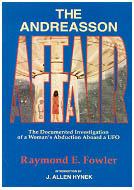
The Andreasson Affair
The Documented Investigation of a Woman's Abduction Aboard a UFO
Find on Amazon →As an Amazon Associate, OverClassified may earn from qualifying purchases made through this link, at no extra cost to you.
Why This Is Essential Reading
The Andreasson Affair earns its place on this list because it is the book that showed ufology just how far the investigative template The Interrupted Journey had built could be pushed — and how uncomfortable the results could be. Raymond Fowler assembled a genuinely rigorous investigation, complete with polygraph testing and character-reference checks few contemporary single-case studies matched, and pointed it at an account that turned out to be stranger, more physically specific, and more explicitly religious than anything the Hill case had prepared the field to evaluate. The result introduced the alien-implant motif to abduction literature, generated a four-volume sequel investigation spanning nearly two decades of Fowler's career, and forced researchers on every side of the debate to reckon with a case that resisted the comfortable binary of "credible witness, secular event" the Hills had offered. Reading it alongside this site's own Missing Time, Abduction, and Abducted entries shows a genre that did not develop in a straight line from the Hills to Hopkins to Mack to Clancy, but through this case's own, considerably stranger detour first.
Related Cases & Theories
Essential Viewing
Raymond Fowler on UFOs, Government Cover-Ups & the Andreasson Affair (Full Interview, 1987)
Eyes On Cinema — A full 1987 interview with author Raymond E. Fowler discussing his investigation of the Andreasson case directly, verified via YouTube oEmbed before inclusion.
The Betty Andreasson alien abduction incident in South Ashburnham, Massachusetts, January 25, 1967
Eyes On Cinema — A documentary-style overview of the January 25, 1967 encounter this book investigates, covering the same case timeline and hypnosis-session material, verified via YouTube oEmbed before inclusion.
Sources Cited
- Fowler, Raymond E. The Andreasson Affair: The Documented Investigation of a Woman's Abduction Aboard a UFO. Prentice-Hall, 1979 (ISBN 0130366080 / 9780130366085, foreword by J. Allen Hynek); Wild Flower Press pbk. reprint, Newberg, OR, 1994 (ISBN 0926524259 / 9780926524255, cited here, matching the edition already cited on this site's resources library and its Berkshire UFO Wave / Thom Reed case file). archive.org
- "Raymond E. Fowler." Wikipedia (biography: birth, education, Air Force service, Sylvania/GTE career, NICAP/MUFON/CUFOS roles, Exeter investigation, publication list, Woodside Planetarium & Observatory). en.wikipedia.org
- "Alien implants." Wikipedia (crediting this book by name as the publication that "first publicized" the claim of a physically implanted object recovered from an abductee, attributed to Betty Andreasson's 1967 account). en.wikipedia.org
- Taves, Ernest H. "Betty Through the Looking Glass." Skeptical Inquirer, Vol. 4, No. 2, Winter 1979/1980, pp. 88–95 (contemporary critical review of this book). skepticalinquirer.org
- Taves, Ernest H. Review of The Andreasson Affair, Phase Two. Skeptical Inquirer, Vol. 7, No. 2, Winter 1982/1983 (follow-up critical review of Fowler's 1982 sequel). skepticalinquirer.org
- "The Andreasson affair: the documented investigation of a woman's abduction aboard a UFO." Internet Archive full digitized scan, item andreassonaffair0000fowl (edition and publication details, 239 pp., bibliography and index). archive.org
- "THE ANDREASSON AFFAIRE by Raymond Fowler." Internet Archive full-text scan (primary-source confirmation of investigation team members Jules Vaillancourt, Joseph Santangelo, Fred Youngren, hypnotist Harold Edelstein of the New England Institute of Hypnosis, polygraph examiner Ernest Reid, and the entity "Quazgaa"). archive.org
- "The Andreasson Affair: The Documented Investigation of a Woman's Abduction Aboard a Ufo." AbeBooks (bibliographic listing for ISBN 9780926524255 / 0926524259, Wild Flower Press, confirming it as a reissue of the 1979 Prentice-Hall original, "long out of print" and reissued for a new generation of readers). abebooks.com
- "The Andreasson affair: the documented investigation of a woman's abduction aboard a UFO." Library of Congress catalog record (item 94019414, bibliographic confirmation of the Wild Flower Press edition). loc.gov
- "Vale UFO Visionary Betty Andreasson Luca (1937–2022)." The Daily Grail, March 2022 (obituary and case retrospective covering Betty Andreasson Luca's life and the case's investigation history). dailygrail.com
- "Betty Ann Aho Andreasson Luca (1937–2022)." Find a Grave memorial (birth/death dates and family details). findagrave.com
- "These, Our Poor Afflicted Neighbours: A Woman's Powerful Place in Two Alien Abduction Narratives." We Are the Mutants, August 22, 2017 (comparative critical analysis of the Andreasson and Hill cases, religious framing, and gender dynamics in abduction narratives). wearethemutants.com
- This site's own resources library: Full Reading List, where this exact 1994 Wild Flower Press edition (ISBN 0926524259) is cited directly.
- This site's own case file: Berkshire UFO Wave / Thom Reed (Case File #072), which cites this exact edition in its own further-reading section and profiles Fowler's shared investigative lineage between the two cases.
- This site's own case file: Allagash Waterway Abduction (Case File #045), Fowler's later investigation built directly on the methodology this book established.
- This site's own key-figures entry: Raymond E. Fowler, for his broader site-wide career and case connections beyond this book.
- This site's own key-figures entry: J. Allen Hynek, who wrote this book's foreword and founded the Center for UFO Studies that sponsored the investigation.
- This site's own essential-reading entry: The Interrupted Journey by John G. Fuller, the 1966 book whose hypnotic-regression template this investigation directly extended.
Have corrections, additional research, or peer-reviewed sources? Help improve this entry.
Suggest an Edit